
Waitlist Management Chatbot
Free Booking And Scheduling Chatbot Template
Smart waitlist with priority options and preference-based notifications



What Is a Waitlist Management Chatbot?
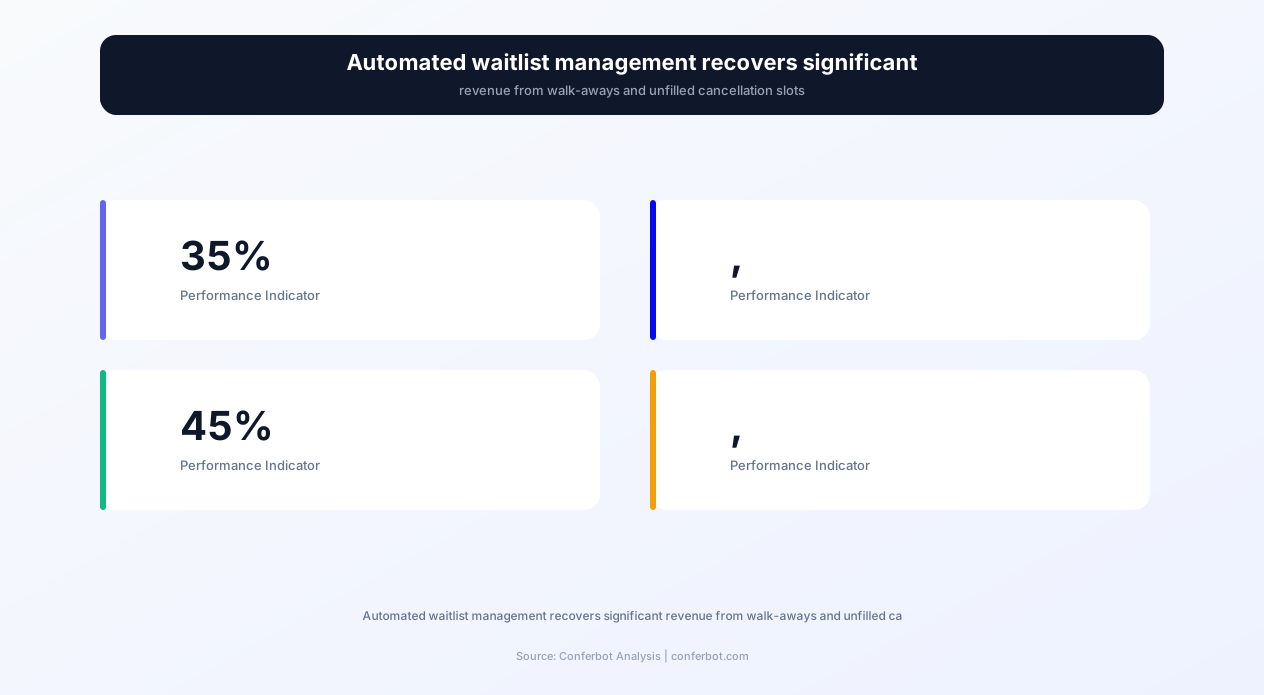
A waitlist management chatbot is an AI-powered queue coordination system that transforms the traditional "put your name down and wait" experience into an intelligent, automated process — providing real-time queue position updates, accurate ETA notifications, automatic slot-filling when cancellations occur, priority upgrades, multi-location waitlist management, party size optimization, VIP handling protocols, and data-driven capacity planning. In 2026, businesses that rely on waitlists — restaurants, medical clinics, salons, service centers, entertainment venues, and high-demand retail — lose significant revenue from walk-aways, no-shows, and inefficient queue management. Industry research shows that waitlist automation reduces walk-aways by 35%, fills cancellation slots 4x faster than manual notification, and improves customer satisfaction with the waiting experience by 45% through transparency and communication.
The Hidden Cost of Poor Waitlist Management
Every business with demand exceeding immediate capacity operates some form of waitlist — but most manage it poorly, losing revenue at every stage. Restaurants lose $150-200 per empty table per evening when parties leave rather than wait. Medical practices lose $150-300 per empty appointment slot when cancellations aren't filled. Salons lose $75-200 when clients who would happily take a cancelled slot aren't notified in time. The fundamental problem is information asymmetry: customers don't know how long they'll actually wait, and businesses don't know which waiting customers will actually show up. This uncertainty produces predictable losses from both sides — customers leave because they assume the wait is longer than it is, and businesses cannot fill cancellation slots because they discover them too late to notify waiting customers.
The chatbot solves this information asymmetry by maintaining continuous, automated communication between the business and everyone on the waitlist. Customers receive real-time position updates and accurate ETAs (reducing walk-aways because they know exactly when their turn is coming). Businesses receive instant cancellation notifications and the chatbot immediately contacts the next appropriate party on the waitlist (filling slots in seconds rather than the minutes-to-hours of manual phone calls). This bidirectional automation captures revenue that manual waitlist management systematically loses.
Industries That Transform Waitlist Revenue
- Restaurants: Managing dinner rush queues, brunch waitlists, reservation overflow, and bar seating with party-size optimization that maximizes covers per hour.
- Healthcare practices: Managing appointment waitlists for specialists, filling cancellation slots for high-demand providers, and coordinating multi-provider scheduling.
- Hair salons and spas: Walk-in queues, cancellation filling for booked stylists, and service-specific waitlists (specific stylist, specific treatment).
- Auto service centers: Service bay waitlists, parts-availability queues, and courtesy vehicle waitlists for longer repairs.
- Government and DMV offices: Public service queues with transparent position and estimated wait time for each service type.
- Retail (limited inventory): Product launch waitlists, limited-edition availability queues, and restock notification management.
- Entertainment venues: Table waitlists at clubs, tee time overflow for golf courses, and bowling lane availability management.
Built on Conferbot's AI chatbot builder, this template provides multi-channel waitlist communication through your website, WhatsApp, and SMS simultaneously. The calendar integration connects waitlist management with your reservation system, while the API integration enables connection with POS systems, practice management software, and capacity planning tools.
How the Waitlist Management Chatbot Works
The waitlist management chatbot operates as an intelligent queue coordinator that manages the complete lifecycle of waitlisted customers — from initial queue entry through position updates, ETA notifications, slot offers, arrival confirmation, and post-visit engagement. The system uses real-time data about queue length, average service duration, party size (or appointment type), and historical patterns to provide accurate wait estimates and optimize seat/slot utilization.
Stage 1: Waitlist Entry and Information Collection
Customers join the waitlist through multiple entry points: website widget, QR code scan at the venue, WhatsApp message, or direct chatbot interaction. The entry process collects essential information conversationally:
- Party/group details: Number of people (restaurants), service needed (salons/clinics), vehicle details (auto service). This information determines queue positioning and slot matching.
- Contact information: Phone number or messaging handle for notifications. The chatbot works through WhatsApp, SMS, or in-app messaging based on customer preference.
- Special requirements: Accessibility needs, highchair requirements, specific provider preference, VIP status identification. These requirements affect queue routing and slot matching.
- Flexible timing: "Are you flexible about when you arrive, or do you need a specific time window?" Flexible customers can receive earlier slot offers from cancellations.
Upon joining, the customer receives immediate confirmation with their queue position, estimated wait time, and instructions for what happens next: "You're #7 in line. Estimated wait: 35 minutes. I'll send you updates every 10 minutes and alert you 5 minutes before your turn. You're free to wait nearby — no need to stay at the venue."
Stage 2: Real-Time Position Updates and ETA Refinement
As the queue progresses, the chatbot sends periodic updates calibrated to wait length. For short waits (under 15 minutes), updates arrive every 5 minutes. For medium waits (15-45 minutes), every 10 minutes. For long waits (45+ minutes), every 15 minutes. Each update includes current position, revised ETA, and reassurance: "You're now #4 — about 18 minutes away. The line is moving faster than initially estimated!" The ETA algorithm continuously recalibrates based on actual service durations observed during the current session, not just historical averages — if today's tables are turning faster or slower than typical, the estimates adjust in real-time.
Stage 3: Ready Notification and Arrival Confirmation
When the customer's turn approaches, the chatbot sends a priority notification: "Your table is ready in approximately 5 minutes! Please head to the host stand. Reply CONFIRM when you're on your way, or let me know if you need a few more minutes." This pre-arrival notification gives customers time to return from nearby shopping, finish their drink at the bar, or walk back from wherever they're waiting. The CONFIRM mechanism provides the business with arrival certainty — if a customer doesn't confirm within 3-5 minutes, the chatbot sends one follow-up before moving to the next party, preventing empty-table revenue loss from no-responses.
Stage 4: Cancellation Detection and Automatic Slot-Filling
When a waitlisted customer cancels (by messaging the bot, by failing to confirm at their turn, or by staff marking them as departed), the chatbot instantly identifies the best replacement from remaining waitlist entries. "Best replacement" considers multiple factors: party size match (a table for 4 is best filled by a party of 4, not a party of 2 that wastes capacity), proximity (customers who indicated they're nearby can arrive faster), wait duration (prioritizing customers who've waited longest, subject to size match), and VIP status. The replacement notification is sent within seconds of cancellation: "Great news! A spot just opened up and you're next. Can you arrive within 10 minutes?" This automatic slot-filling recovers revenue that manual processes lose to notification delays — by the time a host makes 3-4 phone calls to find someone available, 15-20 minutes of table time are lost.
Stage 5: Queue Analytics and Capacity Optimization
Beyond individual customer management, the chatbot provides the business with real-time and historical analytics for capacity planning: average wait times by day of week and hour, peak demand periods, walk-away rates and their correlation with wait time thresholds, party size distribution, conversion rate from waitlist to served, and no-show patterns. This data enables operational decisions: staffing adjustments for peak periods, reservation strategy refinement (how many tables to hold versus release to walk-ins), and service-time optimization targets. The chatbot's historical data also enables predictive waitlist estimates: "Based on typical Tuesday evening patterns, if you join the list now at 6:30pm, you'll likely be seated by 7:15pm" — providing accuracy that instills customer confidence in the waiting experience.
Key Features of the Waitlist Management Chatbot Template
The waitlist management template provides sophisticated queue orchestration capabilities that serve businesses across industries — from high-volume restaurants and busy medical practices to entertainment venues and service centers. Each feature addresses a specific revenue-loss mechanism in traditional waitlist management, converting operational inefficiency into captured revenue and improved customer satisfaction.
Feature Matrix
| Feature | Description | Operational Benefit | Customer Benefit |
|---|---|---|---|
| Real-time queue position tracking | Live position and ETA updates delivered automatically at calibrated intervals | Reduces walk-aways by 35% through transparency that maintains commitment | Know exactly where you stand without asking or guessing |
| Automatic cancellation filling | Instant notification to next-eligible waitlist entry when slots open unexpectedly | Fills cancelled slots in seconds versus 15-20 minutes manually | Get served sooner when others cancel — rewarded for patience |
| Party size optimization | Matches available capacity to waitlist parties by size for maximum utilization | Increases seats filled per hour by 18% through intelligent matching | Faster seating when a matching table opens regardless of position |
| Multi-location queue management | Unified waitlist across multiple locations with cross-location availability offers | Distributes demand evenly across locations, reducing overload at popular spots | Option to be served sooner at nearby alternative location |
| VIP priority handling | Configurable priority tiers for loyalty members, regulars, and VIP guests | Rewards high-value customers with tangible wait reduction benefit | Loyal customers receive faster service reflecting their relationship value |
| Virtual queuing (remote wait) | Customers wait anywhere and receive notification when their turn approaches | Eliminates physical crowding in waiting areas, improves atmosphere | Freedom to shop, walk, or relax nearby instead of sitting in a lobby |
| Predicted wait time AI | Machine learning model predicting wait based on current and historical patterns | Accurate estimates prevent over-promising that leads to disappointment | Reliable time estimates for planning other activities while waiting |
| Waitlist-to-reservation conversion | Offer future reservations to walk-away customers who find today's wait too long | Converts would-be lost customers into future guaranteed visits | Alternative option when today's wait doesn't work for their schedule |
| Capacity planning dashboard | Historical analytics on demand patterns, peak times, and conversion rates | Data-driven staffing, seating, and reservation strategy decisions | Shorter waits overall as business optimizes operations from data |
| Multi-channel notifications | Updates via SMS, WhatsApp, app notification, or email based on preference | Higher notification delivery and read rates across diverse demographics | Receive updates through preferred communication channel |
Party Size Optimization: Maximizing Revenue Per Hour
One of the most significant revenue-impact features is party size optimization. Traditional first-come-first-served queuing ignores the capacity math: seating a party of 2 at a 4-top when a party of 4 is #3 in line wastes 50% of that table's revenue potential. The chatbot's optimization algorithm considers available table sizes (or appointment slots, or service bays) against waitlist party sizes, occasionally promoting a perfectly-sized party ahead of a smaller party when a matching table becomes available. This is communicated transparently: "A table perfect for your party of 4 just became available! Would you like to be seated now, even though you were #5?" Customers uniformly appreciate being offered earlier seating, and the business captures 18% more revenue per hour through optimized matching versus strict sequential queuing.
Virtual Queuing: Freedom While Waiting
The virtual queuing capability transforms the waiting experience from a physical endurance test into a flexible, location-independent process. Instead of sitting in a crowded waiting area watching the clock, customers join the virtual queue and wait wherever they prefer — the coffee shop next door, their car, a nearby store, or walking around the area. The chatbot maintains communication throughout: position updates, ETA refinements, and the critical "your turn is approaching" notification that gives them time to return. For restaurants, this eliminates the common problem of packed waiting areas that make the venue feel chaotic and deter potential walk-ins. For medical offices, it eliminates the health risk of packed waiting rooms (particularly relevant since COVID). For any business, virtual queuing improves the waiting experience while freeing physical space.
Waitlist-to-Reservation Conversion
When a customer decides today's wait is too long and starts to leave, that is a revenue loss — but not necessarily a permanent one. The chatbot detects walk-away signals (customer removes themselves from waitlist, asks "how much longer??" with frustration indicators, or has been on the list beyond the walk-away threshold) and offers an alternative: "I understand the wait is longer than ideal today. Would you like me to book you a reservation for another time this week? I can guarantee a table at your preferred time." This conversion captures 22% of walk-away customers as future reservations, transforming a lost visit into a confirmed future visit with zero acquisition cost. The reservation also captures the customer's contact for future marketing, building the relationship even though today's visit didn't happen.
Ready to try Waitlist Management Chatbot?
Deploy this template in under 10 minutes. No coding required.
Use This Template Free →Before and After: Waitlist Performance Transformation
Businesses implementing automated waitlist management consistently measure significant improvements in revenue capture, customer satisfaction, and operational efficiency. These improvements reflect the elimination of specific failure modes in manual waitlist management: communication delays, lost customers, unfilled cancellation slots, and suboptimal capacity utilization that collectively represent 15-25% of potential revenue during high-demand periods.
Performance Comparison: Manual Waitlist vs. Automated Chatbot Waitlist
| Metric | Before (Manual/Paper) | After (Chatbot Automated) | Improvement |
|---|---|---|---|
| Walk-away rate (left before served) | 28% | 18% | -35% walk-aways |
| Cancellation slot fill rate | 34% (phone calls too slow) | 87% (instant notification) | +156% slot utilization |
| Average time to fill cancelled slot | 18 minutes (call 3-5 people) | 45 seconds (auto-notify next eligible) | -96% filling time |
| Customer wait time satisfaction | 3.1/5 rating | 4.5/5 rating | +45% satisfaction |
| No-show rate when called for turn | 15% (left without telling staff) | 5% (confirmed via chatbot) | -67% no-shows |
| Revenue per peak hour (restaurant) | $1,840 | $2,190 | +19% peak revenue |
| Staff time on waitlist management | 2.5 hours/shift | 20 minutes/shift | -87% staff time |
| Waitlist-to-future-reservation conversion | 0% (no mechanism) | 22% of walk-aways | New revenue recovery channel |
| Average customer wait (perceived) | 42 minutes (felt longer) | 38 minutes (felt shorter) | Better perception despite similar actual wait |
| Return visit rate (waitlisted customers) | 31% | 54% | +74% return rate |
Understanding the Walk-Away Revenue Impact
Walk-aways — customers who join the waitlist but leave before being served — represent the most direct revenue loss from poor waitlist management. For a restaurant with 40 waitlisted parties on a Friday evening and a 28% walk-away rate, that is 11 parties lost. At an average check of $85 per party, the walk-away revenue loss is $935 per evening or $48,620 annually (Friday and Saturday evenings only). Reducing the walk-away rate from 28% to 18% recovers 4 parties per evening: $340/night × 104 peak nights = $35,360 in annual revenue recovered.
Walk-aways happen primarily because of uncertainty — customers who don't know their actual wait time assume the worst and leave. The chatbot's continuous ETA updates address this directly. Industry research demonstrates that customers will wait 40% longer when they know the exact remaining wait time versus when they have no estimate. A customer who would walk away after 20 minutes of uncertain waiting will remain for 28 minutes when receiving updates confirming they'll be seated in 30 minutes. This psychological effect — the certainty of a known endpoint — is the mechanism behind the 35% walk-away reduction.
Cancellation Slot Revenue: The Fastest ROI
The chatbot's most immediate financial impact comes from automated cancellation slot-filling. In manual systems, filling a cancellation requires a staff member to notice the cancellation, review the waitlist for appropriate candidates, make 3-5 phone calls (most unanswered or declined), and eventually fill the slot — a process consuming 15-20 minutes during which the slot sits empty. With the chatbot, cancellation triggers instant notification to the next eligible party, who confirms within seconds. For a restaurant losing $150-200 per unfilled table hour, saving even 15 minutes per cancellation event across 4-6 cancellations per evening recovers $150-300 nightly. For medical practices where appointment slots are worth $150-300 each, filling one additional cancellation per day produces $750-1,500 weekly in recovered revenue.
Customer Satisfaction and Return Rate Correlation
The 74% improvement in return visit rate (from 31% to 54% for waitlisted customers) reflects a fundamental change in the waiting experience. Customers who experience manual waitlist management — uncertainty, no updates, crowded waiting areas, and occasional being-forgotten — associate the business with frustration and are less likely to return, especially for planned visits (they might return on off-peak occasions but won't deliberately choose busy times). Customers who experience automated waitlist management — transparent positioning, accurate updates, freedom to wait elsewhere, and considerate communication — associate the waiting experience with professionalism and respect for their time. These customers return specifically during peak times because they trust the system to manage their wait efficiently, producing sustainable revenue growth during the highest-margin periods.
Restaurant-Specific Waitlist Optimization
Restaurants represent the highest-volume waitlist use case, with peak-hour queue management directly determining revenue per available seat hour (RevPASH) — the restaurant industry's key capacity utilization metric. The chatbot template includes restaurant-specific features that address the unique challenges of food service waitlists: variable party sizes, table configuration flexibility, bar-versus-dining preferences, patio availability (weather-dependent), and the critical timing coordination between party arrival and table readiness.
Table-Party Size Matching Algorithm
Restaurant tables come in fixed sizes (2-tops, 4-tops, 6-tops, booths, communal), but parties arrive in variable sizes. The matching algorithm optimizes assignments to minimize wasted seats while maintaining fairness:
- Exact match priority: A party of 4 gets first opportunity at a 4-top, even if a party of 2 is ahead in queue (the 2-top will still be offered the next 2-top or offered the 4-top if no 2-tops are available and the party of 4 hasn't arrived yet).
- Flexible seating offers: "A spot at the bar is available right now — would you prefer immediate bar seating, or would you like to continue waiting for a table? Estimated table wait: 15 more minutes." This gives customers choice while filling bar revenue.
- Table combination logic: For large parties (6+), the bot identifies when combining adjacent tables becomes available and notifies the large party: "We can seat your group of 8 now by combining two tables. Would you prefer this, or wait for our large booth?" — maximizing seating flexibility.
- Patio/indoor preference: Tracks customer preference and notifies specifically when their preferred seating type is available, rather than offering all availability generically.
Reservation Overflow Management
Most restaurants maintain a reservation system alongside walk-in service — but managing the intersection creates constant friction. Reservations that no-show leave tables empty; walk-ins that arrive during reservation-heavy periods are told "we only have bar seating." The chatbot bridges this gap: tracking reservation confirmation status (sending confirmation requests to reserved parties 2 hours before, marking as likely-no-show if unconfirmed by 30 minutes before), and converting likely-no-show tables into waitlist availability. A party that reserved at 7:30pm and hasn't confirmed by 7:00pm is flagged — the chatbot alerts the next waitlist party that a table "may become available around 7:30-7:45" with first-right-of-refusal if the reservation doesn't arrive by 15 minutes past.
Peak-Hour Revenue Maximization
During peak hours (typically 6:30-8:30pm for dinner service), every minute of empty table time represents lost revenue. The chatbot minimizes empty time through multiple mechanisms:
- Pre-arrival coordination: Notifying the next party 5-7 minutes before their table will be ready, giving them time to return without the table sitting empty waiting for them.
- Turnover awareness: Monitoring table occupancy duration and factoring dessert/coffee stage estimates into next-party notifications, enabling near-zero gap between parties.
- Split waitlist management: Maintaining separate queues for different table sizes, ensuring a party of 2 doesn't block service of a party of 4 at a 4-top just because they were first in a single-queue system.
- Upsell during wait: "While you wait, would you like to start with drinks at our bar? Your bar tab can transfer to your table." This generates immediate revenue, improves the waiting experience, and often accelerates table turnover as the party is already mid-meal when seated.
The $150-200 Per Empty Table Calculation
Restaurant industry data shows that an empty table during peak dinner service represents $150-200 in lost revenue (average check divided by turns per evening, multiplied by contribution margin). For a 60-seat restaurant with 15 tables, losing just one table for one hour during peak service costs $75-100 (half a table-turn). Over a typical evening with 3-4 cancellations and 5-6 walk-aways, manual waitlist management leaves $450-800 per evening in unrealized revenue. The chatbot's combination of reduced walk-aways (recovering 3-4 parties), faster cancellation filling (saving 15 minutes per event × 3-4 events), and optimized table-party matching (eliminating 2-tops at 4-top waste) recovers $350-600 per evening during peak service. Annually, for a restaurant open 6 evenings/week: $350-600 × 312 evenings = $109,200-$187,200 in recovered peak-hour revenue.
Special Event and Holiday Waitlist Management
Major holidays, special events, and seasonal peaks produce extreme waitlist demand that overwhelms manual management. The chatbot handles surge periods through configurable settings: longer estimated wait times communicated honestly, expanded waitlist capacity with accurate positioning even at positions 30+, priority queue for loyalty program members, and overflow management that directs customers to alternative locations or offers reservation slots for future dates. Valentine's Day, Mother's Day, and New Year's Eve — the restaurant industry's highest-demand evenings — benefit most from automated management, as the waitlist volume (50-100+ parties) makes manual phone-call-based management physically impossible for host staff also managing seating, greetings, and reservations simultaneously.
Healthcare and Service Industry Waitlist Applications
Beyond restaurants, waitlist automation delivers transformative value for healthcare practices, salons, auto service centers, and any business where demand regularly exceeds immediate capacity. Each industry has unique waitlist characteristics — appointment duration variability, provider-specific preferences, service-type routing, and urgency-based prioritization — that the chatbot template addresses through configurable workflows rather than one-size-fits-all queue management.
Healthcare Practice Waitlists
Medical and dental practices face a particularly costly waitlist problem: appointment slots with specialists and in-demand providers are valued at $150-500 each, cancellations occur at 12-18% rates, and filling those slots requires contacting patients who specifically need that provider, that appointment length, and can arrive on short notice. The chatbot maintains a dynamic waitlist for each provider, categorized by appointment type (routine check-up, procedure, consultation) and urgency. When a cancellation occurs, the bot instantly notifies the highest-priority matching waitlist patient: "Dr. Smith has an opening this Thursday at 2pm (originally a 3-week wait from your position). Would you like to take this slot?"
Healthcare waitlist automation produces exceptional ROI because appointment values are high and cancellation rates are significant. A specialist filling just one additional cancellation per day at $200 average appointment value generates $1,000/week in recovered revenue — $52,000 annually from a single provider. For multi-provider practices, the compound effect across 5-10 providers generates $200,000-500,000 in annual revenue recovery from what would otherwise be empty appointment time. The chatbot also manages the psychologically important communication aspect: patients waiting weeks for specialist appointments receive periodic position updates that reduce the anxiety and appointment-shopping behavior that produces double-bookings and subsequent cancellations at other practices.
Salon and Spa Waitlists
Salons face a unique waitlist complexity: customers often want a specific stylist, not just any available chair. The chatbot manages stylist-specific waitlists alongside general availability, enabling multi-track queue management. "Your preferred stylist Ashley is booked until next Thursday. However, stylist Marcus has similar specialization and availability tomorrow. Would you like: (A) Wait for Ashley next Thursday, (B) Book with Marcus tomorrow, or (C) Join Ashley's cancellation waitlist and I'll notify you if anything opens sooner?" This multi-option presentation serves the customer (choice), the salon (fills otherwise empty chairs), and the stylist (cancellation waitlist fills their gaps automatically).
Salon walk-in management during busy periods (Saturday mornings, pre-holiday periods) benefits from the same virtual queuing approach used in restaurants. Instead of customers sitting in the salon lobby for 45 minutes watching others get served, they join the virtual queue, receive a "come back in 30 minutes" notification, and spend their wait time shopping nearby — improving their mood and the salon's atmosphere simultaneously. The chatbot tracks service duration in progress and adjusts wait estimates dynamically: if a current client adds an extra service (extends their appointment), the bot automatically updates all waiting customers with revised ETAs.
Auto Service Center Waitlists
Auto service centers manage multiple concurrent waitlist types: service bay availability for walk-in work, parts-on-order queues for repairs awaiting components, and loaner/rental vehicle waitlists for customers needing transportation during extended repairs. The chatbot coordinates these parallel queues:
- Service bay queue: "Your oil change/tire rotation is next. Estimated start: 25 minutes. We'll text when your vehicle enters the bay and again when complete."
- Parts waitlist: "The replacement part for your vehicle is on order. Expected arrival: Tuesday. I'll notify you immediately when it arrives and schedule your repair appointment."
- Loaner vehicle queue: "All loaner vehicles are currently out. You're #2 on the loaner waitlist. Expected availability: tomorrow afternoon when current borrowers return. I'll confirm as soon as one is checked in."
Government and Public Service Queues
Government offices (DMV, permit offices, social services) benefit enormously from virtual queuing — transforming the dreaded "take a number and wait in a room for 2 hours" experience into a transparent, manageable process. Citizens join the queue remotely, receive position updates, and arrive when their number approaches. This reduces physical waiting room crowding (improving accessibility and reducing facility burden), eliminates the lost-productivity cost of citizens sitting in government offices for hours, and improves public satisfaction with government services. The chatbot also routes citizens to the correct service type (ensuring they join the right queue for their need), provides preparation information ("bring these documents"), and schedules future appointments for complex matters requiring multiple visits — reducing repeat visits and wasted time for both citizens and government staff.
Retail Product Launch Waitlists
High-demand product launches (limited-edition items, pre-orders, restock notifications) use the chatbot as a notification and prioritization system. Customers join the waitlist with purchase commitment ("I'd like to be notified and purchase immediately when the product is available"). When inventory arrives, the chatbot processes the waitlist sequentially: notifying the first customer with a time-limited purchase link, moving to the next customer if the first doesn't complete purchase within the allotted time (typically 15-30 minutes). This manages demand fairly while maximizing sell-through rate — every unit finds a buyer without the chaos of first-come-first-served scrambles that crash websites and frustrate customers.
50,000+ businesses use Conferbot templates to automate conversations
VIP Handling, Priority Tiers, and Loyalty Integration
Not all waitlist entries should be treated equally — businesses legitimately need to provide preferential treatment to high-value customers, loyalty program members, VIP guests, and specific categories that warrant priority handling. The chatbot implements configurable priority tiers that accelerate certain customers through the queue while maintaining transparency and fairness for all waitlist participants. The key design principle: priority customers receive tangibly faster service, but standard customers receive honest communication about their wait rather than being silently deprioritized with inaccurate ETAs.
Priority Tier Configuration
The template supports configurable priority tiers that reflect your specific business value hierarchy:
- Tier 1 — VIP/Platinum: Maximum 5-10 minute wait regardless of queue length. These are your highest-value customers: top loyalty members, celebrity guests, major spenders. The bot places them at the front of the queue immediately or within one position of current front.
- Tier 2 — Gold/Regular: 50% wait reduction. Loyal customers who deserve recognition without the absolute priority of VIPs. If the standard wait is 40 minutes, Gold members wait approximately 20 minutes.
- Tier 3 — Silver/Members: 25% wait reduction. Entry-level loyalty members receiving modest but tangible benefit that demonstrates the value of program membership.
- Tier 4 — Standard: Normal queue positioning based on arrival order and party-size matching. Accurate ETA communication ensures satisfaction despite not receiving priority.
How Priority Works Without Alienating Standard Customers
The critical design challenge in priority queuing is ensuring standard customers don't feel cheated when they notice others being served first. The chatbot handles this through honest but tactful communication: standard customers receive their ETA based on their actual expected wait (including priority customers ahead of them), so their experience meets expectations even if they aren't in strict first-come-first-served order. The priority system is visible as a loyalty program benefit: "Members receive priority seating — ask about our loyalty program!" This frames the priority as an aspirational benefit rather than an unfair system.
The algorithm also implements fairness constraints preventing extreme priority abuse: no standard customer should wait more than 150% of their originally quoted ETA due to priority insertions. If priority insertions would push a standard customer beyond this threshold, the system delays priority insertion until the constraint is satisfied. This prevents scenarios where a standard customer quoted 30 minutes ends up waiting 60 minutes because 10 VIPs arrived after them — the maximum impact on any individual standard customer is limited and predictable.
Loyalty Program Integration for Priority Qualification
Priority tier assignment integrates with your existing loyalty program through the API integration. When a customer joins the waitlist, the bot checks their loyalty status against your CRM or loyalty platform and automatically applies the appropriate priority tier. For businesses without formal loyalty programs, the bot can identify high-value customers through phone number or email matching against your customer database, automatically upgrading frequent visitors to priority status based on visit frequency or spend history. This recognition without explicit program enrollment creates a "surprise and delight" experience: "Welcome back! I see you're one of our valued regulars — I've placed you in our priority queue. Estimated wait: 12 minutes." The customer feels recognized and valued without having enrolled in anything.
VIP Notification and White-Glove Handling
For top-tier VIPs (business owners' personal guests, celebrity visitors, top 1% spenders), the chatbot provides enhanced handling:
- Staff pre-notification: When a VIP joins the waitlist, management receives an immediate alert with the guest's name, preferences (if previously recorded), and any special requirements.
- Preference memory: The bot remembers VIP preferences from previous visits — preferred table location, dietary restrictions, preferred server, noise-level preference — and communicates these to staff for preparation.
- Proactive communication: "Mr. Johnson, your usual corner booth is being prepared now. Estimated: 4 minutes. Your server tonight will be Sarah, as you preferred last time."
- Post-visit engagement: After a VIP visit, personalized follow-up thanking them for their visit and offering direct reservation access for their next visit, bypassing the waitlist entirely for future occasions.
Priority as a Revenue Tool: Priority Upgrades
Some businesses offer paid priority upgrades — similar to airline priority boarding or FastPass systems. The chatbot can offer position upgrades during the wait: "You're currently #8 with a 35-minute estimated wait. Would you like to upgrade to priority seating for $15? You'd move to position #3 with an estimated 10-minute wait." This generates incremental revenue while giving price-insensitive customers a choice. The upgrade pricing is configurable based on current wait time (longer waits justify higher upgrade prices) and demand level (busier periods command premium). Businesses implementing paid priority report $50-200 in daily upgrade revenue during peak periods, with high acceptance rates (18-25%) among parties celebrating special occasions or with time constraints.
Deployment, Analytics, and Multi-Location Scaling
Deploying the waitlist management chatbot and scaling it across locations requires thoughtful configuration that reflects your specific business operations, capacity model, and customer communication philosophy. This section covers the practical implementation path from single-location deployment through multi-location scaling, with the analytics framework that enables continuous optimization.
Single-Location Deployment
Initial deployment configures the chatbot for your specific capacity and service model:
- Capacity definition: Number of tables/chairs/bays/slots, sizes/types of each, and which can be combined or reconfigured. This data drives the matching algorithm and ETA calculations.
- Service time patterns: Average service duration by type (lunch vs. dinner, haircut vs. color, oil change vs. brake repair). Historical data produces more accurate initial ETAs; the AI refines these continuously from actual observations.
- Operating parameters: Peak hours, quiet hours, staffing levels by period, and capacity changes (patio opens seasonally, extra stations staffed on weekends).
- Communication preferences: Update frequency, notification channel priority (SMS vs. WhatsApp vs. app), tone and branding of messages, and language support for your demographic.
- Priority rules: Tier definitions, qualification criteria, maximum wait impact on standard customers, and any paid upgrade pricing.
The deployment provides immediate value from day one: customers joining the waitlist receive instant position confirmation and ETA rather than vague "about 30-40 minutes" verbal estimates. Staff no longer manage a physical waitlist or make phone calls for cancellation filling. The system begins collecting operational data that improves ETA accuracy within the first week.
Analytics Dashboard: Operational Intelligence
The analytics system captures comprehensive waitlist data for operational optimization:
- Wait time analysis: Average, median, and distribution of wait times by day of week, hour, and party size. Identifies when waits exceed customer tolerance thresholds.
- Walk-away analysis: At what wait time/position do customers leave? Does this vary by party size, day of week, or weather? Insights enable targeted interventions (additional staffing when waits approach walk-away threshold).
- Cancellation patterns: When do cancellations occur, how quickly are they filled, and what percentage remain unfilled? Identifies whether the fill-rate problem is notification speed (solved by the bot) or waitlist depth (requires marketing to grow the standby list).
- Conversion funnel: What percentage of website/QR visitors join the waitlist, what percentage of waitlist joins actually arrive for service, and what factors correlate with completion? Enables funnel optimization.
- Revenue impact tracking: Direct measurement of recovered revenue from filled cancellations, reduced walk-aways, and optimized table matching. Provides clear ROI visibility.
Multi-Location Scaling
For businesses with multiple locations (restaurant groups, salon chains, clinic networks), the chatbot enables cross-location waitlist management that optimizes demand distribution:
- Cross-location availability: "The wait at our downtown location is 45 minutes. However, our midtown location (8 minutes away) has a 10-minute wait right now. Would you prefer to go there instead?" This redistributes demand from overloaded to underutilized locations.
- Unified customer profiles: VIP/loyalty status recognized across all locations. A platinum customer at any location receives priority treatment everywhere.
- Centralized analytics: Compare waitlist performance across locations to identify operational best practices. If Location A has 50% lower walk-aways than Location B, investigate why and replicate.
- Demand forecasting: Aggregate data across locations enables more accurate demand prediction for each location, enabling proactive staffing and capacity adjustments.
ROI Framework
The waitlist chatbot ROI calculation for a typical high-demand restaurant (80 seats, busy 5 evenings/week):
Revenue recovered from reduced walk-aways: 4 parties/evening × $85 average check × 5 evenings × 52 weeks = $88,400/year
Revenue from faster cancellation filling: 3 slots/evening × 15 min saved × $3.33/min table value × 5 evenings × 52 weeks = $38,961/year
Revenue from waitlist-to-reservation conversion: 2 conversions/evening × $85 × 5 evenings × 52 weeks = $44,200/year
Staff time savings: 2.5 hours/shift × $20/hour × 5 shifts × 52 weeks = $13,000/year
Total annual impact: $184,561
For most high-demand businesses, the chatbot's waitlist management pays for itself within the first 2-3 weeks of deployment. The ROI compounds over time as the AI's ETA accuracy improves (further reducing walk-aways) and as the customer base becomes accustomed to the virtual queuing experience (increasing adoption and reducing physical waiting-area friction). Connect the waitlist chatbot with your website chatbot for online queue joining and your WhatsApp chatbot for notification delivery through the channel customers already use daily.
Waitlist Management Chatbot FAQ
Everything you need to know about chatbots for waitlist management chatbot.
Why Use a Template vs Building from Scratch?
Templates encode years of optimization data into the conversation flow before you start.
| Factor | Conferbot Template | Build from Scratch | Hire a Developer |
|---|---|---|---|
| Time to deploy | 10 minutes | 2-8 hours | 2-6 weeks |
| Cost | Free | Your time | $5,000-$25,000 |
| Day-1 conversion | 15-22% | 5-8% | 10-15% |
| Proven flows | Yes, data-tested | No | Depends |
| Updates included | Automatic | Manual | Paid |
| Multi-channel | 8+ channels | 1 channel | Extra cost |
| Analytics | Built-in | Must build | Extra cost |
Ready to Deploy Waitlist Management Chatbot?
Join 50,000+ businesses. Free forever plan available. No credit card required.