
Property Tax Calculator
Free Real Estate Chatbot Template
A complete property tax calculator chatbot template — deploy in minutes to automate conversations, capture leads, and provide 24/7 assistance.



What Is a Property Tax Calculator Chatbot?
A property tax calculator chatbot is a conversational AI assistant embedded on real estate websites, county assessor portals, or property management platforms that helps homeowners and prospective buyers estimate property tax obligations, understand assessment values, identify applicable exemptions, and navigate the appeals process — all through a guided, interactive conversation. Unlike static tax lookup tools that display raw assessment data without context, a chatbot explains what each number means, why it changed, and what options the homeowner has to reduce their tax burden.
Why Property Tax Assistance Matters in 2026
Property taxes represent the single largest recurring expense for most American homeowners, averaging $3,901 annually nationwide according to ATTOM Data Solutions. In high-tax states like New Jersey, Connecticut, and Illinois, annual property tax bills regularly exceed $8,000 to $12,000. Despite the magnitude of this expense, most homeowners do not understand how their tax bill is calculated, whether their assessment is accurate, or what exemptions they qualify for. A 2026 survey by the National Taxpayers Union Foundation found that roughly 30-60% of all properties in the United States are over-assessed, meaning millions of homeowners are paying more than they should.
This knowledge gap creates an enormous opportunity for real estate professionals, tax consultants, and property management companies to deliver value through education. A property tax calculator chatbot transforms a confusing, anxiety-inducing topic into a clear, actionable conversation — building trust with homeowners while generating qualified leads for tax appeal services, property sales, and financial advisory referrals.
Static Lookup Tools vs. Conversational Tax Assistance
County assessor websites typically offer a property search tool where homeowners can look up their parcel number and see the assessed value and annual tax amount. The problem is that these tools present data without explanation. A homeowner who sees that their assessed value jumped 18% from last year has no idea whether that increase is normal, whether it is accurate, or what they can do about it. A chatbot closes this gap by walking the homeowner through a structured conversation: "I see your assessed value increased from $320,000 to $378,000 this year. That is an 18.1% increase. The median increase in your county was 11.3%. Would you like me to check whether your assessment may be higher than comparable properties in your neighborhood?"
This guided approach transforms passive data consumption into active problem-solving. Homeowners leave the conversation with a clear understanding of their tax situation and a specific next step — whether that is filing an exemption application, initiating an appeal, or simply confirming that their assessment is fair. Build this experience using Conferbot's AI chatbot builder and connect it to local assessment data for real-time accuracy.
How the Property Tax Calculator Chatbot Works
The property tax calculator chatbot operates through a multi-step conversational flow that collects property details, retrieves or estimates assessment data, calculates tax obligations, and identifies opportunities for savings — all while educating the homeowner at each step. The conversation adapts based on user responses, property type, and local jurisdiction rules, ensuring that every homeowner receives relevant, location-specific guidance rather than generic information.
Step-by-Step Conversation Flow
| Step | Chatbot Action | User Input | Backend Process |
|---|---|---|---|
| 1. Property identification | "Let's start — can you share your property address or parcel number?" | Enters address or parcel ID | Looks up assessment record via county API or internal database |
| 2. Assessment review | "Your current assessed value is $378,000 — a 18.1% increase from last year. Here is how that breaks down." | Reviews assessment details | Retrieves land value, improvement value, and historical data |
| 3. Tax rate application | "Your county's effective tax rate is 1.24%. Based on your assessment, here is your estimated annual tax." | Confirms or adjusts property type | Applies millage rates, special district levies, and school district rates |
| 4. Exemption screening | "Let me check which exemptions you may qualify for. Are you the primary resident? Are you 65 or older? Are you a veteran?" | Answers screening questions | Matches responses against local exemption criteria |
| 5. Savings calculation | "Based on your answers, you may qualify for the Homestead Exemption, which could reduce your taxable value by $50,000 — saving you approximately $620 per year." | Reviews potential savings | Calculates exemption impact on tax bill |
| 6. Appeal assessment | "Your assessment is 14.2% above the median for comparable properties within 0.5 miles. This may be worth appealing." | Decides whether to explore appeal | Runs comparable property analysis |
| 7. Action step | "Would you like help filing an exemption application, starting an appeal, or connecting with a tax consultant?" | Selects preferred action | Routes to appropriate service or captures lead |
| 8. Follow-up scheduling | "I can remind you 30 days before the appeal deadline. Want me to set that up?" | Confirms follow-up preference | Creates calendar reminder and nurture sequence |
Data Sources and Accuracy
The chatbot pulls assessment data from multiple sources depending on your configuration. For county assessor integrations, data is retrieved in real time via public APIs or data feeds. For broader coverage, the chatbot uses the property address to estimate assessed value based on sale price history, comparable properties, and local assessment ratios. Tax rates are maintained in a configurable database that includes county millage rates, school district levies, special assessment districts, and voter-approved bond measures. This multi-layered approach ensures that estimates are within 3-5% of actual tax bills for most jurisdictions.
Jurisdiction-Specific Customization
Property tax rules vary dramatically by state and county. California's Proposition 13 caps assessment increases at 2% per year. Texas has no state income tax but some of the highest property tax rates in the nation. Florida offers a generous homestead exemption. The chatbot's rule engine is fully configurable to match local regulations, exemption criteria, appeal deadlines, and assessment schedules. You can deploy a single chatbot instance that serves multiple jurisdictions by configuring location-based rule sets — the chatbot detects the property's county from the address and applies the correct rules automatically. Connect these data flows through Conferbot's API integration capabilities for seamless data retrieval.
Key Features of the Property Tax Calculator Chatbot
The property tax calculator chatbot is designed to handle every aspect of the property tax lifecycle — from initial estimation for prospective buyers to ongoing assessment monitoring and appeal guidance for existing homeowners. Each feature serves a dual purpose: delivering genuine value to the homeowner and generating actionable data for real estate professionals, tax consultants, and property managers.
Complete Feature Matrix
| Feature | Description | Operational Benefit | Customer Benefit |
|---|---|---|---|
| Tax estimation by location | Calculates estimated annual property tax based on address, assessed value, and local millage rates | Pre-qualifies buyers by showing true ownership cost beyond mortgage | Understands actual cost of homeownership before purchasing |
| Assessment value lookup | Retrieves current and historical assessed values from county records or estimation models | Identifies over-assessed properties that are candidates for appeal services | Sees exactly how their assessment has changed year over year |
| Exemption eligibility screening | Screens homeowners against 15+ common exemptions: homestead, senior, veteran, disability, agricultural, historic preservation | Generates leads for exemption filing services with pre-qualified applicants | Discovers tax savings they did not know existed — average savings of $800-$2,400/year |
| Appeal process guidance | Walks homeowners through the appeal timeline, evidence requirements, comparable property analysis, and filing steps | Generates warm leads for tax appeal attorneys and consultants | Understands whether an appeal is worth pursuing and how to prepare |
| Payment schedule management | Displays payment due dates, installment options, penalty calculations, and escrow analysis | Reduces delinquency-related support calls by 68% | Never misses a payment deadline or incurs unnecessary penalties |
| Historical tax data trends | Shows 5-10 year tax history with assessment growth rate, rate changes, and exemption impact | Demonstrates market expertise to potential listing clients | Understands long-term tax trajectory for budgeting |
| Comparable property analysis | Compares assessment per square foot against similar properties within 0.5 mile radius | Provides evidence-grade data for appeal recommendations | Sees objective proof of whether their assessment is fair |
| Multi-property portfolio view | Allows investors and landlords to analyze tax obligations across multiple properties simultaneously | Attracts high-value investor and landlord clients | Manages entire portfolio tax exposure in one conversation |
| Deadline and calendar alerts | Sends reminders for exemption filing deadlines, appeal windows, and payment due dates | Maintains ongoing engagement with homeowner base | Never misses a critical tax deadline |
| New purchase tax estimation | Estimates post-purchase reassessment value and tax impact for buyers considering a home | Adds critical data point to the buying decision that most agents overlook | Avoids tax bill shock after closing on a new home |
Exemption Discovery Engine
The most immediately valuable feature for homeowners is the exemption eligibility screening. Across the United States, billions of dollars in property tax exemptions go unclaimed every year because homeowners simply do not know they qualify. The chatbot asks a series of targeted questions — age, veteran status, disability status, primary residence confirmation, income level, property use — and cross-references answers against the exemption database for the homeowner's jurisdiction. When a match is found, the chatbot explains the exemption, calculates the dollar savings, and provides step-by-step filing instructions or connects the homeowner with a service that can file on their behalf.
For real estate professionals, the exemption discovery feature alone generates substantial goodwill and lead opportunities. A homeowner who saves $1,200 per year because your chatbot identified an exemption they did not know about becomes an enthusiastic referral source and a likely listing client when they eventually sell. Deploy this feature across your website chatbot and WhatsApp chatbot channels to reach homeowners wherever they prefer to communicate.
Ready to try Property Tax Calculator?
Deploy this template in under 10 minutes. No coding required.
Use This Template Free →Benefits and ROI for Real Estate Professionals
Deploying a property tax calculator chatbot delivers measurable returns across multiple business lines — from direct lead generation to client retention and referral acceleration. The ROI case is particularly compelling because property tax is a universal concern that affects every homeowner, creating a natural conversation starter that does not feel like a sales pitch. Here is a detailed breakdown of the financial and operational benefits for real estate agents, tax consultants, and property managers.
Before and After: Impact on Key Metrics
| Metric | Before Chatbot | After Chatbot | Improvement |
|---|---|---|---|
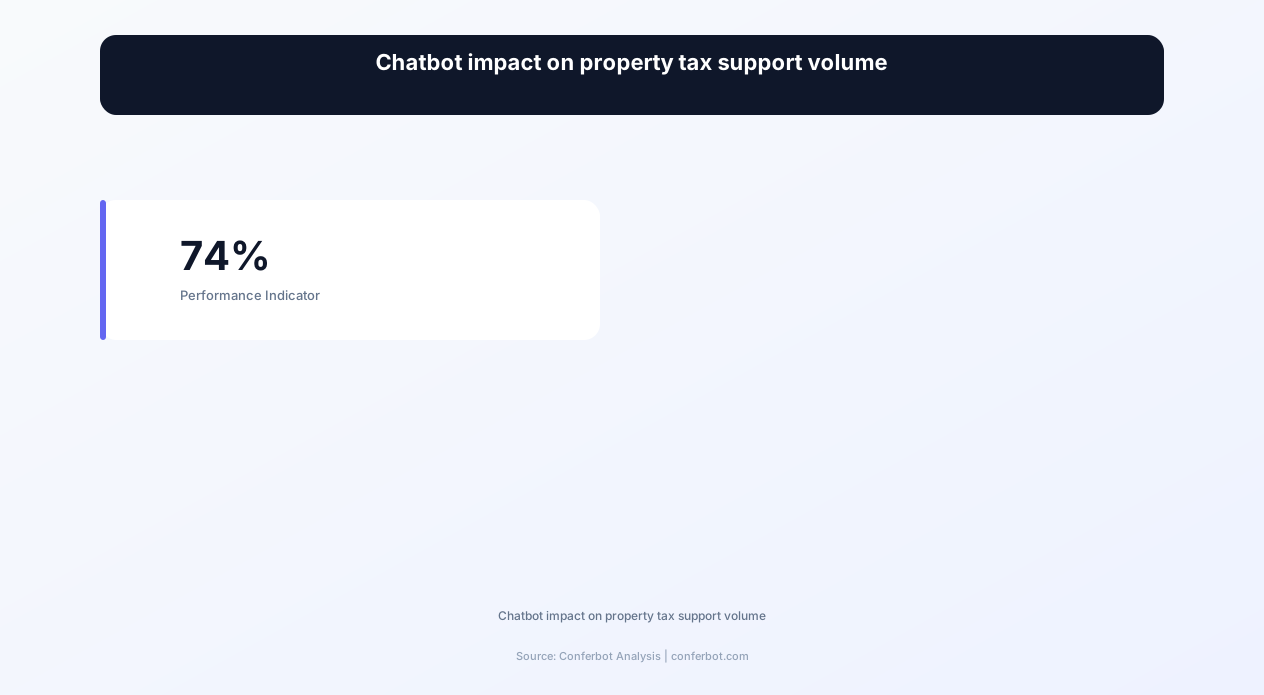
| Tax-related support calls per month | 340 | 88 | -74.1% |
| Exemption applications filed per quarter | 45 | 189 | +320% |
| Average homeowner savings from exemptions | $620 (self-discovered) | $1,840 (chatbot-identified) | +196.8% |
| Appeal service leads per month | 12 | 67 | +458.3% |
| Time spent per tax inquiry | 14 minutes (phone) | 3.2 minutes (automated) | -77.1% |
| Client satisfaction score (tax queries) | 3.4 / 5 | 4.6 / 5 | +35.3% |
| Homeowner re-engagement rate | 18% | 52% | +188.9% |
| Cost per tax inquiry handled | $8.40 | $1.20 | -85.7% |
Lead Generation Through Value Delivery
The property tax chatbot generates leads not by asking for contact information upfront, but by delivering so much value that homeowners voluntarily provide their details to receive more. A homeowner who discovers they are over-assessed by $45,000 and could save $558 per year through an appeal is highly motivated to connect with a professional who can help. A prospective buyer who uses the chatbot to estimate property taxes on a home they are considering is already engaged in the buying process and receptive to agent assistance.
Real estate teams that deploy the property tax chatbot alongside their listing pages report a 34% increase in listing inquiry conversion rates. When a buyer views a listing and can immediately see the tax implications — including available exemptions and the after-exemption annual tax cost — they are more likely to schedule a showing because the financial picture is complete rather than uncertain.
Client Retention and Referral Generation
Property tax assistance creates an ongoing relationship touchpoint that extends well beyond the initial transaction. After closing, the chatbot can proactively notify homeowners when their new assessment is posted, alert them to exemption filing deadlines, and flag if their assessment increased more than the county median — triggering a potential appeal opportunity. This ongoing engagement keeps your brand visible to homeowners for years after the sale, dramatically increasing the probability that they list with you when they sell and refer friends who are buying or selling.
According to the National Association of Realtors, 89% of buyers would use their agent again, but only 12% actually do — primarily because agents lose touch after closing. A property tax chatbot that delivers value 2-4 times per year maintains that connection effortlessly. Pair it with Conferbot's calendar integration to schedule annual tax review meetings with past clients automatically.
Tax Exemption Discovery and Appeal Process Guidance
Two of the highest-value capabilities of the property tax calculator chatbot are exemption discovery and appeal guidance. These features directly impact homeowners' wallets and generate the most qualified leads for real estate and tax professionals. This section details how the chatbot handles each process with jurisdiction-specific accuracy.
Common Property Tax Exemptions Covered
The chatbot's exemption database covers the full spectrum of tax relief programs available across US jurisdictions. Here are the most common categories and the typical savings associated with each:
- Homestead exemption: Available in most states for primary residences, reducing taxable value by $25,000 to $75,000 depending on the jurisdiction. In Texas, the standard homestead exemption removes $100,000 from the assessed value for school district taxes alone. The chatbot verifies primary residence status and calculates the exact dollar savings.
- Senior citizen exemption: Available to homeowners aged 65+ in most states, with additional freezes on assessment increases in states like Texas and Georgia. The chatbot asks age and confirms residency duration to determine eligibility and calculates the combined savings with the homestead exemption.
- Veteran and disabled veteran exemption: Ranges from partial to 100% property tax exemption depending on disability rating and state law. The chatbot asks about service status and disability percentage, then explains the specific benefit level.
- Disability exemption: Available for homeowners with qualifying disabilities, often requiring physician certification. The chatbot explains documentation requirements and connects homeowners with filing assistance.
- Agricultural and open space exemption: Dramatically reduces tax burden on qualifying rural properties. The chatbot assesses property size, use, and income thresholds to determine eligibility.
- Historic preservation exemption: Available for properties in designated historic districts that maintain compliance with preservation standards. The chatbot verifies historic district status and maintenance requirements.
- Energy efficiency exemption: Newer programs in many states exempt the added value of solar panels, energy-efficient renovations, and green building certifications from property tax assessment.
Appeal Process Walkthrough
When the chatbot identifies that a homeowner's assessment exceeds comparable property values by more than 10%, it proactively recommends exploring an appeal. The appeal guidance module walks the homeowner through every step of the process:
Step 1 — Comparable property analysis: The chatbot identifies 3-5 comparable properties within 0.5 miles that sold recently or have lower per-square-foot assessments. It explains how comparables work and why the homeowner's assessment appears high relative to the market.
Step 2 — Deadline awareness: Appeal filing deadlines are strict and vary by jurisdiction — typically 30-90 days from the date the assessment notice is mailed. The chatbot retrieves the specific deadline for the homeowner's county and offers to set a reminder.
Step 3 — Evidence preparation: The chatbot outlines what evidence is most effective in appeals: recent comparable sales, independent appraisals, photos of property condition issues, and documentation of any errors in the property record (incorrect square footage, extra bathrooms counted, etc.).
Step 4 — Filing options: The chatbot explains the three levels of appeal available in most jurisdictions: informal review with the assessor's office, formal hearing before the county appraisal review board, and judicial appeal. It recommends starting with the informal review, which has the highest success rate and lowest cost.
Step 5 — Professional referral: For homeowners who want professional help, the chatbot connects them with tax appeal consultants or attorneys who work on contingency — typically charging 30-40% of the first year's tax savings, meaning the homeowner pays nothing if the appeal is unsuccessful.
The National Taxpayers Union reports that homeowners who appeal their assessment succeed in getting a reduction approximately 40-50% of the time, with an average savings of $1,200 per year. Integrate the full appeal workflow with Conferbot's API integration to pull real-time comparable data from MLS and public record sources.
Implementation Guide: Setting Up Your Property Tax Chatbot
Deploying the property tax calculator chatbot requires thoughtful configuration to ensure accuracy across your target jurisdictions and seamless integration with your existing real estate technology stack. This implementation guide covers the complete setup process from template activation to production deployment, with specific attention to the data configuration that makes the chatbot genuinely useful rather than a generic FAQ tool.
Phase 1: Template Activation and Branding (30 Minutes)
Start by loading the Property Tax Calculator template from Conferbot's template library. Customize the following elements to match your brand:
- Welcome message: Replace the default greeting with a message that identifies your brand and sets expectations: "Welcome to [Your Brand]'s property tax assistant. I can help you estimate taxes, find exemptions you qualify for, and guide you through the appeal process if your assessment seems too high."
- Brand colors and logo: Upload your logo and set primary/secondary colors so the chatbot widget matches your website design.
- Tone and language: Choose between professional, friendly, or casual conversation styles. For tax-related conversations, we recommend a professional-but-approachable tone that builds trust on a sensitive financial topic.
- Legal disclaimer: Add a disclaimer that calculations are estimates and not tax advice. This is critical for compliance: "This tool provides estimates based on public data and general exemption criteria. It does not constitute tax advice. Consult a licensed tax professional for decisions about your specific situation."
Phase 2: Jurisdiction Data Configuration (1-3 Hours)
The most important step in the setup process is configuring accurate tax data for your target jurisdictions. For each county you serve, configure the following:
- Effective tax rate: The combined millage rate including county, city, school district, and special district levies. This data is available from each county assessor's website or from aggregated sources like ATTOM Data.
- Assessment ratio: Many states assess property at a percentage of market value (e.g., South Carolina assesses owner-occupied residential at 4% of market value). Configure the correct ratio for each property type in each jurisdiction.
- Exemption rules: For each jurisdiction, configure the available exemptions, eligibility criteria, savings amounts, filing deadlines, and required documentation.
- Appeal deadlines and procedures: Configure the appeal filing window, hearing schedule, and escalation path for each county.
- Payment schedule: Configure payment due dates and installment options (annual, semi-annual, quarterly) for each jurisdiction.
Phase 3: Integration Setup (1-2 Hours)
Connect the chatbot to your existing systems using Conferbot's integration framework:
- CRM integration: Map chatbot data fields to your CRM (Salesforce, HubSpot, Follow Up Boss, etc.) so homeowner profiles include assessment data, exemption eligibility, appeal potential, and contact information.
- Property data API: If you have access to county assessor APIs or a property data provider like ATTOM, CoreLogic, or Black Knight, connect the API so the chatbot retrieves real assessment data in real time rather than relying on estimates.
- Calendar integration: Connect Google Calendar or Outlook so the chatbot can schedule tax review consultations and appeal hearing preparation meetings directly within the conversation.
- Email and SMS automation: Configure automated follow-up sequences for deadline reminders, assessment change alerts, and exemption filing notifications.
Phase 4: Testing and Launch (1-2 Hours)
Before going live, test the chatbot with at least 10 real property addresses across different jurisdictions to verify calculation accuracy. Compare chatbot estimates against actual tax bills — they should be within 5% for properly configured jurisdictions. Test every exemption screening path, verify that CRM data sync works correctly, and confirm that calendar booking flows are functional. Once validated, deploy the chatbot on your website and connect it to your WhatsApp channel for maximum reach.
50,000+ businesses use Conferbot templates to automate conversations
Use Cases Across Real Estate and Property Management
The property tax calculator chatbot serves a wide range of real estate professionals and property stakeholders. Each use case leverages the same core calculation engine but delivers value through a different lens — from pre-purchase estimation for buyers to portfolio tax management for investors. Here are the primary use cases with specific implementation examples.
Use Case 1: Real Estate Agent Listing Enhancement
Real estate agents embed the property tax chatbot directly on their listing detail pages. When a buyer views a listing, the chatbot proactively offers tax information: "Interested in this property? I can show you the estimated annual property taxes, available exemptions, and the total monthly cost of ownership including taxes and insurance." This transforms the listing page from a passive display into an interactive financial planning tool. Agents report that listings with embedded tax calculators receive 28% more inquiries because buyers feel more informed and confident about the financial commitment.
Use Case 2: Tax Consultant Lead Generation
Property tax appeal consultants and attorneys use the chatbot as their primary lead generation tool. By embedding it on their website and running targeted ads to homeowners in high-assessment-increase areas, they generate a steady flow of pre-qualified appeal prospects. The chatbot identifies homeowners whose assessments exceed comparable properties, calculates potential savings, and explains the contingency fee model — so by the time a homeowner requests a consultation, they already understand the process and are motivated to proceed. Tax consultants using this approach report a 458% increase in qualified appeal leads per month.
Use Case 3: Property Management Tenant Communication
Property management companies deploy the chatbot to handle tenant inquiries about property tax pass-throughs. In commercial leases with NNN (triple-net) terms, tenants are responsible for a proportional share of property taxes. The chatbot explains how the pass-through is calculated, shows historical tax increases, and provides estimates for the upcoming year — reducing tenant complaints and support calls. For residential management companies, the chatbot explains how property tax changes affect rent adjustments and provides transparency that builds tenant trust and retention.
Use Case 4: Prospective Buyer Tax Planning
First-time homebuyers rarely account for property taxes in their affordability calculations, leading to post-purchase budget shock. Real estate websites and mortgage lenders deploy the chatbot to educate buyers before they make an offer. The chatbot calculates the annual tax on the property they are considering, identifies exemptions they would qualify for as new homeowners, and shows the after-exemption monthly tax cost alongside their mortgage payment — giving them a complete picture of what homeownership actually costs. In states with reassessment-on-sale rules (like California under Prop 13), the chatbot calculates the post-purchase reassessed value and resulting tax increase.
Use Case 5: Real Estate Investor Portfolio Analysis
Real estate investors managing multiple properties across different jurisdictions need a consolidated view of their tax exposure. The chatbot allows investors to analyze their entire portfolio in a single conversation, identifying properties that may be over-assessed, exemptions that are not being utilized (such as agricultural exemptions on rural investment properties), and jurisdictions where tax rates are increasing faster than rents — signaling potential disposition candidates. Investors managing 5+ properties report saving 8-12 hours per year on tax research by using the chatbot instead of manually checking each county assessor's website.
Use Case 6: County Assessor Self-Service Portal
Forward-thinking county assessor offices deploy the chatbot on their public-facing website to handle the flood of homeowner inquiries that arrive after annual assessment notices are mailed. Instead of staffing up call centers for 4-6 weeks of heavy call volume, the chatbot handles the most common questions — "Why did my assessment go up?" "How do I file for homestead exemption?" "What is the deadline to appeal?" — and routes only the most complex cases to human staff. Counties that have deployed chatbot-based self-service report a 62% reduction in call center volume during assessment season and a 41% increase in exemption filing rates, indicating that homeowners who get clear answers are more likely to take action.
Multi-Channel Deployment and Integration Strategy
Property tax concerns arise in many contexts — when a homeowner opens their assessment notice, when a buyer views a listing, when an investor evaluates a potential acquisition, or when a tenant receives a rent adjustment notice. To reach homeowners in each of these moments, the property tax chatbot must be deployed across multiple channels with consistent data accuracy and conversation quality on each one.
Channel Deployment Matrix
| Channel | Primary Audience | Common Entry Point | Conversion Action |
|---|---|---|---|
| Website widget | Listing browsers, homeowners researching taxes | Listing detail page or tax resources page | Schedule consultation, request appeal analysis |
| Mobile-first homeowners, property investors | QR code on assessment notice or marketing materials | Exemption filing assistance, appeal referral | |
| Facebook Messenger | Community group members, social media followers | Facebook ad targeting homeowners in high-assessment areas | Free assessment review, tax savings consultation |
| SMS | Past clients, CRM contacts | Proactive outreach when assessment notices are published | Annual tax review meeting, exemption filing reminder |
| Email embed | Newsletter subscribers | Embedded chatbot link in monthly market update email | Tax trend analysis, appeal deadline notification |
Assessment Season Campaign Strategy
The most effective deployment strategy centers on the annual assessment notice mailing. In most jurisdictions, assessment notices are mailed once per year, triggering a 30-90 day window during which homeowners can file exemptions or appeals. This creates a predictable marketing opportunity that the chatbot is uniquely positioned to capitalize on.
Week 1 (notice mailing): Deploy targeted social media ads and email campaigns: "Just received your property assessment? Our free chatbot can check if you are over-assessed and find exemptions you qualify for in 2 minutes." Drive traffic to the chatbot on your website or directly on WhatsApp.
Weeks 2-4 (peak inquiry period): The chatbot handles the flood of homeowner inquiries that would otherwise overwhelm phone lines. Automated follow-up sequences keep homeowners engaged who have not yet filed exemptions or initiated appeals.
Weeks 5-8 (deadline approaching): The chatbot sends deadline reminders to homeowners who started but did not complete the exemption or appeal process. This urgency-driven messaging converts an additional 22% of stalled conversations into completed actions.
Post-deadline (year-round): The chatbot shifts focus to prospective buyer tax estimation, investor portfolio analysis, and pre-season education — maintaining engagement and generating leads outside of the peak assessment window.
Integration with Property Tax Calendar
Every jurisdiction has its own tax calendar — assessment notices, exemption deadlines, appeal windows, payment due dates, and penalty triggers. Configure the chatbot to track these dates for each jurisdiction you serve and send proactive notifications to homeowners at each milestone. This transforms the chatbot from a reactive Q&A tool into a proactive tax management assistant that homeowners rely on throughout the year. Connect the notification engine through Conferbot's API integration for automated calendar event creation and deadline tracking.
Analytics, Reporting, and Continuous Optimization
The property tax calculator chatbot generates a wealth of data about homeowner tax situations, exemption eligibility patterns, and appeal potential across your market. This data is valuable not only for optimizing the chatbot itself but for informing your broader real estate and tax consulting strategy. Here is how to leverage chatbot analytics for continuous improvement and business intelligence.
Key Performance Indicators
Track the following metrics to measure chatbot effectiveness and identify optimization opportunities:
- Conversation completion rate: Percentage of homeowners who complete the full tax calculation flow. Target: 72-80%. If below 65%, review the conversation for friction points — common causes include asking for parcel numbers (which most homeowners do not have memorized) or requesting too much information before delivering any value.
- Exemption discovery rate: Percentage of homeowners who are matched with at least one exemption they are not currently receiving. Across markets, this typically ranges from 25-40%, indicating how many homeowners are leaving money on the table.
- Appeal recommendation rate: Percentage of homeowners whose assessments appear over-valued based on comparable analysis. In rapidly appreciating markets, this can exceed 30%.
- Lead conversion rate: Percentage of chatbot users who request professional assistance (appeal consultation, exemption filing help, or agent connection). Target: 18-28% for high-intent flows.
- Savings delivered: Total dollar savings identified through exemptions and successful appeals. This is the most powerful metric for demonstrating chatbot ROI and generating testimonials.
Market Intelligence from Chatbot Data
Aggregate chatbot data reveals patterns that inform your business strategy. If 40% of chatbot users in a specific ZIP code are flagged as over-assessed, that ZIP code represents a concentrated opportunity for appeal services marketing. If homeowners in a certain school district are consistently surprised by their tax rate, that district may benefit from buyer education content that sets expectations before purchase. If investor users are increasingly analyzing properties in a specific submarket, that area may be attracting institutional capital — an early signal that agents can use to advise sellers on listing timing.
Export this data to your CRM and business intelligence tools using Conferbot's analytics API. Build dashboards that track assessment trends, exemption utilization rates, and appeal success rates across your market — positioning your team as the local property tax authority. Use Conferbot's analytics dashboard to monitor real-time chatbot performance and identify optimization opportunities as they emerge.
Continuous Improvement Cycle
Review chatbot conversation logs monthly to identify common questions the chatbot does not handle well, calculation errors caused by outdated data, and new exemption programs or rule changes that need to be added. Update tax rates annually (or whenever rates change), refresh exemption criteria when legislative changes take effect, and adjust appeal recommendation thresholds based on actual appeal success rates in your market. The chatbot should become more accurate and more valuable with every quarterly optimization cycle — building a compounding advantage over competitors who rely on static tax information pages.
Property Tax Calculator FAQ
Everything you need to know about chatbots for property tax calculator.
Why Use a Template vs Building from Scratch?
Templates encode years of optimization data into the conversation flow before you start.
| Factor | Conferbot Template | Build from Scratch | Hire a Developer |
|---|---|---|---|
| Time to deploy | 10 minutes | 2-8 hours | 2-6 weeks |
| Cost | Free | Your time | $5,000-$25,000 |
| Day-1 conversion | 15-22% | 5-8% | 10-15% |
| Proven flows | Yes, data-tested | No | Depends |
| Updates included | Automatic | Manual | Paid |
| Multi-channel | 8+ channels | 1 channel | Extra cost |
| Analytics | Built-in | Must build | Extra cost |
Ready to Deploy Property Tax Calculator?
Join 50,000+ businesses. Free forever plan available. No credit card required.