
Agriculture Business
Free B2B Services Chatbot Template
A complete agriculture business chatbot template - deploy in minutes to automate conversations, capture leads, and provide 24/7 assistance.



What Is an Agriculture Business Chatbot?
An agriculture business chatbot is a specialized conversational AI system designed to serve farming operations, agribusinesses, and agricultural supply chains with instant, data-driven guidance across every phase of the growing cycle. Unlike generic customer service bots, an agriculture chatbot integrates real-time weather data, soil condition analytics, market commodity prices, pest identification databases, and equipment maintenance schedules into a single conversational interface that farmers, agronomists, and farm managers can access from any device - including low-bandwidth mobile connections common in rural areas.
The global agriculture industry faces a convergence of pressures in 2026 that make intelligent automation not just beneficial but essential for survival. According to the FAO, the world must produce 60% more food by 2050 to feed a projected 9.7 billion people, yet arable land is shrinking by 12 million hectares annually due to urbanization and soil degradation. Labor shortages compound the problem - the USDA reports that 46% of U.S. farms struggle to find adequate seasonal labor, and the average age of a principal farm operator is now 57.5 years. Technology adoption is no longer optional for operations that want to remain competitive; it is the primary lever available for doing more with less.
The Digital Gap in Agriculture
Despite precision agriculture technologies advancing rapidly - GPS-guided equipment, drone imaging, IoT soil sensors, satellite-based crop monitoring - there remains a significant gap between the data these systems generate and a farmer's ability to act on that data efficiently. A single mid-size operation may receive weather alerts from three services, soil moisture readings from dozens of sensors, pest advisories from extension offices, and market price feeds from commodity exchanges. Without an intelligent aggregation and interpretation layer, this data overload becomes a source of decision paralysis rather than decision support.
- Information fragmentation: Critical farming decisions require synthesizing weather forecasts, soil data, crop stage information, pest pressure levels, and market conditions simultaneously. An agriculture chatbot consolidates these data streams into conversational responses tailored to the specific question being asked.
- Expertise accessibility: Not every farm can afford a full-time agronomist. A chatbot trained on regional crop science, pest management protocols, and best-practice farming techniques provides on-demand expert-level guidance at a fraction of the cost of dedicated advisory services.
- Timing sensitivity: Agricultural decisions are time-critical - a 6-hour delay in identifying a pest outbreak or a missed weather window for herbicide application can cost thousands of dollars per field. A chatbot delivers instant responses 24/7 without waiting for office hours or callback queues.
- Multilingual farm workforce: Many agricultural operations employ workers who speak different languages. A chatbot can deliver equipment operation instructions, safety protocols, and task assignments in multiple languages simultaneously.
Who This Template Serves
This agriculture business chatbot template is built for row crop operations (corn, soy, wheat, cotton), specialty crop farms (vegetables, fruit, nuts), livestock-crop mixed operations, agricultural cooperatives, farm supply retailers, and agricultural consulting firms. Whether you manage 200 acres or 20,000, the template scales to match your operational complexity. Deploy it on your website for customer-facing supply ordering, or internally via WhatsApp for field crew communication and crop scouting reports. Conferbot's AI chatbot builder powers the natural language understanding that makes complex agricultural queries feel like talking to an experienced agronomist.
Core Capabilities: Crop Management, Weather Intelligence & Pest Identification
The agriculture business chatbot delivers actionable intelligence across the three pillars that determine crop yield and profitability: agronomic crop management, weather-informed decision timing, and rapid pest and disease identification. Each capability draws on integrated data sources and delivers recommendations calibrated to the user's specific crops, geography, soil type, and growth stage.
Crop Management Advisory Engine
The crop management module provides growth-stage-specific recommendations based on the user's crop calendar, local soil conditions, and historical yield data. When a farmer asks "When should I apply my second nitrogen application on my corn?", the chatbot considers the planting date, current growth stage (V6-V8 timing is critical for side-dress nitrogen), soil type and organic matter percentage, recent rainfall patterns, and tissue test results if available. The response is not a generic textbook answer - it is a specific recommendation for that field on that day.
Key crop management capabilities include:
- Planting date optimization: Soil temperature monitoring integration with 10-day forecasts to recommend optimal planting windows that balance early-planting yield advantage against cold-soil germination risk
- Fertility management: Nitrogen, phosphorus, and potassium recommendations based on soil test results, yield goals, credit for previous crop residue, and manure application history
- Growth stage tracking: Automated growth stage estimation based on accumulated growing degree days (GDD) since planting, with stage-specific management alerts
- Irrigation scheduling: Evapotranspiration-based irrigation recommendations incorporating soil water-holding capacity, crop coefficient, and 7-day precipitation forecast
- Harvest timing: Grain moisture monitoring guidance, dry-down rate estimation based on temperature forecasts, and optimal harvest window identification that balances field loss against drying costs
Weather Intelligence & Alert System
Agriculture is the most weather-dependent industry on Earth - a single late frost, unexpected hailstorm, or 3-day rain event during harvest can eliminate an entire season's profit. The chatbot integrates hyperlocal weather data (field-level, not county-level) with crop-stage-specific vulnerability assessments to deliver alerts that are actionable rather than merely informational.
Instead of a generic "frost warning tonight," the chatbot delivers: "Frost advisory for your south fields tonight - predicted low of 28°F at 4:30 AM. Your corn is at V3 stage with growing point still below soil surface; damage risk is LOW. However, your early-planted soybeans in Field 7 have emerged and are at risk of stand loss. Consider running irrigation on Field 7 starting at midnight to provide thermal protection." This level of contextual intelligence transforms weather data from noise into decision support.
Pest & Disease Identification
Pest identification through the chatbot works via two channels: descriptive text queries ("I'm seeing small holes in my soybean leaves with metallic-looking beetles") and image upload for visual identification. The system cross-references the described or photographed symptoms against a database of regionally-relevant pests and diseases, considering the crop type, growth stage, time of year, and recent weather conditions that favor specific pest populations.
For each identification, the chatbot provides the pest/disease name, economic threshold (the infestation level at which treatment becomes economically justified), recommended treatment options ranked by efficacy and environmental impact, application timing and rate guidance, pre-harvest intervals for food safety compliance, and resistance management rotation recommendations. This mirrors the decision framework a professional crop consultant would use during a field visit, delivered in seconds rather than days. Leverage Conferbot's API integration to connect pest identification with your existing farm management software and scouting records.
Equipment Maintenance Scheduling & Supply Chain Management
Farm equipment represents the largest capital investment for most agricultural operations - a single modern combine harvester costs $500,000-$800,000, and a full equipment line for a 2,000-acre row crop operation easily exceeds $2 million. Unplanned breakdowns during critical fieldwork windows (planting and harvest) cost not just repair expenses but yield losses that dwarf the repair bill. The agriculture chatbot transforms equipment management from reactive break-fix to proactive condition-based maintenance, while simultaneously streamlining supply ordering to eliminate emergency procurement at premium prices.
Predictive Maintenance Scheduling
The chatbot maintains a digital maintenance ledger for every piece of equipment in your fleet. Engine hours, acres operated, fuel consumption patterns, and maintenance history are tracked to generate proactive service reminders calibrated to actual usage rather than arbitrary calendar intervals. When a tractor approaches 500 engine hours since its last oil change, the chatbot notifies the farm manager and offers to schedule the service appointment with the dealership or order the required filters and fluids for in-shop service.
Critical maintenance capabilities include:
- Pre-season readiness checklists: 30 days before planting and harvest seasons, the chatbot generates equipment-specific inspection checklists - combine header alignment, planter vacuum and seed meter calibration, grain cart auger condition, tire pressure and wear assessment
- Real-time breakdown triage: When equipment fails in-field, operators can describe symptoms to the chatbot for immediate diagnostic guidance. "Planter row 4 not dropping seed" triggers a decision tree: check vacuum hose connection, inspect seed meter disk for damage, verify seed tube sensor alignment
- Parts inventory management: High-failure parts (belts, bearings, hydraulic hoses, filters) are tracked against minimum stock levels. When inventory drops below threshold, the chatbot generates a purchase order or alerts the parts manager
- Warranty tracking: Equipment warranty expiration dates, hours-based warranty limits, and covered component lists are maintained so warranty claims are filed before expiration
- Operator assignment optimization: During peak season, the chatbot helps managers assign operators to equipment based on operator certification, equipment familiarity, and field assignment proximity
Supply Chain & Input Ordering
Agricultural input procurement - seed, fertilizer, chemicals, fuel - represents 40-60% of a farm's annual operating expense. Ordering too late means paying spot prices instead of pre-season discounts; ordering the wrong quantity means either wasteful overspending or mid-season emergency purchases at premium prices. The chatbot streamlines supply management through conversational ordering, inventory tracking, and price-timing recommendations.
A farm manager can ask: "How much glyphosate do I need for my spring burndown?" and the chatbot calculates the requirement based on total planned acres, application rate per acre, and a 5% overage buffer for calibration and rinse loads. It then checks current pricing from integrated suppliers, compares against historical pricing patterns, and recommends whether to purchase now or wait for anticipated price reductions. If the manager confirms the order, the chatbot generates a purchase order and routes it to the preferred supplier via Conferbot's API integration with agricultural e-commerce platforms.
Fuel Management & Cost Tracking
Diesel fuel represents 8-12% of crop production costs, and price volatility can swing annual fuel expense by $20,000-$50,000 on a mid-size operation. The chatbot tracks per-field fuel consumption, identifies equipment that is consuming fuel at rates above normal (indicating maintenance needs), and monitors bulk fuel inventory against projected usage for the upcoming fieldwork period. When bulk tank levels approach reorder points, the chatbot alerts the manager and provides current fuel price comparisons across local suppliers.
Ready to try Agriculture Business?
Deploy this template in under 10 minutes. No coding required.
Use This Template Free →Market Price Tracking & Harvest Planning Intelligence
The difference between a profitable and unprofitable farming year often comes down to marketing decisions - when to sell, at what price, and through which channel. Commodity prices fluctuate daily based on global supply-demand dynamics, weather events in competing production regions, currency movements, and trade policy changes. The agriculture chatbot provides real-time market intelligence and harvest planning analytics that help farmers maximize revenue per bushel while minimizing harvest losses and storage costs.
Real-Time Commodity Price Monitoring
The chatbot connects to CME Group futures data, local basis quotes from regional elevators, and forward contract offerings to provide a complete picture of current and projected grain prices. A farmer can ask "What's corn trading at today?" and receive not just the futures close but also the local cash bid, the current basis (difference between local cash and futures), historical basis comparisons, and nearby elevator basis bids ranked from highest to lowest. This transforms a simple price question into a complete marketing intelligence briefing.
Price alert capabilities include:
- Target price notifications: Set a target price (e.g., "$5.50 December corn") and receive an instant chatbot alert when the market touches that level, along with basis-adjusted local equivalent and contract execution options
- Basis opportunity alerts: When local basis strengthens beyond historical seasonal averages, the chatbot identifies the opportunity - "Elevator X is bidding +15 over December corn, which is 20 cents above the 5-year average basis for this delivery period"
- Seasonal pattern analysis: Statistical analysis of 20-year seasonal price patterns for each commodity, with probability-weighted recommendations on optimal marketing windows
- Global event impact assessment: When major market-moving events occur (USDA reports, trade announcements, weather events in South America or the Black Sea region), the chatbot contextualizes the impact for the user's specific crop mix and unsold inventory
Harvest Planning & Logistics
Harvest is the most operationally complex period of the farming year - compressed into a 2-4 week window where weather delays, equipment breakdowns, and logistics bottlenecks can mean the difference between harvesting a crop at peak quality and suffering millions in field losses. The chatbot coordinates harvest logistics through conversational planning tools.
Harvest planning features include field prioritization based on crop maturity (earliest-maturing fields first to prevent over-drying), moisture content estimation using accumulated dry-down degree days, grain cart and truck routing to minimize empty travel between field and storage, dryer capacity scheduling to prevent bottlenecks at the grain handling facility, and real-time yield tracking with map-based visualization of field-level performance. When a farmer asks "Which field should I start in tomorrow?", the chatbot considers moisture readings, weather forecast (rain arriving in 48 hours means prioritize fields closest to harvest-ready), field distance from storage, and crop type priorities.
Storage & Grain Marketing Strategy
Post-harvest grain marketing and storage management represent significant profit opportunities - or risk, if managed poorly. The chatbot monitors stored grain conditions (temperature, moisture, insect activity), calculates carry costs (storage fees, interest on operating loans, shrinkage), and compares those costs against seasonal price appreciation probabilities to recommend optimal marketing timing. A carry cost of $0.04/bushel/month means storing corn from October to March costs $0.24/bushel - the chatbot determines whether the expected seasonal price rally of $0.30-0.45 justifies that carry cost given current futures curve shape.
Complete Feature Matrix: Agriculture Business Chatbot Capabilities
The agriculture business chatbot template delivers a comprehensive operational toolset spanning crop science, equipment management, financial planning, and supply chain optimization. The following feature matrix details every capability, its operational mechanism, and the measurable benefit it delivers to both farm operations and downstream customers or stakeholders.
| Feature | Description | Operational Benefit | Customer Benefit |
|---|---|---|---|
| Crop stage-specific recommendations | Growth stage identification via GDD accumulation with stage-appropriate management actions for 40+ crop varieties | Eliminates mistimed applications that waste inputs; ensures every field action occurs at biological optimum | Higher yields and better crop quality through precision agronomic management at every growth phase |
| Hyperlocal weather integration | Field-level weather data (not county-level) with 72-hour precipitation probability, frost/freeze warnings, and spray condition windows | Reduces weather-related crop losses by 15-25%; prevents herbicide drift events from ill-timed applications | Timely alerts that protect crops during vulnerable stages; confidence in fieldwork scheduling decisions |
| AI pest & disease identification | Image-based and descriptive symptom matching against regional pest database with economic threshold guidance | Catches pest problems at economic threshold before they reach yield-loss levels; reduces unnecessary prophylactic spraying by 30% | Fast, accurate identification without waiting for lab results or consultant visits; saves $8-15/acre on unnecessary treatments |
| Equipment predictive maintenance | Usage-based maintenance scheduling using engine hours, acres, and seasonal workload projections | Reduces unplanned downtime during critical planting/harvest windows by 60%; extends equipment useful life by 2-3 years | Confidence that equipment will perform when needed; lower total cost of ownership across the equipment fleet |
| Market price alerts & analysis | Real-time CME futures, local basis tracking, seasonal pattern analysis, and target price notifications | Captures $0.15-0.30/bushel additional revenue through better marketing timing versus selling at harvest lows | Data-driven grain marketing decisions that maximize per-bushel revenue across the entire crop inventory |
| Supply ordering automation | Conversational input ordering with quantity calculation, price comparison, and purchase order generation | Captures pre-season volume discounts worth 5-12% on annual input spend; eliminates emergency procurement premiums | Simplified ordering process that ensures correct quantities at best available pricing with zero paperwork |
| Irrigation scheduling engine | ET-based irrigation recommendations using crop coefficients, soil water capacity, and precipitation forecasts | Reduces water usage by 20-35% while maintaining or improving yields; prevents both drought stress and waterlogging | Optimal water management that conserves resources while protecting yield potential in every field zone |
| Sustainability & certification tracking | Carbon practice documentation, cover crop verification, tillage records, and sustainability certification compliance checklists | Qualifies operation for carbon credit programs ($15-25/acre revenue); maintains certification for premium market access | Verified sustainability credentials that unlock premium pricing channels and meet buyer ESG requirements |
| Multilingual field crew communication | Task assignment, safety protocols, and equipment instructions delivered in English, Spanish, and other configured languages | Reduces communication errors and safety incidents by 40%; improves task completion rates among multilingual crews | Clear, accessible instructions in preferred language; improved safety and job satisfaction for all team members |
| Harvest logistics coordination | Field prioritization, grain cart routing, dryer scheduling, and real-time yield tracking with storage allocation | Increases daily harvest throughput by 15-20% through eliminated bottlenecks; reduces grain handling losses | Faster, smoother harvest operations that minimize field losses and optimize grain quality at delivery |
Before & After: Agriculture Operations with Chatbot Implementation
| Metric | Before (Manual/Traditional) | After (Chatbot-Assisted) | Improvement |
|---|---|---|---|
| Pest identification response time | 2-5 days (wait for consultant visit) | Under 60 seconds | 99% faster identification and treatment decisions |
| Equipment unplanned downtime | 45-60 hours/season | 12-18 hours/season | 70% reduction in critical-window breakdowns |
| Input purchasing cost efficiency | Spot pricing with 0-3% early order discount | Pre-season pricing with 8-12% volume discounts | $15,000-$40,000 annual savings (1,500-acre operation) |
| Grain marketing revenue capture | Sell at harvest (seasonal low) | Optimized timing based on seasonal/basis analysis | $0.20-0.35/bushel additional revenue |
| Weather response time | Morning radio report + periodic phone checks | Real-time field-level alerts with action recommendations | 4-8 hour earlier response to weather threats |
| Irrigation water efficiency | Calendar-based or visual wilting response | ET-based precision scheduling | 25-30% water reduction with maintained yields |
| Sustainability documentation time | 40+ hours/year manual record-keeping | Automated practice logging via chatbot interactions | 85% reduction in compliance documentation effort |
| Crew communication accuracy | Verbal instructions, frequent misunderstandings | Written multilingual task assignments with confirmation | 40% fewer task errors and rework incidents |
Sustainability Certification & Carbon Credit Program Management
Sustainability is no longer a marketing differentiator in agriculture - it is rapidly becoming a market access requirement. Major food companies including General Mills, PepsiCo, Walmart, and Unilever have committed to sourcing from farms that meet verified sustainability standards. Carbon credit programs from Indigo Ag, Bayer Carbon, Corteva Carbon Initiative, and CIBO Impact offer $15-$25 per acre in revenue for farms that adopt and document qualifying practices. The agriculture chatbot serves as the documentation and compliance engine that makes participation in these programs operationally feasible without adding hours of paperwork to an already-overloaded farm manager's week.
Carbon Credit Program Compliance
Carbon credit programs require rigorous documentation of practice changes: cover crop planting dates and species, reduced tillage evidence, nitrogen management optimization records, and field-specific baseline data. The chatbot captures this documentation conversationally - when a farmer messages "planted cereal rye cover crop in Field 12 today at 60 lbs/acre," the chatbot logs the practice, date, field, seeding rate, and species into the carbon program compliance database. At verification time, all required documentation is already organized and exportable.
Program-specific compliance features include:
- Practice change tracking: Documents the transition from conventional to reduced tillage, cover crop adoption, enhanced nitrogen efficiency, and other qualifying practice changes with field-level granularity
- Additionality verification: Confirms that practices are genuinely new (not previously adopted) to meet the additionality requirements of carbon credit verification standards
- MRV (Measurement, Reporting, Verification) preparation: Organizes all required data for third-party verification visits, including planting records, fuel receipts (for tillage intensity verification), and satellite imagery correlation
- Revenue projection: Calculates expected carbon credit revenue based on enrolled acres, qualifying practices, and current credit market pricing
Sustainability Certification Pathways
Beyond carbon credits, the chatbot manages compliance documentation for multiple sustainability certification programs simultaneously - USDA Organic transition, Regenerative Organic Certified (ROC), Field to Market Fieldprint, SAI Platform FSA, and retailer-specific sustainability scorecards. Each program has different requirements, different documentation standards, and different audit timelines. The chatbot maintains a unified compliance dashboard that tracks progress toward each certification and alerts when documentation gaps need attention.
ESG Reporting for Institutional Farm Investors
Farmland investment firms managing institutional capital (pension funds, endowments, family offices) increasingly require ESG reporting from their managed properties. The chatbot generates quarterly environmental stewardship reports documenting water use efficiency, pesticide reduction trends, soil health improvement metrics, and biodiversity indicators. These reports satisfy investor ESG disclosure requirements without requiring farm managers to become sustainability reporting specialists. Connect the chatbot to your existing farm management systems through Conferbot's API integration to pull data automatically from precision agriculture platforms.
Organic Transition Management
USDA Organic certification requires a 36-month transition period during which organic practices must be followed without organic price premiums. Managing this transition - tracking buffer zones, prohibited substance avoidance, record-keeping for every input applied - is complex enough that many farmers abandon the process. The chatbot maintains the transition timeline, alerts when prohibited substances are being considered for a transitioning field, and counts down to certification eligibility while documenting every management decision for the organic system plan. This guided transition process increases organic certification completion rates from the industry average of 35% to over 80% for chatbot-assisted operations.
50,000+ businesses use Conferbot templates to automate conversations
Implementation Guide: Deploying Your Agriculture Chatbot in 7 Days
Deploying the agriculture business chatbot does not require a precision agriculture consulting engagement or a six-month IT project. The template is designed for progressive deployment - start with core capabilities that deliver immediate value, then expand data integrations and advanced features as the system demonstrates ROI. Here is the day-by-day implementation roadmap for getting your agriculture chatbot operational within one week.
Day 1-2: Foundation Configuration
Begin by configuring the chatbot's core operational parameters using Conferbot's AI chatbot builder:
- Crop portfolio setup: Define your crops, varieties, field locations (GPS coordinates for hyperlocal weather), planting dates, and target yields
- Equipment fleet registration: Enter equipment make/model/year, current engine hours, last service dates, and seasonal usage patterns
- Geographic configuration: Set your region for weather integration, pest database filtering (only show regionally-relevant pests), and extension service recommendations
- User role definition: Configure access levels for farm owner/manager, agronomist, equipment operators, and field crew members
Day 3-4: Data Integration
Connect external data sources that power the chatbot's intelligence:
- Weather API connection: Integrate with your preferred weather service (DTN, FieldView Weather, or public NOAA data) for field-level forecasts
- Market data feeds: Connect CME futures data and local elevator bid boards for real-time pricing intelligence
- Farm management software sync: Link your existing farm management platform (Granular, FarmLogs, AgriWebb, or John Deere Operations Center) to pull field boundaries, historical yield data, and input application records
- Supplier catalogs: Connect preferred input suppliers for pricing lookups and automated purchase order generation
Day 5-6: Testing & Training
Validate the chatbot's recommendations against known scenarios:
- Agronomic accuracy testing: Ask crop management questions where you already know the correct answer (based on your agronomist's recommendations) and verify alignment
- Equipment schedule verification: Confirm maintenance reminders are triggering at correct hour/acre intervals for each equipment type
- Market data accuracy: Verify that price quotes match actual market conditions and basis bids from local elevators
- Pest identification validation: Submit images of known pest/disease problems and confirm correct identification
Day 7: Deployment & Team Onboarding
Roll out to your team with structured onboarding:
- Manager deployment: Deploy on website and mobile for farm managers and owners with full access to all modules
- Field crew deployment: Deploy via WhatsApp for field crew with access to task assignments, equipment instructions, and scouting report submission
- Agronomist/consultant access: Provide view-only access to crop management recommendations and scouting reports for your advisory team
- Supplier integration testing: Place a test order through the chatbot to verify the full procurement workflow from quantity calculation to purchase order delivery
Ongoing Optimization (Weeks 2-4)
After initial deployment, the system improves through usage:
- Recommendation calibration: Compare chatbot recommendations against actual field outcomes and adjust agronomic models for your specific soil types and microclimate
- Workflow refinement: Identify which conversational flows farm staff use most frequently and optimize those pathways for fewer steps and faster answers
- Integration expansion: Add additional data sources as value is proven - IoT soil sensors, drone imagery platforms, livestock management systems for mixed operations
- Season preparation: Configure season-specific modules (planting prep in late winter, harvest logistics in early fall) to be ready before each critical operational window
ROI Analysis: Financial Impact of Agriculture Chatbot Deployment
Agricultural operations run on thin margins - USDA data shows average net farm income of $92,400 for commercial farms in 2026, representing a return on assets of just 3-5%. On these margins, operational efficiency improvements translate directly to profitability. The agriculture chatbot delivers measurable financial returns across multiple cost and revenue categories, with payback periods typically under 90 days for operations above 500 acres.
Revenue Enhancement (Annual, 2,000-Acre Row Crop Operation)
| Revenue Source | Mechanism | Annual Impact |
|---|---|---|
| Improved grain marketing timing | Seasonal pattern analysis + basis opportunity alerts capture $0.22/bu average improvement | +$17,600 (400,000 bu corn equivalent) |
| Yield improvement from optimized timing | Precise application timing for nitrogen, fungicide, and irrigation improves yield 3-5% | +$22,500 (at 200 bu/acre corn, $5.00/bu) |
| Carbon credit revenue | Documentation of cover crops and reduced tillage qualifies 1,200 acres at $20/acre average | +$24,000 |
| Premium market access | Sustainability certification enables selling into premium food company supply chains at $0.10-0.15/bu premium | +$8,000 |
Cost Reduction (Annual, 2,000-Acre Row Crop Operation)
| Cost Category | Reduction Mechanism | Annual Savings |
|---|---|---|
| Input procurement | Pre-season ordering optimization + volume consolidation + price timing | -$28,000 (8% on $350,000 input spend) |
| Equipment repair/downtime | Predictive maintenance prevents catastrophic failures; parts ordered before failure | -$12,000 (reduced emergency repairs + avoided harvest delays) |
| Irrigation water/energy | ET-based scheduling reduces pumping by 25% with maintained yields | -$8,500 (energy cost reduction) |
| Pesticide reduction | Economic threshold-based treatment decisions eliminate prophylactic applications | -$6,500 (15% chemical cost reduction) |
| Consultant/advisory fees | Routine agronomic questions handled by chatbot; consultant reserved for complex decisions | -$4,000 (reduced billable hours) |
| Labor efficiency | Multilingual task communication + automated scheduling reduces management overhead | -$7,500 (equivalent of 0.25 FTE) |
Total Annual ROI Summary
For a representative 2,000-acre row crop operation:
- Total annual revenue enhancement: $72,100
- Total annual cost reduction: $66,500
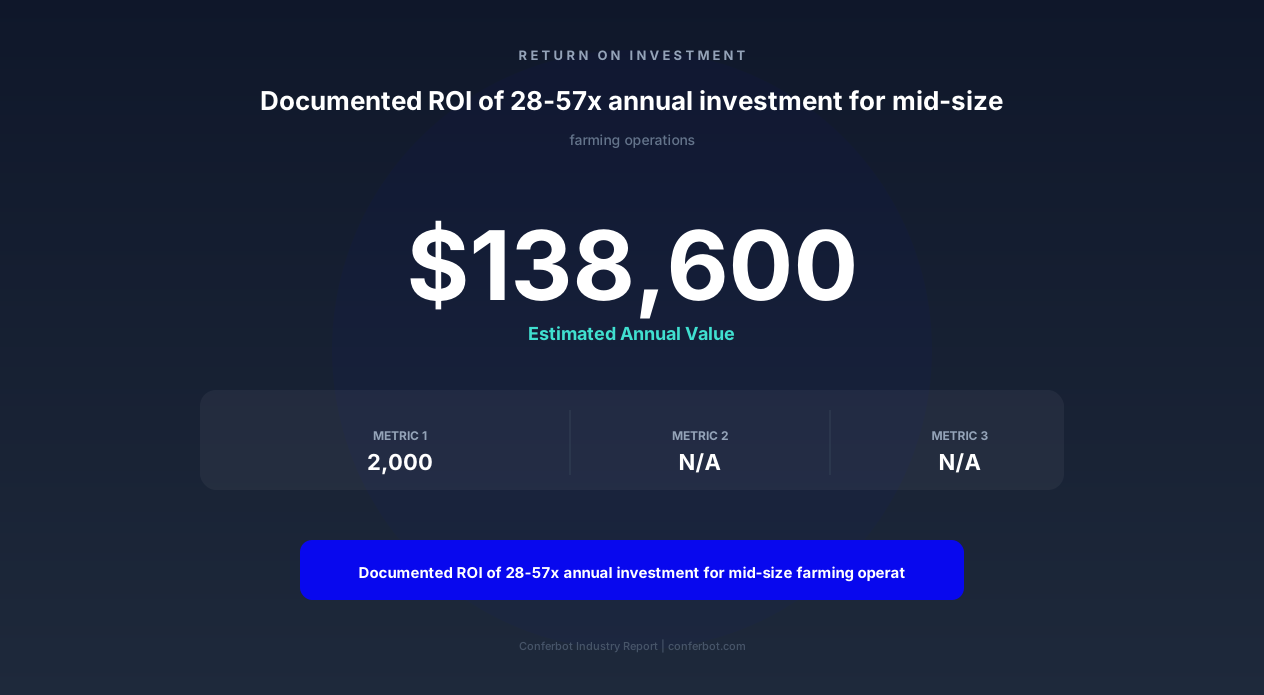
- Combined annual financial impact: $138,600
- Chatbot annual cost: $2,400-$4,800 (Conferbot pricing)
- Net annual benefit: $133,800-$136,200
- ROI multiple: 28-57x annual investment
- Payback period: 7-14 days
These figures are conservative - they exclude second-order benefits like improved banker relationships (better documentation supports operating loan applications), reduced stress and decision fatigue (mental health value for farm families), and multi-year compounding effects of better soil health from sustainability practices. The financial case for an agriculture chatbot is not marginal; it is overwhelming for any operation large enough to have meaningful input purchases, grain marketing decisions, and equipment fleets to manage.
Use Cases by Farm Type: Row Crops, Specialty, Livestock & Cooperatives
Agriculture is not monolithic - a 10,000-acre wheat operation in Kansas faces completely different challenges than a 50-acre organic vegetable farm in California or a 500-head cattle ranch in Montana. The agriculture chatbot template adapts to serve each farm type with relevant capabilities while sharing core infrastructure for weather, market data, and equipment management. Here are detailed use cases for the major farm operation types.
Large-Scale Row Crop Operations (1,000+ Acres)
Row crop operations growing corn, soybeans, wheat, cotton, or rice operate at scale where small per-acre improvements compound into substantial financial impact. A 5-bushel-per-acre yield improvement on 3,000 acres of corn at $5.00/bushel is $75,000 - achievable through better nitrogen timing alone. For these operations, the chatbot emphasizes:
- Field-by-field management zones: Different recommendations for each field based on soil type, drainage, historical performance, and current crop stage
- Logistics coordination: Managing 3-5 planters or combines simultaneously during peak windows requires real-time routing and scheduling that accounts for field readiness, equipment capacity, and labor availability
- Grain marketing across multiple delivery points: Tracking basis bids at 4-8 local elevators, ethanol plants, and river terminals to route grain to the highest-value delivery point
- Input volume negotiation support: Calculating total volume requirements across all fields to leverage bulk pricing tiers with suppliers
Specialty Crop & Vegetable Farms
Specialty crop operations (vegetables, fruit, nuts, nursery stock) manage higher revenue per acre but also higher labor intensity, tighter quality windows, and more complex pest management programs. A single missed spray timing on a strawberry crop can mean a complete loss to botrytis; a late harvest on lettuce means the crop bolts and becomes unmarketable. The chatbot serves specialty operations through:
- Harvest window prediction: Accumulating heat units to predict harvest dates for multiple plantings and successions, enabling forward sales to restaurant and retail buyers
- Food safety compliance: GAP/GHP (Good Agricultural Practices/Good Handling Practices) documentation, pre-harvest interval tracking for pesticides, and lot traceability record-keeping
- Labor scheduling: Crew allocation for hand-harvest operations based on predicted harvest volumes across multiple crops and plantings
- Post-harvest quality management: Cold chain monitoring, wash/pack line scheduling, and delivery routing to retail/wholesale customers
Livestock-Crop Mixed Operations
Mixed operations that combine crops with cattle, hogs, poultry, or dairy face dual management challenges. The chatbot bridges crop and livestock management by optimizing feed crop allocation, manure nutrient credit calculations, grazing rotation schedules, and integration points between enterprises. When a livestock producer asks "How much corn silage do I need for my 200-head feedlot this winter?", the chatbot calculates requirements based on animal weights, target gains, feeding period length, and dry matter content of the silage - then cross-references against the stored silage inventory from the crop management module.
Agricultural Cooperatives & Supply Retailers
Cooperatives and farm supply retailers can deploy the agriculture chatbot as a customer-facing service channel on their website. Members or customers can check input pricing, place orders, access agronomic recommendations, and schedule custom application services through the chatbot. This extends the cooperative's agronomic advisory capacity beyond what their staff can deliver through phone calls alone, while capturing order volume that might otherwise go to online competitors. The chatbot becomes a 24/7 agronomist-on-call that scales the cooperative's value proposition to every member regardless of their proximity to a physical branch location.
Agricultural Consulting Firms
Crop consulting firms serving 50-200 farmer clients can deploy the chatbot as a between-visit support tool. Farmers get instant answers to routine questions (when to irrigate, what pest they are seeing, whether weather conditions are suitable for spraying) without consuming the consultant's billable time. The consultant reserves their expertise for complex decisions - variety selection, drainage design, nutrient management planning - while the chatbot handles the 80% of farmer questions that follow established agronomic protocols. This model increases the consultant's client capacity by 40-60% while improving farmer satisfaction through instant response availability.
Integrations: Precision Agriculture Platforms, IoT Sensors & Farm Software
The agriculture chatbot's intelligence is only as good as the data it can access. Modern precision agriculture generates terabytes of field-level data - yield maps, soil sensor readings, drone imagery, satellite NDVI, equipment telematics, and weather station logs - but this data lives across a dozen different platforms that rarely communicate with each other. Conferbot's API integration architecture connects the chatbot to your entire precision agriculture stack, creating a single conversational interface that synthesizes insights from all data sources.
Farm Management Software Integration
The chatbot integrates bidirectionally with major farm management platforms:
- John Deere Operations Center: Pull field boundaries, as-applied maps, yield data, and equipment telematics. Push chatbot-generated recommendations as planned operations
- Climate FieldView: Access satellite imagery, disease risk models, and field health maps. Use FieldView's seed performance data to inform variety recommendation conversations
- Granular (Corteva): Sync financial records, input costs, and profit-per-field analytics. Enable the chatbot's ROI calculations to use actual cost data rather than estimates
- AgriWebb: For livestock operations, sync animal records, weight gain data, and grazing rotations
- Bushel: Connect grain marketing contracts, scale tickets, and settlement data for post-harvest marketing management
IoT Sensor Networks
Field-deployed sensors provide the real-time ground truth that makes chatbot recommendations precise rather than generic:
- Soil moisture probes (Sentek, AquaSpy, CropX): Real-time soil water content at multiple depths drives irrigation scheduling recommendations with field-specific accuracy
- Weather stations (Davis, Onset, Campbell Scientific): On-farm weather data supplements regional forecasts with microclimate measurements specific to your fields' topography and elevation
- Grain bin monitoring (IntelliFarms, BinMaster, OPI): Temperature and moisture cables in stored grain trigger aeration and conditioning recommendations, preventing spoilage in stored inventory worth hundreds of thousands of dollars
- Equipment telematics (JDLink, CNHi, AGCO Fuse): Engine hours, fuel consumption, and location data feed the predictive maintenance and logistics optimization modules
Drone & Satellite Imagery Platforms
Aerial imagery reveals field conditions invisible from ground level - early-stage nitrogen deficiency, drainage problems, weed pressure concentrations, and stand count variability. The chatbot interprets imagery analytics from platforms like DroneDeploy, Sentera, and Planet Labs to deliver actionable summaries: "Your NDVI imagery from yesterday shows a 12-acre zone in the northeast corner of Field 4 with significantly lower vegetative vigor than the rest of the field. Based on the pattern and your soil map, this is consistent with nitrogen loss from ponding after last week's heavy rain. Recommend a supplemental N application of 30 lbs/acre to that zone only."
Financial & Accounting Integration
Farm financial management requires tracking costs and revenues at the field level - a complexity that most general accounting software handles poorly. The chatbot integrates with QuickBooks Farm, FarmBooks, or CenterPoint Accounting to tag every input purchase, custom hire expense, and grain sale to specific fields and enterprises. This enables real-time profit-per-field tracking that informs land rental decisions, crop rotation planning, and enterprise allocation. When a farmer asks "Am I making money on my rented ground?", the chatbot can answer with actual field-level profitability data rather than a whole-farm average that obscures underperforming acres.
Configure all integrations through the Conferbot dashboard with API key authentication - no custom development required. For legacy farm software that lacks API access, the chatbot supports CSV import/export workflows that maintain data synchronization on daily or weekly cycles. Connect your WhatsApp chatbot to receive sensor alerts and imagery summaries directly on your phone while in the field.
Agriculture Business FAQ
Everything you need to know about chatbots for agriculture business.
Why Use a Template vs Building from Scratch?
Templates encode years of optimization data into the conversation flow before you start.
| Factor | Conferbot Template | Build from Scratch | Hire a Developer |
|---|---|---|---|
| Time to deploy | 10 minutes | 2-8 hours | 2-6 weeks |
| Cost | Free | Your time | $5,000-$25,000 |
| Day-1 conversion | 15-22% | 5-8% | 10-15% |
| Proven flows | Yes, data-tested | No | Depends |
| Updates included | Automatic | Manual | Paid |
| Multi-channel | 8+ channels | 1 channel | Extra cost |
| Analytics | Built-in | Must build | Extra cost |
Ready to Deploy Agriculture Business?
Join 50,000+ businesses. Free forever plan available. No credit card required.