
Logistics Shipment Tracking Chatbot
Free Support And Faq Chatbot Template
Package tracking, delivery management, and shipping quotes



What Is a Logistics Shipment Tracking Chatbot?
A logistics shipment tracking chatbot is a conversational AI system purpose-built for freight carriers, third-party logistics providers (3PLs), last-mile delivery companies, and e-commerce shippers that automates the entire customer communication lifecycle around package and shipment tracking. It handles real-time tracking inquiries, proactive delivery notifications, exception management, proof of delivery requests, customs status updates, driver dispatch coordination, and bulk shipment queries — all through natural language conversations across web, mobile, WhatsApp, and SMS channels.
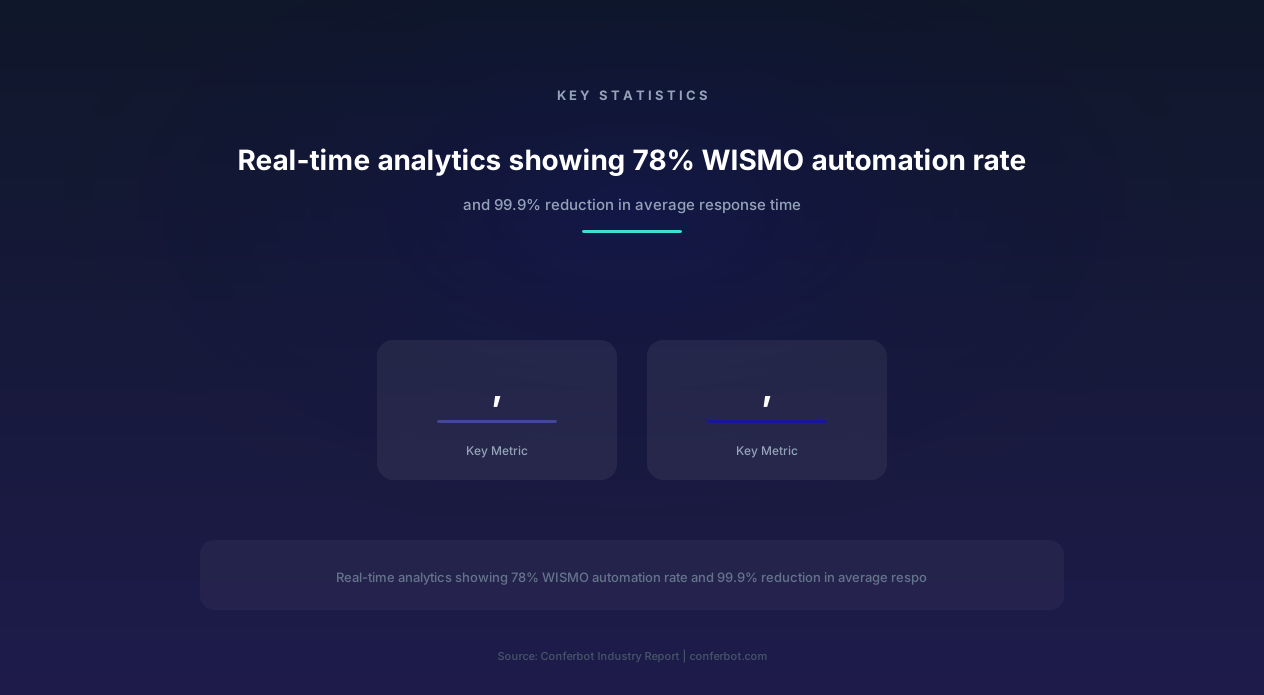
The logistics industry faces a staggering communication problem. "Where Is My Order?" (WISMO) queries account for 70% of all customer service contacts in logistics and e-commerce — making them the single largest driver of support costs across the supply chain. McKinsey's 2026 logistics report estimates that the global logistics industry spends $11 billion annually on customer service operations, with the majority consumed by repetitive tracking inquiries that require no human judgment to resolve. Every one of these queries follows the same pattern: customer provides a tracking number, agent looks it up in the TMS, reads the status, and relays it back. This is pure automation potential.
The market opportunity is massive and growing. The logistics voicebot and chatbot market is expanding at an 18.6% CAGR through 2028, driven by rising parcel volumes (global parcel deliveries exceeded 200 billion in 2026), increasing customer expectations for real-time visibility, and the economic pressure on carriers to reduce per-shipment service costs. Companies implementing tracking chatbots report 70-85% automation rates for WISMO queries, 60-75% reduction in call center volume, and 40-55% improvement in customer satisfaction scores.
Conferbot's logistics shipment tracking template connects to your Transportation Management System (TMS), Warehouse Management System (WMS), and carrier APIs through our API integration platform. It deploys on your customer portal, WhatsApp Business channel, and embedded tracking pages — giving shippers, consignees, and end customers instant access to shipment visibility without waiting in phone queues or navigating complex tracking portals. This guide covers everything logistics operators need to deploy world-class shipment tracking automation in 2026.
Real-Time Tracking: Instant Visibility Across the Supply Chain
The core function of a logistics shipment tracking chatbot is delivering real-time shipment status to any stakeholder who needs it — whether that is an end consumer checking a single package, a retail operations manager monitoring hundreds of inbound containers, or a manufacturer tracking a critical parts shipment. The chatbot connects to your tracking data infrastructure and translates raw logistics data into clear, actionable information delivered conversationally.
Multi-Carrier Tracking Integration
Modern supply chains involve multiple carriers across multiple modes. A single shipment might move from factory to port via truck (local carrier), cross the ocean on a container vessel (ocean carrier), clear customs via a broker, move to a distribution center via rail, and reach the end customer via last-mile delivery. The tracking chatbot aggregates visibility across all these legs into a single, unified tracking experience. The customer does not need to know which carrier has the package at each stage — they simply ask "Where is my shipment?" and receive a complete, real-time answer.
The chatbot integrates with:
Parcel carriers: FedEx, UPS, DHL, USPS, Royal Mail, Australia Post, and 200+ regional carriers through standardized tracking APIs.
Freight carriers: LTL, FTL, intermodal, ocean, and air freight carriers with EDI and API-based status updates.
TMS platforms: Direct connection to MercuryGate, BluJay, Oracle TMS, SAP TM, and other enterprise transportation management systems.
WMS platforms: Manhattan Associates, Blue Yonder, SAP EWM for warehouse-level visibility (picked, packed, staged, loaded).
Intelligent Status Translation
Raw tracking events from carriers are cryptic: "DEPARTED ORIGIN FACILITY," "IN TRANSIT TO NEXT FACILITY," "TENDERED TO DELIVERY SERVICE PROVIDER." Customers do not understand this language. The chatbot translates every tracking event into plain, informative language:
| Raw Carrier Event | Chatbot Translation | Additional Context |
|---|---|---|
| DEPARTED ORIGIN FACILITY | "Your package left the warehouse and is on its way" | Estimated delivery: [date] |
| IN TRANSIT - DELAYED | "Your package is slightly delayed due to weather" | New estimated delivery: [date], original: [date] |
| OUT FOR DELIVERY | "Your package is on the delivery truck right now!" | Expected delivery window: [time range] |
| DELIVERY ATTEMPTED - NO ACCESS | "The driver tried to deliver but could not access your location" | Options: reschedule, redirect, hold at facility |
| HELD AT CUSTOMS | "Your shipment is being processed by customs" | Required action: [documentation needed] |
Proactive Notification Engine
The most effective tracking chatbots do not wait for customers to ask — they proactively push status updates at key milestones. Research shows that proactive notifications reduce inbound WISMO queries by an additional 35-45% beyond the self-service deflection. The chatbot sends automated updates when: order is confirmed, shipment leaves warehouse, package is in transit, delivery is scheduled for tomorrow, package is out for delivery, delivery is complete, and — critically — when any exception occurs. Customers who receive proactive exception notifications are 3x less likely to contact support than those who discover delays on their own.
WISMO Automation: Eliminating the #1 Support Cost Driver
WISMO (Where Is My Order?) queries are the Mount Everest of logistics customer service costs. They are high-volume, low-complexity, highly repetitive, and entirely predictable — making them the perfect automation target. A properly deployed tracking chatbot automates 70-85% of all WISMO inquiries without any human involvement, freeing your customer service team to handle the complex exceptions, escalations, and relationship-critical interactions that genuinely require human judgment.
WISMO Query Resolution Flow
The chatbot handles WISMO queries through a streamlined conversational flow:
Step 1 — Identification: "Hi! I can help you track your shipment. Please share your tracking number, order number, or the email address associated with your order." The chatbot accepts multiple identifier types, reducing friction for customers who may not have their tracking number readily available.
Step 2 — Lookup and status: The chatbot queries your TMS/OMS in real-time and delivers the current status in plain language, with the estimated delivery date prominently displayed.
Step 3 — Contextual follow-up: Based on the shipment status, the chatbot proactively offers relevant follow-up information: "Would you like me to send you a notification when it arrives?" or "The package is at your local facility — would you like to redirect it to a different address?"
Step 4 — Resolution confirmation: "Is there anything else I can help you with regarding this shipment?" This ensures the customer's question is fully resolved before ending the conversation.
The Economics of WISMO Automation
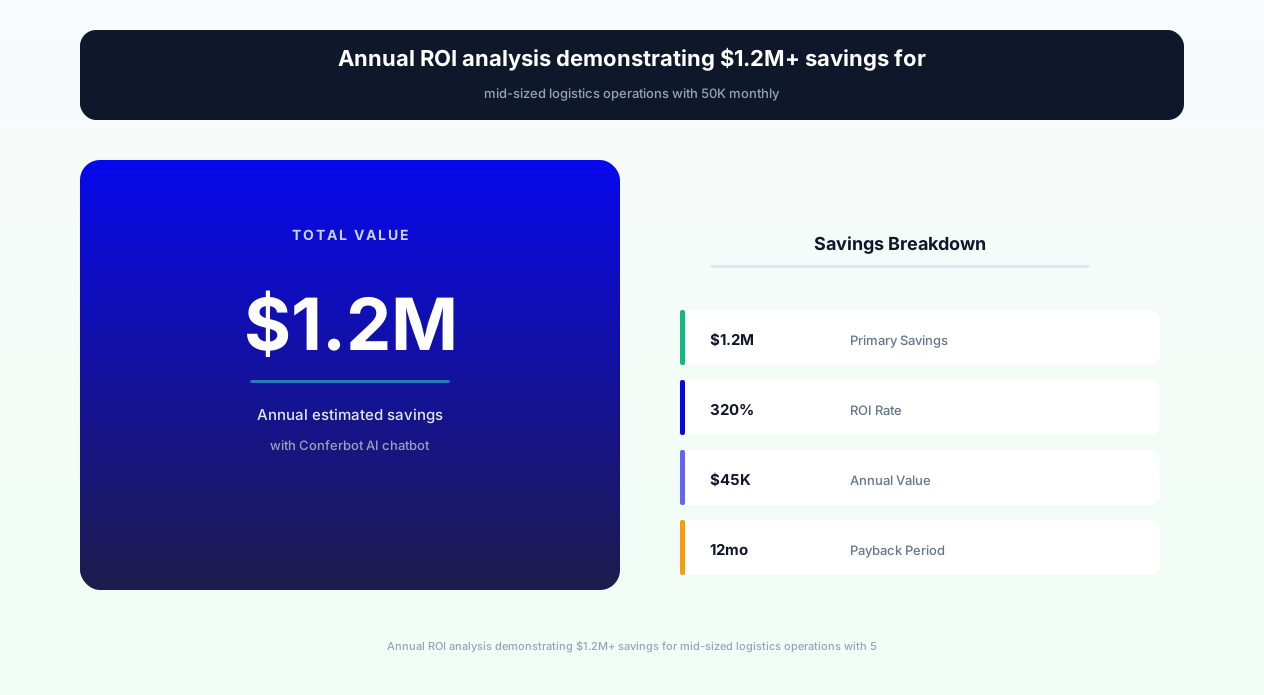
Consider a mid-sized logistics company handling 50,000 shipments per month:
| Metric | Before Chatbot | After Chatbot | Impact |
|---|---|---|---|
| Monthly WISMO inquiries | 15,000 | 15,000 (same volume) | - |
| Automated resolution rate | 0% | 78% | 11,700 queries automated |
| Human-handled queries | 15,000 | 3,300 | -78% |
| Average cost per query (human) | $8.50 | $8.50 | - |
| Monthly support cost | $127,500 | $28,050 | -$99,450/month saved |
| Average response time | 4.2 hours | 8 seconds | -99.9% |
| Customer satisfaction (CSAT) | 3.2/5 | 4.4/5 | +37% |
| Annual savings | - | - | $1,193,400 |
Multi-Identifier Lookup
Customers often do not have their tracking number when they reach out. They might have an order number from the e-commerce platform, a reference number from their ERP, a booking number from the carrier, or simply the email address they used at checkout. The chatbot supports all of these lookup methods, querying across multiple systems to locate the correct shipment. For authenticated users (logged into the customer portal), the chatbot can even display all active shipments without requiring any identifier — "You have 3 active shipments. Which one would you like to check?"
This flexibility is critical for B2B logistics where a single customer might have dozens of active shipments identified by PO numbers, BOL numbers, container numbers, or internal reference codes. The chatbot maps all identifiers to the underlying shipment record, ensuring that regardless of what the customer calls their shipment, the chatbot can find it instantly.
Ready to try Logistics Shipment Tracking Chatbot?
Deploy this template in under 10 minutes. No coding required.
Use This Template Free →Exception Management: Proactive Resolution for Delivery Disruptions
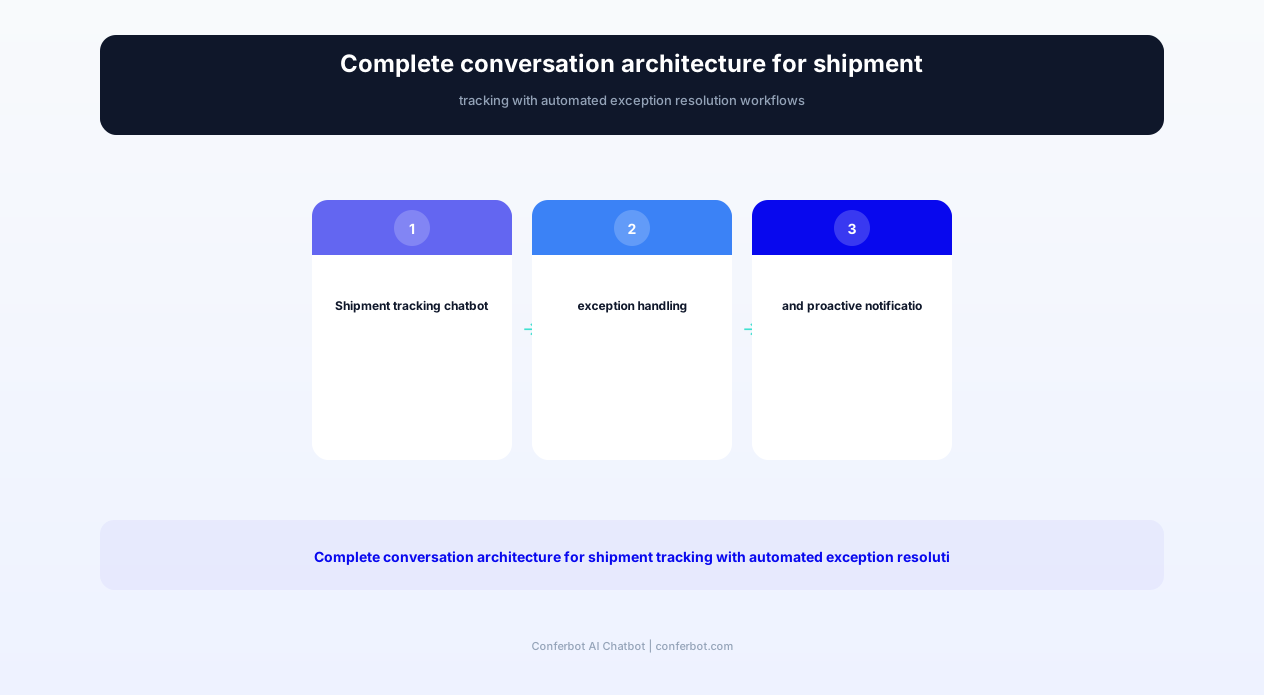
Delivery exceptions — delays, failed deliveries, damaged goods, customs holds, address issues — are where customer experience is won or lost in logistics. A shipment that arrives on time requires no customer service. A shipment that encounters an exception requires immediate, proactive, and effective communication. The tracking chatbot transforms exception management from a reactive scramble into a structured, automated resolution process that preserves customer relationships even when deliveries go wrong.
Exception Types and Automated Responses
The chatbot monitors the tracking data stream for exception events and immediately triggers appropriate response workflows:
Weather delays: "Your shipment is experiencing a slight delay due to severe weather in [region]. Based on current conditions, we expect delivery by [new date] instead of [original date]. We are monitoring the situation and will update you if anything changes." This proactive communication prevents the customer from discovering the delay on their own and feeling uninformed.
Failed delivery attempt: "The driver attempted delivery at [time] but was unable to complete it — [specific reason: no one home, access code needed, address inaccessible]. You have three options: 1) Schedule a redelivery for tomorrow, 2) Redirect to a nearby pickup point, 3) Hold at the depot for self-collection. Which would you prefer?" This gives the customer immediate resolution options rather than requiring them to call and wait on hold.
Customs hold: "Your international shipment is currently being processed by customs at [port]. The estimated clearance time is [duration]. If any additional documentation is needed, I will notify you immediately with specific instructions." For known documentation requirements: "Customs requires a commercial invoice for this shipment. Can you upload it here, or would you like me to connect you with our customs team?"
Damaged shipment: "I am sorry — it appears your package was damaged during transit. I have automatically initiated a claim and created a replacement order. Your replacement will ship within [timeframe]. Would you like a return label for the damaged item, or is it beyond use?" This immediate resolution — without requiring the customer to navigate a claims process — dramatically improves satisfaction scores for negative experiences.
Escalation Intelligence
Not every exception can be resolved by the chatbot. The system includes intelligent escalation criteria that route complex or high-stakes exceptions to human agents with full context:
Auto-escalation triggers: High-value shipments ($10,000+), perishable goods with temperature excursions, hazmat incidents, VIP customer accounts, repeated exceptions on same shipment (3+), and customer expressing frustration (sentiment analysis). When escalation occurs, the human agent receives the complete conversation history, shipment details, exception timeline, and recommended resolution — enabling them to resolve the issue in a single interaction rather than starting from scratch.
Exception Analytics
The chatbot aggregates exception data across all shipments to identify systemic issues: carriers with higher delay rates, routes with frequent customs problems, addresses that consistently fail delivery, and peak periods when exceptions spike. This operational intelligence feeds back into logistics planning — allowing companies to preemptively address root causes rather than just managing symptoms. A logistics operation that reduces exceptions by even 10% through data-driven route and carrier optimization saves far more than the chatbot costs to operate.
Bulk Shipment Queries & B2B Portal: Enterprise-Grade Visibility
While consumer tracking typically involves a single package, B2B logistics customers often need visibility across hundreds or thousands of active shipments simultaneously. A procurement manager at a retail chain might be tracking 500 inbound containers. A manufacturer might have 200 outbound shipments to monitor. A 3PL's customer might need a daily status report across all their freight. The tracking chatbot handles these enterprise-scale queries through bulk operations that deliver aggregated intelligence, not just individual package status.
Bulk Query Capabilities
The chatbot supports multi-shipment queries through natural language:
"Show me all delayed shipments" — Returns a filtered list of all active shipments with exception status, sorted by severity and estimated delay duration. Includes action buttons for each: escalate, accept new ETA, or contact carrier.
"What is arriving this week?" — Returns a daily breakdown of expected deliveries for the current week, grouped by destination warehouse/facility. Flags any shipments at risk of missing their appointment windows.
"Status of PO #12345 through PO #12350" — Bulk lookup by PO range, returning a consolidated status table with tracking numbers, current locations, and ETAs for each purchase order.
"Which shipments from [supplier] are in transit?" — Filters by origin/supplier and returns a real-time map view of all shipments from that trading partner.
Automated Reporting
B2B customers frequently need scheduled reports — daily shipment summaries, weekly KPI dashboards, monthly performance reviews. The chatbot automates these through scheduled delivery:
| Report Type | Frequency | Contents | Delivery Channel |
|---|---|---|---|
| Daily Digest | Every morning, 7 AM | Arriving today, exceptions, action items | Email + WhatsApp |
| Exception Alert | Real-time | Critical delays, failed deliveries, customs holds | SMS + Push notification |
| Weekly Summary | Monday morning | Shipment counts, on-time rate, cost analysis | Email with PDF attachment |
| Monthly Scorecard | 1st of month | Carrier performance, route analysis, cost trends | Email + customer portal |
Multi-User Access Control
Enterprise logistics accounts have multiple stakeholders who need different levels of tracking access. The chatbot respects role-based permissions: warehouse managers see inbound shipment details, sales teams see outbound delivery status, finance teams see cost and billing data, and executive stakeholders see high-level KPI dashboards. Authentication integrates with your existing SSO/SAML infrastructure, and the chatbot adjusts its responses based on the authenticated user's role and permissions.
API-First Architecture for System Integration
For customers who want tracking data flowing into their own systems — ERP, WMS, TMS, or custom dashboards — the chatbot's underlying API provides programmatic access to all tracking data, notifications, and exception workflows. This enables customers to build custom integrations using Conferbot's API integration layer while still offering the conversational interface for ad-hoc queries and exception management. The two interfaces complement each other: systematic data flows via API, human-friendly interactions via chatbot.
Driver Communication & Last-Mile Coordination
Last-mile delivery is the most expensive and most failure-prone segment of the logistics chain, accounting for 53% of total shipping cost according to Capgemini's 2026 logistics research. The tracking chatbot extends beyond customer-facing communication to coordinate driver dispatch, delivery scheduling, and real-time last-mile operations — reducing failed deliveries, optimizing routes, and improving the delivery experience for both drivers and recipients.
Recipient-Driver Communication Bridge
When a delivery is approaching, the chatbot facilitates communication between the recipient and the driver without exposing personal phone numbers:
Delivery window confirmation: "Your delivery is scheduled between 2-4 PM today. Will someone be available to receive it? If not, I can help reschedule or arrange a safe drop location." This pre-delivery confirmation reduces failed delivery attempts by 35-40% — a massive cost saving given that each re-delivery attempt costs $15-25.
Access instructions: "The driver is 15 minutes away. Are there any special delivery instructions? (Gate code, specific door, leave with neighbor, etc.)" These instructions are relayed to the driver in real-time, preventing the most common reason for failed deliveries in apartment and gated communities.
Real-time ETA updates: "Your driver is 3 stops away — estimated arrival in 12 minutes." Live ETA tracking allows recipients to prepare for the delivery, reducing wait times and missed deliveries.
Delivery Preference Management
The chatbot allows recipients to set and manage delivery preferences that persist across all future shipments:
Safe place instructions: "Always leave packages behind the blue pot on the porch" — stored and applied to all future deliveries to this address.
Delivery time preferences: "I prefer afternoon deliveries (after 2 PM)" — routed to scheduling systems to optimize delivery windows.
Alternative recipients: "If I am not home, my neighbor at #204 (Maria) can accept packages" — registered as an authorized alternative recipient.
Communication preferences: "Send updates via WhatsApp, not SMS" — channels configured per recipient preference.
Proof of Delivery & Confirmation
After delivery, the chatbot sends immediate confirmation with proof of delivery: "Your package has been delivered! [Photo of package at door]. It was left at [location] at [time]. Everything look good?" This immediate post-delivery touchpoint serves dual purposes: it provides the customer with instant confirmation (eliminating "was it delivered?" follow-up calls), and it captures real-time delivery quality feedback that flags issues while the driver is still in the area.
For high-value or signature-required deliveries, the chatbot captures electronic signatures, ID verification, and photographic proof directly within the conversational interface — no separate app required. This documentation is automatically attached to the shipment record for compliance, insurance, and dispute resolution purposes.
Route Optimization Notifications
When route conditions change (traffic, road closures, weather), the chatbot proactively updates affected recipients: "Due to traffic on your delivery route, your package will arrive approximately 30 minutes later than originally estimated. New window: 3:30-4:30 PM." This transparency manages expectations and prevents the frustration of waiting for a delivery that is running behind schedule without explanation.
50,000+ businesses use Conferbot templates to automate conversations
Implementation Guide: Connecting Your Logistics Tech Stack
Deploying a logistics shipment tracking chatbot requires integration with your existing logistics technology infrastructure — TMS, WMS, carrier APIs, and customer databases. Conferbot's template is pre-built for logistics-specific integrations, reducing deployment time from months to weeks. Here is the implementation roadmap for 2026.
Phase 1: Core Integration (Week 1-2)
TMS Connection: Connect your Transportation Management System to the chatbot via API or EDI. Supported systems include Oracle TMS, SAP Transportation Management, MercuryGate, BluJay, Descartes, and any system with REST API capabilities. This connection provides the chatbot with real-time shipment status, carrier assignments, ETAs, and exception data.
Carrier API Setup: Configure direct carrier tracking API connections for real-time status beyond TMS updates. Major carriers (FedEx, UPS, DHL) provide real-time tracking webhooks that push status changes to the chatbot within seconds of occurrence — faster than TMS polling intervals.
Customer Database Sync: Connect your CRM or customer database to enable authenticated lookups, order history, and preference management. This allows the chatbot to recognize returning customers and provide personalized service without requiring them to re-identify themselves.
Phase 2: Channel Deployment (Week 2-3)
Website widget: Deploy the tracking chatbot on your customer portal and tracking pages. Customers who currently navigate complex tracking portals can instead simply ask their question conversationally.
WhatsApp Business: Enable WhatsApp as a tracking channel — critical for international logistics where WhatsApp is the dominant messaging platform. Customers send their tracking number via WhatsApp and receive real-time updates in the same conversation thread.
SMS notifications: Configure automated SMS updates for delivery milestones. SMS remains the most reliable channel for time-critical notifications (out for delivery, delivery complete, exception alerts).
Phase 3: Optimization (Week 3-4)
Exception workflow configuration: Define escalation rules, automated responses for each exception type, and routing logic for human handoff. Test each exception scenario end-to-end.
Bulk operations setup: Configure enterprise customer portals with role-based access, scheduled reports, and bulk query capabilities.
Analytics dashboard: Set up tracking for key metrics: automation rate, average resolution time, customer satisfaction, exception handling speed, and cost per inquiry.
Technical Architecture
| Component | Description | Operational Benefit | Customer Benefit |
|---|---|---|---|
| Real-time Tracking Engine | Webhook-based carrier status ingestion with sub-second latency | Always-current data without polling overhead | Instant, accurate tracking responses |
| Multi-Carrier Aggregator | Unified API layer across 200+ carriers and TMS platforms | Single integration point for entire carrier network | One place to track any shipment regardless of carrier |
| Exception Detection Engine | ML-based anomaly detection on tracking event streams | Identifies exceptions before carriers report them | Proactive notification before customer notices delay |
| Notification Orchestrator | Multi-channel message routing with preference management | Reduces inbound WISMO by 35-45% through proactive updates | Updates arrive in preferred channel at preferred time |
| NLP Query Parser | Natural language understanding for logistics-specific queries | Handles complex B2B queries without rigid menu navigation | Ask anything in natural language, get instant answers |
| Bulk Operations Module | Multi-shipment queries, scheduled reports, portfolio views | Serves enterprise customers without dedicated account managers | Fleet-wide visibility in seconds, not hours |
| Driver Communication Bridge | Anonymous messaging between recipient and driver | Reduces failed deliveries by 35-40% | Coordinate delivery without sharing personal phone numbers |
| Analytics & Insights | Operational intelligence from chatbot interaction data | Identifies systemic issues for root cause resolution | Continuously improving delivery experience |
Integration Security
Logistics data is commercially sensitive — shipment volumes, carrier rates, customer addresses, and delivery patterns. The chatbot implements enterprise-grade security: TLS 1.3 encryption for all data in transit, AES-256 encryption at rest, SOC 2 Type II compliance, role-based access control, audit logging for all data access, and configurable data retention policies. Customer PII is handled according to GDPR, CCPA, and regional privacy regulations with automated data minimization and right-to-deletion support.
Customs & International Shipping: Cross-Border Visibility
International shipping introduces a layer of complexity that domestic logistics does not face: customs clearance, duties and taxes, import documentation, restricted goods compliance, and multi-country tracking hand-offs. For cross-border shippers, the tracking chatbot provides end-to-end visibility across the entire international journey — including the customs black box where most tracking portals simply show "in transit" for days or weeks with no additional information.
Customs Status Transparency
When a shipment enters customs, most tracking systems go dark. The customer sees "cleared customs" or "held at customs" with no additional detail. The tracking chatbot provides granular customs visibility:
"Your shipment arrived at [port/airport] on [date] and entered customs processing. Current status: Document review — the customs authority is verifying your commercial invoice and packing list. Estimated clearance: 1-2 business days. No action needed from you at this time."
If documentation issues arise: "Customs requires an additional document for your shipment: Certificate of Origin for items classified under HS code [number]. I can help you prepare this — would you like instructions, or shall I connect you with our customs broker?"
Duties and Taxes Communication
For DDP (Delivered Duty Paid) shipments, the chatbot provides transparency on duties paid on the customer's behalf. For DAP (Delivered at Place) shipments where the recipient is responsible for import charges, the chatbot proactively communicates estimated duties before delivery: "Your shipment will incur approximately $[amount] in import duties and GST/VAT. This will need to be paid before delivery can be completed. Payment options: [online payment link], [pay driver on delivery], [pay at customs office]."
Country-Specific Compliance
Different countries have different import requirements, restricted items lists, and documentation standards. The chatbot is configured with country-specific knowledge:
Australia: Biosecurity requirements, mandatory quarantine inspection for certain goods, ABN requirements for commercial imports.
EU: EORI number requirements, VAT import schemes (IOSS), CE marking verification, product safety documentation.
Brazil: CPF/CNPJ requirements, Siscomex registration, complex state-level tax calculations (ICMS).
India: IEC code requirements, BIS certification for electronics, FSSAI approval for food products.
The chatbot preemptively identifies potential compliance issues before they cause delays: "Based on the declared contents of your shipment to Australia, a biosecurity inspection may be required at the border. This typically adds 2-3 business days. We have ensured all documentation is in order to minimize the inspection timeline."
Multi-Language International Support
International shipments involve stakeholders in different countries speaking different languages. The chatbot operates in 95+ languages, automatically detecting the user's preferred language and responding accordingly. A shipper in Germany can track their export in German, while the recipient in Japan tracks the same shipment in Japanese — each receiving culturally appropriate communication styles, date/time formats, and address conventions. This eliminates the language barrier that makes international logistics particularly frustrating for end recipients who cannot navigate English-language tracking portals.
ROI Analysis & Industry Use Cases: Proving the Business Case
The return on investment for a logistics shipment tracking chatbot is among the most straightforward to calculate in any chatbot category — because the cost it eliminates (human-handled WISMO queries) is directly measurable, high-volume, and recurring. Here is the comprehensive ROI framework and real-world use cases across logistics segments in 2026.
ROI Calculation Framework
Direct cost savings: (Monthly WISMO queries x Automation rate x Cost per human-handled query). For a company with 20,000 monthly WISMO queries, 78% automation rate, and $8.50 per human query: 20,000 x 0.78 x $8.50 = $132,600/month saved ($1.59M annually).
Failed delivery reduction: (Monthly deliveries x Current failure rate x Failure rate reduction x Cost per re-delivery). For 100,000 monthly deliveries, 8% failure rate, 35% reduction, $22 per re-delivery: 100,000 x 0.08 x 0.35 x $22 = $61,600/month saved.
Customer retention value: Logistics companies with superior tracking experiences see 15-25% lower customer churn. For a company with $10M in annual revenue and 20% churn reduction, that represents $2M in retained revenue annually.
Use Case: E-Commerce Fulfillment (3PL)
A third-party logistics provider handling fulfillment for 50 e-commerce brands deployed the tracking chatbot across all client customer portals. Results after 6 months: WISMO queries automated at 82% rate, client customer satisfaction scores improved 41%, and the 3PL was able to reduce their customer service team from 24 agents to 9 while handling 30% more shipment volume. The chatbot paid for itself in the first 11 days of operation.
Use Case: Freight Brokerage
A domestic freight brokerage with 5,000 active shipments at any given time deployed the chatbot for both their shipper customers and carrier partners. Shippers use it to check load status; carriers use it to confirm pickup appointments and report delays. Results: Shipper check-call volume decreased 71%, carrier communication errors decreased 45%, and the operations team reclaimed 120 hours/week previously spent on status update phone calls — redirecting that capacity to relationship building and lane optimization.
Use Case: Last-Mile Delivery Startup
A same-day delivery startup operating in 3 metropolitan areas used the chatbot to manage recipient communication during the delivery window. Results: Failed delivery attempts decreased from 12% to 4.2% (saving $18 per avoided re-delivery), customer ratings improved from 4.1 to 4.7 stars, and the company scaled from 3 cities to 8 without adding customer service headcount — the chatbot absorbed all communication volume from the expansion.
Competitive Landscape Comparison
| Feature | Conferbot Logistics | Narvar ($$$) | AfterShip ($99-999/mo) | Custom Build |
|---|---|---|---|---|
| Conversational tracking | Full NLP chat | Limited | Tracking page only | 6+ months dev |
| Multi-carrier support | 200+ carriers | 100+ carriers | 1,000+ carriers | Per-carrier build |
| Exception handling AI | Automated resolution | Notification only | Notification only | Manual rules |
| B2B bulk operations | Full suite | Limited | Not available | Custom dev |
| WhatsApp/SMS channels | Native multi-channel | Email focus | Limited | Per-channel build |
| Driver coordination | Built-in | Not available | Not available | Separate system |
| Customs intelligence | Country-specific AI | Basic notifications | Not available | Manual updates |
| Setup time | 2-3 weeks | 4-8 weeks | 1-2 weeks | 4-6 months |
The logistics shipment tracking chatbot integrates with your existing website chatbot for pre-sales inquiries and your calendar integration for scheduling delivery appointments and pickup slots. Combined with live chat handoff for complex exception resolution, it creates a complete customer communication ecosystem that scales with your shipment volume without proportionally scaling your support costs.
Logistics Shipment Tracking Chatbot FAQ
Everything you need to know about chatbots for logistics shipment tracking chatbot.
Why Use a Template vs Building from Scratch?
Templates encode years of optimization data into the conversation flow before you start.
| Factor | Conferbot Template | Build from Scratch | Hire a Developer |
|---|---|---|---|
| Time to deploy | 10 minutes | 2-8 hours | 2-6 weeks |
| Cost | Free | Your time | $5,000-$25,000 |
| Day-1 conversion | 15-22% | 5-8% | 10-15% |
| Proven flows | Yes, data-tested | No | Depends |
| Updates included | Automatic | Manual | Paid |
| Multi-channel | 8+ channels | 1 channel | Extra cost |
| Analytics | Built-in | Must build | Extra cost |
Ready to Deploy Logistics Shipment Tracking Chatbot?
Join 50,000+ businesses. Free forever plan available. No credit card required.