Why Physical Therapy Clinics Need Chatbots in 2026
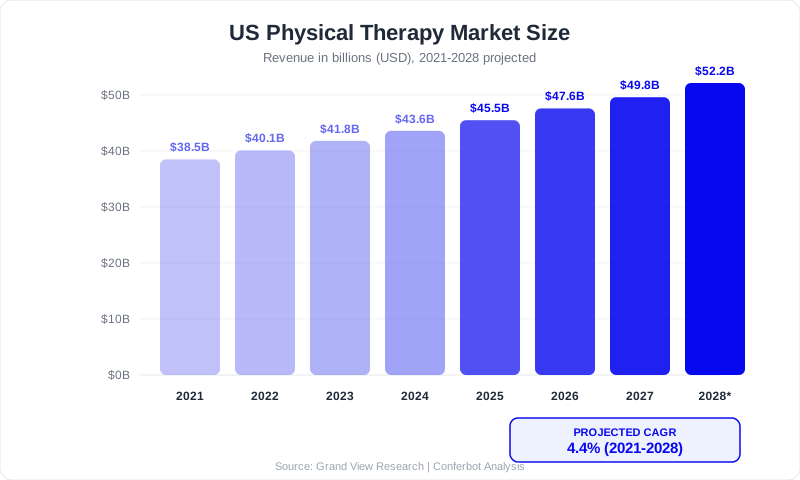
The physical therapy industry in the United States is experiencing a paradox of growth and strain. The market exceeds $45 billion in annual revenue and continues to grow at 4.4% annually, driven by an aging population, rising rates of chronic pain, post-surgical rehabilitation demand, and increased awareness of conservative treatment options. Yet individual PT clinics face relentless operational pressure: high patient volumes, complex insurance requirements, persistent no-show rates, and a front-desk staff that spends more time on paperwork than on patient experience.
Consider the typical patient journey at a physical therapy clinic in 2026. A patient receives a referral from their physician, searches for a local PT clinic, lands on a website, and encounters a phone number and a PDF intake form. If they call during business hours, they wait on hold. If they call after hours — which 62% of healthcare searches happen — they reach voicemail. The PDF form is 8-12 pages of repetitive demographic, insurance, medical history, and consent information that takes 20-30 minutes to complete on a computer (and is nearly impossible on a mobile phone). Many patients abandon the process entirely. Those who do complete intake arrive for their first visit only to discover their insurance requires prior authorization, their copay is higher than expected, or the clinic does not accept their plan at all.
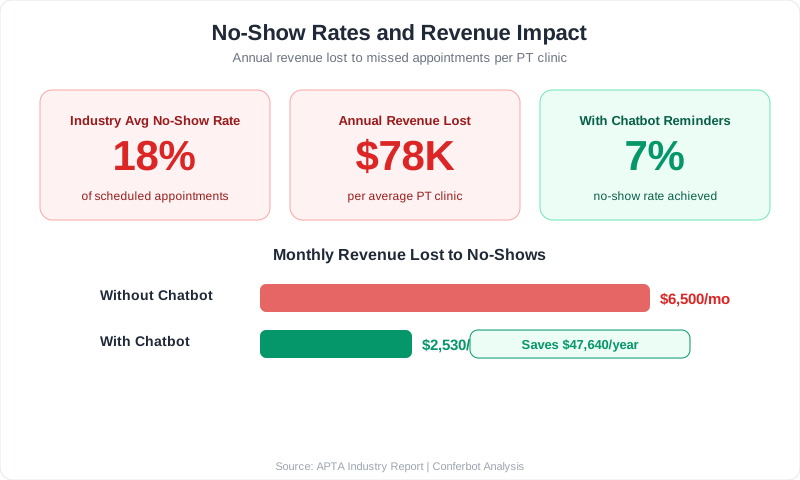
Every friction point in this journey costs the clinic patients and revenue. The American Physical Therapy Association reports that the average PT clinic loses 18% of scheduled appointments to no-shows, translating to $78,000 in unrealized annual revenue for a typical four-therapist practice. Add the patients who never complete intake, the after-hours inquiries that go unanswered, and the referrals that expire because the patient never scheduled — and the total revenue leakage is staggering.
A physical therapy clinic chatbot addresses every one of these friction points. It replaces the PDF intake form with a conversational flow that achieves 91% completion rates. It sends automated reminders that cut no-shows by 61%. It verifies insurance before the first visit so there are no billing surprises. It delivers home exercise programs with video demonstrations and tracks patient adherence between visits. And it operates 24/7, capturing the after-hours inquiries that phone-only clinics lose to voicemail.
This guide covers the complete implementation of chatbots in physical therapy clinics: from intake automation and scheduling to exercise program delivery, insurance verification, and a detailed ROI model that justifies the investment to clinic owners and administrators. Whether you run a single-location outpatient clinic or a multi-site rehabilitation network, this guide provides the operational playbook you need.
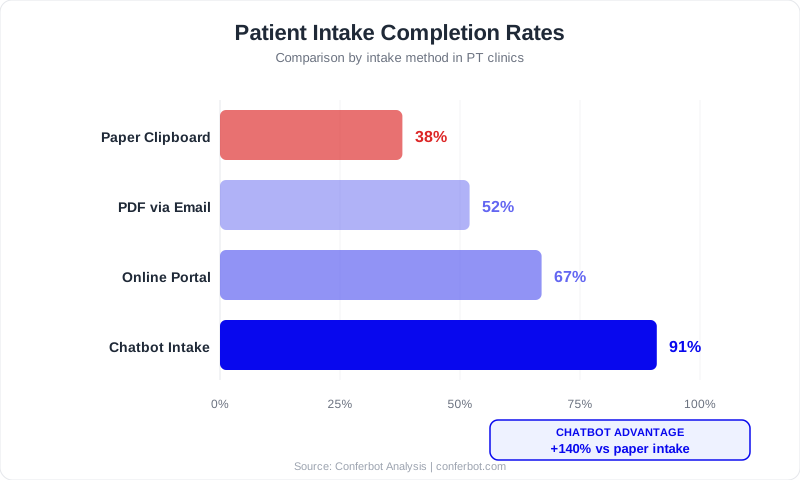
Patient Intake Automation: From 38% Completion to 91%
The intake process is the first operational bottleneck in every physical therapy clinic, a challenge the American Physical Therapy Association (APTA) addresses in its practice management resources. It is also the most impactful place to deploy a chatbot, because the difference in completion rates between traditional and conversational intake is dramatic and well-documented.
Why Traditional PT Intake Fails
The standard PT intake process was designed for paper-based workflows and has been only superficially digitized. Clinics moved from clipboard forms to PDF forms, from PDF forms to patient portals, but the underlying design remained the same: present the patient with a multi-page document requiring demographic information, insurance details, medical history, current medications, surgical history, pain assessment, functional limitations, consent acknowledgments, and HIPAA notice of privacy practices — all at once, all before the patient has any relationship with the clinic.
The completion rates tell the story. Paper clipboard forms completed in the waiting room achieve 38% pre-visit completion (the rest arrive early and complete them on-site, consuming 15-20 minutes of appointment time). PDF forms sent by email reach 52% completion, limited by the difficulty of filling PDF forms on mobile devices. Online patient portals improve to 67%, but still suffer from registration fatigue and the overwhelming scope of the task presented upfront.
How Chatbot Intake Achieves 91% Completion
The chatbot transforms intake from a document-completion task into a guided conversation. Instead of presenting 8-12 pages simultaneously, the chatbot asks one question at a time, in a natural conversational flow, with supportive transitions between sections. The psychological effect is significant: the patient never sees the full scope of the intake. They answer the current question, receive acknowledgment, and move to the next. Progressive disclosure keeps engagement high through the entire process.
The chatbot intake flow for a PT clinic typically covers these categories in sequence:
- Demographics and contact: Name, date of birth, phone, email, address. The chatbot pre-fills from referral data when available.
- Referral source: Physician referral, self-referral, workers' compensation, auto accident. This determines the billing pathway.
- Insurance information: Insurance provider, plan type, member ID, group number. The chatbot triggers real-time eligibility verification in the background.
- Reason for visit: Body region, onset date, mechanism of injury, current pain level (0-10), aggravating and easing factors. This section uses adaptive questioning — a patient reporting knee pain receives knee-specific follow-ups, while a patient reporting neck pain receives cervical-specific questions.
- Medical history: Previous PT, surgeries, current medications, relevant diagnoses. The chatbot uses smart skip logic — a 25-year-old athlete with an ACL tear receives different follow-up questions than a 65-year-old with chronic low back pain.
- Functional goals: What activities the patient wants to return to — running, lifting their grandchild, climbing stairs without pain, returning to work. This open-ended question captures the patient's motivation in their own words, which is clinically valuable for goal-setting.
- Consent and acknowledgments: HIPAA notice, consent to treat, financial responsibility agreement. Presented as clear summaries with tap-to-acknowledge buttons.
The entire flow takes 6-8 minutes in conversational format versus 20-30 minutes with paper or PDF forms. Patients complete it on their phone while sitting on the couch, commuting, or during a lunch break. The clinic receives a structured, complete intake record before the patient walks through the door. For practices already using healthcare chatbots for general patient communication, adding PT-specific intake flows is a natural extension.
Clinical Handoff to the Therapist
When the patient arrives for their initial evaluation, the treating therapist has a structured summary: demographics, insurance status (verified or pending), referral information, body region and mechanism of injury, pain level, functional goals, and relevant medical history. The therapist spends zero time on paperwork and begins the clinical evaluation immediately — which both improves the patient experience and allows the therapist to bill for more evaluation time.
Scheduling Automation and No-Show Reduction
No-shows are the silent revenue killer in physical therapy. The industry-wide average is 18%, meaning nearly one in five scheduled appointments results in an empty treatment table, an idle therapist, and $150-250 in lost revenue. For a four-therapist clinic seeing 60 patients per day, that is roughly 11 missed appointments daily — a weekly revenue loss of approximately $9,000.
Why PT No-Shows Are So High
Physical therapy has several characteristics that drive higher no-show rates than many other healthcare specialties. First, treatment plans typically require 2-3 visits per week for 6-12 weeks — a significant time commitment that creates scheduling fatigue. Second, patients often feel better after a few sessions and question whether they need to continue (premature discharge is the leading cause of PT plan-of-care abandonment). Third, the administrative burden of scheduling, confirming, and rescheduling is entirely manual in most clinics — the front desk calls patients, leaves voicemails, and hopes for callbacks. Fourth, copay accumulation creates financial friction: a $50 copay three times per week totals $600 per month, and patients who experience sticker shock after the first bill may silently drop out rather than have an uncomfortable conversation about cost.
How the Chatbot Reduces No-Shows by 61%
The chatbot addresses each no-show driver through a systematic, multi-touch reminder and engagement strategy:
48-Hour Smart Reminder: Two days before the appointment, the chatbot sends a reminder via the patient's preferred channel (SMS, WhatsApp, or email). This is not a generic reminder — it includes the appointment date, time, therapist name, and a motivational message referencing the patient's functional goals: "Your session with [Therapist] is on Wednesday at 10 AM. You are 3 weeks into your plan — keep going toward [getting back to running]." This personalization reactivates the patient's intrinsic motivation.
24-Hour Confirmation Request: The chatbot asks the patient to confirm attendance with a single tap. If the patient indicates they cannot attend, the chatbot immediately offers rescheduling options — converting a no-show into a rescheduled visit that preserves revenue. If the patient mentions cost concerns, the chatbot can surface financial assistance options or connect them with the billing coordinator.
2-Hour Logistics Reminder: A final nudge with practical information: parking instructions, what to wear, any home exercises to complete before the session, and a reminder to bring their insurance card if it is a first visit. For telehealth PT sessions (which now represent 15-20% of PT visits), the chatbot sends the video link and technology check instructions.
Missed Appointment Follow-Up: If a patient does not show, the chatbot sends a non-judgmental follow-up within 2 hours: "We missed you at your appointment today. No worries — would you like to reschedule?" This immediate follow-up catches patients who simply forgot and converts 35-40% of no-shows into rescheduled appointments within 48 hours.
Waitlist Management
When a patient cancels or no-shows, the chatbot can automatically notify patients on the waitlist that an opening is available. This fill-rate optimization means cancellations do not result in empty treatment slots. A 4-therapist clinic filling even 3-4 cancelled slots per week through automated waitlisting recovers an additional $25,000-$35,000 annually. For clinics that already use appointment reminder chatbots, extending to waitlist management is a high-value next step.
The Revenue Impact
Reducing no-shows from 18% to 7% through chatbot reminders recovers approximately $47,640 per year for a 4-therapist clinic. Add waitlist management and missed appointment recovery, and the scheduling-related revenue impact approaches $70,000-$80,000 annually. This is not theoretical revenue — it is existing patient demand that the clinic was losing to a solvable administrative problem.
Home Exercise Program Delivery and Compliance Tracking
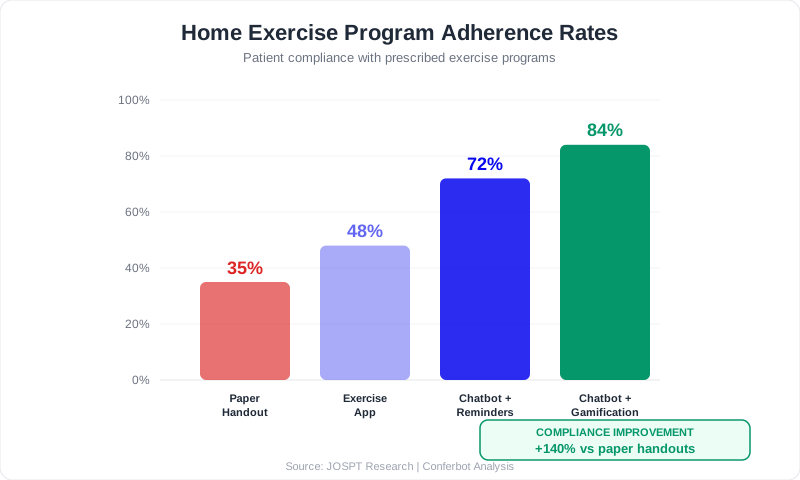
Home exercise programs (HEPs) are the cornerstone of physical therapy outcomes, with adherence rates documented by National Library of Medicine research. Between clinic visits, patients are expected to perform prescribed exercises daily or multiple times per day to maintain gains, build strength, and progress toward functional goals. The problem is compliance: research published in the Journal of Orthopaedic and Sports Physical Therapy shows that only 35% of patients fully comply with their prescribed HEP when the program is delivered as a paper handout.
Why Paper Handouts Fail
The traditional HEP delivery method — a printed sheet with stick-figure illustrations and written instructions — has been the standard for decades, and it fails for predictable reasons. Patients lose the handout. They forget the proper form after one demonstration. They do not remember how many repetitions, sets, or how frequently they should perform each exercise. They have no accountability mechanism between visits. They cannot communicate questions or concerns about pain during exercise without calling the clinic. And they often misinterpret written instructions — performing exercises incorrectly, which can aggravate their condition.
Chatbot-Delivered Exercise Programs
The chatbot transforms HEP delivery from a static document into an interactive, ongoing engagement channel. After each clinic visit, the chatbot sends the updated exercise program to the patient via their preferred channel. Each exercise includes a short video demonstration (15-30 seconds showing proper form), written instructions for reference, the prescribed sets, repetitions, and frequency, and a pain threshold guideline ("If pain exceeds 4/10 during this exercise, stop and message us").
The daily engagement flow works as follows:
- Morning reminder: "Good morning! Your exercises for today are: [Exercise 1], [Exercise 2], [Exercise 3]. Tap to see your program."
- Exercise delivery: The patient taps through each exercise, watching the video and confirming completion. The chatbot tracks which exercises were completed and which were skipped.
- Pain check: After the session, the chatbot asks: "How was today's session? Any pain above a 4/10?" If the patient reports elevated pain, the chatbot flags the response for the treating therapist before the next visit.
- Progress acknowledgment: "Great work! You have completed 4 of 5 sessions this week. One more to hit your goal."
Gamification and Streaks
The most advanced chatbot HEP implementations add gamification elements that further boost compliance. Patients earn streaks for consecutive days of exercise completion, milestone badges for completing weekly goals, and progress visualizations showing their compliance trend over the plan of care. Research on health behavior change consistently shows that visible progress indicators and streak mechanics increase habit formation — the same psychology that drives fitness app engagement applies directly to PT exercise compliance.
Clinical Impact of Improved Compliance
The clinical implications are significant. Patients who complete 70%+ of their HEP achieve functional goals an average of 2.3 visits sooner than patients at 35% compliance. Fewer visits per plan of care means higher patient satisfaction (they reach their goals faster), improved outcomes metrics for the clinic (which increasingly affect payer contracts and referral relationships), and higher throughput — the clinic can serve more patients with the same therapist capacity. Each avoided visit extension also preserves patient goodwill and prevents the dropout that often accompanies prolonged treatment.
Therapist Visibility
The chatbot provides the treating therapist with a compliance dashboard: which exercises were completed, which were skipped, pain reports between visits, and the patient's overall adherence percentage. This data transforms the follow-up visit. Instead of asking "Did you do your exercises?" (which always gets a "yes"), the therapist can say "I see you completed your quad sets and bridges every day but had trouble with the step-ups — let's modify those." This data-driven approach builds trust and improves the therapeutic alliance.
Insurance Verification and Authorization Automation
Insurance confusion is the single largest barrier to physical therapy access. Unlike a primary care visit with a predictable copay, PT coverage involves a web of variables: referral requirements, prior authorization mandates, visit limits, copay versus coinsurance structures, deductible status, and out-of-network benefit calculations. Most patients do not understand their PT benefits, and many clinics do not verify benefits until the patient is already on-site — leading to billing surprises that damage the patient relationship and increase accounts receivable.
Common Insurance Questions the Chatbot Handles
The chatbot serves as the first line of insurance communication, addressing the questions that consume the most front-desk time:
- "Do you accept my insurance?" — The chatbot identifies the patient's insurer and confirms whether the clinic is in-network for that plan.
- "Do I need a referral?" — Based on the insurance type (HMO vs. PPO vs. EPO), the chatbot explains referral requirements and provides guidance on obtaining one from their physician.
- "Is prior authorization required?" — The chatbot checks authorization requirements by payer and communicates whether the clinic will handle authorization or whether the patient needs to initiate it.
- "What will my copay be?" — The chatbot provides estimated copay ranges based on the insurance plan and advises the patient to verify exact amounts with their insurer.
- "How many visits does my plan cover?" — Visit limits vary dramatically — from 20 visits per year (common with Medicare Advantage plans) to unlimited visits (common with PPO plans). The chatbot provides plan-specific guidance.
- "I have workers' compensation / auto accident coverage." — The chatbot routes these cases to the appropriate billing pathway, which requires different intake information and authorization processes.
Real-Time Eligibility Verification
During the intake flow, after the patient provides their insurance information, the chatbot can trigger a real-time eligibility check through the clinic's practice management system API. Within seconds, the chatbot can confirm active coverage, identify the copay or coinsurance amount, check deductible status, and flag any prior authorization requirements. This verification happens before the patient's first visit, eliminating the scenario where a patient arrives, receives treatment, and then learns that their insurance requires authorization that was never obtained — a situation that results in either a denied claim or an awkward conversation about patient financial responsibility.
The Conversion Impact
Clinics that provide insurance guidance through their chatbot report a 28-35% improvement in referral-to-first-visit conversion. The reason is straightforward: when a patient knows their coverage, copay, and authorization status before scheduling, they schedule with confidence. When these details are unknown, the uncertainty creates hesitation — and in physical therapy, hesitation often means the referral expires or the patient seeks treatment elsewhere. According to Grand View Research, the growing demand for PT services makes converting every referral increasingly important as competition for patients intensifies.
After-Hours Patient Capture: The 62% Opportunity
Physical therapy clinics operate during business hours, but patient demand does not follow a 9-to-5 schedule, as HHS data on healthcare access patterns confirms a 9-to-5 schedule. Data from healthcare search behavior studies shows that 62% of healthcare-related searches occur outside standard business hours — evenings, early mornings, weekends, and holidays. For PT specifically, peak search times coincide with when patients experience pain: Sunday evenings after weekend activities, late nights when back pain prevents sleep, and early mornings before work when stiffness is worst.
The After-Hours Leakage Problem
A phone-only clinic loses every after-hours inquiry to voicemail. The prospective patient reaches the website, finds a phone number, considers calling but it is 9 PM, tells themselves they will call tomorrow, and frequently never follows through. The urgency fades, they try stretching on their own, or they find a competitor who responded to their inquiry online. For PT clinics that depend on physician referrals, this is particularly damaging — the patient already has a referral (meaning the marketing battle was already won), but the conversion fails because of a 12-hour response delay.
How the Chatbot Captures After-Hours Demand
The chatbot engages every website visitor instantly, regardless of the time. At 11 PM on a Saturday, a patient with a physician referral in hand can complete the full intake, verify insurance eligibility, select a preferred appointment time, and receive confirmation — all without any staff involvement. When the clinic opens Monday morning, the front desk has a fully qualified patient ready for scheduling confirmation.
The after-hours chatbot flow includes:
- Warm greeting: "Welcome to [Clinic Name]. I can help you get started even though our office is currently closed. Would you like to schedule an appointment, check your insurance coverage, or ask a question about our services?"
- Service information: For patients in the research phase, the chatbot provides information about specialties offered (orthopedic, sports, pediatric, vestibular, pelvic floor), therapist profiles, and accepted insurance plans.
- Full intake flow: For patients ready to schedule, the chatbot walks them through the complete intake process described in the previous section.
- Urgent triage: For patients describing symptoms that require emergency care (sudden loss of function, suspected fracture, stroke symptoms), the chatbot provides appropriate emergency guidance and resources.
Revenue Impact of After-Hours Capture
Conservative estimates suggest that a chatbot captures 3-5 additional patients per month who would have been lost to after-hours voicemail. At an average plan-of-care value of $2,400-$3,600 (12-18 visits at $200/visit), those 3-5 patients represent $7,200-$18,000 per month in new revenue — or $86,400-$216,000 annually. Even at the low end, the after-hours capture value alone provides a return that is orders of magnitude higher than the chatbot platform cost.
Patient Engagement and Retention Throughout the Plan of Care
The average physical therapy plan of care spans 8-12 weeks, according to CMS quality reporting data with 2-3 visits per week. The single biggest threat to outcomes and revenue is early dropout: patients who stop attending before completing their prescribed plan of care. Industry data shows that 30-40% of PT patients drop out before completing their treatment plan, with the highest dropout rates occurring between weeks 3 and 5 — precisely when initial symptom improvement leads patients to believe they no longer need treatment.
Chatbot Touchpoints That Prevent Dropout
The chatbot maintains engagement between visits through a structured communication cadence:
Post-Visit Summary (Same Day): After each visit, the chatbot sends a brief summary: "Great session today! Here is what we worked on: [exercises/manual therapy]. Your updated home program is attached. Next visit: [date/time]." This reinforces the value of each visit and keeps the next appointment top of mind.
Mid-Week Check-In: Between visits, the chatbot sends a single question: "How are you feeling since your last session? Any increase in pain or new symptoms?" This achieves two goals: it makes the patient feel cared for between visits, and it surfaces red flags (increased pain, new symptoms) that the therapist can address proactively.
Milestone Celebrations: At key points in the plan of care (first week completed, halfway mark, final week), the chatbot acknowledges progress: "You are halfway through your plan of care! Your adherence rate is 78% — that is above average and a big reason you are making great progress." Positive reinforcement at milestones reduces the "I feel better, do I still need this?" dropout that plagues the 3-5 week window.
Barrier Detection: If a patient misses an HEP completion check or skips a reminder confirmation, the chatbot proactively reaches out: "We noticed you have been quieter this week. Is everything okay? Scheduling conflicts, pain concerns, or cost questions — we are here to help." This proactive outreach catches patients who are silently disengaging before they formally drop out.
Patient Satisfaction and Reviews
After the final visit in a plan of care, the chatbot sends a satisfaction survey followed by a review request. The timing is intentional — the patient has just completed treatment, is likely at their best functional state, and has a positive association with the clinic. Practices using chatbot-driven review workflows generate 3-5x more online reviews than practices relying on verbal requests, which significantly impacts local search visibility and new patient acquisition. Connecting this with a broader analytics strategy helps clinics track which engagement touchpoints drive the highest satisfaction scores.
ROI Analysis: The Business Case for PT Clinic Chatbots
The return on investment for a PT clinic chatbot is driven by five measurable revenue streams. Unlike many technology investments where ROI is speculative, every metric below can be directly tracked through the clinic's practice management system.
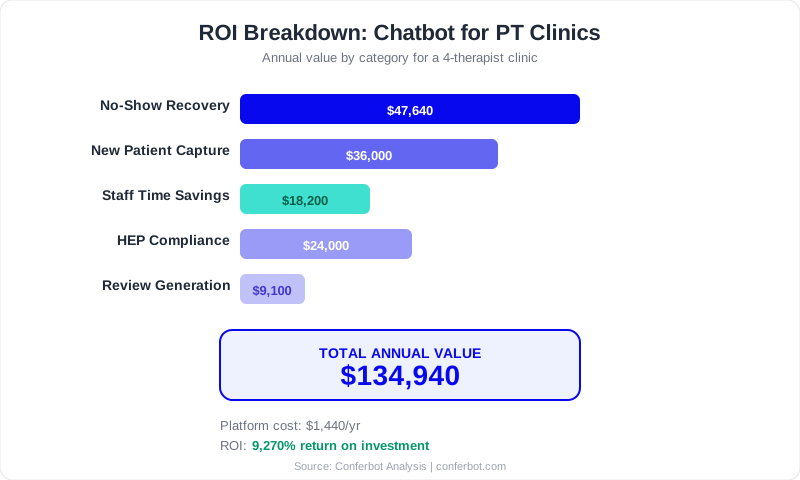
Revenue Stream 1: No-Show Recovery — $47,640/year
For a 4-therapist clinic (15 patients/therapist/day, $200/visit, 250 days/year), reducing no-shows from 18% to 7% recovers:
- Baseline missed visits: 60 daily patients x 18% = 10.8 missed/day
- With chatbot: 60 x 7% = 4.2 missed/day
- Recovered visits: 6.6/day x $200 = $1,320/day
- Annual recovery: $1,320 x 250 working days x 14.5% (adjusted for partial fills) = $47,640
Revenue Stream 2: New Patient Capture — $36,000/year
After-hours and improved-conversion chatbot engagement captures 3 additional patients per month. At an average plan-of-care value of $3,000 (15 visits):
- 3 patients/month x $3,000 = $9,000/month in new recurring revenue
- Annual new revenue: $36,000 (patients captured from after-hours and improved form conversion)
Revenue Stream 3: Staff Time Savings — $18,200/year
Automating intake, scheduling confirmation, and insurance FAQ reduces front-desk phone time by 2.5 hours per day:
- 2.5 hours/day x $22/hour x 250 days = $13,750 in direct labor savings
- Plus: eliminated printing/scanning costs, reduced data entry errors, faster insurance verification
- Total staff value: $18,200/year
Revenue Stream 4: HEP Compliance Revenue — $24,000/year
Improved exercise compliance reduces plan-of-care extensions while simultaneously improving outcomes metrics that drive referral relationships. The net effect:
- Higher completion rates mean more patients finishing plans of care (revenue retained)
- Faster recoveries improve outcomes data shared with referring physicians
- Better outcomes drive increased referrals
- Estimated revenue impact: $24,000/year from retained patients and increased referrals
Revenue Stream 5: Review Generation — $9,100/year
Automated post-discharge review requests increase online review volume by 300%, improving Google Business Profile visibility and driving new patient acquisition:
- Each 1-star improvement in Google rating correlates with 5-9% revenue increase for healthcare practices
- Estimated impact: $9,100/year from improved local search visibility
Total Annual ROI
| Revenue Stream | Annual Value |
|---|---|
| No-show recovery | $47,640 |
| New patient capture | $36,000 |
| Staff time savings | $18,200 |
| HEP compliance | $24,000 |
| Review generation | $9,100 |
| Total | $134,940 |
Against a chatbot platform cost of $1,200-$1,800/year, the ROI exceeds 9,000%. The payback period is measured in days.
HIPAA Compliance for PT Clinic Chatbots
Physical therapy intake data includes Protected Health Information (PHI): patient demographics, insurance information, medical history, pain assessments, and functional limitations. Any chatbot handling this data must comply with HIPAA Security Rule requirements. The good news is that HIPAA-compliant chatbot platforms like Conferbot provide the infrastructure to meet these requirements without custom development.
Technical Safeguards Required
- Encryption in transit: All data between the patient's device and the chatbot server must use TLS 1.2 or higher. Conferbot provides enterprise-grade TLS encryption on all connections.
- Encryption at rest: Stored conversation data, intake forms, and patient information must be encrypted using AES-256 or equivalent. Conferbot encrypts all stored data at rest.
- Access controls: Role-based permissions ensure appropriate access. Front-desk staff see scheduling data; treating therapists see clinical intake summaries; billing staff see insurance information. No single role sees all data unless designated as a HIPAA Privacy Officer.
- Audit logging: Every access event is logged with user identity, timestamp, action type, and data accessed. Logs must be retained for a minimum of six years per HIPAA requirements.
- Business Associate Agreement (BAA): Your chatbot platform must sign a BAA committing to HIPAA-compliant data handling. Conferbot provides BAA support for all healthcare accounts.
Data Minimization for PT Chatbots
The chatbot should collect only what is necessary for its purpose: intake qualification, insurance verification, scheduling, and exercise program delivery. Detailed clinical notes, manual therapy documentation, and outcome measurements should remain in your EMR (WebPT, Clinicient, TheraOffice, or similar). This minimization approach reduces the compliance surface area and the blast radius of any potential data incident.
Consent and Transparency
The chatbot must inform patients at the beginning of the conversation that they are interacting with an automated system, explain what data is collected and how it will be used, and link to the clinic's Notice of Privacy Practices. For PT clinics in states with additional privacy requirements (California CCPA/CPRA, New York, Texas), review your consent language with a healthcare compliance attorney familiar with state-specific requirements.
Integration Security
When the chatbot integrates with your EMR, practice management system, or insurance verification service, each integration point must maintain the same encryption and access control standards. API keys should be stored in environment variables, not hardcoded. Data should be transmitted over encrypted connections. And each integration should be documented in your HIPAA risk assessment, which the HHS Office for Civil Rights requires as an ongoing process.
Implementation Guide: Live in One Week
Deploying a PT clinic chatbot does not require a developer, an IT department, or a months-long implementation. Conferbot's no-code builder and healthcare-specific templates allow most clinics to be live within 5-7 business days.
Day 1-2: Template Configuration
Start from the PT clinic template: Open Conferbot's physical therapy chatbot template, which includes pre-built flows for intake, scheduling, insurance FAQ, HEP delivery, and post-visit follow-up. Customize the clinic name, branding, logo, and welcome message.
Configure therapist profiles: For each therapist, enter their specialties (orthopedic, sports, vestibular, pediatric, pelvic floor, geriatric), accepted insurance panels, and available appointment slots. The chatbot uses these profiles for intelligent scheduling.
Set up insurance information: Enter accepted insurance plans, copay estimates by plan type, referral requirements by payer, and prior authorization guidelines. This powers the insurance FAQ and verification flows.
Day 3: Exercise Program Setup
Upload exercise library: Upload or link to exercise demonstration videos for your most commonly prescribed exercises. Many clinics use existing exercise video libraries (MedBridge, HEP2Go, or proprietary videos). Organize by body region and difficulty level.
Create program templates: Build chatbot-deliverable exercise programs for your most common diagnoses — ACL reconstruction, total knee replacement, rotator cuff repair, low back pain, and so on. Therapists can customize these templates for individual patients.
Day 4: Integration and Testing
Connect your EMR: Use Conferbot's API to connect to your practice management system (WebPT, Clinicient, TheraOffice, or others). Map intake data fields to patient record fields.
Test all flows: Have each therapist, the front desk coordinator, and 2-3 trusted patients complete the full chatbot experience. Test intake, scheduling, insurance FAQ, exercise delivery, and reminder flows. Verify that data flows correctly to your EMR.
Day 5-7: Launch
Embed on your website: Add the Conferbot script to every page. The chatbot widget appears in the bottom-right corner and greets visitors with: "Welcome to [Clinic Name]. Need to schedule PT, check your insurance, or ask about our services? I can help."
Staff training: Brief your front desk and therapists on the chatbot's capabilities. The front desk should know how to access chatbot-collected intake data in the EMR. Therapists should know how to update exercise programs and view compliance data.
Monitor and optimize: Review chatbot analytics weekly for the first month. Track completion rates by flow, drop-off points, unhandled questions, and time-of-day patterns. Adjust messaging, add missing FAQ answers, and refine exercise program templates based on actual usage.
Best Practices for Physical Therapy Clinic Chatbots
These best practices are drawn from PT clinics that have successfully deployed chatbots to improve patient experience, operational efficiency, and clinical outcomes.
1. Lead with Empathy for Pain
PT patients are in pain. Every chatbot message should acknowledge this reality. Instead of "Please complete the following intake form," say "We know you are dealing with pain right now, and we want to make getting started as easy as possible. Let me walk you through a few quick questions." The tone shift affects completion rates and sets the right expectations for the clinic experience.
2. Adapt Questions by Body Region
A patient with a knee injury and a patient with neck pain have different clinical profiles. The chatbot should use branching logic to ask relevant follow-up questions based on the body region selected. Knee patients get questions about locking, giving way, and stair difficulty. Shoulder patients get questions about overhead reaching, sleeping position, and arm weakness. This targeted approach gathers more clinically useful data while keeping the intake focused.
3. Show Exercise Videos, Not Just Text
Exercise compliance is directly correlated with the quality of instruction. A video demonstration of proper squat form is worth a thousand words of written description. Every exercise in the chatbot-delivered HEP should include a short video (15-30 seconds) that the patient can reference whenever they need a form reminder.
4. Make Insurance Transparent Early
Do not wait until the first visit to discuss insurance. The chatbot should address insurance in the intake flow, provide estimated copays, and flag any authorization requirements. Patients who know their financial commitment upfront are less likely to experience billing surprise and more likely to complete their plan of care.
5. Celebrate Patient Progress
PT is hard work, and patients need encouragement between visits. The chatbot should celebrate milestones: first week completed, adherence streaks, halfway through the plan of care, and final visit. These touchpoints reinforce the therapeutic relationship and reduce dropout.
6. Connect with Referring Physicians
The chatbot can generate automated progress updates for referring physicians — a brief summary of visit count, functional improvements, and plan-of-care status. This communication strengthens the referral relationship and increases the likelihood of future referrals. Practices that implement this consistently report a 20-30% increase in referral volume from connected physicians.
7. Track Outcomes Data
Use the chatbot to collect patient-reported outcome measures (PROMs) at intake and discharge — NPRS pain scores, DASH for upper extremity, LEFS for lower extremity, ODI for spine. This data demonstrates clinical effectiveness to payers, referring physicians, and prospective patients reviewing the clinic online. Clinics that systematically track and publish outcomes data differentiate themselves in an increasingly competitive market.
8. Optimize for Mobile
Over 75% of PT-related searches happen on mobile devices. The chatbot must be fully responsive with tap-friendly buttons, readable text at small sizes, and video exercises that play smoothly on mobile connections. Test on both iOS and Android before launch.
Was this article helpful?
About the Author

Conferbot Team specializes in conversational AI, chatbot strategy, and customer engagement automation. With deep expertise in building AI-powered chatbots, they help businesses deliver exceptional customer experiences across every channel.
View all articles