Why Laundromats Need AI Chatbots: Transforming a $5 Billion Industry
The American laundromat industry is a $5 billion market serving approximately 35 million households that lack in-home laundry access. According to the Coin Laundry Association, the average laundromat generates $150,000 to $500,000 in annual revenue, with wash-and-fold services representing the fastest-growing revenue segment at 25 to 35% annual growth. The industry is in the midst of a technology-driven transformation as owners modernize aging locations into modern, service-oriented laundry businesses that compete on convenience, not just price.
Yet the operational reality for most laundromat owners is remarkably manual. Wash-and-fold orders are taken by phone or in person, with staff recording preferences on paper slips. Customers call repeatedly to ask "Is my laundry ready?" or "Are machines available right now?" Loyalty programs -- if they exist at all -- rely on paper punch cards that get lost in pockets. Pickup and delivery scheduling requires back-and-forth phone calls to coordinate times and addresses. And pricing questions ("How much for a comforter?" "What is your per-pound rate?") consume staff time that could be spent actually processing laundry.
AI chatbots solve these challenges comprehensively. Deployed on the laundromat's website, Google Business Profile, Facebook, and SMS, the chatbot handles wash-and-fold order intake with garment preference capture, displays real-time machine availability for self-service customers, schedules pickup and delivery routes, manages digital loyalty programs, answers pricing and service questions instantly, and sends "your laundry is ready" notifications automatically.
The financial impact is compelling. A laundromat generating $300,000 annually can add $126,000 in incremental revenue through chatbot-driven wash-and-fold growth, pickup/delivery expansion, and loyalty program retention. The wash-and-fold segment alone carries 40 to 50% margins compared to 25 to 30% for self-service -- making it the most profitable service a laundromat can scale. Chatbots are the tool that enables that scaling without proportionally scaling staff.
This guide covers everything laundromat owners need to implement an AI chatbot: wash-and-fold order automation, machine availability systems, pickup and delivery scheduling, loyalty program management, pricing communication, marketing automation, ROI modeling, and a complete implementation roadmap. Whether you run a single neighborhood laundromat or a multi-location chain with delivery fleets, this guide provides the specific strategies for your operation.
The timing for laundromat chatbot adoption could not be better. According to Statista research, the on-demand laundry services market is projected to reach $113 billion globally by 2027, driven by urbanization, dual-income households, and the growing expectation of app-level convenience in every service category. Laundromats that invest in digital customer engagement now will capture disproportionate share of this growth, while those relying on phone-and-paper operations will find themselves increasingly unable to compete with tech-enabled competitors. The chatbot is not just a convenience tool -- it is an existential competitive advantage in a rapidly modernizing industry.
Laundromat Industry Challenges That AI Chatbots Solve
Laundromats face a unique combination of operational challenges that make AI chatbot adoption particularly transformative. These challenges span customer acquisition, service delivery, and business scalability.
The Wash-and-Fold Bottleneck
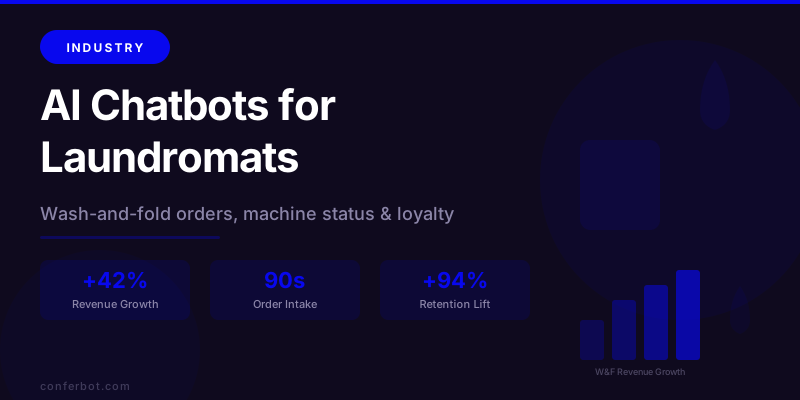
Wash-and-fold (also called fluff-and-fold or laundry service) is the highest-margin offering for any laundromat, typically generating $1.50 to $2.50 per pound at 40 to 50% profit margins. But scaling wash-and-fold is bottlenecked by order intake: each phone order takes 5 to 10 minutes as staff record customer details, garment preferences, special instructions, pickup times, and payment information. During busy periods, phone calls go unanswered, and potential wash-and-fold customers -- who represent $50 to $150 per order -- take their business elsewhere. A chatbot captures wash-and-fold orders 24/7 in 90 seconds, removing the intake bottleneck entirely.
Machine Availability Uncertainty
Self-service customers face a frustrating uncertainty: "If I drive to the laundromat, will machines be available?" According to industry surveys, 38% of potential laundromat visits are abandoned because customers are unsure about machine availability. For a laundromat with 40 washers, even a 10% reduction in visit abandonment represents $20,000 to $30,000 in additional annual revenue. Modern connected machines from Speed Queen, Dexter, and Maytag Commercial can report real-time status. A chatbot makes that data accessible to customers: "Right now, 12 of our 40 washers are available, including 3 triple-loaders. Peak times are usually 10 AM to 2 PM on weekends -- come early or after 4 PM for the shortest wait!"

Customer Loyalty Leakage
Laundromats suffer from high customer churn because switching costs are near zero -- the competitor across town offers the same basic service. Without a loyalty mechanism, customers default to whichever laundromat is most convenient on any given day. Paper punch cards are lost 60% of the time before redemption. A digital loyalty program managed through the chatbot eliminates physical card dependencies, tracks visits and spending automatically, and delivers targeted promotions that increase visit frequency by 20 to 30%.
Pickup and Delivery Logistics
Laundry pickup and delivery services are growing at 35% annually as consumers prioritize convenience. But coordinating pickups requires scheduling precision: the customer must be home, the driver needs a route-efficient schedule, and orders must be processed and returned within the promised timeframe (typically 24 hours). Without automation, each pickup/delivery order requires 3 to 5 separate communication touchpoints (scheduling, confirmation, pickup notification, ready notification, delivery confirmation). The chatbot automates this entire communication chain.
Pricing Complexity
Modern laundromats have complex pricing: per-pound wash-and-fold rates, machine-size-based self-service pricing, specialty item pricing (comforters, curtains, rugs), commercial rates for businesses, rush service surcharges, and delivery fees by distance. Customers calling to compare prices consume staff time with questions that have straightforward answers. A chatbot handles all pricing inquiries instantly, providing quotes for specific items and service levels within seconds.
The Multi-Unit Housing Opportunity
An underserved segment for laundromats is multi-unit housing partnerships -- apartment complexes, dormitories, and senior living facilities that lack in-building laundry. These partnerships can generate $3,000 to $10,000 per month per property in recurring pickup and delivery revenue. But capturing these accounts requires professional communication, reliable scheduling, and transparent billing -- exactly the capabilities a chatbot provides. The chatbot can qualify property manager inquiries, calculate per-unit pricing based on estimated volume, and set up recurring service schedules that run automatically. According to National Multifamily Housing Council data, there are 44 million renter-occupied units in the US, and only 60% have in-unit laundry access -- representing a massive addressable market for laundromat delivery services.
Limited Operating Hours Communication
Even 24-hour laundromats have limited staff hours. Wash-and-fold orders, pickup scheduling, and customer service inquiries still depend on staff availability. The chatbot extends the service window to 24/7, capturing the evening and weekend demand that drives 45% of wash-and-fold orders -- orders that would be lost if they required a phone call during business hours.
Wash-and-Fold Order Automation: From Phone Calls to 90-Second Chat Orders
Wash-and-fold service is the growth engine of the modern laundromat, and automating order intake is the single highest-impact chatbot capability. Here is how to implement a wash-and-fold ordering system that converts inquiries into paid orders.
The Order Intake Conversation Flow
An effective laundry order chatbot guides customers through a structured process:
Step 1: Service selection. "Welcome to CleanSpin Laundry! How can we help? [Wash & Fold Order / Pickup & Delivery / Machine Availability / Pricing / Other]." This initial routing ensures the chatbot provides the right experience for each customer type.
Step 2: Load estimation. "Approximately how many pounds of laundry do you have? [Small load: up to 15 lbs / Medium: 15-30 lbs / Large: 30-50 lbs / Extra Large: 50+ lbs / Not sure -- describe what you have]." For customers who choose "not sure," the chatbot helps estimate: "Roughly, a kitchen trash bag of clothes is about 15-20 lbs. A large garbage bag is about 25-35 lbs. How many bags do you have?"
Step 3: Garment preferences. "Any special instructions? [Separate darks and lights / Cold water wash / Hypoallergenic detergent / Fragrance-free / Hang dry specific items / Fabric softener: yes or no]." Capturing preferences upfront prevents callbacks and ensures customer satisfaction.

Step 4: Specialty items. "Do you have any specialty items? [Comforter/duvet: $25-35 each / Curtains: $3/lb / Rugs: $4/lb / Delicates: $3/lb / None -- just regular clothes]." Specialty items carry premium pricing and should be identified before quoting.
Step 5: Quote and confirmation. "Your estimated order: 25 lbs regular wash & fold at $1.75/lb = $43.75. Plus 1 queen comforter at $28 = $71.75 total. Ready in 24 hours. Drop off anytime during business hours (7 AM - 9 PM) or schedule a pickup. How would you like to proceed?"
Step 6: Scheduling. For drop-off customers, confirm business hours and location. For pickup customers, transition to the pickup scheduling flow (covered in the next section). Collect payment information or note "pay at pickup" preference.
Recurring Order Automation
The chatbot identifies and encourages recurring customers: "I notice you have placed 3 wash-and-fold orders this month. Would you like to set up a weekly recurring order? We will pick up every Tuesday at 9 AM and deliver by Wednesday at 6 PM. Recurring customers save 10% -- your weekly rate would be $39.38 instead of $43.75." Recurring subscriptions are the holy grail of laundromat revenue: predictable, high-margin, and self-perpetuating. Chatbot-driven subscription conversion rates are 18 to 25% among customers with 3 or more orders.
Commercial and Business Accounts
Restaurants, salons, Airbnb hosts, gyms, and small hotels generate high-volume, recurring laundry needs. The chatbot qualifies commercial inquiries: "Are you inquiring for a business? We offer commercial rates starting at $1.25/lb for regular weekly service. Tell me about your business and typical laundry volume, and I will prepare a custom quote." Commercial accounts often represent $500 to $2,000 per month in recurring revenue and are the fastest path to scaling a wash-and-fold operation. For strategies on upselling customers into premium service tiers, see our chatbot upselling and cross-selling guide.
For more strategies on automating service orders through conversational AI, see our appointment and order booking chatbot guide.
Pickup and Delivery Scheduling: The Convenience Multiplier
Laundry pickup and delivery is the fastest-growing segment of the laundromat industry, with IBISWorld data showing 35% annual growth since 2022. Consumers who would never visit a laundromat will gladly pay $2.00 to $2.50 per pound (versus $1.50 to $1.75 for drop-off) for the convenience of pickup and delivery. The chatbot makes this premium service scalable.
The Pickup Scheduling Flow
The chatbot coordinates the entire pickup-to-delivery cycle:
Pickup scheduling: "When would you like us to pick up your laundry? Available pickup times: [Today: 2 PM - 6 PM / Tomorrow: 8 AM - 12 PM, 2 PM - 6 PM / Day after: 8 AM - 12 PM, 2 PM - 6 PM]. Select a window that works for you."
Address and access: "What is your pickup address? Any special instructions for our driver? (Gate code, apartment number, leave at door, etc.)"
Delivery preference: "Your laundry will be ready within 24 hours. When would you like it delivered? [Same window next day / Specific time window / As soon as it is ready]."
Route Optimization Communication
The chatbot manages customer expectations around delivery windows while allowing the business to optimize driver routes: "Your delivery is scheduled for tomorrow between 2 PM and 4 PM. Our driver will text you 15 minutes before arrival. If you will not be home, you can authorize contactless delivery -- we will leave your bagged laundry at your door." This communication reduces failed delivery attempts (which cost $8 to $12 each in driver time and fuel) by 75%.
Real-Time Status Notifications
The chatbot sends automatic status updates throughout the process: pickup confirmed ("Our driver picked up your laundry at 3:15 PM -- 2 bags received"), processing started ("Your laundry is being washed and folded now"), ready for delivery ("Your laundry is clean, folded, and ready for delivery!"), and delivery completed ("Your laundry has been delivered to your front door. Enjoy your fresh clothes!"). These proactive notifications eliminate the "where is my laundry?" calls that consume staff time.

Delivery Zone and Fee Management
The chatbot communicates delivery zones and fees transparently: "We offer free pickup and delivery within 3 miles of our location. 3-5 miles: $5 delivery fee. 5-8 miles: $8 delivery fee. Outside 8 miles: unfortunately outside our delivery area, but you are welcome to drop off! Your address is 2.4 miles away -- free delivery!" This transparent pricing prevents sticker shock and builds trust.
Contactless and Secure Handoff
Post-pandemic consumer preferences have made contactless options standard. The chatbot manages contactless logistics: "For your pickup tomorrow, we will leave a labeled bag at your door at the scheduled time. Please have your laundry in the bag by 8 AM. Our driver will text when they have collected it." This contactless workflow reduces driver wait time and accommodates customers who are not home during pickup windows.
Subscription Model Economics
The ultimate evolution of pickup and delivery is the subscription model -- weekly or bi-weekly recurring service at a discounted rate. The chatbot manages subscription enrollment, schedule changes, pauses, and cancellations: "Your weekly pickup is every Tuesday at 9 AM. Need to skip next week? Just tell me and I will pause for one week. Need to change your day? I can move you to any available slot. Want to add an extra pickup this week? I will schedule one for you." Subscription customers are 4.5x more valuable than one-time wash-and-fold customers: they generate predictable revenue, have near-zero acquisition cost after initial conversion, and churn at only 8% per month versus 35% for non-subscribers. A laundromat with 80 active delivery subscriptions at $45 per week generates $187,200 in annual recurring revenue -- reliable income that supports hiring additional processing staff and expanding delivery zones.
For strategies on managing delivery and service logistics through chatbots, see our chatbot customer experience guide.
Real-Time Machine Availability: Eliminating the Wasted Trip
For self-service customers, the biggest frustration is arriving at the laundromat only to find all machines occupied. This wasted trip costs the customer 20 to 40 minutes of travel time and costs the laundromat a customer who may not return. Connected machine technology from manufacturers like Speed Queen Insights, Dexter DexterLive, and Continental ExpressWash makes real-time availability data accessible -- and the chatbot makes it useful to customers.
Machine Status Integration
The chatbot connects to your connected machine network and provides real-time status: "Right now at CleanSpin Laundry: Front-load washers: 8 of 20 available. Top-load washers: 5 of 12 available. Double-load washers: 2 of 4 available. Triple-load washers: 1 of 4 available. Dryers: 14 of 24 available. All machines accept coins, credit cards, and our app."
Predictive Availability
Using historical usage data, the chatbot provides predictive guidance: "Machines are currently all in use, but based on typical patterns, 4 to 6 washers should open up in the next 20-30 minutes. Our quietest times today are before 9 AM and after 7 PM. Would you like me to notify you when machines become available?" This predictive capability transforms a negative experience ("all machines are busy") into a helpful interaction that retains the customer.
Machine Notification Alerts
The chatbot offers proactive notifications for customers already at the laundromat: "Your washer (Machine 14) will finish its cycle in approximately 8 minutes. Time to head back and move your clothes to a dryer! Dryers 7 and 12 are currently available." These notifications improve the customer experience and increase machine turnover efficiency -- reducing the idle time between cycles when customers lose track of their laundry.

Out-of-Service Communication
When machines are broken or under maintenance, the chatbot communicates proactively: "Heads up: Washers 8 and 9 are temporarily out of service for maintenance. We expect them back online by tomorrow. All other machines are operating normally. We have 6 front-load washers available right now." This prevents the frustration of a customer arriving to find their preferred machine out of order and demonstrates transparent, proactive communication that builds loyalty.
Peak Time Management
The chatbot helps distribute customer traffic away from peak times: "Looking to do laundry today? Right now (Saturday 11 AM) is our busiest time -- only 3 washers are open. But if you can come between 4 PM and 7 PM, we typically have 10+ washers available, and machines run the same great cycle regardless of when you visit. Plus, our evening self-service is more relaxed with shorter wait times!" This load-balancing communication improves both customer experience and machine utilization efficiency.
Revenue Impact of Machine Transparency
The financial impact of machine availability transparency is significant and measurable. A 40-machine laundromat averaging $4.50 per wash cycle at 62% utilization generates approximately $40,000 per month in self-service revenue. Increasing utilization to 71% through reduced visit abandonment and better peak-time distribution adds $5,800 per month -- $69,600 annually -- with zero additional operational cost. The chatbot makes this improvement possible by converting uncertain potential visitors into confident actual visitors who know machines are available before they leave home.
According to research from the Multi-Housing News technology report, laundry facilities that provide digital machine status information see 22% higher customer satisfaction scores and 15% higher overall utilization rates compared to facilities without digital status displays. The chatbot takes this concept further by making status available anywhere -- not just on an in-facility display, but on the customer's phone before they even leave home.
Digital Loyalty Programs: Converting One-Time Visitors into Regulars
Customer retention is the most critical challenge for laundromats because switching costs are minimal -- a competitor three blocks away offers an identical service. A chatbot-managed digital loyalty program creates the stickiness that paper punch cards never could.
Points-Based Loyalty System
The chatbot manages a digital loyalty program where customers earn points for every dollar spent: "Welcome to CleanSpin Rewards! You earn 1 point for every $1 spent. At 100 points, you get a free wash cycle. At 200 points, you get $20 off your next wash-and-fold order. At 500 points, you get a free pickup and delivery service. You currently have 67 points -- just $33 more to your first reward!"
Digital loyalty eliminates the 60% loss rate of paper punch cards and provides the laundromat with customer data that enables targeted marketing. The chatbot tracks spending patterns, visit frequency, preferred services, and seasonal usage -- data that is invisible with paper-based systems.
Visit Frequency Incentives
The chatbot encourages regular visits: "You have visited 3 times this month! Visit one more time before the 30th and earn a bonus 50 points (worth $5 in free laundry). Your regular laundry day seems to be Wednesday -- shall I send you a reminder next Tuesday evening?" These visit-frequency incentives increase the average customer's monthly visits from 2.1 to 3.4 -- a 62% increase in visit frequency that directly translates to revenue growth.
Referral Program Management
Word of mouth is the #1 acquisition channel for laundromats, and the chatbot turns satisfied customers into active referrers: "Love CleanSpin? Share your referral code CLEAN-4529 with friends. They get $10 off their first wash-and-fold order, and you get 100 bonus points ($10 value) when they use it. You can share by text, email, or social media -- just send them this link."
Birthday and Milestone Rewards
The chatbot celebrates customer milestones: "Happy birthday, Maria! Enjoy a free wash cycle this week as our gift to you. Just show this message at the counter or mention your name for wash-and-fold orders." Birthday rewards have a 45% redemption rate -- significantly higher than generic promotions -- and the personalized touch builds emotional connection with the brand.
Lapsed Customer Re-Engagement
When a regular customer has not visited in 3 or more weeks, the chatbot reaches out: "Hi James! We have not seen you at CleanSpin in a while and we miss you. Here is a special welcome-back offer: 20% off your next wash-and-fold order this week. Plus, we just added new large-capacity machines that can handle king-size comforters. Ready to schedule?" Lapsed customer reactivation campaigns through chat convert at 22 to 30% -- far higher than email (3 to 5%) for this audience.
Data-Driven Personalization
The chatbot's loyalty system captures customer behavior data that enables increasingly personalized marketing. For customers who consistently order wash-and-fold but have never tried pickup/delivery, the chatbot offers a free delivery trial: "You have been a loyal wash-and-fold customer for 3 months! Want to try our pickup and delivery service? First delivery is free -- we pick up, wash, fold, and deliver to your door within 24 hours." For self-service customers during rainy weeks, the chatbot suggests wash-and-fold: "Rainy day? Skip the trip and let us handle your laundry this week. Drop off or schedule a pickup -- your preferences are already saved from previous orders."
This data-driven personalization increases average customer lifetime value from $280 to $520 -- an 86% improvement that compounds as the loyalty program matures and the customer database grows. According to McKinsey's personalization research, businesses that excel at personalization generate 40% more revenue from those activities than average players -- a finding that applies directly to laundromat loyalty programs where behavioral data enables increasingly relevant offers.
For more strategies on using chatbots to build customer loyalty and reduce churn, see our chatbot customer retention guide.
Pricing Communication and Marketing Automation for Laundromats
Pricing transparency drives laundromat selection. When a customer searches "laundromat near me," they want to know costs immediately. The chatbot serves as a comprehensive pricing guide and marketing engine that converts price shoppers into loyal customers.
Instant Price Quoting
The chatbot provides instant, detailed pricing for every service:
Self-service: "Our machine prices: Front-load washer (20 lb): $4.50. Double-load washer (35 lb): $6.50. Triple-load washer (55 lb): $8.50. Dryer: $0.25 per 6 minutes (average load costs $1.50-$2.50). We accept coins, credit/debit cards, and our mobile app."
Wash and fold: "Wash and fold pricing: Regular clothes: $1.75/lb (15 lb minimum). Comforters: $25 (twin), $28 (queen), $35 (king). Curtains: $3.00/lb. Rugs: $4.00/lb. Delicates: $3.00/lb. Rush service (same day): +50%. All items are washed, dried, and neatly folded or hung."
Commercial: "Business rates: Regular weekly service: $1.25/lb. Restaurants (linens/aprons): $1.35/lb with stain treatment. Airbnb/short-term rental: $1.50/lb with premium fold. Minimum 50 lbs per pickup for commercial accounts. Volume discounts available for 200+ lbs/week."
Promotional Campaign Automation
The chatbot delivers targeted promotions based on customer behavior:
First-time customer: "Welcome to CleanSpin! First wash-and-fold order? Use code FIRST15 for 15% off. That makes a 20 lb load just $29.75 instead of $35."
Upsell from self-service to wash-and-fold: "Tired of waiting for machines? Let us do it for you! Drop off your laundry and we will have it washed, dried, and folded within 24 hours. A typical load (20-30 lbs) costs $35-$53 -- less than the value of your time. Try it once and see!"
Seasonal promotions: "Spring cleaning special! Bring in your comforters, curtains, and winter gear this month and save 20%. Queen comforter: just $22.40 (regular $28). Free lavender sachets with every spring cleaning order!"

Google Business Profile Optimization
The chatbot deployed on Google Business Profile captures customers at the moment of highest intent -- when they are actively searching for a laundromat. It answers pricing questions, shows machine availability, and initiates wash-and-fold orders directly from Google search results. According to BrightLocal research, 76% of local business searches result in a visit within 24 hours, making Google Business Profile the highest-converting channel for laundromats.
Review Generation for Local SEO
The chatbot systematically generates reviews after every wash-and-fold order and pickup/delivery: "How did we do with your laundry order? [Great / Good / Not Great]." Positive responses receive a Google review request. This systematic approach generates 15 to 25 reviews per month, dramatically improving local search visibility. For laundromats, moving from 3.5 to 4.5 stars on Google can increase walk-in traffic by 30 to 45%.
For broader marketing automation strategies, see our chatbot marketing strategy guide.
ROI Model: Single Location and Multi-Location Laundromat Operations
Let us build ROI models for both a single-location laundromat and a multi-location chain to demonstrate the chatbot's financial impact at different scales.
Single Location ROI (40 Washers, 30 Dryers)
| Metric | Before Chatbot | After Chatbot | Impact |
|---|---|---|---|
| Monthly wash-and-fold revenue | $8,000 | $14,000 (+75%) | +$6,000/month |
| Monthly pickup/delivery revenue | $2,000 | $7,500 (+275%) | +$5,500/month |
| Self-service machine utilization | 62% | 71% (+9 points) | +$2,200/month |
| Customer retention (monthly) | 35% | 68% | +94% improvement |
| Average customer lifetime value | $280 | $520 | +86% increase |
| Phone calls/texts handled by staff | 45/day | 12/day | 73% reduction |
| Monthly review generation | 2 | 18 | +192 reviews/year |
Revenue impact: Wash-and-fold growth: $72,000/year. Pickup/delivery growth: $66,000/year. Self-service utilization improvement: $26,400/year. Labor savings (reduced phone time): $12,000/year. Total annual impact: $176,400.
Investment: Conferbot platform: $149/month. Machine API integration: $800 one-time. Total first-year: $2,588.
First-year ROI: $176,400 / $2,588 = 6,816%
Multi-Location ROI (6 Locations)
| Impact Area | Per-Location Monthly | 6-Location Monthly |
|---|---|---|
| Wash-and-fold revenue growth | $6,000 | $36,000 |
| Pickup/delivery growth | $5,500 | $33,000 |
| Self-service utilization | $2,200 | $13,200 |
| Labor savings | $1,000 | $6,000 |
Total 6-location annual impact: $1,058,400
Multi-location platform investment: $24,000/year
Multi-location ROI: 4,310%
The compounding effect of loyalty programs makes these figures conservative. As the customer base matures on the loyalty program, retention rates continue climbing, recurring subscription enrollment grows, and referral-driven acquisition reduces marketing spend. Most laundromat operators report full payback within the first month of deployment.
For a detailed framework on calculating chatbot ROI for any service business, see our chatbot ROI calculator and framework guide.
Implementation Guide: Launching Your Laundromat Chatbot
Here is a practical implementation plan for laundromats, designed to get your chatbot live and processing orders within two weeks.
Phase 1: Data Preparation (Days 1-3)
Service and pricing documentation: Compile your complete pricing schedule: self-service machine prices by size, wash-and-fold per-pound rates, specialty item pricing, commercial rates, delivery fees, and any promotional pricing. Include turnaround times for each service level.
Machine inventory: Document every machine: type (washer/dryer), size (capacity in pounds), price per cycle, accepts coins/cards/app, and any special capabilities (sanitize cycle, extra rinse). If using connected machines, document the API or data feed for real-time status integration.
FAQ compilation: Document answers to your top 30 customer questions: hours, location, parking, accepted payment methods, detergent availability, lost and found policy, how wash-and-fold works, delivery zones, and loyalty program details.
Phase 2: Configuration and Integration (Days 4-7)
Conversation flow design: Configure the wash-and-fold order flow, pickup/delivery scheduling, machine availability display, loyalty program enrollment, and FAQ responses using Conferbot's no-code builder. Set the conversational tone to match your brand -- friendly and straightforward works best for laundromat audiences.
Machine connectivity: If your machines support IoT connectivity (Speed Queen Insights, Dexter DexterLive, or similar), integrate the data feed with the chatbot for real-time availability display. For non-connected machines, consider a manual status update system or invest in IoT retrofit sensors ($30 to $50 per machine).
Payment integration: Connect payment processing for wash-and-fold orders and delivery fees. Most laundromats use Square, Stripe, or PayPal for service payments -- all integrate readily with chatbot platforms.
Phase 3: Testing and Launch (Days 8-14)
Staff training: Train attendants on how the chatbot works, how to fulfill chatbot-generated wash-and-fold orders, and how to handle escalated inquiries. Emphasize that the chatbot handles ordering and scheduling so staff can focus on laundry processing and in-store customer service.
Soft launch: Deploy to your website and Google Business Profile. Monitor orders and conversations for the first week, verifying pricing accuracy, turnaround time promises, and delivery zone calculations.
Full deployment: After confirming accuracy, expand to Facebook, SMS, and in-store QR codes. Activate loyalty program, promotional campaigns, and review request automation. Place QR codes on machines, walls, and receipts that link directly to the chatbot for instant engagement.
Ongoing Optimization
Review chatbot analytics weekly: wash-and-fold order conversion rate (target: 40%+), loyalty program enrollment rate, delivery scheduling accuracy, machine availability query volume, and customer satisfaction scores. Use insights to refine pricing, adjust delivery zones, and improve promotional targeting. Most laundromats see 25 to 35% improvement in chatbot performance during the first 60 days as the conversation flows are refined based on real customer interactions.
For more guidance on building chatbots for service businesses, see our no-code chatbot builder guide and our conversation design masterclass.
Was this article helpful?
AI Chatbot for Laundromats FAQ
Everything you need to know about chatbots for ai chatbot for laundromats.
About the Author

Conferbot Team specializes in conversational AI, chatbot strategy, and customer engagement automation. With deep expertise in building AI-powered chatbots, they help businesses deliver exceptional customer experiences across every channel.
View all articles