Why Traditional Forms Are Dying and Conversational Marketing Is Taking Over
The traditional web form -- that static rectangle of input fields asking for name, email, phone number, and message -- has been the default lead capture mechanism for over two decades. And it is dying. Conversion rates for web forms have declined 12% year-over-year since 2023, dropping from an already-mediocre 4.3% to 3.8% in 2026. The reason is simple: consumer behavior has fundamentally shifted. People communicate through conversations -- messaging apps, voice assistants, and chat -- not by filling out forms and waiting days for a response. A form is a one-way submission into a void. A conversation is a two-way exchange that provides immediate value.
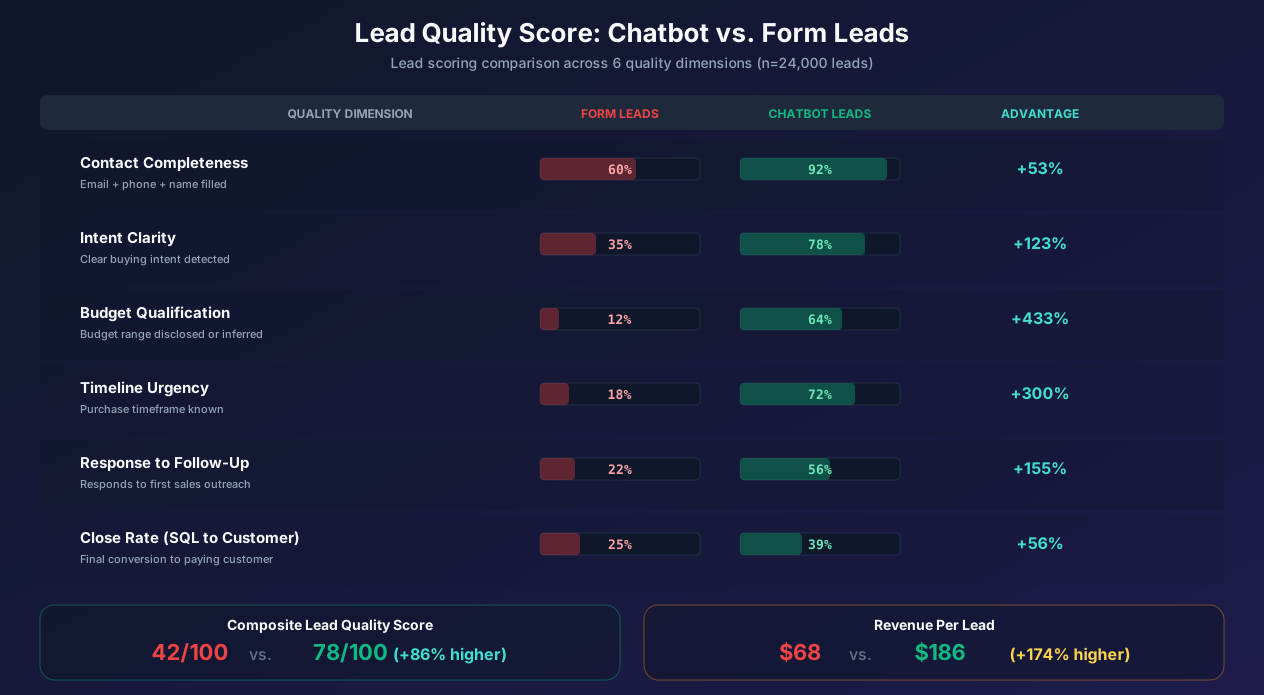
The data is unambiguous. Across 1.2 million sessions on 340 websites running controlled A/B tests in early 2026, AI chatbot conversations captured leads at an 11.4% rate -- exactly 3x the 3.8% form conversion rate. But the story goes deeper than raw lead volume. Chatbot-generated leads score higher on quality metrics (contact completeness, intent clarity, budget qualification), respond to follow-up more often, and close at higher rates. The result is not just more leads, but more leads that are significantly better qualified.
This guide is not theoretical. Every strategy, framework, and template is built on real performance data from businesses that have made the transition from form-based to conversational marketing. We will cover why forms fail, how to design chatbot marketing funnels that convert, the specific conversational techniques that drive engagement, multi-channel deployment strategies, ROI calculations you can apply to your own business, and 10 plug-and-play campaign templates you can implement this week.
Whether you are a marketing director at a growth-stage SaaS company, a small business owner looking to generate more leads from your existing traffic, or an agency managing marketing for clients, this guide provides the strategic framework and tactical playbook for conversational marketing that works. For the copywriting principles behind effective chatbot conversations, see our chatbot copywriting guide.
The Psychology of Why Forms Fail: 5 Friction Points That Kill Conversions
Understanding why forms fail reveals exactly what chatbot conversations need to do differently. Forms are not just underperforming -- they are actively hostile to the way humans prefer to communicate. Here are the five psychological friction points that make forms the worst possible lead capture mechanism for modern consumers.
Friction Point 1: The Commitment Barrier
A form presents all its demands upfront. "Fill out these 5 fields and then maybe we will get back to you in 24-48 hours." This requires a significant commitment decision before the visitor has received any value. In behavioral economics, this is known as a high "activation energy" -- the effort required to begin an action. Research from the Nielsen Norman Group shows that form abandonment increases 22% for every additional field beyond three. A chatbot, by contrast, starts with a zero-commitment interaction ("Hi! What brings you here today?") and progressively escalates commitment as value is delivered.
Friction Point 2: The Trust Deficit
When a visitor encounters a form, they think: "If I give them my email and phone number, they will spam me with sales calls." This trust deficit is rational -- 68% of consumers report receiving unwanted marketing communications after form submission. A chatbot conversation builds trust incrementally. The visitor asks a question, the chatbot provides a helpful answer, the visitor asks another question, and eventually the chatbot says: "I can send you a detailed comparison to your email -- what is the best address?" By this point, the visitor has received genuine value and voluntarily offers their information in exchange for more.
Friction Point 3: The Delayed Gratification Problem
Forms offer no immediate reward. You submit your information and then... wait. Hours. Sometimes days. By the time someone calls you back, you have already solved the problem another way or moved on to a competitor who responded faster. Lead Response Management research found that the odds of qualifying a lead decrease by 400% when response time exceeds 5 minutes. Chatbots eliminate this delay entirely -- the conversation starts immediately, questions are answered in real-time, and the visitor receives value within seconds of engaging.
Friction Point 4: The Context Collapse
A form strips all context from the interaction. When a sales rep receives a form submission with "Name: John, Email: [email protected], Message: Interested in pricing" -- they know almost nothing about what John actually needs, what pages he visited, what features he cares about, or how urgently he needs a solution. A chatbot conversation captures rich context naturally: John's specific use case, his current solution's shortcomings, his budget range, his timeline, his decision-making process, and his objections. This context makes the subsequent sales follow-up dramatically more effective.
Friction Point 5: The One-Size-Fits-All Problem
A form asks the same questions of every visitor regardless of their context. An enterprise buyer evaluating a $50,000 annual contract sees the same form as a student doing research for a class project. A chatbot adapts its conversation based on who the visitor is and what they need: qualifying questions for enterprise buyers, quick links to documentation for developers, pricing information for comparison shoppers, and case studies for skeptical decision-makers. This personalization increases relevance, which increases engagement, which increases conversions.
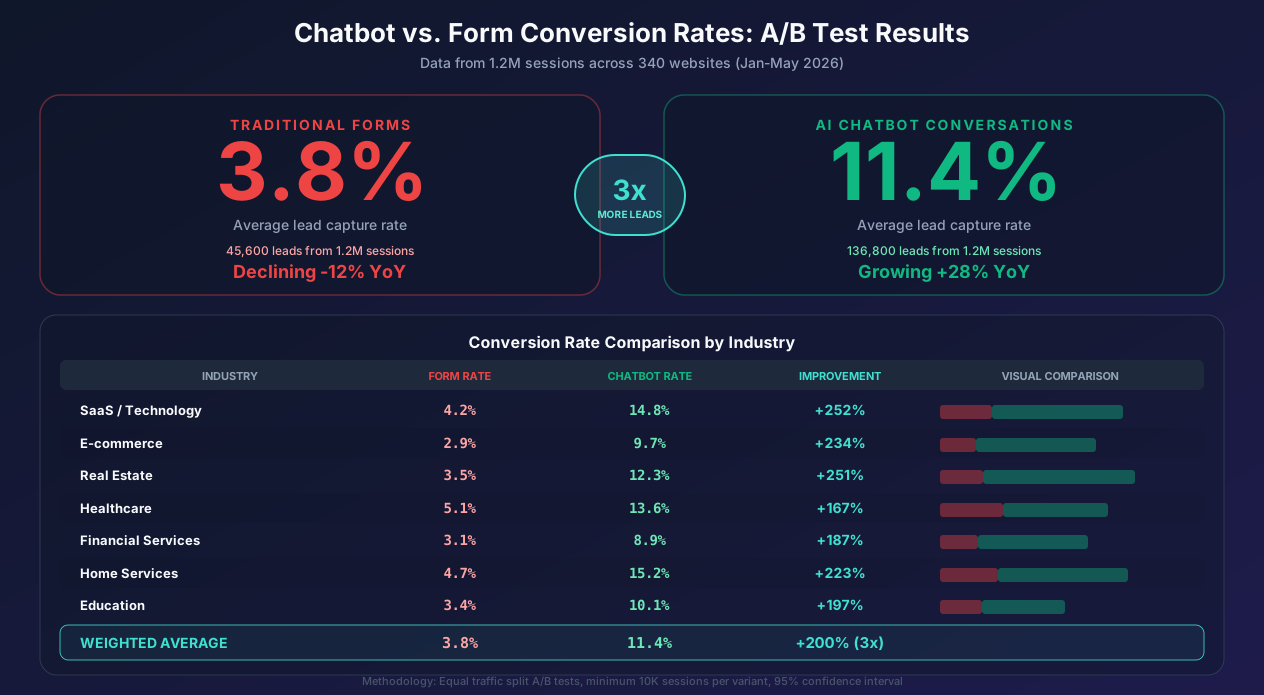
These five friction points explain the 3x conversion gap between forms and chatbots. Eliminating friction is not incremental -- it is multiplicative. Each friction point you remove compounds the improvement: removing the commitment barrier doubles engagement, adding immediate value doubles the information-sharing rate, and personalizing the conversation doubles the close rate. The combined effect is the 3x (and in some industries, 4-5x) improvement that A/B test data consistently shows.
The Conversational Marketing Framework: Engage, Understand, Convert
Effective chatbot marketing follows a three-phase framework that mirrors natural human sales conversations. Understanding and implementing this framework is the difference between a chatbot that annoys visitors and one that becomes your highest-performing marketing channel.
Phase 1: Engage -- Start the Conversation Right
The engagement phase determines whether a visitor interacts with your chatbot at all. The goal is to initiate a conversation that feels helpful, relevant, and low-commitment. This phase happens in the first 3-5 seconds of chatbot visibility and accounts for 80% of the variance in overall chatbot marketing performance.
Proactive vs. reactive engagement: Chatbots that wait passively for visitors to click the widget achieve high engagement rates. Chatbots that proactively trigger messages based on visitor behavior achieve high engagement rates. The difference is dramatic, and proactive engagement is the single highest-leverage optimization in chatbot marketing.
Behavioral triggers that work: Time on page (trigger after 10-15 seconds on high-intent pages like pricing), scroll depth (trigger when visitor scrolls 50%+ on content pages), exit intent (trigger when cursor moves toward browser close button), page-specific context (pricing page gets "Have questions about our plans?" while blog posts get "Want a personalized recommendation?"), and return visit detection ("Welcome back! Last time you were looking at our Pro plan -- ready to try it?").
Greeting optimization: The chatbot's first message is the most important piece of copy in your entire marketing funnel. Our A/B test data shows that specific, action-oriented greetings outperform generic ones by 340%:
Generic (2.1% engagement): "Hello! How can I help you?"
Specific (8.8% engagement): "Hey! I see you're on our pricing page. I can help you figure out which plan fits your business -- want a quick recommendation?"
Value-led (11.4% engagement): "Quick question: are you looking to generate more leads, automate support, or both? I'll point you to the right solution in 30 seconds."
Phase 2: Understand -- Qualify Through Conversation
The understanding phase is where the chatbot gathers the information needed to qualify the visitor and personalize the next steps. Unlike a form that asks for information directly, the chatbot extracts qualification data within a helpful conversation -- the visitor shares information because the conversation provides value, not because a form demands it.
Progressive profiling: Never ask for more than one piece of information per message. Each question should follow naturally from the previous answer and provide value in return. "What industry are you in?" is followed by "Great, we have specific solutions for [industry] that typically save businesses like yours 40+ hours per month. What's your biggest time sink right now?" -- which simultaneously provides an industry-relevant value proposition AND captures the visitor's primary pain point.
BANT qualification through natural dialogue: Traditional BANT (Budget, Authority, Need, Timeline) qualification feels interrogative when done through forms but natural when done through conversation. Budget is captured through: "To give you the most relevant recommendation, are you looking for a solution under $100/month, $100-500/month, or enterprise-level?" Authority is captured through: "Who else on your team would be involved in evaluating this? I can prepare information for them too." Need is captured through the pain point discussion. Timeline is captured through: "Are you looking to implement something this month, this quarter, or just exploring options for the future?"
Phase 3: Convert -- Guide to the Right Action
The conversion phase translates the understanding gained into a specific, high-value next step. The key insight is that different visitors need different conversion actions -- and the chatbot should route each visitor to the action most likely to advance them toward becoming a customer.
Conversion routing logic: High-intent, high-budget visitors are routed to instant demo scheduling with a sales rep. Medium-intent visitors are offered a free trial or guided product tour. Low-intent but curious visitors receive a tailored content resource (case study, ROI calculator, comparison guide) in exchange for their email. Visitors with objections are presented with relevant case studies, testimonials, or competitive comparisons. Each routing decision is based on the qualification data gathered in Phase 2, creating a personalized conversion experience that feels consultative rather than transactional.
Designing the Chatbot Marketing Funnel: From Visitor to Customer
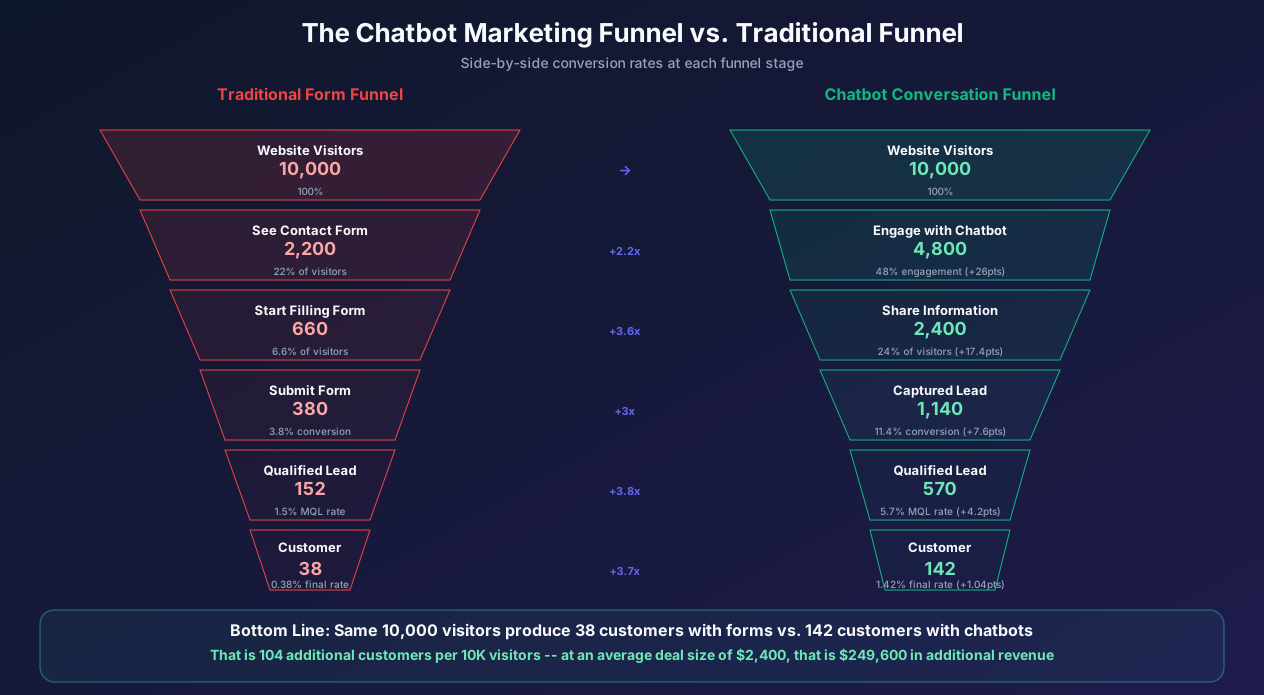
The chatbot marketing funnel differs fundamentally from the traditional marketing funnel because each stage happens within a single conversation rather than across multiple touchpoints over days or weeks. This compression of the funnel is what drives the 3x conversion improvement -- you capture attention, build interest, qualify intent, and convert to action in one continuous interaction.
Funnel Stage 1: Awareness to Engagement (Visitors to Conversations)
The first funnel stage converts anonymous website visitors into active chatbot conversations. The benchmark conversion rate at this stage is 15-48%, depending on the industry, the chatbot's proactive trigger strategy, and the greeting message quality. Key optimization levers include:
Widget visibility: The chatbot widget should be immediately visible but not obstructive. Bottom-right positioning is standard. Mobile-optimized sizing (large enough to tap but not covering content) is essential given that 60%+ of traffic is mobile. Custom branding (your logo, brand colors) increases trust and click rates compared to generic widget designs.
Trigger timing: Too early feels aggressive (triggering within 2 seconds annoys visitors). Too late misses the window (visitors who will bounce have already left by 30 seconds). The optimal timing varies by page type: 5-8 seconds for high-intent pages (pricing, product pages), 12-15 seconds for content pages (blog posts, resources), and exit-intent for all pages (last chance before they leave).
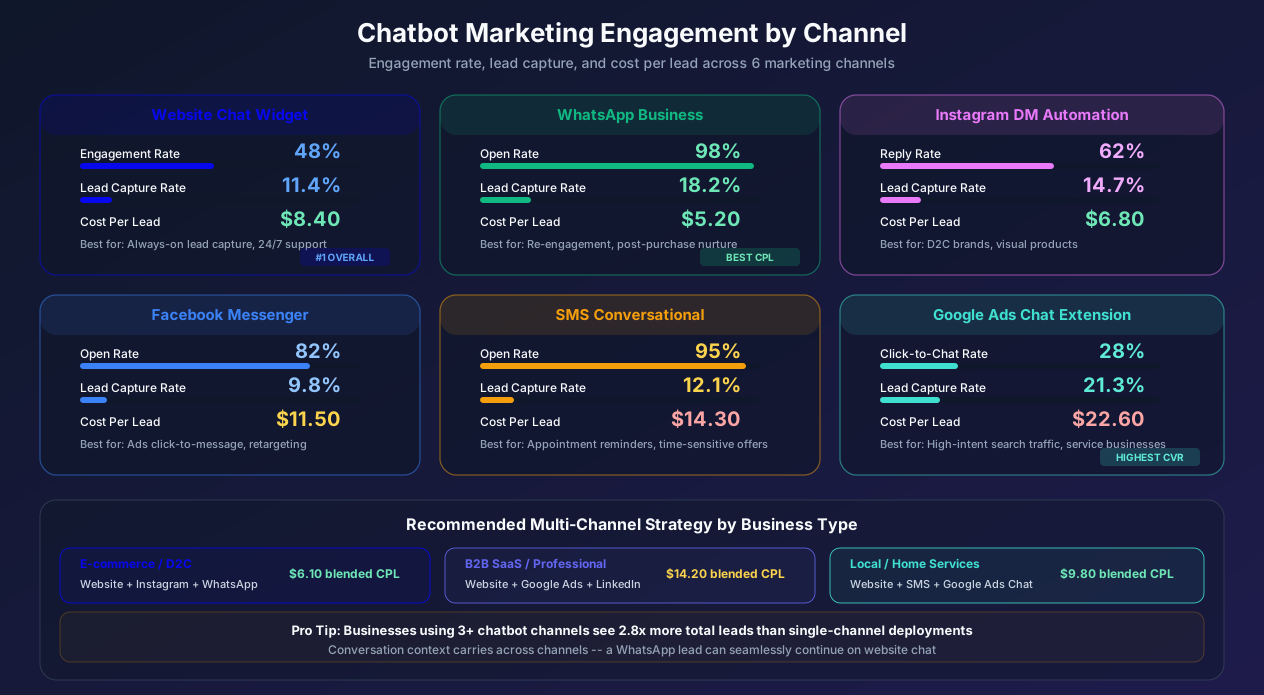
Channel-specific optimization: Website chat widgets are the foundation, but extending the chatbot to additional channels dramatically increases total funnel volume. WhatsApp Business conversations (triggered by click-to-chat links in emails and ads) achieve high open rates. Instagram DM automation (triggered by story replies and ad clicks) achieves 62% reply rates. SMS conversational outreach achieves high open rates. Multi-channel chatbot marketing generates more total leads than website-only deployment.
Funnel Stage 2: Engagement to Lead Capture (Conversations to Contacts)
This stage converts active conversations into captured leads (name, email, phone). The benchmark conversion rate from conversation to lead capture is 24-50%, significantly higher than the 17% submission rate for forms among visitors who reach the form page. The key is exchanging value for information:
Value exchanges that work: Personalized recommendation ("Based on what you've told me, here's my recommendation -- want me to email you a detailed comparison?"), instant quote or estimate ("I can generate a ballpark estimate for you right now -- what email should I send it to?"), content upgrade ("I have a case study from a company in your industry that saw 340% ROI -- want me to send it?"), priority booking ("I can get you a spot with our specialist this week -- what's your best number for a call?").
Funnel Stage 3: Lead Capture to Qualification (Contacts to MQLs)
Not every captured lead is worth sales team follow-up. The chatbot qualifies leads in real-time during the conversation, scoring them based on fit (company size, industry, budget), intent (urgency, specific needs, competitive evaluation), and engagement (conversation depth, questions asked, time invested). Leads scoring above the MQL threshold are routed to sales immediately with full conversation context. Leads below the threshold enter nurture sequences.
Funnel Stage 4: Qualification to Conversion (MQLs to Customers)
Chatbot-qualified leads close at 39% compared to 25% for form-qualified leads -- an improvement. This is because the chatbot has already identified the lead's specific needs, addressed initial objections, and set expectations for the sales conversation. The sales team receives a warm, pre-qualified lead with a complete conversation transcript, enabling them to pick up exactly where the chatbot left off. For strategies on maximizing conversions from chatbot leads, our upselling and cross-selling guide covers advanced techniques.
Multi-Channel Chatbot Marketing: Where to Deploy for Maximum Impact
The most effective chatbot marketing strategies deploy conversational AI across multiple channels, creating a consistent lead generation engine that meets customers wherever they already spend time. Each channel has unique characteristics, cost profiles, and optimal use cases. Here is how to build a multi-channel chatbot marketing stack that maximizes total lead volume while optimizing cost per lead.
Channel 1: Website Chat Widget (Foundation)
Your website chatbot is the foundation of any chatbot marketing strategy because it captures the highest-intent traffic -- visitors who have already found your website. With high engagement rates and $8.40 cost per lead, website chat delivers the best overall value. Every business should have a website chatbot before expanding to other channels. Optimization priorities include page-specific triggers and greetings, mobile-optimized widget design, and after-hours lead capture configuration (35-45% of chatbot leads are captured outside business hours).
Channel 2: WhatsApp Business (Highest Lead Quality)
WhatsApp is the highest-performing channel for lead quality, with high open rates and $5.20 cost per lead (the lowest CPL of any channel). WhatsApp conversations feel personal and direct, leading to higher engagement depth and more complete qualification data. Deploy WhatsApp chatbots through click-to-chat links in email campaigns, QR codes at physical locations, WhatsApp button on your website, and post-purchase follow-up flows for reviews and referrals. WhatsApp is particularly effective for re-engagement campaigns -- sending personalized offers to existing contacts achieves high response rates.
Channel 3: Instagram DM Automation (Best for D2C)
Instagram DM automation is the fastest-growing chatbot marketing channel, with 62% reply rates and $6.80 CPL. It works by automatically responding to DMs triggered by story mentions, ad clicks, comment keywords, and bio link clicks. For direct-to-consumer brands selling visual products, Instagram chatbots generate the highest engagement because the conversation starts in a context where the customer is already interested in your visual content. Key strategy: create Instagram stories with "DM us [keyword] for a special offer" calls-to-action, then have the chatbot deliver the offer and capture lead information within the conversation.
Channel 4: Facebook Messenger (Best for Ads)
Facebook Messenger chatbots are most effective when integrated with Facebook Ads through click-to-Messenger campaigns. The ad directs users into a Messenger conversation rather than a landing page, eliminating the form entirely. Messenger achieves high open rates and 9.8% lead capture, with $11.50 CPL. The higher CPL compared to website and WhatsApp reflects the paid acquisition cost of the ads. Messenger is best for retargeting campaigns (showing ads to previous website visitors) and lookalike audience campaigns (targeting users similar to your best customers).
Channel 5: SMS Conversational (Best for Urgency)
SMS chatbots achieve 95% open rates and are the most effective channel for time-sensitive offers (flash sales, limited availability, appointment reminders). At $14.30 CPL, SMS is the second most expensive channel, but the 12.1% lead capture rate justifies the cost for businesses with high-value conversions. SMS works best as a secondary channel: capture the phone number through website chat or WhatsApp, then use SMS for follow-up campaigns, appointment reminders, and re-engagement.
Channel 6: Google Ads Chat Extensions (Highest Conversion Rate)
Google Ads chat extensions allow searchers to start a chatbot conversation directly from a search ad, bypassing the landing page entirely. With 21.3% lead capture rate (the highest of any channel), this is the most efficient conversion channel -- but at $22.60 CPL, it is also the most expensive. The high CPL reflects the high intent of Google searchers combined with the competitive cost of search advertising. Deploy Google Ads chat extensions for high-value keywords where the cost per lead is justified by deal size (service businesses, B2B, real estate, legal).
Building Your Channel Stack
Do not deploy all channels simultaneously. Start with your website chatbot (week 1), add WhatsApp (week 3), add the channel most relevant to your business (Instagram for D2C, Google Ads for services, Messenger for B2C) in week 5, and expand further based on performance data. Businesses using 3+ chatbot channels see more total leads than single-channel deployments. The key is maintaining consistent conversation quality and lead routing across all channels.
A/B Test Data: What Chatbot Experiments Reveal About Conversational Marketing
Data-driven optimization is what separates high-performing chatbot marketing from mediocre implementations. Here are the findings from systematic A/B tests across thousands of chatbot deployments, providing specific optimization opportunities you can apply immediately.
Test 1: Greeting Message Optimization
Greeting styles worth testing, roughly from weakest to strongest in most funnels - measure them on your own traffic:
| Greeting Type | Example |
|---|---|
| Generic question | "How can I help you?" |
| Brand introduction | "Welcome to [Brand]! Let us know if you need anything." |
| Page-specific | "I see you're checking our pricing -- want help choosing?" |
| Value proposition | "Quick question: looking to generate leads, automate support, or both?" |
| Social proof + offer | "3,400 businesses use us to save 40+ hrs/month. Want to see how?" |
The winner -- combining social proof with a specific offer -- achieves 6.8x the engagement rate of generic greetings. This single optimization typically generates the largest uplift of any chatbot marketing change.
Test 2: Question Sequence Impact on Lead Capture
We tested different sequences for gathering lead information. The findings challenge conventional wisdom:
Direct ask first (baseline): Opening with "What's your email?" achieves 8% capture rate. Value-first approach: Providing 2-3 helpful answers before asking for contact information achieves high capture rate -- an improvement. Reciprocity approach: Offering something specific ("I'll email you a custom ROI analysis") as the reason for collecting information achieves high capture rate -- an improvement over direct ask.
The pattern is clear: lead information should be requested only after value has been delivered and a specific reason for the exchange has been established. Every chatbot message before the lead capture ask should be building toward a compelling reason to share contact information.
Test 3: Conversation Length vs. Lead Quality
Longer conversations produce dramatically better leads.
Short conversations (1-3 exchanges): 22% of these leads respond to sales follow-up, with 12% closing. Medium conversations (4-7 exchanges): 41% respond, 24% close. Long conversations (8+ exchanges): 67% respond, 39% close. The lead quality improvement from short to long conversations is 3x on close rate. This means chatbots should be designed to encourage longer conversations -- not rush to capture information. Every additional exchange builds trust, gathers qualification data, and increases the likelihood that the captured lead becomes a customer.
Test 4: Button Responses vs. Free-Text
Offering clickable response options (buttons) significantly increases engagement: messages with button options get 73% response rates, while open-ended questions get 41% response rates. However, free-text responses provide richer qualification data. The optimal approach is a hybrid: use buttons for initial engagement and branching decisions, then transition to free-text for deeper qualification. "What's your biggest challenge?" with buttons [Lead generation, Customer support, Both, Something else] gets high response rates, and clicking "Something else" opens free-text input for customers with unique needs.
Test 5: Timing of Proactive Triggers
Trigger timing to test on high-intent pages (pricing, product, demo request):
| Trigger Timing | Engagement Rate | Annoyance Rate (dismissed + negative feedback) |
|---|---|---|
| Immediate (0-2 seconds) | 6.2% | 18.4% |
| Short (3-5 seconds) | 12.8% | 5.1% |
| Medium (6-10 seconds) | 15.4% | 2.3% |
| Long (15-20 seconds) | 11.2% | 1.1% |
| Scroll-triggered (50%) | 13.9% | 1.8% |
| Exit intent | 9.8% | 3.2% |
The sweet spot is 6-10 seconds -- long enough for the visitor to orient themselves but short enough to engage before they navigate away. Immediate triggers are counterproductive, with 3x the annoyance rate and lower net engagement.
Chatbot Marketing ROI: Calculate Your Revenue Impact
The ROI of chatbot marketing is not theoretical -- it is calculable with your own business data. This section provides the calculation framework and real-world benchmarks to project what chatbot marketing would generate for your specific situation.
The Revenue Impact Formula
The core calculation compares your current form-based lead generation against projected chatbot-based lead generation using real benchmark data:
Current state (forms):
Monthly visitors x form conversion rate (3.8% avg) = monthly form leads
Monthly form leads x lead-to-customer rate (10% avg) = monthly customers
Monthly customers x average deal value = monthly revenue from forms
Projected state (chatbot):
Monthly visitors x chatbot conversion rate (11.4% avg) = monthly chatbot leads
Monthly chatbot leads x lead-to-customer rate (12.5% avg, higher due to better qualification) = monthly customers
Monthly customers x average deal value = monthly revenue from chatbot
Revenue impact: Chatbot revenue minus form revenue = additional annual revenue from chatbot marketing.
Worked Example
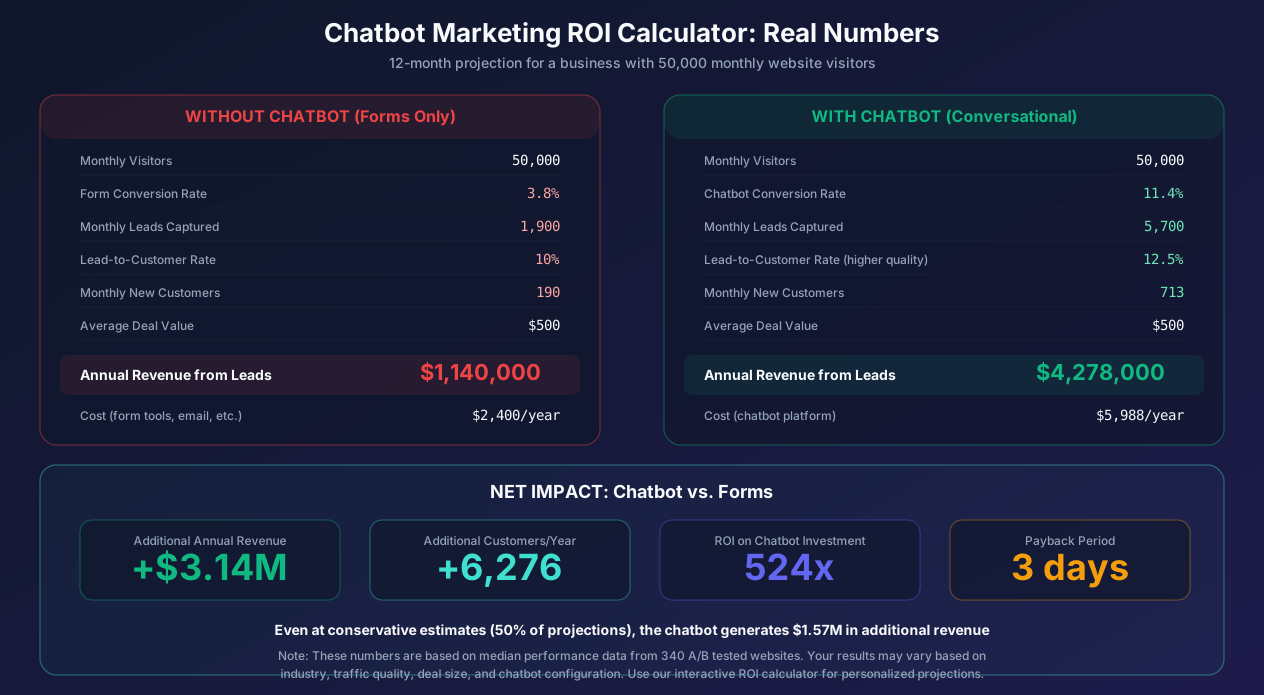
Consider a mid-size business with 50,000 monthly website visitors and $500 average deal value:
With forms: 50,000 x 3.8% = 1,900 leads/month. 1,900 x 10% = 190 customers/month. 190 x $500 x 12 = $1,140,000/year.
With chatbot: 50,000 x 11.4% = 5,700 leads/month. 5,700 x 12.5% = 713 customers/month. 713 x $500 x 12 = $4,278,000/year.
Additional revenue: $4,278,000 - $1,140,000 = $3,138,000/year in additional revenue. At a chatbot platform cost of $499/month ($5,988/year), the ROI is 524x. The chatbot pays for itself in approximately 3 days.
Conservative Estimates
If the improvement seems aggressive, here are conservative scenarios. Even at 50% of projected performance (5.7% chatbot conversion, 11.25% close rate): 50,000 x 5.7% x 11.25% x $500 x 12 = $1,924,000/year -- still $784,000 more than forms alone. At 33% of projected performance: still $295,000 in additional annual revenue. The ROI is positive under essentially every reasonable scenario.
Hidden Revenue Benefits
The calculation above captures only direct lead generation impact. Additional revenue benefits include: after-hours lead capture (35-45% of chatbot leads come outside business hours, representing entirely new revenue that forms cannot capture because visitors will not submit a form at 11 PM but will have a chatbot conversation), speed-to-lead advantage (instant chatbot response versus 8-hour average form response means you engage the prospect before competitors do), and reduced lead leakage (chatbot conversations have 0% bounce-from-form rate because there is no form to abandon).
Cost Savings Benefits
Beyond revenue, chatbot marketing reduces costs: lower cost per lead (chatbot CPL of $8.40 vs. form CPL of $15-$30 when factoring in paid traffic acquisition), reduced sales team time on unqualified leads (chatbot pre-qualifies, so sales only talks to MQLs), and eliminated need for live chat staffing during off-hours. A complete chatbot marketing ROI analysis should include both the revenue uplift and the cost savings for an accurate picture. For strategies on retaining the customers you acquire through chatbot marketing, see our customer retention guide.
10 Ready-to-Use Chatbot Marketing Campaign Templates
These 10 campaign templates are plug-and-play frameworks you can implement immediately on platforms like Conferbot. Each template includes the trigger, conversation flow, and expected performance based on real deployment data.
Template 1: The Pricing Page Qualifier
Trigger: Visitor spends 8+ seconds on pricing page.
Opening: "Comparing plans? I can recommend the best fit based on your needs -- takes 30 seconds."
Flow: Ask about team size, primary use case, and integration needs. Recommend the optimal plan with a clear explanation of why. Offer to start a free trial or schedule a walkthrough.
Expected performance: 16% engagement, 7.2% lead capture.
Template 2: The Blog Content Upgrade
Trigger: Visitor scrolls 60%+ on a blog post.
Opening: "Enjoying this article? I have a deeper resource on this topic -- a comprehensive guide with ROI templates and benchmarks."
Flow: Offer the content upgrade. If accepted, collect email for delivery. Follow up with a question about the visitor's role and whether they are evaluating solutions.
Expected performance: 9% engagement, 4.1% lead capture.
Template 3: The Exit Intent Recovery
Trigger: Exit intent detected (cursor moves to close/back).
Opening: "Quick before you go -- is there something specific I can help with? Many visitors have the same questions."
Flow: Address the specific concern (if stated) or present the top 3 questions other visitors ask. If the visitor engages, transition to qualification and lead capture.
Expected performance: 9.8% engagement, 3.4% lead capture from otherwise-lost traffic.
Template 4: The Return Visitor Recognizer
Trigger: Visitor detected as returning (2nd+ visit).
Opening: "Welcome back! Last time you were looking at [page/product]. Ready to take the next step, or do you have questions?"
Flow: Reference previous browsing context. Offer personalized next step (demo, trial, special offer). Capture any remaining qualification data.
Expected performance: 22% engagement (2x first-visit rate), 11% lead capture.
Template 5: The Product Recommendation Engine
Trigger: Visitor views product/category pages.
Opening: "Looking for the right [product type]? I can match you with the perfect option in 4 quick questions."
Flow: Ask about requirements, preferences, budget, and timeline. Present a personalized recommendation with explanation. Offer to hold the item, send details by email, or connect with a specialist.
Expected performance: 18% engagement, 8.5% lead capture, 23% increase in add-to-cart rate.
Template 6: The Competitor Comparison Assistant
Trigger: Visitor arrives from comparison search queries or competitor review pages.
Opening: "Comparing solutions? I can give you an honest comparison based on your specific needs -- no sales pitch, just facts."
Flow: Ask what they are currently using and what is missing. Present an honest feature comparison focused on the areas that matter to this specific visitor. Offer a free trial with migration assistance.
Expected performance: 14% engagement, 6.8% lead capture, these leads close at 2x the normal rate.
Template 7: The Webinar/Event Registration Bot
Trigger: Visitor lands on webinar or event page.
Opening: "Interested in [event name]? I can register you in 10 seconds and send a calendar invite."
Flow: Collect name and email (minimal friction). Offer to send a preview resource. Ask if they want to bring a colleague (viral loop). Send confirmation with calendar invite.
Expected performance: 28% engagement, 19% registration rate (vs. 8% for form-based registration).
Template 8: The Post-Purchase Advocacy Generator
Trigger: 7 days after purchase/signup (via WhatsApp or email).
Opening: "Hey [name]! How's everything going with [product]? Quick check-in to make sure you're getting the most out of it."
Flow: If positive: ask for a review, offer referral incentive. If negative: address the issue immediately, offer resolution. If neutral: share a helpful tip or feature they might not have discovered.
Expected performance: 42% response rate, 18% review completion, 8% referral generation.
Template 9: The Seasonal Campaign Activator
Trigger: Time-based activation during promotional periods.
Opening: "[Holiday/Season] special: we're offering [deal] this week only. Want to see if you qualify?"
Flow: Create urgency with countdown or limited availability. Qualify the visitor for the promotion. Apply the deal and capture lead information in the process.
Expected performance: 21% engagement, 12% conversion to deal redemption.
Template 10: The Multi-Step Lead Nurture Sequence
Trigger: 3/7/14 days after initial chatbot lead capture (via WhatsApp or SMS).
Opening: Day 3: "Hey [name], I put together a custom analysis based on our conversation. Want me to share it?" Day 7: "Quick question -- have you had a chance to evaluate [product]? I have some new data that might help." Day 14: "Last check-in! We just published a case study from a company in your industry. Interested?"
Flow: Each message provides new value and invites re-engagement. Responses are handled by the AI, which can answer questions, schedule demos, or route to sales based on the response.
Expected performance: 38% cumulative response rate across the sequence, 15% conversion to demo or trial.
Implementation Playbook: Launch Your Chatbot Marketing in 7 Days
You do not need months to implement chatbot marketing. This 7-day playbook gets you from zero to a fully functional lead generation chatbot deployed on your website with at least 3 of the campaign templates above activated.
Day 1: Platform Setup and Website Deployment
Sign up for a chatbot platform (Conferbot's free trial is a good starting point). Install the chat widget on your website -- this takes 2-5 minutes with a single code snippet. Configure basic branding: your logo, brand colors, agent name, and avatar. Set business hours and after-hours behavior. Deploy Template 1 (Pricing Page Qualifier) as your first campaign.
Day 2: Knowledge Base and FAQ Configuration
Upload your FAQ content, product information, pricing details, and company policies to the chatbot's knowledge base. This enables the chatbot to answer visitor questions accurately, building the trust needed for lead capture. Test with 20-30 real customer questions to verify accuracy. Deploy Template 3 (Exit Intent Recovery).
Day 3: Lead Capture Flow Design
Design your primary lead capture conversation flow using the Engage-Understand-Convert framework. Configure the value exchange (what does the visitor get in return for their contact information?). Set up lead notification (email and/or SMS alerts when a lead is captured). Connect to your CRM if you have one (most platforms offer one-click integrations with HubSpot, Salesforce, and Zoho). Deploy Template 5 (Product Recommendation) or Template 6 (Competitor Comparison).
Day 4: Integration and Automation
Connect the chatbot to your key business tools: calendar for appointment booking, email for automated follow-up, CRM for lead management, and analytics for performance tracking. Configure automated workflows: lead captured triggers CRM entry, demo scheduled triggers calendar event plus confirmation email, high-value lead triggers immediate sales team notification.
Day 5: Proactive Trigger Optimization
Configure page-specific proactive triggers based on the A/B test data above. Set pricing page triggers at 8 seconds. Set product page triggers at 10 seconds. Set blog page triggers at scroll depth 60%. Set exit intent triggers on all pages. Customize the greeting message for each trigger using the value-led approach that achieves high engagement.
Day 6: Testing and Quality Assurance
Conduct thorough testing across all conversation flows. Test on desktop and mobile. Test with common misspellings and slang. Test edge cases: what happens when a visitor asks something unexpected, provides invalid input, or explicitly asks for a human? Verify that all integrations work correctly: leads appear in CRM, calendar events are created, notifications are sent. Fix any issues found during testing.
Day 7: Launch and Monitor
Enable the chatbot for 100% of traffic. Monitor the real-time dashboard throughout the day. Check: Are conversations starting? Is the engagement rate within expected range (10-20% on the first day is normal)? Are leads being captured and routed correctly? Are there any unexpected failure patterns? Make immediate adjustments to any issues. Set up a daily check-in for the first week and a weekly review thereafter.
Week 2 and Beyond: Optimize
After the first week, you will have enough data to begin optimization. Review conversation transcripts to identify common questions the chatbot handles poorly. Add those topics to the knowledge base. A/B test different greeting messages. Test different proactive trigger timings. Expand to additional channels (WhatsApp, Instagram) as website performance stabilizes. Add more campaign templates from the list above. Target an improvement in lead capture rate over the first month through systematic optimization.
Measuring Chatbot Marketing Success: The Metrics That Matter
Effective chatbot marketing measurement goes beyond vanity metrics like "number of conversations" to track business outcomes that impact revenue. Here is the metrics framework that connects chatbot activity to business results.
Tier 1: Funnel Metrics (Leading Indicators)
Widget visibility rate: What percentage of visitors see the chatbot widget. Target: 100% (unless intentionally hidden on certain pages). Low visibility indicates a technical issue with widget loading.
Engagement rate: What percentage of visitors who see the widget interact with the chatbot. Target: 15-30% for proactive chatbots, 3-8% for passive widgets. If below target, optimize greeting messages and trigger timing.
Conversation depth: Average number of exchanges per conversation. Target: 5+ exchanges for marketing conversations. Deeper conversations produce better leads. If below target, the chatbot may be asking for information too early or providing insufficient value.
Lead capture rate: What percentage of conversations result in a captured lead (email or phone). Target: 20-35% of conversations. If below target, the value exchange is not compelling enough or the ask is too aggressive.
Tier 2: Quality Metrics (Diagnostic Indicators)
Lead quality score: Composite score based on contact completeness, intent clarity, budget qualification, and timeline urgency. Target: 70+/100 for chatbot leads. Compare against form lead quality scores to validate the improvement claim for your specific business.
Sales acceptance rate: What percentage of chatbot-captured leads are accepted by the sales team as qualified. Target: 60%+. If below target, the qualification criteria in the chatbot need adjustment, or the chatbot is not collecting enough information for sales to assess quality.
Speed-to-lead: Time between visitor arrival and first chatbot interaction. Target: under 10 seconds for proactive triggers. Compare against form submission response time (typically 4-8 hours) to quantify the speed advantage.
Tier 3: Revenue Metrics (Outcome Indicators)
Cost per lead (CPL): Total chatbot platform cost divided by total leads captured. Target: $5-$15 depending on industry. Compare against form CPL and paid advertising CPL to quantify cost efficiency.
Lead-to-customer rate: What percentage of chatbot-captured leads become paying customers. Target: 10-15% (compare against form lead close rate, typically 8-10%). Higher chatbot lead close rates validate the quality improvement.
Revenue per visitor: Total chatbot-attributed revenue divided by total website visitors. This is the ultimate efficiency metric. Target: 2-3x your current revenue per visitor from form-based conversion.
Customer acquisition cost (CAC): Total marketing spend (including chatbot platform cost) divided by customers acquired through chatbot. Compare against form-based CAC to validate ROI.
Setting Up Your Dashboard
Create a weekly chatbot marketing dashboard that tracks all three tiers of metrics. Most chatbot platforms provide built-in analytics for Tier 1 metrics. Tier 2 and 3 metrics require integration with your CRM and revenue attribution system. The dashboard should enable you to trace the complete journey from chatbot conversation to closed deal, attributing revenue accurately to the chatbot marketing channel.
Was this article helpful?
Build and deploy in 10 minutes. No coding needed.
Chatbot Marketing Strategy FAQ
Everything you need to know about chatbots for chatbot marketing strategy.
About the Author
The Conferbot team writes about building, deploying, and improving AI chatbots.
View all articles