
Loan Pre-Qualification Chatbot
Free Finance Chatbot Template
An AI-powered loan pre-qualification chatbot that helps visitors check their eligibility for personal, home, auto, or business loans. Collects financial details conversationally and provides instant preliminary assessments.



What Is a Loan Pre-Qualification Chatbot?
A loan pre-qualification chatbot is a conversational AI assistant designed for banks, credit unions, mortgage brokers, and online lenders to guide prospective borrowers through an automated pre-qualification assessment -- collecting income details, estimating creditworthiness, calculating debt-to-income ratios, matching applicants to eligible loan products, and providing preliminary rate estimates -- all without requiring a loan officer to pick up the phone. In 2026, consumer expectations for lending have shifted decisively toward digital-first experiences. Borrowers who once tolerated a two-week back-and-forth with a loan officer now expect answers within minutes. When a potential homebuyer lands on your website at 9 PM on a Sunday evening, excited about a listing they just toured, they want to know one thing immediately: can I afford this? If your website offers nothing but a "Contact Us" form and a phone number that goes to voicemail, that borrower moves to a competitor with an instant pre-qualification tool before you open for business on Monday morning.
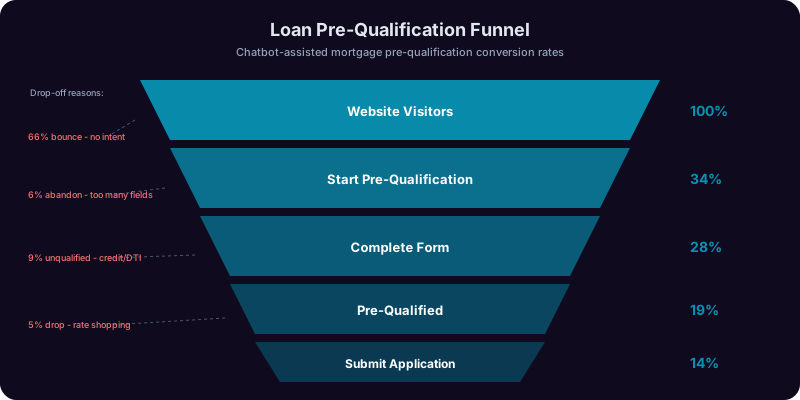
The loan pre-qualification chatbot solves this by conducting the initial borrower intake conversation automatically. A prospective borrower visits your website, clicks the chatbot widget, and is guided through a structured series of questions: What type of loan are you looking for? What is your estimated annual income? What is your approximate credit score range? What are your current monthly debt obligations? What is the target property value or loan amount? Are you a first-time homebuyer? The chatbot processes these inputs in real time, calculates a preliminary debt-to-income ratio, determines which loan products the borrower may qualify for (conventional, FHA, VA, USDA, jumbo), and presents an estimated rate range based on current market conditions and the borrower's profile. Within 3-5 minutes, the borrower has a clear picture of their purchasing power and next steps -- and you have a qualified lead with complete financial profile data delivered directly to your loan origination system or CRM.
This is not a generic chatbot adapted for lending. The conversation flow mirrors the structured intake process that experienced loan officers use during initial consultations. Every question serves a specific underwriting purpose: income determines capacity, credit score determines pricing tier, existing debt obligations determine DTI ratio, and property details determine loan program eligibility. The chatbot applies the same logic that a loan officer uses -- just faster, more consistently, and available around the clock. Built on Conferbot's no-code builder, the loan pre-qualification chatbot deploys on your website, WhatsApp, and messaging channels within hours, with no developer resources required.
For lenders who have been losing borrowers to competitors with slicker digital experiences, the pre-qualification chatbot levels the playing field immediately. According to the Mortgage Bankers Association, over 70% of borrowers in 2026 begin their mortgage journey online. The lenders who capture these borrowers are the ones who provide instant, intelligent responses -- not the ones who ask borrowers to wait until Monday for a callback.
How the Loan Pre-Qualification Chatbot Works
The loan pre-qualification chatbot follows a carefully sequenced intake flow that mirrors the logic of an experienced loan officer's initial consultation. Each stage collects specific data points that feed into the qualification assessment, ensuring the borrower receives an accurate preliminary result while the lender receives a fully profiled lead. Here is how the conversation progresses from first click to pre-qualification result.
Stage 1: Loan Purpose Identification
The conversation opens with a professional greeting that establishes your institution's identity and immediately asks the most critical routing question: what is the purpose of the loan? Options include home purchase, refinance (rate-and-term or cash-out), home equity loan or line of credit, construction loan, and investment property financing. This single question determines the entire downstream conversation path. A home purchase applicant needs property value and down payment questions. A refinance applicant needs current mortgage balance, estimated home value, and current rate. An investment property borrower triggers different eligibility criteria and rate tiers. The chatbot routes automatically using Conferbot's NLP engine, even when borrowers describe their needs conversationally rather than selecting a predefined option.
Stage 2: Income and Employment Assessment
After establishing loan purpose, the chatbot collects employment and income information. It asks about employment type (W-2 employee, self-employed, retired, other), approximate gross annual income, and length of employment at current position. For self-employed borrowers, it asks about years in business and whether they can document income through tax returns. These questions directly map to underwriting requirements: two years of stable employment history is a standard guideline for most loan programs, and self-employment requires additional documentation that affects the application timeline. The chatbot captures this early so your loan officer knows exactly what documentation to request at first contact.
Stage 3: Credit Profile Estimation
The chatbot asks the borrower to estimate their credit score within ranges: Excellent (740+), Good (700-739), Fair (660-699), Below Average (620-659), or Below 620. This is a self-reported estimate, not a credit pull -- the chatbot makes this distinction clear to avoid borrower concern about hard inquiries. The credit range determines which loan programs are available: conventional loans typically require 620+, FHA loans accept scores as low as 580, and VA loans have more flexible credit requirements. The chatbot uses this information to narrow the product recommendations presented in the results stage, ensuring the borrower sees only products they are likely to qualify for rather than a generic list.
Stage 4: Debt-to-Income Calculation
DTI ratio is the gatekeeper of loan qualification. The chatbot collects the borrower's current monthly debt obligations: existing mortgage or rent payment, car loans, student loans, credit card minimum payments, and any other recurring debt. It then calculates both front-end DTI (proposed housing payment divided by gross monthly income) and back-end DTI (total monthly debt obligations plus proposed housing payment divided by gross monthly income). Most conventional loans require a back-end DTI below 43%, while FHA loans allow up to 50% in some cases. The chatbot performs this calculation instantly and uses the result to determine qualification status and maximum affordable payment, giving the borrower a clear picture of their purchasing power.

Stage 5: Loan Product Matching and Rate Estimates
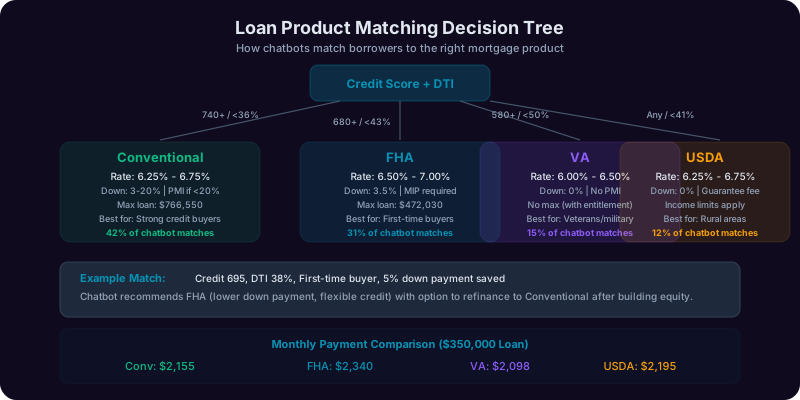
With the borrower's complete financial profile assembled, the chatbot matches them to eligible loan products. A borrower with a 720 credit score, 35% DTI, 10% down payment, and W-2 employment might see: Conventional 30-year fixed at an estimated rate range, Conventional 15-year fixed at a lower rate, and FHA 30-year if the lower down payment option is appealing. A veteran with similar credentials would also see VA loan options with zero down payment. Each product recommendation includes the estimated rate range, estimated monthly payment (principal and interest), and a brief explanation of why the product fits their profile. These are estimates based on current market rates and the self-reported data -- the chatbot clearly states that final rates depend on a full application and credit pull.
Stage 6: Application Start and Lead Capture
After presenting the pre-qualification results, the chatbot transitions to lead capture. It collects the borrower's name, email address, phone number, and preferred contact time. It offers two clear next steps: start a full application online or schedule a call with a loan officer to discuss options. The complete borrower profile -- loan purpose, income, credit range, DTI calculation, matched products, and contact information -- is delivered to your loan origination system or CRM as a structured lead. Your loan officer receives a borrower who already understands their options and is ready for the next step, rather than a cold inquiry that requires 20 minutes of basic intake questions.
Key Features: Credit Assessment, DTI Calculation, and Product Matching
The loan pre-qualification chatbot includes features specifically designed for the lending industry's qualification workflows. These are not generic lead capture tools repackaged for finance -- they implement the actual logic that loan officers use to assess borrower eligibility, estimate affordability, and recommend appropriate products.
Real-Time DTI Ratio Calculation
The chatbot calculates both front-end and back-end debt-to-income ratios in real time as the borrower provides their income and debt information. Front-end DTI (housing expense divided by gross income) determines maximum affordable housing payment. Back-end DTI (total debt obligations divided by gross income) determines overall qualification status. The chatbot displays these ratios to the borrower with clear explanations: "Based on your income of $85,000 and current monthly debts of $1,200, your back-end DTI with the estimated mortgage payment would be 38%, which is within the 43% maximum for conventional loans." This transparency builds trust and educates the borrower simultaneously, reducing the number of basic questions your loan officers need to answer during follow-up calls.
Intelligent Loan Product Matching
The chatbot maintains a configurable product matrix that maps borrower characteristics to available loan programs. Credit score ranges, DTI thresholds, down payment percentages, property types, and occupancy types all factor into the matching algorithm. You configure the matrix through Conferbot's visual builder to reflect your institution's actual product offerings and underwriting guidelines. When your rates change or you launch a new product, update the matrix in minutes -- no code changes required. The matching logic handles edge cases that generic calculators miss: a borrower with a 680 credit score and 5% down payment is matched to FHA rather than conventional because the pricing would be significantly better, even though they technically qualify for both.
Credit Score Range Guidance
Many borrowers do not know their exact credit score or confuse their free credit monitoring score with a FICO mortgage score. The chatbot handles this gracefully by using ranges rather than exact numbers and by explaining what each range means for their options. For borrowers who select "I'm not sure," the chatbot provides guidance on how to check their score for free through AnnualCreditReport.com and explains that the pre-qualification can proceed with an estimate, with exact pricing determined after a formal credit pull during the full application. This approach prevents borrower drop-off from uncertainty while maintaining the integrity of the pre-qualification assessment.
Rate Estimate Engine
The chatbot provides estimated rate ranges based on the borrower's profile and current market conditions. These rates are configurable in the Conferbot dashboard and should be updated regularly to reflect market movements. The chatbot presents rates as ranges (e.g., "5.75% - 6.25%") rather than exact quotes, with a clear disclaimer that final rates depend on a complete application, credit pull, property appraisal, and current lock-date pricing. This approach gives borrowers the actionable information they need to make decisions while protecting your institution from rate commitment liability. The rate engine accounts for credit tier pricing adjustments, loan-to-value pricing, and loan amount tiers that affect real-world mortgage pricing.
First-Time Homebuyer Detection
The chatbot identifies first-time homebuyers and adjusts the conversation accordingly. First-time buyers qualify for additional programs (FHA with 3.5% down, various state and local down payment assistance programs, and first-time buyer conventional products with reduced PMI). The chatbot highlights these options and explains eligibility requirements in plain language. It also adjusts the educational tone of the conversation -- first-time buyers need more explanation of terms like DTI, PMI, escrow, and points than experienced borrowers. This adaptive approach ensures that both novice and experienced borrowers receive an appropriately tailored experience through the same chatbot.
Multi-Channel Deployment
The same pre-qualification flow deploys across your website, WhatsApp, Facebook Messenger, and Instagram. Borrowers increasingly discover lenders through social media advertising, and the chatbot provides a seamless transition from ad click to pre-qualification without requiring the borrower to navigate to a separate website or application portal. Conferbot's omnichannel integration ensures that all leads flow into the same pipeline regardless of channel, with consistent data quality across every entry point.
Ready to try Loan Pre-Qualification Chatbot?
Deploy this template in under 10 minutes. No coding required.
Use This Template Free →Benefits for Banks, Credit Unions, and Mortgage Brokers
The financial and operational impact of deploying a loan pre-qualification chatbot is measurable across the metrics that matter most to lending institutions: lead volume, lead quality, loan officer productivity, pull-through rate, and cost per funded loan. Here is how each benefit translates to real lending operations.
Capture High-Intent Borrowers Around the Clock
Lending websites receive 40-55% of their traffic outside business hours -- evenings when borrowers research after work, weekends when they tour homes, and early mornings before the workday begins. These are the highest-intent visitors: they are actively shopping for homes, comparing lenders, and making decisions. Without a chatbot, their only option is a static rate calculator (which provides no lead capture) or a contact form (which has 5-10% submission rates). The pre-qualification chatbot engages these visitors in a meaningful financial conversation, provides instant value through DTI calculation and product matching, and captures their complete profile. Lenders deploying the chatbot typically see a 3-4x increase in website-to-lead conversion, with after-hours leads accounting for 45-60% of total chatbot leads.
Reduce Loan Officer Time on Unqualified Leads
Loan officers at most institutions spend 25-40% of their time on initial intake conversations that do not convert to applications. The borrower's income is too low, their credit is too damaged, their DTI is too high, or they are simply not ready to buy yet. The chatbot filters these scenarios before a loan officer invests any time. Borrowers who do not meet minimum qualification criteria receive a polite explanation of what they need to improve (higher credit score, lower debt, larger down payment) and a suggestion to check back when their situation changes. Borrowers who do qualify arrive at the loan officer's desk with a complete financial profile, eliminating 15-20 minutes of basic intake per lead. This means loan officers spend their time on closable borrowers rather than tire-kickers.
Faster Response Time Wins More Loans
In mortgage lending, the lender who provides the first substantive response wins the borrower 35-50% of the time. Borrowers typically contact 2-4 lenders simultaneously. The chatbot ensures your response is fastest: the borrower receives instant pre-qualification results, and your loan officer receives a fully profiled lead within seconds. While competitors are returning calls from yesterday's voicemails, your loan officer is already calling a borrower who has seen their options and is ready to proceed. According to the Consumer Financial Protection Bureau, borrowers who receive faster responses report higher satisfaction and are more likely to complete the application process with that lender.
Improved Pull-Through Rate
Pull-through rate -- the percentage of pre-qualified borrowers who complete the full application and close a loan -- is a critical efficiency metric for lenders. Traditional pre-qualification methods (phone call with loan officer, paper application, basic online form) produce pull-through rates of 20-35%. The chatbot improves pull-through by ensuring borrowers understand their qualification status, estimated payments, and product options before they commit to a full application. Borrowers who start applications after chatbot pre-qualification have more realistic expectations and fewer surprises during underwriting, reducing abandonment. Lenders report pull-through improvements of 10-15 percentage points after deploying structured pre-qualification through the chatbot.
Data-Driven Marketing Optimization
Every pre-qualification conversation generates structured data: loan purpose, income ranges, credit tiers, down payment percentages, and property types. Aggregated across hundreds of conversations, this data reveals which borrower segments are visiting your website, where they drop off in the qualification process, and which loan products are most in demand. This intelligence enables targeted marketing: if your data shows a high volume of first-time buyers with credit scores in the 660-699 range, you can create FHA-focused ad campaigns targeting that segment. Conferbot's analytics dashboard makes this data accessible without requiring a data analyst to run reports.
Pre-Qualification Volume and Revenue Impact Data
Lending institutions operate on volume and efficiency -- the revenue impact of converting even a small percentage more of existing website traffic into funded loans is substantial. Here is the data from lenders who have deployed chatbot-based pre-qualification compared against traditional intake methods.
| Metric | Traditional Intake | With Pre-Qualification Chatbot | Impact |
|---|---|---|---|
| Website visitor to lead conversion | 2-5% | 10-18% | 3-4x improvement |
| After-hours lead capture rate | 5-10% | 70-85% | 7-14x improvement |
| Average lead response time | 4-24 hours | Under 3 minutes | 90%+ faster |
| Loan officer time per lead (intake) | 15-25 minutes | 3-5 minutes | 75-80% reduction |
| Pre-qualification to application rate | 25-35% | 40-55% | +15-20 percentage points |
| Pull-through rate (app to close) | 55-65% | 65-78% | +10-13 percentage points |
| Cost per funded loan (marketing) | $800-$2,000 | $400-$900 | 45-55% reduction |
| Monthly qualified leads (mid-size lender) | 80-150 | 150-280 | +70-130 additional leads |
Revenue Impact Modeling
Consider a mortgage broker with an average loan amount of $350,000 and an origination fee of 1%. If the chatbot adds 50 qualified pre-qualifications per month and improves the application-to-close pull-through rate from 60% to 72%, the financial impact is significant:
| Scenario | Monthly Pre-Quals | App Rate | Pull-Through | Funded Loans | Monthly Revenue |
|---|---|---|---|---|---|
| Without chatbot | 100 | 30% | 60% | 18 | $63,000 |
| With chatbot | 150 | 45% | 72% | 48.6 | $170,100 |
| Difference | +50 | +15 pts | +12 pts | +30.6 | +$107,100 |
The revenue improvement comes from three compounding factors: more leads entering the pipeline (the chatbot captures borrowers who would have bounced), higher application conversion (borrowers who complete pre-qualification are more committed), and better pull-through (pre-qualified borrowers have fewer surprises during underwriting). Even at conservative estimates -- 20 additional leads per month with 5 percentage point improvements in each conversion stage -- a lender with $350,000 average loan size adds over $30,000 in monthly origination revenue from the chatbot alone.
Regulatory Compliance and Fair Lending Considerations
Lending is one of the most heavily regulated industries in the United States, and any technology that touches the borrower qualification process must comply with federal and state regulations. The loan pre-qualification chatbot is designed with compliance built into its architecture, not bolted on as an afterthought.
Equal Credit Opportunity Act (ECOA) Compliance
The chatbot never asks about race, color, religion, national origin, sex, marital status, age, or whether the borrower receives public assistance income -- the prohibited bases under ECOA and Fair Housing Act. Every question in the pre-qualification flow relates directly to financial qualification: income, employment, credit, debt, and property details. The chatbot applies identical logic to every borrower regardless of any protected characteristic, producing consistent outcomes that can be audited and documented. This consistency is actually an advantage over human-conducted pre-qualifications, where unconscious bias can affect the questions asked, the information provided, or the enthusiasm of the response.
Truth in Lending Act (TILA) Disclosures
The chatbot presents rate estimates as ranges with clear disclaimers that these are not rate commitments, rate locks, or official loan offers. The chatbot does not trigger TILA disclosure requirements because it provides estimates rather than specific credit terms tied to a specific transaction. However, the chatbot's messaging is configurable to include any institution-specific disclosures your compliance team requires, including state-specific licensing notices, NMLS identifiers, and equal housing lender statements. All disclosures are displayed prominently within the conversation flow rather than hidden in fine print.
Data Privacy and Security
Borrower data collected through the chatbot is transmitted and stored using encryption that meets financial industry standards. The chatbot does not collect Social Security numbers, account numbers, or other sensitive financial identifiers during the pre-qualification stage -- these are collected later during the formal application through your secure loan origination system. The data collected (income ranges, credit score estimates, debt amounts, and contact information) is sufficient for pre-qualification without crossing into sensitive data territory. Conferbot's data security framework provides the controls needed for financial institution compliance, including data retention policies, access controls, and audit logging.
Audit Trail and Documentation
Every chatbot conversation is logged and timestamped, creating a complete audit trail of what information was presented to the borrower and what responses were collected. This documentation is valuable for compliance reviews, fair lending examinations, and dispute resolution. If a borrower claims they were quoted a specific rate, the conversation log shows exactly what was presented. If a regulator asks how pre-qualification decisions are made, the chatbot's logic is transparent and consistent -- unlike loan officer phone conversations that vary from call to call and are rarely documented comprehensively.
50,000+ businesses use Conferbot templates to automate conversations
Use Cases Across Lending Verticals
While the core pre-qualification logic applies across lending, different institution types and loan products require tailored implementations. The chatbot template is flexible enough to serve the full spectrum of lending verticals with configuration changes rather than custom development.
Residential Mortgage Lending
The primary use case: homebuyers and refinancers who visit your website seeking pre-qualification. The chatbot handles purchase and refinance flows, calculates DTI, matches borrowers to conventional, FHA, VA, USDA, and jumbo products, and provides estimated payments and rates. For mortgage brokers working with multiple wholesale lenders, the chatbot can present product options from different sources, helping borrowers understand the range of options available. This is particularly powerful for independent brokers competing against direct lenders with larger marketing budgets -- the chatbot provides a digital experience that matches or exceeds what big banks offer.
Credit Union Member Services
Credit unions can deploy the chatbot to serve existing members exploring mortgage, auto, and personal loan options. The chatbot identifies whether the visitor is a current member and adjusts product offerings and rates accordingly -- members typically receive preferential pricing. For potential new members, the chatbot explains membership eligibility requirements alongside loan pre-qualification, combining member acquisition with lending lead generation. Credit unions report that the chatbot increases cross-selling by exposing members to loan products they did not know the credit union offered.
Auto Lending
The chatbot adapts to auto lending by replacing property-related questions with vehicle-related ones: new or used, estimated purchase price, desired loan term, and trade-in value. DTI calculation remains identical, but the product matching logic changes to reflect auto loan rate tiers, term options, and credit requirements. Auto dealerships deploy the chatbot on their website to pre-qualify buyers before they walk into the showroom, reducing the time spent in the finance office and improving the customer experience. Banks and credit unions use it on their auto lending landing pages to capture borrowers shopping for rates before visiting a dealership.
Small Business Lending
Small business loan pre-qualification replaces personal income questions with business revenue, time in business, and purpose of funds. The chatbot collects annual revenue, monthly revenue, time in business, industry, estimated credit score, and requested loan amount. Product matching maps to SBA loans, term loans, lines of credit, equipment financing, and commercial real estate loans based on the business profile. The chatbot filters out businesses that do not meet minimum requirements (such as less than 2 years in business for SBA loans) and routes qualified leads to the appropriate commercial lending officer.
Home Equity and HELOC
For home equity lending, the chatbot collects current property value, outstanding mortgage balance, and desired loan or credit line amount to calculate combined loan-to-value (CLTV) ratios. Most lenders allow CLTV up to 80-90% for home equity products. The chatbot determines available equity, calculates the maximum eligible amount, and presents options for fixed-rate home equity loans versus variable-rate HELOCs with estimated rates and payments for each. Homeowners exploring equity access appreciate the instant answer to "how much equity can I tap?" rather than waiting days for a loan officer callback.
Integration with Loan Origination Systems and Banking Platforms
A pre-qualification chatbot that captures borrower data but does not feed it into your existing lending workflow creates friction rather than eliminating it. Seamless integration with your loan origination system, CRM, and marketing automation platform is what transforms the chatbot from a standalone widget into a core component of your digital lending pipeline.
Loan Origination System (LOS) Integration
Every pre-qualified borrower captured by the chatbot is automatically pushed to your LOS through Conferbot's API integration framework. For Encompass (ICE Mortgage Technology) users, the chatbot creates a new loan file pre-populated with borrower name, contact information, income, employment type, estimated credit range, loan purpose, and property details. For Calyx, Byte, and MortgageFlex users, the integration delivers the same structured data via API or webhook. The loan officer opens a file that already contains the pre-qualification data, eliminating manual entry and reducing the risk of transcription errors that create compliance issues downstream.
CRM and Lead Management
For institutions using HubSpot, Salesforce, or industry-specific CRMs like Velocify or BNTouch, the chatbot creates contact records with all qualification data mapped to custom properties. Leads are scored based on readiness indicators: a borrower with a 740+ credit score, 20% down payment, and a property already identified is a hot lead scored at the top of the queue. A borrower who is "just exploring options" with no property in mind is a nurture lead routed to a drip email campaign. This automated scoring and routing ensures loan officers focus on the most closable opportunities first.
Marketing Automation Connection
Borrowers who complete pre-qualification but do not immediately start an application enter an automated nurture sequence. The chatbot triggers enrollment in email campaigns tailored to their profile: first-time buyer educational series, refinance rate watch alerts, or home equity awareness campaigns. When a borrower returns to your website weeks later, the chatbot recognizes them and picks up where the previous conversation left off, providing updated rate estimates and asking if their situation has changed. This persistent engagement keeps your institution top-of-mind through what is often a months-long homebuying decision process.
Analytics and Reporting
The chatbot provides lending-specific analytics through the Conferbot analytics dashboard: pre-qualification volume by loan purpose, credit tier distribution, average DTI ratios, product match distribution, and conversion rates at each stage of the funnel. These metrics integrate with your existing reporting through API exports, enabling your leadership team to track digital channel performance alongside traditional channels. The data answers strategic questions: Are we attracting the right borrower segments? Which loan products are most in demand? Where in the qualification process are we losing potential borrowers?
Getting Started with Your Loan Pre-Qualification Chatbot
Deploying the loan pre-qualification chatbot takes 2-4 hours for a basic setup and 2-3 days for a fully integrated deployment with LOS connections, compliance review, and custom branding. The process is designed for non-technical users -- if your marketing team can use a web form builder, they can configure this chatbot.
Step 1: Clone the Template
Open the Conferbot template library and select the Loan Pre-Qualification Chatbot. Click "Use This Template" to clone it to your workspace. The template includes the complete conversation flow: loan purpose, income assessment, credit range, debt obligations, DTI calculation, property details, product matching, rate estimates, and lead capture. Review the flow in the visual builder to understand the structure before customizing.
Step 2: Configure Your Loan Products and Rates
Update the product matrix with your institution's actual offerings, rate ranges, and qualification criteria. Set minimum credit scores for each program, DTI limits, down payment requirements, and current rate ranges. If you offer specialized programs (state housing authority products, first-time buyer programs, or portfolio loans), add them to the product matrix. Update rate estimates weekly or when significant market movements occur to keep the chatbot's recommendations current and credible.
Step 3: Compliance Review
Have your compliance team review the chatbot conversation flow, disclosures, and disclaimers before deployment. Ensure that all required licensing statements, equal housing lender notices, NMLS identifiers, and state-specific disclosures are included. Verify that the chatbot's rate estimate presentations meet your institution's advertising compliance requirements. Conferbot's template includes placeholder disclosures that should be replaced with your institution-specific language approved by compliance.
Step 4: Connect Your LOS and CRM
In the Conferbot integrations hub, connect the chatbot to your loan origination system and CRM. Map the chatbot's data fields to your system's properties. Test the integration by completing the pre-qualification flow yourself and verifying the lead appears correctly in your LOS and CRM with all fields populated. For Encompass users, verify the loan file is created with the correct template and data mapping.
Step 5: Deploy and Monitor
Embed the chatbot on your website's mortgage landing pages, rate pages, and home page. Deploy across WhatsApp, Messenger, and social media channels where you advertise. Monitor the analytics dashboard daily for the first two weeks: track conversation starts, completion rates, pre-qualification results distribution, and lead-to-application conversion. Adjust qualification thresholds, product options, and rate ranges based on real borrower interaction data. Most lenders find that after 2-3 rounds of optimization, the chatbot stabilizes with a 55-70% conversation completion rate and a measurable increase in qualified applications.
Chatbot Pre-Qualification vs. Traditional Methods
Lenders currently use several methods to pre-qualify borrowers, each with distinct advantages and limitations. Understanding how the chatbot compares helps determine where it fits in your overall lending workflow.
Phone-Based Pre-Qualification
A loan officer conducts a 15-25 minute phone conversation to collect income, credit, and debt information and provides a verbal pre-qualification. Advantages: personal rapport building, ability to handle complex scenarios, and immediate follow-up questions. Limitations: only available during business hours, scales only by adding staff, quality varies by loan officer, and no structured data capture for analytics. The chatbot handles the routine intake portion, freeing loan officers to focus on relationship building and complex scenarios that require human judgment.
Static Online Calculators
Most lender websites include mortgage calculators that let visitors input a loan amount and see estimated payments. These provide some value but capture zero leads -- the visitor calculates, leaves, and you never know they were there. The chatbot provides the same calculator functionality embedded within a conversation that also captures the borrower's complete financial profile and contact information. The visitor gets the same instant answers, but you get a qualified lead instead of an anonymous page view.
Online Application Forms
Full online applications (1003 forms) capture comprehensive data but have extremely high abandonment rates -- 60-80% of borrowers who start an online application abandon it before submission. The application asks for too much detail too early: exact income figures, precise debt balances, property address, and Social Security number. The chatbot uses ranges and estimates that feel conversational rather than bureaucratic, achieving 55-70% completion rates compared to the 20-40% completion rates of traditional online applications. Borrowers who complete the chatbot pre-qualification and then start a full application have already committed psychologically and are far less likely to abandon.
The Hybrid Approach
The most effective deployment uses the chatbot as the top of the lending funnel, not a replacement for human interaction. The chatbot handles the initial intake and pre-qualification, the borrower receives instant results, the loan officer receives a complete lead profile, and the human conversation picks up where the chatbot left off -- focused on relationship building, complex questions, and moving the application forward rather than collecting basic information. This hybrid approach typically produces the highest conversion rates because it combines the chatbot's speed and consistency with the loan officer's expertise and personal touch.
Data Security and Borrower Privacy Protections
Financial data demands the highest level of protection. The loan pre-qualification chatbot is built with security architecture appropriate for handling borrower financial information, while carefully limiting the sensitivity of data collected during the pre-qualification stage.
Minimized Data Collection by Design
The chatbot intentionally collects only the data points needed for pre-qualification: income ranges, credit score ranges, debt amounts, and contact information. It does not collect Social Security numbers, bank account numbers, tax documents, or exact income figures during the pre-qualification stage. This minimization approach reduces risk -- if a data breach occurred, the exposure would be limited to information that is not sufficient for identity theft or account fraud. Exact financial details and sensitive identifiers are collected later through your institution's secure, audited loan origination system.
Encryption and Transmission Security
All data transmitted between the borrower's browser and the chatbot server uses TLS 1.3 encryption. Data at rest is encrypted using AES-256. The chatbot infrastructure is hosted in SOC 2 compliant data centers with access controls, intrusion detection, and regular security audits. For institutions requiring additional security controls, Conferbot offers dedicated hosting options and custom data residency configurations.
Access Controls and Audit Logging
Access to borrower data captured through the chatbot is restricted to authorized users within your institution through role-based access controls. Every access to borrower data is logged with timestamp, user identity, and action taken. These audit logs are retained according to your institution's data retention policy and are available for compliance reviews, regulatory examinations, and internal audits. The logging system meets the documentation requirements that financial regulators expect for consumer-facing digital tools.
For institutions evaluating the chatbot's security posture, Conferbot provides a detailed security whitepaper, SOC 2 Type II report, and penetration test results upon request through the security documentation portal. Your information security team can review these materials as part of vendor due diligence before deployment.
Loan Pre-Qualification Chatbot FAQ
Everything you need to know about chatbots for loan pre-qualification chatbot.
Why Use a Template vs Building from Scratch?
Templates encode years of optimization data into the conversation flow before you start.
| Factor | Conferbot Template | Build from Scratch | Hire a Developer |
|---|---|---|---|
| Time to deploy | 10 minutes | 2-8 hours | 2-6 weeks |
| Cost | Free | Your time | $5,000-$25,000 |
| Day-1 conversion | 15-22% | 5-8% | 10-15% |
| Proven flows | Yes, data-tested | No | Depends |
| Updates included | Automatic | Manual | Paid |
| Multi-channel | 8+ channels | 1 channel | Extra cost |
| Analytics | Built-in | Must build | Extra cost |
Ready to Deploy Loan Pre-Qualification Chatbot?
Join 50,000+ businesses. Free forever plan available. No credit card required.