
B2B Lead Qualification
Free B2B Services Chatbot Template
Supercharge your B2B sales funnel with Conferbot’s B2B Lead Qualification Assistant. Efficiently qualify leads, automate prospect follow-ups, and provide 24/7 support to improve conversion rates and shorten sales cycles.



What Is a B2B Lead Qualification Chatbot?
A B2B lead qualification chatbot is a purpose-built conversational AI tool that intercepts every inbound enterprise prospect, collects firmographic and behavioral signals, scores the account against your ideal customer profile, and routes the opportunity to the correct sales motion — all before a human rep spends a single minute on the conversation. Unlike a generic contact form or a basic FAQ bot, a B2B qualification chatbot is engineered around the mechanics of enterprise sales: multi-stakeholder buying committees, complex product fit requirements, and revenue thresholds that make thorough qualification a financial necessity, not a nice-to-have.
Enterprise B2B sales organizations face a qualification problem that is qualitatively different from SMB or mid-market scenarios. The average enterprise deal involves 6-10 decision-making stakeholders, a buying cycle of 6-18 months, and a cost of pursuit (demos, proposals, RFP responses, legal reviews) that can exceed $15,000-$40,000 per lost opportunity. Committing those resources to an account that was never a realistic fit — wrong industry, wrong company size, wrong budget cycle, or wrong technical environment — is not just a waste of time. It is a direct hit to your cost of sales and a displacement of capacity from accounts that would close.
The Enterprise Qualification Gap
Most B2B companies rely on their SDR or BDR team to perform initial qualification through manual outreach: cold calls, discovery emails, and LinkedIn sequences. This process has three structural weaknesses. First, it is slow — the average SDR response to a new inbound lead is 42 hours, and research consistently shows that lead qualification rates drop dramatically after the first five minutes of interest. Second, it is inconsistent — different reps weight qualification criteria differently, ask questions in different orders, and bring different levels of rigor to scoring. Third, it is expensive — fully-loaded SDR costs of $70,000-$95,000 per head mean that manual qualification of low-quality leads is one of the highest-cost inefficiencies in enterprise sales operations.
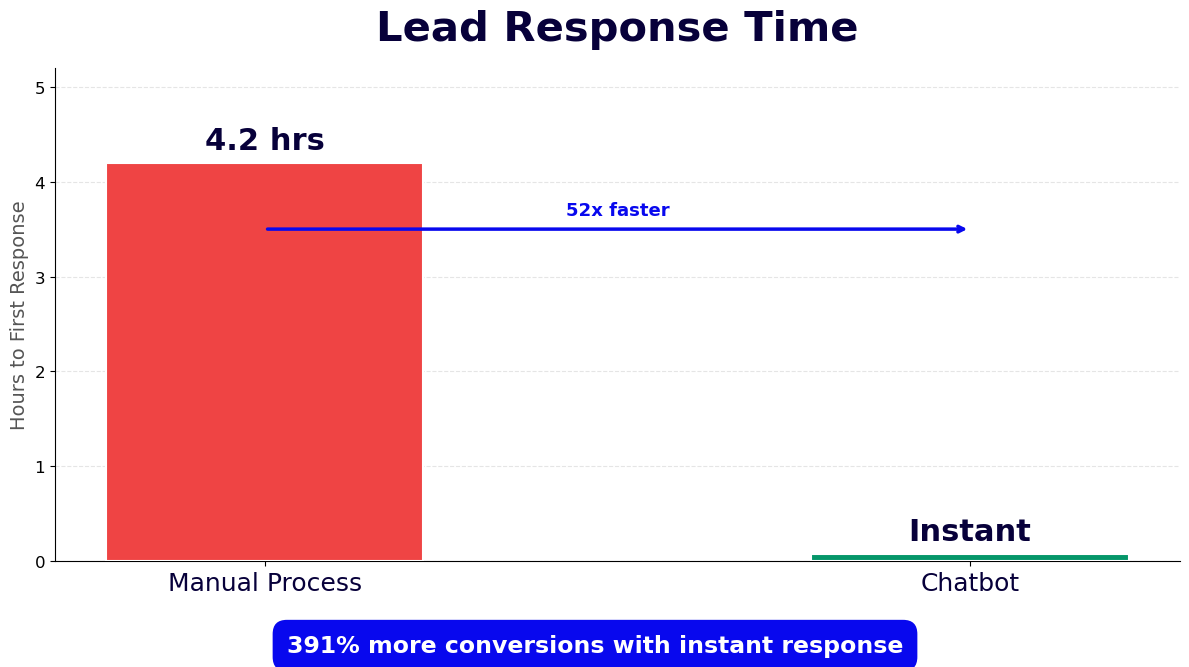
- Speed gap: A B2B qualification chatbot responds to inbound interest in under 30 seconds, 24 hours a day, including weekends and across time zones. Enterprise buyers who submit a contact form at 11pm on a Tuesday expect some form of immediate response — silence for 42 hours signals disorganization.
- Consistency gap: A chatbot applies the same firmographic filters, the same BANT questions, and the same scoring weights to every single lead. The account scoring data that flows into your CRM is comparable across every lead source, every rep, and every week of the year.
- Cost gap: Chatbot-based initial qualification costs a fraction of SDR-based qualification for the same volume. The economics improve further at scale — a chatbot handles 10x the volume of a human SDR with zero marginal cost increase.
Who This Template Is Built For
This template is designed for B2B organizations with deal sizes above $15,000 ACV, sales cycles longer than 45 days, and defined ICP criteria that can be evaluated through structured questions. It is particularly suited for enterprise SaaS vendors, managed service providers, professional services firms with retainer-based engagements, and technology infrastructure companies whose qualification criteria include technical environment, integration requirements, and organizational complexity. Explore Conferbot's AI chatbot builder to see the full capability set powering this template's enterprise qualification logic.
How It Works: Firmographic Data, BANT Scoring, and Account Routing
The B2B lead qualification chatbot operates through three sequential intelligence layers: firmographic data collection and enrichment, structured BANT scoring, and rule-based account routing to the appropriate sales motion. Each layer builds on the previous one, so routing decisions are grounded in both the hard account data and the prospect's expressed intent. Here is how all three layers work in practice.
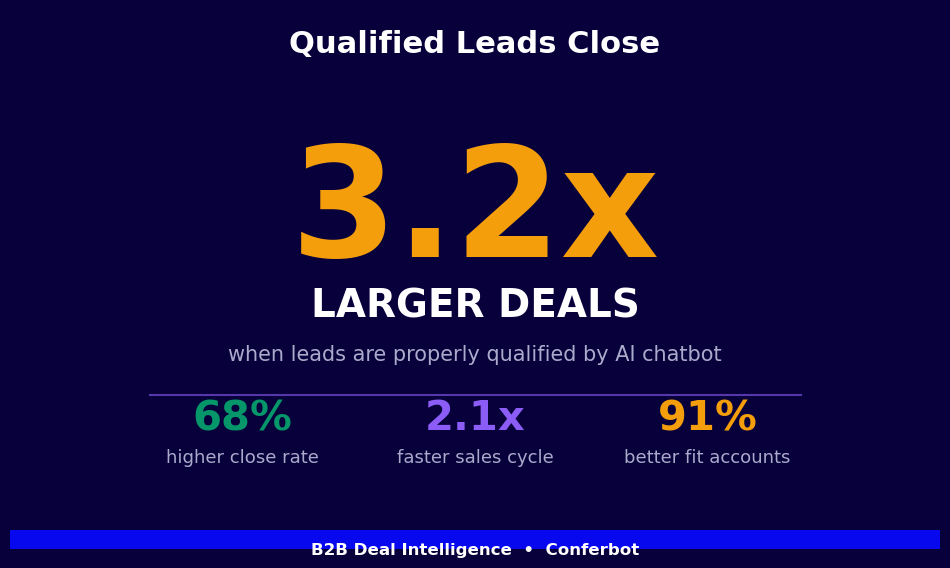
Layer 1: Firmographic Data Collection and Enrichment
Firmographic qualification begins before the first BANT question is asked. When a prospect initiates a chat session, the bot captures their business email address and passes it to Conferbot's API integration layer, which queries enrichment providers (Clearbit, Apollo, ZoomInfo, or your preferred data source) to retrieve company-level firmographic data: company name, industry, employee count, estimated annual revenue, technology stack, and geographic footprint. This data is used to pre-score the account and determine which BANT question path to follow — a 10-person startup gets a different qualification path than a 5,000-person enterprise.
Firmographic data enrichment reduces the question burden on prospects by eliminating questions the bot can answer automatically from third-party data. Instead of asking "How many employees does your company have?" — a question that many enterprise contacts consider a waste of their time when the answer is publicly available — the bot confirms the enriched data and asks the higher-value questions that cannot be inferred: budget cycle, technical requirements, and decision process.
Layer 2: BANT Scoring Framework
| BANT Dimension | Enterprise Question Approach | High Score (3 pts) | Medium Score (2 pts) | Low Score (1 pt) |
|---|---|---|---|---|
| Budget | "Do you have a budget allocated for this initiative, or is this in the exploration phase?" followed by range confirmation | Defined budget, within product pricing range, current fiscal year | Budget in planning for next fiscal year, directionally correct | No budget defined, needs executive approval, no timeline for budget cycle |
| Authority | "Who else will be involved in evaluating and approving this decision?" + "What is your role in the buying process?" | Economic buyer or VP-level champion with direct budget authority | Department head with strong influence, building internal business case | End user or analyst with no procurement authority or budget access |
| Need | "What is driving this evaluation right now?" + "What does the current state cost your organization?" | Active pain with quantified business impact, executive-sponsored initiative | Recognized need with informal internal support, future-state planning | Exploratory interest, no defined pain or business case in progress |
| Timeline | "When are you targeting to have a solution in production?" + "Is there a contract expiry or event driving your timeline?" | Decision required in under 60 days, clear forcing event | 60-180 day decision horizon, no hard deadline | No defined timeline, 6+ months out, or indefinitely exploratory |
Layer 3: Account Routing Logic
BANT scores are combined with firmographic data to produce a composite account score that drives routing:
- Enterprise High-Fit (Score 10-12, company size above 500 employees): Routes to a named enterprise AE with immediate calendar availability presented in-chat. Slack alert sent to AE and sales manager simultaneously. CRM Opportunity created at "Discovery Scheduled" stage.
- Mid-Market Qualified (Score 7-9, 50-500 employees): Routes to mid-market AE for follow-up within 2 hours during business hours. SDR enrolled in parallel to warm the account while calendar invite is arranged.
- Nurture Qualified (Score 4-6): Enters structured ABM nurture sequence. Account tagged for re-qualification in 60 days. Relevant content (case studies, ROI calculators) delivered immediately to maintain engagement.
- Disqualified: Accounts outside ICP criteria receive a tailored response explaining what would make a better fit, a relevant free resource, and a referral suggestion where applicable.
The routing logic integrates directly with Conferbot's omnichannel platform, so routing decisions are applied consistently whether the conversation originates from your website, a website chat widget, or an outbound campaign landing page.
Key Features: Multi-Stakeholder Scoring, ABM Signals, and Live Handoff
Enterprise B2B qualification demands features that go well beyond what a consumer-facing chatbot requires. Buying committees, multi-thread account coverage, account-based marketing signals, and live escalation to senior reps are table stakes for a qualification tool that can credibly serve an enterprise sales motion. Here is the complete feature set for the B2B lead qualification chatbot.
Feature Comparison: Manual SDR Qualification vs. Chatbot-Assisted Qualification
| Capability | Manual SDR Process | B2B Qualification Chatbot | Impact |
|---|---|---|---|
| Response time | 2-42 hours (business hours only) | Under 30 seconds (24/7/365) | 7x higher qualification rate for immediate responders |
| Firmographic enrichment | Manual LinkedIn/ZoomInfo lookup, inconsistent | Automatic via API on conversation start | 100% enrichment rate vs. 60-70% manual rate |
| Multi-stakeholder capture | Single contact captured, other stakeholders missed | Bot prompts for additional stakeholder names, emails, roles | 2-3x broader account coverage per opportunity |
| Scoring consistency | Varies by rep, seniority, and time of day | Identical scoring criteria for every conversation | Pipeline quality data becomes reliable and comparable |
| CRM data entry | Manual after call, often incomplete or delayed | Automatic at conversation end, 100% field completion | Eliminates 45-60 min/day of SDR admin per rep |
| Off-hours qualification | Voicemail or missed opportunity | Full qualification conversation completed, rep notified next morning | Captures 20-30% of leads that arrive outside business hours |
| ABM account matching | Not performed in real time | Matches inbound against target account list on conversation start | Priority accounts escalated immediately regardless of form-fill score |
Multi-Stakeholder Qualification
Enterprise deals are won or lost based on how broadly you engage the buying committee. A single champion who loves your product cannot close a deal when procurement, IT security, legal, and the CFO's office all have veto power. The B2B qualification chatbot captures the full stakeholder picture by asking directly: "Who else will be involved in evaluating this?" and "Is there a technical evaluator or IT stakeholder we should be in contact with?" Stakeholder names and roles captured in the chatbot feed directly into a CRM account structure with multiple contacts mapped to the opportunity.
ABM Target Account Recognition
For organizations running account-based marketing programs, the chatbot checks every inbound lead against your target account list in real time. When a prospect from a named target account initiates a conversation, they receive a differentiated experience: personalized greeting referencing their company, an expedited qualification path, and immediate routing to the dedicated AE or pod responsible for that account. Target account contacts skip standard qualification scoring and route directly to high-priority engagement.
Live Handoff to Senior AEs
When a high-value enterprise prospect asks a question the bot cannot answer — specific pricing for a complex configuration, detailed security compliance documentation, or executive-level reference requests — Conferbot's live chat integration escalates the conversation instantly to the on-call senior AE. The AE receives the full conversation transcript, the account's BANT score, and the enriched firmographic profile before sending a single message. Context preservation at handoff is the difference between a smooth enterprise experience and a frustrating repetition of information the prospect already provided.
Ready to try B2B Lead Qualification?
Deploy this template in under 10 minutes. No coding required.
Use This Template Free →CRM and ABM Platform Integration: Salesforce, HubSpot, and 6sense
A B2B lead qualification chatbot that does not integrate deeply with your revenue technology stack is just an expensive form. The qualification data the chatbot collects — firmographic profile, BANT scores, stakeholder map, conversation transcript — needs to flow into Salesforce or HubSpot as structured, queryable data. It needs to sync with ABM platforms like 6sense, Demandbase, or Terminus so account intent signals and chatbot qualification data are visible in a single account view. And it needs to trigger the downstream workflows that turn a qualified lead into a booked meeting. Conferbot's API integration architecture is built to support all of these connections without custom engineering.
Salesforce Integration: Object Mapping and Workflow Triggers
The Salesforce integration maps chatbot data to Salesforce's native object model:
- Lead and Contact objects: Net-new prospects are created as Leads. Existing Contacts are matched via email deduplication and enriched with new qualification data. Multi-stakeholder contacts from the same account are all created and linked to the parent Account record.
- Opportunity creation: Accounts scoring above the High threshold have Opportunities created automatically with Stage, Close Date (estimated from timeline score), and Amount (based on company size and product tier) pre-populated.
- Custom BANT fields: Budget score, authority level, need classification, and timeline score are written to custom Opportunity fields, enabling pipeline reporting by qualification quality.
- Task and activity logging: The chatbot conversation is logged as an Activity on the Lead/Contact, with the full transcript attached as a note. Follow-up tasks are auto-created and assigned to the routing-designated rep with a due date based on lead score tier.
- Salesforce Flows: Chatbot-created records can trigger any existing Salesforce Flow, enabling integration with territory assignment, deal desk approval, and forecast categorization automations already in your org.
HubSpot Integration: Lifecycle Stage and Sequence Enrollment
HubSpot integration follows the same data model adapted to HubSpot's contact and deal framework:
- Contact lifecycle stage: Chatbot-qualified leads are set to SQL (Sales Qualified Lead) or MQL based on score tier, bypassing the manual review step that typically delays lifecycle stage progression.
- Deal creation: High-scoring leads generate Deals in the configured pipeline stage with all BANT data mapped to deal properties.
- Sequence enrollment: Medium-scoring leads are enrolled in the appropriate HubSpot sequence immediately — an SDR follow-up sequence or an ABM nurture sequence depending on company size and score.
- Meeting logging: Meetings booked through the chatbot appear as HubSpot Meetings linked to the contact, deal, and company, with the chatbot session attached as an associated note.
ABM Platform Sync: 6sense, Demandbase, and Terminus
| ABM Platform | Chatbot Data Sent | ABM Data Received | Use Case |
|---|---|---|---|
| 6sense | Account domain, qualification score, conversation timestamp | Account intent tier, buying stage prediction, predicted close date | Prioritize chatbot follow-up against 6sense buying stage — High intent + High BANT = immediate AE outreach |
| Demandbase | Account firmographic data, qualification outcome | Engagement score, account journey stage, advertising exposure history | Suppress advertising spend on already-qualified accounts; intensify for High-BANT/Low-intent accounts |
| Terminus | Account ID, BANT tier, stakeholder contacts captured | Account engagement data, contact-level ad exposure | Sync chatbot-qualified contacts to Terminus for targeted outreach campaigns on unresponsive accounts |
For teams deploying across website and messaging channels, the WhatsApp integration extends enterprise qualification to the channel where a growing share of international B2B buyers prefer to communicate, with all qualification data flowing to the same CRM integration regardless of originating channel.
Use Cases by Company Size: Startup, Mid-Market, and Enterprise
B2B lead qualification logic cannot be one-size-fits-all. A startup with 8 employees qualifying for a $2,400/year SaaS tool has entirely different buying dynamics than a mid-market company of 300 people evaluating a $120,000 platform, or a Fortune 500 enterprise procuring a $2M managed services contract. Conferbot's B2B qualification template includes pre-configured qualification paths for each company-size segment, activated automatically based on firmographic enrichment data.
Startup and Small Business (1-50 Employees)
Startup qualification is fast and lightweight. Decision-making is concentrated (often 1-2 people), budget processes are informal, and deal cycles are short. The qualification path for this segment focuses on three questions: Is the pain real and active? Does the buyer have authority to purchase today? Is the budget range aligned to your SMB pricing tier? The chatbot completes startup qualification in 4-6 exchanges. Startups that score positively on all three factors are routed to a product-led growth motion — a free trial or self-serve onboarding — rather than a high-touch sales engagement, optimizing AE time for accounts with higher deal value. Startups that are too early or too small but show the right signals are enrolled in a founder-track nurture sequence for re-qualification when the company reaches a growth inflection point.
Mid-Market (51-500 Employees)
Mid-market qualification represents the highest-volume, highest-complexity segment for most B2B vendors. Decision-making involves multiple stakeholders (3-5 is typical), budget processes are semi-formal, and deal cycles run 60-120 days. The qualification path for this segment covers all four BANT dimensions in full, plus two additional questions: who else is involved in the evaluation, and what other solutions are being considered. Competitive intelligence captured at qualification — "We are also looking at [Competitor A] and [Competitor B]" — flows into the CRM as a structured field and triggers competitive battle card delivery to the AE. Mid-market accounts use the standard BANT routing described earlier, with qualified accounts routed to mid-market AEs and a concurrent SDR warm-up sequence.
Enterprise (500+ Employees)
Enterprise qualification is the most complex and the highest-stakes. The chatbot extends the standard BANT framework with enterprise-specific questions covering: executive sponsorship (is there a named C-suite or VP sponsor for this initiative?), procurement process (do you have a formal vendor evaluation process?), security and compliance requirements (are there specific certifications or data residency requirements?), and implementation resource availability (do you have internal IT resources allocated, or will this require a professional services engagement?). Enterprise accounts also receive the multi-stakeholder capture flow described in the features section, building out the full buying committee map in a single initial conversation.
Qualification Path Comparison by Segment
| Factor | Startup (1-50) | Mid-Market (51-500) | Enterprise (500+) |
|---|---|---|---|
| Number of qualification questions | 6-8 | 10-14 | 14-20 |
| Stakeholder capture | Primary contact only | Champion + 1-2 additional | Full buying committee map |
| Scoring framework | Simplified BANT (budget + need) | Full BANT | BANT + enterprise extensions |
| Routing outcome | Self-serve or SMB AE | Mid-market AE + SDR | Named enterprise AE + immediate escalation |
| Average conversation length | 3-5 minutes | 7-10 minutes | 10-15 minutes |
| CRM objects created | Contact + Deal | Contact + Deal + Tasks | Account + multiple Contacts + Opportunity + Tasks |
See how the qualification template integrates with broader demand generation programs in the lead generation templates library, including templates for inbound lead capture and outbound landing page qualification.
Pipeline Impact Data: What B2B Sales Teams Measure in 2026
Sales leaders evaluating a qualification chatbot investment need to understand impact across the full pipeline, not just the top-of-funnel metrics. The data below covers four impact areas — lead response speed, qualification accuracy, pipeline velocity, and AE efficiency — drawn from B2B sales teams that have deployed conversational qualification at scale.
Lead Response Speed and Qualification Rate
The relationship between response speed and qualification rate in B2B is well-documented. MIT research confirmed that contacting a web-generated lead within 5 minutes makes qualification 21x more likely than waiting 30 minutes. A chatbot that responds in under 30 seconds captures that speed advantage for every inbound lead, not just the ones that arrive during business hours when SDRs are at their desks.
For B2B organizations with significant inbound volume from international markets, the off-hours qualification rate is particularly impactful. EMEA and APAC prospects frequently initiate contact outside US business hours. Without a qualification bot, these leads wait 8-16 hours for any response. With the bot, they receive full qualification and, if qualified, a calendar booking option — turning time-zone friction into a qualification advantage.
Pipeline Quality and Conversion Metrics
| Pipeline Metric | SDR-Only Baseline | Chatbot-Assisted Qualification | Change |
|---|---|---|---|
| Inbound lead response time | Average 5.1 hours | Under 30 seconds | 99% faster |
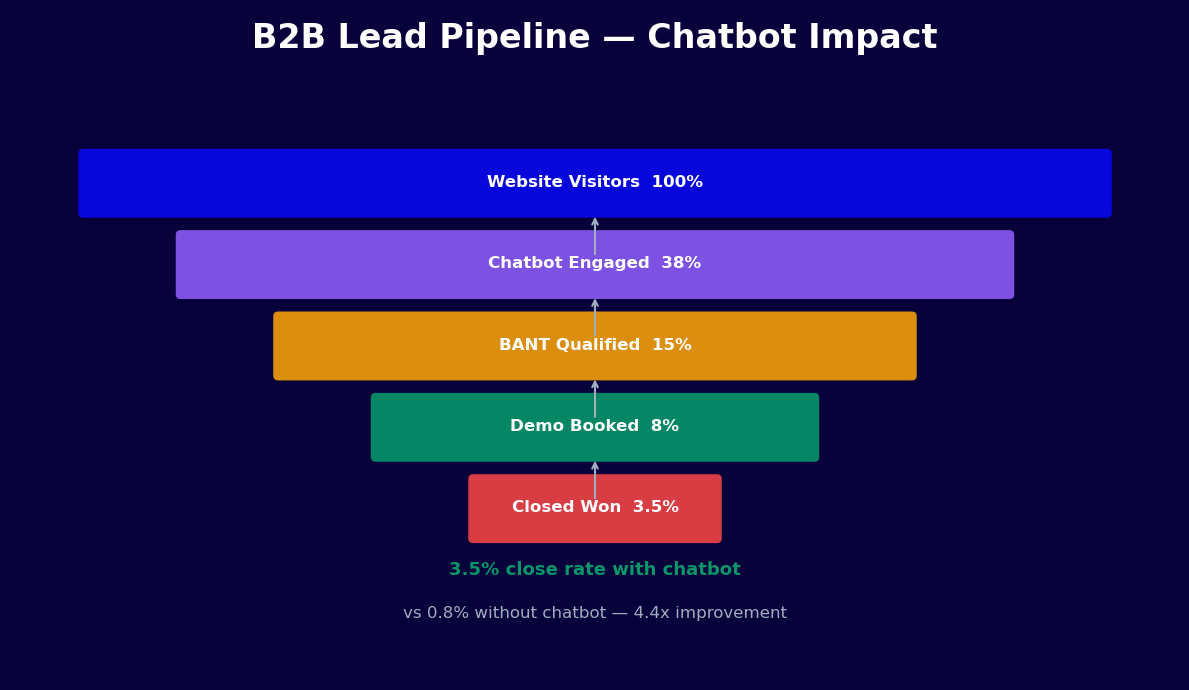
| MQL-to-SQL conversion rate | 11-16% | 26-34% | +15-20 percentage points |
| SQL-to-demo show rate | 56% | 76% | +20 percentage points |
| Average deal size (chatbot-qualified pipeline) | Baseline | +21% above baseline | Better ICP adherence filters smaller deals |
| Sales cycle length (qualified pipeline) | Baseline | 18% shorter | Earlier stakeholder mapping reduces late-stage surprises |
| Pipeline coverage ratio | 2.8x quota | 4.1x quota | 46% more qualified pipeline at same headcount |
| CRM data completeness | 62% of required fields populated | 97% of required fields populated | Reliable pipeline forecasting becomes possible |
AE Efficiency Impact
The efficiency argument for qualification automation centers on how AEs spend their time. In a typical SDR + AE model, AEs spend 30-40% of their time on discovery calls with prospects who were inadequately qualified — prospects who lack budget authority, are too early in their evaluation, or whose company profile falls outside the ICP. Chatbot-based qualification, because it applies rigorous scoring before any human time is invested, substantially reduces this waste.
Organizations that track this metric report that AEs in chatbot-assisted qualification programs spend 65-70% of their time on genuinely qualified opportunities versus 40-50% in SDR-only programs. For a quota-carrying AE, that additional productive time translates to 2-4 more demos per week — a 25-35% increase in deal creation velocity from the same headcount. At a $150,000 ACV average deal size and a 22% close rate, two additional demos per week per AE represents $1.5-2M in additional annual pipeline creation per rep.
ROI Calculation Model
For a 10-person AE team with 5 SDRs, 400 inbound leads/month, $120,000 average ACV, and a current 14% MQL-to-SQL rate: deploying a qualification chatbot that improves MQL-to-SQL to 30% produces 64 additional SQLs per month. At a 22% close rate, that is 14 additional closed deals per month. At $120,000 ACV, that is $1.68M in additional monthly recurring revenue from the same lead volume and same headcount. Review Conferbot pricing to model the ROI against your specific revenue metrics.
50,000+ businesses use Conferbot templates to automate conversations
Setup Guide: Deploying Your B2B Qualification Chatbot
The B2B lead qualification chatbot can be deployed end-to-end in under 90 minutes for most organizations. The setup process involves five phases: ICP definition, conversation configuration, firmographic enrichment setup, CRM integration, and channel deployment. Here is the complete guide.
Phase 1: Define Your ICP and Scoring Criteria (20 Minutes)
Before configuring the bot, document your ideal customer profile with explicit quantitative thresholds: minimum company size (employees or revenue), target industries, geographic coverage, technology requirements (must-have integrations, excluded platforms), and deal size range. Translate each ICP criterion into a pass/fail or scored chatbot question. For example: "Minimum company size: 100 employees" becomes the bot asking about team size with "under 50 employees" as an instant-disqualification trigger and "100-500 employees" as a Medium score for the enterprise path.
Define your BANT scoring weights. B2B organizations with long sales cycles and large deal sizes typically weight Authority and Timeline more heavily than budget (which is often not finalized until late in an enterprise evaluation). Organizations selling into budget-constrained markets weight Budget first. Document the weight assigned to each BANT dimension so the chatbot scoring configuration matches your sales team's actual qualification logic.
Phase 2: Configure Conversation Flows (25 Minutes)
Using Conferbot's AI chatbot builder, open the B2B Lead Qualification template and configure the conversation flows for each company-size segment. Key configuration steps:
- Firmographic branching: Set the employee-count thresholds that trigger each segment path (Startup / Mid-Market / Enterprise). These thresholds are applied automatically using enrichment data, but configure fallback questions for prospects whose enrichment data is unavailable.
- BANT question customization: Review each default BANT question and adjust for your product and market. Replace generic budget range examples with your actual pricing tiers.
- Multi-stakeholder prompts: Configure the stakeholder capture section to ask for the roles most relevant to your product category (IT security, legal, finance, etc.).
- Disqualification messaging: Write personalized disqualification responses for the most common out-of-ICP scenarios. A prospect who is too small today but growing should receive different messaging than a prospect in an excluded vertical.
Phase 3: Set Up Firmographic Enrichment (15 Minutes)
Connect your enrichment provider (Clearbit, Apollo, or ZoomInfo) via the Integrations panel. Configure the email capture trigger at the start of the conversation. Test enrichment against 5-10 known company emails to verify that company size, industry, and revenue data is returning correctly and mapping to the correct segment paths.
Phase 4: CRM Integration and Routing (20 Minutes)
Connect HubSpot or Salesforce via OAuth in the Integrations panel. Map each qualification data point to the appropriate CRM field. Configure routing rules: score thresholds, rep assignment logic (territory, round-robin, or named account), notification channels (Slack, email), and CRM object creation rules. Test with three qualification scenarios — High, Medium, and Disqualified — and verify that CRM records, deal/opportunity creation, and rep notifications all trigger correctly.
Phase 5: Channel Deployment (10 Minutes)
Deploy via the website embed snippet to your primary demand-generation pages: homepage chat widget, pricing page, demo request page, and contact page. For teams targeting international buyers, deploy to WhatsApp through the omnichannel settings. Configure channel-specific routing rules if different pages or channels should route to different sales teams. Run end-to-end tests across each deployed channel before marking the deployment live.
Multi-Stakeholder Qualification: Mapping Enterprise Buying Committees
Enterprise B2B deals are not won with a single champion. The average enterprise software purchase involves 6-10 stakeholders across functions — a business unit buyer who owns the problem, an IT evaluator who owns the technical assessment, a finance or procurement contact who owns the commercial process, a legal reviewer who owns the contract, and often a C-suite sponsor who provides organizational cover and budget authority. A qualification chatbot that captures only the initial inbound contact misses 80-90% of the stakeholder picture — and deals that reach late stages without identified stakeholders across all veto-holding functions are significantly more likely to stall or die.
The Buying Committee Mapping Conversation
The B2B qualification chatbot includes a dedicated buying committee mapping section for Enterprise-segment leads. After completing the core BANT questions, the bot asks a structured sequence of stakeholder discovery questions:
- Business owner: "Who owns the business outcome this solution needs to deliver? Is that you, or is there a business unit leader or VP we should connect with as well?"
- Technical evaluator: "Will there be a technical evaluation involving your IT or engineering team? Who typically leads that at your organization?"
- Finance/procurement: "Once you have identified a preferred vendor, what does the procurement and approval process look like? Is there a procurement team or CFO sign-off required?"
- Security/compliance: "Does your organization have a security review process for new software vendors? Who leads that, and do you have a standard vendor security questionnaire?"
- Executive sponsor: "Is there an executive at the VP or C-suite level sponsoring this initiative? Having executive alignment early typically helps us move faster and set more realistic timelines."
Stakeholder Data in CRM
Each stakeholder named during the conversation is captured as a separate CRM contact linked to the Account and Opportunity. Stakeholder role is captured as a structured field (Business Buyer / Technical Evaluator / Finance / Security / Executive Sponsor), enabling sales managers to see at a glance whether each veto-holding role has been identified and contacted. Opportunities with all five roles mapped close at significantly higher rates than those with only the initial champion contact — the chatbot's stakeholder mapping function directly addresses one of the most common causes of enterprise deal stall.
Persona-Specific Follow-Up Routing
Different stakeholders need different follow-up content and contacts. The chatbot's stakeholder routing logic ensures that:
- Technical evaluators are routed to a solutions engineer for a technical deep-dive, not an AE who cannot answer infrastructure questions
- Finance contacts receive commercial documentation (pricing model, ROI methodology, payment terms) before the first finance call
- Security reviewers are immediately connected with the security team and pre-filled with the vendor security questionnaire and SOC 2 documentation
- Executive sponsors receive an executive briefing deck and a request for an executive discovery conversation, separate from the technical evaluation track
This persona-specific routing, driven entirely by data collected in the initial qualification conversation, compresses enterprise evaluation cycles by running multiple evaluation tracks in parallel rather than sequentially. Connect the chatbot to your live chat platform so that technical evaluators who want to go deep immediately can be escalated to a solutions engineer in real time, while other stakeholder threads progress through asynchronous follow-up sequences. For teams deploying across channels, review the omnichannel documentation to configure stakeholder-specific routing across all active channels.
B2B Lead Qualification FAQ
Everything you need to know about chatbots for b2b lead qualification.
Why Use a Template vs Building from Scratch?
Templates encode years of optimization data into the conversation flow before you start.
| Factor | Conferbot Template | Build from Scratch | Hire a Developer |
|---|---|---|---|
| Time to deploy | 10 minutes | 2-8 hours | 2-6 weeks |
| Cost | Free | Your time | $5,000-$25,000 |
| Day-1 conversion | 15-22% | 5-8% | 10-15% |
| Proven flows | Yes, data-tested | No | Depends |
| Updates included | Automatic | Manual | Paid |
| Multi-channel | 8+ channels | 1 channel | Extra cost |
| Analytics | Built-in | Must build | Extra cost |
Related B2B Services Templates
Explore more chatbot templates in this category
Ready to Deploy B2B Lead Qualification?
Join 50,000+ businesses. Free forever plan available. No credit card required.