
Diet and Nutrition Advisor
Free Healthcare and Wellness Chatbot Template
Transform your health with Conferbot's Diet and Nutrition Advisor. Offering personalized meal plans, dietary advice, and real-time tracking, it empowers users to achieve their nutritional goals and improve overall well-being.
What Is a Diet and Nutrition Advisor Chatbot?
A diet and nutrition advisor chatbot is an AI-powered conversational tool that delivers personalized meal guidance, dietary analysis, and nutrition education to clients at any hour, without requiring a practitioner to be available for every interaction. It asks clients about their health goals, dietary preferences, food intolerances, and lifestyle, then generates individualized meal frameworks, macro targets, and food recommendations that align with evidence-based nutritional principles.
In 2026, the global wellness market exceeds $5 trillion. Registered dietitians, certified nutritionists, and wellness coaches are in high demand, yet the economics of one-on-one nutrition counseling limit how many clients a practitioner can serve. A single nutritionist can actively manage 30-50 clients before quality of service begins to degrade. A nutrition advisor chatbot changes that ratio entirely: it handles intake assessments, preference surveys, daily check-ins, meal plan delivery, and routine follow-up questions for hundreds of clients simultaneously, freeing the practitioner to focus on clinical judgment, complex cases, and program refinement.
This template is built for nutritionists, registered dietitians, wellness coaches, corporate wellness programs, and health-focused apps that need to deliver consistent, personalized dietary guidance at scale. It integrates with Conferbot's AI chatbot builder, uses NLP processing to understand nuanced dietary descriptions, and deploys on your website and WhatsApp within hours. No coding is required.
This page covers how the intake and personalization flow works, the nutritional logic engine, key features for practitioners and clients, integration with calendar booking for consultations, client engagement and retention data, a setup guide for nutrition practices, and compliance considerations for dietary advice.
How It Works: Intake, Personalization, and Meal Plan Delivery
The diet and nutrition advisor chatbot operates through a structured four-stage pipeline that transforms a new client inquiry into a personalized, actionable nutrition plan. Each stage is configurable for different practice models, dietary philosophies, and client populations.
Stage 1: Health and Goal Assessment
The conversation begins with a comprehensive intake that captures everything a nutritionist needs to build an informed plan. The chatbot collects the client's primary goal (weight loss, muscle gain, energy improvement, disease management, general wellness), current dietary pattern, health conditions that affect nutrition (diabetes, celiac disease, irritable bowel syndrome, cardiovascular disease), medications that interact with food or nutrients, height and weight for BMI and caloric baseline calculations, and activity level. This intake replaces the lengthy paper forms most nutrition practices use and produces a structured data record that the practitioner can review in seconds.
Stage 2: Dietary Preference and Restriction Mapping
After the health assessment, the chatbot conducts a detailed preference mapping. It asks about dietary patterns the client already follows or wants to follow (Mediterranean, plant-based, low-carb, intermittent fasting, whole foods), specific foods the client dislikes or cannot eat, allergy and intolerance details (lactose, gluten, tree nuts, shellfish), cooking skill level and time available for meal preparation, and budget constraints. The NLP engine interprets free-text responses to capture nuance: a client who says "I try to avoid processed foods but I travel a lot" is mapped to a different recommendation profile than one who says "I meal prep every Sunday." This preference profile ensures that recommendations the client receives are ones they can realistically follow.
Stage 3: Personalized Plan Generation
Using the intake data and preference profile, the chatbot generates a personalized nutrition framework. This includes daily caloric targets based on the client's basal metabolic rate and activity level, macronutrient distribution targets (protein, carbohydrate, and fat percentages) calibrated to the client's goal, a sample weekly meal structure with breakfast, lunch, dinner, and snack suggestions, a food list organized by food group with portion guidance, and a list of foods to limit or avoid given the client's health conditions and goals. The practitioner reviews and approves the generated plan before it is delivered to the client, maintaining clinical oversight while eliminating the time needed to build each plan from scratch.
Stage 4: Ongoing Check-Ins and Adjustment
The chatbot conducts automated daily or weekly check-ins to track progress and flag issues. It asks clients to log how closely they followed their plan, report any symptoms or energy changes, share weight or measurement updates, and ask questions that have come up during the week. Responses that indicate the client is struggling with adherence, experiencing adverse symptoms, or requesting a significant plan change are escalated to the practitioner for review. Routine questions -- "Can I substitute quinoa for brown rice?", "What can I eat before a morning workout?" -- are answered automatically by the chatbot using the knowledge base the practitioner has configured. See how chatbot analytics tracks client engagement rates, check-in completion, and adherence patterns across your entire client base.
Key Features of the Diet and Nutrition Advisor Chatbot
The nutrition advisor chatbot delivers its value through a feature set designed around the operational needs of nutrition practices and the behavioral needs of clients working to change their dietary habits.
| Feature | What It Does | Practitioner Benefit | Client Benefit |
|---|---|---|---|
| Automated intake assessment | Collects health history, goals, and preferences before first consultation | Enters each session with full client context | No repetitive paper forms |
| Personalized meal frameworks | Generates goal-aligned meal structures based on intake data | Drafts plans in minutes rather than hours | Receives a plan that fits their life, not a generic template |
| Automated check-ins | Daily or weekly progress prompts sent to clients automatically | Visibility into client adherence without manual follow-up | Stays accountable without scheduling a call |
| Food substitution Q&A | Answers common swap questions automatically from practitioner knowledge base | Reduces repetitive client messages by 60-70% | Gets instant answers to everyday questions |
| Symptom and reaction flagging | Escalates adverse reactions or concerning patterns to the practitioner | Early warning on clients who need clinical attention | Safety net for dietary changes |
| Consultation booking | Schedules follow-up sessions from within the chat | Converts engaged clients into booked appointments | Books sessions without leaving the platform |
| Multi-channel delivery | Runs on website, WhatsApp, and messaging apps | Reaches clients on the channels they use daily | Accesses guidance on any device |
| Progress tracking summaries | Compiles check-in data into weekly summaries for practitioner review | Reviews all clients in minutes rather than hours | Sees their own progress summarized clearly |
Nutritional Knowledge Base Configuration
The chatbot's Q&A capability is powered by a nutritional knowledge base that the practitioner configures. This knowledge base contains answers to the most common client questions across their specific practice scope: substitution options for common foods, pre- and post-workout nutrition guidance, meal timing recommendations, supplement basics, label reading tips, and practical advice for eating well while traveling or dining out. The practitioner builds this once and the chatbot applies it consistently across all client interactions. New questions that the chatbot cannot answer are flagged and added to the knowledge base after the practitioner responds, continuously expanding the system's coverage.
Calendar Booking Integration
When a client's check-in data or conversation indicates they need a real consultation -- they are not making progress, they have a complex dietary question, or they want to discuss their plan in detail -- the chatbot transitions into a booking flow using Conferbot's calendar booking integration. Available consultation slots are shown directly in the chat, the client books without leaving the conversation, and a calendar invite is sent automatically. This integrated booking captures consultation demand at the moment of highest client motivation, increasing scheduled session rates compared to sending clients to a separate booking page.
Ready to try Diet and Nutrition Advisor?
Deploy this template in under 10 minutes. No coding required.
Use This Template Free →Nutritional Logic: How the Chatbot Applies Evidence-Based Principles
A nutrition advisor chatbot is only clinically useful if the guidance it provides aligns with established nutritional science. This section explains the evidence-based frameworks built into the template and how practitioners configure the system to reflect their specific dietary philosophy and client population.
Caloric and Macronutrient Frameworks
The chatbot's foundational calculations are based on validated energy expenditure equations. Resting metabolic rate is estimated using the Mifflin-St Jeor equation, which remains the most accurate predictive formula for most adult populations according to current research. Activity multipliers are applied based on the client's reported exercise frequency and intensity. The resulting total daily energy expenditure is adjusted upward or downward based on the client's goal: a 10-20% deficit for gradual weight loss, a 10-15% surplus for muscle gain, or maintenance calories for performance and wellness goals.
Macronutrient distribution defaults are evidence-based starting points rather than fixed prescriptions. For general wellness, the chatbot defaults to ranges consistent with dietary guidelines: 45-65% carbohydrates, 20-35% fats, 10-35% protein. For specific goals, the defaults shift: higher protein targets for muscle gain clients, reduced refined carbohydrate guidance for clients with insulin resistance, and modified fat ratios for cardiovascular health goals. Each of these defaults is configurable by the practitioner to reflect their clinical approach.
Dietary Pattern Support
| Dietary Pattern | Primary Evidence Base | Chatbot Support | Key Customization Points |
|---|---|---|---|
| Mediterranean | Cardiovascular and cognitive health outcomes | Full meal framework and food lists | Olive oil emphasis, fish frequency, legume proportion |
| Plant-based / Vegan | Environmental and chronic disease prevention | Complete protein combination guidance, B12/iron/omega-3 flags | Protein source diversity, supplement recommendations |
| Low-carbohydrate | Metabolic health and weight management | Carb threshold tracking, fat source quality guidance | Carb ceiling, ketogenic vs. moderate-low distinction |
| DASH | Hypertension management | Sodium tracking, potassium-rich food emphasis | Sodium target, dairy inclusion, meal structure |
| Anti-inflammatory | Chronic inflammation and autoimmune support | Food polarity lists, omega-3 to omega-6 ratio guidance | Specific inflammatory trigger exclusions |
Practitioner Override and Clinical Authority
The chatbot is designed as a tool that supports practitioner judgment, not one that replaces it. Every generated plan is presented to the practitioner for review before delivery to the client. The practitioner can edit any element of the generated framework -- caloric targets, food inclusions, meal timing, supplementation notes -- and add clinical commentary. When a client's check-in data suggests a change to the plan is needed, the chatbot flags the change for practitioner review rather than making autonomous adjustments. This structure maintains full clinical authority with the practitioner while leveraging the chatbot for the high-volume, routine interactions that consume practitioner time without requiring clinical judgment.
Connect client nutrition data to your broader practice analytics through Conferbot's analytics dashboard, which tracks intake completion rates, check-in engagement, adherence self-reporting, and consultation conversion across your client base.
Client Engagement and Retention in Nutrition Coaching
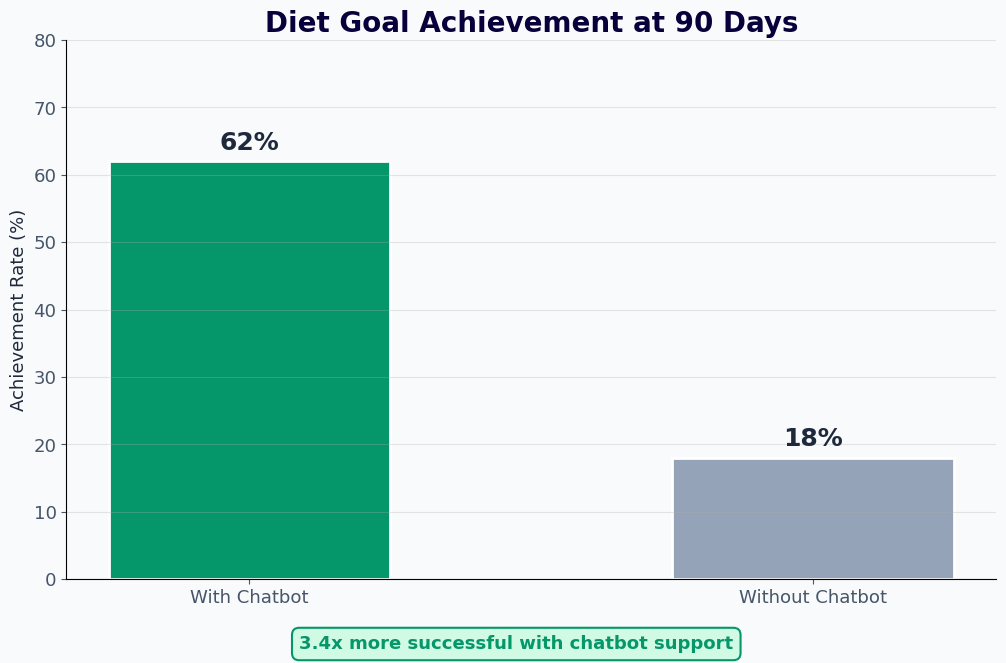
The clinical effectiveness of a nutrition program is directly correlated with client adherence and engagement. A plan that is scientifically sound but ignored produces no outcomes. The diet and nutrition advisor chatbot is specifically designed to drive the engagement behaviors that support dietary behavior change: regular check-ins, timely question answering, accountability nudges, and easy access to guidance at the moment it is needed.
The Adherence Problem in Nutrition Coaching
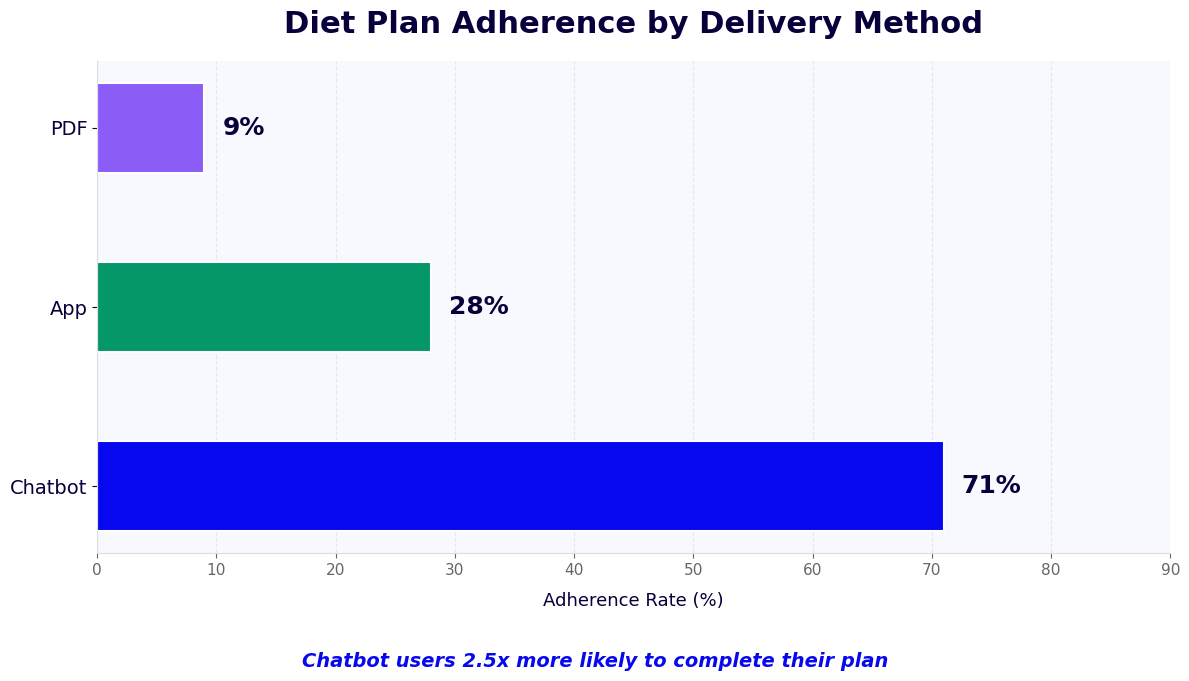
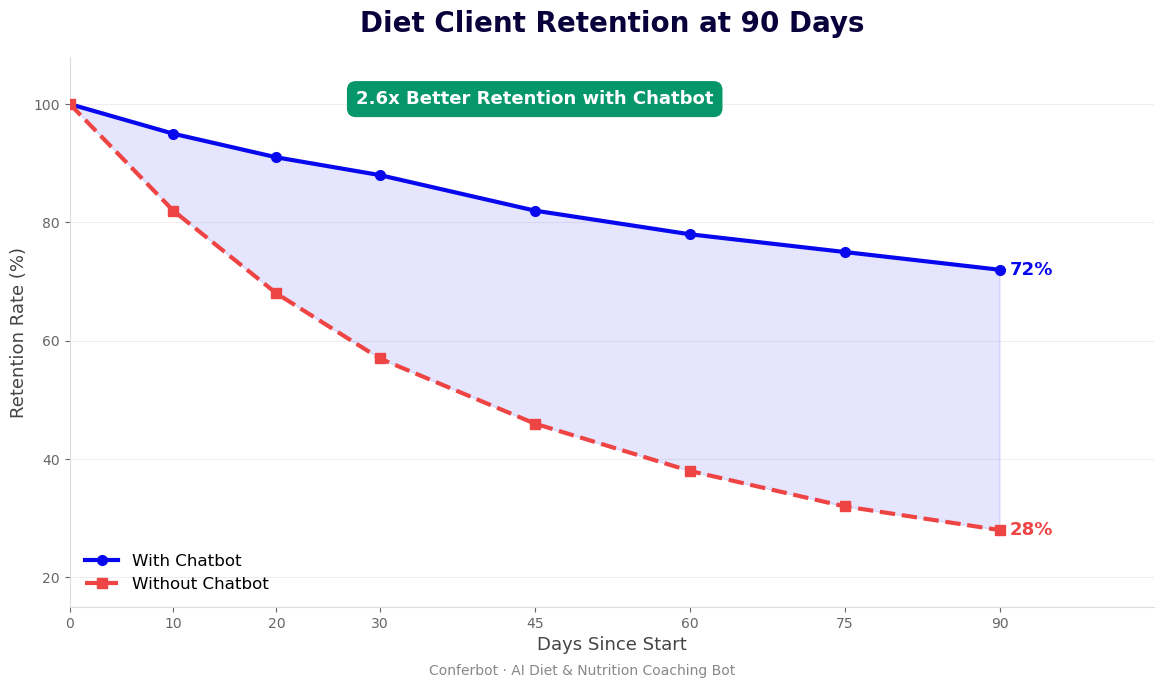
Dietary adherence is the single greatest predictor of program outcomes. Research consistently shows that clients who maintain daily engagement with their nutrition program -- whether through journaling, check-ins, or practitioner contact -- achieve significantly better outcomes than those who only interact at scheduled appointments. In 2026, the average nutrition coaching program sees 40-60% of clients disengage within the first month, primarily because the gap between scheduled sessions is too long and questions go unanswered for days. A chatbot eliminates the response latency that drives disengagement.
Engagement Metrics Comparison
| Engagement Metric | Without Chatbot | With Chatbot | Improvement |
|---|---|---|---|
| Daily check-in completion rate | 18-25% | 55-70% | 3x improvement |
| 30-day program retention | 45-55% | 72-82% | 40-50% higher |
| Time to first practitioner question (new client) | 1-3 days | Same session | Immediate onboarding |
| Unanswered client questions per week | 3-8 per client | Under 1 per client | 85% reduction |
| Follow-up consultation booking rate | 35-42% | 58-68% | 60% higher conversion |
| Client-reported satisfaction (program) | 3.4/5 | 4.3/5 | 26% improvement |
Behavioral Nudges and Motivation
Beyond data collection, the chatbot provides motivational support between sessions. It sends congratulatory messages when clients report a successful check-in week, offers practical encouragement when clients report difficulty, and provides contextual education -- a brief explanation of why protein timing matters, a reminder about hydration targets, or a tip for navigating a social eating situation -- without requiring the practitioner to draft individual messages. These nudges are configurable: the practitioner sets the tone (motivational, educational, clinical, conversational) and the frequency, and the chatbot delivers them consistently to every client.
WhatsApp Engagement for Mobile-First Clients
The majority of clients engage with wellness programs primarily on mobile devices. Deploying the nutrition advisor on WhatsApp puts daily check-ins, meal questions, and plan access inside the messaging app clients already use for personal communication. WhatsApp-based check-ins show 2-3x higher completion rates than email-based check-in forms, because the barrier to responding to a WhatsApp message is far lower than opening an email, navigating to a form, and submitting it. For nutrition programs targeting behavioral change, this friction reduction translates directly into better outcomes data and higher client satisfaction. Connect WhatsApp and your website into a unified client experience through Conferbot's omnichannel platform.
Use Cases: Nutritionists, Wellness Coaches, and Corporate Programs
The diet and nutrition advisor chatbot template adapts to the operational model of several distinct nutrition and wellness practice types. Here are the primary use cases and how the configuration differs across each context.
Individual Nutrition Practice
For solo or small-group registered dietitians and nutritionists, the chatbot functions as a virtual practice manager. It handles new client intake and onboarding so practitioners arrive at first consultations fully briefed. Between sessions, it manages daily check-ins, answers routine food questions, and collects progress data. The practitioner reviews a weekly summary of client activity rather than individual messages, cutting administrative time by 8-12 hours per week. Consultation booking is embedded in the chatbot, converting engaged clients into booked appointments without any scheduling friction. A solo nutritionist using the chatbot can comfortably manage 80-120 active clients rather than the 30-50 typical without automation.
Wellness Coaching Programs
Wellness coaches who deliver nutrition guidance as part of a broader lifestyle program use the chatbot to deliver the nutrition component at scale while reserving their one-on-one time for behavioral coaching, mindset work, and accountability conversations. The chatbot handles meal planning Q&A, food logging prompts, and educational content delivery. The coach is notified when a client's nutrition data suggests they are struggling or when a question falls outside the chatbot's configured scope. This division of labor lets wellness coaches expand their client capacity without compromising the depth of the coaching relationship.
Corporate Wellness Programs
Employers running employee wellness programs use the nutrition advisor chatbot to deliver dietary guidance to large employee populations without requiring proportional dietitian headcount. The chatbot conducts annual health risk assessments, delivers personalized nutrition guidance based on each employee's health profile, runs seasonal healthy eating challenges, and provides on-demand food and meal guidance. Aggregate engagement and health outcome data is available to wellness program administrators through the analytics dashboard, enabling program effectiveness reporting. The chatbot deploys on the corporate wellness portal and through WhatsApp for employees who prefer mobile access.
Health and Fitness Apps
Digital health applications that include a nutrition feature use the chatbot template as the conversational layer for meal planning and dietary guidance. Rather than building custom AI flows from scratch, the app team configures Conferbot's template to match their app's dietary philosophy, user language, and feature set. The chatbot's API integration capabilities allow it to read data from food logging components and wearable integrations to provide contextually informed recommendations based on the user's actual intake and activity data rather than self-reported estimates alone.
50,000+ businesses use Conferbot templates to automate conversations
Setup Guide: Launching Your Nutrition Advisor Chatbot
Deploying a diet and nutrition advisor chatbot with Conferbot requires no technical background. A nutrition practitioner or practice manager can configure, test, and launch a fully functional system in one working day. Here is the step-by-step process.
Step 1: Select the Template and Define Scope (30 Minutes)
Start from the Diet and Nutrition Advisor template in the Conferbot template library. Before customizing, define the scope of the chatbot's guidance: which dietary patterns will you support, what health conditions are within scope for dietary guidance, and what conditions require a referral to a physician rather than dietary recommendations. Document these scope boundaries because they will guide every configuration decision that follows. Practitioners who serve a specific clinical population (diabetes management, eating disorder recovery, oncology nutrition) should narrow the scope accordingly and configure the chatbot to escalate any question outside that scope immediately.
Step 2: Configure the Intake Assessment (1-2 Hours)
Customize the intake assessment questions to match your practice's onboarding protocol. Add any questions specific to your client population that are not in the default template -- specific lab values you routinely review, particular lifestyle factors relevant to your specialty, or intake scales you use for dietary assessment. Set up branching logic so the chatbot asks follow-up questions based on answers: a client who indicates diabetes triggers additional questions about medication, blood glucose monitoring, and carbohydrate awareness. Test the intake flow thoroughly from the client's perspective before proceeding.
Step 3: Build the Nutritional Knowledge Base (2-4 Hours)
The knowledge base is where you invest the most setup time, and it is the component that delivers the most ongoing value. Write answers to the 50-100 questions your clients ask most frequently: common food substitutions, meal timing questions, alcohol and special occasion guidance, travel and restaurant navigation, supplement basics, label reading, and preparation tips. Organize answers by topic category so the NLP engine can retrieve the right answer reliably. Export existing FAQ documents, email templates, or client handouts as a starting point rather than writing from scratch.
Step 4: Connect Calendar Booking (30 Minutes)
Link your consultation calendar through Conferbot's calendar booking integration. Configure which appointment types appear in the chatbot (initial consultation, follow-up session, plan review), set buffer times between appointments, and define availability windows. Test the booking flow to confirm calendar invites are generated correctly and availability is updating in real time. Set up escalation triggers so the chatbot offers a booking prompt automatically when a client's check-in data indicates they need a real session.
Step 5: Deploy and Test (1 Hour)
Generate the website embed code and place it on your practice website, client portal, or landing page. Configure the WhatsApp channel through Conferbot's omnichannel settings for clients who prefer mobile engagement. Run a complete test conversation from intake through check-in to consultation booking, including a simulated adverse symptom flag to confirm the escalation path works correctly. Verify that the practitioner review queue is receiving intake summaries and check-in alerts as expected. After launch, monitor the analytics dashboard weekly and expand the knowledge base based on questions the chatbot is unable to answer in the first weeks of operation.
Compliance and Scope-of-Practice Considerations
Deploying a nutrition advisor chatbot requires careful attention to the legal and ethical boundaries that govern dietary advice. These boundaries vary by jurisdiction, practitioner credential type, and the health status of the client population being served. This section covers the primary compliance considerations for nutrition practices deploying AI-assisted guidance tools.
Scope of Practice by Credential Type
Registered dietitians, certified nutritionists, health coaches, and wellness coaches operate under different legal scopes of practice that determine what dietary guidance they can provide. In the United States, the practice of medical nutrition therapy -- providing dietary treatment for diagnosed medical conditions -- is restricted to licensed registered dietitians in most states. A health coach chatbot can provide general wellness and healthy eating guidance but cannot provide therapeutic dietary prescriptions for diagnosed conditions. The chatbot must be configured to match the credential and scope of the practitioner deploying it, with appropriate escalation and referral language for questions that fall outside that scope.
Disclaimer and Transparency Requirements
Every interaction in which the chatbot provides dietary guidance should include clear disclosure that the guidance is informational, not a substitute for personalized medical or clinical nutrition advice, and that clients with diagnosed medical conditions should consult a licensed healthcare provider. These disclaimers should appear at the start of the intake flow, at the delivery of any meal plan, and in any check-in that surfaces concerning symptoms. The template includes configurable disclaimer text that practitioners can adapt to match their jurisdiction's requirements and their legal counsel's guidance.
Data Privacy for Health Information
Nutrition chatbots collect health-related personal data: medical conditions, medications, body measurements, and dietary health history. The applicable data privacy regulations depend on how this data is classified in the practitioner's jurisdiction. In the United States, nutrition coaching data may or may not constitute protected health information under HIPAA depending on the nature of the practitioner-client relationship. In the EU, this data is classified as sensitive personal data under GDPR and requires explicit consent and appropriate technical safeguards. Conferbot's platform supports GDPR-compliant consent flows, data retention configuration, and right-to-deletion requests. Practitioners operating in HIPAA-covered contexts should execute a Business Associate Agreement with Conferbot and configure data handling to meet their compliance requirements. Use the analytics dashboard to maintain records of client consent and data access for audit purposes.
Diet and Nutrition Advisor FAQ
Everything you need to know about chatbots for diet and nutrition advisor.
Why Use a Template vs Building from Scratch?
Templates encode years of optimization data into the conversation flow before you start.
| Factor | Conferbot Template | Build from Scratch | Hire a Developer |
|---|---|---|---|
| Time to deploy | 10 minutes | 2-8 hours | 2-6 weeks |
| Cost | Free | Your time | $5,000-$25,000 |
| Day-1 conversion | 15-22% | 5-8% | 10-15% |
| Proven flows | Yes, data-tested | No | Depends |
| Updates included | Automatic | Manual | Paid |
| Multi-channel | 8+ channels | 1 channel | Extra cost |
| Analytics | Built-in | Must build | Extra cost |
Related Healthcare and Wellness Templates
Explore more chatbot templates in this category



Ready to Deploy Diet and Nutrition Advisor?
Join 50,000+ businesses. Free forever plan available. No credit card required.