
Pest Control Appointment Setter Chatbot
Free Home Services Chatbot Template
A pest control booking chatbot that helps homeowners identify pest problems, assess severity, and schedule inspection appointments. It collects property details and contact information to connect users with qualified pest control technicians. Perfect for pest control companies, property management firms, and home service platforms looking to automate lead capture and appointment scheduling.


What Is a Pest Control Appointment Setter Chatbot?
A pest control appointment setter chatbot is an AI-powered conversational tool that automates lead capture and appointment scheduling for pest control and extermination businesses. It handles inbound service inquiries at any hour, qualifies the pest problem, collects property information, quotes service options, and books appointments with the appropriate technician -- all without a dispatcher or office manager involvement for standard residential and commercial service requests.
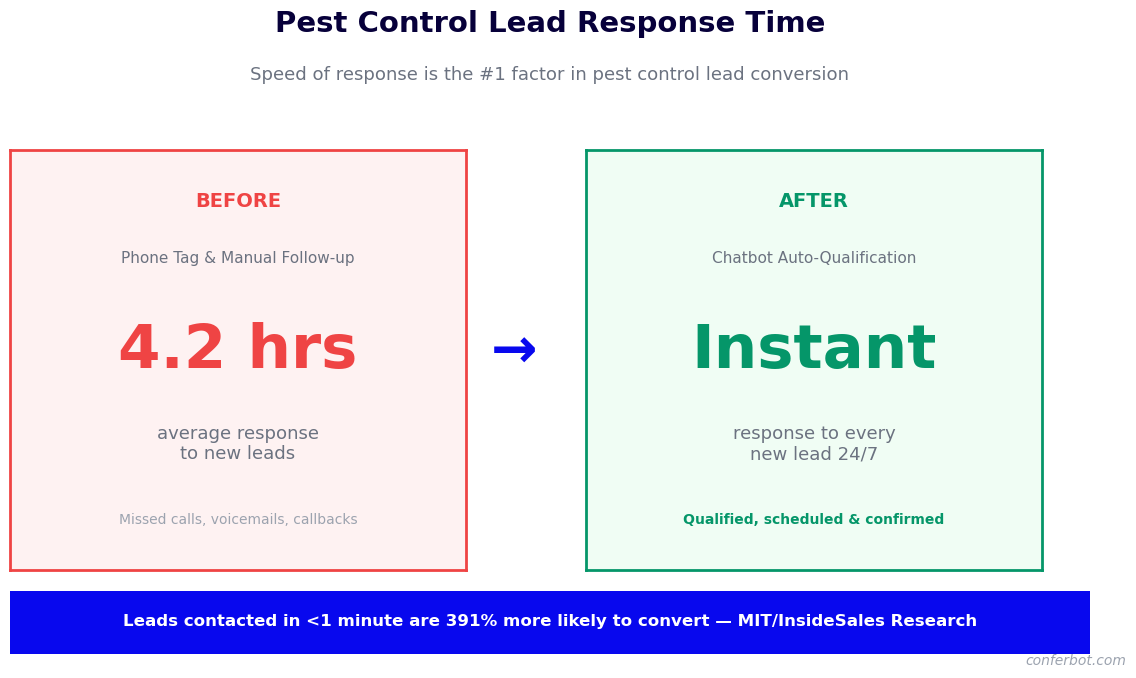
Pest control is a business where response speed directly determines conversion rate. A homeowner who discovers a rodent in their kitchen at 10 PM or a business owner who finds cockroaches before opening is not waiting until morning to call -- they are searching online right now and will book with the first pest control company that responds. In 2026, pest control companies that can capture and respond to these off-hours inquiries automatically book 30-40% more jobs than competitors who only answer phones during business hours. The chatbot is that always-on response layer.
Beyond emergency response, the chatbot serves the full range of pest control service inquiries: routine prevention treatments, new customer onboarding, annual service plan enrollment, commercial account setup, and re-treatment requests for existing customers. For each inquiry type, the chatbot qualifies the service need, presents the appropriate service options with pricing, and books the appointment -- or escalates to a human technician for complex commercial accounts or unusual pest situations that require a site assessment before quoting.
Built on Conferbot's AI chatbot builder with NLP processing, the pest control chatbot deploys on your website and WhatsApp without engineering resources. It integrates with field service management software to check technician availability and book jobs directly into the schedule. This page covers the service qualification flow, lead capture mechanics, integration with scheduling systems, service plan upsell sequences, and a setup guide for pest control operators.
How the Pest Control Chatbot Works: Lead Qualification to Booked Job
The pest control appointment setter follows a structured conversation flow designed around the specific questions a dispatcher asks every service call: What pest? How many? Where in the property? What type of property? What is the urgency? Here is how each stage operates in 2026.
Stage 1: Pest Identification and Problem Qualification
The chatbot opens by asking about the pest problem the customer is experiencing. Customers can describe their situation in natural language -- "I saw a mouse in my kitchen last night," "there are ants coming in through my bathroom," "I think I have termites in my deck" -- and Conferbot's NLP engine identifies the pest type and maps it to the appropriate service category. For customers who are not sure what pest they have, the chatbot offers a guided identification flow: "Where are you seeing the problem?", "What does it look like?", "Have you noticed any droppings or damage?" This identification conversation qualifies the job type before any scheduling occurs, ensuring the technician dispatched has the right training and equipment for the specific pest problem.
Stage 2: Property and Infestation Assessment
The chatbot collects property information needed to scope the job and provide accurate pricing: property type (single-family residential, multi-family, commercial, industrial), property size, construction type for termite treatment scoping, the specific area of the infestation, and severity indicators (single sighting, recurring problem, evidence of significant infestation). For rodent problems, it asks about entry point locations and evidence of nesting. For termite inquiries, it asks about the type of wood construction and whether there is a crawl space or basement. This property assessment data is passed to the technician before the appointment, allowing them to arrive with the right materials and treatment plan rather than arriving to assess and then returning to treat.
Stage 3: Service Option Presentation and Pricing
Based on the pest type and property assessment, the chatbot presents the appropriate service options with pricing. For standard residential pests, this includes a one-time treatment option and a recurring service plan with pricing per visit and the total annual cost comparison. The chatbot explains the guarantee terms for each option -- most pest control companies offer re-treatment guarantees for service plan customers but not for one-time treatments -- and the benefits of the plan relative to the one-time treatment. This structured presentation consistently increases service plan enrollment rates compared to quoting one-time treatments only and then mentioning the plan as an afterthought.
Stage 4: Appointment Booking and Confirmation
The chatbot checks technician availability through the calendar integration for the customer's location and presents available appointment windows. The customer selects their preferred window, provides any access instructions (gate codes, pet information, preferred entry point), and receives an immediate confirmation with the appointment details, the technician's name, and preparation instructions for the treatment type selected. For recurring service plan customers, the chatbot books the first appointment and sets up the recurring schedule simultaneously. Appointment reminders are sent automatically at 24 hours and one hour before the service window. Track booking volume, job type distribution, and service plan conversion through Conferbot's analytics dashboard.
Key Features of the Pest Control Appointment Setter
The pest control chatbot's feature set covers the complete customer journey from initial inquiry to recurring service relationship, with capabilities specific to pest control business operations.
| Feature | What It Does | Business Benefit | Customer Benefit |
|---|---|---|---|
| 24/7 lead capture | Responds to pest inquiries at any hour and books appointments | Captures 30-40% more jobs from off-hours inquiries | Gets an immediate response to an urgent pest problem |
| Pest identification flow | Guides unsure customers through pest identification | Qualifies job type before dispatch | Gets professional guidance on what pest they have |
| Property assessment | Collects property type, size, and infestation details | Technicians arrive prepared with right materials | Accurate quote based on actual property details |
| Service plan presentation | Compares one-time treatment vs. recurring plan with total cost | Higher service plan enrollment vs. one-time treatment | Understands the value of preventive service before deciding |
| Real-time scheduling | Checks technician availability and books into the schedule directly | No double-bookings, no dispatcher involvement | Immediate appointment confirmation without calling back |
| Service zone routing | Routes bookings to the nearest qualified technician by zip code | Optimized dispatch without manual routing | Appointment with the technician covering their area |
| Pre-service preparation instructions | Sends preparation requirements specific to the treatment type | Fewer wasted appointments due to unprepared properties | Knows exactly what to do before the technician arrives |
| Re-treatment request handling | Processes re-treatment requests for existing service plan customers | Handles common customer service request without staff | Books re-treatment in minutes without waiting on hold |
Emergency Same-Day Dispatch
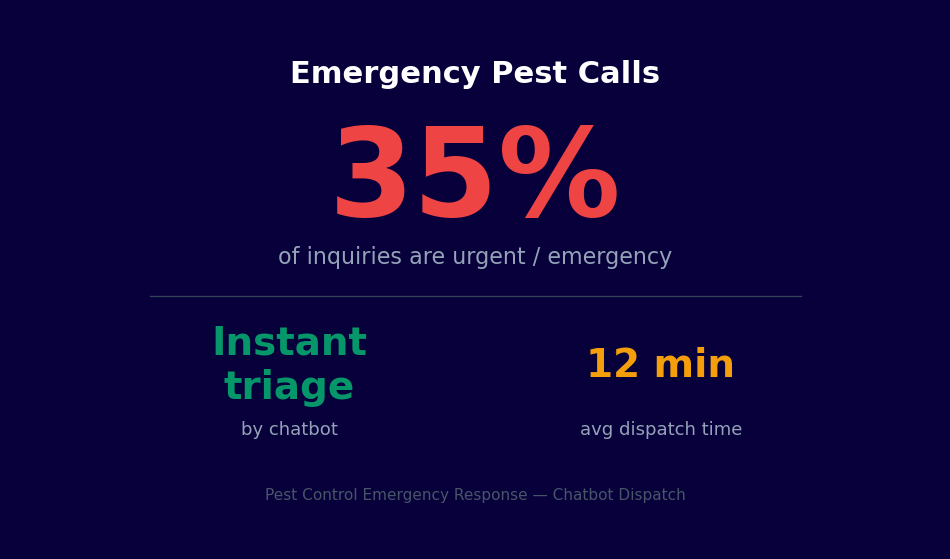
For pest situations the customer describes as urgent -- a commercial kitchen with an active rodent problem, a bed bug discovery, a wasp nest in a high-traffic area -- the chatbot identifies the urgency indicators and routes to a same-day or next-available emergency dispatch pathway. The customer is presented with the same-day availability and the emergency service pricing, and the booking triggers an immediate notification to the on-call technician or dispatcher. This emergency response capability is one of the primary competitive differentiators for pest control companies in markets where competitor response times for emergency requests are measured in days.
Ready to try Pest Control Appointment Setter Chatbot?
Deploy this template in under 10 minutes. No coding required.
Use This Template Free →Service Plan Enrollment and Customer Retention
Service plan customers are the most valuable customer segment in pest control -- they generate predictable recurring revenue, have higher lifetime value than one-time customers, and refer new customers at higher rates. The appointment setter chatbot is a powerful service plan enrollment tool because it presents the plan comparison at the moment of highest motivation: when the customer has just described an active pest problem and is already planning to book a treatment.
Service Plan Comparison and Value Presentation
The chatbot presents the one-time treatment and recurring service plan comparison with a structured value analysis: the per-treatment cost under the plan versus the one-time treatment cost, the number of treatments included annually, the guarantee coverage that comes with plan membership, and the total annual cost. For a customer paying $150 for a one-time treatment with no guarantee versus $45 per quarter for four annual treatments with unlimited re-treatments under a service plan, the plan comparison makes the value calculation straightforward. This structured presentation consistently outperforms verbal plan pitches by service technicians, who often skip the plan offer or present it less compellingly when they are focused on completing the treatment.
Seasonal Treatment Upsell Campaigns
For existing customers on service plans, the chatbot drives seasonal upsell campaigns: mosquito treatment add-ons in spring, bed bug inspections for customers returning from summer travel, rodent exclusion services in fall before mice begin seeking indoor harborage. These seasonal upsell conversations are sent proactively to the relevant customer segments via WhatsApp or email, presenting the add-on service with a direct booking link. Customers respond to these proactive service reminders at significantly higher rates than they do to generic promotional emails, because the seasonal context is relevant and the booking requires minimal friction.
Renewal and Reactivation Campaigns
For lapsed service plan customers -- those whose plans expired and were not renewed -- the chatbot manages reactivation campaigns that present renewal offers with re-enrollment incentives. These campaigns are triggered automatically at 30, 60, and 90 days after plan expiration, with the offer value increasing at each interval. For one-time treatment customers who have never enrolled in a plan, the chatbot triggers a follow-up conversation at 30 days post-treatment asking whether they are still pest-free and presenting the service plan as ongoing prevention. This follow-up sequence converts one-time customers to plan members at rates of 15-25% when executed with the right timing and offer. Connect service plan renewal data to your CRM through Conferbot's API integration.
Commercial Account Development
Commercial pest control accounts -- restaurants, hotels, food processing facilities, property management companies -- represent the highest-value customer segment for many pest control businesses, but require a different sales process than residential service. The chatbot qualifies commercial inquiries by collecting the business type, facility size, regulatory compliance requirements (HACCP, FDA, local health department), and current pest management provider. This qualification data is routed to a commercial account manager for follow-up rather than attempting to close a complex commercial contract through the chatbot. The chatbot's role in commercial sales is lead qualification and appointment scheduling for the commercial assessment visit, not attempting to close the account through the chat interface.
Integration with Field Service Management Software
The pest control appointment setter's scheduling capabilities depend on integration with the field service management platform the business uses to manage technician schedules, job records, chemical usage logs, and customer service history. This integration is what converts a chatbot appointment from a customer promise into an actual dispatched job in the technician's schedule.
Scheduling Integration
Conferbot integrates with major field service management platforms used in the pest control industry through the calendar booking and API integration features. When the chatbot books an appointment, the job is created directly in the field service platform with all qualifying information populated: customer contact information, address, property details, pest type, service selected, and any access instructions or special notes. The technician's schedule is updated in real time, and any scheduling conflicts are detected and resolved before the booking confirmation is sent to the customer.
Customer History Lookup
For returning customers, the chatbot queries the field service management platform to retrieve the customer's service history: previous treatments, service plan status, past pest issues, and any outstanding re-treatment guarantees. This history lookup allows the chatbot to provide personalized responses: "I can see you had a rodent treatment in October -- are you seeing new activity, or is this a re-treatment request?" This personalization improves the customer experience and reduces the need for the customer to explain their history from scratch on every contact.
| Integration Type | Data Exchanged | Automation Enabled |
|---|---|---|
| Field service platform | Job creation, technician availability, customer history | Appointment booking, dispatch notification, job status updates |
| CRM | Lead records, service plan status, contact details | Lead scoring, renewal campaign triggers, upsell sequences |
| Payment processor | Treatment quotes, plan pricing, payment capture | Prepayment for bookings, service plan billing setup |
| Routing software | Customer address, service zone, technician location | Optimized technician routing, service zone assignment |
Post-Service Follow-Up Automation
After each service visit, the chatbot sends an automated follow-up: a service completion confirmation with the treatment details and any observations noted by the technician, a satisfaction survey, and a re-treatment guarantee reminder for service plan customers. The follow-up timing is triggered by the job completion status in the field service management platform, so the message arrives within minutes of the technician marking the job complete. Satisfaction survey responses that indicate a problem trigger an immediate escalation to the service manager for resolution.
Lead Generation and Digital Marketing Integration
Beyond handling inbound inquiries from existing website visitors, the pest control chatbot integrates with the business's digital marketing stack to capture leads from paid search, social media advertising, and local search channels.
Google Local Services Ads Integration
Pest control businesses running Google Local Services Ads generate significant inbound lead volume during pest season. The chatbot on the website captures visitors who arrive from Local Services Ad clicks and initiates the qualification and booking conversation immediately, converting paid traffic into booked appointments rather than requiring the visitor to call. For businesses paying $30-80 per Local Services Ad click in competitive markets, the chatbot's ability to book appointments from website visitors who would otherwise bounce without converting improves the return on Local Services Ad spend substantially.
Review and Referral Generation
The post-service follow-up sequence includes a review request that is sent at the optimal timing: 24-48 hours after a successful service visit when the customer's satisfaction is highest. The review request links directly to the business's Google Business Profile review page, the platform that has the highest impact on local search visibility for pest control businesses. For customers on service plans, the chatbot also includes a referral request: "If you know a neighbor or friend who needs pest control, we would love a referral -- here is a link to share with them." Referral programs managed through the chatbot consistently generate new customer acquisition at a cost of $15-30 per referred customer, far below typical paid acquisition costs of $80-150 per booked job.
Seasonal Campaign Management
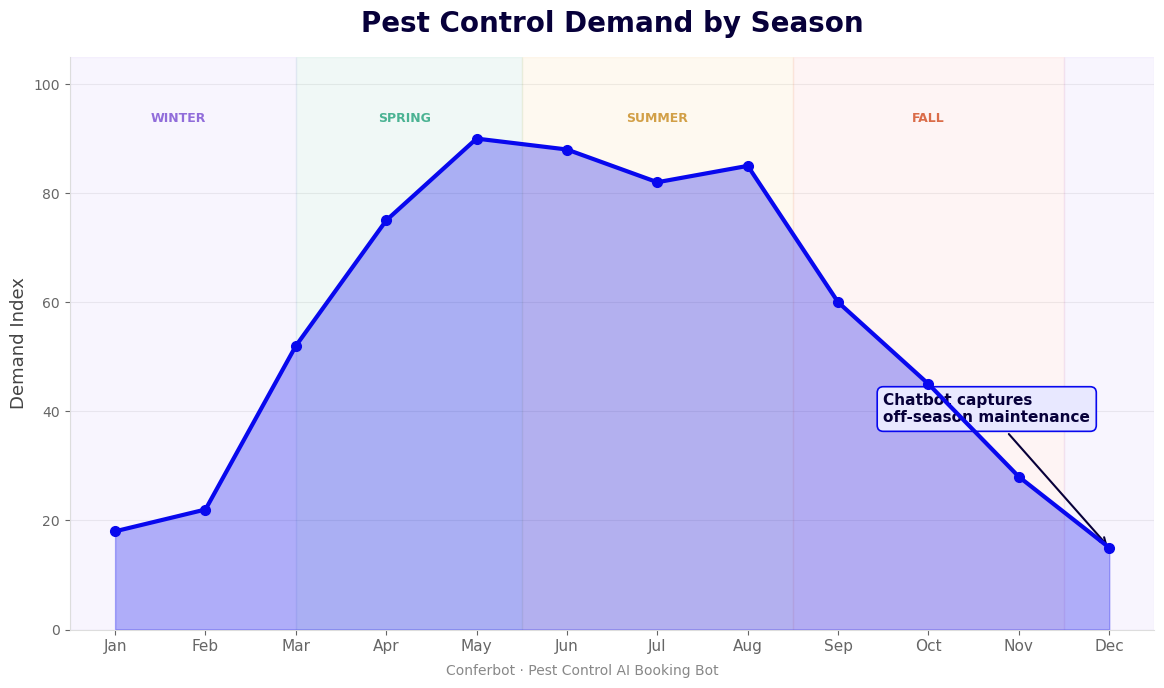
Pest control demand is highly seasonal, with distinct peak periods for different pest types in different geographic markets. The chatbot supports seasonal campaign management through configurable promotional offers that activate during defined date ranges: early-bird mosquito treatment discounts in late winter, termite awareness campaigns in spring swarming season, rodent exclusion promotions in early fall. These seasonal campaigns can be pushed proactively to the chatbot's existing customer list via WhatsApp or email, with booking available directly within the campaign message. Monitor campaign performance and booking conversion rates through Conferbot's analytics dashboard.
50,000+ businesses use Conferbot templates to automate conversations
Setup Guide: Deploying Your Pest Control Appointment Setter
Pest control operators can configure and deploy a fully functional appointment setter chatbot using Conferbot's no-code platform in two to four hours. Once the initial configuration and field service platform integration are complete, the chatbot requires minimal ongoing maintenance for standard operations. Here is the complete setup process.
Step 1: Define Service Menu and Pricing (30 Minutes)
List all residential and commercial pest control services you offer, the pests each service covers, the pricing structure (one-time vs. recurring plan, pricing by property size or flat rate), and the guarantee terms for each service type. Define the emergency services you offer, the same-day availability windows, and the emergency pricing premium. Identify which pest types or property situations require a site assessment before quoting rather than a standard price -- these are the scenarios where the chatbot escalates to a human rather than attempting to close online. Define your service zones by zip code or geographic area.
Step 2: Configure the Pest Qualification and Booking Flow (1-2 Hours)
Start from the Pest Control Appointment Setter template in Conferbot and configure the pest identification pathways for each pest category you service. Set up the property assessment questions for each service type and map the responses to the appropriate service options and pricing. Configure the service plan comparison presentation with your actual pricing and guarantee terms. Set up the service zone routing logic that assigns bookings to the correct technician based on the customer's zip code. Configure the emergency dispatch pathway with the urgency indicators that trigger same-day routing.
Step 3: Connect to Field Service Management and Calendar (1 Hour)
Configure the integration with your field service management platform through Conferbot's API integration and calendar booking settings. Map the chatbot's job fields to your field service platform's job record fields. Test the booking flow by completing a test appointment and verifying that the job appears correctly in the field service platform with all qualifying information populated. Set up the post-service follow-up trigger based on the job completion status from the field service platform.
Step 4: Launch and Monitor Performance (30 Minutes)
Deploy the chatbot on your website using the embed code, placing it prominently on the homepage and services pages where pest inquiries originate. Configure the WhatsApp channel for customers who prefer messaging over web. Set up the seasonal campaign schedule with your first proactive campaign to the existing customer list. Run a final end-to-end test -- complete a test inquiry for each major pest category, verify the booking confirmation, and confirm the field service platform job record. Monitor booking volume, service plan enrollment rates, and lead-to-booked-job conversion through the analytics dashboard. Review the pricing page for plan options that match your business scale.
Pest Control Appointment Setter Chatbot FAQ
Everything you need to know about chatbots for pest control appointment setter chatbot.
Why Use a Template vs Building from Scratch?
Templates encode years of optimization data into the conversation flow before you start.
| Factor | Conferbot Template | Build from Scratch | Hire a Developer |
|---|---|---|---|
| Time to deploy | 10 minutes | 2-8 hours | 2-6 weeks |
| Cost | Free | Your time | $5,000-$25,000 |
| Day-1 conversion | 15-22% | 5-8% | 10-15% |
| Proven flows | Yes, data-tested | No | Depends |
| Updates included | Automatic | Manual | Paid |
| Multi-channel | 8+ channels | 1 channel | Extra cost |
| Analytics | Built-in | Must build | Extra cost |
Ready to Deploy Pest Control Appointment Setter Chatbot?
Join 50,000+ businesses. Free forever plan available. No credit card required.