
Solar Panel Savings Calculator Chatbot
Free Solar and Energy Chatbot Template
An interactive solar savings calculator chatbot that helps homeowners and businesses estimate their potential savings from solar panel installation. Collects property details, energy usage, and roof conditions to provide a preliminary savings estimate and connect qualified leads with solar consultants.



What Is a Solar Panel Savings Calculator Chatbot?
A solar panel savings calculator chatbot is a conversational AI assistant that walks homeowners and commercial property owners through a complete solar viability assessment -- from current energy consumption analysis to projected 25-year savings -- entirely through an interactive chat interface. Unlike static solar calculators that present a single number based on ZIP code alone, this chatbot conducts a multi-step assessment covering electricity usage patterns, roof characteristics, shading conditions, local utility rates, available incentives, and financing preferences to deliver a genuinely personalized savings projection that accounts for the variables that matter most to each individual property.
In 2026, residential solar installations have become one of the fastest-growing home improvement categories in the United States, with the Solar Energy Industries Association (SEIA) reporting year-over-year installation growth that consistently outpaces market projections. Yet the single biggest obstacle to adoption is not cost -- it is confusion. Homeowners are overwhelmed by variables they do not understand: system sizing measured in kilowatts, net metering policies that differ by utility, federal and state incentive stacking, the difference between a solar lease and a power purchase agreement, and the impact of roof orientation on annual production. A savings calculator chatbot cuts through this complexity by asking the right questions in plain language and translating the answers into a clear financial picture the homeowner can act on.
The chatbot is designed for solar installation companies, energy consultants, roofing companies that offer solar add-ons, and clean energy marketplaces that connect homeowners with local installers. It serves as the first substantive interaction a prospective customer has with your business -- replacing the generic "get a quote" form that captures a name and email but provides zero value in return. Instead, the chatbot delivers immediate, tangible value: a savings estimate the homeowner can discuss with their family, a financing comparison they can evaluate on their own timeline, and a clear next step to move forward when they are ready.
Built on Conferbot's no-code chatbot builder, the solar panel savings calculator requires no engineering resources to deploy or customize. You configure your local utility rates, incentive programs, financing options, and service area parameters through a visual interface -- and the chatbot handles the rest. It deploys on your website, WhatsApp, Facebook Messenger, and other channels through Conferbot's omnichannel platform, capturing leads wherever homeowners begin their solar research.
This guide covers the complete chatbot workflow -- from the initial energy usage assessment through roof evaluation, savings calculation, financing education, installer matching, and ROI timeline projection -- along with integration options, conversion data, and deployment best practices for solar companies in 2026.
Energy Usage Assessment: The Foundation of Accurate Savings Projections
Every credible solar savings estimate starts with understanding how much electricity the homeowner currently uses and what they pay for it. The chatbot's energy usage assessment module collects this information conversationally, guiding the homeowner through a series of straightforward questions that establish the baseline against which all savings projections are calculated. This stage is not a formality -- the quality of the usage data directly determines the accuracy and credibility of the savings estimate the chatbot delivers.
Monthly Electricity Bill Collection
The chatbot asks for the homeowner's average monthly electricity bill -- the single most accessible data point for most homeowners. It provides range options ($50-$100, $100-$150, $150-$200, $200-$300, $300+) for quick selection, with a free-text option for homeowners who know their exact amount. This bill amount serves as the primary input for system sizing calculations and savings projections. A homeowner paying $250 per month requires a fundamentally different system size -- and sees a fundamentally different savings trajectory -- than one paying $100 per month.
Seasonal Usage Patterns
Electricity consumption is rarely uniform across the year. The chatbot asks whether the homeowner's bills are relatively stable or vary significantly by season. Properties with heavy air conditioning loads in summer may have bills that double or triple compared to winter months. This seasonal variation affects optimal system sizing: a system sized for the annual average may overproduce in winter and underproduce in summer, while a system sized for peak summer demand may generate significant excess in other months. The chatbot captures this pattern to inform the system sizing recommendation.
Utility Rate Structure Identification
Utility rate structures directly impact solar economics. The chatbot uses the homeowner's ZIP code to identify their likely utility provider and rate structure. Time-of-use (TOU) rates, tiered rates, and flat rates each affect solar savings differently. Under TOU pricing, solar panels that produce electricity during expensive peak hours deliver more financial value per kilowatt-hour than under flat-rate pricing. The chatbot explains how the homeowner's rate structure affects their specific savings potential -- a level of personalization that static calculators rarely achieve.
Future Usage Considerations
Smart solar sizing accounts for future electricity needs, not just current consumption. The chatbot asks whether the homeowner anticipates changes that would increase electricity usage: purchasing an electric vehicle (adding 3,000-4,500 kWh annually), installing a home battery system, adding a pool or hot tub, or converting gas appliances to electric. These anticipated changes can increase optimal system size by 20-40%, and sizing the system correctly from the start avoids the cost and complexity of expanding later. This forward-looking assessment demonstrates sophistication that builds trust with homeowners who are making a 25-year investment decision.
All energy usage data collected during this assessment flows into the savings calculation engine and is simultaneously captured in your CRM through Conferbot's API integration, giving your sales team complete context before the first human conversation.
Roof Evaluation: Assessing Physical Viability for Solar Installation
A solar savings projection is meaningless if the roof cannot support an installation. The chatbot's roof evaluation module collects the physical characteristics that determine whether installation is feasible, what system size the roof can accommodate, and whether any preparatory work (like roof replacement) needs to happen first. This assessment prevents the most common source of wasted time in the solar sales process: scheduling site assessments for properties that have obvious disqualifying roof conditions.
Roof Age and Condition
Roof age is the single most important structural consideration. Solar panels are designed to produce electricity for 25-30 years. Installing panels on a roof with only 5-10 years of remaining life means the homeowner will face the expense of removing and reinstalling the panels when the roof needs replacement -- a cost of $2,000-$5,000 that significantly impacts project economics. The chatbot collects roof age and presents clear guidance: roofs under 10 years old are typically installation-ready, roofs 10-15 years old may benefit from a professional inspection before installation, and roofs over 15-20 years old should likely be replaced first. For homeowners who need a new roof, the chatbot can present bundled roof-and-solar financing options that many installers offer.
Roof Orientation and Pitch
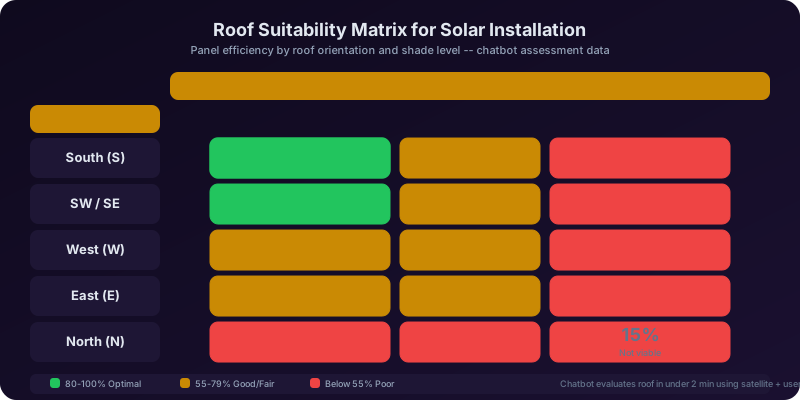
In the Northern Hemisphere, south-facing roof planes receive the most annual solar radiation and produce the highest energy output per panel. West-facing roofs produce roughly 85% of the output of south-facing roofs, while east-facing roofs are similar. North-facing roof planes produce significantly less and are generally not recommended for solar installation. The chatbot asks the homeowner to identify which direction their main roof faces -- using compass directions or landmarks (toward the street, toward the backyard) -- and adjusts the production estimate accordingly. Roof pitch also matters: a moderate pitch of 15-40 degrees is optimal for most latitudes, while flat roofs require tilt racking that affects both cost and aesthetics.
Shading Assessment
Shading is the most significant environmental factor affecting solar panel performance. A panel that receives full sun all day produces dramatically more electricity than one shaded by trees, neighboring buildings, or chimneys for even a few hours. The chatbot collects shading information through a conversational flow: Are there tall trees near the roof? Do neighboring buildings cast shadows on the roof during any part of the day? Is there significant shading in the morning, afternoon, or all day? Conferbot's NLP engine can interpret natural language descriptions like "big oak tree on the south side" and factor the shading impact into the production estimate. Heavily shaded properties receive honest guidance: the chatbot does not inflate savings for properties where shading will significantly reduce system output.
Roof Material Compatibility
Most roofing materials are compatible with solar installation, but the installation method and cost vary. Composition shingle roofs (the most common residential roofing material) use standard penetrating mounts and are the least expensive to install on. Tile roofs require specialized tile hooks that add cost. Metal roofs use clamp-on mounts that are actually simpler than shingle installations. Flat roofs use ballasted racking systems. The chatbot collects roof material type to adjust the installation cost estimate and set appropriate expectations about the mounting approach.
Available Roof Area
The usable roof area determines maximum system size. Dormers, skylights, vents, chimneys, and other roof penetrations reduce the available space for panels. The chatbot asks about these obstructions to provide a preliminary estimate of how many panels can fit. For homeowners who are unsure about their available roof area, the chatbot notes that a detailed roof measurement will be conducted during the site assessment -- but provides a conservative estimate based on typical roof configurations for the property type.
The combination of roof age, orientation, shading, material, and available area gives the chatbot enough information to determine whether the property is a strong solar candidate, a conditional candidate (needs roof work or tree trimming), or a poor candidate for rooftop solar. For poor candidates, the chatbot does not end the conversation -- it pivots to community solar or ground-mount options, keeping the lead in the funnel rather than discarding it.
Ready to try Solar Panel Savings Calculator Chatbot?
Deploy this template in under 10 minutes. No coding required.
Use This Template Free →How the Solar Savings Calculation Works
The savings calculation is the centerpiece of the chatbot experience -- the moment where all the collected data transforms into a financial picture the homeowner can evaluate. The chatbot's calculation engine synthesizes energy usage data, roof characteristics, local solar irradiance, utility rates, incentive programs, and financing terms to produce a comprehensive savings projection that covers the full lifecycle of the solar installation. Here is how each component of the calculation works.
System Size Recommendation
Based on the homeowner's electricity consumption and roof constraints, the chatbot recommends an optimal system size measured in kilowatts (kW). The sizing algorithm targets offsetting 80-100% of the homeowner's annual electricity consumption -- with the exact target depending on net metering policies in their area. In states with full retail net metering, sizing to 100% offset or slightly above makes financial sense. In states with reduced net metering compensation, sizing to 90-95% of consumption optimizes the financial return. The chatbot presents the recommended system size alongside the number of panels required and the estimated roof area they will cover.
Annual Energy Production Estimate
Using the recommended system size and location-specific solar irradiance data from the National Renewable Energy Laboratory's PVWatts calculator, the chatbot estimates annual energy production in kilowatt-hours (kWh). This estimate accounts for the roof orientation, pitch, and shading factors collected during the roof evaluation. The production estimate includes a standard annual degradation factor (typically 0.5% per year) to reflect the gradual decline in panel efficiency over the system's 25-year warranted life. The chatbot presents both the first-year production estimate and the 25-year cumulative production.
Financial Savings Projection
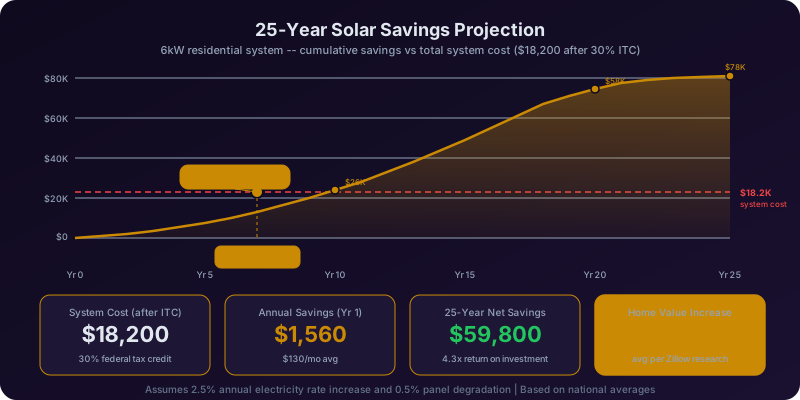
The financial savings calculation combines annual production with the homeowner's utility rate to project dollar savings. The chatbot factors in the homeowner's current rate structure and applies a conservative annual utility rate escalation factor (typically 2-3% based on historical EIA data) to project future savings. This escalation factor is actually where solar economics become most compelling: as utility rates increase year over year, the value of each kilowatt-hour the solar system produces increases proportionally -- while the cost of the solar system remains fixed at the purchase price. The chatbot illustrates this with a year-by-year savings table that shows increasing annual savings over the system life.
Incentive Application
Federal, state, and local incentives significantly reduce the net cost of a solar installation. The chatbot automatically applies applicable incentives based on the homeowner's location. The federal Investment Tax Credit (ITC) -- currently at 30% of the total system cost through 2032 under the Inflation Reduction Act -- is the most significant incentive for most homeowners. State-level incentives vary: some states offer additional tax credits, rebates, or performance-based incentives like Solar Renewable Energy Credits (SRECs). The chatbot presents the gross system cost, each applicable incentive with its value, and the net cost after all incentives are applied.
Net Cost and Payback Period
The payback period -- the number of years before cumulative electricity savings equal the net system cost -- is the metric most homeowners care about most. The chatbot calculates this using the net cost after incentives divided by the annual savings, adjusted for utility rate escalation and panel degradation. For most residential installations in 2026, the payback period falls between 6 and 12 years -- meaning the homeowner receives 13 to 19 years of essentially free electricity after recouping their investment. The chatbot presents this as a clear financial milestone: "Based on your energy usage and local rates, your system will pay for itself in approximately 8 years, then save you an estimated $47,000 over the remaining 17 years of the system's warranted life."
The entire calculation is presented as a summary at the end of the assessment, formatted for clarity and designed to give the homeowner a complete financial picture they can discuss with their household before deciding on next steps. All calculation parameters are configurable through Conferbot's dashboard, allowing you to update utility rates, incentive values, and system pricing as market conditions change.
Financing Options: Helping Homeowners Find the Right Payment Structure
Solar financing is where most homeowners either gain confidence to move forward or lose momentum and abandon the process. The cost of a residential solar installation in 2026 typically ranges from $15,000 to $35,000 before incentives -- a significant investment that few homeowners make without understanding their financing options in detail. The chatbot's financing module presents each option clearly, compares them against the homeowner's priorities, and helps them identify the structure that best fits their financial situation.
Cash Purchase
Paying cash delivers the highest total return on investment because the homeowner avoids interest payments and captures the full value of incentives, savings, and increased property value. The chatbot presents the cash scenario with the net cost after the federal tax credit, the payback period, the 25-year net savings, and the internal rate of return. For homeowners with available capital, cash purchase typically delivers a 10-15% annual return -- significantly higher than most investment alternatives with comparable risk profiles. The chatbot also notes the property value increase: studies from the Lawrence Berkeley National Laboratory show that homes with owned solar systems sell for a premium of approximately $4 per watt of installed capacity.
Solar Loan
Solar loans allow homeowners to finance the system with monthly payments that are typically lower than their current electricity bill -- achieving immediate positive cash flow from day one. The chatbot presents loan scenarios with common terms: 10-year, 15-year, and 20-year options, with typical interest rates based on current market conditions. For each term, the chatbot shows the monthly payment, the comparison to the current electricity bill, the total interest paid, and the net savings after subtracting loan costs from electricity savings. Solar loans allow the homeowner to claim the federal tax credit (since they own the system), which can be applied as a lump-sum loan paydown to reduce the remaining balance and monthly payment.
Solar Lease
A solar lease allows the homeowner to have panels installed on their roof with zero upfront cost and a fixed monthly payment to the leasing company. The homeowner uses the electricity the panels produce and pays the lease payment instead of (or in addition to a reduced) utility bill. The chatbot explains that leases offer simplicity and immediate savings, but the total lifetime savings are lower than ownership because the leasing company captures a portion of the economic value. Leases are best suited for homeowners who want solar with zero financial risk and are comfortable with lower total savings in exchange for simplicity.
Power Purchase Agreement (PPA)
A PPA is similar to a lease, but instead of a fixed monthly payment, the homeowner pays for the electricity the panels produce at a rate lower than their utility rate. The chatbot explains the PPA rate, the annual escalator (typically 1-3%), and the comparison to the homeowner's current utility rate and its historical escalation. PPAs offer the most straightforward value proposition: "You pay less per kilowatt-hour for solar electricity than you currently pay your utility, with no upfront cost and no system maintenance responsibility."
Side-by-Side Financing Comparison
After presenting individual options, the chatbot delivers a comparison table tailored to the homeowner's specific numbers.
| Factor | Cash Purchase | Solar Loan | Lease | PPA |
|---|---|---|---|---|
| Upfront cost | Net system cost | $0 | $0 | $0 |
| Monthly payment | None | Loan payment | Fixed lease payment | Per-kWh rate |
| 25-year net savings | Highest | High | Moderate | Moderate |
| System ownership | Yes | Yes | No (leasing company) | No (PPA provider) |
| Federal tax credit | Yes (homeowner claims) | Yes (homeowner claims) | No (company claims) | No (company claims) |
| Maintenance responsibility | Homeowner | Homeowner | Leasing company | PPA provider |
| Property value impact | Increases value | Increases value | Neutral or transfer | Neutral or transfer |
| Best for | Maximum ROI seekers | Owners wanting $0 down | Simplicity seekers | Pay-as-you-go preference |
This comparison -- personalized with the homeowner's actual numbers -- is the most valuable deliverable in the entire chatbot interaction. Homeowners frequently screenshot or save this comparison for household discussions, extending the chatbot's influence beyond the initial conversation. The chatbot's ability to present complex financial structures in clear, comparable terms replaces a 30-45 minute sales consultation and allows the homeowner to arrive at the site assessment already knowing which financing path they prefer.
Installer Matching: Connecting Homeowners with the Right Solar Company
For solar marketplaces and lead aggregation platforms, the installer matching feature is the revenue-generating function of the chatbot. For individual installation companies, installer matching translates to territory routing and appointment booking. In both cases, the chatbot uses the homeowner's location, project scope, and preferences to connect them with the right installer -- and it does so at the moment of highest purchase intent, immediately after the homeowner has seen their personalized savings projection.
Geographic Matching
The homeowner's ZIP code determines which installers serve their area. The chatbot maintains a configurable service area database and matches the homeowner with installers who are licensed and active in their specific location. For solar marketplaces connecting multiple installers, this geographic matching ensures the homeowner receives quotes from companies that actually serve their area -- eliminating the frustration of receiving calls from out-of-area companies that cannot install. For single-company deployments, geographic matching confirms the property is within the service area and routes to the appropriate regional office or installation team.
Project Scope Matching
The chatbot's qualification data -- system size, roof type, financing preference, timeline -- informs installer matching beyond simple geography. A large commercial project requires an installer with commercial experience and appropriate licensing. A project requiring roof replacement before solar installation benefits from an installer who offers integrated roofing and solar services. A customer interested in battery storage needs an installer certified for battery installation. The chatbot matches these project characteristics to installer capabilities, ensuring the homeowner connects with a company equipped to handle their specific project.
Appointment Scheduling
For qualified homeowners ready to proceed, the chatbot offers direct appointment scheduling through Conferbot's calendar integration. Rather than collecting contact information and waiting for a callback -- during which delay the homeowner's motivation often fades -- the chatbot presents available site assessment times and books the appointment in real time. The homeowner receives an immediate confirmation with the date, time, installer name, and what to expect during the assessment. This instant booking capability captures purchase intent at its peak and significantly reduces the time between first inquiry and first in-person interaction.
Multi-Quote Requests
For marketplace platforms, the chatbot can present multiple installer options with their respective ratings, years of experience, warranty terms, and pricing ranges. The homeowner selects which installers they want to receive quotes from, and the chatbot submits qualified lead data to each selected installer simultaneously. This competitive quoting process benefits the homeowner (better pricing through competition) and the marketplace (higher per-lead revenue through multi-match distribution). The chatbot presents this as a value-add: "We recommend getting 2-3 quotes to ensure you find the best combination of price, warranty, and installer reputation for your project."
All installer matching data -- which installers were presented, which the homeowner selected, and whether appointments were booked -- feeds into the analytics dashboard, giving marketplace operators visibility into installer performance, match acceptance rates, and conversion patterns across their network.
50,000+ businesses use Conferbot templates to automate conversations
ROI Timeline: Visualizing the Long-Term Financial Picture
The ROI timeline is the final persuasive element in the chatbot's savings assessment -- a year-by-year financial projection that shows the homeowner exactly when their investment breaks even and how much they save over the full system life. This timeline transforms solar from an abstract "good investment" into a concrete financial plan with specific milestones the homeowner can anticipate.
Year-by-Year Savings Breakdown
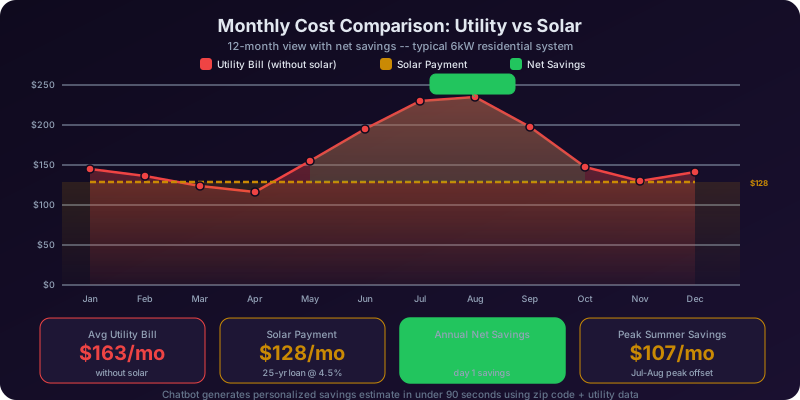
The chatbot generates a year-by-year projection that shows annual solar production (declining slightly each year due to panel degradation), annual utility savings (increasing each year as utility rates rise), cumulative savings, and the remaining balance until payback. For financed systems, the projection includes loan payments and shows the net cash flow each year -- positive from the start for well-structured solar loans where the monthly payment is less than the electricity savings. The homeowner sees that their solar investment is not just a long-term play: it delivers measurable financial benefit from year one.
Key Financial Milestones
The chatbot highlights specific milestones in the ROI timeline that make the investment tangible. The payback milestone marks when cumulative savings equal the net system cost -- typically year 6-10 for cash purchases and year 1 for zero-down financing. The "free electricity" milestone marks the end of the loan term when the homeowner has no further payments but continues receiving savings. The 25-year total savings milestone shows the complete financial picture: the total amount saved over the system's warranted life, which typically ranges from $25,000 to $75,000 depending on system size and local utility rates.
Sensitivity Analysis
Credible financial projections acknowledge uncertainty. The chatbot presents a range of outcomes based on different assumptions about utility rate escalation and system performance. The conservative scenario uses lower utility rate growth and higher degradation. The expected scenario uses median assumptions. The optimistic scenario uses higher utility rate growth based on recent trends. This range gives the homeowner confidence that even in the worst case, the investment delivers meaningful savings -- and in the likely case, it delivers substantially more. This honest presentation of uncertainty builds trust and differentiates the chatbot from competitors who present only the most optimistic projections.
Property Value Impact
The ROI timeline includes the property value increase associated with owned solar systems. Research from the Lawrence Berkeley National Laboratory, Zillow, and multiple real estate studies consistently shows that homes with owned solar systems sell for a premium. The chatbot includes this value in the total return calculation -- noting that even if the homeowner sells the property before the full 25-year payback period, they recoup a significant portion of their investment through the higher sale price. For homeowners concerned about "what if I move," this data point addresses one of the most common objections to solar investment.
Comparison to Alternative Investments
The chatbot contextualizes the solar ROI by comparing it to familiar financial benchmarks. The internal rate of return (IRR) on a solar investment -- typically 10-20% depending on financing structure and location -- compares favorably to historical stock market returns, bond yields, and savings account interest rates. The chatbot presents this comparison matter-of-factly: "Your estimated solar return of 14% annually exceeds the historical average stock market return of 10%, with the added benefit that solar savings are not subject to market volatility." This financial framing is particularly effective for homeowners who approach solar as an investment decision rather than an environmental one.
Key Features of the Solar Panel Savings Calculator Chatbot
The solar panel savings calculator chatbot includes features built specifically for the solar industry's unique sales process. These are not generic lead capture tools adapted for solar -- they are purpose-built functions that address the specific challenges of educating homeowners about solar economics, qualifying properties for installation viability, and converting research-phase visitors into site assessment appointments.
ZIP Code-Based Localization
The chatbot uses the homeowner's ZIP code to automatically load location-specific data: local utility provider and rate structure, state and utility-level incentive programs, average solar irradiance for the area, net metering policies, and available installers. This localization means every interaction is personalized to the homeowner's actual circumstances rather than presenting national averages that may not apply to their situation. The difference between solar economics in Arizona and Massachusetts is dramatic -- and the chatbot reflects this reality in every calculation it presents.
Adaptive Conversation Flow
The chatbot adapts its conversation path based on the homeowner's responses. A homeowner with a new roof skips the roof replacement discussion. A renter is redirected to community solar options rather than rooftop installation. A commercial property owner receives different system sizing logic and financing options than a residential homeowner. A homeowner who already has quotes from other companies receives a comparison-focused experience rather than an introductory education. This adaptive flow ensures every homeowner receives a relevant conversation -- not a one-size-fits-all script that wastes time on irrelevant questions.
Real-Time Savings Display
As the homeowner provides information, the chatbot progressively builds and displays the savings estimate. After the energy usage assessment, a preliminary savings range appears. After the roof evaluation, the range narrows. After financing selection, the specific monthly and lifetime numbers are presented. This progressive disclosure maintains engagement throughout the conversation -- the homeowner sees the estimate becoming more precise with each answer, creating a sense of investment in the outcome that reduces drop-off rates.
Lead Scoring and Prioritization
Every response contributes to a composite lead score that determines follow-up priority. High-value signals include: homeownership (versus renting), high monthly electricity bills, new roof, minimal shading, preference for cash or loan financing, and near-term installation timeline. The chatbot calculates a score from 0-100 and passes it to your CRM alongside all qualification data, enabling your sales team to prioritize high-intent, high-value leads for immediate outreach while lower-scoring leads enter automated nurture sequences.
Multi-Language Support
Solar adoption spans all demographic groups, and the chatbot supports conversations in multiple languages through Conferbot's multilingual capabilities. Spanish, Chinese, Vietnamese, and Korean language support is particularly valuable for solar companies operating in diverse markets. The chatbot detects the visitor's preferred language and conducts the entire savings assessment in that language -- including financial terminology, incentive descriptions, and next-step instructions -- ensuring that language is never a barrier to solar adoption.
Battery Storage Integration
Home battery storage is an increasingly important component of residential solar systems, particularly in states with time-of-use rates or reduced net metering. The chatbot assesses whether battery storage makes financial sense for the homeowner based on their utility rate structure, backup power needs, and budget. For homeowners in areas with frequent power outages or high TOU differentials, the chatbot presents a combined solar-plus-storage savings analysis that shows the additional investment and additional savings from battery integration.
Conversion Rate Data: Solar Calculator Chatbot Performance Metrics
Solar companies evaluating a savings calculator chatbot need concrete performance data to justify the investment. The economics are straightforward: customer acquisition cost in residential solar is one of the industry's largest expense categories, and any tool that improves lead quality, increases conversion rates, or reduces time-to-close translates directly to bottom-line improvement. Here is the performance data from solar companies and marketplaces using Conferbot's solar calculator chatbot.
| Metric | Static Calculator / Form | Savings Calculator Chatbot | Improvement |
|---|---|---|---|
| Visitor to lead conversion | 2-5% | 10-18% | 3-5x improvement |
| Lead to site assessment | 20-30% | 50-65% | +25-35 percentage points |
| Assessment to contract | 20-30% | 30-42% | +10-12 percentage points |
| Overall visitor to customer | 0.1-0.4% | 1.5-4.5% | 8-15x improvement |
| Cost per qualified lead | $180-$350 | $40-$110 | 55-70% reduction |
| Average sales cycle | 60-90 days | 35-55 days | 30-40% shorter |
| Off-hours lead capture | 15-25% of total | 45-55% of total | 2-3x after-hours leads |
| Lead data completeness | Name + email only | 12+ qualification fields | Complete pre-qualification |
Why Chatbot Conversion Outperforms Static Calculators
Static solar calculators suffer from two fundamental problems. First, they deliver a single number based on minimal input (usually just ZIP code), which is too imprecise to be credible and too impersonal to build trust. The homeowner receives a generic estimate they cannot act on confidently. Second, they do not capture lead information until after the calculation -- and by that point, most visitors have already gotten the information they came for and leave without converting. The chatbot reverses this dynamic: it collects information progressively throughout the conversation while delivering increasing value at each step, and it captures contact information at the natural point in the conversation where the homeowner wants to receive their complete savings report -- after they have invested time and received genuine value.
Revenue Impact Example
Consider a solar company spending $10,000 per month on Google Ads generating 2,000 website visitors. With a static calculator at 3% conversion, that produces 60 leads at $167 per lead. With a chatbot at 14% conversion, the same traffic produces 280 qualified leads at $36 per lead. If site assessment booking improves from 25% to 58%, that is 162 assessments versus 15 previously. At a 25% close rate, the chatbot-equipped company closes 40 deals per month from the same ad spend that previously produced 4 deals. The revenue multiplication from identical traffic spend represents one of the highest-ROI marketing investments available to solar companies.
CRM, Design Tool, and Marketing Integrations
A solar savings calculator chatbot operating in isolation creates data silos that undermine its value. The chatbot collects detailed qualification data that needs to flow seamlessly into your CRM for sales follow-up, your solar design tools for system engineering, and your marketing automation platform for lead nurture. Conferbot's integration framework connects the chatbot with the solar industry's core technology stack.
Solar CRM Integration
When a homeowner completes the savings assessment, all collected data -- energy usage, roof characteristics, savings projections, financing preference, timeline, and lead score -- automatically populates a new lead record in your CRM. Conferbot integrates with solar-specific CRM platforms including Aurora Solar, Enerflo, Solar Nexus, and SalesRabbit, as well as general-purpose CRMs like HubSpot, Salesforce, and Pipedrive through Conferbot's API integration framework. Custom field mapping ensures solar-specific data points land in the correct fields for downstream automation, reporting, and sales workflows.
Solar Design Tool Connection
The chatbot's pre-qualification data accelerates the design process. Property address enables satellite imagery retrieval for remote roof assessment. Energy usage data informs system sizing. Roof characteristics (orientation, pitch, shading, material) provide inputs for panel layout optimization. By the time a designer begins working on a project, the foundational data is already in the system -- pre-populated from the chatbot conversation. For companies using Aurora Solar, Helioscope, or OpenSolar, this pre-population reduces design time from hours to minutes for preliminary proposals.
Marketing Automation
Not every homeowner who completes the savings assessment is ready to schedule a site assessment immediately. The chatbot's integration with marketing automation platforms (HubSpot, ActiveCampaign, Mailchimp, Klaviyo) enables segmented nurture campaigns based on chatbot qualification data. A homeowner with a high lead score but "just researching" timeline enters a high-touch nurture sequence with educational content about solar economics. A homeowner who completed the assessment but did not provide contact information can be retargeted with display ads featuring their estimated savings range. A homeowner who booked a site assessment but has not confirmed receives automated reminders. This post-conversation automation extends the chatbot's influence beyond the initial interaction and captures leads that are not ready to convert immediately.
Zapier and Webhook Support
For companies using tools without native Conferbot integrations, webhook and Zapier connections provide flexible data routing. Every chatbot event -- conversation start, assessment completion, appointment booking, lead score calculation -- can trigger a webhook that pushes data to any system with an API. Zapier integration enables no-code connections to 5,000+ applications, allowing non-technical marketing teams to build their own data workflows without developer involvement.
Deployment and Customization for Your Solar Business
Deploying the solar panel savings calculator chatbot on your website and marketing channels takes less than a day from start to live operation. Conferbot's no-code platform handles the technical implementation, leaving you to focus on configuring the solar-specific parameters that make the calculator accurate for your market, service area, and product offerings.
Configuration Steps
The initial setup involves configuring five categories of solar-specific data. First, service area definition: the ZIP codes, cities, or states where you install. Second, utility data: the providers and rate structures in your service area. Third, incentive programs: the federal, state, and local incentives available to your customers, with their current values and eligibility criteria. Fourth, system pricing: your cost per watt for different system sizes, roof types, and configurations. Fifth, financing options: the specific loan, lease, and PPA products you offer, with their terms and rates. This configuration uses Conferbot's visual builder -- no code, no spreadsheets, no developer tickets.
Brand Customization
The chatbot's appearance and voice match your brand identity. Colors, fonts, logo, avatar, and conversation tone are all configurable through the builder. Solar companies targeting environmentally motivated customers may choose a warm, mission-driven tone. Companies targeting cost-conscious homeowners may choose a direct, numbers-focused tone. Companies targeting luxury homeowners may choose a premium, consultative tone. The chatbot's personality should match your brand promise -- and the visual design should integrate seamlessly with your website rather than looking like a bolted-on widget.
Channel Deployment
The chatbot deploys across multiple channels through Conferbot's omnichannel platform. Website deployment uses a single JavaScript snippet added to your site. WhatsApp deployment connects through the WhatsApp Business API. Facebook Messenger deployment connects through your Facebook page settings. Google Business Profile integration adds the chatbot to your Google listing. Each channel maintains the same conversation flow, data collection, and CRM integration -- ensuring consistent lead quality regardless of where the homeowner starts the conversation.
Testing and Optimization
Before going live, Conferbot's preview mode lets you run through the complete chatbot conversation as a homeowner would experience it. Test different scenarios: a high-value lead with a new roof and high electricity bill, a renter who needs to be redirected to community solar, a commercial property owner with different sizing requirements. After deployment, the analytics dashboard reveals conversation completion rates, drop-off points, lead quality distribution, and conversion metrics -- giving you the data to continuously optimize the conversation flow, savings assumptions, and call-to-action messaging for maximum performance in your market.
Frequently Asked Questions
Below are the most common questions solar companies and homeowners ask about the solar panel savings calculator chatbot.
Solar Panel Savings Calculator Chatbot FAQ
Everything you need to know about chatbots for solar panel savings calculator chatbot.
Why Use a Template vs Building from Scratch?
Templates encode years of optimization data into the conversation flow before you start.
| Factor | Conferbot Template | Build from Scratch | Hire a Developer |
|---|---|---|---|
| Time to deploy | 10 minutes | 2-8 hours | 2-6 weeks |
| Cost | Free | Your time | $5,000-$25,000 |
| Day-1 conversion | 15-22% | 5-8% | 10-15% |
| Proven flows | Yes, data-tested | No | Depends |
| Updates included | Automatic | Manual | Paid |
| Multi-channel | 8+ channels | 1 channel | Extra cost |
| Analytics | Built-in | Must build | Extra cost |
Ready to Deploy Solar Panel Savings Calculator Chatbot?
Join 50,000+ businesses. Free forever plan available. No credit card required.