9 Free Templates Available

Best Surveys Chatbot Templates

Get free, ready-to-use surveys chatbot templates that help boost conversions and automate customer interactions. Start building in 2 minutes with no coding required.

100% Free
No Coding Required
Instant Deploy
🤖
67%
Higher Conversions
2min
Setup Time
24/7
Automated
9+
Templates

Explore Templates & Resources

Browse templates, learn about the category, or find answers to common questions

Categories24

Surveys Templates

Choose from our collection of proven surveys chatbot templates

9templates
Voice of Customer (VoC) Analysis - Surveys template preview

Voice of Customer (VoC) Analysis

Gain deep insights into customer feedback with Conferbot's Voice of Customer Analysis Assistant. Transform feedback into actionable insights with automated surveys, real-time analysis, and 24/7 support to drive growth and enhance customer satisfaction.

Surveys
3uses
1likes
AB Testing Feedback Analyzer - Surveys template preview

AB Testing Feedback Analyzer

Elevate your A/B testing process with Conferbot’s A/B Testing Feedback Analyzer. Discover patterns in user responses, refine variations, and improve performance with automated analysis and actionable insights.

Surveys
6uses
2likes
Sentiment Analysis - Surveys template preview

Sentiment Analysis

Understand customer sentiment with Conferbot's Sentiment Analysis Assistant. Gain actionable insights through real-time sentiment tracking, helping you improve customer experiences, product development, and marketing strategies.

Surveys
4uses
1likes
Exit Interview Conductor - Surveys template preview

Exit Interview Conductor

Improve employee retention and workplace culture with Conferbot's Exit Interview Conductor. This chatbot automates exit interviews, ensuring comprehensive, unbiased feedback collection and real-time analysis to enhance your organizational health.

Surveys
4uses
2likes
Website User Experience Survey - Surveys template preview

Website User Experience Survey

Improve your website’s performance with Conferbot's Website User Experience Survey Assistant. Collect real-time feedback, analyze user behavior, and enhance user satisfaction with our 24/7 automated solution.

Surveys
5uses
1likes
Product Market Fit Survey - Surveys template preview

Product Market Fit Survey

Elevate your product development with Conferbot's Product Market Fit Survey Assistant. Experience efficient survey management, insightful market analysis, and 24/7 support to align your products with market demands.

Surveys
5uses
1likes
Employee Satisfaction Survey - Surveys template preview

Employee Satisfaction Survey

Enhance workplace culture with Conferbot's Employee Satisfaction Survey Assistant. Experience streamlined survey distribution, real-time feedback analysis, and 24/7 support to improve employee engagement and organizational health.

Surveys
6uses
1likes
Post Purchase Survey - Surveys template preview

Post Purchase Survey

Understand your customers' shopping experience immediately after they've completed a purchase.

Surveys
7uses
3likes
Product Feedback - Surveys template preview

Product Feedback

Enhance your customer insight with Conferbot's Post Purchase Survey chatbot. Discover real-time feedback on shopping experiences, improve service quality, and foster customer loyalty. Effortless integration and instant insights.

Surveys
4uses
3likes
Page 1 of 2

NPS Surveys That Actually Get Responses

Net Promoter Score is the gold standard for measuring customer loyalty, but traditional NPS surveys suffer from abysmal response rates. Email-based NPS surveys average just 10-15% response rates, meaning you are making strategic decisions based on feedback from a small, potentially unrepresentative fraction of your customer base. A survey chatbot transforms NPS collection by conducting surveys conversationally, in-context, and across multiple channels, achieving response rates that give you a genuinely representative picture of customer sentiment.

💡 Key Insight

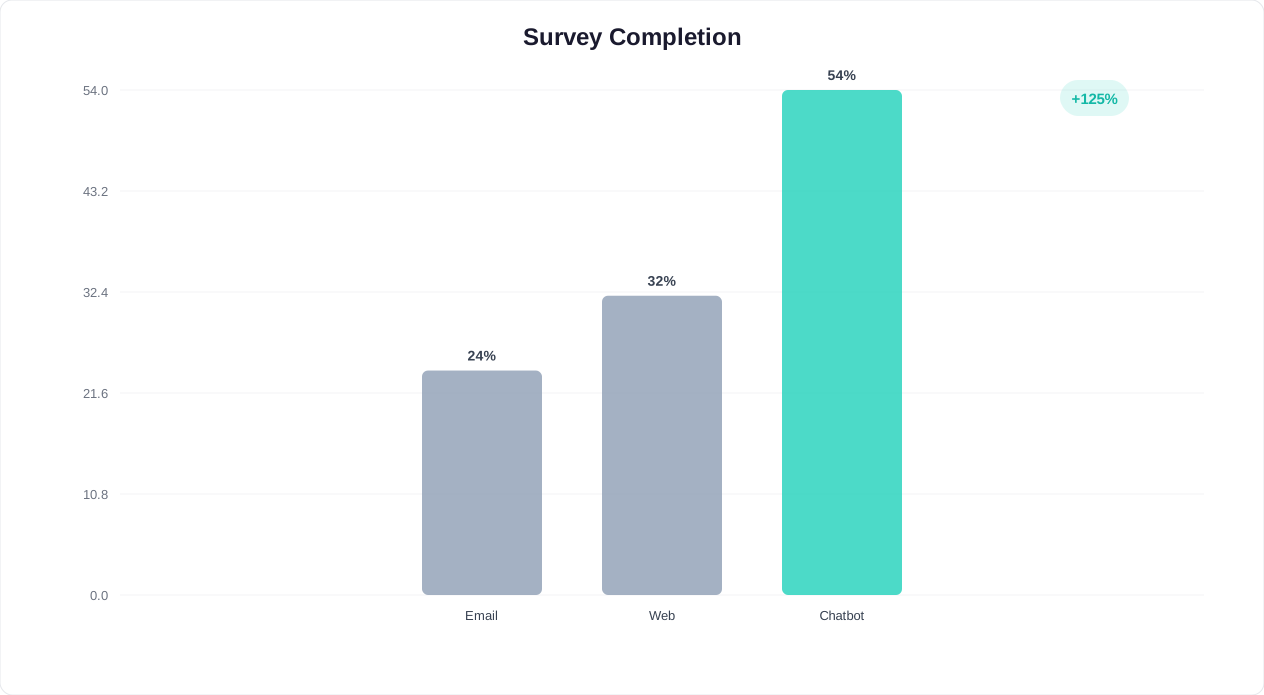
Chatbot-based surveys achieve a 54% average completion rate compared to just 24% for traditional web forms — a 2.25x improvement that transforms the statistical reliability of your feedback data.

Response rate comparison between traditional survey forms and conversational chatbot surveys
Survey completion rate comparison between chatbot surveys and traditional web forms

Conversational NPS Collection

The chatbot asks the NPS question -- "How likely are you to recommend us?" -- within a natural conversation rather than a sterile survey form. After the score, it asks a conversational follow-up: "Thank you for that 8! What's the one thing we could improve to make it a 10?" This open-ended follow-up in conversational format generates richer qualitative insights than the typical text box on a survey form, because respondents feel like they are talking to someone who cares rather than filling out a requirement.

Conversational NPS surveys achieve 30-50% response rates -- three to five times the email survey average. This higher response rate produces more statistically reliable scores and more actionable qualitative feedback. Marketing and product teams get the volume of data they need to identify trends, segment analysis, and track improvements over time.

Trigger-Based NPS Timing

NPS accuracy depends heavily on timing. The chatbot triggers NPS surveys at optimal moments: after a successful support interaction, following a product milestone (first month anniversary, feature adoption), at subscription renewal, or after a positive customer experience. These contextual triggers capture sentiment when it is most authentic and actionable, rather than on an arbitrary quarterly schedule.

  • Transactional NPS: Measure satisfaction after specific interactions -- support tickets, onboarding, feature usage -- to identify which touchpoints drive loyalty and which create detractors.
  • Relationship NPS: Conduct periodic overall relationship surveys to track long-term loyalty trends and benchmark against industry standards.
  • Segmented analysis: Compare NPS across customer segments -- by plan tier, industry, company size, tenure, and usage level -- to identify where loyalty is strongest and where intervention is needed.

Closed-Loop Follow-Up

The chatbot does not just collect scores -- it triggers appropriate follow-up actions. Detractors (scores 0-6) receive immediate attention: the chatbot acknowledges their frustration, collects specific feedback, and routes the issue to customer success for personal outreach. Promoters (scores 9-10) are thanked and invited to leave a public review, provide a testimonial, or join a referral program. This closed-loop approach turns NPS from a passive metric into an active customer engagement program.

📊 Performance Insight

Organizations using trigger-based NPS collection report 3x higher response rates and 40% more actionable qualitative feedback compared to fixed-schedule email surveys.

NPS Trend Reporting

Track NPS trends over time with visual dashboards that show score distribution, segment comparisons, and the impact of product changes and service improvements on customer sentiment. The chatbot's continuous data collection provides real-time NPS monitoring rather than quarterly snapshots, enabling faster response to emerging sentiment shifts before they become retention problems.

CSAT Collection: Measuring Satisfaction at Every Touchpoint

Customer Satisfaction Score (CSAT) measures how well you meet expectations at specific touchpoints -- after a support interaction, following a purchase, or upon completing onboarding. But CSAT surveys suffer from the same response rate challenges as all traditional surveys, and low response rates make it impossible to identify systemic issues before they become customer churn. A survey chatbot embeds CSAT collection naturally into customer interactions, capturing feedback at the moment of experience with minimal friction.

⚡ Efficiency Insight

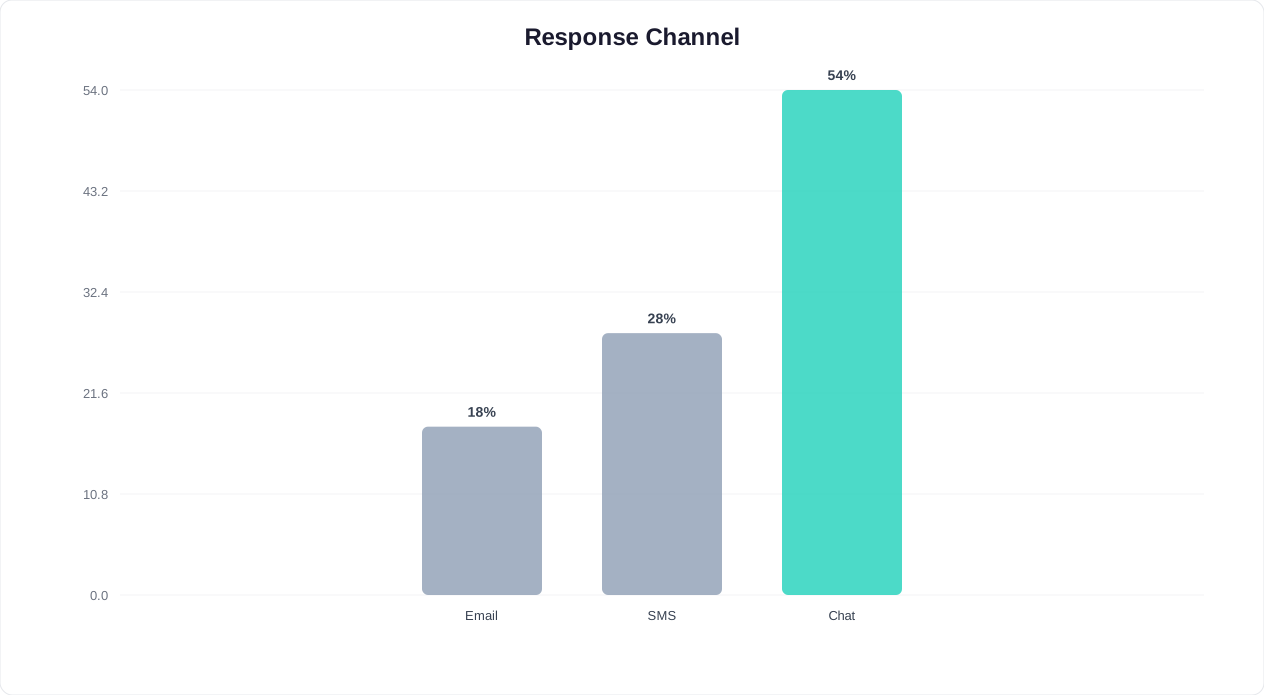
In-context CSAT surveys collected via chatbot achieve 40-60% response rates — up to 6x higher than retrospective email surveys sent 24-48 hours after an interaction.

Survey response rates by collection channel — chatbot, email, SMS, and in-app

In-Context CSAT Measurement

The chatbot collects CSAT immediately after the relevant experience, while the interaction is fresh in the customer's mind. After a support ticket is resolved, the chatbot asks: "How satisfied are you with the help you received today?" After onboarding completion: "How would you rate your onboarding experience?" This in-context collection produces more accurate responses than retrospective surveys and achieves 40-60% response rates because the survey feels like a natural continuation of the interaction.

The conversational format allows for nuanced follow-up. A customer who rates their support experience as "dissatisfied" is immediately asked what went wrong, and the chatbot can even attempt to resolve the remaining issue in real time. This immediate recovery opportunity transforms a negative experience into a positive one, potentially saving the customer relationship while capturing the feedback.

Multi-Touchpoint CSAT Mapping

Deploy CSAT surveys across every customer touchpoint to build a complete satisfaction map: sales process, onboarding, product usage, support interactions, billing, and renewal. This comprehensive mapping reveals which touchpoints drive satisfaction and which create friction, enabling targeted improvements where they will have the greatest impact on overall customer experience.

  • Agent-level CSAT: For support teams, the chatbot collects CSAT per agent, providing coaching insights and identifying top performers whose practices can be replicated across the team.
  • Feature-level satisfaction: Measure satisfaction with specific product features to inform product development priorities and identify features that delight versus frustrate users.
  • Process satisfaction: Evaluate satisfaction with business processes like billing, contract renewal, and account management to identify operational improvements that enhance the customer experience.

CSAT Benchmarking and Trending

The chatbot provides CSAT trending data that reveals whether satisfaction is improving, declining, or stable across touchpoints and segments. Monthly and quarterly trend reports highlight areas of improvement and emerging concerns, while benchmark comparisons against industry averages contextualize your performance. Teams can set CSAT thresholds that trigger alerts when scores drop below acceptable levels, enabling proactive intervention.

Survey TypeEmail CompletionChatbot CompletionImprovement
NPS (1 question + follow-up)12%48%+300%
CSAT (post-interaction)18%55%+206%
Product feedback (5-10 questions)8%35%+338%
Employee pulse (weekly)42%78%+86%
Event feedback15%62%+313%

Integration with Customer Health Scores

CSAT data feeds into composite customer health scores alongside usage data, support ticket volume, and engagement metrics. The chatbot's continuous CSAT collection provides a real-time satisfaction signal that complements product analytics, giving customer success teams a complete picture of account health and early warning of at-risk accounts. Companies using chatbot-collected CSAT as a health score component report 25-35% improvements in churn prediction accuracy.

Product Feedback Collection Through Conversational AI

Product teams need continuous feedback to build features customers want, fix issues customers experience, and prioritize the roadmap based on actual user needs rather than assumptions. Traditional feedback channels -- support tickets, feature request forms, quarterly surveys -- capture feedback from a vocal minority and miss the silent majority. A survey chatbot proactively solicits feedback from all users, capturing insights that would otherwise go unvoiced and providing product teams with representative, actionable data.

Improvement in feedback collection volume and quality over time with chatbot surveys

In-App Feedback Collection

The chatbot appears within your product at strategic moments to collect contextual feedback. After a user completes a workflow for the first time, the chatbot asks about the experience. When a user explores a new feature, it checks in: "I see you just tried our reporting dashboard -- was it easy to find what you needed?" This in-context, in-product feedback is far more specific and actionable than general satisfaction surveys because it relates to a concrete experience the user just had.

In-app chatbot surveys collect feedback from 5-10x more users than passive feedback channels like feature request forms or community forums. This broader representation ensures product decisions are based on majority needs rather than the loudest voices, reducing the risk of building features that satisfy a vocal few while ignoring the silent many.

Feature Request Prioritization

The chatbot collects and categorizes feature requests conversationally, asking clarifying questions that product managers would ask: "Can you describe how you would use this feature?" "How often would you use it?" "What workaround are you using today?" This structured collection provides product teams with context-rich requests that can be evaluated and prioritized more effectively than one-line feature request submissions.

  • Usage-based prompts: Trigger feedback requests based on actual product usage patterns -- ask power users about advanced features, new users about onboarding, inactive users about barriers to adoption.
  • Beta feedback collection: For users testing new features, the chatbot conducts structured beta feedback sessions that capture usability issues, missing functionality, and overall impressions in a consistent format.
  • Competitive feedback: When users mention competitor features they wish you had, the chatbot captures these competitive insights and routes them to product strategy teams.

💡 Key Insight

In-app chatbot surveys collect feedback from 5-10x more users than passive feedback channels, ensuring product decisions are based on representative data rather than the loudest voices.

Feedback ChannelReachResponse QualityActionability
Support ticketsLow (problem-driven only)High (detailed context)Medium
Feature request formsVery low (1-2% of users)Low (one-liners)Low
Quarterly email surveysLow (8-12% response)MediumMedium
Chatbot in-app surveysHigh (35-55% response)High (contextual + follow-ups)Very high
Community forumsLow (power users only)VariableLow

Feedback Analytics and Themes

The chatbot analyzes feedback responses to identify themes and trends automatically. Instead of manually reading thousands of feedback entries, product teams receive summarized insights: "42% of feedback this month mentions reporting customization" or "Enterprise users are 3x more likely to request API improvements." These automated insights accelerate the feedback-to-action cycle and ensure no significant theme goes unnoticed.

Closing the Feedback Loop

When a requested feature ships, the chatbot notifies users who requested it: "You asked for custom report templates -- we just launched them! Would you like a quick tour?" This closed-loop communication demonstrates that you listen to feedback, building customer loyalty and encouraging future feedback participation. Users who receive these notifications are 60-70% more likely to provide feedback in the future.

Employee Pulse Surveys: Real-Time Workforce Insights

Annual employee engagement surveys are increasingly recognized as inadequate -- by the time results are compiled and analyzed, the issues they reveal may have already caused resignations. Employee pulse surveys conducted through a chatbot provide real-time workforce sentiment data, enabling HR and leadership teams to identify and address concerns before they become retention problems. The chatbot format achieves higher participation rates and more honest feedback than traditional survey tools.

📊 Performance Insight

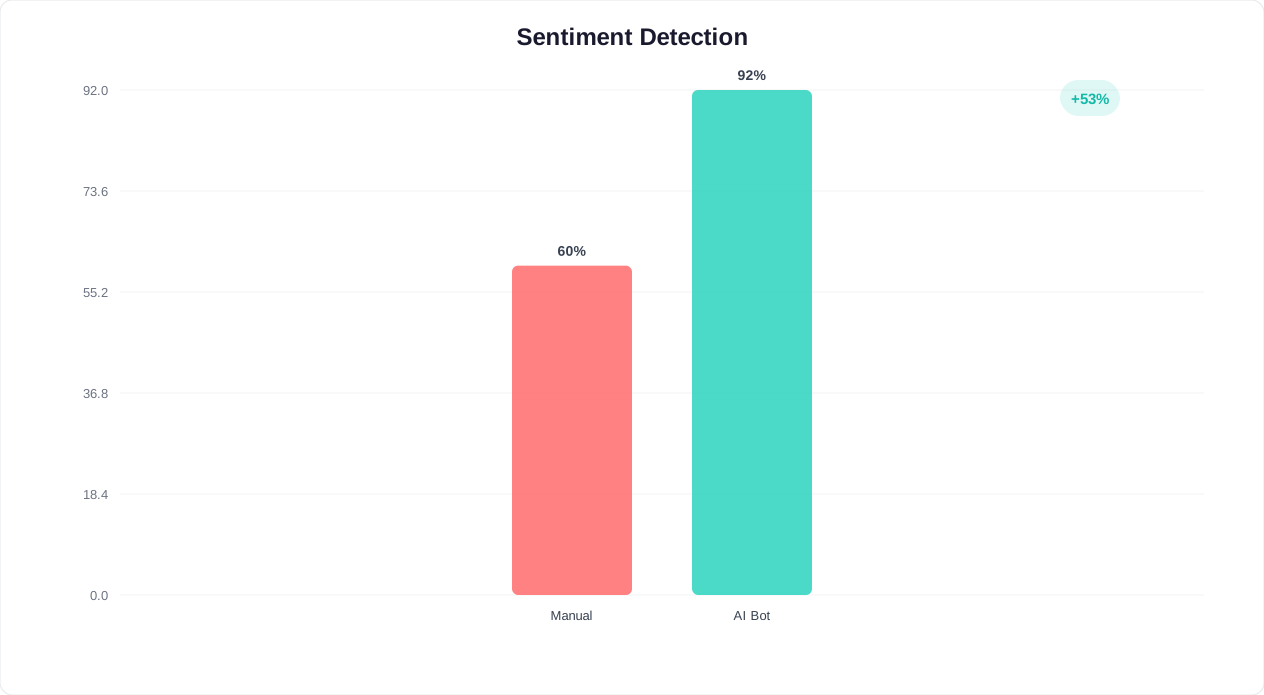
Real-time sentiment tracking through chatbot pulse surveys enables HR teams to detect disengagement signals 6-8 weeks earlier than annual surveys, giving leadership a critical intervention window before resignation decisions are made.

Real-time employee sentiment analysis trends captured through chatbot pulse surveys

Frequent, Lightweight Check-Ins

The chatbot conducts brief pulse surveys -- two to five questions -- on a weekly or biweekly cadence. Each survey focuses on a specific dimension: workload, team dynamics, management support, career development, or workplace culture. Because the surveys are short and conversational, participation rates remain high even with frequent cadence, unlike lengthy annual surveys that feel like a chore. Organizations using chatbot pulse surveys maintain 70-85% participation rates compared to 40-60% for traditional annual surveys.

The conversational format encourages honest, detailed responses. Employees share more when they feel they are having a conversation rather than filling out a form. The chatbot's empathetic acknowledgment of responses ("I hear you -- that sounds frustrating") validates employee feelings and encourages continued openness, producing richer qualitative data alongside quantitative metrics.

Anonymity and Trust

Employee survey effectiveness depends on trust that responses are truly anonymous. The chatbot clearly communicates anonymity guarantees and technical safeguards. Responses are aggregated at the team level with minimum response thresholds to prevent individual identification. This transparency about data handling builds the trust necessary for honest feedback, especially on sensitive topics like management effectiveness and workplace culture.

  • Onboarding pulse: New hire pulse surveys at 30, 60, and 90 days identify onboarding gaps and early disengagement signals before new employees become flight risks.
  • Post-change pulses: After organizational changes (restructuring, policy changes, leadership transitions), the chatbot captures real-time reaction and sentiment to guide communication and support strategies.
  • DEI measurement: Pulse surveys can measure inclusion, belonging, and equity experiences across demographic segments, providing data to support diversity and inclusion initiatives.

Manager Dashboards and Action Plans

Pulse survey results are delivered to managers through intuitive dashboards showing team sentiment trends, comparison to organizational benchmarks, and flagged areas requiring attention. The chatbot also suggests evidence-based actions: if team workload scores are declining, it recommends specific interventions like workload redistribution, project deprioritization, or temporary resource allocation.

Predictive Attrition Modeling

Chatbot pulse data feeds predictive models that identify teams and individuals at risk of attrition before resignation occurs. Declining engagement scores, negative sentiment trends, and specific feedback patterns correlate with turnover risk. HR teams can intervene proactively with retention strategies targeted at at-risk populations, potentially reducing voluntary turnover by 15-25% in high-risk segments.

Event Feedback Surveys: Capturing Attendee Insights in Real Time

Event organizers invest significant resources in conferences, webinars, workshops, and training sessions, but post-event surveys typically capture feedback from fewer than 20% of attendees. This low response rate makes it difficult to accurately evaluate event success, identify improvement opportunities, and justify continued investment. A survey chatbot captures event feedback in real time and immediately after the event, achieving dramatically higher response rates and more detailed, actionable insights.

In-Event Feedback Collection

The chatbot collects feedback during the event, not just after it. Attendees can rate sessions immediately after they attend, report logistical issues (room temperature, audio quality, seating) for real-time resolution, and share what they are enjoying most. This real-time feedback enables event organizers to make adjustments during the event itself -- rearranging seating, adjusting agendas, or addressing technical issues -- rather than only learning about problems from post-event surveys when it is too late.

In-event chatbot feedback achieves 50-70% response rates because the barrier to participation is minimal: attendees simply respond to a quick chatbot prompt on their phone via WhatsApp or a web interface between sessions. The immediacy captures genuine reactions rather than the faded memories that characterize surveys sent days later.

Session-Level Evaluation

For multi-session events, the chatbot evaluates each session individually, capturing speaker ratings, content quality assessments, relevance scores, and specific feedback. This granular data helps organizers identify top-performing speakers and topics (for future invitations) and underperforming sessions (for elimination or improvement). Speaker-level feedback also provides valuable coaching data that helps presenters improve their delivery and content.

  • Speaker ratings: Attendees rate speakers on content quality, delivery, relevance, and engagement, providing quantified feedback that informs future speaker selection.
  • Content relevance: Track how relevant attendees found each session to their role and interests, helping organizers better match content to audience needs in future events.
  • Networking quality: Assess the value of networking opportunities, facilitated connections, and social events to optimize the non-content aspects of the event experience.

Post-Event Follow-Up Surveys

Within 24 hours of the event, the chatbot conducts comprehensive follow-up surveys that capture overall event evaluation, key takeaways, improvement suggestions, and interest in future events. The timing -- while the experience is still fresh but after the attendee has had time to reflect -- produces thoughtful, actionable feedback. The chatbot also collects testimonials from satisfied attendees and gauges interest in upcoming events and related offerings.

⚡ Efficiency Insight

In-event chatbot feedback achieves 50-70% response rates while capturing real-time insights that enable organizers to make adjustments during the event itself — not days later from a post-event survey.

Feedback TimingResponse RateData QualityActionability
During event (chatbot)50-70%Very high (real-time reactions)Immediate adjustments possible
Same-day post-event35-50%High (fresh memory)Next event planning
24-hour email survey15-25%Medium (fading details)General themes only
1-week post-event email5-10%Low (selective recall)Limited

Event ROI Measurement

The chatbot helps quantify event ROI by tracking attendee actions post-event: did they visit your website, request a demo, download resources, or share event content on social media? By combining satisfaction data with behavioral outcomes, organizers can demonstrate concrete ROI to stakeholders and sponsors, justifying continued investment in events and securing budget for future programs.


Conversational Surveys vs Traditional Forms: A Complete Comparison

The shift from traditional survey forms to conversational chatbot surveys represents a fundamental change in how organizations collect feedback. Survey form completion rates have declined steadily over the past decade as consumers and employees experience "survey fatigue" from the proliferation of feedback requests across every digital interaction. Conversational surveys offer a compelling alternative that addresses the core reasons people abandon traditional surveys.

Response Rate Comparison

The data is clear: conversational surveys consistently outperform traditional forms across every metric. Chatbot surveys achieve 3-5x higher completion rates, generate longer and more detailed open-ended responses, and produce lower abandonment rates. The conversational format addresses the primary reasons people skip surveys: they feel impersonal, take too long, and provide no immediate value. A chatbot survey feels like a brief conversation rather than a task, and the adaptive format means respondents only answer questions relevant to their experience.

MetricTraditional FormsChatbot Surveys
Completion rate10-15%35-55%
Average response time5-8 minutes2-3 minutes
Open-ended response length8-15 words25-50 words
Abandonment rate40-60%10-20%
Mobile completion rate8-12%40-55%

Data Quality Advantages

Conversational surveys produce higher-quality data because the chatbot can validate responses in real time, ask clarifying follow-up questions, and adapt the survey flow based on previous answers. A respondent who gives a contradictory answer is gently prompted to clarify. A respondent who provides a particularly interesting insight receives a follow-up question that explores the topic more deeply. This adaptive intelligence is impossible with static forms.

  • Reduced survey fatigue: The conversational format keeps respondents engaged through the entire survey, reducing the "Christmas tree" response pattern (randomly selecting answers to finish quickly) common in long form surveys.
  • Natural language responses: Respondents provide richer qualitative feedback in conversational format because typing a chat response feels more natural than filling in a text box on a form.
  • Contextual branching: The chatbot skips irrelevant questions automatically based on previous responses, keeping the survey focused and respectful of the respondent's time.

Implementation Considerations

Transitioning from form-based to chatbot-based surveys requires thoughtful implementation. Not every survey is suited for conversational format -- very long research surveys with complex matrix questions may still work better as forms. The chatbot excels at short-to-medium surveys (5-15 questions), satisfaction measurement, feedback collection, and any survey where response rate is critical to data validity.

Getting Started

Start by converting your lowest-performing surveys to chatbot format. NPS surveys, post-interaction CSAT, and event feedback are excellent starting points because they are short, time-sensitive, and benefit most from higher response rates. As your team gains comfort with conversational survey design, expand to more complex use cases like product research, market analysis, and comprehensive customer experience measurement.

💡 Key Insight

Companies that switch their NPS and CSAT collection from email forms to conversational chatbot surveys see an average 54% completion rate versus 24% for web forms — generating 3x more feedback data with higher response quality.

Ready to transform your survey strategy? Explore Conferbot's conditional logic builder to design adaptive survey flows, connect responses to your CRM via the integrations hub, and track results in real time with the analytics dashboard.

FAQ

Surveys Templates FAQ

Everything you need to know about chatbots for surveys templates.

🔍
Popular:

Chatbot surveys consistently achieve 3-5x higher completion rates than email surveys. While email surveys average 10-15% response rates, conversational chatbot surveys typically achieve 35-55% completion rates due to their interactive format, adaptive questioning, and in-context delivery.

Chatbot surveys complement rather than replace traditional tools. They excel at short-to-medium surveys where response rate is critical: NPS, CSAT, event feedback, and product feedback. Complex research surveys with matrix questions may still benefit from traditional formats. Many organizations use both approaches.

Conferbot provides configurable anonymity settings. For anonymous surveys, responses are aggregated at the group level with minimum response thresholds to prevent individual identification. Technical safeguards ensure that response data cannot be linked to individual respondents, and clear anonymity guarantees are communicated to participants.

Yes, the chatbot triggers NPS and CSAT surveys automatically based on configurable events: after support interactions, at subscription milestones, following purchases, or on a recurring schedule. It collects scores, asks follow-up questions, and routes responses to appropriate teams for action.

The conversational format naturally encourages detailed open-ended responses -- chatbot respondents provide 2-3x longer answers than form respondents. The chatbot can ask clarifying follow-ups on interesting responses and uses natural language processing to categorize and theme open-ended feedback automatically.

Yes, Conferbot supports employee pulse surveys with features designed for workforce feedback: guaranteed anonymity, manager-level dashboards, trend tracking, and integration with HR systems. Organizations using chatbot pulse surveys maintain 70-85% participation rates with weekly or biweekly survey cadences.

Yes, Conferbot supports multilingual survey deployment. Surveys can be configured in multiple languages, and the chatbot detects the respondent's language preference automatically. This capability is essential for global organizations collecting feedback across diverse workforce and customer populations.

Survey responses sync automatically to your CRM, analytics platforms, and BI tools via native integrations and APIs. Data can be exported to tools like Tableau, Power BI, or Google Data Studio for advanced analysis. Real-time dashboards within Conferbot provide immediate visibility into survey results.

Yes, adaptive branching is a core advantage of conversational surveys. The chatbot skips irrelevant questions, asks deeper follow-ups on important topics, and adjusts the survey path based on each response. This adaptive flow keeps surveys focused and respects the respondent's time.

The chatbot collects feedback for all event types: conferences, webinars, workshops, training sessions, product launches, and internal company events. It supports in-event real-time feedback, post-session ratings, and comprehensive post-event evaluation surveys with session-level and speaker-level granularity.

How to Use Surveys Chatbot Templates

Postępuj zgodnie z tymi prostymi krokami, aby skonfigurować swojego chatbota surveys i uruchomić go w kilka minut

🎯

1. Choose Your Template

Select from high-converting lead generation templates designed for your industry and use case.

📋

2. Customize Qualifying Questions

Modify questions to match your ideal customer profile and lead scoring criteria.

🔄

3. Set Up Lead Routing

Configure automatic lead distribution to your sales team based on qualification scores.

🔗

4. Integrate with Your CRM

Connect to HubSpot, Salesforce, or your preferred CRM for seamless lead management.

📊

5. Deploy and Monitor

Launch your chatbot and track conversion rates, lead quality, and ROI through our analytics dashboard.

Dlaczego Wybrać Nasze Szablony Surveys ?

Porównaj zalety korzystania z profesjonalnych szablonów w porównaniu do budowania od zera

Z Szablonami Conferbot

  • Wdrożenie w 10 minut
  • Sprawdzone wzorce konwersji
  • Najlepsze praktyki branżowe w zestawie
  • Gotowe do użycia integracje
  • Ciągłe aktualizacje i ulepszenia
  • Wsparcie ekspertów 24/7
  • Darmowy start

Budowanie od Zera

  • Tygodnie lub miesiące rozwoju
  • Podejście prób i błędów
  • Brak sprawdzonych wzorców
  • Złożona konfiguracja integracji
  • Ciągłe obciążenie konserwacją
  • Ograniczone zasoby wsparcia
  • Wysokie koszty rozwoju

Gotowy Przekształcić Swój Surveys?

Dołącz do tysięcy firm używających naszych szablonów surveys do automatyzacji konwersacji i poprawy wyników