Why Car Wash Businesses Are Deploying Chatbots in 2026
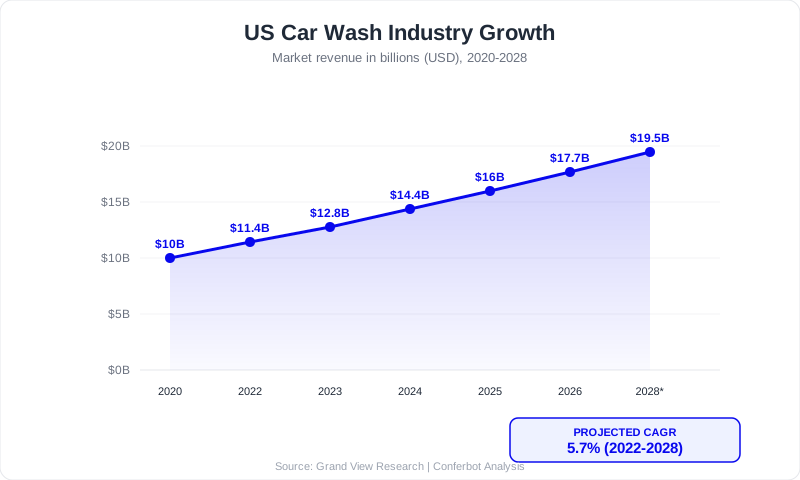
The car wash and auto detailing industry in the United States is a $17.7 billion market and growing at 5.7% annually, driven by increasing vehicle ownership, consumer preference for professional cleaning over DIY, and the explosive growth of membership-based wash models. According to Grand View Research, the industry is projected to reach $19.5 billion by 2028, with express tunnel washes and mobile detailing operations leading the growth.
Yet the operational model at most car wash and detailing businesses has not kept pace with market growth. Walk-in customers wait in line. Phone bookings for detailing appointments go to voicemail during busy hours. Membership sign-ups happen on paper forms at the register. Upselling depends entirely on the cashier's verbal pitch, which varies wildly in effectiveness. And customer retention is largely passive — when a membership card expires or a credit card declines, the customer simply stops coming.
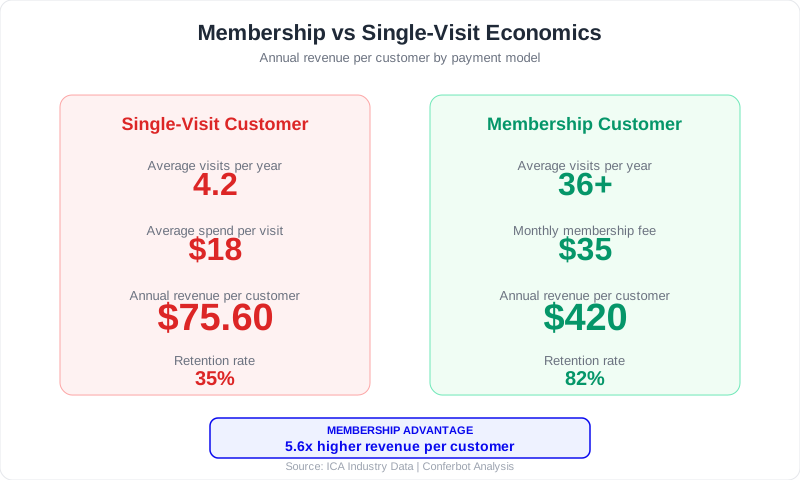
The economics of the car wash business make chatbot automation particularly compelling. The difference between a single-visit customer and a membership customer is not incremental — it is transformational. A single-visit customer generates $75.60 per year. A membership customer generates $420 per year. Converting even a small percentage of walk-in customers to members has an outsized impact on annual revenue, and a chatbot is the most effective conversion tool available because it engages every customer, every time, with consistent messaging and frictionless enrollment.
This guide covers the complete chatbot implementation for car wash and auto detailing businesses: appointment booking, membership sales and management, service upselling, mobile detailing operations, customer retention, and a detailed ROI model. Whether you operate a single-bay hand wash, a multi-lane express tunnel, a mobile detailing fleet, or a full-service detailing center, this guide provides the playbook to increase revenue per customer and reduce operational costs through chatbot automation.
The competitive landscape makes this investment increasingly urgent. The car wash industry has consolidated rapidly, with private equity-backed chains like Mister Car Wash, Take 5, and Zips acquiring independent operators at an accelerating pace. These well-capitalized chains deploy sophisticated technology — mobile apps, automated RFID recognition, CRM systems — that create a customer experience independent operators cannot match with manual processes. A chatbot is the most cost-effective way for independent and small-chain operators to close this technology gap: it provides membership enrollment, appointment booking, upselling, and customer engagement capabilities that rival the technology deployed by operators with 100x the budget.
The industry is also shifting structurally toward subscription models. According to the International Carwash Association, membership programs now account for 40-60% of revenue at express tunnel operations that have implemented them — up from virtually zero a decade ago. The chatbot accelerates this shift by making membership enrollment frictionless and ongoing management automated. For operators who have not yet implemented a membership program, the chatbot provides the enrollment infrastructure without requiring a custom mobile app or expensive POS system upgrades.
Appointment Booking for Detailing and Premium Services
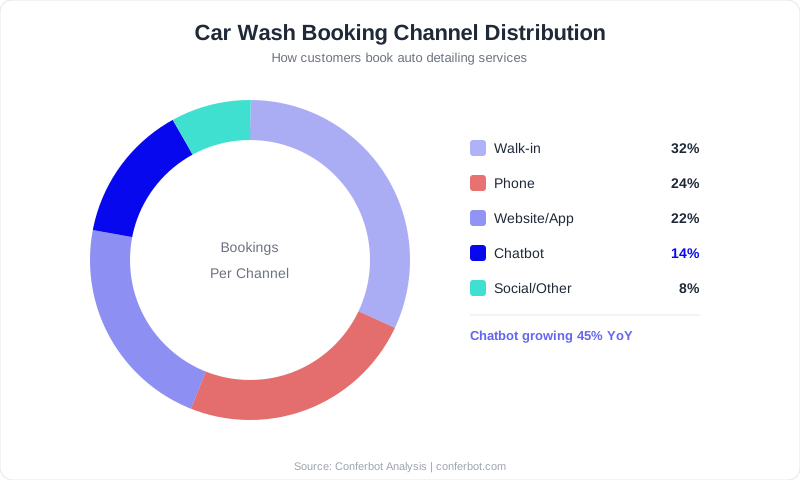
While express tunnel washes typically operate on a drive-up, no-appointment basis, the higher-revenue segments of the car wash industry, as analyzed by the International Carwash Association (ICA), — full detailing, paint correction, ceramic coating, interior deep cleaning, and mobile detailing — require scheduled appointments. These services command $150-$500+ per visit, and the booking experience directly impacts conversion. A customer who calls for a detailing appointment and reaches voicemail during a busy Saturday morning is a customer who calls your competitor next.
How the Chatbot Booking Flow Works
The chatbot guides customers through a structured booking process that captures all the information needed to schedule the right service at the right time:
- Service selection: The chatbot presents available services with descriptions and pricing — basic exterior wash, interior cleaning, full detail, paint correction, ceramic coating, headlight restoration, engine bay cleaning, and specialty services. Each option includes a brief description of what is included so the customer makes an informed choice.
- Vehicle information: Make, model, year, and size category (sedan, SUV, truck, van). Vehicle size determines pricing and time allocation — a full detail on a Suburban takes twice as long as a Civic.
- Condition assessment: For detailing services, the chatbot asks about current condition: pet hair, heavy stains, smoke odor, last professional cleaning date. This helps the detailer prepare the right equipment and allocate appropriate time.
- Time slot selection: The chatbot shows available appointments based on the service selected and vehicle size. A 2-hour full detail and a 6-hour paint correction have very different scheduling requirements.
- Mobile vs. in-shop: For businesses offering both, the chatbot asks the customer's preference and collects the service location address for mobile detailing.
- Confirmation and payment: The customer receives instant confirmation with service details, appointment time, price, and what to prepare (remove personal items, ensure vehicle access for mobile detailing).
Service Area Verification for Mobile Detailing
Mobile detailing businesses need to verify that the customer's location is within their service area before confirming the booking. The chatbot collects the address, checks it against the defined service radius, and either confirms availability or offers alternatives (a different date when a detailer will be in the area, or the option to bring the vehicle to the shop). This automated verification eliminates the back-and-forth that wastes time for both the customer and the scheduling coordinator.
The Impact on Premium Service Revenue
Businesses that deploy chatbot booking for premium services report a 25-40% increase in detailing appointments. The primary driver is after-hours booking: customers researching detailing services in the evening can book immediately instead of planning to call during business hours (and frequently forgetting). The chatbot captures this demand that phone-only booking misses entirely. For businesses building a comprehensive appointment booking strategy, the car wash chatbot is a high-value application.
Pre-Arrival Vehicle Information Collection
For detailing appointments, the chatbot can collect vehicle photos before the appointment, allowing the detailer to assess condition, prepare the right products, and allocate accurate time. A customer who sends a photo showing heavy pet hair and stained upholstery can be quoted appropriately and scheduled for a longer time block. This pre-arrival assessment eliminates the common problem of underquoting — where a customer books a standard detail, the detailer arrives to find a vehicle requiring twice the expected work, and either absorbs the cost or has an uncomfortable upsell conversation on-site.
The chatbot also collects vehicle-specific preparation instructions: "Please remove all personal items from the vehicle before your appointment. If you have aftermarket tint, please let us know so we can use tint-safe products." These preparation reminders reduce appointment delays and ensure the detailer can begin work immediately upon arrival. For a mobile detailer handling 4-5 appointments per day, saving even 10 minutes per appointment through better preparation creates capacity for an additional weekly appointment — representing $800-$1,600 in monthly revenue.
Membership Sales and Management: The Revenue Engine
Membership programs are the most significant revenue innovation in the car wash industry, a subscription model that McKinsey's automotive services research identifies as a key growth driver in the past decade. The economics are compelling and well-understood by operators, but execution remains a challenge. Converting walk-in customers to members requires a consistent, persuasive pitch at the register — and when the register line is 10 cars deep on a Saturday, that pitch gets abbreviated or skipped entirely.
The Membership Math
The numbers make the strategic imperative clear. A single-visit customer averages 4.2 visits per year at $18 per visit, generating $75.60 in annual revenue with a 35% year-over-year retention rate. A membership customer pays $35 per month for unlimited washes, visits 3+ times per month, generates $420 in annual revenue, and retains at 82%. The membership customer is worth 5.6 times more — and the cost to serve them is marginally higher (additional water and chemicals per visit) while the revenue is contractually recurring.
How the Chatbot Drives Membership Conversion
The chatbot converts customers to memberships through multiple touchpoints:
Website visitors: When a visitor lands on the website and indicates interest in wash services, the chatbot presents the value proposition: "Did you know that if you wash your car more than twice a month, a membership saves you money? Our $35/month plan includes unlimited washes — that is less than two single washes." This comparison reframing is the most effective membership pitch, and the chatbot delivers it perfectly every time.
Post-visit conversion: After a single-visit purchase, the chatbot follows up: "Thanks for visiting today! If you enjoyed your [Service], you would save $X per year with a membership. Want me to set that up?" This post-visit touchpoint catches the customer while satisfaction is high.
Lapsed customer reactivation: For customers who have not visited in 60+ days, the chatbot sends a re-engagement message with a trial membership offer: "We miss you! Try our membership free for the first month — unlimited washes anytime. Cancel if it is not for you." Free trial offers convert 18-25% of lapsed customers into paying members.
Membership Management Automation
Once a customer becomes a member, the chatbot handles the ongoing management that would otherwise consume staff time:
- Payment updates: When a credit card expires or a payment fails, the chatbot notifies the member and collects updated payment information — preventing the involuntary churn that accounts for 40-50% of all membership cancellations.
- Tier upgrades: The chatbot periodically presents upgrade offers: "You have been using Basic Wash 4+ times per month. Our Premium plan includes tire shine, interior vacuum, and air freshener for just $10 more. Want to upgrade?"
- Pause and resume: Members traveling or temporarily not needing service can pause their membership through the chatbot instead of canceling. This preserves the customer relationship and eliminates the re-acquisition cost of winning them back.
- Cancellation prevention: When a member requests cancellation, the chatbot asks why and offers retention alternatives: a lower tier, a temporary pause, or a one-time discount. This save flow retains 25-35% of members who would otherwise cancel.
Upselling and Service Upgrades That Increase Average Ticket Value
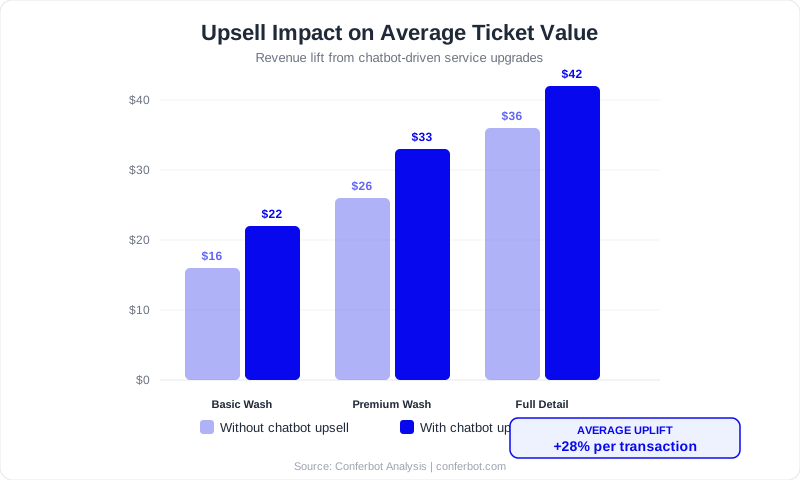
Upselling is the highest-margin revenue opportunity in the car wash business — the incremental cost of adding a tire shine, interior vacuum, or premium wax to an existing wash is minimal, but the revenue impact is substantial. The challenge is consistency: a verbally delivered upsell depends on the cashier's motivation, training, and how busy they are at the moment. The chatbot delivers a consistent, data-driven upsell every time.
Strategic Upsell Points
The chatbot identifies optimal upsell moments based on the customer's purchase history and current selection:
At booking: When a customer selects a basic wash, the chatbot presents the premium upgrade: "For just $6 more, the Premium Wash includes tire shine, wheel cleaning, and rain-repellent treatment. Most customers say it is worth the upgrade. Would you like to add it?" This comparison-based framing achieves a 30-40% upgrade rate — significantly higher than the 10-15% achieved by verbal cashier upsells.
Seasonal promotions: The chatbot presents timely add-ons based on season: "Spring is here — would you like to add an undercarriage wash to remove winter salt buildup? Just $8 extra." Or: "Summer sun is tough on your paint. Add our UV-protective wax treatment for $12 to keep your finish looking new." Seasonal relevance increases add-on acceptance by 35-50% compared to generic offers.
Condition-based recommendations: For detailing bookings, the chatbot uses the condition assessment data to recommend specific add-ons: "You mentioned pet hair — our deep fabric extraction service removes pet hair completely from all upholstery and carpet. Would you like to add that for $40?" Condition-based recommendations feel helpful rather than salesy, which dramatically improves acceptance rates.
Membership tier comparison: For members at lower tiers, the chatbot tracks service usage and presents tier upgrades when the math favors the customer: "You have added tire shine to your last 4 visits at $4 each. If you upgrade to the Premium membership, tire shine is included — you would actually save $6 per month. Want me to upgrade you?" This data-driven upsell feels like a favor, not a pitch.
The Revenue Impact
Across all service tiers, chatbot-driven upselling increases the average ticket value by 28%. For a car wash processing 200 vehicles per day at a baseline average of $18, that 28% uplift represents an additional $1,008 per day — or $367,920 per year. Even a fraction of this uplift, achieved through chatbot-driven pre-booking upsells and membership tier upgrades, represents transformational revenue growth. This pattern mirrors the broader AI upselling impact documented across service industries.
Customer Lifetime Value: The 3-Year View
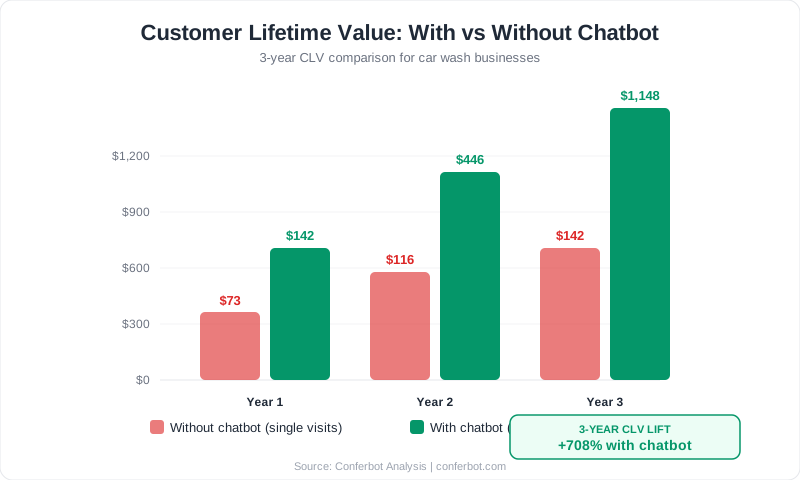
The most powerful metric for understanding the chatbot's impact on a car wash business is customer lifetime value (CLV), a concept that Harvard Business Review has shown to be the most predictive measure of business health's impact on a car wash business is customer lifetime value (CLV). The short-term revenue per transaction tells only part of the story. The full picture emerges over a 3-year horizon, where the compounding effects of membership conversion, retention, and upselling create a dramatic divergence between chatbot-engaged and non-engaged customers.
CLV Without Chatbot
A typical single-visit customer without chatbot engagement generates declining revenue over time:
- Year 1: $73 — 4.2 visits at $18 average, with some seasonal variation
- Year 2: $43 — retention drops to 60%, visit frequency declines to 3.8
- Year 3: $26 — retention drops further to 55%, the customer is effectively churning
- 3-year total: $142
CLV With Chatbot (Membership Conversion)
A customer who is converted to membership through chatbot engagement follows a radically different trajectory:
- Year 1: $142 — $35/month x 12 months x 34% conversion (some join mid-year). Includes upsell revenue from tier upgrades and add-ons.
- Year 2: $446 cumulative — 82% retention rate means most members continue. Upsell to higher tiers adds incremental revenue.
- Year 3: $1,148 cumulative — long-term members become the highest-value customers, referring friends and family, and consistently accepting premium add-ons.
- 3-year total: $1,148
The 708% increase in CLV is the single most compelling argument for chatbot deployment in the car wash industry. It is not about saving $4 per booking or reducing hold times — it is about fundamentally transforming the revenue trajectory of every customer relationship. A car wash that converts 100 additional customers per year to membership through chatbot engagement adds approximately $114,800 in incremental 3-year CLV.
The Flywheel Effect
CLV improvement creates a compounding flywheel. Higher per-customer revenue increases marketing budget capacity, which drives more customer acquisition. More members reduce revenue volatility (recurring vs. weather-dependent single visits). Higher retention reduces acquisition cost per dollar of revenue. And satisfied members generate referrals that bring in pre-qualified prospects with higher conversion rates than cold traffic. The chatbot accelerates every stage of this flywheel.
Referral Programs That Compound CLV
The chatbot automates referral program management — a capability that further amplifies customer lifetime value. After a positive interaction (high satisfaction rating, membership renewal, or detailing completion), the chatbot presents a referral offer: "Love your results? Share this link with a friend — they get $10 off their first wash, and you earn a free Premium Wash." The chatbot tracks referral codes, credits rewards automatically, and notifies the referring customer when their reward is available.
Referral-acquired customers have 25-30% higher retention rates than advertising-acquired customers because they arrive with social proof and a trusted recommendation. A car wash that generates 20 referral customers per month through chatbot automation adds approximately $8,400 in annual membership revenue (at 50% membership conversion and $420 annual membership value) — revenue that costs nothing to acquire beyond the reward fulfillment. Over time, as each referral customer generates their own referrals, the program creates a self-sustaining growth loop that compounds customer lifetime value across the entire customer base.
Mobile Detailing Operations: Chatbot as the Dispatcher
Mobile detailing is the fastest-growing segment of the car wash industry, projected to grow at 8-10% annually through 2030. Mobile operators bring detailing services to the customer's home or office, eliminating the need for the customer to drive to a shop and wait. The convenience premium supports higher pricing — a mobile full detail commands $200-$400 versus $150-$250 for the same service in-shop.
Operational Challenges the Chatbot Solves
Mobile detailing presents unique scheduling challenges that the chatbot addresses:
Route optimization: The chatbot can schedule appointments geographically, grouping bookings by neighborhood or zone to minimize drive time between appointments. A detailer who spends 30 minutes driving between appointments instead of 60 minutes can fit an additional appointment per day — representing $200+ in additional daily revenue.
Service area verification: The chatbot collects the service address and automatically verifies it falls within the service area. For addresses outside the zone, the chatbot can offer a surcharge option or waitlist the customer for a day when the detailer will be in their area.
Access requirements: The chatbot asks about water access, electrical access (for equipment), covered vs. outdoor parking, and any gate codes or access restrictions. These details, collected automatically, eliminate the pre-appointment calls that consume the detailer's driving time.
Same-day availability: Mobile detailing customers often have spontaneous demand — "Can someone come today?" The chatbot checks real-time availability across all detailers and offers the earliest available slot, including same-day options when gaps exist in the schedule.
Multi-Detailer Coordination
For mobile detailing businesses with multiple operators, the chatbot serves as an automated dispatcher. It tracks each detailer's schedule, location, equipment capabilities, and service specializations (some detailers may be certified for ceramic coating while others handle standard details). The chatbot matches the customer's service request to the right detailer at the right time in the right area — a coordination task that would require a full-time dispatcher for a fleet of 4+ detailers.
Recurring Mobile Detailing Subscriptions
The chatbot enables mobile detailing businesses to sell recurring service subscriptions — a model that transforms volatile per-booking revenue into predictable monthly income. A bi-weekly exterior detail subscription at $120/month or a monthly full detail at $180/month guarantees consistent revenue and fills scheduling gaps. The chatbot presents subscription options after a customer's first appointment: "Enjoyed your detail today? Our bi-weekly plan keeps your vehicle spotless and saves you 20% compared to individual bookings. Would you like to set up a recurring schedule?" It manages the ongoing subscription — confirming upcoming appointments, processing payments, handling rescheduling, and adjusting seasonal schedules. Mobile detailing businesses that introduce chatbot-managed subscriptions report 35-40% of customers converting to recurring plans within the first six months, creating a revenue floor that supports business growth and investment in additional equipment and staff.
Seasonal Marketing and Weather-Based Promotions
Car wash demand is inherently seasonal and weather-sensitive. A sunny spring weekend can double typical volume, while a rainy week can cut traffic by 60%. Smart car wash operators use seasonal marketing and weather-triggered promotions to smooth demand — and the chatbot is the ideal delivery channel for these time-sensitive offers.
Seasonal Campaign Automation
The chatbot can deliver pre-scheduled seasonal campaigns throughout the year:
- January-February: "Post-winter salt removal special — protect your paint and undercarriage. Add our Winter Recovery package for $15 with any wash."
- March-April: "Spring cleaning for your car! Full interior detail at 20% off this month. Book now — spots fill fast."
- May-June: "Summer is here. Protect your paint with our ceramic coating special — $199 (regularly $299). Limited availability."
- September-October: "Fall leaf season means more debris. Our Premium membership includes unlimited washes — sign up today and get your first month free."
- November-December: "Gift card season! Give the gift of clean. $50 gift cards for $40 through the chatbot."
Weather-Triggered Messaging
The chatbot can integrate with weather APIs to send contextually relevant messages:
- After a rainstorm: "The rain stopped, but the water spots have not. Come in for a spot-free rinse — just $5 for members."
- Before a pollen surge: "Pollen season peaks this week. Protect your clear coat with our pollen removal wash — includes wax protection."
- During a heat wave: "Extreme heat damages UV protection. Add our UV shield treatment to your next wash — just $8."
Weather-triggered messages achieve 2-3x higher engagement rates than generic promotional messages because they address a problem the customer is experiencing right now. The ICA (International Carwash Association) reports that weather-responsive operators see 15-25% higher revenue per rainy-season week than operators who rely solely on foot traffic.
Customer Loyalty Programs and Punch-Card Digitization
Many car wash operators still use physical punch cards for loyalty programs — a system plagued by lost cards, inconsistent tracking, and zero customer data. The chatbot digitizes the loyalty experience entirely. Every visit is tracked automatically, and customers earn rewards without carrying a card: "You have completed 8 of 10 washes toward your free Premium Wash! Just 2 more visits to go." The chatbot notifies customers when they are close to earning a reward, creating urgency that drives additional visits: "You are just one wash away from a free Premium upgrade — visit anytime this week to claim it." Digital loyalty tracking also provides the operator with customer visit frequency data, average spend per visit, and redemption patterns — insights that physical punch cards could never provide. Operators who migrate from physical to chatbot-managed loyalty programs see a 22-30% increase in loyalty program participation and a 15% increase in visit frequency among enrolled customers.
Beyond simple visit tracking, the chatbot can run time-limited loyalty promotions: "Double points this weekend only — every wash earns 2x toward your free service." These flash promotions drive traffic during slow periods and create a sense of exclusivity for loyal customers. The chatbot can also segment customers by behavior — sending re-engagement offers to lapsing loyalty members and VIP offers to high-frequency customers — creating a personalized retention strategy that a physical punch card system cannot replicate.
Fleet and Commercial Accounts
Fleet and commercial accounts represent the highest-value segment, with fleet management trends tracked by the Automotive Fleet research platform for car wash and detailing businesses. A single fleet contract with a car dealership, rental company, ride-share driver group, or corporate fleet can generate $5,000-$50,000+ in annual revenue — with predictable, recurring volume that smooths seasonal fluctuation.
How the Chatbot Captures Fleet Leads
Fleet managers have different needs than individual consumers, and the chatbot should detect fleet inquiries and route them to a specialized flow:
- Fleet size and type: Number of vehicles, vehicle types (sedans, SUVs, trucks, vans), and frequency requirements (daily, weekly, monthly).
- Service requirements: Exterior only, interior + exterior, full detail, paint protection — fleet contracts often specify service levels.
- Location logistics: On-site service at the fleet lot versus vehicles brought to the shop. Mobile detailing is particularly attractive for fleet clients because it minimizes vehicle downtime.
- Billing and reporting: Fleet clients typically need monthly invoicing, per-vehicle cost tracking, and service completion reports. The chatbot captures these requirements upfront so the sales proposal addresses them.
The chatbot collects this information and generates a qualified fleet lead for the sales team. A fleet inquiry that provides vehicle count, service frequency, and location is far more actionable than a generic "I want a quote" phone message. Businesses using chatbot fleet lead qualification report 40-60% faster proposal turnaround and higher close rates because the initial qualification is complete before the first sales conversation.
Fleet Account Management
Once a fleet contract is active, the chatbot can manage day-to-day operations: scheduling individual vehicle washes, tracking completed services, sending monthly summary reports to the fleet manager, and alerting when vehicles are due for their next scheduled service. This level of automated account management strengthens the relationship and makes it operationally painful for the fleet to switch providers — creating natural retention without the need for aggressive contract terms.
ROI Analysis: Chatbot for Car Wash and Detailing Businesses
The ROI for a car wash chatbot operates across five revenue dimensions. We model a mid-size operation: a 2-bay express wash with a detailing center, processing 200 vehicles per day with a 15% membership base.
Revenue Stream 1: Membership Conversion — $50,400/year
Converting an additional 10 customers per month from single-visit to membership through chatbot engagement:
- 10 new members/month x $35/month = $350 incremental monthly recurring revenue per cohort
- Cumulative annual impact (with 82% retention): $50,400
Revenue Stream 2: Upsell Revenue — $36,720/year
Chatbot-driven upselling increases average ticket by $0.50 across 200 daily transactions:
- $0.50 additional x 200 vehicles x 365 days = $36,500
- Plus membership tier upgrades: approximately $220/year additional
- Total upsell revenue: $36,720
Revenue Stream 3: Detailing Bookings — $28,800/year
After-hours and improved-conversion chatbot captures 12 additional detailing appointments per month at $200 average:
- 12 appointments x $200 x 12 months = $28,800
Revenue Stream 4: Membership Retention — $18,900/year
Chatbot save flows retain 25% of members who would otherwise cancel. With 150 active members and 2.5% monthly churn:
- 3.75 saves/month x $35/month x average 12 remaining months x 25% save rate x 12 months = $18,900
Revenue Stream 5: Fleet and Review Growth — $12,000/year
Fleet lead generation and improved Google reviews drive additional volume:
- 2 fleet contracts/year at $5,000 average = $10,000
- Review-driven customer acquisition: $2,000
- Total: $12,000
Total Annual ROI
| Revenue Stream | Annual Value |
|---|---|
| Membership conversion | $50,400 |
| Upsell revenue | $36,720 |
| Detailing bookings | $28,800 |
| Membership retention | $18,900 |
| Fleet/reviews | $12,000 |
| Total | $146,820 |
Against a chatbot platform cost of $1,200-$1,800/year, the ROI exceeds 9,700%.
Implementation Guide and Best Practices
Deploying a car wash chatbot follows a straightforward path using Conferbot's no-code builder and service business templates.
Day 1-2: Configuration
Customize the template with your business name, location(s), branding, and service menu. Enter all service offerings with descriptions, pricing, and time requirements. Set up membership tiers with pricing, included services, and upgrade paths.
Day 3: Integrations
Connect your scheduling system for detailing appointments. Set up payment processing for membership enrollment and detailing bookings. If you use POS software (DRB, Washify, Rinsed), check for API integration options to sync membership data.
Day 4-5: Launch
Embed the chatbot on your website, deploy on WhatsApp and Facebook Messenger (where many car wash customers communicate), and train staff on the chatbot's capabilities. The chatbot greeting for a car wash should be service-oriented: "Need a wash, want to book detailing, or interested in saving with a membership? I can help."
Best Practices
- Lead with the membership value proposition: Every interaction should include a touchpoint that communicates membership value. Even customers booking a single wash should see the comparison: "Your wash today costs $16. Members pay $35/month for unlimited washes."
- Use visual menus: Car wash services benefit from visual presentation. Include images of service results (before/after detailing photos) in the chatbot flow to help customers understand what they are purchasing.
- Personalize based on history: Returning customers should be recognized: "Welcome back! Your last visit was a Premium Wash on May 10. Would you like the same service, or would you like to try something different?"
- Automate weather promotions: Integrate weather data to trigger contextual messages that drive traffic during slow periods.
- Track membership metrics obsessively: The chatbot should feed membership conversion rate, churn rate, tier distribution, and save flow success rate into your analytics dashboard for continuous optimization.
- Optimize for mobile: 80%+ of car wash website traffic comes from mobile devices (customers searching while driving). The chatbot must be fully responsive with large tap targets and minimal typing required.
Was this article helpful?
About the Author

Conferbot Team specializes in conversational AI, chatbot strategy, and customer engagement automation. With deep expertise in building AI-powered chatbots, they help businesses deliver exceptional customer experiences across every channel.
View all articles