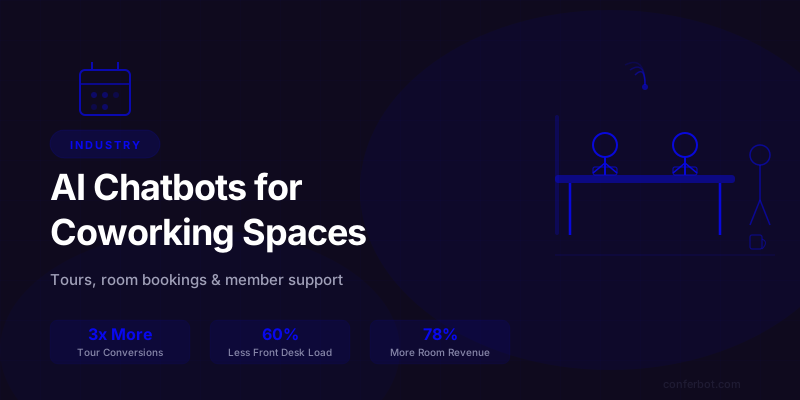
Why Coworking Spaces Need AI Chatbots: The $40 Billion Opportunity
The global coworking industry has exploded into a $40 billion market with over 41,000 spaces worldwide, and it shows no signs of slowing down. According to Statista's coworking industry data, the number of people using coworking spaces globally is projected to reach 41.9 million by 2027, up from 5 million in 2017. The shift to hybrid work has transformed coworking from a niche for freelancers into a mainstream real estate strategy for enterprises, startups, and remote workers alike. JLL's workspace trends research reports that flexible workspace now represents 2 to 3% of total office inventory in major cities and is growing at 20% annually, with corporate demand now exceeding individual demand for the first time.
Yet most coworking spaces still operate with communication infrastructure designed for a traditional office landlord: a phone number, an email address, a contact form, and a community manager who splits their time between answering inquiries, giving tours, managing events, handling maintenance issues, onboarding new members, and building the community that differentiates coworking from conventional office space. According to the Global Coworking Unconference Conference (GCUC) industry report, the average community manager handles 47 member interactions per day on top of 12 to 18 prospect inquiries, and 68% report that administrative overload prevents them from focusing on the community-building activities that drive member retention.
Consider what happens when a startup founder visits your coworking space website at 10 PM on a Sunday. She has just received funding, needs a 6-person team office starting next month, and wants to know about pricing, meeting room access, and internet speeds. On the typical coworking website, she finds a contact form and a phone number that goes to voicemail outside of 9-to-5 business hours. By Monday morning, she has already booked tours at two other spaces that responded instantly. The Deskmag Global Coworking Survey found that 54% of coworking prospects visit or join the first space that responds to their inquiry, regardless of whether it is objectively the best fit for their needs.

An AI chatbot deployed on your coworking space website, WhatsApp, or social media channels can instantly qualify prospects, book tours, check real-time desk and office availability, explain pricing plans, answer FAQs about amenities and services, process meeting room reservations for existing members, promote community events, manage visitor check-in, and handle billing inquiries. It operates 24 hours a day, 7 days a week, capturing leads that would otherwise go to the WeWork, Regus, or independent competitor down the street, while freeing your community managers from the repetitive inquiry-handling that consumes 30 to 40% of their workday.
The financial case is compelling. A 200-desk coworking space with an average revenue per member of $450 per month generates $1.08 million annually at full occupancy. The industry average occupancy rate is 72%, meaning $302,400 in annual revenue goes unrealized. If a chatbot increases tour bookings by 60%, improves tour-to-membership conversion by 15%, and reduces member churn by 10% through better communication, the annual revenue impact exceeds $145,000, achieved with a technology investment under $3,000 per year. This guide covers every aspect of AI chatbot implementation for coworking spaces: tour booking automation, member onboarding, room reservation management, community engagement, visitor management, billing support, and integration with workspace management platforms. Whether you operate a single boutique space or a network of locations, you will find strategies designed specifically for the coworking business model. For a broader look at how chatbots automate event and booking management, see our event management chatbot guide.
Coworking Industry Challenges That AI Chatbots Solve
Coworking is a unique business that combines real estate, hospitality, community management, and technology. The challenges operators face are distinct from traditional office leasing, and they require communication solutions that match the speed and flexibility that coworking promises its members.
The Tour Booking Bottleneck
Tours are the primary conversion mechanism in coworking sales. A prospect who physically visits your space is 5 to 8 times more likely to become a member than one who only sees your website. But booking a tour requires a conversation: the prospect needs to describe what they are looking for, the operator needs to check availability for the right product type, and both need to find a mutually convenient time. On the phone, this takes 10 to 15 minutes. Via email, it takes 2 to 4 exchanges over 1 to 3 days. During that time, the prospect may book a tour at a competitor who responded faster.
According to industry data compiled by Statista, the average coworking space receives 40 to 80 tour requests per month, but only 55 to 65% of those requests result in a completed tour. The remaining 35 to 45% are lost to scheduling friction, slow response times, and prospect drop-off during the back-and-forth booking process. An AI chatbot compresses this booking process to a single 90-second conversation, available 24/7.
Meeting Room Revenue Leakage
Meeting rooms are the highest-margin revenue stream in coworking, generating $15 to $75 per hour per room. But booking friction causes significant revenue leakage. Members who need a meeting room in the next hour do not want to call the front desk, wait for an email response, or navigate a clunky booking portal. They want to send a quick message: "Book the boardroom for 2 PM today for 2 hours." If that is not frictionless, they hold the meeting at a coffee shop, in the lounge area, or at a competitor's space. Industry data suggests that the average coworking space captures only 40 to 50% of potential meeting room revenue due to booking friction and lack of awareness among members about availability.
Member Onboarding Complexity
New member onboarding involves dozens of information transfers: WiFi credentials, printer setup, mail handling procedures, kitchen etiquette, booking systems, community guidelines, event calendar, emergency procedures, parking information, and introductions to the community. When this information is delivered in a one-time walkthrough, members retain about 20% and spend the next two weeks asking the community manager the same questions. A chatbot serves as a permanent onboarding resource that members can query anytime: "What is the WiFi password?" "How do I book a meeting room?" "Where do I pick up my mail?"
Community Manager Burnout
Community managers are the heart of coworking, but they are stretched impossibly thin. According to the GCUC industry report, the average community manager is responsible for sales, tours, onboarding, event planning, facility management, member support, billing, vendor coordination, and social media. They handle 47+ member interactions and 12 to 18 prospect inquiries daily. Repetitive questions ("What are your hours?" "Do you have parking?" "Can I book a day pass?") consume time that should be spent on high-value activities: building community, hosting events, and developing enterprise relationships that drive revenue growth.

After-Hours and Weekend Lead Loss
Coworking spaces typically staff their front desk Monday through Friday, 9 AM to 5 PM. But remote workers browse coworking options during evenings and weekends when they are planning their work week. Freelancers research spaces during their project downtime, often late at night. Enterprise real estate teams evaluate flex space options on their own schedule. Without 24/7 responsiveness, coworking spaces lose 30 to 45% of potential leads to competitors who happen to respond faster. The chatbot ensures every inquiry gets an immediate, intelligent response regardless of when it arrives.
Multi-Location Coordination
Operators managing multiple locations face the additional challenge of routing prospects to the right location based on their needs, budget, and geography. A prospect asking about a 10-person office needs to be matched with locations that have that inventory at the right price point. A chatbot handles this cross-location routing instantly, whereas a single community manager at one location may not have visibility into availability across the network.
Tour Booking Automation: Convert Website Visitors Into Walk-Ins
Tour booking is the single highest-value chatbot function for coworking spaces. Every tour that converts into a membership represents $5,400 to $54,000+ in annual recurring revenue depending on the product (hot desk vs. dedicated desk vs. private office vs. enterprise suite). Automating the tour booking process captures more prospects, qualifies them before they walk in, and reduces the no-show rate that wastes community manager time.
The Tour Booking Conversation Flow
An effective coworking tour booking chatbot guides prospects through a qualification and scheduling process that takes 60 to 90 seconds:
Step 1: Need Identification. "Welcome to [Space Name]! I would love to help you find the perfect workspace. What are you looking for? [Hot desk / Dedicated desk / Private office / Meeting room / Virtual office / Event space / Day pass / Not sure yet]." For "Not sure yet" responses, the chatbot asks clarifying questions: "No problem! How many people will be working? Are you looking for a daily, weekly, or monthly commitment? Do you need a private space or are you comfortable in an open environment?" These responses determine which products to recommend.
Step 2: Team Size and Requirements. "How many people will need workspace? [Just me / 2-4 people / 5-10 people / 11-25 people / 25+]." For larger teams, the chatbot flags the inquiry as enterprise-level and routes it to the sales team with priority notification, as enterprise deals represent significantly higher lifetime value. It asks additional questions for enterprise: "Are you looking for a single location or multiple locations?" "What is your lease or commitment timeline?"
Step 3: Budget and Commitment. "Do you have a monthly budget in mind? [Under $300/month / $300-$600/month / $600-$1,500/month / $1,500-$5,000/month / $5,000+/month / Not sure yet]." "What commitment length works best for you? [Day pass / Month-to-month / 3 months / 6 months / 12 months / Flexible]." Budget and commitment preferences are matched against your pricing to pre-qualify whether the prospect is a fit, preventing tours for prospects who cannot afford your space.
Step 4: Location Preference (for multi-location operators). "We have locations in [neighborhood/city list]. Which area is most convenient for you?" Or for single-location spaces: "We are located at [address]. Is that convenient for your commute?"
Step 5: Tour Scheduling. "I would love to show you around! Here are our available tour times: [Dynamic calendar display showing available 30-minute slots]. Tours typically last 30 minutes and include a walk through our workspace areas, meeting rooms, amenities, and a chance to ask questions. Which time works best?"
Step 6: Confirmation and Preparation. "Your tour is confirmed for [date/time] at [location]. You will receive a confirmation email with directions and parking information. To make the most of your visit, you might want to think about: What amenities matter most to you, any special requirements (24/7 access, phone booths, standing desks), and your ideal start date. See you soon!"

Tour Reminder and No-Show Prevention
Tour no-shows waste 30 minutes of community manager time per occurrence and represent lost conversion opportunities. The chatbot sends automated reminders: 24 hours before ("Looking forward to showing you [Space Name] tomorrow at [time]! Reply CONFIRM to let us know you are coming, or let me know if you need to reschedule."), 2 hours before ("Quick reminder: your tour of [Space Name] is at [time] today. Here are directions: [link]. Parking is available at [details]. See you soon!"). Spaces using automated tour reminders report no-show rates dropping from 30-35% to 10-12%, effectively increasing completed tours by 25-30% without additional marketing spend. This approach mirrors the strategies detailed in our appointment booking chatbot guide.
Virtual Tour Fallback
Not every prospect can visit in person, especially enterprise decision-makers evaluating spaces in cities they do not live in. When a prospect cannot schedule an in-person tour, the chatbot offers alternatives: "I understand an in-person visit does not work right now. Would you like to: [Take a virtual video tour (self-guided)] / [Schedule a live virtual tour with our community manager via Zoom] / [Receive a detailed information packet with photos, pricing, and floor plans]." The virtual tour option captures prospects who would otherwise be lost entirely due to geographic or scheduling constraints.
Post-Tour Follow-Up Automation
After a tour, timely follow-up is critical but often neglected as community managers get pulled into daily operations. The chatbot automates post-tour sequences: same day ("Thank you for visiting [Space Name] today! I hope you enjoyed the tour. Do you have any questions I can help with?"), day 2 ("Hi [Name], I wanted to follow up on your visit. Based on what you shared, our [specific product] plan at $[price]/month would be a great fit. Would you like to move forward with a membership, or would a trial day help you decide?"), day 5 ("Just checking in! Our [specific product] is available starting [date]. We are offering [any current promotion] for new members who join this month. Shall I reserve your spot?"). These automated follow-ups recover 20 to 30% of prospects who toured but did not commit on the day.
Meeting Room Reservations: Maximize Your Highest-Margin Revenue Stream
Meeting rooms generate $50,000 to $200,000+ in annual revenue for a well-managed coworking space, with margins of 70 to 85%. Yet most spaces capture only 40 to 50% of potential meeting room revenue because booking is not frictionless enough. An AI chatbot makes meeting room booking as easy as sending a text message, dramatically increasing utilization and revenue.
Instant Booking via Chat
Members can book meeting rooms through a quick chat conversation:
Member: "I need a meeting room for 6 people tomorrow at 2 PM for 2 hours."
Chatbot: "I have two options available for 6 people tomorrow at 2 PM: (1) Summit Room (capacity 8, TV/screen, whiteboard) - $45/hour ($90 total), (2) Horizon Room (capacity 6, TV/screen, video conferencing) - $35/hour ($70 total). Both include complimentary coffee, water, and whiteboard markers. Which would you prefer?"
Member: "Summit Room."
Chatbot: "Done! Summit Room is booked for tomorrow, [date], 2:00 PM to 4:00 PM. Confirmation sent to your email. Would you like to add any catering? We offer: Coffee and pastry tray ($35), Lunch spread ($15/person), or Custom catering (I will connect you with our events team). Need anything else?"
This entire interaction takes 30 seconds. Compare this to the traditional process: walk to the front desk, wait if the community manager is busy, check the booking calendar, fill out a reservation form, and handle payment. Or the digital alternative: log into the booking portal, navigate to the room booking section, search for availability, compare options, and complete the multi-step booking process. The chatbot collapses all of this friction into a natural conversation.
Non-Member and Day-Pass Room Bookings
Meeting rooms are not just for members. Many coworking spaces allow non-members to book rooms at a premium rate, creating a revenue stream and a funnel for membership conversion. The chatbot handles non-member bookings with additional qualification: "It looks like you are not currently a member. No problem! You can book our meeting rooms on a per-use basis. For non-members, rates are [premium rate]. Would you also like to learn about our membership plans? Members receive [discount percentage] off all meeting room bookings." This upsell prompt converts a percentage of one-time room bookers into recurring members.
Recurring Booking Management
Many members need regular meeting room access: weekly team standups, monthly board meetings, quarterly client presentations. The chatbot manages recurring bookings: "Would you like to make this a recurring booking? [Weekly / Biweekly / Monthly]. I will reserve the Summit Room for you every [day] at [time] for [duration]. You will receive a confirmation at the start of each month, and you can modify or cancel individual sessions with 24 hours notice." Recurring bookings increase room utilization predictability and revenue stability.
Smart Room Recommendations
The chatbot recommends the optimal room based on the member's needs: group size determines minimum capacity, meeting type determines equipment needs (video conferencing for remote participants, whiteboard for brainstorming, presentation screen for pitches), duration affects pricing recommendations (half-day and full-day rates may be more economical), and budget preferences filter options. This intelligent matching ensures members book the right room for their needs rather than defaulting to the same room every time or booking oversized rooms that reduce availability for others.
Integration with Workspace Management Platforms
The chatbot integrates with popular coworking management platforms for real-time room availability and booking:
| Platform | Integration Capabilities |
|---|---|
| Nexudus | Room booking, member directory, billing, event management |
| OfficeRnD | Space booking, member management, invoicing, access control |
| Cobot | Booking, memberships, invoices, time tracking |
| Optix | Room booking, member app, analytics, access |
| Archie | Desk and room booking, CRM, billing, visitor management |
| Andcards | Booking, benefits, events, community feed |
With these integrations, the chatbot provides real-time availability and instantly confirms bookings, rather than creating reservation requests that require manual confirmation. For operators exploring API-based integrations with their workspace management platforms, see our website chatbot deployment guide for technical integration details.
Member Onboarding and Ongoing Support: From Day One to Year Five
Member retention is the most important financial metric in coworking. Acquiring a new member costs 5 to 7 times more than retaining an existing one, and the average coworking member stays 18 to 24 months. Extending that average stay by even 3 months per member adds tens of thousands of dollars in lifetime revenue across the membership base. Effective onboarding and ongoing support are the primary drivers of retention, and a chatbot excels at both.
Day-One Onboarding Sequence
When a new member joins, the chatbot delivers a structured onboarding sequence over their first week:
Day 1 (Welcome): "Welcome to [Space Name], [Name]! We are thrilled to have you as a member. Here is everything you need to get started: WiFi network: [SSID], Password: [password]. Your desk/office is: [location]. Building access: [instructions for key card/app/code]. Printing: [setup instructions]. Kitchen: [guidelines]. Mail: [handling instructions]. Need anything? Just message me anytime, 24/7!"
Day 2 (Community): "Getting settled in? Here are some ways to connect with the community: Upcoming events: [next 3 events with dates]. Slack/community channel: [link]. Member directory: [link]. Community guidelines: [link]. Introducing yourself in the #introductions channel is a great way to meet fellow members!"
Day 3 (Amenities): "Did you know you have access to these amenities? Meeting rooms: [hours included per month, how to book]. Phone booths: [location and booking]. Event space: [availability for member events]. Gym/wellness: [if applicable]. Bike storage: [location]. Nap room: [if applicable]. Not sure how to access something? Just ask!"
Day 5 (Check-in): "How is your first week going? Is there anything we can help with? [Everything is great / I have a question / Something needs fixing / I would like to meet people]. We want to make sure your experience is perfect from the start."
This structured onboarding replaces the single walk-through that most spaces provide, which overwhelms new members with information they immediately forget. By drip-feeding information over the first week, the chatbot ensures members actually absorb and use the resources available to them.
24/7 Member Support
After onboarding, the chatbot serves as a permanent member support channel. Common member questions the chatbot handles instantly:
- "What is the WiFi password?" (The number one question at every coworking space.)
- "How do I book a meeting room?"
- "What are the building hours?"
- "Is there parking available?"
- "The printer is not working."
- "Can I bring a guest today?"
- "How do I get packages delivered here?"
- "What is the guest WiFi for my visitors?"
- "Where is the closest lunch spot?"
- "How do I cancel or upgrade my plan?"
These questions account for 60 to 70% of all member interactions with the community manager. By handling them instantly through the chatbot, the community manager is freed to focus on the relationship-building, event planning, and community development that actually drive retention and differentiate the space from competitors.

Issue Reporting and Facility Management
When members encounter facility issues (broken printer, temperature problems, cleanliness concerns, security issues), the chatbot provides a structured reporting flow: "What type of issue are you experiencing? [Technology (WiFi, printer, AV) / Facility (temperature, cleaning, furniture) / Security / Noise / Other]." It collects details, assigns a ticket, notifies the appropriate staff member, and provides the member with a ticket number and expected resolution time. This structured reporting replaces the verbal complaints that are often forgotten or the email complaints that get buried.
Plan Upgrades and Upselling
The chatbot identifies upsell opportunities based on member behavior and needs. When a hot desk member asks about booking a dedicated desk for the third time: "I noticed you have been using dedicated desks frequently. Our Dedicated Desk plan at $[price]/month includes a permanent desk, personal storage, and 10 hours of meeting room time. That is $[savings] less per month than your current hot desk plus booking fees. Would you like to learn more or upgrade?" When a small team in a 4-person office asks about larger rooms: "It sounds like your team is growing! We have a 6-person office available on the same floor. Would you like to tour it?" These contextual upsells increase average revenue per member while providing genuine value.
Community Events and Member Engagement: The Chatbot as Community Hub
Community is the differentiator that separates a great coworking space from a glorified office rental. Members stay for the community, recommend the space because of the community, and pay a premium for the community. The chatbot amplifies community-building efforts by making events more visible, registration easier, and member connections more accessible.
Event Discovery and Registration
Coworking spaces host a steady calendar of events: networking mixers, lunch-and-learns, workshops, pitch nights, wellness sessions, and happy hours. The challenge is that many members are unaware of upcoming events or forget about events they intended to attend. The chatbot solves this through proactive event promotion and frictionless registration:
Proactive promotion: "This week at [Space Name]: (1) Tuesday 12 PM: Lunch & Learn - AI Tools for Small Business (free, includes lunch), (2) Wednesday 6 PM: Networking Happy Hour (free, beer and wine), (3) Thursday 2 PM: Pitch Practice (members pitch to get feedback). Would you like to RSVP for any of these?"
On-demand discovery: Members can ask "What events are coming up?" and receive a personalized list based on their interests, past attendance, and membership type. New members receive all events; long-time members receive curated recommendations based on their event history.
One-message RSVP: "RSVP me for the networking happy hour." "Done! You are registered for the Networking Happy Hour on Wednesday at 6 PM. I will send you a reminder that morning. Would you like to invite a guest?"
Event Reminders and Follow-Up
Event attendance is directly correlated with reminder frequency and timing. The chatbot sends: a registration confirmation immediately, a reminder the morning of the event, and a reminder 1 hour before the event. Post-event, the chatbot sends a follow-up: "How was the Networking Happy Hour last night? [Great / Good / Could be better / I could not make it]. Your feedback helps us plan better events!" For "I could not make it" responses: "No worries! We host networking events twice a month. Want me to remind you about the next one?" This re-engagement prevents one-time RSVP dropoffs from becoming permanent disengagement.
Member-to-Member Introductions
One of the most valuable services a coworking space provides is facilitating connections between members. The chatbot enables this at scale: "I am looking for a graphic designer for a project." The chatbot searches the member directory (with permission-based opt-in): "We have 3 members who are graphic designers. Here are their profiles: [profile summaries]. Would you like me to introduce you to any of them?" This matchmaking service, which would require a community manager with encyclopedic knowledge of every member, is automated through the chatbot's access to the member directory and skills database.
Guest and Visitor Management
Members frequently bring guests: clients for meetings, collaborators for working sessions, or friends they are trying to recruit as members. The chatbot streamlines the guest process: "I am bringing a guest tomorrow." "No problem! Here are our guest policies: [policies]. Your guest will need to: [check-in procedure]. Guest day passes are $[price] or free with your plan (you have [number] guest passes remaining this month). Would you like to register your guest now?"
For external visitors arriving for meetings, the chatbot can manage check-in: "Welcome to [Space Name]! Who are you here to see? [Member name]." The chatbot notifies the member: "Your guest [Guest Name] has arrived at reception." It provides the visitor with WiFi credentials, facility map, and any relevant information while the member comes to meet them. This automated visitor management creates a professional first impression and reduces the front desk burden of managing walk-in visitors. For more on visitor-facing chatbot deployments, see the website chatbot deployment guide.
Billing Inquiries and Financial Transparency: Reduce Payment Friction
Billing questions are the least exciting but most frequent source of friction between coworking operators and members. Members want to know what they owe, what charges are for, and how to update their payment information. Community managers would rather spend their time on literally anything else. A chatbot handles billing inquiries with instant accuracy, reducing billing-related interactions by 80% and improving the member experience around a historically friction-prone touchpoint.
Instant Balance and Invoice Access
Members can check their financial status at any time:
"What is my current balance?" "Your current balance is $750.00. This includes: Monthly membership (Dedicated Desk): $550.00, Meeting room bookings (3 hours): $135.00, Printing credits: $15.00, Guest day pass (1): $50.00. Your next payment of $750.00 is scheduled for July 1. Would you like a detailed invoice or a payment link?"
This self-service billing access eliminates the most common billing-related inquiry and reduces the perceived friction of variable charges. When members can instantly see what they owe and why, they are less likely to dispute charges or escalate to the community manager.
Plan Comparison and Change Requests
Members considering plan changes can explore options through the chatbot: "What plans are available?" The chatbot presents a comparison tailored to the member's current usage:
"Based on your current usage, here are your options: (1) Hot Desk ($250/month): 10 days/month access, your current plan. (2) Dedicated Desk ($450/month): Unlimited access, personal desk, storage, 8hr meeting rooms. (3) Private Office ($850/month): 24/7 access, lockable office, 15hr meeting rooms, mail handling. You have used 14 days this month on your 10-day Hot Desk plan. Upgrading to Dedicated Desk would save you $[amount] based on your current overage charges. Would you like to upgrade?"
This data-driven recommendation makes the upgrade feel helpful rather than salesy, and it automates the analysis that a community manager would otherwise need to perform manually for each member considering a plan change.
Payment Method Updates and Failed Payment Recovery
Expired credit cards and failed payments cause involuntary churn that is entirely preventable. The chatbot sends proactive notifications: "Heads up! The credit card on file ending in 4521 expires next month. Please update your payment method to avoid any interruption to your membership: [update link]." When a payment fails: "Your monthly payment of $[amount] was not processed. This is usually due to an expired card or insufficient funds. Please update your payment method here: [link]. If there is an issue, just reply to this message and I will connect you with our billing team." These proactive payment recovery messages prevent 60 to 70% of involuntary churn from failed payments.
Deposit and Contract Questions
Members frequently have questions about deposits, notice periods, and contract terms: "How much notice do I need to give to cancel?" "Is my security deposit refundable?" "Can I pause my membership for a month?" The chatbot provides instant, accurate answers from your terms and conditions, reducing the legal ambiguity and frustration that accompanies these questions. Clear, instant answers about cancellation policies can actually improve retention by removing the fear that members are "trapped" in a commitment.
ROI Model: Coworking Chatbot Financial Impact by Space Size
The financial impact of an AI chatbot varies based on space size, market, and current operational efficiency. Here are detailed ROI models for three common coworking operation profiles.
Boutique Space (30-60 Desks)
A single-location coworking space with 50 desks, 3 meeting rooms, 1 community manager, and an average revenue per member of $400 per month.
| Metric | Before Chatbot | After Chatbot | Impact |
|---|---|---|---|
| Monthly tour requests captured | 18 | 31 (+72%) | +13 qualified leads/month |
| Tour completion rate | 62% | 88% | +26 percentage points |
| Tour-to-membership conversion | 35% | 42% | +7 percentage points |
| Meeting room utilization | 38% | 62% | +63% more bookings |
| Member churn rate (monthly) | 6.5% | 4.8% | -26% reduction |
| CM hours on repetitive inquiries/week | 14 hours | 4 hours | 10 hours freed |
Annual revenue impact: 13 additional monthly tour requests x 88% completion x 42% conversion x $400/month x 20 months average stay = $38,400 in incremental membership revenue. Meeting room utilization increase: $28,800 additional annual room revenue. Churn reduction retaining 4 additional members per year: $32,000 in preserved revenue. CM time savings enabling event programming that drives 2 additional memberships per quarter: $38,400. Total first-year impact: $137,600+
Annual investment: Conferbot platform at $99/month = $1,188/year. ROI: 11,483%
Mid-Size Space (100-250 Desks)
A coworking space with 200 desks, 8 meeting rooms, 2 community managers, and a mix of hot desks, dedicated desks, and private offices. Average revenue per member: $550/month.
| Metric | Before Chatbot | After Chatbot | Impact |
|---|---|---|---|
| Monthly tour requests | 55 | 88 (+60%) | +33 qualified leads/month |
| Tour-to-membership conversion | 32% | 40% | +8 percentage points |
| Meeting room revenue per month | $8,200 | $14,600 | +78% increase |
| Average member tenure | 19 months | 23 months | +21% longer stays |
| CM time on repetitive tasks | 25 hours/week (combined) | 8 hours/week | 17 hours freed |
Annual revenue impact: Incremental membership revenue from increased tour conversion: $108,000. Meeting room revenue increase: $76,800. Extended member tenure value: $88,000 in preserved revenue. Enterprise lead capture (2 additional enterprise deals per year): $72,000. Total first-year impact: $344,800+
Annual investment: Conferbot platform at $149/month + integrations = $2,400/year. ROI: 14,267%

Multi-Location Network (3+ Locations)
For operators managing multiple coworking locations, the chatbot provides centralized lead management with location-specific routing. The chatbot qualifies prospects and routes them to the optimal location based on geography, workspace type needed, budget, and current availability. Cross-location waitlisting ensures that when one location is full, prospects are offered alternatives at nearby locations rather than being lost entirely.
Multi-location network annual impact: $500,000 to $1.5 million in combined lead capture, room revenue, retention, and operational efficiency, depending on network size and market.
For a broader look at calculating chatbot ROI, visit our pricing page to explore plans that fit spaces of every size.
Implementation Guide: From Zero to Live in 21 Days
Deploying an AI chatbot for a coworking space follows a structured process that balances speed with thoroughness. Most spaces can go from zero to live in three weeks.
Week 1: Foundation and Content
Days 1-2: Platform setup and branding. Create your Conferbot account, configure the chat widget to match your space's brand (colors, logo, tone of voice), and select deployment channels. Most coworking spaces deploy on their website, Instagram, and WhatsApp, since those are the channels where prospects and members already communicate.
Days 3-5: Knowledge base creation. Upload your space's core content: membership plans with pricing and what is included at each tier, meeting room inventory with photos, capacity, equipment, and hourly rates, amenity descriptions and usage policies, building hours, access procedures, and parking information, community guidelines and house rules, event calendar and recurring event descriptions, FAQ covering the 40 to 60 most common prospect and member questions. Use the Conferbot AI chatbot builder to import content from your existing website, brochures, and member handbook.
Days 6-7: Conversation flow design. Build the tour booking flow with qualification questions and calendar integration. Build the meeting room reservation flow with real-time availability and instant confirmation. Build the member onboarding sequence (5-day drip). Build the billing inquiry flow with balance lookup and payment links.
Week 2: Integration and Testing
Days 8-10: Workspace management platform integration. Connect the chatbot to your workspace management system (Nexudus, OfficeRnD, Cobot, Optix, or similar) for real-time room availability, member data, and billing information. Set up CRM integration so tour bookings create lead records automatically. Configure email and SMS notifications so community managers are alerted when high-value prospects or urgent issues come through.
Days 11-12: Internal testing. Have your community managers, operations team, and a few trusted members test every flow. The sales team tests tour booking and prospect qualification. The community team tests member support and event promotion. The operations team tests room booking and issue reporting. Document gaps and refine responses.
Days 13-14: Member beta testing. Invite 10 to 15 active members to use the chatbot for a week and provide feedback. Ask them to try booking a meeting room, asking a question, and registering for an event through the chatbot. Their real-world usage patterns reveal conversation gaps that internal testing misses.
Week 3: Launch and Optimization
Days 15-17: Production deployment. Install the chatbot on your website, social media channels, and member communication platforms. Send an announcement to all members introducing the chatbot and highlighting its capabilities. Update your Google Business Profile and social media bios to mention 24/7 availability.
Days 18-21: Monitor, learn, and refine. Monitor every conversation for the first week. Identify unanswered questions and add content. Refine conversation flows based on actual usage patterns. Adjust the chatbot's personality and tone to match your space's brand. Set up analytics dashboards tracking tour bookings, room reservations, member inquiries resolved, and response times.
For detailed guidance on deploying chatbots on your website and social channels, our website chatbot guide covers channel-specific configuration and best practices.
Competitive Edge: Why Early Chatbot Adoption Is a Moat for Coworking Operators
The coworking industry is intensely competitive. In most major cities, prospects can choose from dozens of spaces within a few miles of each other, many offering similar amenities at similar price points. The differentiator is increasingly not the physical space itself but the experience surrounding it: responsiveness, community, convenience, and the feeling that the operator genuinely cares about each member's success. A chatbot amplifies all of these experience dimensions.
Speed as a Competitive Weapon
In coworking, the first space to respond wins. When a prospect submits tour requests to three spaces, the one that responds within 30 seconds with intelligent follow-up questions has a massive advantage over the ones that respond in 4 to 24 hours with a generic confirmation. This is not speculation; the Deskmag Global Coworking Survey found that 54% of coworking members joined the first space that responded to their inquiry. A chatbot ensures you are always the first responder, even at 2 AM on a Sunday.
Data-Driven Operations
Every chatbot conversation generates data: what prospects ask about most, which objections prevent conversion, what times of day generate the most inquiries, which events members care about, what facility issues recur, and which members are at risk of churning based on decreased engagement. Over time, this data creates an operational intelligence advantage that informs marketing spend, event programming, facility investment, pricing strategy, and expansion decisions. A competitor without this data is making decisions based on gut feeling while you are making decisions based on thousands of member and prospect interactions.
Enterprise Sales Acceleration
Enterprise deals (10+ desks) represent the highest-value segment of the coworking market. Enterprise procurement teams evaluate multiple spaces simultaneously and expect professional, detailed, and rapid responses. A chatbot that instantly qualifies enterprise inquiries, provides detailed product information, schedules tours with the appropriate sales person, and follows up professionally gives your space a significant advantage in the enterprise sales cycle where responsiveness and professionalism directly influence the decision.
The Platform Integration Opportunity
As coworking technology evolves, with smart access systems, IoT-enabled spaces, AI-optimized layouts, and integrated member apps, the chatbot serves as the conversational interface layer that ties everything together. Members do not need to learn a new app for each function; they simply message the chatbot. "Turn on the lights in my office." "What is my internet usage this month?" "Is the gym busy right now?" The chatbot becomes the universal interface for the smart coworking space, and operators who build this conversational layer now will be positioned to integrate emerging technologies seamlessly as they mature.
For coworking operators ready to deploy their first chatbot, the Conferbot AI chatbot builder provides a no-code platform that can be configured for the coworking use case in days, not months. Start with tour booking automation (the highest-impact use case) and expand to room reservations, member support, and community engagement as your team gains confidence. Review our pricing plans to find the right tier for your space.
Was this article helpful?
AI Chatbot for Coworking Spaces FAQ
Everything you need to know about chatbots for ai chatbot for coworking spaces.
About the Author
Conferbot Team specializes in conversational AI, chatbot strategy, and customer engagement automation. With deep expertise in building AI-powered chatbots, they help businesses deliver exceptional customer experiences across every channel.
View all articles