The $4 Trillion Cart Abandonment Problem
Cart abandonment is the single largest source of lost revenue in e-commerce. The numbers are staggering:
- 70.19% average cart abandonment rate across all e-commerce industries (Baymard Institute, 2026)
- $4.2 trillion in merchandise is abandoned in online shopping carts annually worldwide
- Mobile cart abandonment is even higher at 85.6%, driven by smaller screens and more distractions — a finding supported by research from Statista's e-commerce reports
- The average e-commerce store loses $2,800-4,500/month to cart abandonment
Why Shoppers Abandon Carts
Understanding why shoppers abandon helps design effective recovery strategies:
| Reason | % of Abandoners | Chatbot Solution |
|---|---|---|
| Unexpected shipping costs | 48% | Proactive shipping info before checkout |
| Required to create account | 26% | Guest checkout guidance via chat |
| Complicated checkout process | 22% | Step-by-step checkout assistance |
| Could not calculate total cost | 21% | Real-time cost calculator in chat |
| Site errors/crashes | 17% | Alternative checkout path via chat |
| Did not trust site with payment | 17% | Trust signals and security assurance |
| Delivery too slow | 16% | Faster shipping options or alternatives |
| Just browsing/comparing | 58% | Nurture with product info and incentives |
Why Email Recovery Is Not Enough
Traditional abandoned cart recovery relies on email sequences — and while they work, their effectiveness has plateaued. As Shopify's research on cart abandonment confirms, email-only strategies are hitting a ceiling:
- Email open rates for cart recovery: 40-45% (good, but declining)
- Email click-through rates: 8-12%
- Email recovery conversion rate: 3-5% of abandoned carts
- Time to first email: 1-24 hours (critical delay)
The fundamental problem with email recovery is timing. By the time a cart abandonment email arrives (even with a 1-hour delay), the customer has moved on — browsing competitors, distracted by other activities, or simply losing purchase intent. Chatbots solve this by engaging in real time, while the customer is still on your site or immediately after via messaging channels they actively use.
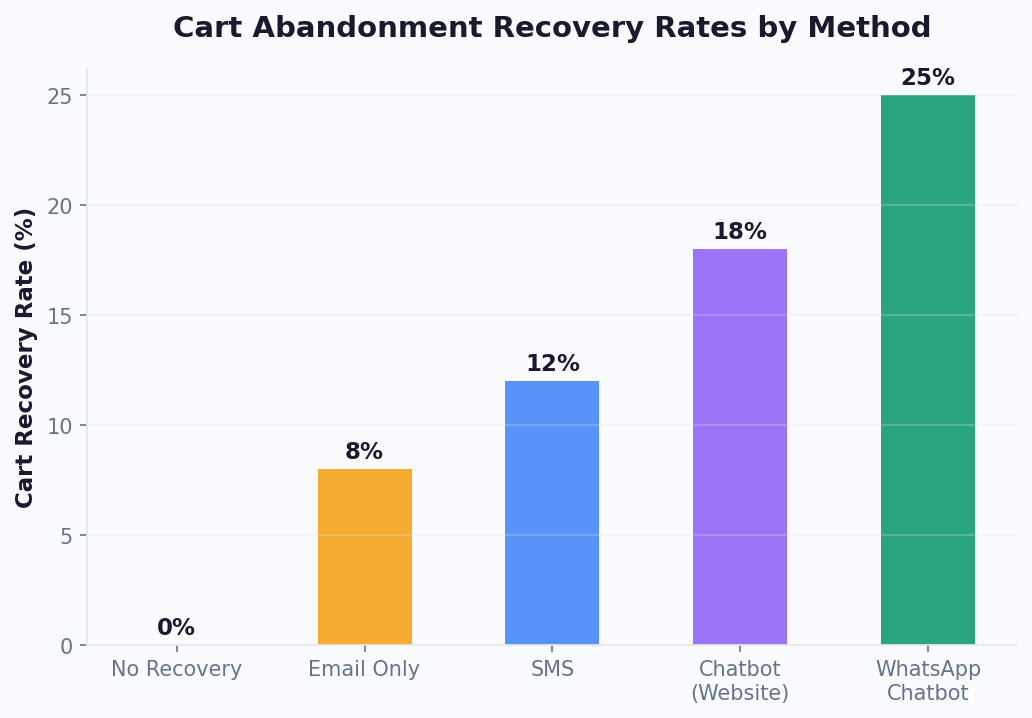
Chatbot-powered recovery campaigns on platforms like Conferbot for e-commerce achieve 15-25% recovery rates — three to five times higher than email alone.
5 Chatbot Cart Recovery Strategies That Work
Effective chatbot cart recovery is not just about sending a "You left something behind!" message. Here are five strategies that consistently produce the highest recovery rates.
Strategy 1: Real-Time Exit Intent Engagement
The most effective recovery happens before the cart is truly abandoned. When a customer shows exit intent on a checkout page (cursor moving to close tab, scrolling to browser bar, or inactivity), the chatbot triggers immediately:
Chatbot: "Hi! I noticed you have not completed your order. Is there anything I can help with? Many customers have questions about shipping or returns at this stage."
This proactive engagement catches customers at the decision point — when they are considering leaving but have not yet committed to it. By addressing concerns in real time (shipping costs, return policy, size questions), the chatbot resolves the objection that would have caused abandonment.
Recovery rate: 10-15% of exit-intent engagements convert to completed purchases.
Strategy 2: WhatsApp Cart Recovery
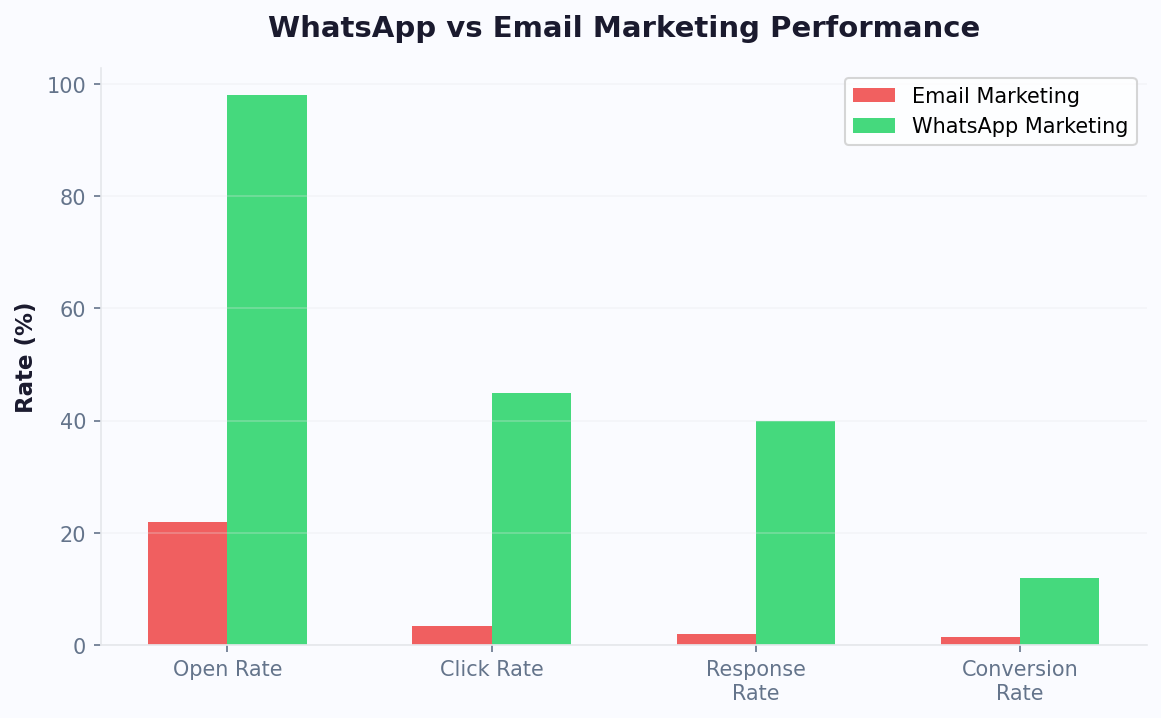
For customers who have already left the site, WhatsApp is the most effective recovery channel. Marketing automation platforms like Klaviyo have recognized this shift by adding WhatsApp to their channel mix. With 98% open rates (versus 40-45% for email), WhatsApp messages cut through the noise:
Message 1 (30 minutes after abandonment): "Hey [Name]! You left some great items in your cart at [Store]. Want me to hold them for you? Your cart: [Product image + name + price]. Tap here to complete your order: [link]"
Message 2 (24 hours, if not recovered): "Your [Product] is still waiting! I can offer you free shipping if you complete your order today. Here is your checkout link: [link]"
Recovery rate: 15-25% of WhatsApp recovery messages convert, with the best results on message 1.
Strategy 3: Messenger Recovery Campaigns
Facebook Messenger recovery works similarly to WhatsApp but reaches customers who interact with your brand on Facebook and Instagram. Messenger chatbots can display product carousels, show the abandoned cart contents visually, and process the recovery within the Messenger interface.
Recovery rate: 12-20% conversion on Messenger recovery messages.
Strategy 4: Incentive Escalation
Instead of leading with a discount (which trains customers to abandon for deals), use an escalation sequence:
- First touch (0-30 min): Helpful reminder with no discount — address potential concerns
- Second touch (24 hours): Free shipping offer
- Third touch (48 hours): Small discount (5-10%)
- Final touch (72 hours): Larger discount (15-20%) with urgency ("Last chance — your cart expires tomorrow")
This approach recovers price-insensitive customers without discount (touch 1-2) and only uses discounts for price-sensitive customers who need the incentive (touch 3-4).
Strategy 5: AI-Powered Objection Handling
Rather than generic recovery messages, AI agent-powered chatbots can identify and address the specific reason for abandonment. By analyzing the customer's session behavior (which pages they visited, how long they spent on checkout, what they searched), the chatbot tailors its recovery approach to the likely objection — whether that is price, shipping, trust, or product uncertainty.
Setting Up Cart Recovery Chatbots: Step by Step
Implementing chatbot cart recovery requires connecting your e-commerce platform to your chatbot system. Here is the practical setup process.
Step 1: Connect Your E-Commerce Platform
Integrate your chatbot with your store using API integration:
- Shopify: Use Shopify's abandoned checkout webhook to trigger chatbot messages when a cart is abandoned
- WooCommerce: Use the WooCommerce REST API to detect abandoned carts and trigger recovery flows
- Custom platforms: Set up event tracking that fires when a customer adds items to cart and leaves without completing checkout
The integration should pass cart data to the chatbot: customer name, email, phone (if available), product names, images, prices, and cart total.
Step 2: Build the Recovery Flow
Create your chatbot recovery conversation in the visual builder:
- Trigger: Cart abandonment event (with configurable delay — start with 15-30 minutes)
- Initial message: Friendly, helpful reminder with cart summary
- Objection handling: Branch based on customer response (price concern, shipping question, product question, not ready)
- Resolution paths:
- Price concern → offer discount or payment plan
- Shipping concern → clarify shipping options and costs
- Product question → provide information or connect to support
- Not ready → save cart for later, offer email reminder
- Cart recovery link: Include a direct link back to their saved cart for one-click completion
- Escalation sequence: Schedule follow-up messages at 24, 48, and 72 hours if not recovered
Step 3: Configure Multi-Channel Recovery
Set up recovery messages across channels based on available customer data:
- Website visitors (known): Website chatbot popup on return visit
- WhatsApp opt-ins: WhatsApp recovery message (highest conversion)
- Messenger subscribers: Messenger recovery message
- Email only: Email with chatbot link (fallback channel)
Step 4: Set Up Tracking and Analytics
Track these metrics for each recovery campaign:
- Carts abandoned (total and by reason)
- Recovery messages sent (by channel)
- Message open/read rate (by channel)
- Recovery conversations started
- Carts recovered (completed purchases)
- Revenue recovered
- Recovery rate (recovered / abandoned)
- Cost per recovery (platform cost / recoveries)
Step 5: Test Before Launch
Run through the complete flow yourself:
- Add items to cart and abandon at checkout
- Verify the recovery message triggers at the correct time
- Test every objection-handling branch
- Confirm the cart recovery link takes you back to a saved cart (not an empty one)
- Test on each configured channel (website, WhatsApp, Messenger)
- Verify analytics are tracking correctly
Cart Recovery by Channel: Which Performs Best?
Not all recovery channels are equal. Here is a data-driven comparison of cart recovery performance by channel in 2026.
| Channel | Open/Read Rate | Click Rate | Recovery Rate | Average Time to Recover |
|---|---|---|---|---|
| 98% | 35-45% | 15-25% | 1-4 hours | |
| Messenger | 80-88% | 25-35% | 12-20% | 2-6 hours |
| Website chatbot | 100% (on-site) | 20-30% | 10-15% | Immediate |
| SMS | 95% | 15-20% | 8-12% | 2-8 hours |
| 40-45% | 8-12% | 3-5% | 12-48 hours |
Why WhatsApp Wins
WhatsApp consistently outperforms other recovery channels for several reasons:
- Highest open rates: 98% of WhatsApp messages are read, usually within minutes
- Rich media support: Product images, buttons, and links create a visual, shoppable experience within the message
- Conversational follow-up: Customers can reply with questions and get immediate AI-powered answers, removing purchase barriers in real time
- Trust and familiarity: Customers already trust WhatsApp as a personal communication channel
The Multi-Channel Advantage
The best recovery strategy uses multiple channels in a waterfall approach:
- First attempt (0-30 min): Website chatbot (if customer is still on site) or WhatsApp (if they have left)
- Second attempt (24 hours): WhatsApp or Messenger (whichever was not used first)
- Third attempt (48 hours): Email with chatbot link
- Final attempt (72 hours): SMS with direct checkout link
This waterfall ensures maximum reach: you contact customers through their most responsive channel first, then fall back to alternatives. Using Conferbot's e-commerce chatbot with omnichannel support, this entire sequence can be configured once and runs automatically.
Channel Selection Based on Available Data
Your channel options depend on what customer data you have:
- Phone number + WhatsApp opt-in: Use WhatsApp (best option)
- Facebook/Instagram follower: Use Messenger
- Email only: Use email with chatbot link
- Anonymous visitor: Use website chatbot exit-intent trigger only
This is why collecting WhatsApp opt-ins during the shopping experience (not just at checkout) is valuable — it gives you the highest-performing recovery channel for carts abandoned before contact information is collected at checkout.
Cart Recovery Messages That Convert: Templates and Psychology
The words you use in recovery messages significantly impact conversion rates. Here are proven message templates with the psychology behind why they work.
Template 1: The Helpful Reminder (No Discount)
Message: "Hey [Name]! I noticed you were checking out [Product Name]. Sometimes checkout can be tricky — can I help with anything? I can answer questions about shipping, sizing, or returns."
Why it works: Positions the chatbot as helpful rather than salesy. Many customers abandon due to unanswered questions, not price. This message opens a conversation that can resolve the actual objection.
Best for: First recovery touch (0-30 minutes after abandonment)
Template 2: Social Proof Recovery
Message: "[Product Name] is one of our best sellers — 2,847 customers gave it 4.8/5 stars. Your cart is saved and ready to go. Complete your order: [link]"
Why it works: Social proof reduces purchase uncertainty. Knowing that thousands of others bought and loved the product builds confidence, especially for customers who abandoned due to trust concerns.
Best for: Products with strong reviews, 24-hour follow-up
Template 3: Scarcity and Urgency
Message: "Quick heads up — [Product Name] is selling fast and we only have [X] left in your size. Your cart is saved for the next 24 hours. Grab it before it is gone: [link]"
Why it works: Scarcity creates urgency without offering a discount. When customers believe the product may sell out, they are motivated to act. Only use this when scarcity is genuine — fake scarcity erodes trust.
Best for: Limited-stock products, 48-hour follow-up
Template 4: Free Shipping Offer
Message: "Good news! I can offer you free shipping on your cart with [Product Name]. That saves you $[shipping cost]. This offer is good for 24 hours. Complete your order: [link]"
Why it works: Shipping costs are the number one reason for cart abandonment. Offering free shipping directly addresses this top objection without discounting the product itself (which preserves perceived value).
Best for: Second recovery touch (24 hours), carts with high-value items
Template 5: Discount with Urgency
Message: "Last chance, [Name]! Here is an exclusive 15% off your cart: [Product Name] — now just $[discounted price]. Use code SAVE15 at checkout. This code expires in 24 hours: [link]"
Why it works: Combines discount with a time limit. The expiration creates urgency while the discount addresses price sensitivity. Use this as your final recovery attempt, not your first.
Best for: Final recovery touch (48-72 hours), price-sensitive customers
Message Optimization Tips
- Personalize with product name and image: Generic "you left items in your cart" messages convert 30% less than personalized messages showing the specific product
- Include a direct cart link: One-click return to a saved cart removes friction. Never send customers to the homepage.
- Keep it short: Recovery messages should be under 100 words. Longer messages have lower engagement.
- Test timing: A/B test different send times. Some audiences respond better to 15-minute delays, others to 1-hour delays. Let data guide your timing.
Measuring Cart Recovery ROI
Cart recovery is one of the most measurable marketing activities. Here is how to calculate and track the ROI of your chatbot recovery program.
The Basic ROI Formula
Monthly Revenue Recovered = Carts Abandoned x Recovery Rate x Average Cart Value
For a typical e-commerce store:
- Monthly abandoned carts: 500
- Recovery rate (chatbot): 18%
- Average cart value: $85
- Monthly revenue recovered: 500 x 0.18 x $85 = $7,650
Against a chatbot platform cost of $149/month, that is a 51x return on investment.
Compare Against Email-Only Recovery
| Metric | Email Only | Chatbot Multi-Channel | Improvement |
|---|---|---|---|
| Recovery rate | 4% | 18% | +350% |
| Monthly recoveries | 20 | 90 | +70 |
| Monthly revenue recovered | $1,700 | $7,650 | +$5,950 |
| Annual revenue recovered | $20,400 | $91,800 | +$71,400 |
| Platform cost/month | $50 | $149 | +$99 |
| Net annual ROI | $19,800 | $90,012 | +$70,212 |
Metrics to Track Weekly
- Recovery rate by channel: Which channel converts best for your audience?
- Revenue recovered: Total and per recovery attempt
- Average recovered cart value: Is it higher or lower than average purchase value?
- Discount cost: How much are you spending on incentives per recovery?
- Net recovery value: Revenue recovered minus discount cost and platform fees
- Time to recovery: How quickly after abandonment do recoveries happen?
- Recovery by product: Which products have highest/lowest recovery rates?
Advanced Metrics
- Customer lifetime value of recovered customers: Do recovered customers become repeat buyers? Track their subsequent purchase behavior.
- Discount dependency: Are customers increasingly abandoning carts to receive discounts? Monitor this trend and reduce discount reliance if detected.
- Recovery cost per channel: Factor in WhatsApp per-conversation costs, Messenger charges, and platform fees to calculate true cost per recovery.
Optimization Loop
Use recovery data to continuously optimize:
- If certain products have low recovery rates, investigate why (pricing, description quality, image quality)
- If a specific message template outperforms others, expand its use
- If one channel dominates recovery, invest more in growing that channel's subscriber base
- If recoveries cluster at certain times, adjust timing for other recovery messages
The data from cart recovery chatbots also feeds broader business improvements. High abandonment rates for specific products signal pricing or presentation issues. Common objections identified through chatbot conversations inform product page improvements, shipping policy changes, and checkout optimization.
7 Cart Recovery Mistakes That Kill Your Conversion Rate
Most businesses implementing cart recovery chatbots make preventable mistakes that significantly reduce their recovery rate. Avoiding these errors can double your recovered revenue without changing your tools or budget. For a broader look at e-commerce chatbot strategy, see our e-commerce sales chatbot guide.
Mistake 1: Leading With Discounts
The problem: Offering 15-20% off in your first recovery message trains customers to abandon carts intentionally. Within 3-6 months, your abandonment rate increases as savvy shoppers learn the pattern.
The fix: Start with helpful, non-discount messages. Address potential objections (shipping, sizing, returns) first. Reserve discounts for the third or fourth touch in your sequence, and only for customers who haven't responded to earlier messages.
Mistake 2: Waiting Too Long to Engage
The problem: Sending your first recovery message 24 hours after abandonment. By then, purchase intent has evaporated — the customer has either bought from a competitor or forgotten about your product entirely.
The fix: Deploy exit-intent chatbot triggers for on-site recovery (immediate). For off-site recovery via WhatsApp or Messenger, send within 30-60 minutes. Data consistently shows that messages sent within the first hour achieve 3x higher recovery rates than those sent after 24 hours.
Mistake 3: Generic Messages Without Product Context
The problem: Sending "You left items in your cart!" without showing what those items are. The customer may have visited 10 stores today — they won't remember what's in your cart without a visual reminder.
The fix: Always include the specific product name, image, and price in recovery messages. Personalization increases click-through rates by 30-45% compared to generic reminders.
Mistake 4: No Mobile Optimization
The problem: Recovery messages that link to a desktop-optimized checkout page. With 85.6% mobile abandonment rate, most recovery interactions happen on phones.
The fix: Ensure all recovery links lead to mobile-optimized cart pages. Use platform-native experiences where possible — WhatsApp product cards, Messenger carousels — so customers can review and act without switching apps.
Mistake 5: Ignoring Post-Recovery Behavior
The problem: Treating cart recovery as a one-time transaction instead of the beginning of a customer relationship. Recovered customers have shown purchase intent — they're prime candidates for repeat purchases.
The fix: After successful recovery, enroll customers in a post-purchase nurture sequence. Send order confirmations via the same channel they recovered on (maintaining the conversation thread), request reviews after delivery, and suggest complementary products 14-21 days later. Explore our e-commerce chatbot guide for full lifecycle strategies.
Mistake 6: Same Message Across All Channels
The problem: Copying the same recovery text across email, WhatsApp, Messenger, and SMS. Each channel has different formatting, character limits, and user expectations.
The fix: Adapt your message for each channel's native format. WhatsApp messages should use product cards and quick-reply buttons. Email can include multiple products with full descriptions. SMS should be ultra-concise with a single link. For platform-specific approaches, read our WooCommerce chatbot integration guide.
Mistake 7: No Frequency Cap on Recovery Messages
The problem: Sending 5-6 recovery messages for a single abandoned cart. After 3-4 messages, additional outreach becomes harassment and triggers unsubscribes or blocks.
The fix: Cap your recovery sequence at 3-4 messages maximum, spaced over 72 hours. If the customer hasn't recovered by then, add them to a general remarketing audience instead of sending more cart-specific messages. Respect the "no" — even if it's implicit.
Advanced Cart Recovery Strategies for 2026
Beyond basic recovery messages, advanced strategies can push your recovery rate from 15% to 25%+ and turn cart abandonment from a problem into a competitive advantage.
1. Predictive Abandonment Prevention
The best recovery happens before abandonment. AI can analyze browsing patterns to predict abandonment intent and trigger proactive engagement:
- Hesitation signals: Customer visits the same product page 3+ times, adds and removes items, or spends excessive time on checkout without progressing
- Price sensitivity signals: Customer visits pricing page, compares products by price, or searches for coupon codes
- Trust signals: Customer reads reviews extensively, checks return policy, or visits the "About Us" page during checkout
The chatbot can proactively address the likely concern before the customer decides to leave, converting what would have been an abandonment into a completed purchase.
2. Cross-Sell Recovery
When a customer abandons a high-price item, the recovery chatbot can suggest alternatives:
Message: "I see you were looking at the [Premium Product] at $299. We also have the [Standard Product] at $149 that our customers love. Would you like to see how they compare?"
This recovers revenue that would otherwise be lost entirely by offering a lower-commitment alternative. Some revenue is better than none.
3. Social Proof Automation
Integrate review data into recovery messages dynamically. When a customer abandons a cart containing a highly-rated product, the recovery message includes the star rating, review count, and a selected customer quote. When the product is new with few reviews, the chatbot emphasizes other trust signals (money-back guarantee, free returns).
4. Bundle Recovery
Instead of recovering the exact abandoned cart, offer a bundle deal:
Message: "Your [Product A] pairs perfectly with [Product B]. Buy them together and save 20%. Bundle price: $[price]. Want me to update your cart?"
This increases average order value while providing an incentive for the customer to return — without simply discounting the original item.
5. Payment Flexibility
For high-value carts, offer payment alternatives through the chatbot:
Message: "Your cart total is $450. Did you know you can split this into 4 payments of $112.50 with no interest through our buy-now-pay-later option? Complete your order: [link]"
Payment flexibility addresses price shock without discounting, preserving full revenue while making the purchase more accessible.
6. Cart Recovery for Repeat Customers
Repeat customers who abandon carts should receive different messaging than new customers. They already trust your brand, so trust-building messages are unnecessary. Focus on urgency, loyalty rewards, and personalized recommendations based on purchase history:
Message: "Welcome back, [Name]! As a valued customer, I have applied your loyalty discount of 10% to the [Product] in your cart. Ready to check out? [link]"
These advanced strategies require chatbot platforms with strong integrations hub capabilities (including Stripe for payments), AI-powered personalization, and multi-channel deployment — all capabilities available on Conferbot's e-commerce platform.
Measuring Advanced Strategy Impact
When implementing multiple recovery strategies simultaneously, isolate the incremental contribution of each technique by running controlled tests: deploy predictive prevention on 50% of sessions and measure the abandonment rate difference, test bundle offers against standard recovery messages in alternating weeks, and segment payment flexibility messaging to carts above a specific value threshold. Track not only immediate recovery rates but also the 30-day repeat purchase rate for recovered customers — advanced strategies like personalized cross-sells and loyalty-based messaging typically generate 40-60% higher customer lifetime value compared to basic discount-driven recovery approaches. The compounding effect of sophisticated cart recovery extends well beyond the initial transaction into long-term customer relationship building. Stores that systematically A/B test their advanced recovery strategies and document winning patterns in a shared playbook achieve 25-35% higher recovery rates by month six compared to those that deploy a single approach and never iterate on their messaging, timing, or incentive structures.
Was this article helpful?
Build and deploy in 10 minutes. No coding needed.
Abandoned Cart Recovery With Chatbots FAQ
Everything you need to know about chatbots for abandoned cart recovery with chatbots.
About the Author
Deepak is the founder of Conferbot and writes about building, deploying, and improving AI chatbots.
View all articles