Why Plastic Surgery Practices Are Deploying Chatbots in 2026
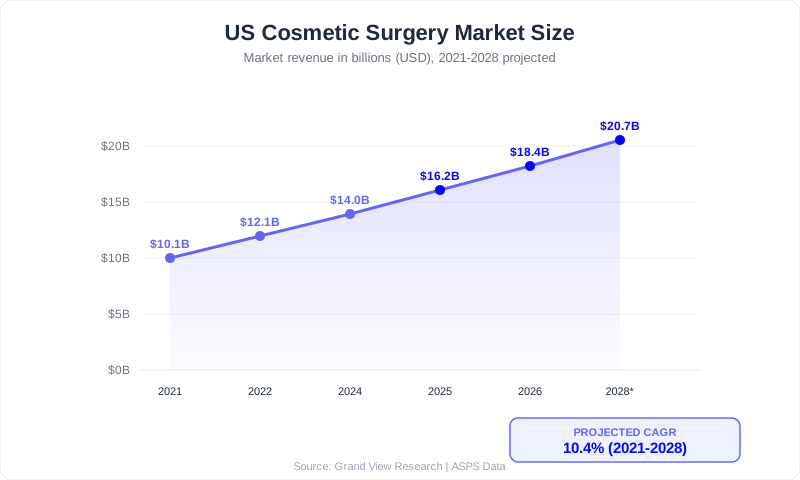
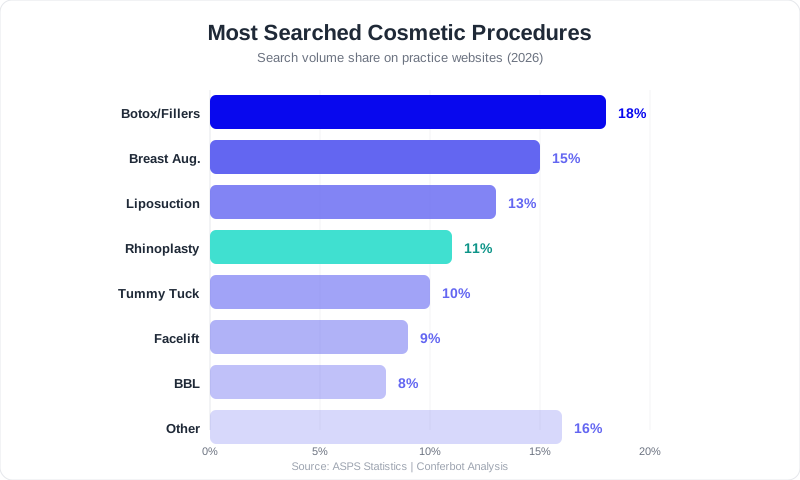
The cosmetic surgery industry in the United States is experiencing extraordinary growth. The market exceeded $18.4 billion in 2026 and is projected to reach $20.7 billion by 2028, growing at a 10.4% compound annual growth rate. The American Society of Plastic Surgeons reports that cosmetic procedures have increased 19% since 2019, with both surgical and non-surgical procedures reaching record volumes. Botox, fillers, breast augmentation, liposuction, and rhinoplasty lead the market, while emerging procedures like body contouring and non-surgical skin tightening are growing even faster.
Yet the patient acquisition model at most practices has not kept pace with market growth. The typical patient journey begins with an online search — "rhinoplasty cost," "best breast augmentation surgeon near me," "how much does liposuction cost" — which leads to a practice website. At this point, the prospective patient encounters a phone number, a contact form, and a gallery of before-and-after photos. They may spend 10-15 minutes browsing, but unless they take the action of calling or submitting a form (which fewer than 8% of visitors do), they leave and are lost forever.
The economics of losing these visitors is staggering. Plastic surgery practices spend $200-$800 per website visitor through Google Ads, social media advertising, and SEO investment. When 92% of those visitors leave without engaging, the effective patient acquisition cost skyrockets. A practice spending $15,000/month on advertising to generate 300 website visitors, of which 24 fill out a form, and 8 show up for consultations, is paying $1,875 per consultation attendee — before the patient has agreed to any procedure.
A chatbot fundamentally changes this equation. Instead of passively waiting for visitors to submit forms, the chatbot engages every visitor proactively: answering procedure questions, providing pricing ranges, matching patients to the right procedures based on their goals, and booking consultations — all within the same browsing session. Practices deploying chatbots see consultation booking rates increase from 3.2% to 14.8% of website visitors — a 4.6x improvement that transforms the economics of patient acquisition.
The competitive pressure makes chatbot adoption increasingly urgent. In major metropolitan markets, 20-40 plastic surgery practices compete for the same patient pool. Google Ads costs for cosmetic surgery keywords have increased 35-50% over the past three years, with keywords like "breast augmentation near me" and "rhinoplasty cost" commanding $100-$200 per click. In this environment, the practice that converts the highest percentage of its website traffic wins — not the practice that spends the most on advertising. A chatbot is the highest-leverage investment a practice can make to improve conversion efficiency, because it addresses every visitor rather than the small fraction who voluntarily submit forms or make phone calls.
The patient demographic adds another dimension. Cosmetic surgery patients increasingly skew younger — Millennials and Gen Z now represent the fastest-growing patient segments, driven by social media influence and the normalization of aesthetic procedures. These patients overwhelmingly prefer text-based communication over phone calls. They research procedures on Instagram and TikTok, read reviews on RealSelf, and expect to interact with practices through conversational interfaces. A chatbot meets these patients where they are — in a familiar, comfortable digital conversation — rather than forcing them into a phone call that feels outdated and anxiety-inducing.
This guide covers the complete chatbot implementation for cosmetic and plastic surgery practices: procedure matching, consultation booking, financing conversations, HIPAA compliance, patient nurturing, and a detailed acquisition cost model. Whether you are a solo surgeon or a multi-provider aesthetic practice, this guide provides the strategy to acquire more patients at lower cost.
Speed-to-Lead: Why Response Time Determines Conversion
In cosmetic surgery, the speed of response to a patient inquiry is the single strongest predictor, a lead response dynamic that Harvard Business Review's lead response research has quantified across industries of whether that inquiry converts to a consultation. This is not unique to plastic surgery — lead response research across industries consistently shows that speed wins — but the effect is amplified in cosmetic surgery because the decision to seek a consultation is emotionally charged, often private, and frequently made during moments of motivation that fade quickly.
The Response Time Decay Curve
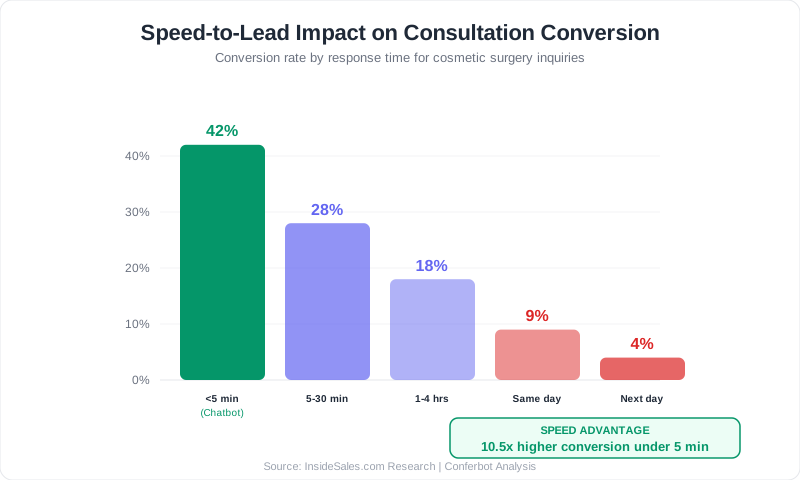
The data is unambiguous: consultation conversion drops exponentially with response time. A practice that responds within 5 minutes converts 42% of inquiries. The same practice responding within 30 minutes converts 28%. By the time the response reaches "same business day," conversion has fallen to 9%. And the typical plastic surgery practice response time — next business day — converts only 4% of inquiries.
The reasons for this steep decay are rooted in the psychology of cosmetic surgery decisions:
- Emotional momentum: A person researching rhinoplasty at 10 PM has reached a point of emotional readiness to take action. That readiness is fragile. By the next morning, the feeling may have passed, replaced by doubt, fear of judgment, or the daily routine that pushed the decision aside.
- Privacy concerns: Many cosmetic surgery searches happen in private moments — late at night, during lunch breaks, when alone. The patient wants to engage when they have privacy, not during a callback the next day when they may be at work or with family.
- Competitive shopping: Prospective patients typically research 3-5 practices simultaneously. The first practice to engage in a meaningful conversation captures the patient's attention and builds rapport before competitors have even responded.
- Information needs: Patients have specific questions — cost, recovery time, candidacy, results — that determine whether they book a consultation. A chatbot answers these questions instantly. A form submission promises answers "within 24-48 hours."
The Chatbot Advantage
The chatbot achieves the under-5-minute response time for every single inquiry, 24 hours a day, 365 days a year. It does not go to lunch, leave for the day, or take weekends off. At 11 PM on a Saturday — which is peak cosmetic surgery research time — the chatbot is providing the same quality engagement as the best patient coordinator during business hours. For practices investing heavily in lead generation, the chatbot is the tool that prevents that investment from being wasted on unanswered inquiries.
Procedure Matching: Guiding Patients From Interest to Understanding
Many prospective cosmetic surgery patients arrive at a practice website with a general goal but unclear about which specific procedure addresses their concern. They know they want a "better nose" or "flatter stomach" or "younger-looking face," but they may not know the difference between rhinoplasty and liquid rhinoplasty, liposuction and CoolSculpting, a facelift and a thread lift. The chatbot serves as an educational guide that matches the patient's aesthetic goals to the right procedure — increasing both the quality of consultations and the likelihood of booking.
How the Matching Flow Works
The chatbot's procedure matching flow is conversational and goal-oriented:
- Area of concern: The chatbot asks which area the patient wants to address: face, nose, eyes, breasts, body/abdomen, skin, or a combination. This initial question channels the conversation into the right procedure category.
- Specific goals: For body concerns, follow-up questions include: "Are you looking to remove excess fat, tighten loose skin, or both?" For facial concerns: "Are you interested in reducing wrinkles, reshaping features, or restoring volume?" These questions mirror the evaluation a surgeon performs during consultation, pre-qualifying the patient.
- Procedure education: Based on the patient's goals, the chatbot presents 1-3 recommended procedures with plain-language descriptions: what the procedure involves, typical recovery time, expected results, and approximate cost range. For example: "Based on your goals, rhinoplasty may be a good fit. It involves reshaping the nose structure for improved appearance and proportion. Recovery is typically 1-2 weeks, with final results visible in 6-12 months. Cost typically ranges from $8,000-$15,000 depending on complexity."
- Before/after gallery: The chatbot can link to relevant before/after photos filtered by the matched procedure, helping the patient visualize potential results.
- Consultation recommendation: "The best way to determine if [procedure] is right for you is a personal consultation with Dr. [Name]. Would you like to schedule one? There is no obligation, and many patients find it helpful to discuss their goals in person."
The Impact on Consultation Quality
Patients who arrive at their consultation having already been educated by the chatbot are significantly better prepared. They understand the general procedure, have realistic cost expectations, and can articulate specific goals. This improves the surgeon's ability to recommend the right approach during the consultation and reduces the time spent on basic education — allowing more time for the personalized assessment that builds confidence and drives procedure acceptance. Practices report that chatbot-educated patients have a 35-45% consultation-to-procedure conversion rate compared to 25-30% for patients who arrive without pre-education.
Addressing Common Concerns and Misconceptions
Beyond procedure matching, the chatbot addresses the fears and misconceptions that prevent patients from booking consultations. Common concerns include:
- "Will it look natural?" — The chatbot reassures by describing the surgeon's approach to natural-looking results and linking to before/after galleries that demonstrate subtle, proportional outcomes.
- "What about scarring?" — The chatbot provides procedure-specific information about incision placement, scar management protocols, and typical healing timelines.
- "Am I too old/young for this procedure?" — The chatbot provides candidacy guidelines without making age-based judgments, noting that consultation is the best way to determine individual candidacy.
- "What if I do not like the results?" — The chatbot addresses this sensitive concern by describing the consultation process (3D imaging, surgeon recommendations, realistic expectations setting) and the practice's commitment to patient satisfaction.
- "Is it safe?" — The chatbot provides board certification information, facility accreditation details, and safety statistics without minimizing the realities of surgical procedures.
Each concern addressed by the chatbot removes a barrier to booking. Patients who have their fears acknowledged and addressed are 40-50% more likely to book a consultation than patients whose concerns remain unaddressed during their website visit. The chatbot's ability to handle these sensitive topics with empathy and accuracy — consistently, for every visitor — is something that a contact form and FAQ page simply cannot replicate.
Consultation Booking: The 4.6x Conversion Multiplier
The consultation is the pivotal moment in the cosmetic surgery patient journey, as recognized by the Aesthetic Society (ASAPS). Every dollar spent on marketing, every website visit, every chatbot interaction converges on a single question: does the patient book and attend a consultation? The chatbot's impact on consultation booking is the most directly measurable ROI metric for plastic surgery practices.
The Consultation Funnel
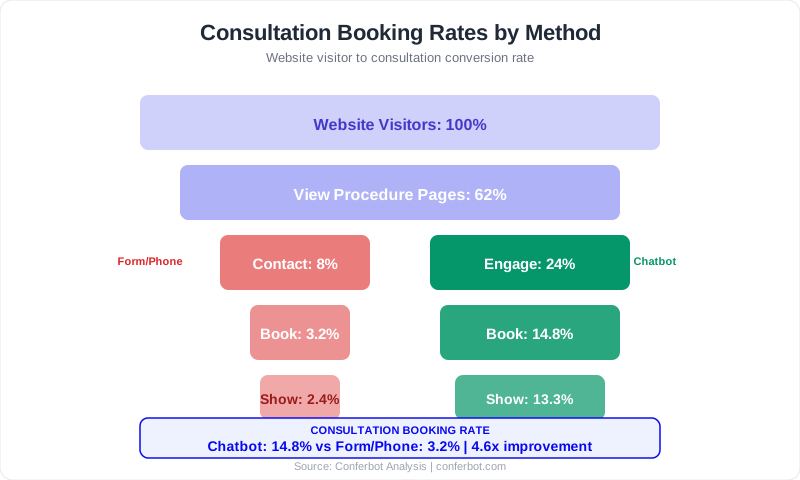
The funnel visualization tells the complete story. Of 100 website visitors:
- 62% view procedure pages (regardless of engagement method)
- Without chatbot: 8% contact the practice → 3.2% book a consultation → 2.4% actually show up
- With chatbot: 24% engage in conversation → 14.8% book a consultation → 13.3% actually show up
The chatbot delivers a 4.6x improvement in consultation booking rate and a 5.5x improvement in consultation attendance. The attendance improvement is particularly significant because a booked consultation that results in a no-show has negative ROI — the surgeon's time was blocked, the exam room was reserved, and the practice incurred the full acquisition cost with zero revenue.
Why Chatbot-Booked Consultations Have Higher Show Rates
The 90% show rate for chatbot-booked consultations (13.3 out of 14.8) versus the 75% show rate for form-booked consultations (2.4 out of 3.2) is driven by three factors:
1. Pre-qualification reduces uncertainty: Patients who have discussed their goals, received procedure recommendations, and reviewed pricing ranges through the chatbot arrive with confidence. They know what to expect. Form-booked patients often have unresolved questions that create anxiety and increase no-show risk.
2. Automated reminders: The chatbot sends consultation reminders at 48 hours, 24 hours, and 2 hours. The 24-hour reminder includes what to expect during the consultation, what to bring, and how long it will take — reducing the pre-appointment anxiety that is a significant no-show driver for cosmetic surgery.
3. Investment of time: A patient who spent 5-10 minutes conversing with the chatbot about their goals has invested more cognitive and emotional energy than a patient who spent 30 seconds filling out a form. Behavioral psychology research shows that time investment increases commitment to follow-through.
Virtual Consultation Option
For patients who are not ready for an in-person consultation, the chatbot can offer a virtual consultation option — a 15-20 minute video call with the patient coordinator or surgeon. Virtual consultations convert at lower rates than in-person, but they capture patients who would otherwise be completely lost — particularly patients who are early in their research, located far from the practice, or reluctant to commit to an in-person visit for a procedure they are still considering. For practices building a multi-channel acquisition strategy, virtual consultations represent a valuable mid-funnel touchpoint.
Financing Conversations: Removing the Cost Barrier
Cost is the number one barrier to cosmetic surgery conversion. Unlike medically necessary procedures covered by insurance, cosmetic surgery is an out-of-pocket expense that can range from $3,000 for minor procedures to $30,000+ for combined surgical plans. The chatbot's ability to address cost concerns at the point of inquiry — rather than deferring to a post-consultation financial discussion — dramatically improves consultation booking rates.
How the Chatbot Handles Cost Conversations
The chatbot approaches cost with transparency and empathy:
Price ranges by procedure: Instead of hiding pricing, the chatbot provides realistic ranges: "Rhinoplasty at our practice typically ranges from $8,000 to $15,000 depending on complexity. Your surgeon will provide an exact quote during your consultation." This transparency sets expectations and prevents the sticker shock that causes consultation no-shows.
Financing introduction: Immediately after presenting the price range, the chatbot introduces financing options: "Many of our patients use financing to make their procedure affordable. With CareCredit or PatientFi, a $12,000 procedure can be as low as $250/month with approved credit. Would you like more information about financing?"
Monthly payment calculator: The chatbot can present a simplified payment calculator: "For a $12,000 procedure with 48-month financing at typical rates, estimated monthly payments would be approximately $265-$310/month. These are estimates — final terms depend on credit approval."
Pre-qualification invitation: For patients who express interest in financing, the chatbot can link to a pre-qualification tool that provides an estimated approval amount and monthly payment without affecting their credit score. Knowing they are pre-approved removes the financial uncertainty that prevents many patients from booking.
The Conversion Impact
Practices that introduce financing through the chatbot (before the consultation, not after) report a 40-55% increase in consultation booking among price-sensitive patients. The reason is simple: a patient who sees "$12,000" and thinks "I cannot afford that" never books. The same patient who sees "$250/month" thinks "That is doable" and books the consultation. The chatbot reframes the cost from a lump sum to a monthly investment — the same psychological technique that drives auto sales and mortgage origination.
Insurance Coverage for Reconstructive Procedures
While most cosmetic procedures are not covered by insurance, reconstructive procedures — rhinoplasty for breathing issues, breast reduction for chronic back pain, skin removal after massive weight loss — may qualify for insurance coverage. The chatbot identifies these cases during the intake flow: "Is your procedure related to a medical condition or prior surgery? In some cases, insurance may cover part of the cost. Let us check during your consultation." This routing captures patients who might otherwise assume they cannot afford the procedure.
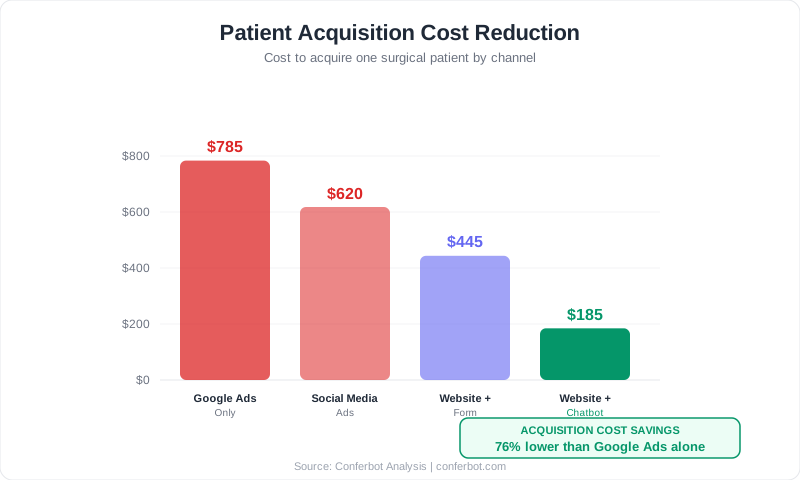
Patient Acquisition Cost: The 76% Reduction
Patient acquisition cost (PAC) is the metric that determines whether a plastic surgery practice's marketing is sustainable. In an industry where competition for Google Ads keywords can cost $50-$200 per click, and social media advertising costs continue to rise, the efficiency of converting website traffic to consultations is the primary lever for managing PAC.
PAC by Channel
The cost to acquire a single surgical patient varies dramatically by acquisition channel:
- Google Ads only (no chatbot): $785. High CPC for cosmetic surgery keywords ($50-$200/click), low website-to-consultation conversion (3.2%), and 75% consultation show rate. Cost per surgical patient: $785.
- Social media advertising: $620. Lower CPC but also lower intent. Social media captures patients earlier in the decision process, requiring more nurturing to convert.
- Website + contact form: $445. Organic and paid traffic combined, with form-based conversion at 3.2% and standard follow-up.
- Website + chatbot: $185. Same traffic sources, but the chatbot's 14.8% booking rate and 90% show rate dramatically reduce the number of visitors needed to generate one surgical patient.
How the Chatbot Reduces PAC by 76%
The math is straightforward. To acquire one surgical patient:
- Without chatbot: 100 visitors x $7.85 avg cost per visitor = $785 in traffic cost. Of 100 visitors, 3.2 book, 2.4 show, and 1 books surgery (at 42% consultation-to-surgery conversion).
- With chatbot: 100 visitors x $7.85 = $785 in traffic cost. Of 100 visitors, 14.8 book, 13.3 show, and 5.6 book surgery. Cost per surgical patient: $785 / 5.6 = $140. Adding chatbot platform cost: approximately $185 per patient.
The 76% reduction in PAC means the practice either acquires 4.2x more patients for the same marketing budget, or achieves the same patient volume at 76% lower cost — freeing budget for facility improvements, staff compensation, or additional marketing investment. According to Grand View Research, the competitive intensity in the cosmetic surgery market makes acquisition efficiency increasingly critical for practice sustainability.
HIPAA Compliance for Cosmetic Surgery Chatbots
Cosmetic surgery chatbots handle sensitive information, requiring compliance with HHS HIPAA regulations: patient aesthetic concerns, medical history, procedure interest, and contact information. While cosmetic procedures are elective, the data collected is Protected Health Information (PHI) under HIPAA, and practices must ensure their chatbot platform meets the same compliance standards as any other healthcare technology.
Unique Sensitivity of Aesthetic Health Information
Cosmetic surgery PHI carries unique sensitivity beyond typical medical records. A breach revealing that a patient inquired about rhinoplasty, breast augmentation, or body contouring can cause personal embarrassment, professional consequences, and social harm. Patients who are considering cosmetic procedures — many of whom have not shared their plans with friends, family, or partners — need absolute confidence that their inquiry is confidential.
Required Technical Safeguards
- Encryption in transit and at rest: All chatbot communications must use TLS 1.2+ in transit and AES-256 encryption at rest. Conferbot provides both.
- Access controls: Role-based permissions ensure that only the patient coordinator and treating surgeon access chatbot conversation data. Administrative staff, marketing teams, and other personnel should not have access to patient inquiry details.
- Audit logging: Every access event must be logged and retained for six years minimum.
- Business Associate Agreement: The chatbot platform must execute a BAA with the practice. Conferbot provides BAA support for all HIPAA-compliant chatbot deployments.
- Data minimization: The chatbot should collect only what is necessary for its purpose — procedure interest, contact information, scheduling preference, and financing interest. Detailed medical history, medications, and prior surgical records should be collected within the practice's secure EMR after the patient relationship is established.
Consent and Disclosure
The chatbot must disclose at the beginning of the conversation that the patient is interacting with an automated system, explain what information will be collected and how it will be used, and link to the practice's Notice of Privacy Practices. For cosmetic surgery specifically, the consent should note that inquiry information is kept strictly confidential and is not shared with any third parties.
Before/After Photo Compliance
If the chatbot displays before/after photos, ensure all photos have documented patient consent for use in digital marketing channels. Patient photo consent forms should specifically cover chatbot display, as some consent forms drafted before chatbot technology may not include this channel. Review your photo consent forms with a healthcare attorney to ensure compliance.
Patient Nurturing: From First Visit to Booked Procedure
The cosmetic surgery decision cycle is long. Unlike a dental cleaning or a dermatology appointment, the decision to undergo cosmetic surgery involves months or years of consideration, research, and emotional preparation. The chatbot serves as a patient nurturing tool throughout this extended decision process, maintaining engagement until the patient is ready to move forward.
Nurturing Sequence for Non-Converters
For website visitors who engage with the chatbot but do not book a consultation, a structured follow-up sequence keeps the practice top-of-mind:
- Day 1: "Thank you for exploring [procedure] with us. Here is a guide to understanding what to expect during a consultation: [link]. No pressure — we are here whenever you are ready."
- Day 7: "Many of our patients had the same questions you asked about [procedure]. Here are answers to the top 5 questions we receive: [link to FAQ or blog post]."
- Day 14: "Meet Dr. [Name] in this 2-minute video where they explain their approach to [procedure]: [video link]. Seeing your surgeon's style before the consultation helps you feel comfortable."
- Day 30: "Still considering [procedure]? Our financing options start at $[amount]/month with approved credit. Book a no-obligation consultation to get your personalized quote: [booking link]."
This sequence converts an additional 8-15% of initially undecided visitors over the 30-day period. For a practice generating 100 chatbot-engaged non-converters per month, that is 8-15 additional consultations — at zero additional advertising cost.
Post-Consultation Follow-Up
For patients who attend a consultation but do not immediately book their procedure, the chatbot sends a follow-up sequence:
- Same day: "Thank you for your consultation with Dr. [Name] today. We hope you found it helpful. If you have any questions as you consider your options, I am here to help."
- Day 3: "Many patients take a few days to process the information from their consultation. If any questions have come up, feel free to ask here — I can also connect you directly with your patient coordinator."
- Day 7: "Would you like to review your consultation notes or discuss financing options? Our team is here to help with anything you need as you make your decision."
Post-consultation follow-up converts an additional 10-20% of undecided consultation patients into booked procedures — patients who would otherwise drift away without active engagement.
Seasonal and Event-Based Campaigns
The cosmetic surgery industry has well-documented demand patterns that the chatbot can leverage for targeted campaigns throughout the year:
- January (New Year): "New year, new you. January is our most popular month for consultation bookings. Schedule yours now and start the year with confidence." New Year's resolution messaging drives consultation bookings for body contouring, weight-related procedures, and comprehensive treatment plans.
- Spring (pre-summer): "Summer is 90 days away. Breast augmentation, liposuction, and tummy tuck patients typically need 6-8 weeks of recovery. Book your consultation now to be ready for summer." Timeline-based urgency is effective because surgical patients need to plan around recovery periods.
- Fall (post-summer): "Fall is the ideal time for facial procedures — cooler weather means easier healing and you will look your best for the holiday season. Rhinoplasty and facelift consultations are available this month." Post-summer campaigns target patients who spent the summer researching and are ready to commit.
- Wedding and event season: "Getting married? Many brides and grooms schedule consultations 6-12 months before their wedding. Let us create a timeline for your goals." Event-based campaigns convert highly motivated patients who have a specific date driving their decision.
These campaigns are delivered through the chatbot's proactive messaging to previous visitors who provided contact information but did not book. By reaching patients with timely, relevant messaging at moments of seasonal motivation, the chatbot extends the practice's marketing reach at near-zero marginal cost. Practices running seasonal chatbot campaigns report 15-25% of re-engaged prospects converting to consultations — representing patients who would have been permanently lost without the follow-up touchpoint.
Implementation Guide and Best Practices
Deploying a plastic surgery chatbot requires attention to both conversion optimization and the sensitive nature of cosmetic procedure inquiries. Here is the implementation roadmap.
Week 1: Configuration
Build procedure library: For each procedure offered, create a chatbot-ready profile: description in patient-friendly language, typical cost range, recovery timeline, candidacy criteria, and links to before/after galleries. Avoid clinical jargon — patients search for "nose job," not "rhinoplasty," and the chatbot should recognize both terms.
Configure surgeon profiles: For each surgeon, include their specialties, credentials, approach philosophy, and a brief bio. Many patients select surgeons based on personality and approach — the chatbot should convey the surgeon's style.
Set up consultation types: In-person consultation, virtual consultation, and complimentary aesthetic assessment. Different practice models may offer different consultation formats.
Week 2: Integrations and Compliance
Connect scheduling: Link the chatbot to your practice management system or scheduling tool. Consultations should be booked directly into the surgeon's calendar with appropriate time blocks.
Set up financing links: Integrate CareCredit, PatientFi, Prosper Healthcare Lending, or your preferred financing partner's pre-qualification tool.
HIPAA review: Execute the BAA with Conferbot, review consent language, verify encryption settings, and configure role-based access controls.
Week 3: Launch
Embed and test: Deploy the chatbot on all website pages, particularly procedure-specific pages where patient intent is highest. Test every procedure matching flow, consultation booking path, and financing conversation.
Staff training: Train patient coordinators on the chatbot's capabilities and how to access chatbot-collected patient information. Coordinators should know which patients were chatbot-qualified so they can reference the conversation during follow-up calls.
Best Practices
- Lead with empathy, not sales: Cosmetic surgery decisions are deeply personal. The chatbot tone should be warm, supportive, and non-judgmental. Avoid aggressive sales language. "Many patients find that [procedure] helps them feel more confident" is better than "Book your surgery today!"
- Provide honest cost ranges: Understating costs to drive consultations backfires when the patient learns the real price and feels misled. Provide realistic ranges that include all costs (surgeon fee, facility fee, anesthesia).
- Respect the research phase: Not every chatbot interaction should push for a consultation booking. Some patients are in early research mode and need information, not a sales pitch. The chatbot should detect research-phase behavior and provide educational content without pressure.
- Use procedure-specific landing pages: Deploy the chatbot with procedure-specific greetings on procedure pages: "Interested in rhinoplasty? I can explain what to expect, show you before/after photos, and help you book a consultation." This contextual greeting converts 2-3x higher than a generic greeting.
- Track the full funnel: Measure not just consultation bookings, but the complete path: chatbot engagement rate, procedure matching completion, consultation booking rate, show rate, and consultation-to-procedure conversion. Each stage reveals optimization opportunities. Using Conferbot analytics provides real-time visibility into this funnel.
- Collect and showcase reviews: After successful procedures, the chatbot can request reviews at the optimal moment — when the patient sees their final results and is most satisfied. Reviews from real patients are the most powerful trust signal in cosmetic surgery marketing.
Emerging Trends: AI Photo Analysis and Virtual Try-On
The intersection of AI technology and cosmetic surgery is producing capabilities, with innovation trends tracked by the American Society of Plastic Surgeons (ASPS), that would have seemed impossible a few years ago — and chatbots are the delivery channel for these innovations.
AI-Assisted Photo Analysis
Emerging chatbot integrations allow patients to upload a selfie and receive AI-generated analysis: facial symmetry assessment, potential improvement areas, and procedure recommendations based on their facial structure. While this technology cannot replace a surgeon's clinical evaluation, it serves as a powerful engagement tool that increases chatbot interaction time and consultation booking rates. Patients who receive personalized AI analysis convert to consultations at 2-3x the rate of patients who receive generic procedure information.
Virtual Try-On Visualization
AR (augmented reality) visualization tools allow patients to see approximate post-procedure results on their own photos. A patient considering rhinoplasty can see a simulated result on their face. A patient considering fillers can see where volume would be added. These visualizations, delivered through the chatbot conversation, create an emotional connection to the potential outcome that significantly increases consultation intent.
Multi-Procedure Planning
Many cosmetic surgery patients are interested in multiple procedures — a "mommy makeover" combining breast augmentation, tummy tuck, and liposuction, for example. The chatbot can identify multi-procedure interest during the matching flow and present combined procedure plans with integrated pricing and consolidated recovery timelines. Combined procedure patients represent the highest per-patient revenue in cosmetic surgery, and the chatbot's ability to identify and nurture these patients is a significant revenue driver.
The Future of Patient Acquisition
As AI capabilities continue to advance, the chatbot's role will expand from scheduling assistant to comprehensive pre-consultation advisor. Practices that adopt chatbot technology now build the patient data, conversation optimization, and workflow integration that position them for these next-generation capabilities. The competitive advantage compounds over time — early adopters develop chatbot conversation flows that are battle-tested across thousands of interactions, while late adopters start from zero.
Was this article helpful?
About the Author
Conferbot Team specializes in conversational AI, chatbot strategy, and customer engagement automation. With deep expertise in building AI-powered chatbots, they help businesses deliver exceptional customer experiences across every channel.
View all articles