
Fashion Size Finder Chatbot
Free Ecommerce And Retail Chatbot Template
AI-powered size recommendation chatbot for fashion retailers



What Is a Fashion Size Finder Chatbot?
A fashion size finder chatbot is an AI-powered conversational assistant that guides shoppers through personalized size recommendations for clothing, footwear, and accessories. By asking about body measurements, fit preferences, brand familiarity, and purchase history, it delivers confident sizing advice that eliminates the guesswork responsible for the fashion industry's massive return problem -- and the revenue hemorrhage that comes with it.
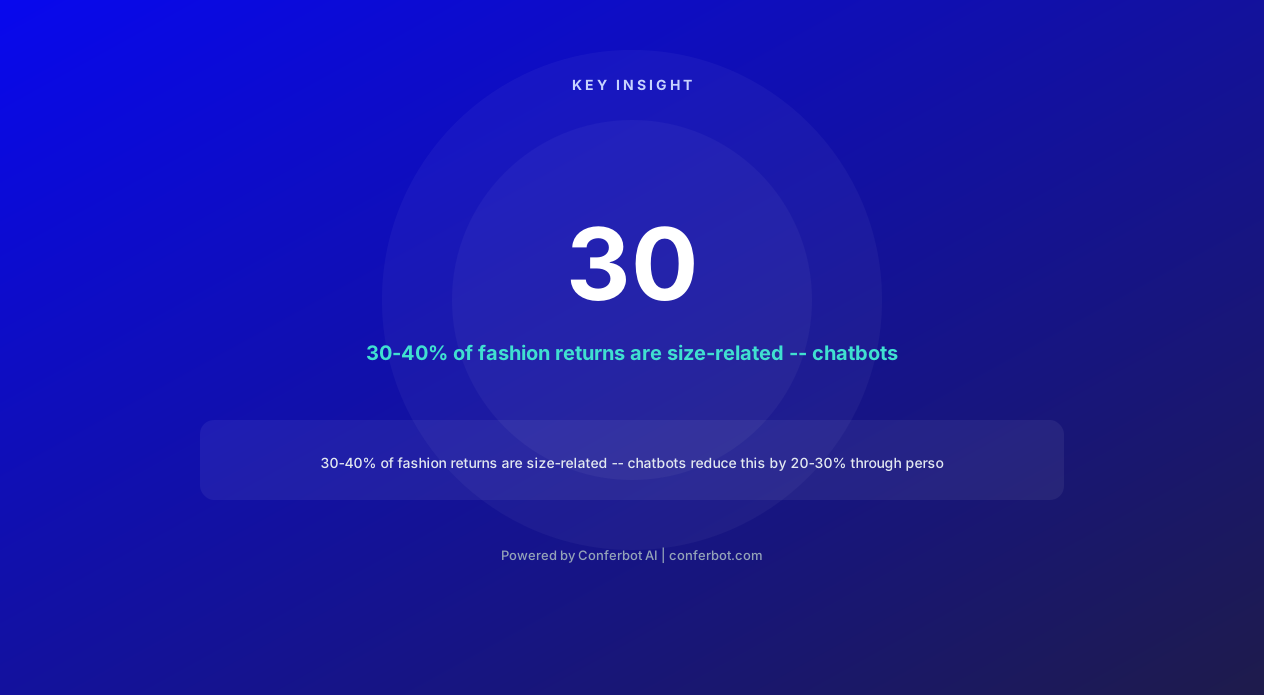
The scale of the fashion returns crisis is staggering. 30-40% of all online fashion purchases are returned, and sizing issues account for the overwhelming majority of these returns. For a fashion brand doing $10 million in annual online revenue, size-related returns cost $1.5-$2 million per year in direct costs (shipping, processing, restocking, inventory damage) and significantly more in lost customer lifetime value. Every size-related return is a failure of information -- the customer wanted the product, they just could not determine the right size from a static size chart.
Traditional size charts are a relic of in-store retail slapped onto e-commerce without adaptation. They provide measurements in centimeters or inches that most shoppers have never taken, vary dramatically between brands (a "Medium" at Zara fits completely differently than at H&M), and offer no guidance on fit preference (slim fit vs. relaxed, cropped vs. regular length). The result: shoppers either guess (and frequently guess wrong) or buy multiple sizes intending to return the ones that do not fit -- a behavior called "bracketing" that costs retailers billions annually.
Fashion brands deploying size recommendation chatbots report 20-30% reduction in size-related returns, with Nike's chatbot demonstrating 3x higher engagement than static size guides. Conferbot's AI chatbot builder provides a purpose-built fashion sizing template that combines measurement guidance, brand-specific size databases, fit preference matching, and purchase history analysis to deliver confident recommendations that keep products on customers and out of return bins.
This page covers the complete architecture of a size finder chatbot, the measurement and recommendation methodologies, brand-specific sizing intelligence, return reduction ROI, implementation for different fashion categories, and a deployment guide for brands of every size.
How AI Size Recommendation Works
A size finder chatbot is not simply a digital version of a size chart. It combines multiple data inputs through an intelligent matching algorithm that accounts for the complexity of human bodies and brand-specific manufacturing variations. Understanding the methodology explains why chatbot recommendations dramatically outperform static charts.
Multi-Input Sizing Algorithm
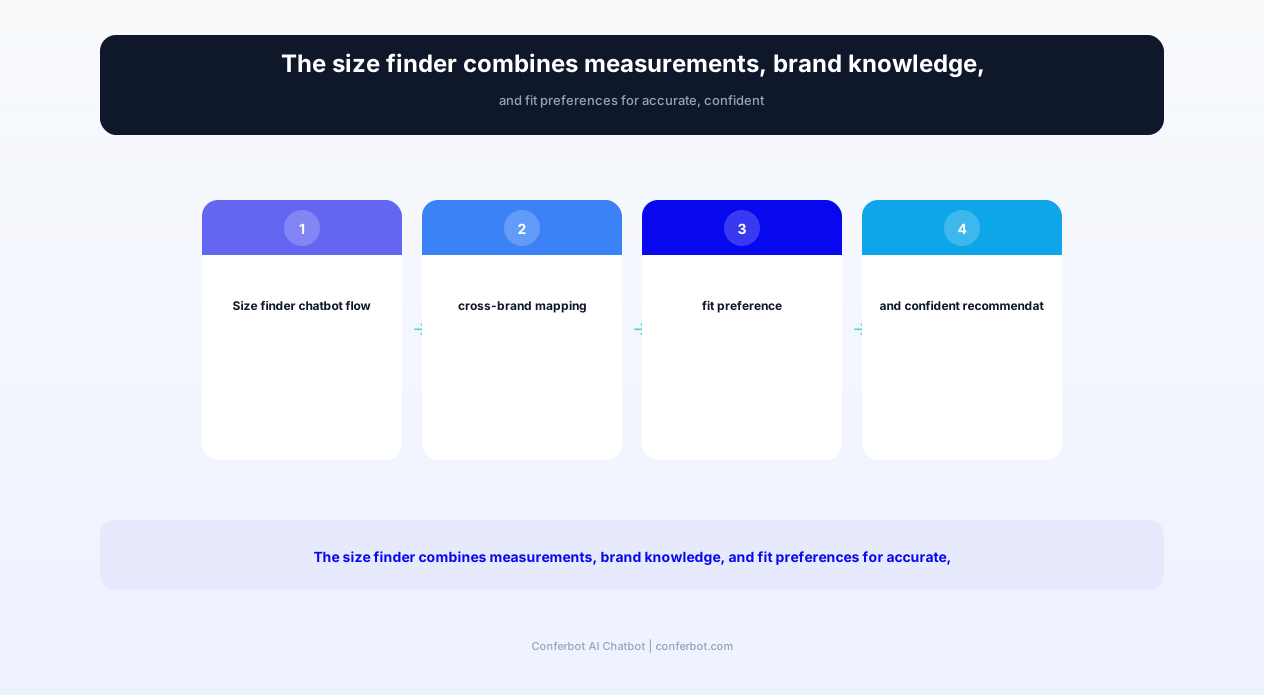
The chatbot collects and synthesizes several types of data to produce its recommendation:
- Body measurements: Key measurements (chest/bust, waist, hips, inseam, shoulder width) collected through guided measurement instructions with visual aids
- Reference sizing: "What size do you wear in [familiar brand]?" -- the chatbot maps between brand size systems using its cross-brand database
- Fit preference: Does the customer prefer fitted, regular, or relaxed fit? This adjusts the recommendation beyond pure measurement matching
- Body shape indicators: Questions about proportions (longer torso vs. longer legs, broader shoulders vs. narrower) that affect fit beyond simple measurements
- Product-specific factors: Fabric stretch, intended drape, garment construction, and styling intent that affect how a measurement translates to a size in that specific product
Brand-Specific Size Database
The chatbot maintains a database of actual garment measurements across brands -- not the size chart published on the brand's website (which is often aspirational rather than actual), but real measurements from production samples. This database reveals the critical insight that a "Size 8" varies by up to 2-3 inches in key measurements between brands. When a customer says "I'm usually a Medium," the chatbot does not assume Medium -- it asks which brand and maps that to the actual measurement range.
Machine Learning Refinement
The recommendation engine improves over time through feedback loops:
- Return data: When customers return items due to size, the chatbot records which recommendation led to the return and what the customer exchanged for, calibrating future recommendations for that product
- Purchase patterns: Analyzing which sizes customers ultimately keep (versus return) across thousands of transactions reveals systematic sizing biases in specific products
- Explicit feedback: Post-delivery questions ("How did the fit work out?") provide direct calibration data that no static system can capture
Confidence Scoring
Not all recommendations carry the same certainty. The chatbot communicates confidence levels:
- High confidence (85-95%): "Based on your measurements and fit preferences, we strongly recommend Size M." -- When measurement data is clear and the product has consistent sizing
- Moderate confidence (70-84%): "We recommend Size M, though if you prefer a looser fit, Size L would also work." -- When the customer falls between sizes or has a strong fit preference
- Low confidence (below 70%): "Based on what you've told us, you're between sizes. We'd suggest ordering both M and L and returning what doesn't fit -- free returns on size exchanges." -- When data is insufficient for a confident recommendation
This transparency builds trust. Customers appreciate honesty about uncertainty rather than false confidence that leads to wrong purchases.
Complete Feature Matrix
The fashion size finder chatbot template includes comprehensive features addressing every aspect of the online sizing challenge, from initial measurement through post-purchase feedback.
| Feature | Description | Operational Benefit | Customer Benefit |
|---|---|---|---|
| Guided measurement collection | Step-by-step visual instructions for taking body measurements with common reference points | Accurate measurement data for reliable recommendations | Clear, easy-to-follow measurement process without confusion |
| Cross-brand size mapping | Database mapping sizes between 200+ brands based on actual garment measurements | Recommendations that account for brand-specific sizing variations | "I wear M at Nike" translates accurately to other brands without guessing |
| Fit preference profiling | Captures preference for slim, regular, or relaxed fit across different garment types | Reduces "wrong fit" returns that are technically the right size but wrong preference | Gets the fit they actually want, not just the measurement that matches |
| Product-specific adjustments | Adjusts recommendations based on fabric, stretch, garment construction, and intended drape | Different recommendation for a structured blazer vs. a stretchy t-shirt in the same brand | Appropriate sizing for each specific product, not a one-size-fits-all recommendation |
| Body shape intelligence | Questions about proportions and body shape that affect fit beyond linear measurements | More accurate recommendations for diverse body types | Feels seen and understood rather than reduced to a number on a tape measure |
| Size comparison across brands | "How does Brand X's Medium compare to Brand Y's Medium?" with specific measurement differences | Educates customers, reducing confusion-driven returns | Understands exactly how brands compare before purchasing |
| Footwear sizing engine | Specific algorithms for shoe sizing including width, arch, and brand-specific last shapes | Addresses footwear's unique sizing challenges (width variance, brand differences) | Confident shoe purchases without ordering 3 sizes to try at home |
| Virtual try-on guidance | Integration with AR try-on tools, directing customers to virtual fitting experiences | Combines measurement-based recommendation with visual confirmation | Sees how the garment looks before purchasing, building confidence |
| Purchase history learning | Remembers past purchases and fit feedback for increasingly accurate recommendations | Repeat customers get instantly accurate recommendations without re-measuring | The system knows their body and preferences better with each purchase |
| Style quiz integration | Combines size finding with style preference quiz for complete product matching | Cross-sells complementary items with correct sizing pre-applied | Discovers new products that fit both their body and their style |
| Return reduction analytics | Tracks return rates by product, size recommendation accuracy, and calibration needs | Identifies products with systematic sizing issues before they generate costly returns | Indirectly benefits from increasingly accurate recommendations |
Each feature is configurable per product category (tops, bottoms, dresses, footwear, accessories) and adapts to your specific catalog's sizing system through the Conferbot visual builder.
Ready to try Fashion Size Finder Chatbot?
Deploy this template in under 10 minutes. No coding required.
Use This Template Free →Category-Specific Sizing Approaches
Different fashion categories present distinct sizing challenges. A chatbot that handles dresses the same way it handles shoes will fail at both. The size finder template includes category-specific algorithms optimized for the unique variables that determine fit in each product type.
Tops and Shirts
Key variables: chest/bust measurement, shoulder width, sleeve length, torso length, and desired fit (fitted vs. relaxed). The chatbot asks about intended use (layering piece vs. standalone, tucked in vs. untucked) to adjust length recommendations. For women's tops specifically, bust-to-waist ratio is critical -- a customer with a large bust and small waist may need different sizes in structured blouses versus stretchy t-shirts.
Bottoms (Pants, Jeans, Skirts)
Key variables: waist measurement (at natural waist vs. where they actually wear pants), hip measurement, inseam length, thigh circumference, and rise preference (low, mid, high). Jeans are particularly complex because denim stretches 0.5-1.5 inches after wear -- the chatbot factors in fabric composition (percentage of elastane/spandex) and recommends accordingly: "For 100% cotton denim, size down one as it will stretch to fit. For stretch denim (2%+ elastane), take your true size."
Dresses
Dresses require both top and bottom body measurements since they must fit across the bust, waist, and hips simultaneously. The chatbot identifies the customer's "dominant measurement" (the measurement that dictates their size) and recommends based on dress construction: a fit-and-flare dress that only fits closely at the bust is sized differently than a bodycon dress that fits closely everywhere. Empire waist, wrap, shift, and A-line silhouettes each have distinct sizing logic.
Footwear
Shoe sizing is arguably the most complex category. Key variables: foot length (primary sizing factor), foot width (narrow, standard, wide, extra-wide), arch height, volume, and intended use (running shoes fit differently than dress shoes). The chatbot also factors in sock thickness for boots, brand-specific last shapes (Nike runs narrow, New Balance runs wide), and half-size availability. For brands that do not offer half sizes, the bot recommends sizing up with an insole rather than squeezing into a too-small shoe.
Outerwear and Jackets
Outerwear sizing must account for layering underneath. The chatbot asks: "Will you typically wear this over a thick sweater or just a t-shirt?" and adjusts the recommendation accordingly. Sleeve length, shoulder fit, and torso length are critical -- a jacket that is the right chest size but too short in the arms is unwearable. For performance outerwear (ski jackets, rain shells), the chatbot factors in mobility requirements.
Activewear and Athleisure
Athletic clothing prioritizes performance fit: compression for support, freedom of movement for yoga, aerodynamic fit for cycling. The chatbot asks about activity type and intensity level to recommend appropriate compression and stretch. For sports bras specifically, the combination of band size and cup size with impact level (low for yoga, high for running) creates a multi-variable recommendation that static charts fail to communicate clearly.
Accessories (Rings, Belts, Hats)
Even accessories require sizing guidance. The chatbot provides ring size determination (measure a well-fitting ring or wrap paper around the finger), belt sizing (waist measurement + 2 inches for buckle), and hat sizing (head circumference measured above the ears). These categories often have the highest return rates because customers do not know how to measure and assume "one size fits most" when it does not.
Before and After: Measurable Impact
The following metrics represent typical performance improvements for fashion brands deploying the size finder chatbot, based on data from brands ranging from DTC startups to established multi-brand retailers.
| Metric | Before Chatbot | After Chatbot | Improvement |
|---|---|---|---|
| Size-related return rate | 30-40% of orders | 18-25% of orders | 20-30% reduction in returns |
| Customer confidence at purchase | 45% feel confident in size selection | 82% feel confident after chatbot recommendation | +37 points in purchase confidence |
| Bracketing behavior (ordering multiple sizes) | 22% of customers bracket | 8% of customers bracket | 64% reduction in bracketing |
| Conversion rate (size-dependent products) | 2.1% (hesitation from size uncertainty) | 3.8% (confidence from recommendation) | 81% conversion increase |
| Average order value | $75 (single item due to uncertainty) | $110 (confident multi-item purchases) | 47% higher AOV |
| Customer satisfaction (sizing experience) | 3.2/5 (frustrated by size charts) | 4.6/5 (helpful recommendations) | +1.4 points |
| Repeat purchase rate | 28% (burned by wrong sizes) | 42% (positive first experience) | 50% more repeat customers |
| Size exchange requests | 15% of orders require exchange | 6% of orders require exchange | 60% fewer exchanges |
| Customer support sizing inquiries | 35% of tickets about sizing | 8% of tickets about sizing | 77% reduction in sizing support |
| Chatbot engagement rate on product pages | N/A (static size chart) | 25-35% of product page visitors | Active sizing assistance adoption |
ROI Calculation for a Mid-Size Fashion Brand
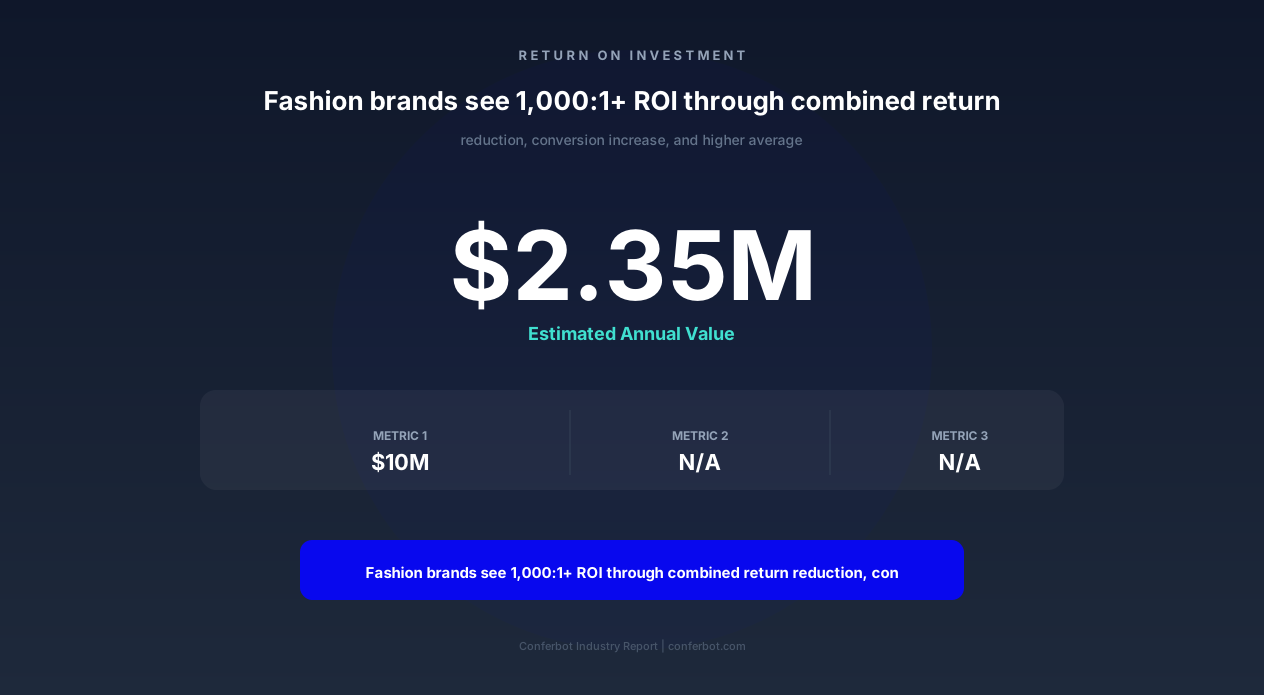
Consider a DTC fashion brand with $10 million annual online revenue, 35% return rate (industry standard), and $15 average return processing cost:
- Current return cost: 100,000 orders x 35% return rate x $15 processing = $525,000/year in return costs
- Return reduction (25%): 8,750 fewer returns x $15 = $131,250/year saved in processing
- Revenue retention (returns are lost revenue): 8,750 retained orders x $100 AOV = $875,000/year in retained revenue
- Conversion rate uplift: 81% increase on size-dependent products = approximately $800,000/year in additional revenue
- AOV increase: 47% higher AOV from confident purchasers = $470,000/year additional revenue
- Support cost reduction: 77% fewer sizing tickets x $8/ticket x 12,000 sizing tickets/year = $73,920/year saved
- Total annual impact: $2,350,170
Against a Conferbot subscription of $49-199/month, the ROI exceeds 1,000:1 for fashion brands with significant online sales. Even for smaller brands at $1M revenue, the return reduction alone justifies the investment within the first month.
Cross-Brand Size Comparison Engine
One of the most common sizing questions shoppers ask is "I'm a [size] in [brand] -- what size should I get in your brand?" The cross-brand comparison engine answers this question accurately using actual garment measurement data rather than generic size chart assumptions.
How Cross-Brand Mapping Works
The comparison engine maintains a database of actual garment measurements (not published size charts, which are often inaccurate) across 200+ popular brands. When a customer says "I wear a size 8 at Zara," the system knows that Zara's size 8 corresponds to approximately 26.5" waist and 37" hip measurements. It then maps those measurements against the specific product the customer is considering, accounting for the destination brand's size system, the product's intended fit, and fabric characteristics.
Why This Matters: The Size Inconsistency Problem
The same "Medium" varies dramatically across brands:
- Nike Women's Medium: Bust 35-37.5", Waist 27.5-30", Hips 37.5-40"
- Zara Medium: Bust 33.5-35.5", Waist 26-27.5", Hips 36-37.5"
- ASOS Medium: Bust 36-38", Waist 28-30", Hips 38-40"
- Free People Medium: Bust 35-36", Waist 27-28", Hips 37-38"
A customer who wears Medium at Nike might need a Large at Zara for the same fit. Without this mapping, the customer either guesses wrong (generating a return) or avoids the purchase entirely (lost revenue). The chatbot eliminates both outcomes by providing accurate cross-brand translation.
Database Maintenance and Accuracy
The size database is maintained through multiple sources:
- Published brand size charts: Starting point, but treated as approximate due to known inaccuracies
- Actual garment measurements: Physical measurements of production samples (most accurate)
- Customer feedback data: When customers report "I followed the chatbot's recommendation and the size was perfect/too large/too small," this calibrates the database
- Return exchange data: When a customer exchanges a size M for size L, this indicates the M runs small for that product line
Customer-Facing Comparison Interface
The chatbot presents cross-brand comparisons in accessible language:
- "You mentioned you wear a Medium at Nike. For this brand, their sizing runs slightly smaller than Nike, so we'd recommend a Large for a similar fit."
- "This brand's size 28 jeans are equivalent to Levi's size 29 -- they use a slightly smaller measurement scale."
- "If you like your H&M Small to fit snugly, go with this brand's XS -- they have a more generous cut."
This conversational approach is infinitely more useful than a measurement table that requires the customer to own a tape measure and know how to use it. Most online shoppers know their size at 2-3 familiar brands -- leveraging that knowledge is the fastest path to an accurate recommendation.
International Size System Conversion
The chatbot also handles international size system conversions (US/UK/EU/Asian sizing) which confuse international shoppers shopping cross-border. A US size 8 is a UK size 12 and an EU size 40 -- and none of these correspond to Japanese sizing. The bot detects the customer's location or asks their preferred system and translates accordingly.
50,000+ businesses use Conferbot templates to automate conversations
Implementation Guide for Fashion Brands
Deploying the size finder chatbot requires two phases: initial setup (1-3 hours depending on catalog complexity) and ongoing calibration (15-30 minutes weekly for the first month, then monthly thereafter). This guide covers both phases.
Step 1: Catalog Size Data Import
The chatbot needs your product sizing data to make recommendations. In Conferbot's dashboard, import your size data through one of these methods:
- CSV upload: Export your size charts as a spreadsheet with columns for product/category, size label, and measurements (bust, waist, hips, length for each size)
- API sync: Connect to your e-commerce platform (Shopify, WooCommerce, Magento) through API integration and pull size data from product metadata
- Manual entry: For smaller catalogs (under 50 products), enter size data directly in the dashboard
Critical: Enter actual garment measurements, not body measurements. The chatbot needs to know "Size M chest measurement is 40 inches" (garment measurement) to match against a customer's 36-inch chest measurement (body measurement) -- the 4-inch difference is ease/fit allowance.
Step 2: Configure Fit Profiles
Define how your brand's products fit across categories:
- Slim fit: 1-2 inches ease in the chest/bust, close through the body
- Regular fit: 3-4 inches ease, standard comfort
- Relaxed fit: 5-6 inches ease, loose and comfortable
- Oversized: 7+ inches ease, intentionally loose
Tag each product with its fit profile. This allows the chatbot to distinguish between "this product is too big" and "this product is intentionally oversized" -- a critical distinction that static size charts fail to communicate.
Step 3: Set Up Measurement Guidance
Configure the visual measurement instructions that guide customers through self-measurement:
- Bust/chest: "Wrap the measuring tape around the fullest part of your chest, keeping it level"
- Waist: "Measure at your natural waistline -- the narrowest part of your torso, typically above the belly button"
- Hips: "Measure around the widest part of your hips and buttocks"
- Inseam: "Measure from your crotch to where you want the hem to fall"
Include visual diagrams or short video clips for each measurement. Customers who measure incorrectly will receive wrong recommendations, so clear guidance is essential.
Step 4: Configure the Cross-Brand Database
Add brand comparisons most relevant to your customer base. The chatbot includes a pre-loaded database of 200+ popular brands, but you should verify and adjust mappings for brands that share your target customer. If your customers frequently mention wearing "[Brand X] size M," verify that the system's Brand X data is accurate.
Step 5: Deploy on Product Pages
Install the chatbot widget on product pages with a contextual trigger:
- Product page widget: "Not sure about your size? Let me help!" button near the size selector
- Size chart enhancement: Chatbot link within your existing size chart: "Want personalized sizing? Chat with our size assistant"
- Cart page prompt: If a customer adds an item without interacting with size guidance, offer: "Would you like to verify your size before checkout?"
Step 6: Configure Feedback Loop
Set up post-delivery fit feedback collection:
- Send a chatbot message 5-7 days after delivery: "How did the [Product Name] in size [Size] fit?"
- Collect responses: "Perfect fit," "Too small," "Too large," "Length was wrong"
- Feed responses back into the recommendation engine for calibration
This feedback loop is what transforms a static size recommendation tool into an improving AI system that gets more accurate with every purchase.
The Return Reduction Strategy
Returns are not just a logistics problem -- they are a profitability crisis for fashion brands. The size finder chatbot is the single most effective tool for reducing size-related returns because it addresses the root cause (information gap) rather than the symptom (incorrect purchases). Here is the comprehensive return reduction strategy.
Understanding Why Size Returns Happen
Research by Narvar and Loop Returns identifies the specific reasons behind size-related returns:
- 35%: "It didn't fit as expected" -- the size chart said one thing, the garment fit differently
- 25%: "I ordered the wrong size" -- customer selected incorrectly due to confusion
- 20%: "The fit wasn't what I wanted" -- correct size but wrong silhouette/style
- 12%: "I ordered multiple sizes to try" -- intentional bracketing
- 8%: "The product looked different than expected" -- not size-related but reported as such
The chatbot directly addresses the first four categories (92% of size returns) through accurate recommendations, clear communication about fit and style, and reduced need for bracketing.
Pre-Purchase Intervention Points
The chatbot intervenes at multiple points before the purchase to prevent wrong-size orders:
- Product page engagement: Proactive size assistance when a customer hesitates on the size selector
- Cart review: "You selected Size S for [Product]. Based on your profile, Size M might be a better fit -- would you like to check?"
- Checkout warning: If the system detects likely sizing mismatch (customer's profile suggests different size than selected), a gentle prompt before payment
Post-Purchase but Pre-Ship Intervention
For orders flagged as potential sizing mismatches, some brands implement a post-purchase confirmation: "We noticed the size you ordered might not be your best fit based on your previous purchases. Would you like to adjust before we ship?" This requires integration with your order management system but catches errors before shipping costs are incurred.
Exchange over Refund Optimization
When returns do happen, the chatbot guides customers toward exchanges rather than refunds:
- When a return is initiated for size reasons, the bot immediately offers an exchange: "Sorry that didn't work! Based on your feedback that it was too small, Size M would be your best fit. Can I process an exchange for you?"
- Cross-ship exchanges (send the new size before receiving the return) reduce the time without the product and increase exchange completion rates by 40%
- Exchanges retain revenue that refunds lose -- converting 50% of returns to exchanges preserves $500,000+ annually for a $10M brand
Bracketing Reduction
Bracketing (ordering multiple sizes to try at home) is expensive: it doubles or triples shipping costs per order and guarantees at least one return per transaction. The chatbot reduces bracketing by providing confidence. When a customer asks "Should I order both sizes?", the bot can respond: "Based on your measurements and this product's fit, I'm 90% confident Size M is your best fit. If you'd like extra confidence, I can explain exactly why -- would you prefer that over ordering both?"
Brands implementing this strategy report a 64% reduction in bracketing behavior, which translates directly to shipping cost savings and inventory optimization.
Size Technology Market Comparison
The fashion sizing technology market includes several established players alongside AI-native solutions. Understanding the landscape helps brands choose the right approach for their size, budget, and technical capabilities.
True Fit
True Fit is the largest dedicated sizing platform, used by major retailers. It leverages a massive purchase-and-return dataset to recommend sizes. Strengths: enormous brand database, proven enterprise results, retailer network effects. Limitations: enterprise pricing ($5,000-50,000+/month), complex integration, limited customization of the user experience, and recommendations based on aggregate purchase data rather than individual body measurements.
Fit Analytics (now Snap/Virtual Try-On)
Fit Analytics was acquired by Snap and pivoted toward AR/virtual try-on. The original size recommendation product is being sunset in favor of AR experiences. Strengths: visual try-on technology, strong ML backing. Limitations: unclear long-term product direction, limited availability for non-enterprise brands, AR requires customer device camera access (lower adoption than chat).
Kiwi Sizing
Kiwi Sizing provides size recommendation widgets for Shopify and WooCommerce stores. Strengths: easy installation, reasonable pricing ($10-50/month), Shopify app store presence. Limitations: basic recommendation logic (measurement table lookup, not AI-powered), no conversational interface, limited cross-brand intelligence, no fit preference handling.
Bold Metrics
Bold Metrics uses body measurement prediction from demographic data (height, weight, age) rather than actual measurements. Strengths: no measuring required from customers, quick recommendations. Limitations: predictions are less accurate than actual measurements (especially for non-standard body types), privacy concerns about demographic data collection, limited fashion category coverage.
Conferbot Fashion Size Finder
Conferbot's template combines conversational AI with size intelligence at accessible pricing:
| Capability | True Fit | Kiwi Sizing | Bold Metrics | Conferbot |
|---|---|---|---|---|
| AI-powered recommendations | ML-based | Table lookup | Predictive | LLM + measurement-based |
| Conversational interface | Widget only | Widget only | Widget only | Full chatbot conversation |
| Cross-brand comparison | Extensive | Limited | Moderate | 200+ brands |
| Fit preference handling | Basic | No | No | Detailed (slim/regular/relaxed per category) |
| Multi-channel (website + WhatsApp) | Website only | Website only | Website only | Website + WhatsApp + Messenger |
| Post-purchase feedback loop | Via retailer data | No | Limited | Built-in conversational feedback |
| Pricing | $5,000-$50,000+/month | $10-$50/month | $500-$2,000/month | $49-$199/month |
| Best for | Enterprise retailers | Small Shopify stores | Mid-market apparel | DTC brands and mid-market retailers |
For DTC brands and mid-size retailers in 2026, Conferbot offers the best combination of AI-powered accuracy, conversational user experience, and accessible pricing. Enterprise retailers with $100M+ revenue may benefit from True Fit's dataset scale, but brands below that threshold get equivalent results at 1/100th the cost.
Best Practices for Size Finder Success
A size finder chatbot succeeds when it reduces returns and increases purchase confidence. These best practices maximize both outcomes based on data from top-performing fashion brands on the platform.
Make Size Help Visible and Accessible
The best size finder in the world is useless if customers do not know it exists. Position the chatbot trigger prominently:
- Directly next to the size selector dropdown (not buried at the bottom of the page)
- Use action-oriented copy: "Find my size" outperforms "Size guide" by 2x in engagement
- Add a brief value proposition: "Get your perfect size in 30 seconds" sets expectations
- Consider auto-triggering for first-time visitors who hover on the size selector for 3+ seconds
Accept Multiple Input Methods
Not every customer wants to measure themselves. Provide multiple paths to a recommendation:
- Path 1 (fastest): "What size do you usually wear at [popular brand]?" -- cross-brand mapping
- Path 2 (most accurate): Body measurements -- for customers who have them or are willing to measure
- Path 3 (quick estimate): Height, weight, and body type -- less accurate but frictionless
Let customers choose their preferred path. Forcing measurements on someone who just wants a quick size recommendation creates friction that reduces adoption.
Be Honest About Uncertainty
When the recommendation confidence is low (customer between sizes, unusual body proportions, insufficient data), communicate honestly rather than guessing. "You're right between sizes -- here's what we suggest based on your fit preference" builds more trust than a confident recommendation that turns out to be wrong. Customers appreciate transparency and are more likely to keep products when they understood the sizing nuance before purchasing.
Leverage Purchase History for Returning Customers
Returning customers should not re-measure every time. Recognize them (via account login or email) and use their purchase and fit feedback history: "Last time you ordered the Slim Tee in Medium and said it fit perfectly. This product has a similar cut -- Medium should work great here too." This personalization makes the experience effortless for loyal customers and reinforces repeat purchasing behavior.
Collect and Act on Fit Feedback
Post-delivery fit feedback is the most valuable data for improving recommendations. Send a brief follow-up 5-7 days after delivery:
- "How did your [Product] in size [Size] fit?" with options: Too small / Perfect / Too large
- If imperfect: "Was it the length, width, or overall?" for specific calibration
- Store this feedback against both the customer profile and the product's sizing accuracy record
Products that consistently receive "too small" or "too large" feedback should be flagged for size chart correction or chatbot recommendation adjustment. This continuous improvement loop is what separates a good size finder from a great one.
Integrate with Returns UX
When a customer initiates a return for size reasons, the chatbot should:
- Ask what went wrong ("Was it too large, too small, or was the fit/style not what you expected?")
- Offer an immediate exchange recommendation ("Based on your feedback, Size M would be a better fit -- want me to process an exchange?")
- Update their size profile to prevent the same issue on future purchases
- Record the data for product-specific sizing calibration
This turns a negative experience (return) into a positive one (seamless exchange + improved future recommendations), increasing the probability of retaining the customer for future purchases.
Fashion Size Finder Chatbot FAQ
Everything you need to know about chatbots for fashion size finder chatbot.
Why Use a Template vs Building from Scratch?
Templates encode years of optimization data into the conversation flow before you start.
| Factor | Conferbot Template | Build from Scratch | Hire a Developer |
|---|---|---|---|
| Time to deploy | 10 minutes | 2-8 hours | 2-6 weeks |
| Cost | Free | Your time | $5,000-$25,000 |
| Day-1 conversion | 15-22% | 5-8% | 10-15% |
| Proven flows | Yes, data-tested | No | Depends |
| Updates included | Automatic | Manual | Paid |
| Multi-channel | 8+ channels | 1 channel | Extra cost |
| Analytics | Built-in | Must build | Extra cost |
Ready to Deploy Fashion Size Finder Chatbot?
Join 50,000+ businesses. Free forever plan available. No credit card required.