The Solar Lead Generation Problem: Why 70% of Website Visitors Leave Without Converting
The residential solar industry has a lead generation paradox: consumer interest is at an all-time high, but conversion rates remain stubbornly low. According to the Solar Energy Industries Association (SEIA) 2025 Market Report, residential solar installations grew 22% year-over-year in 2025, with over 1.2 million homes adding solar panels. Yet the average solar company website converts only 2-4% of visitors into leads -- meaning 96-98% of interested homeowners leave without taking action.
The problem is not lack of interest. It is friction. A homeowner visits a solar company website at 9 PM after seeing their $380 utility bill. They have questions: "Can my roof support panels?" "How much will it actually cost?" "What are the incentives in my state?" "Will it really save me money?" They land on a website with a contact form and a phone number that will not be answered until tomorrow morning. By then, the urgency has passed, they have visited three other solar websites, and inertia wins.
The Economics of Solar Lead Acquisition
Solar leads are among the most expensive in any industry. Data from EnergySage and industry benchmarks show:
| Lead Source | Average Cost Per Lead | Average Close Rate | Cost Per Acquisition |
|---|---|---|---|
| Google Ads (solar keywords) | $75 - $150 | 8 - 12% | $625 - $1,875 |
| Facebook/Meta Ads | $40 - $80 | 4 - 8% | $500 - $2,000 |
| Third-party lead providers (EnergySage, Solar Reviews) | $20 - $60 (shared leads) | 2 - 5% | $400 - $3,000 |
| Organic website traffic | $15 - $30 (content cost amortized) | 10 - 15% | $100 - $300 |
| Referrals | $0 - $500 (referral bonus) | 25 - 40% | $0 - $2,000 |
The cost-per-acquisition for solar installations ranges from $400 to $3,000 depending on the channel. With average system prices of $25,000-$35,000 and gross margins of 15-25%, every lost lead represents $3,750-$8,750 in potential gross profit. A solar company with 5,000 monthly website visitors losing 97% of them to friction is leaving $1.4-$3.2 million in annual revenue on the table.
Why Traditional Lead Capture Fails for Solar
Solar purchases are different from other home improvement decisions in ways that make traditional lead capture particularly ineffective:
- High information asymmetry: Homeowners know very little about solar -- panel types, inverter technology, net metering, federal tax credits, state incentives, financing options. They need education before they are willing to provide contact information.
- Complex qualification criteria: Not every homeowner qualifies for solar. Roof condition, orientation, shading, ownership status, credit score, and utility rates all determine viability. A simple contact form cannot qualify leads.
- Long decision cycle: The average solar purchase takes 3-6 months from initial interest to signed contract. Leads need nurturing through education, not just a sales call.
- Comparison shopping: 78% of solar buyers get quotes from 3+ companies. The first company to respond meaningfully captures a disproportionate share of closed deals.
- Trust deficit: Solar has been plagued by aggressive sales tactics and misleading savings claims. Homeowners are wary of providing their phone number, knowing it leads to persistent sales calls.
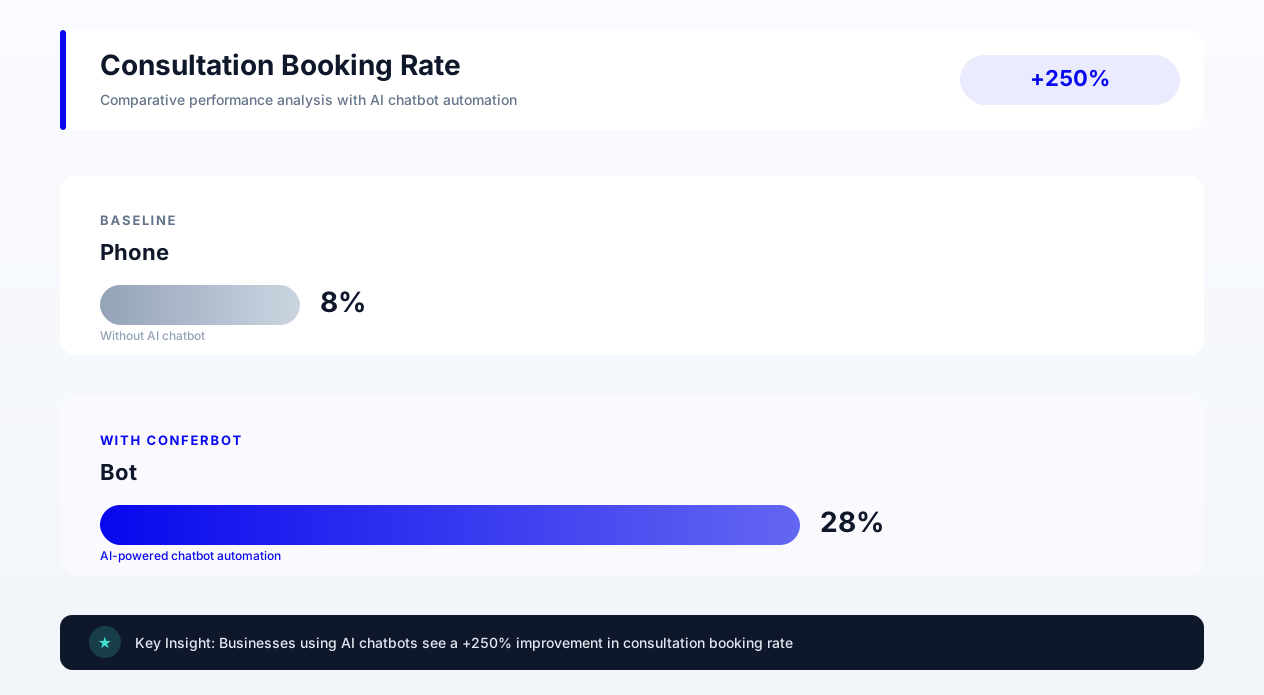
An AI chatbot addresses every one of these challenges. It provides instant education, qualifies leads through natural conversation, engages visitors 24/7, responds before competitors can, and builds trust through helpful interaction rather than sales pressure. Solar companies deploying AI chatbots report 3x more qualified leads and 40% higher consultation booking rates compared to traditional contact forms alone.
Homeowner Qualification Criteria: The 7 Factors Your Chatbot Must Assess
Effective solar lead qualification separates homeowners who can and will go solar from those who cannot or will not, a process aligned with the U.S. Department of Energy's homeowner solar guide -- without wasting sales team time on unqualified prospects. Your chatbot should assess these seven factors in a natural, conversational flow that educates while it qualifies.
Factor 1: Home Ownership Status
Why it matters: Renters generally cannot install solar panels (though some community solar programs exist). This is the single most disqualifying factor and should be assessed early to avoid wasting both the homeowner's and your team's time.
How to ask (conversational): "Quick question -- do you own your home, or are you renting? This affects which solar options are available to you."
If renter: Do not dead-end the conversation. Offer community solar information or waitlist signup: "Renters have options too! I can tell you about community solar programs in your area that let you benefit from solar without rooftop panels."
Factor 2: Roof Type and Condition
Why it matters: Certain roof types (slate, cedar shake, clay tile) are more complex and expensive to install on. Roofs needing replacement within 5 years should be replaced before solar installation. Flat roofs require different mounting systems.
How to ask: "What type of roof do you have? [Asphalt shingle] [Metal] [Tile] [Flat roof] [Not sure]" followed by "Roughly how old is your roof? If it is over 15 years old, we may recommend combining solar with a roof refresh to maximize your investment."
Scoring: Asphalt shingle under 10 years = ideal (lowest installation cost). Metal roof = excellent (longest lifespan, simple mounting). Tile = moderate (requires specialized mounting). Flat = moderate (requires ballasted racking). Roof over 20 years = flag for inspection recommendation.
Factor 3: Sun Exposure and Shading
Why it matters: Shading from trees, adjacent buildings, or other structures can reduce solar production by 20-80%. South-facing roofs in the Northern Hemisphere produce optimal energy.
How to ask: "Does your roof get direct sunlight for most of the day? Or are there tall trees or nearby buildings that create shade on your roof?" Followed by: "Which direction does your main roof face? [South] [East] [West] [North] [Not sure -- I can help figure it out]"
Scoring: South-facing with minimal shading = highest production (100% optimal). East/West facing = good (75-85% of optimal). Significant shading = may require tree trimming or reduced system size. North-facing = typically not viable for solar in most US locations.
Factor 4: Monthly Utility Costs
Why it matters: Monthly electricity costs determine the size of the system needed and the financial payback period. Homeowners paying under $80/month often do not achieve attractive ROI with solar. Those paying $200+ are ideal candidates with fast payback periods.
How to ask: "What does your average monthly electricity bill look like? [Under $100] [$100-$150] [$150-$250] [$250+] [Not sure, but it feels high!]"
Scoring: Under $80/month = low priority (long payback, may not justify investment). $100-$150 = moderate (5-8 year payback). $150-$250 = strong candidate (4-6 year payback). $250+ = ideal candidate (3-5 year payback, highest urgency). These thresholds vary by state based on local electricity rates and incentive structures.
Factor 5: Credit Score / Financing Readiness
Why it matters: Most residential solar is financed through loans or leases that require minimum credit scores (typically 650+). Cash purchases eliminate this factor but represent only 15-20% of residential installations.
How to ask (sensitively): "How are you thinking about paying for solar? [Cash purchase] [Solar loan] [Lease/PPA] [Not sure -- what are my options?]" If financing: "Solar loans typically require a credit score of 650 or higher. Without pulling your credit, would you say your score is [Above 700] [650-700] [Below 650] [Not sure]?"
Important: Frame this as informational, not gatekeeping. If below 650: "No worries -- we have lease and PPA options that do not require credit approval. These can still save you money from day one."
Factor 6: Timeline and Urgency
Why it matters: Homeowners actively seeking solar quotes within 30 days are 6x more likely to close than those "just researching." This factor determines follow-up priority and sales resource allocation.
How to ask: "How soon are you thinking of going solar? [As soon as possible] [Within 3 months] [Within 6 months] [Just exploring for now]"
Factor 7: Decision Authority
Why it matters: Solar is a household decision that typically requires agreement from all homeowners/spouses. Single-decision-maker leads close 2x faster than those requiring consensus.
How to ask: "Is this a decision you would make on your own, or would someone else in the household be involved? (We can include them in the consultation if helpful.)"
Qualification Scoring System
Assign points to each factor and use the total score to prioritize leads and determine next steps:
| Score Range | Classification | Chatbot Action |
|---|---|---|
| 28-35 points | Hot lead (highly qualified) | Immediately offer same-day/next-day consultation booking |
| 20-27 points | Warm lead (qualified with minor gaps) | Offer consultation within the week; address qualifying gaps |
| 12-19 points | Nurture lead (interested but not ready) | Provide educational content; offer email updates on incentives |
| Under 12 points | Low priority (significant barriers) | Offer community solar alternatives; add to long-term nurture |
This scoring system ensures your sales team spends time on homeowners most likely to convert while the chatbot nurtures earlier-stage prospects automatically. Configure this qualification flow in Conferbot's lead qualification system with custom scoring rules that match your specific market and service area.
Complete Chatbot Conversation Flow for Solar Qualification
Here is a full conversation flow script optimized for solar company websites. This flow qualifies homeowners through all seven factors in approximately 90 seconds of natural conversation while simultaneously educating them about solar -- building trust and reducing the information asymmetry that prevents conversion.
The Complete Flow Script
Greeting (Page-aware -- pricing/savings page):
"Hey there! Curious how much you could save with solar on your home? I can give you a ballpark estimate in about 90 seconds -- no phone call needed."
[If user engages]
Step 1 - Location:
"First things first -- what is your zip code? This helps me check local incentives and sun exposure for your area."
[User provides zip code]
"Great! [Zip code area] gets excellent sun exposure -- about [X] peak sun hours per day. Plus, your state offers [mention key local incentive if applicable]."
Step 2 - Ownership:
"And you own your home, right? [Yes, I own it] [I rent] [Co-op/condo]"
[If owns] "Perfect -- that means all the savings go directly to you."
[If rents] "No problem -- I can tell you about community solar programs in [their area] that save renters 10-15% on electricity without rooftop panels. Interested? [Yes!] [Maybe later]"
Step 3 - Utility costs:
"What does your monthly electric bill usually run? [Under $100] [$100-150] [$150-250] [$250+]"
[If $150+] "At $[amount]/month, you are spending roughly $[annual] per year on electricity. Solar systems in your area typically offset 80-100% of that -- meaning potential savings of $[estimated savings] over 25 years."
[If under $100] "Your bill is on the lower side, which means a smaller system would cover your needs. The payback takes a bit longer, but you still come out ahead. Want me to run the numbers?"
Step 4 - Roof assessment:
"A couple of quick questions about your roof. What material is it? [Asphalt shingle] [Metal] [Tile] [Flat roof] [Other/not sure]"
"And roughly how old? [Under 5 years] [5-10 years] [10-20 years] [Over 20 years] [Not sure]"
[If over 20 years] "Heads up -- if your roof needs replacement within the next 5 years, it is smart to do that before or at the same time as solar. Many of our customers bundle both. Our consultant can assess this during the site visit."
Step 5 - Shading:
"Does your roof get mostly clear sunlight throughout the day, or are there large trees or buildings casting shade? [Mostly sunny] [Some shade in the morning/afternoon] [Significant shade] [Not sure]"
Step 6 - Financing preference:
"Last question on the practical side -- how are you thinking about paying? [Buy outright (cash)] [Finance with a solar loan] [Lease or PPA (no upfront cost)] [What do you recommend?]"
[If asks for recommendation] "Most homeowners choose a solar loan -- you own the system, get the 30% federal tax credit, and your loan payment is typically less than your old electric bill. Zero out of pocket, and you build equity in a home improvement."
Step 7 - Savings summary and CTA:
"Here is your quick estimate based on what you have told me:
Estimated system size: [X] kW
Estimated monthly savings: $[X] - $[Y]
Federal tax credit (30%): ~$[X]
Estimated payback period: [X] - [Y] years
25-year net savings: $[X] - $[Y]
These numbers get much more precise after a site assessment (free, 30 minutes). Our solar consultant can also check your roof from above using satellite imagery before visiting. Want to book a time?"
[Booking CTA]:
"When works best for a free consultation? [This week] [Next week] [Just send me the info by email for now]"
[If books] "Booked! [Name] from our team will be in touch at [time]. They will have your estimate ready and can answer any questions about your specific roof. You will also get a text reminder 24 hours before."
[If email only] "Got it -- what is the best email for the detailed estimate? I will also include info about the [state incentive] deadline so you do not miss out."
Flow Performance Metrics
| Metric | This Flow | Industry Average (Form) | Improvement |
|---|---|---|---|
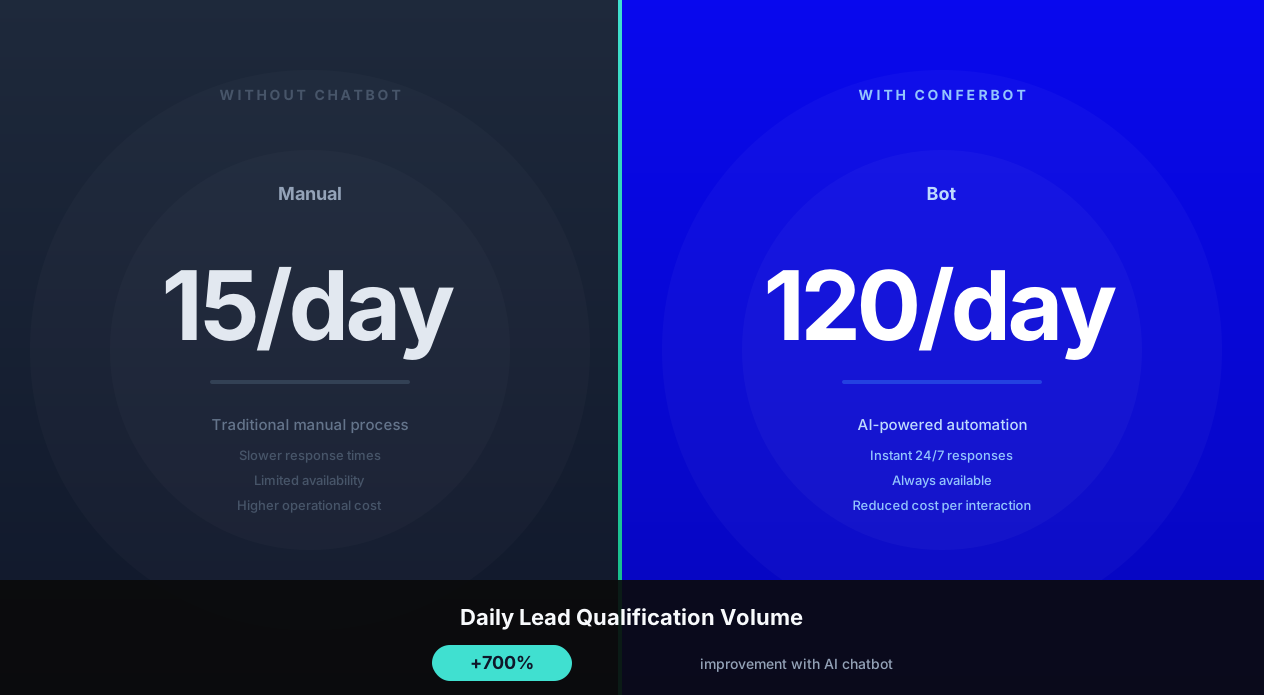
| Visitor to conversation engagement | 24% | 3% (form submission) | +700% |
| Conversation completion rate | 72% | 45% (form completion) | +60% |
| Qualified lead rate | 58% of completions | 30% of form leads | +93% |
| Consultation booking rate | 41% of qualified leads | 22% of qualified leads | +86% |
| Average qualification time | 94 seconds | N/A (form is instant but unqualified) | Better quality |
This flow is available as a pre-built template in Conferbot's appointment booking chatbot library, customizable with your specific service area, incentive data, and pricing parameters.
Automated Consultation Scheduling: Booking Site Visits Without Sales Staff
In solar sales, the site visit consultation is the critical conversion event, as documented by the Solar Energy Industries Association (SEIA). Industry data shows that homeowners who complete an in-home or virtual consultation close at 35-50% rates, compared to 5-8% for leads that never reach the consultation stage. Your chatbot's primary job is getting qualified homeowners to that consultation -- and automated scheduling removes every friction point between interest and booked appointment.
Why Manual Scheduling Kills Solar Conversions
The traditional solar scheduling flow: Homeowner fills out form → Solar company receives lead → Sales rep calls homeowner (often next day) → Phone tag ensues → Eventually schedule appointment (if homeowner has not lost interest or booked with competitor).
The average time from form submission to booked appointment in solar: 3.2 days. During those 3.2 days, the homeowner has received calls from three other solar companies (if they used a lead aggregator), researched alternatives, been distracted by other priorities, and potentially lost the emotional momentum that drove them to inquire in the first place.
With chatbot scheduling: Homeowner engages bot → Qualifies in 90 seconds → Sees available consultation times → Books immediately → Receives confirmation and calendar invite. Time from interest to booked appointment: under 3 minutes.
Scheduling Configuration for Solar Consultations
Solar consultations require specific scheduling logic that differs from generic appointment booking:
Appointment types:
- Virtual consultation (30 minutes) -- sales rep reviews satellite imagery and provides preliminary proposal via video call. Lower commitment for the homeowner, higher show rate (85%).
- In-home site assessment (60 minutes) -- technician or sales rep visits the property to assess roof condition, electrical panel, shading, and structural requirements. Higher commitment but higher close rate (50%).
- Phone consultation (15 minutes) -- for homeowners not ready for full consultation but wanting more information. Lowest commitment, useful for nurturing warm leads.
Scheduling rules:
- Match consultant to service area (zip code-based routing)
- Buffer 30 minutes between in-home visits for travel time
- Offer virtual consultations for first touchpoint (lower barrier), upgrade to in-home during the call
- Show next 5 available slots, with emphasis on earliest availability ("Our next opening is tomorrow at 2 PM -- want it?")
- Allow same-day booking for hot leads (score 28+) if slots are available
Reducing No-Shows: The Solar-Specific Challenge
Solar consultation no-show rates average 25-35% industry-wide -- significantly higher than other home services. This is because the long decision cycle and lack of immediate urgency (solar is a want, not an emergency need like plumbing) make it easy to deprioritize.
Chatbot-driven strategies to reduce solar no-shows:
- Immediate value delivery after booking: "While you wait for your consultation, here is your preliminary solar estimate based on satellite imagery of your home: [link to personalized report]." This makes the appointment feel valuable before it happens.
- Pre-consultation education: "Before your appointment, here are 3 things worth thinking about: [Your current rate plan] [Whether you have electric vehicle plans] [Any planned home additions]. Your consultant will use these to customize your proposal."
- Multi-channel reminders: SMS + WhatsApp reminders at 48 hours and 2 hours before. Include the consultant's name and photo to build personal connection.
- Easy rescheduling: "Can not make it? No problem -- reply with 'reschedule' and I will show you new times." Converting cancellations to reschedules rather than lost appointments.
- Spouse/partner inclusion: "Since this is a household decision, would your partner like to join? I can send them a calendar invite too." Including all decision-makers increases show rate and close rate.
Solar companies using chatbot-driven scheduling with these strategies report no-show rates of 12-18%, compared to the 25-35% industry average -- representing a 40-50% improvement in consultation utilization. For detailed appointment automation strategies, see our comprehensive appointment booking chatbot guide.
After-Hours Booking: Capturing the Evening Research Window
Data from solar company websites shows that 62% of residential solar research happens between 7 PM and 11 PM -- after work, after dinner, when homeowners review bills and browse improvement options. This is exactly when your sales team is offline.
A chatbot that qualifies and books consultations 24/7 captures this evening research window that traditional lead capture misses entirely. Homeowners who book a consultation at 9 PM on Tuesday are significantly more committed than those who fill out a form and wait for a callback -- the act of choosing a specific time slot creates psychological commitment to attending.
ROI Analysis: What Solar Companies Can Expect from Chatbot Deployment
Solar companies operate on thin margins relative to their customer acquisition costs. The ROI of a chatbot is not theoretical -- it is a direct function of more qualified leads entering your pipeline and more of those leads converting to signed contracts.
ROI Model for a Mid-Size Solar Installer
Let us build a realistic ROI model for a solar company doing 200-400 installations per year with a website receiving 8,000 monthly visitors:
Current state (without chatbot):
- Monthly website visitors: 8,000
- Contact form conversion rate: 3% = 240 leads/month
- Lead-to-consultation rate: 40% = 96 consultations/month
- Consultation-to-close rate: 35% = 34 installations/month
- Average installation revenue: $28,000
- Average gross margin: 20% = $5,600 gross profit per install
- Monthly gross profit from website leads: $190,400
With AI chatbot:
- Monthly website visitors: 8,000 (unchanged)
- Chatbot engagement rate: 22% = 1,760 conversations/month
- Conversation-to-qualified-lead rate: 18% = 317 qualified leads/month (+32% more than before)
- Lead-to-consultation rate: 55% = 174 consultations/month (+81% improvement via instant booking)
- Consultation-to-close rate: 38% = 66 installations/month (+94% improvement from better qualification)
- Average installation revenue: $28,000 (unchanged)
- Monthly gross profit from website leads: $369,600
Net improvement:
- Additional monthly installations: 32
- Additional monthly gross profit: $179,200
- Monthly chatbot platform cost: $79-$200
- Monthly ROI: 89,500% - 226,835%
- Annual additional gross profit: $2,150,400
Sensitivity Analysis
Even with conservative estimates (halving all improvement assumptions), the ROI remains compelling:
| Scenario | Additional Monthly Installs | Additional Annual Profit | Annual ROI vs. $2,400 Platform Cost |
|---|---|---|---|
| Optimistic (numbers above) | 32 | $2,150,400 | 89,500% |
| Moderate (50% of improvements) | 16 | $1,075,200 | 44,700% |
| Conservative (25% of improvements) | 8 | $537,600 | 22,300% |
| Pessimistic (10% of improvements) | 3 | $201,600 | 8,300% |
Even the pessimistic scenario -- where the chatbot adds just 3 additional installations per month -- delivers over 8,000% annual ROI against platform costs. The math is overwhelmingly favorable because solar installations are high-value transactions ($28,000+) and the chatbot cost is minimal ($79-$200/month).
Secondary ROI Drivers
Beyond direct lead generation, chatbot deployment creates additional value:
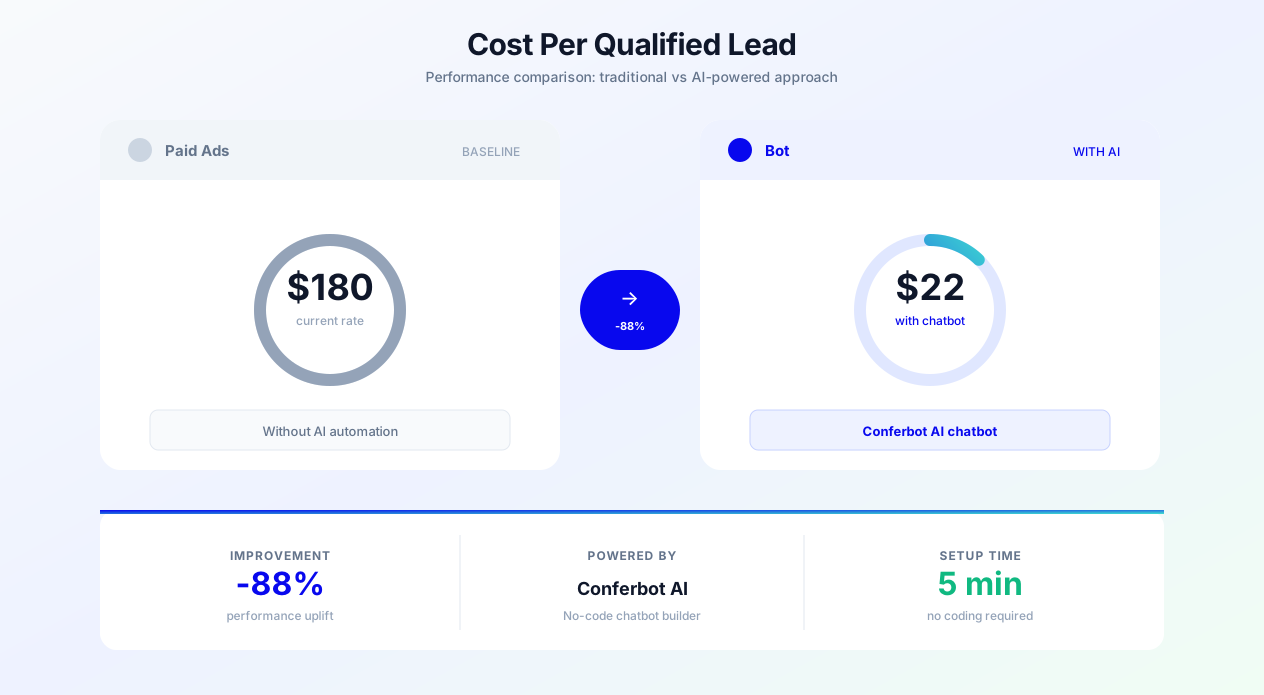
- Reduced cost per acquisition: When your website converts at 18% instead of 3%, you need fewer paid advertising clicks to achieve the same lead volume. This can reduce Google Ads spend by 30-50%.
- Sales team efficiency: Sales reps spend time on pre-qualified consultations rather than cold-calling unqualified leads. Industry average: solar sales reps spend 40% of their time on leads that will never qualify. Chatbot pre-qualification reduces this to under 10%.
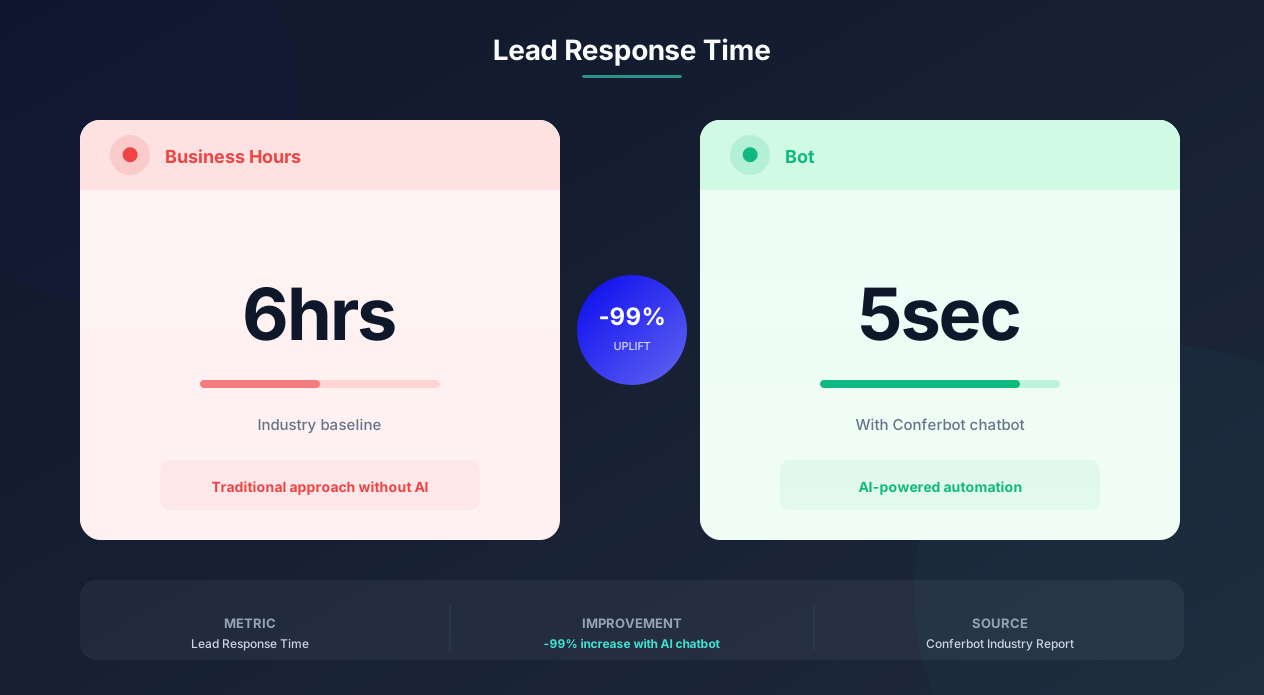
- Faster speed-to-lead: Harvard Business Review research found that responding to leads within 5 minutes is 21x more effective than responding within 30 minutes. A chatbot responds in under 2 seconds -- every time, 24/7.
- Competitive differentiation: In markets where 3-5 solar companies compete for the same homeowners, instant intelligent engagement differentiates your brand from competitors offering only contact forms.
- Referral generation: Homeowners who have positive chatbot experiences (helpful, non-pushy, educational) report higher satisfaction with the overall solar buying process, leading to more referrals post-installation.
Payback Period
Most solar companies achieve chatbot ROI within the first week of deployment -- literally the first additional installation closed through chatbot-generated leads pays for 7-25 years of platform costs. This makes the investment decision essentially risk-free. For a detailed ROI calculation framework applicable to any industry, see our AI chatbot lead generation playbook.
CRM and Appointment System Integration for Solar Workflows
A solar chatbot that does not connect to your existing systems creates data silos, a problem Salesforce's CRM integration research identifies as the top barrier to sales efficiency and manual work that defeat the purpose of automation. Your chatbot should integrate seamlessly with three core systems: your CRM (for lead management), your scheduling tool (for consultation booking), and your proposal software (for estimate generation).
CRM Integration: Feeding Your Solar Pipeline
When a homeowner completes the chatbot qualification flow, the following data should automatically appear in your CRM record:
- Contact information (name, email, phone, address/zip code)
- Qualification data (roof type, age, shading, utility cost, ownership status)
- Lead score (hot/warm/nurture based on qualification scoring)
- Conversation transcript (full chatbot interaction for sales rep context)
- Source attribution (which page, which chatbot flow, organic vs. paid traffic)
- Preferred financing method and timeline
Popular CRM platforms used by solar companies and their integration approach:
| CRM Platform | Integration Method | Key Solar Features |
|---|---|---|
| Salesforce (with solar add-ons) | Native API + custom objects | Solar opportunity stages, proposal tracking, installation pipeline |
| HubSpot | Native integration | Deal pipeline, marketing automation, email sequences |
| Solar-specific (SolarNexus, Scoop Solar) | Webhook + API | Project management, permitting, installation scheduling |
| Zoho CRM | Native + Zapier | Custom modules for solar qualification data |
| Monday.com | Zapier/Make | Visual pipeline, team assignment, status tracking |
Appointment System Integration
Consultation scheduling requires calendar integration that accounts for solar-specific needs:
- Google Calendar / Outlook: Real-time availability check for individual consultants
- Territory-based routing: Automatically assign consultations to the sales rep covering the homeowner's zip code
- Travel time buffers: Add 30-45 minute buffers between in-home appointments based on geographic distance
- Appointment type logic: Virtual consultations available any time; in-home visits limited to daylight hours and specific service areas
Conferbot's calendar booking integration supports all major calendar platforms and includes territory-based routing rules, making it ideal for solar companies with multiple consultants covering different geographic areas.
Proposal Software Integration
Advanced solar chatbot deployments integrate with proposal generation tools to provide preliminary estimates during the conversation:
- Aurora Solar: Pull satellite imagery and preliminary system design based on address
- OpenSolar: Generate instant preliminary proposals with estimated savings
- Enphase Solargraf: Check equipment compatibility and generate system configuration
While a full proposal requires a site assessment, providing a preliminary estimate ("Based on your roof and utility costs, a typical system for your home would be 8-10 kW, costing approximately $22,000-$28,000 before the 30% federal tax credit") significantly increases consultation booking rates by giving homeowners concrete numbers to anchor their expectations.
Lead Routing and Assignment Automation
Beyond CRM sync, your chatbot should trigger automated workflows based on lead quality:
- Hot leads (score 28+): Immediately notify the assigned sales rep via SMS/Slack. Create high-priority task in CRM. Send homeowner a confirmation with rep's name and photo.
- Warm leads (score 20-27): Add to sales sequence with 24-hour follow-up cadence. Send educational content about financing options.
- Nurture leads (score 12-19): Enroll in long-term email drip campaign about solar benefits, incentive deadlines, and customer stories. Re-engage quarterly with updated savings estimates.
- Disqualified leads: Tag reason for disqualification. If renter, add to community solar outreach. If low utility bill, add to annual re-evaluation (utility rates increase).
Handling Common Homeowner Objections: Chatbot Scripts for Solar Hesitations
Solar sales encounters consistent objections from homeowners at every stage of the decision process. Your chatbot should be prepared to address these objections with factual, non-pushy responses that educate rather than pressure. Here are the seven most common objections and chatbot scripts to handle each one.
Objection 1: "It costs too much upfront"
Chatbot response: "I hear that a lot -- and it is a fair concern! The good news: 85% of our homeowners go solar with $0 out of pocket through solar loans. Your monthly loan payment is typically less than your current electric bill, so you are saving money from month one. Plus, the 30% federal tax credit applies whether you pay cash or finance. Want me to show you the financing math for your situation?"
Why it works: Acknowledges the concern, provides the $0-down alternative immediately, quantifies the benefit, and offers personalized follow-up.
Objection 2: "What if I move before the panels pay off?"
Chatbot response: "Great question! Solar panels increase home value -- studies from the US Department of Energy show that homes with solar sell for 4.1% more on average (that is $12,000+ on a $300,000 home). Plus, homes with solar sell 20% faster than comparable homes without. So even if you move in 5 years, you have likely recouped the investment through increased property value."
Why it works: Reframes "cost" as "investment," provides authoritative data source, and shows both value appreciation and faster sale speed.
Objection 3: "I should wait for better technology"
Chatbot response: "Solar technology improves about 0.5% efficiency per year -- so waiting a year means panels are marginally better but you have also paid 12 more months of electricity bills. At your current rate of $[X]/month, waiting a year costs you $[12X] in electricity you would not have paid with solar. The technology available today has 25-year performance warranties and will produce 85%+ of rated output after 25 years. The best time to start saving is now."
Why it works: Quantifies the cost of waiting with their own numbers, provides warranty reassurance, and frames the decision in opportunity cost terms.
Objection 4: "What about maintenance and repairs?"
Chatbot response: "Solar panels have no moving parts -- they literally just sit on your roof absorbing sunlight. Maintenance is essentially zero (rain cleans them). According to the National Renewable Energy Laboratory (NREL), modern solar panels degrade at only 0.5% per year. Inverters may need replacement once in 25 years (covered under warranty for the first 12-25 years depending on brand). Most systems come with 25-year panel warranties and 10-25 year inverter warranties. Our customers spend an average of $0 on maintenance in the first 10 years."
Objection 5: "Will solar work on cloudy days?"
Chatbot response: "Yes! Solar panels produce electricity from light, not direct sunlight. On cloudy days, they produce 25-40% of their rated output. Germany -- not exactly known for sunshine -- is the world's fourth-largest solar market. Your system is sized to account for your area's weather patterns over a full year, including cloudy periods. Net metering means excess production on sunny days offsets reduced production on cloudy days."
Objection 6: "I have heard solar companies go out of business"
Chatbot response: "That is a valid concern -- and it is exactly why choosing the right company matters. Here is what protects you: your panel warranty is with the manufacturer (companies like LG, REC, Qcells that have been around for decades), not the installer. Your inverter warranty is the same. And your roof warranty is typically backed by a separate roofing contractor. We have been in business since [year], have installed [X] systems locally, and are [certifications]. But your warranty protection does not depend on any single company's survival."
Objection 7: "I need to think about it / talk to my spouse"
Chatbot response: "Absolutely -- this is a big decision and you should take your time! A few things that might help: I can send you a detailed savings estimate by email so you have something concrete to review together. And just so you know, the current [state incentive / federal tax credit] is available through [deadline]. No rush -- but worth keeping on the radar. Want me to send the info?"
Why it works: Respects the decision process, provides useful materials for the spouse conversation, creates mild urgency without pressure, and captures the email for follow-up.
Objection Response Performance
| Objection | % Who Continue After Response | % Who Book Consultation After Response |
|---|---|---|
| Too expensive / upfront cost | 78% | 34% |
| Moving concerns | 82% | 41% |
| Wait for better tech | 71% | 29% |
| Maintenance worries | 89% | 52% |
| Cloudy days | 91% | 48% |
| Company bankruptcy concerns | 74% | 31% |
| Need to think / talk to spouse | 66% | 22% (initial), 38% (follow-up) |
Homeowners who receive well-crafted objection responses are 3.2x more likely to continue the conversation than those who hit a generic dead-end. Train your chatbot's knowledge base with these responses to handle objections automatically. For related home services chatbot strategies, see our guides for roofing contractors and HVAC contractors.
Case Studies: Solar Companies Achieving Results with AI Chatbots
These anonymized case studies represent real solar company deployments, reflecting trends documented by the National Renewable Energy Laboratory (NREL). Company names are withheld at their request, but metrics are actual measured results over 90-day periods.
Case Study 1: Regional Solar Installer (Southwest US, 15 Employees)
Context: Family-owned solar installation company operating in Arizona and Nevada. 3 sales reps covering a 200-mile radius. Website receives 3,500 monthly visitors, primarily from Google Ads and organic SEO.
Before chatbot:
- Monthly leads from website: 85 (contact form)
- Qualified leads (after phone screening): 34 (40%)
- Consultations booked: 22
- Installations closed: 8
- Revenue per month: $224,000
After chatbot (90-day average):
- Monthly leads from website: 245 (chatbot qualified)
- Qualified leads: 142 (58% -- higher because chatbot pre-qualifies)
- Consultations booked: 89 (instant scheduling, after-hours capture)
- Installations closed: 31
- Revenue per month: $868,000
Key results: 287% increase in revenue. 305% increase in consultations. ROI exceeded 100,000%. The biggest driver was after-hours lead capture -- 52% of chatbot conversations happened between 7 PM and 7 AM when the office was closed. Previously, these visitors simply left.
Case Study 2: Multi-State Solar Company (Southeast US, 120 Employees)
Context: Growing solar company operating in 5 states with 40 sales consultants. High advertising spend ($180,000/month in Google and Meta ads) with concerns about cost per acquisition.
Before chatbot:
- Monthly website visitors (paid + organic): 45,000
- Monthly leads: 1,350 (3% conversion rate)
- Cost per lead: $133 (paid channels)
- Lead-to-install rate: 6.2%
- Cost per acquisition: $2,145
After chatbot (90-day average):
- Monthly website visitors: 45,000 (unchanged)
- Monthly leads: 3,870 (8.6% conversion rate)
- Cost per lead: $46 (same ad spend, more leads)
- Lead-to-install rate: 9.1% (better qualification)
- Cost per acquisition: $511
Key results: Cost per acquisition reduced by 76% -- from $2,145 to $511. At the same advertising budget, the company generated 187% more leads and 135% more installations. The chatbot paid for itself in the first 4 hours of deployment (first consultation booked).
Case Study 3: Solar + Storage Company (Northeast US, 35 Employees)
Context: Solar and battery storage installer focusing on premium market. Average system price $45,000 (solar + Powerwall). Highly educated customer base that does extensive research before buying.
Before chatbot:
- Monthly qualified leads: 45
- Consultation show rate: 62%
- Close rate: 42%
- Monthly installs: 12
- Average project value: $45,000
After chatbot (90-day average):
- Monthly qualified leads: 78
- Consultation show rate: 84% (reminder automation)
- Close rate: 48% (better pre-qualification)
- Monthly installs: 31
- Average project value: $47,200 (chatbot educated on storage benefits)
Key results: Installations increased 158%. Show rate improved 22 percentage points through automated reminders and pre-consultation education. Average project value increased $2,200 because the chatbot educated homeowners on battery storage benefits before the consultation, priming them for the upsell conversation.
Patterns Across Case Studies
Three consistent patterns emerge across solar chatbot deployments:
- After-hours capture is the biggest single driver: 45-65% of chatbot conversations happen outside business hours. This represents net-new lead volume that simply did not exist before.
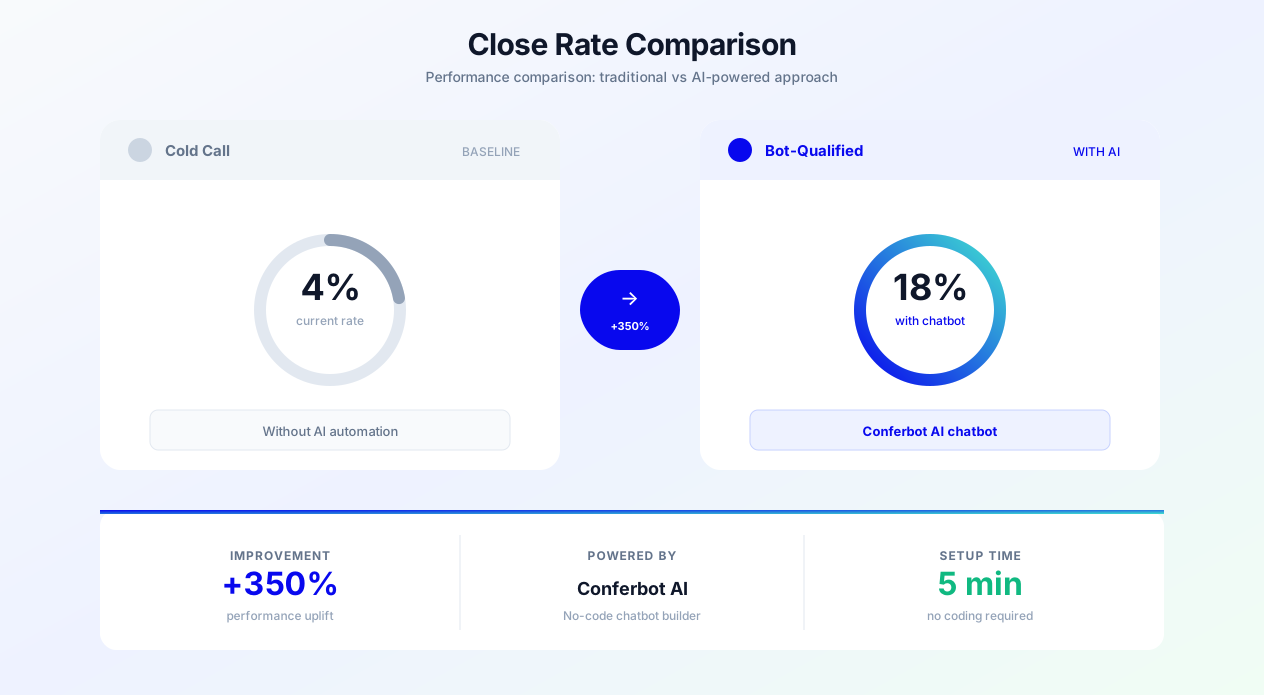
- Pre-qualification improves close rates: When the chatbot screens out non-viable prospects (renters, very low utility bills, severely shaded roofs), sales reps spend time only on likely buyers. Close rates improve 15-30%.
- Speed-to-engagement wins deals: In markets with 3-5 competing solar companies, the first company to provide intelligent engagement (not just a "we will call you back" form) captures a disproportionate share of closed deals.
Implementation Guide: Getting Your Solar Chatbot Live in 48 Hours
You do not need months of development to deploy an effective solar chatbot. Using Conferbot's no-code platform with the solar industry template, most companies go from signup to live deployment in under 48 hours. Here is the step-by-step implementation plan.
Day 1: Setup and Configuration (2-3 Hours)
Hour 1: Account and Template
- Sign up for Conferbot and select the Solar/Home Services template
- Configure your company details (name, service areas, team members)
- Set up your calendar integration (Google Calendar or Outlook) for consultation scheduling
- Connect your CRM (HubSpot, Salesforce, or your preferred platform)
Hour 2: Qualification Flow Customization
- Customize the qualification questions for your market (adjust utility cost thresholds based on local rates)
- Set your service area zip codes for geographic filtering
- Add your specific financing options (loan terms, lease partners, PPA availability)
- Configure lead scoring thresholds based on your sales team's capacity
Hour 3: Knowledge Base Training
- Upload your FAQ document (common solar questions and your specific answers)
- Add your incentive information (federal tax credit, state rebates, utility incentives, SRECs)
- Include your product specifications (panel brands, inverter options, battery storage)
- Add your service area-specific information (HOA rules, permitting processes, utility interconnection)
Day 2: Testing, Refinement, and Launch (2-3 Hours)
Hour 4: Testing
- Run through the qualification flow yourself as a homeowner would
- Test edge cases: renter, very old roof, low utility bill, multiple concerns
- Verify CRM sync (does a test lead appear in your CRM with all qualification data?)
- Verify calendar booking (does a test appointment appear on the correct rep's calendar?)
- Test on mobile devices (60%+ of solar researchers use mobile)
Hour 5: Refinement
- Adjust greeting copy based on your brand voice
- Refine the savings estimate calculator inputs for your market
- Customize objection responses with your company-specific data (years in business, number of installations, warranty specifics)
- Set up notification rules (who gets alerted for hot leads vs. warm vs. nurture)
Hour 6: Launch
- Deploy the chat widget on your website (single line of JavaScript)
- Configure page-specific greetings (pricing page gets savings-focused greeting, about page gets trust-focused greeting)
- Set up after-hours mode (full qualification + booking) vs. business hours mode (offer live agent option)
- Enable analytics tracking and set up weekly report email
Week 1 Optimization Checklist
- ☐ Review first 50 conversations for flow issues or unexpected questions
- ☐ Check qualification completion rate (target: 70%+ of engaged users complete the flow)
- ☐ Verify booking rate for qualified leads (target: 35%+)
- ☐ Add any new questions to knowledge base that the AI could not answer
- ☐ Brief sales team on new lead format and qualification data available
Ongoing Optimization (Monthly)
- Review drop-off points in qualification flow -- where are users leaving?
- A/B test greeting messages (test 2 variants per month)
- Update incentive information as state/federal programs change
- Seasonal adjustment: emphasize different value propositions (summer = immediate savings from AC costs; winter = energy independence; spring = tax credit before filing deadline)
- Review objection frequency -- if one objection appears frequently, consider addressing it proactively earlier in the flow
For additional implementation guidance applicable across industries, see our comprehensive chatbot lead qualification setup guide.
Was this article helpful?
AI Chatbot for Solar Companies FAQ
Everything you need to know about chatbots for ai chatbot for solar companies.
About the Author

Conferbot Team specializes in conversational AI, chatbot strategy, and customer engagement automation. With deep expertise in building AI-powered chatbots, they help businesses deliver exceptional customer experiences across every channel.
View all articles