HIPAA Basics for AI Chatbots: What Healthcare Organizations Must Understand
The Health Insurance Portability and Accountability Act (HIPAA) governs how Protected Health Information (PHI) is collected, stored, transmitted, and processed in the United States. When you deploy an AI chatbot that interacts with patients — whether for appointment scheduling, symptom triage, intake forms, or care coordination — that chatbot becomes part of your HIPAA compliance infrastructure. Any failure in chatbot compliance is your organization's failure, with penalties that range from $100 to $1.9 million per violation category, per year.
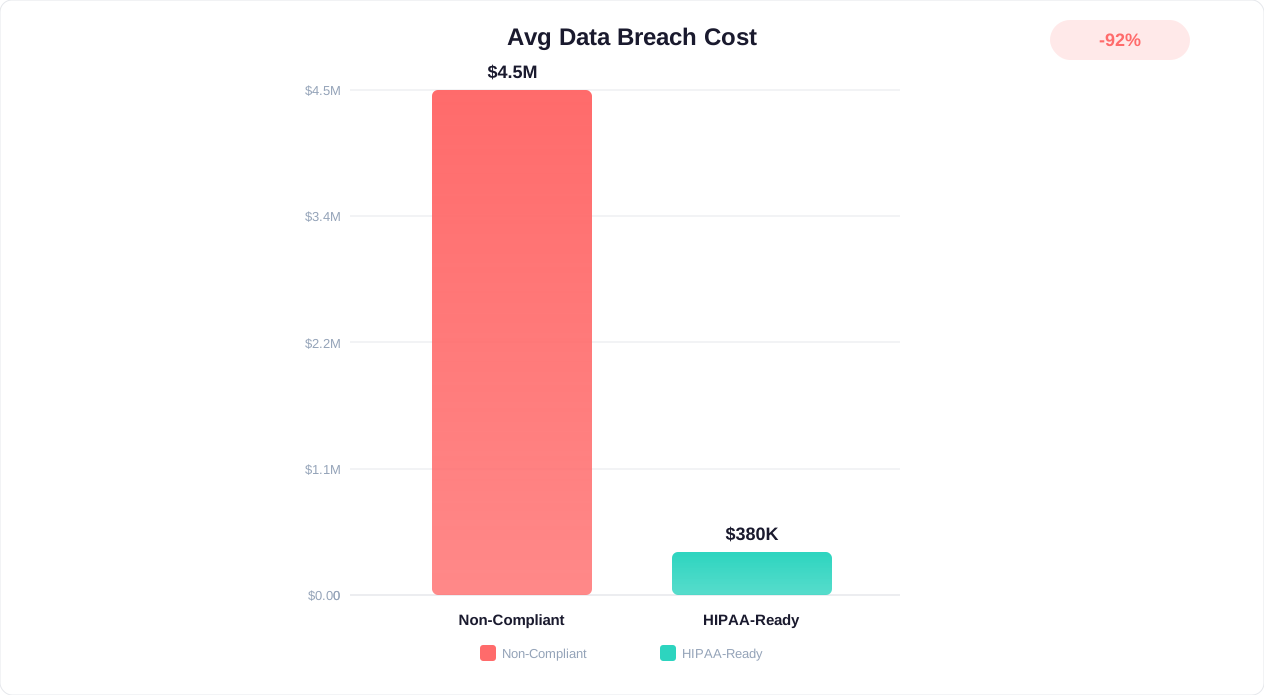
The stakes are not theoretical. The HHS Office for Civil Rights (OCR) reported 725 major breach reports in 2024, affecting over 168 million individuals — a record. The average cost of a healthcare data breach reached $10.93 million in 2025, according to IBM's Cost of a Data Breach Report, making it the most expensive industry for breaches for the 13th consecutive year. AI chatbots introduce new attack surfaces and data handling complexities that healthcare organizations must address proactively.
When HIPAA Applies to Your Chatbot
Not every healthcare chatbot requires HIPAA compliance. The requirement depends on two factors: who operates the chatbot and what data it handles.
| Scenario | HIPAA Required? | Reason |
|---|---|---|
| Hospital chatbot collecting patient symptoms | Yes | Covered entity handling PHI |
| Insurance company chatbot processing claims | Yes | Covered entity handling PHI |
| Third-party chatbot vendor for a clinic | Yes (Business Associate) | Processes PHI on behalf of covered entity |
| General health education chatbot (no personal data) | No | No PHI collected or processed |
| Wellness app chatbot (not connected to provider) | Usually no | Not a covered entity (but FTC Act may apply) |
| Telehealth platform chatbot for pre-visit intake | Yes | PHI collected for treatment purposes |
What Constitutes PHI in Chatbot Conversations
PHI is any individually identifiable health information transmitted or maintained by a covered entity or business associate. In chatbot contexts, PHI includes but is not limited to:
- Direct identifiers: Name, date of birth, Social Security number, medical record number, email address, phone number, geographic data more specific than state
- Health information: Symptoms described in chat, diagnoses discussed, medications mentioned, treatment questions, appointment details
- Insurance information: Plan ID, member number, coverage details, claims data
- Derived data: Chatbot-generated health risk assessments, triage scores, care recommendations linked to an individual
A critical subtlety: even metadata can constitute PHI. If your chatbot logs show that a specific IP address (traceable to a person) interacted with a mental health triage flow at 2 AM, that metadata — the fact that a person sought mental health support — is PHI. Chat analytics, session logs, and error reports must all be treated as potential PHI unless they are fully de-identified according to HIPAA's Safe Harbor or Expert Determination methods.
For organizations already operating healthcare chatbots and looking to ensure compliance, our comprehensive healthcare chatbot guide covers the broader strategic context, while this guide focuses specifically on the HIPAA technical and legal requirements. Understanding the intersection of AI and compliance is also relevant for GDPR-governed organizations that serve patients in the EU.
PHI Handling Rules: The Minimum Necessary Standard for Chatbot Data
HIPAA's Minimum Necessary Standard (45 CFR 164.502(b)) requires that covered entities and business associates limit PHI access, use, and disclosure to the minimum amount necessary, as specified on HHS.gov's Minimum Necessary guidance page, to accomplish the intended purpose. For chatbots, this principle has profound implications for design, data collection, and storage.
Applying Minimum Necessary to Chatbot Design
Every data point your chatbot collects must have a documented, necessary purpose. The chatbot should not collect information "just in case" or because it might be useful later. Specifically:
- Collect only what is needed for the immediate purpose. If a patient is scheduling a routine follow-up, the chatbot needs their name, provider preference, and available times — it does not need their full medical history, insurance details, or symptom description
- Scope data access per workflow. An appointment scheduling chatbot should not have access to clinical notes. A symptom triage chatbot should not have access to billing information. Each chatbot function should connect only to the minimum data sources required
- Implement role-based data views. The same chatbot platform might serve front-desk scheduling (limited PHI access) and clinical intake (broader PHI access). Each role should see only the data fields it needs
PHI Lifecycle in Chatbot Conversations
Track PHI through every stage of its lifecycle within your chatbot system:
| Lifecycle Stage | PHI Handling Requirement | Technical Implementation |
|---|---|---|
| Collection | Explicit purpose stated, consent documented | Consent gate before PHI collection, purpose logging |
| Transmission | Encrypted in transit (TLS 1.3 minimum) | HTTPS enforcement, certificate pinning, no HTTP fallback |
| Processing | Minimum necessary access, audit logged | Scoped API permissions, request-level logging |
| Storage | Encrypted at rest (AES-256), access controlled | Database encryption, key management, RBAC |
| Sharing | Only to authorized recipients with BAA coverage | Access control lists, BAA verification in data pipelines |
| Retention | Retained only as long as necessary (6 years minimum for HIPAA records) | Automated retention enforcement, policy documentation |
| Disposal | Secure destruction per NIST 800-88 | Cryptographic erasure or physical media destruction |
De-Identification for Analytics and AI Training
If you want to use chatbot conversation data for analytics, quality improvement, or AI model training, the data must be de-identified. HIPAA provides two methods:
Safe Harbor Method: Remove all 18 specified identifiers (names, dates, geographic data, phone numbers, email addresses, SSN, MRN, etc.) and confirm that no residual information could identify an individual. This is the most practical approach for chatbot data.
Expert Determination Method: A qualified statistical expert certifies that the risk of identifying any individual from the data is very small. More complex but allows retention of certain data elements useful for analytics.
For AI model training specifically, best practice is to:
- Apply Safe Harbor de-identification to all conversation data
- Replace specific medical details with generalized categories ("Patient reported [SYMPTOM] for [DURATION]")
- Remove any temporal patterns that could enable re-identification
- Maintain a separate, audited pipeline for de-identified training data
- Document the de-identification process as part of your HIPAA compliance records
These requirements should be built into your chatbot platform's data handling from the start. Retrofitting PHI controls into an existing system is significantly more expensive and error-prone than designing for compliance from day one. As discussed in our knowledge base training guide, the data used to train your chatbot's responses must also meet these handling standards when it includes any patient-derived content.
Business Associate Agreements: Your Most Critical Chatbot Compliance Document
If you use a third-party chatbot platform, AI provider, or cloud hosting service to process PHI, that vendor is a Business Associate under HIPAA, and you must have a signed Business Associate Agreement (BAA) before any PHI flows through their systems. Operating without a BAA is itself a HIPAA violation, even if no breach occurs.
What a Chatbot Vendor BAA Must Cover
The BAA is not a formality — it is a legally binding contract that specifies how the vendor will protect PHI. For chatbot vendors, the BAA must address:
| BAA Element | What It Covers | What to Verify |
|---|---|---|
| Permitted uses and disclosures | Exactly how the vendor may use PHI | Limited to providing the chatbot service; no secondary use (marketing, analytics, model training) without authorization |
| Safeguards | Technical, administrative, and physical protections | Encryption standards specified, access controls documented, physical data center security |
| Breach notification | Vendor's obligation to report breaches | Notification timeline (60 days maximum per HIPAA, but negotiate for 24-72 hours), content of notification, cooperation requirements |
| Subcontractor management | How the vendor manages its own sub-processors | BAAs required with all subcontractors who access PHI, right to audit subcontractor list |
| Return/destruction of PHI | What happens to PHI when the contract ends | PHI returned or destroyed within specified timeframe, certification of destruction |
| Audit rights | Your right to verify vendor compliance | Annual audit rights, access to compliance documentation, SOC 2 Type II reports |
| Agent obligations | Vendor's staff training and access controls | HIPAA training for all staff with PHI access, background checks, sanctions policy |
The Subcontractor Chain Problem
Modern chatbot platforms rely on multiple subcontractors — cloud hosting (AWS, GCP, Azure), AI model providers (OpenAI, Anthropic, Google), analytics services, email delivery, and more. Every entity in the chain that touches PHI needs BAA coverage.
This creates a critical evaluation task. When vetting a chatbot vendor, demand:
- Complete subcontractor list: Every third-party service that receives, processes, or stores any data from chatbot interactions
- BAA status for each: Confirmation that a BAA is in place with every subcontractor that handles PHI
- PHI flow diagram: Visual documentation of where PHI travels through the system — from patient's browser to final storage location, including every intermediate system
- AI model provider specifics: If the chatbot uses GPT-4, Claude, or another LLM, does the AI provider have a BAA? What data is sent to the model API? Is conversation data used for model training? (It should not be)
Common BAA Red Flags
- No BAA offered: The vendor says they "don't need a BAA" or are not a Business Associate. If they process PHI, they are — walk away
- Generic BAA without chatbot specifics: The BAA does not mention AI model processing, conversation data handling, or automated decision-making. Insist on chatbot-specific terms
- No AI model training exclusion: The BAA does not explicitly prohibit using your PHI to train the vendor's AI models. This must be an explicit exclusion
- Vague subcontractor terms: "We may use third-party services" without specifying who they are and confirming BAA coverage
- Extended breach notification timelines: BAAs that allow 60+ days for breach notification. Healthcare breaches require rapid response; negotiate for 48-72 hours
A properly executed BAA is the legal foundation of your chatbot's HIPAA compliance. Without it, every patient conversation through your chatbot is a potential violation, regardless of how strong your technical safeguards are. This contrasts with non-healthcare deployments where vendor agreements are important but not legally mandated — as we discuss in our GDPR compliance guide, data processing agreements serve a similar but distinct role in the European framework.
Encryption Standards and Technical Safeguards for HIPAA Chatbots
HIPAA's Security Rule (45 CFR Part 164, Subpart C) requires covered entities and business associates to implement technical safeguards, following the NIST Privacy Framework for risk management that protect the confidentiality, integrity, and availability of electronic PHI (ePHI). For chatbot deployments, this translates to specific encryption, access control, and infrastructure requirements.
Encryption Requirements
While HIPAA technically makes encryption an "addressable" specification (meaning you can implement equivalent alternative measures), in practice, encryption is considered mandatory by OCR for any internet-facing system handling ePHI. No chatbot deployment can reasonably justify not encrypting data in transit and at rest.
| Encryption Layer | Minimum Standard | Recommended Standard | What It Protects |
|---|---|---|---|
| Data in transit | TLS 1.2 | TLS 1.3 | Messages between patient browser and chatbot server |
| Data at rest (database) | AES-128 | AES-256 | Stored conversation transcripts, patient records |
| Data at rest (backups) | AES-128 | AES-256 | Backup copies of chatbot databases |
| Data at rest (file uploads) | AES-256 | AES-256 with per-file keys | Uploaded documents, images, voice recordings |
| Key management | FIPS 140-2 Level 1 | FIPS 140-2 Level 3 (HSM) | Encryption keys themselves |
| API communications | TLS 1.2 + API key | TLS 1.3 + mTLS | Data sent to AI model APIs, integrations |
Access Control Requirements
The Security Rule requires access controls that ensure only authorized individuals can access ePHI. For chatbot systems:
- Unique user identification: Every administrator, developer, and support staff member who can access chatbot data must have a unique login. No shared accounts
- Emergency access procedures: Documented process for accessing ePHI in emergencies when normal authentication is unavailable
- Automatic logoff: Admin dashboards and conversation review tools must automatically log out after a period of inactivity (15-30 minutes recommended)
- Role-based access control (RBAC): Different roles see different data. Scheduling staff see appointment-related PHI only. Clinical staff may see symptom data. Billing staff see insurance data. No role should see everything unless necessary
- Multi-factor authentication (MFA): Required for all administrative access to chatbot systems that contain PHI. SMS-based MFA is increasingly discouraged; use authenticator apps or hardware keys
Transmission Security
Beyond encryption, transmission security for chatbot data includes:
- Certificate pinning: Prevent man-in-the-middle attacks by pinning TLS certificates in the chatbot widget
- No HTTP fallback: The chatbot must refuse to function over unencrypted HTTP connections. Implement HSTS (HTTP Strict Transport Security) with a minimum one-year max-age
- WebSocket security: If the chatbot uses WebSocket connections (common for real-time chat), they must use WSS (WebSocket Secure) protocol
- Content Security Policy: Implement CSP headers that prevent the chatbot widget from loading resources from unauthorized domains
Infrastructure Security
| Requirement | Implementation | Verification Method |
|---|---|---|
| Network segmentation | Chatbot processing isolated in its own VPC/subnet | Network architecture review |
| Intrusion detection | IDS/IPS monitoring chatbot traffic patterns | Alert review, penetration testing |
| Vulnerability management | Regular patching, dependency scanning | Vulnerability scan reports (monthly) |
| DDoS protection | CDN-based protection for chatbot endpoints | Load testing, provider SLA |
| Backup and recovery | Encrypted backups, tested recovery procedures | Quarterly recovery testing |
| Data loss prevention | PHI detection in logs, alerts, and error outputs | DLP scanning, log review |
These technical safeguards form a comprehensive defense-in-depth strategy. No single control is sufficient — HIPAA compliance requires layers of protection that together ensure ePHI is protected against both external threats and internal errors. Organizations evaluating chatbot vendors should verify these controls through SOC 2 Type II reports, HITRUST CSF certification, or independent security assessments.
Audit Logging and Monitoring: HIPAA's Information System Activity Review
HIPAA requires covered entities to implement procedures to regularly review records of information system activity, including audit logs, access reports, and security incident tracking. For chatbot systems handling PHI, this means comprehensive logging of every interaction with patient data.
What Must Be Logged
Every action involving ePHI must produce an audit trail. For chatbot systems, this includes:
| Event Type | Data Logged | Retention Requirement |
|---|---|---|
| Patient conversation initiated | Timestamp, session ID, authentication method, IP (hashed) | 6 years minimum |
| PHI accessed by chatbot | Which records, what fields, purpose, timestamp | 6 years minimum |
| PHI created or modified | What changed, before/after values, who/what triggered | 6 years minimum |
| PHI transmitted to third party | Recipient, purpose, data elements, encryption status | 6 years minimum |
| Administrative access to chat data | Who accessed, what they viewed, timestamp, IP | 6 years minimum |
| Configuration changes | What changed, who changed it, old/new values | 6 years minimum |
| Failed authentication attempts | Timestamp, attempted identity, failure reason | 6 years minimum |
| System errors involving PHI | Error details (with PHI redacted from error messages), timestamp | 6 years minimum |
Audit Log Security
Audit logs themselves are critical records and must be protected:
- Immutability: Logs must be tamper-evident. Use write-once storage (WORM), append-only databases, or cryptographic log chaining where each entry includes a hash of the previous entry
- Separate storage: Store audit logs in a separate system from the chatbot application data. If the chatbot database is compromised, audit logs should remain intact
- Encryption: Logs may contain metadata that constitutes PHI (which patient's records were accessed when). Encrypt log storage at rest
- Access restriction: Only designated compliance and security personnel should have access to audit logs. Chatbot administrators and developers should not be able to view or modify audit trails of their own actions
- Retention enforcement: HIPAA requires retaining compliance-related records for 6 years from the date of creation or the date when the policy was last in effect, whichever is later. Automate retention and prevent premature deletion
Monitoring and Alerting
Logging alone is insufficient — you must actively monitor for suspicious patterns:
- Unusual access patterns: A sudden spike in PHI queries, off-hours access, or access from unusual locations should trigger alerts
- Excessive data retrieval: If the chatbot retrieves significantly more records than typical for a conversation type, flag it for review (potential data exfiltration or misconfigured workflow)
- Failed authentication clusters: Multiple failed login attempts against patient accounts or admin access
- Configuration change monitoring: Any change to chatbot security settings, access controls, or data handling rules should generate immediate alerts to security personnel
- Anomaly detection: Use baseline behavioral models to detect conversations that deviate from normal patterns (unusually long sessions, unusual data access sequences, potential social engineering of the chatbot)
Regular Review Cadence
HIPAA does not specify how often logs must be reviewed, but OCR expects "regular" review. Industry best practice:
- Automated real-time monitoring: Continuous for security events and anomalies
- Weekly manual review: Security team reviews flagged events and access patterns
- Monthly compliance review: Compliance officer reviews audit summary, access reports, and incident log
- Quarterly comprehensive audit: Full audit of chatbot PHI handling against HIPAA requirements
- Annual risk assessment: Complete reassessment of chatbot-related risks as part of the organization's annual HIPAA risk analysis
Robust audit logging ties directly to the chatbot analytics framework — compliance monitoring metrics should be tracked alongside performance metrics in a unified dashboard, enabling both operational optimization and regulatory compliance from a single view.
HIPAA-Compliant Hosting: Cloud Requirements and Vendor Options
Where your chatbot's data physically resides matters enormously for HIPAA compliance. Not all cloud hosting environments are HIPAA-eligible, and even those that are require specific configurations to achieve compliance.
Major Cloud Providers: HIPAA Eligibility
| Cloud Provider | HIPAA BAA Available? | HIPAA-Eligible Services | Key Limitations |
|---|---|---|---|
| AWS | Yes | EC2, RDS, S3, Lambda, and 100+ services | Customer must configure services per AWS HIPAA guidance; not all regions eligible |
| Google Cloud (GCP) | Yes | Compute Engine, Cloud SQL, Cloud Storage, and 90+ services | BAA covers specific services only; must verify each service used |
| Microsoft Azure | Yes | Most Azure services are HIPAA-eligible | Broadest coverage; still requires customer-side configuration |
| DigitalOcean | Yes (as of 2024) | Droplets, Managed Databases, Spaces | Limited HIPAA-eligible service portfolio compared to big three |
| Heroku | Yes (Shield tier only) | Heroku Shield Dynos, Heroku Shield Postgres | Significantly higher cost than standard Heroku; limited customization |
Critical Configuration Requirements
A BAA with your cloud provider is necessary but not sufficient. You must also configure the environment correctly:
- Encryption at rest: Enable encryption for all storage services (database, object storage, file systems). Use customer-managed keys (CMKs) rather than provider-managed keys for additional control
- Encryption in transit: Enforce TLS for all internal and external communications. Disable non-encrypted endpoints
- Logging: Enable cloud provider audit logging (AWS CloudTrail, GCP Audit Logs, Azure Monitor) for all ePHI-related services
- Network isolation: Deploy chatbot infrastructure in a private VPC/VNet. Use private endpoints for database connections. Expose only the chatbot's public-facing endpoint through a load balancer with WAF protection
- Access controls: Implement IAM policies following least-privilege principle. No developer should have production database access for routine operations
- Backup encryption: Automated backups must be encrypted. Cross-region backup replication must use encrypted transit
On-Premises vs. Cloud Considerations
Some healthcare organizations, particularly large hospital systems, prefer on-premises hosting for maximum control. Tradeoffs include:
| Factor | Cloud Hosting | On-Premises |
|---|---|---|
| Initial cost | Low (pay-as-you-go) | High (infrastructure purchase) |
| Ongoing cost | Medium-high (scales with usage) | Medium (maintenance and staffing) |
| Scalability | Elastic (handles traffic spikes) | Limited by physical capacity |
| Compliance responsibility | Shared (provider handles physical security, you handle configuration) | Full (you handle everything) |
| Disaster recovery | Multi-region failover available | Requires separate DR site |
| Time to deploy | Hours to days | Weeks to months |
| Data sovereignty | Data in provider's data center (location selectable) | Data on your premises |
AI Model API Hosting Considerations
A unique challenge for AI chatbots is that the LLM processing often occurs on the AI provider's infrastructure, not your own. When patient messages are sent to an AI model API for processing:
- The AI model provider must be covered by a BAA (either directly with your organization or as a subcontractor under your chatbot platform's BAA)
- PHI must not be used for model training. Verify that the AI provider's API terms explicitly exclude training on your data. Most major providers now offer this for healthcare customers
- Data residency for API calls: Some AI providers process data in specific regions. Verify that your API calls route to infrastructure covered by your compliance requirements
- Consider on-premises or private-cloud AI models: For maximum PHI protection, run smaller specialized models (fine-tuned for your use cases) on your own infrastructure rather than calling external APIs. This eliminates the data-leaving-your-control risk entirely
Healthcare organizations deploying chatbots through platforms like Conferbot should verify the platform's hosting infrastructure meets these requirements and that BAAs cover all layers of the technology stack, from the chat widget delivery through conversation processing to data storage and AI model inference.
Patient Intake Automation: Replacing Paper Forms with HIPAA-Compliant Chatbots
Patient intake is one of the highest-ROI applications for HIPAA-compliant chatbots. Traditional paper-based or basic digital form intake is slow, error-prone, and creates data entry bottlenecks. A well-designed chatbot transforms intake into a conversational experience that is faster for patients and more accurate for providers.
The Intake Problem by the Numbers
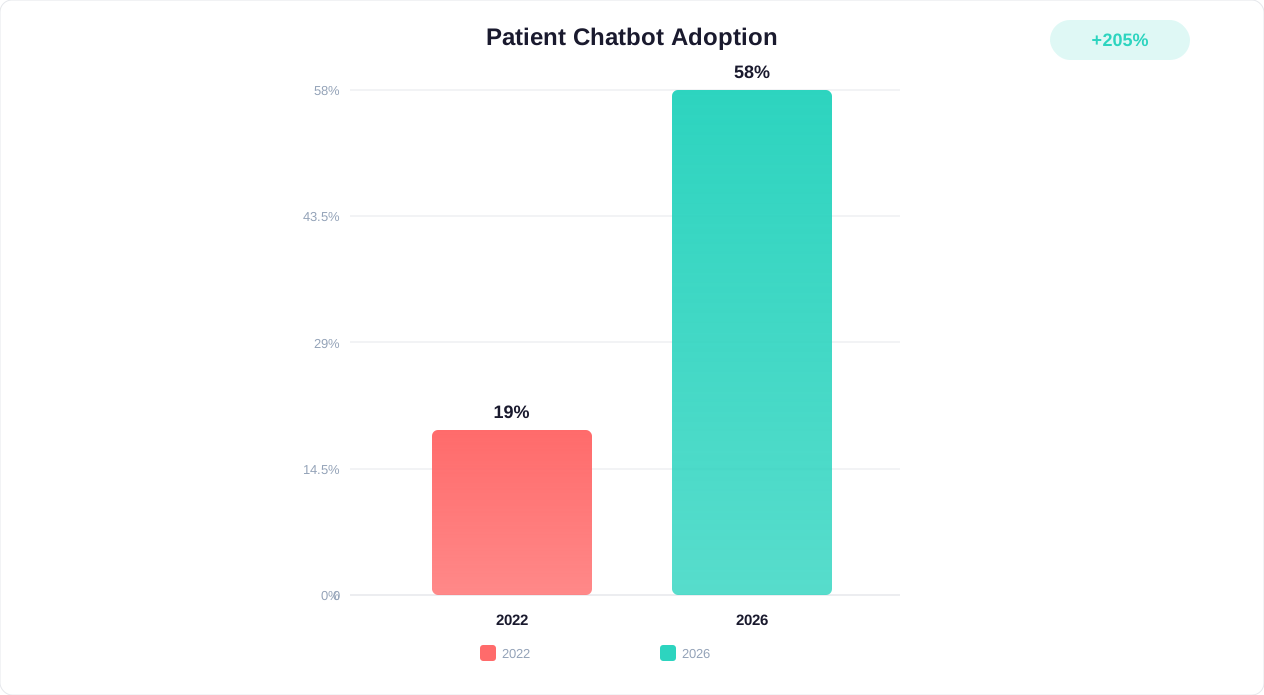
- Patients spend an average of 16 minutes filling out paper intake forms per visit, according to MGMA research
- 23% of intake data contains errors (misspelled names, incorrect dates, illegible handwriting) that require staff follow-up
- Front-desk staff spend 30-40% of their time on data entry from intake forms into EHR systems
- 71% of patients prefer digital intake over paper forms, per a 2025 patient experience survey
- Practices using digital intake automation report 35% reduction in patient wait times and 28% improvement in data accuracy
What a Chatbot-Based Intake Flow Looks Like
A HIPAA-compliant intake chatbot replaces the clipboard with a conversational flow:
- Pre-visit notification: Patient receives a text or email 48 hours before their appointment with a link to complete intake
- Authentication: Patient verifies identity via date of birth + last 4 of SSN, or through the patient portal's existing authentication
- Demographic verification: Chatbot presents existing demographic data (from prior visits) for confirmation or update. "Is your address still 123 Oak Street? Has your phone number changed?"
- Insurance verification: Patient photographs their insurance card. The chatbot's OCR extracts plan details, member ID, and group number. Real-time eligibility check confirms coverage for the scheduled visit type
- Medical history update: Conversational review of medications, allergies, and conditions — much easier than checking boxes on a form. "Are you currently taking any medications? You previously listed Lisinopril 10mg. Is that still current?"
- Reason for visit: The chatbot captures chief complaint in the patient's own words, then asks structured follow-up questions to provide the clinician with useful pre-visit context
- Consent and signatures: Digital consent forms with electronic signature capture (compliant with ESIGN Act and UETA)
- EHR integration: All collected data flows directly into the EHR, pre-populating the visit note and eliminating front-desk data entry
Compliance Requirements Specific to Intake Chatbots
| Requirement | Implementation | Why It Matters |
|---|---|---|
| Pre-collection consent | HIPAA Notice of Privacy Practices acknowledgment within chat flow | Required before collecting any PHI |
| Identity verification | Multi-factor verification before displaying or collecting PHI | Prevents unauthorized access to patient records |
| Session timeout | Auto-save and terminate after 15 minutes of inactivity | Prevents unattended PHI exposure on shared devices |
| Secure link delivery | Intake links expire after single use or 72 hours | Prevents forwarding to unauthorized users |
| Data validation | Real-time validation of DOB, insurance ID, phone format | Reduces errors that could cause PHI mismatches |
| Audit trail | Log every field viewed, entered, and modified with timestamps | Required for HIPAA accountability |
ROI of Chatbot-Based Patient Intake
| Metric | Paper/Basic Digital | Chatbot Intake | Improvement |
|---|---|---|---|
| Time to complete (patient) | 16 minutes | 8-10 minutes | 38-50% reduction |
| Data entry errors | 23% of submissions | 5-8% of submissions | 65-78% reduction |
| Staff time per patient | 12 minutes data entry | 2 minutes review | 83% reduction |
| Insurance verification | Manual (3-5 minutes per patient) | Automated (15 seconds) | 95% time savings |
| Patient satisfaction | Neutral | Positive (convenience factor) | 15-20% improvement |
| No-show rate impact | Baseline | 8-12% reduction (engagement effect) | Revenue recovery |
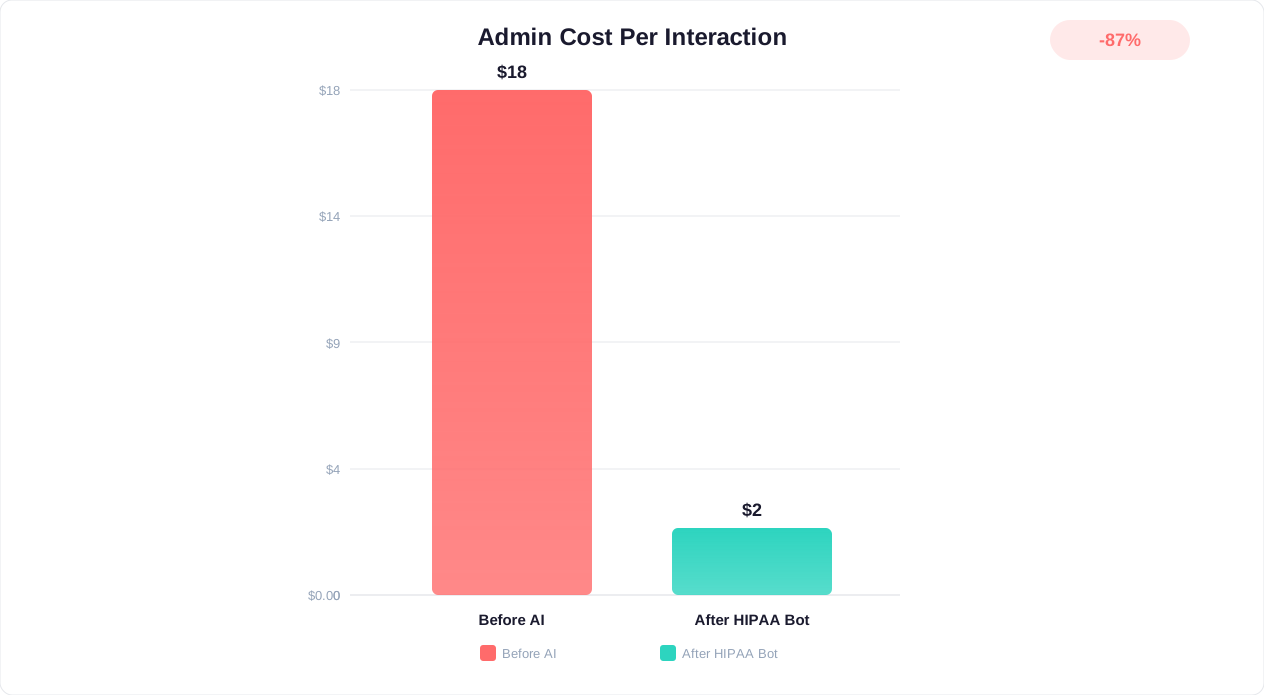
For a small practice seeing 40 patients per day, automating intake saves approximately 8 hours of staff time daily (40 patients x 12 minutes manual entry = 480 minutes). At an average medical office assistant salary of $18/hour, that represents over $37,000 in annual labor savings — before accounting for error reduction, faster insurance verification, and improved patient satisfaction. This aligns with the broader AI customer service efficiency gains documented across industries.
Symptom Triage and Appointment Scheduling: Clinical Use Cases for HIPAA Chatbots
Beyond administrative intake, HIPAA-compliant chatbots can play a direct role in clinical triage, supporting the WHO's clinical classification standards for symptom assessment and care navigation — helping patients determine the right level of care and connecting them to the appropriate provider, all while maintaining strict compliance.
Symptom Triage Chatbots
A symptom triage chatbot guides patients through a structured assessment to determine urgency and recommend the appropriate next step. Unlike generic symptom checker chatbots, HIPAA-compliant triage systems operate within the healthcare organization's clinical framework and can access patient history for more accurate assessments.
How clinical triage chatbots work:
- Symptom collection: Patient describes their concern. The chatbot asks structured follow-up questions based on clinical decision support logic (onset, duration, severity, associated symptoms)
- Risk stratification: Based on responses, the chatbot assigns an urgency level using validated clinical algorithms (similar to nurse triage protocols)
- History integration: For authenticated patients, the chatbot cross-references symptoms against their medical history (existing conditions, medications, allergies) to identify higher-risk presentations
- Disposition recommendation: The chatbot recommends an action based on urgency level
| Urgency Level | Example Presentation | Chatbot Action |
|---|---|---|
| Emergency (Red) | Chest pain, difficulty breathing, stroke symptoms | Display "Call 911 immediately" — no further assessment |
| Urgent (Orange) | High fever with existing conditions, severe abdominal pain | Schedule same-day urgent appointment or recommend urgent care |
| Semi-Urgent (Yellow) | Persistent cough >2 weeks, recurring headaches | Schedule appointment within 24-48 hours |
| Routine (Green) | Medication refill, mild seasonal allergy symptoms | Schedule routine appointment, offer telehealth option |
| Self-Care (Blue) | Common cold symptoms, minor scrapes | Provide self-care guidance, offer follow-up scheduling if not improved in X days |
HIPAA Compliance for Triage Chatbots
Triage chatbots have additional compliance considerations beyond standard intake chatbots:
- Clinical decision support classification: Under the FDA's 2023 guidance, many symptom triage chatbots qualify as Clinical Decision Support (CDS) software. If the chatbot's recommendations are intended to be acted upon without independent clinician review, it may be classified as a medical device requiring FDA authorization
- Liability documentation: Every triage recommendation must include clear disclaimers that the chatbot is not providing a diagnosis and does not replace clinical judgment. The recommendation, its basis, and the patient's response must be documented in the medical record
- Red flag override: For emergency-level symptoms, the chatbot must immediately display emergency instructions without waiting for further assessment. Never gate emergency guidance behind authentication or additional questions
- Clinical validation: Triage algorithms must be validated against accepted clinical standards and reviewed by licensed clinicians. Document the clinical basis for each decision pathway
Appointment Scheduling with Clinical Context
A HIPAA-compliant scheduling chatbot goes beyond basic calendar booking by incorporating clinical context:
- Provider matching: Based on the patient's symptoms and history, suggest the most appropriate provider (specialty, experience with the condition, patient's established relationships)
- Visit type optimization: Recommend in-person vs. telehealth based on the nature of the concern. Conditions requiring physical examination route to in-person; follow-ups and medication management route to telehealth
- Preparation instructions: After booking, provide visit-specific preparation instructions (fasting requirements for labs, what to bring, parking information)
- Insurance verification: Automatically verify that the selected provider is in-network for the patient's plan and that the visit type is covered
- Waitlist management: If the preferred time is not available, offer to place the patient on a waitlist with automated notification when a slot opens
Integration with EHR Systems
For clinical chatbot use cases, EHR integration is essential but complex:
| Integration Type | Standard Used | Data Exchanged |
|---|---|---|
| Patient demographics | HL7 FHIR (R4) | Name, DOB, contact, insurance |
| Appointment scheduling | FHIR Scheduling API | Available slots, booking, cancellation |
| Medical history | FHIR Clinical Resources | Conditions, medications, allergies |
| Triage documentation | HL7 FHIR DocumentReference | Symptom assessment, urgency level |
| Lab results | FHIR DiagnosticReport | Result values, reference ranges |
The shift to FHIR-based interoperability (mandated by the 21st Century Cures Act) has made chatbot-EHR integration significantly more feasible than it was even two years ago. Most major EHR vendors (Epic, Cerner/Oracle Health, athenahealth, Allscripts) now offer FHIR APIs that chatbot platforms can connect to with proper authorization.
HIPAA Chatbot Vendor Evaluation: The Complete Checklist
Selecting a chatbot vendor for healthcare requires evaluating both technical capabilities and compliance posture. This checklist provides a systematic framework for vendor assessment.
Compliance and Legal
- Vendor offers a signed BAA that specifically covers chatbot/AI services
- BAA explicitly prohibits use of PHI for AI model training
- BAA includes subcontractor list with confirmed BAA coverage for each
- Breach notification timeline is 72 hours or less (not the HIPAA maximum of 60 days)
- Vendor has completed a HIPAA risk assessment within the past 12 months
- SOC 2 Type II report available (covering the past 12 months)
- HITRUST CSF certification (preferred but not required)
- Insurance: Vendor carries cyber liability insurance with adequate coverage
Technical Security
- TLS 1.3 enforced for all data in transit
- AES-256 encryption for all data at rest
- Customer-managed encryption keys (CMEK) option available
- Data residency: Can specify US-based hosting (or your required jurisdiction)
- No PHI in logs, error messages, or analytics (PHI-safe logging)
- Automatic session timeout and data purging for inactive conversations
- Penetration testing conducted annually (report available upon request)
- Vulnerability management program with defined SLAs for patching
Access Controls
- Role-based access control with granular permissions
- Multi-factor authentication for all administrative access
- Audit logging of all PHI access and administrative actions
- Logs retained for minimum 6 years per HIPAA requirements
- Logs stored immutably (tamper-evident or write-once storage)
- Segregation of duties: Developers cannot access production PHI
AI Model and Data Handling
- AI model provider covered by BAA (direct or through vendor's subcontractor chain)
- Conversation data explicitly excluded from AI model training
- Ability to use private/dedicated AI model instances (not shared multi-tenant)
- PHI redaction from any data sent to AI model APIs (if using external models)
- Model output guardrails prevent hallucinated medical advice
- Clear documentation of what data is sent to AI model vs. processed locally
Integration and Interoperability
- FHIR R4 API support for EHR integration
- Pre-built connectors for major EHR platforms (Epic, Cerner, athenahealth)
- Secure API architecture (OAuth 2.0, mTLS)
- Webhook support with HMAC signature verification
- Data export capability in standard formats (for data portability)
Operational
- Uptime SLA of 99.9% or higher for chatbot services
- Disaster recovery plan with documented RTO and RPO
- Incident response plan specific to PHI breaches
- Regular employee HIPAA training with documentation
- Background checks for all staff with access to customer environments
- PHI return/destruction procedures defined for contract termination
Scoring Framework
Rate each item as: Fully Met (2), Partially Met (1), Not Met (0). Minimum acceptable score varies by risk tolerance, but industry practice suggests:
| Score Range | Assessment | Recommendation |
|---|---|---|
| 56-64 (90-100%) | Excellent compliance posture | Proceed with confidence |
| 45-55 (70-89%) | Adequate with gaps | Proceed with remediation plan and timeline |
| 32-44 (50-69%) | Significant gaps | Defer until vendor remediates or select alternative |
| Below 32 (<50%) | Inadequate | Do not engage for PHI-handling use cases |
This evaluation framework should be applied not only during initial vendor selection but also during annual vendor reassessment. HIPAA requires ongoing due diligence — a vendor that was compliant last year may have changed practices, infrastructure, or subcontractors. Platforms like Conferbot that provide chatbot best practices documentation and maintain transparent compliance postures make this annual review process significantly more efficient.
Common HIPAA Violations in Chatbot Deployments: What to Avoid
Understanding the most frequent violations helps organizations proactively prevent compliance failures. These are the most common HIPAA violations observed in healthcare chatbot deployments, based on OCR enforcement actions and industry incident reports.
Violation 1: No BAA with Chatbot Vendor
What happens: A healthcare practice deploys a general-purpose chatbot (not designed for healthcare) that processes patient names, symptoms, and appointment requests. No BAA exists with the chatbot vendor because the vendor is not HIPAA-aware.
Why it is common: Small practices often choose chatbot tools based on features and price, not compliance. The chatbot works well, but it is a HIPAA violation from day one.
Penalty range: $100-$50,000 per violation. If the practice knew or should have known a BAA was required, penalties escalate to $10,000-$50,000 per violation.
Prevention: Verify BAA availability before any chatbot evaluation. If the vendor does not offer a BAA, they are not suitable for healthcare PHI use cases. No exceptions.
Violation 2: PHI in Error Logs and Analytics
What happens: The chatbot crashes during a conversation. The error log captures the full conversation context, including patient name, symptoms, and appointment details. These logs are stored in a general-purpose logging service (Datadog, Sentry, CloudWatch) without BAA coverage or PHI protections.
Why it is common: Developers configure logging for debugging without considering that conversation content is PHI. Standard logging practices that work for non-healthcare chatbots create compliance violations in healthcare.
Prevention: Implement PHI-safe logging: automatically strip personal identifiers from error logs, or ensure all logging services are covered by BAAs with appropriate PHI protections.
Violation 3: Chatbot Training on Patient Conversations
What happens: The organization uses real patient conversation transcripts to train or fine-tune the chatbot's AI model, without de-identifying the data or obtaining specific consent for this use.
Why it is common: Real conversations are the best training data for improving chatbot accuracy. Teams use them without realizing they are repurposing PHI beyond the original collection purpose.
Prevention: De-identify all training data per HIPAA Safe Harbor method before use. Document the de-identification process. Maintain a separate, audited pipeline for training data.
Violation 4: Inadequate Patient Authentication
What happens: The chatbot displays or collects PHI without properly verifying the patient's identity. Someone other than the patient — a family member, an ex-partner, a coworker using a shared computer — accesses PHI through the chatbot.
Why it is common: Authentication adds friction to the user experience. Organizations minimize verification steps to improve patient satisfaction, inadvertently weakening PHI access controls.
Prevention: Implement multi-factor verification before any PHI is displayed or collected. Accept that security requires some friction — it is better than a breach.
Violation 5: Unsecured Data Transmission to AI Model APIs
What happens: Patient messages are sent to an external AI model API (GPT-4, Claude, etc.) over properly encrypted connections, but the AI provider does not have a BAA, or the data is used for model training, or it is processed in a non-compliant jurisdiction.
Why it is common: Organizations focus on the encryption layer and forget about the contractual and data-use aspects of the AI provider relationship.
Prevention: Verify BAA coverage with the AI model provider. Confirm data is not used for training. Consider PHI redaction before sending data to external models — strip identifiers and send only the clinical content needed for generating a response.
Violation 6: No Audit Trails for Chatbot PHI Access
What happens: The chatbot accesses patient records, makes appointment changes, and processes clinical information, but there is no audit log of what PHI was accessed, when, or by which chatbot interaction.
Why it is common: Audit logging is a background requirement that does not affect user experience. It gets deprioritized in favor of feature development.
Prevention: Implement audit logging from day one — it is much harder to retrofit. Every PHI access must be logged with timestamp, data elements accessed, purpose, and session context.
For additional compliance guidance covering European regulations that may overlap with your HIPAA requirements (especially for organizations with international patient populations), our GDPR compliance guide provides a complementary framework. Organizations looking to reduce support tickets through chatbot automation in healthcare settings must ensure that efficiency gains do not come at the cost of compliance.
ROI Analysis: HIPAA-Compliant Chatbots for Healthcare Practices
Despite the compliance overhead, HIPAA-compliant chatbots deliver substantial ROI for healthcare organizations. The key is measuring impact across multiple dimensions — operational efficiency, revenue capture, patient satisfaction, and compliance cost avoidance.
ROI by Practice Size
| Metric | Small Practice (5 providers) | Mid-Size Group (20 providers) | Health System (100+ providers) |
|---|---|---|---|
| Annual chatbot platform cost | $6,000-$12,000 | $24,000-$60,000 | $120,000-$500,000 |
| Staff time savings (annual) | $37,000-$52,000 | $150,000-$210,000 | $750,000-$1,200,000 |
| Reduced no-shows (revenue captured) | $24,000-$48,000 | $96,000-$192,000 | $480,000-$960,000 |
| After-hours engagement (new appointments) | $18,000-$30,000 | $72,000-$120,000 | $360,000-$600,000 |
| Compliance cost avoidance | $5,000-$15,000 | $20,000-$60,000 | $100,000-$300,000 |
| Net annual ROI | $78,000-$133,000 | $314,000-$522,000 | $1,570,000-$2,560,000 |
| Payback period | 2-3 months | 2-3 months | 2-4 months |
Breakdown of Value Drivers
Staff time savings: The largest and most immediate ROI driver. Chatbot-automated intake eliminates 8-10 minutes of manual data entry per patient. Automated scheduling removes phone-based booking time. Automated prescription refill requests reduce nurse phone time by 15-20 minutes per day per provider.
No-show reduction: Chatbot-based appointment reminders and easy rescheduling reduce no-show rates by 8-15%. For a practice averaging $200 per visit and experiencing 15% no-shows, even an 8% reduction on 40 daily appointments recovers significant revenue. The chatbot makes rescheduling frictionless — a patient who would otherwise just not show up can reschedule in 30 seconds via chat.
After-hours patient capture: 43% of healthcare appointment searches happen outside business hours, according to a Google Health study. Accenture's digital health research further shows that healthcare organizations with strong digital front doors see 2.3x higher patient acquisition rates than those without. Without a chatbot, these potential patients either find another provider or defer care. A 24/7 scheduling chatbot captures appointments that would otherwise be lost. At an average value of $200 per new patient visit, capturing even 3-5 additional appointments per week adds significant revenue.
Compliance cost avoidance: Proper HIPAA compliance through a certified chatbot platform reduces breach risk and audit exposure. The average cost of a HIPAA breach investigation (even without a fine) is $50,000-$100,000 in legal, forensic, and remediation costs. A compliant chatbot reduces this risk exposure substantially.
Patient Satisfaction Impact
While harder to quantify financially, patient satisfaction improvements from chatbot implementation directly affect:
- Online reputation: Practices with digital engagement tools average 0.4-0.7 stars higher on Google reviews (a critical driver of new patient acquisition)
- Patient retention: 78% of patients say they would switch providers for a better digital experience. Chatbots are a visible, high-impact digital touchpoint
- Referrals: Satisfied patients generate 2-3x more referrals. A convenient, modern intake and scheduling experience creates a positive first impression that drives word-of-mouth
Implementation Cost Considerations
Beyond the platform subscription, budget for:
- EHR integration: $5,000-$25,000 for initial setup (varies significantly by EHR vendor and complexity)
- Clinical workflow design: 40-80 hours of clinical staff time to design triage protocols and intake flows
- Compliance review: $2,000-$10,000 for legal review of BAAs and compliance documentation
- Staff training: 4-8 hours per staff member for chatbot administration and patient support
- Ongoing maintenance: 2-5 hours per month for flow updates, content changes, and performance monitoring
These costs are typically recovered within the first 2-3 months of operation, after which the chatbot generates pure positive ROI. For practices evaluating the financial case, our customer support chatbot guide provides additional ROI calculation frameworks applicable across industries.
Was this article helpful?
HIPAA-Compliant AI Chatbot FAQ
Everything you need to know about chatbots for hipaa-compliant ai chatbot.
About the Author

Conferbot Team specializes in conversational AI, chatbot strategy, and customer engagement automation. With deep expertise in building AI-powered chatbots, they help businesses deliver exceptional customer experiences across every channel.
View all articles