
- Conferbot lets government agencies deploy AI chatbots on websites, WhatsApp, and 8+ channels to answer citizen inquiries 24/7 -- no coding or IT staff required.
- The no-code visual builder with 30+ node types enables agencies to create guided flows for permit applications, benefits enrollment, and service requests in minutes.
- Built-in multilingual support ensures diverse communities can access public services in their preferred language, improving equity and reach.
- Live staff handover with full conversation history and priority levels routes complex citizen cases to the right department automatically.
- A free plan with 600 conversations per month lets agencies pilot AI-powered citizen services before committing to a paid tier.
Why Government Agencies Choose Conferbot
Conferbot helps government agencies serve citizens faster, reduce phone and walk-in volume, and provide accessible multilingual information -- without increasing headcount.
Connect with Your Government Stack
Link your chatbot to the tools your agency already uses. Connect calendars for appointment scheduling, use webhooks for custom data flows to internal systems, and tap into thousands of applications.
Everything You Need for Government Automation
Purpose-built tools that help government agencies automate citizen communication, process service requests, and provide round-the-clock public information.
Citizen Inquiry Bot
Answer the most common citizen questions instantly -- office hours, permit requirements, service eligibility, and required documents. Build a knowledge base from your existing website content and let AI models like OpenAI, Claude and DeepSeek generate accurate, helpful responses.
Service Request Bot
Walk citizens through permit applications, license renewals, and benefit inquiries step by step using no-code chatbot flows. Collect information with file uploads, condition logic, and form fields across 30+ node types.
Appointment Booking
Let citizens schedule office visits and consultations directly through the chatbot. Integrates with Google Calendar and Outlook to keep your agency schedule in sync and send automated confirmations.
Issue Reporting
Collect reports about infrastructure problems, service outages, and other issues with photo uploads via the file upload feature. Route reports to the right department using webhooks and automated workflows.
Multi-Language Support
Serve diverse communities in their preferred language. Build chatbot flows and knowledge bases in any language so every citizen has equal access to public services and information.
Live Staff Handover
Automatically escalate complex or sensitive citizen inquiries to the appropriate government staff member. Full conversation history, priority levels, internal notes, and ticket tracking ensure nothing falls through the cracks.
Powered by leading AI models including GPT, Claude, and Gemini.
Get Started in Three Easy Steps
Deploy your chatbot in minutes, not months. No coding required.
Choose Your Template
Start with a pre-built government template for citizen FAQs, service requests, or appointment booking -- or build from scratch with our drag-and-drop visual builder featuring 30+ node types.
Customize & Connect
Add your agency's content to the AI-powered knowledge base. Import policies, procedures, and service descriptions from your website using the built-in web crawler. Connect Google Calendar for scheduling.
Deploy & Monitor
Go live on your website, WhatsApp, Messenger, and more. Serve citizens 24/7 in multiple languages and track interactions with real-time analytics, geographic reports, and performance dashboards.
Built for Every Government Organization
From city councils to state agencies, Conferbot can help government organizations improve how they serve the public.
Why Government Agencies Need AI Chatbots
Government agencies handle a high volume of citizen inquiries every year -- where and how to apply for a permit or license, how to check the status of an application, office hours, tax and fee questions, and dozens of routine "how do I…" questions. Staff shortages, budget constraints, and legacy systems leave many agencies perpetually behind demand. Citizens who need to check permit status, ask about benefits, or request public records often wait on hold or in line for what should be a minutes-long transaction.
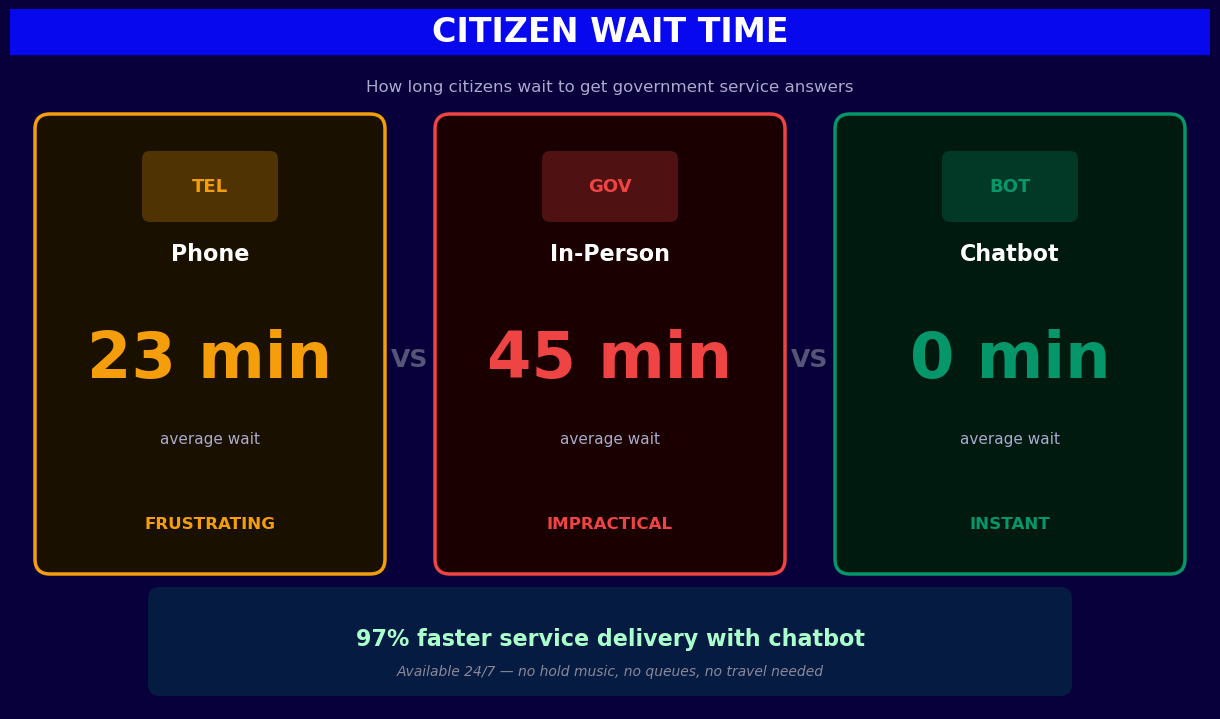
A government chatbot is an AI-powered assistant that answers the routine inquiries that make up the bulk of agency contact volume -- instantly and around the clock. Deployed on your agency website, WhatsApp, and other channels, a chatbot handles permit and license guidance, status lookups, public records intake, and hundreds of citizen FAQs without adding a position to the payroll. By resolving routine questions through self-service, agencies can free staff to focus on the complex cases that genuinely require human judgment.
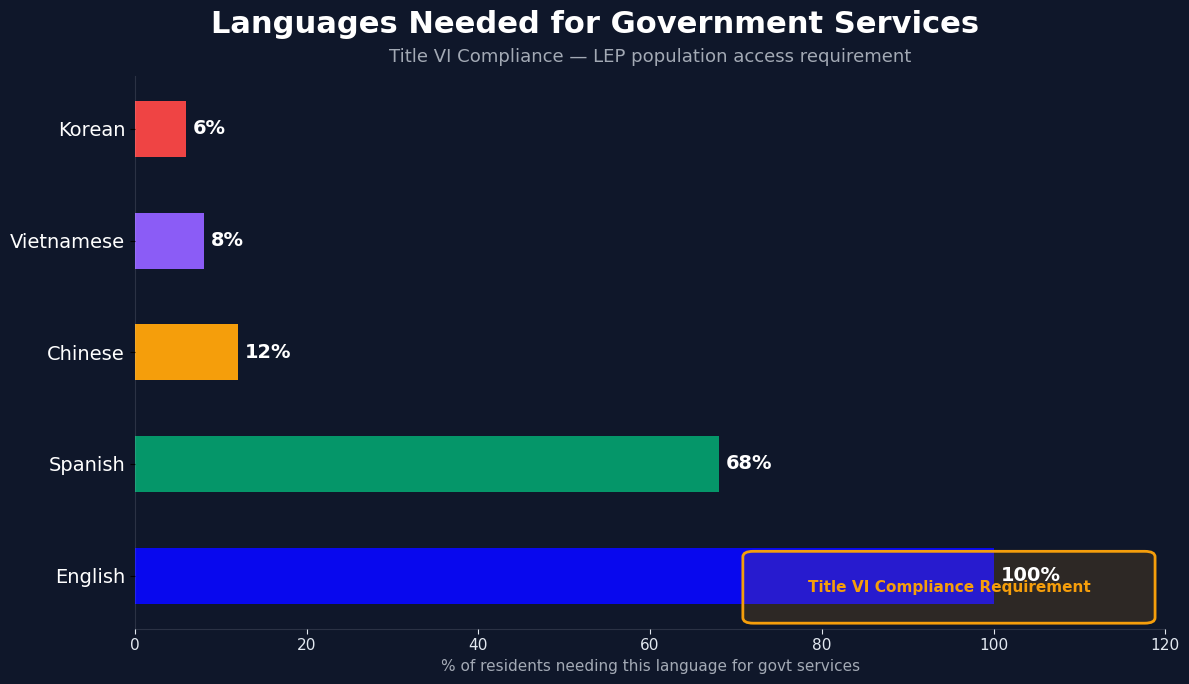
Beyond efficiency, chatbots can advance equity goals. A multilingual chatbot can serve limited-English-proficient (LEP) citizens in their preferred language without a separate interpreter line, supporting Title VI language-access goals. A chatbot designed with accessibility in mind can help reduce barriers for citizens with disabilities -- though agencies should consult their compliance team to confirm ADA, Section 508, and WCAG obligations are met for their deployment.
Conferbot's no-code chatbot builder lets IT generalists and departmental staff configure citizen service flows without custom development, and its built-in web crawler can import existing content from your .gov website to seed the knowledge base. The API integration layer (plus Zapier and webhooks) can connect chatbots to permitting systems, records platforms, and other services, turning static pages into dynamic self-service portals. Analytics dashboards give managers visibility into inquiry volume and resolution patterns -- useful data when justifying budget and demonstrating public value.
This guide covers what government agencies need to know about chatbots in 2026: citizen service automation, permit and license processing, benefits eligibility screening, public records, emergency communications, and ADA/Title VI compliance.
Citizen Service Automation
The majority of government agency interactions fall into a small number of repeating categories: status checks, scheduling, fee inquiries, form guidance, and eligibility questions. A chatbot can handle these consistently and instantly, at a fraction of the staff time a live interaction requires.
24/7 Service Without Overtime
Government offices close at 5 PM. Citizen questions do not. A chatbot deployed on your agency website and messaging channels answers inquiries at midnight, on weekends, and on holidays with the same accuracy as during business hours. For working citizens who cannot call during standard hours, this accessibility matters. Many citizen self-service interactions happen outside business hours -- demand that previously went unmet or required a callback the following day.
High-Volume FAQ Resolution
"What documents do I need for a building permit?" "When is the next bulk trash pickup?" "How do I register to vote?" Agencies field hundreds of variations of a few dozen core questions. A chatbot loaded with current agency information answers these instantly without consuming staff time. When ordinances change, hours shift, or procedures update, modifying the chatbot takes minutes and immediately delivers accurate information to every citizen who asks.
Service Request Intake
Rather than routing citizens through a phone tree to reach the right department, a chatbot identifies what the citizen needs, collects the required information, and either resolves the request directly or creates a properly categorized service ticket routed to the correct department. This guided intake reduces misrouted requests, cuts call handling time for agents who do take calls, and ensures that all required information is captured at first contact rather than through frustrating follow-up calls.
Inter-Department Routing
Citizens rarely know which department handles their issue. A chatbot serves as the agency's universal front door, identifying the nature of the request and routing it appropriately -- building services for permit questions, water authority for utility issues, finance for tax inquiries, and so on. For requests that require live agent assistance, the chatbot provides a warm handoff via live chat with full conversation context transferred so citizens never repeat themselves.
Appointment Scheduling
Many government services -- driver's license renewals, in-person permit reviews, social services consultations -- require appointments. A chatbot manages the entire scheduling workflow: presenting available slots, confirming bookings, sending reminders, and processing reschedule requests. Automated reminders can reduce no-shows and free administrative staff from the time spent managing appointment calendars by phone.
Permit and License Application Automation
Permit and license processing is among the highest-volume and most process-intensive functions in local government. A chatbot does not replace the review and approval process, but it eliminates the inefficiency that surrounds it -- the status calls, the document checklist questions, the incomplete submissions that bounce back to applicants.
Pre-Application Guidance
Before an applicant submits a permit or license application, they typically have questions: Which permit type do I need? What inspections are required? What are the fees? How long does review take? A chatbot answers these through a conversational diagnostic -- asking about the project type, location, scope, and business classification to identify the correct permit category and present the exact requirements. This pre-application guidance can reduce incorrect permit-type submissions, saving both applicants and reviewers significant rework.
Document Checklist and Submission Support
Incomplete applications are the primary cause of permit processing delays. A chatbot walks applicants through the document checklist for their specific permit type, collects uploaded documents within the conversation, validates file formats, and confirms receipt of each required item before the application is submitted. Connected to your permitting system via API, the bot can create the application record directly, eliminating manual data entry by counter staff.
Real-Time Status Tracking
After submission, "What is the status of my permit?" becomes the most frequent call to the permits office. A chatbot integrated with your permitting system provides instant, accurate status information: application received, under review, pending inspection, approved, or issued. Applicants get the answer in seconds rather than waiting on hold. Status self-service can meaningfully reduce inbound permit-related phone calls.
License Renewal Reminders
Business licenses, contractor licenses, and professional certifications have renewal deadlines that carry penalties for non-compliance. A chatbot sends proactive renewal reminders via WhatsApp or email, walks licensees through the renewal requirements, accepts renewal documentation, and confirms completion. Proactive outreach reduces lapsed licenses and the administrative burden of tracking and penalizing late renewals.
| Process Step | Without Chatbot | With Chatbot |
|---|---|---|
| Pre-application questions | Phone call or counter visit | Instant self-service, 24/7 |
| Document checklist | PDF download or phone guidance | Conversational, type-specific checklist |
| Submission | Manual form or counter drop-off | Guided digital intake with validation |
| Status inquiry | Phone call or hold time | Instant self-service, no wait |
| Renewal reminder | Mailed notice or no outreach | Proactive multichannel outreach |
Benefits Eligibility Screening
Benefits programs -- housing assistance, food assistance, utility support, childcare subsidies, and similar programs -- are among government's most critical services and most complex to administer. Many eligible citizens do not apply because the process is intimidating, confusing, or inaccessible. A chatbot lowers these barriers while protecting staff time from applications that do not meet eligibility criteria.
Conversational Pre-Screening
Rather than directing citizens to a long, jargon-filled eligibility form, a chatbot conducts a friendly conversational pre-screen. It asks about household size, income level, residency, and other program-specific criteria in plain language -- one question at a time. Based on responses, it provides a preliminary eligibility assessment and, for likely-eligible applicants, guides them to the next step in the full application process. By reducing the intimidation factor of eligibility determination, this conversational approach can increase application starts among eligible citizens.
Multi-Program Navigation
A citizen facing housing instability may be eligible for multiple assistance programs simultaneously. A chatbot can screen for eligibility across several programs in a single conversation, presenting a personalized summary of what the applicant may qualify for and the next steps for each program. This multi-program awareness ensures that citizens receive the full range of benefits for which they qualify rather than only the one program they happened to ask about.
Application Status and Follow-Up
After submission, benefits applicants frequently call to check on their application status, verify that documents were received, or understand what additional information is needed. A chatbot integrated with your case management system provides real-time status without requiring case worker involvement for routine updates. When escalation is genuinely required -- an application on hold for missing documentation, or a case requiring case worker judgment -- the chatbot routes the citizen appropriately with context already captured.
Recertification Reminders
Many benefit programs require periodic recertification. Missing a recertification deadline can interrupt benefits for eligible recipients, creating hardship and generating remediation work for agency staff. A chatbot sends proactive recertification reminders, walks recipients through the recertification process, collects updated information, and confirms submission before the deadline. This automation dramatically reduces preventable benefits interruptions.
Public Records Requests and Emergency Alerts
Two distinct but equally important use cases -- public records request intake and emergency communications -- illustrate the breadth of government chatbot applications beyond routine citizen service.
Public Records Request Intake
Freedom of Information Act (FOIA) and state public records law requests are legally mandated processes with response deadlines. A chatbot handles the intake process: identifying the requestor, clarifying the scope of records sought, explaining fees and timelines, collecting contact information, and generating a formal request record with a tracking number. This structured intake helps capture all legally required elements at first contact, reducing the administrative back-and-forth that often precedes a properly formed request and freeing records staff to focus on locating and producing responsive records.
Request Status Tracking
Requestors frequently follow up on the status of pending records requests. A chatbot integrated with your records management system provides instant status updates: received, assigned, in review, responsive records identified, and estimated fulfillment date. This self-service status check eliminates the phone calls that interrupt records staff during the review and production process.
Emergency Alert Dissemination
During emergencies -- severe weather, public health events, infrastructure failures, evacuation orders -- the speed and reach of public communication are critical. A chatbot deployed across web, WhatsApp, and SMS channels can push alerts to opted-in citizens instantly, answer questions about the emergency, provide shelter locations and evacuation routes, and direct citizens to official information sources. The two-way nature of chatbot communication is particularly valuable: citizens can ask "Is my address in the evacuation zone?" and receive a geographically specific answer, rather than receiving generic broadcast alerts that may not apply to their situation.
Recovery and Resource Information
After an emergency event, citizens need information about disaster assistance programs, debris removal schedules, facility reopening dates, and recovery resources. A chatbot serves as the central information hub during recovery periods, reducing the call surge that overwhelms agency staff in the aftermath of major events. It collects damage reports, connects citizens with appropriate recovery programs, and provides consistent, authoritative information during a period when misinformation tends to spread.
Multilingual Access, ADA Compliance, and WCAG Standards
Government agencies have legal and ethical obligations to serve all residents equitably, regardless of language, disability, or access method. Chatbots, when properly implemented, advance these obligations rather than creating new barriers.
Title VI Multilingual Service
Title VI of the Civil Rights Act requires federal agencies and recipients of federal funding to provide meaningful access to services for persons with limited English proficiency (LEP). Deploying interpreter services or bilingual staff at scale is expensive and slow. A multilingual chatbot can serve LEP citizens in their preferred language -- Spanish, Chinese, Vietnamese, Arabic, French, Portuguese, and many more -- instantly and consistently, at any hour. This is not mere translation: Conferbot's AI builder supports conversational capability in each supported language, enabling service delivery rather than a translated version of a limited FAQ page. For communities with significant LEP populations, multilingual chatbots can be a cost-effective way to support Title VI language-access goals at scale.
Accessibility, ADA, and WCAG Considerations
The Americans with Disabilities Act and Section 508 of the Rehabilitation Act require that government digital services be accessible to people with disabilities. Conferbot's chatbot widget is designed with accessibility in mind -- including keyboard navigability, screen reader compatibility, sufficient color contrast, and clear focus indicators -- so citizens who use assistive technologies can access chatbot services more easily. Conferbot does not certify conformance on your behalf; consult your compliance team to confirm ADA, Section 508, and WCAG obligations are met for your specific deployment.
Plain Language Standards
Government communications are frequently criticized for impenetrable bureaucratic language. The Plain Writing Act of 2010 requires federal agencies to use clear, accessible language in public communications. A well-configured chatbot can help apply plain-language standards: it translates agency terminology into citizen-friendly language, defines technical terms when they cannot be avoided, and confirms understanding through conversational checkpoints. Plain-language responses can improve comprehension compared to dense government web pages or form instructions.
Device and Channel Accessibility
Not all citizens have desktop computers. Low-income and rural residents are disproportionately mobile-only internet users. A chatbot deployed on WhatsApp and SMS reaches citizens on the devices they actually use, expanding access to government services beyond the citizens who regularly visit agency websites. This channel diversity directly advances equity goals by serving populations that government websites often fail to reach.
| Accessibility Requirement | Chatbot Solution |
|---|---|
| Title VI (LEP access) | Full multilingual conversational service |
| ADA / Section 508 | Accessibility-minded widget (keyboard + screen reader friendly) |
| Plain Writing Act | AI-assisted plain-language responses |
| Mobile access equity | WhatsApp and SMS channel deployment |
ROI and Efficiency Impact
Government agencies operate under tight fiscal constraints and are increasingly accountable to the public for demonstrating value. A chatbot's return depends on your agency's contact volume and cost structure, but the levers are consistent and measurable with your own analytics.
Per-Interaction Cost Reduction
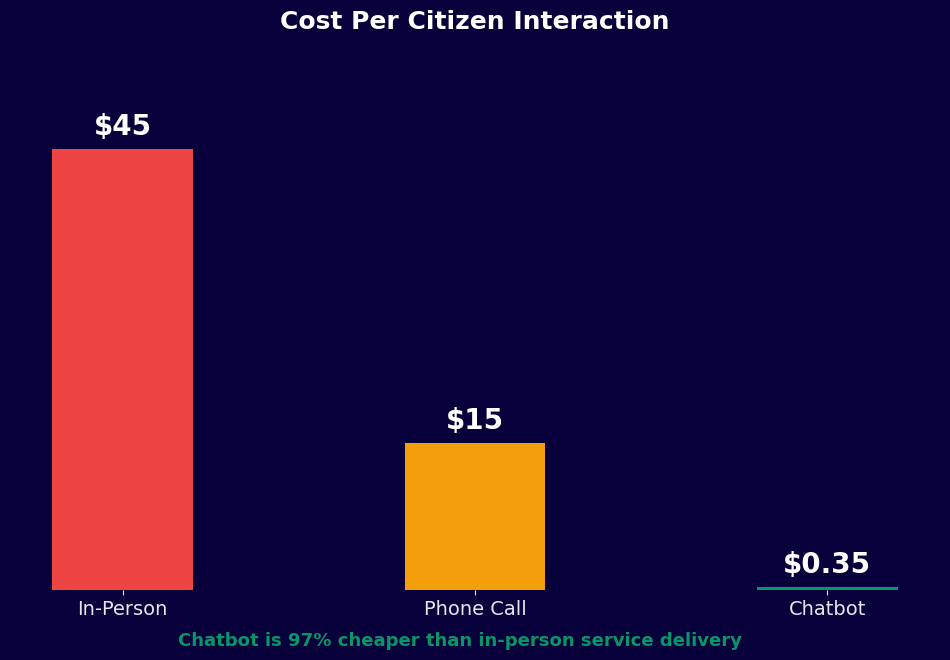
Agent-handled phone calls and counter visits carry real staff, facilities, and overhead costs; a self-service interaction the chatbot resolves carries far less. Every routine inquiry the chatbot deflects therefore frees staff time that can be redirected to complex cases. The exact savings depend on your fully loaded cost per contact and your deflection rate -- figures your agency can measure directly. Illustrative example (your actual figures will vary): if an agency estimates an agent-handled contact at a given cost and the chatbot deflects a meaningful share of its routine monthly contacts, the recovered staff time can quickly exceed typical chatbot platform costs.
Shorter Waits for Citizens
Hold times and queues impose a real time cost on citizens and can erode public trust. A chatbot answers self-serviceable interactions instantly, removing the wait for the routine questions that make up much of contact volume. This is not just an efficiency measure -- it is a public-trust and satisfaction measure that increasingly factors into agency performance evaluations and elected officials' priorities.
Staff Capacity and Morale
When chatbots handle a large share of routine inquiries, agency staff spend less time on repetitive, low-value calls and more time on complex cases that genuinely require human judgment. This shift in workload can improve job satisfaction and reduce burnout -- a meaningful benefit in public sector environments that struggle with retention. Staff freed from repetitive inquiry answering can also provide better service on the complex interactions that remain.
Error Reduction and Compliance
A chatbot delivers consistent information to every citizen, every time. Unlike staff members who may be undertrained, fatigued, or working from outdated materials, a properly maintained chatbot applies current policy uniformly. This consistency can reduce errors in citizen guidance, decrease misrouted applications and requests, and create an audit trail of information provided -- valuable in regulatory and legal contexts.
| Lever | Qualitative impact |
|---|---|
| Cost per interaction | Self-service costs far less than an agent-handled contact |
| Citizen wait time | Eliminated for self-serviceable requests |
| Routine inquiry deflection | Frees staff for complex cases (measure with your analytics) |
| Permit status calls | Reduced through instant status self-service |
| Benefits application starts | Can increase among eligible citizens via friendlier pre-screening |
Get Started with Government Chatbots Today
Whether you are a municipal government, county agency, state department, or federal program office, Conferbot helps you deliver faster, more equitable citizen services with AI chatbots that meet your compliance and accessibility obligations.
Launch in 3 Steps
- Sign up for free at app.conferbot.com/signup -- no credit card required. The free plan includes website chatbot deployment and 600 monthly conversations, suitable for a pilot program on a single service area.
- Configure your citizen service flows using our visual builder and service templates. Customize permit checklists, benefits pre-screening questions, FAQ content, and inter-department routing logic without writing code.
- Deploy across citizen channels -- Publish on your agency website and WhatsApp channel. Enable multilingual support for your LEP communities. Connect to permitting, benefits, and records systems via API integration.
Why Government Agencies Choose Conferbot
- No code required -- Departmental staff configure and update chatbots without IT dependency using our visual builder
- Multilingual by design -- Serve LEP communities in their preferred language to satisfy Title VI requirements
- Accessibility-minded -- Designed with keyboard and screen-reader access in mind to support your ADA and Section 508 efforts (confirm conformance with your compliance team)
- API integration -- Connect to permitting, benefits, records, and GIS systems via Conferbot API integration
- Live agent escalation -- Live chat transfers complex cases to staff with full conversation context
- Performance analytics -- Dashboards track inquiry volume, deflection rates, and citizen satisfaction for budget justification
Explore chatbot solutions for related sectors: healthcare, education, HR, insurance, and real estate.
Start your free government chatbot pilot today and give your citizens faster, always-on self-service in 2026.
Government FAQ
Everything you need to know about chatbots for government.
Chatbots for Other Industries
Discover how businesses in other industries use AI chatbots to automate support, capture leads, and grow.
Government Chatbots by Channel
What running a Government chatbot looks like on each channel - the setup, the handoff rules, and what should never be automated.
Continue Exploring
Explore features, connect third-party tools, and browse ready-made templates.
Deep-dive pillar guides, real use cases, and the chatbot & AI glossary.