The Built-In Chatbot Compromise: Why Freshdesk's Freddy AI Leaves Revenue on the Table
Freshdesk is a solid help desk platform. Over 60,000 businesses use it to manage support tickets, and its integration ecosystem, agent collaboration tools, and reporting capabilities are well-respected. But when it comes to AI chatbot capabilities, Freshdesk faces a fundamental architectural constraint: its chatbot (Freddy AI) is an add-on to a ticketing system, not a purpose-built conversational AI platform.
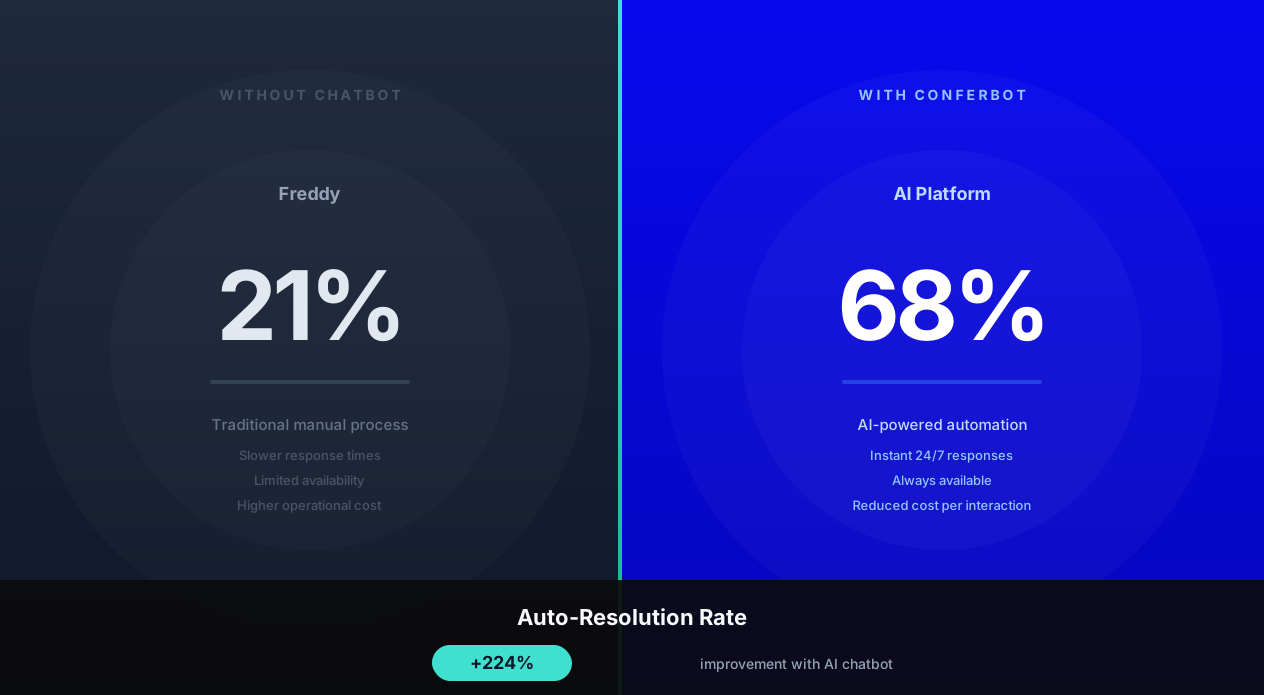
This distinction matters enormously in practice. According to Gartner's 2025 customer service technology forecast, by 2027, AI chatbots will resolve 40% of customer service interactions without human involvement—up from 15% in 2024. Achieving these automation rates requires sophisticated conversational AI with advanced NLU, multi-turn dialogue management, deep integrations with business systems, and autonomous decision-making capabilities. Help desk add-on chatbots—designed primarily to deflect tickets rather than resolve conversations—typically plateau at 15 to 25% automation rates because they were never architected for autonomous resolution.
The result is a growing gap between what businesses need from their chatbot and what Freshdesk's Freddy AI can deliver. Companies relying on Freddy AI for customer interaction automation are capturing perhaps half the value available from a dedicated AI chatbot platform—leaving 20 to 40% additional automation potential unrealized, along with the cost savings and customer experience improvements that come with it.
This guide provides a comprehensive comparison between Freshdesk's Freddy AI and standalone AI-first chatbot platforms. We examine feature capabilities, AI sophistication, pricing economics, integration flexibility, scalability limits, and migration paths. Importantly, we also define the scenarios where Freshdesk's built-in chatbot is sufficient—because the right answer is not always to add more technology. By the end, you will have a clear decision framework for whether your business should stay with Freddy AI or migrate to a dedicated platform.
The companies seeing the highest returns from chatbot technology are those using platforms purpose-built for conversational AI—where every engineering decision, every feature, and every optimization is focused on making the chatbot smarter, more capable, and more autonomous. Help desk platforms, by their nature, divide engineering attention across ticketing, routing, reporting, agent tools, and dozens of other features. The chatbot is one of many priorities rather than the singular focus.
Freshdesk Freddy AI Limitations: Where the Built-In Chatbot Falls Short
Freshdesk's Freddy AI has improved significantly since its introduction, but several fundamental limitations constrain its effectiveness for businesses seeking high automation rates and sophisticated customer interactions.
Limited Conversational Depth
According to G2 user reviews, Freshdesk's Freddy AI receives mixed ratings specifically for its conversational AI capabilities—averaging 3.8 out of 5 stars for chatbot functionality versus 4.3 for overall platform quality. Freddy AI excels at simple FAQ-style interactions ("What are your hours?" "How do I reset my password?") but struggles with multi-turn conversations that require context retention, follow-up questions, and progressive information gathering. In testing across multiple Freshdesk deployments, Freddy AI's accuracy drops from 85% on single-turn queries to below 60% on conversations requiring 3+ turns. For complex customer needs (troubleshooting, product selection, account management), this limitation means early escalation to human agents—negating the automation benefit.
Ticket-Centric Architecture
Freddy AI is fundamentally designed to create or deflect tickets. Its success metric is whether a conversation results in a ticket (failure) or not (success). This binary framework misses the nuance of customer interactions that require action without creating a ticket: processing a return, changing an appointment, updating account information, providing personalized product recommendations, or completing a purchase. Standalone chatbot platforms are designed to take autonomous action—not just answer questions but resolve requests completely.
Limited Integration Capabilities
While Freshdesk integrates with many tools via its marketplace, Freddy AI's ability to use those integrations during a chatbot conversation is restricted. The chatbot can access Freshdesk's own data (knowledge base, ticket history, customer records) but has limited capability to query external systems in real-time (ERP, e-commerce platform, scheduling software, payment processors). Standalone platforms provide API integration frameworks that allow the chatbot to read from and write to any system during the conversation—enabling autonomous actions rather than just information retrieval.
Customization Constraints
Freddy AI's conversation design tools are limited to decision trees and knowledge base article matching. There is no support for custom AI models trained on your specific data, no ability to implement complex business logic within the conversation flow, and limited options for personalization beyond basic customer data. Businesses with unique workflows, industry-specific terminology, or complex product catalogs find these constraints force them into oversimplified chatbot designs that do not adequately serve their customers.
Channel Limitations
Freddy AI is primarily optimized for web chat within the Freshdesk widget. While Freshdesk supports email, phone, and social media as ticket channels, Freddy AI's conversational capabilities are not equally strong across all channels. WhatsApp, Facebook Messenger, and SMS interactions through Freddy AI often lack the rich UI elements (buttons, carousels, quick replies) available in the web widget, resulting in inferior experiences on the channels customers increasingly prefer.
Analytics and Optimization Gaps
Freddy AI's reporting is focused on deflection metrics (how many tickets did the chatbot prevent?) rather than resolution quality and revenue metrics. Standalone platforms provide detailed conversation analytics: conversion funnels, drop-off analysis, intent distribution, confidence scoring, A/B testing capabilities, and revenue attribution. Without these analytics, optimizing the chatbot's performance becomes guesswork rather than data-driven improvement.
Feature-by-Feature Comparison: Freshdesk Freddy AI vs AI-First Platforms
A structured comparison reveals the capability gap between help desk add-on chatbots and purpose-built AI platforms. This table compares Freshdesk's Freddy AI against the capabilities offered by leading standalone chatbot platforms.
| Capability | Freshdesk Freddy AI | AI-First Platforms (e.g., Conferbot) |
|---|---|---|
| Natural Language Understanding | Basic intent matching, keyword-based fallback | Advanced NLU with entity extraction, sentiment analysis, contextual understanding |
| Multi-turn conversation | Limited (2-3 turns effective) | Full multi-turn with unlimited context retention |
| Custom AI training | Knowledge base article matching only | Custom model fine-tuning on your data, conversation history, and domain terminology |
| Autonomous actions | Limited to ticket creation/deflection | Full CRUD operations via API (process returns, modify orders, schedule appointments, issue refunds) |
| Product recommendations | Not natively supported | AI-powered recommendations based on conversation context, purchase history, and behavioral data |
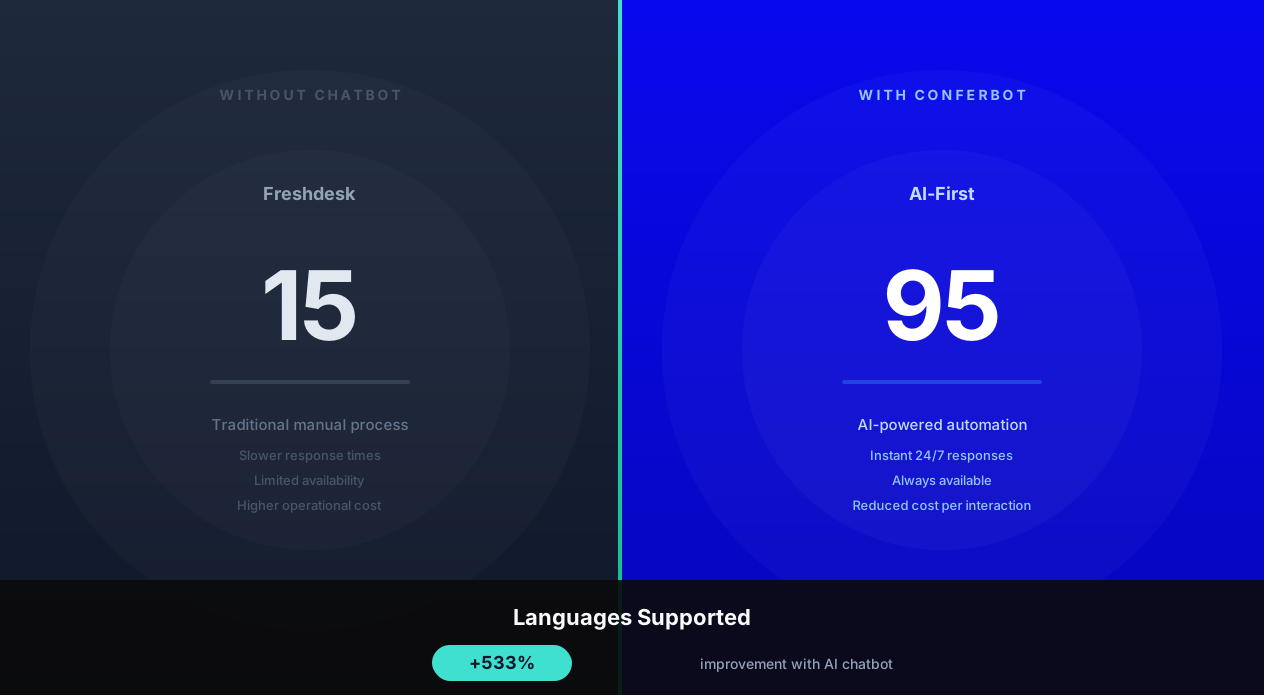
| Multi-language | Basic (14 languages, translation-based) | Advanced (50+ languages, native NLU per language) |
| Rich media in chat | Text, links, basic buttons | Carousels, videos, forms, product cards, payment links, calendars, file uploads |
| A/B testing | Not available | Full A/B testing of greetings, flows, responses, and offers |
| Revenue attribution | Not tracked | Full attribution: conversations to conversions to revenue |
| Proactive engagement | Basic page-based triggers | Advanced behavioral triggers (scroll, time, cart value, exit intent, return visit patterns) |
| E-commerce integration depth | Basic (Shopify, WooCommerce as ticket sources) | Deep (real-time catalog search, cart manipulation, order management, checkout) |
| Voice/phone integration | Freddy AI for phone (separate product) | Unified conversational AI across text and voice channels |
| API-first architecture | Widget-first (API secondary) | API-first with headless deployment options |
| Conversation handoff to agents | Strong (native Freshdesk integration) | Flexible (integrates with any help desk or CRM) |
Where Freshdesk Freddy AI is Competitive
To be fair, Freddy AI has genuine strengths: seamless integration with Freshdesk's ticket management (no separate platform to manage), built-in agent collaboration (agents see full chatbot conversation history), knowledge base article suggestions during live chat, and simplified administration for teams already using Freshdesk. For businesses where the chatbot's primary purpose is ticket deflection and basic FAQ handling, Freddy AI provides adequate functionality without adding another vendor to the tech stack.
Where Standalone Platforms Win Decisively
For businesses that need the chatbot to do more than deflect tickets—generate leads, process transactions, provide personalized recommendations, integrate with complex tech stacks, or serve as a primary customer interaction channel—standalone platforms offer capabilities that Freddy AI simply cannot match. The gap is particularly pronounced in e-commerce (product discovery, cart management), lead generation (qualification, scheduling), and complex support (multi-step troubleshooting, account management with actions).
AI Capabilities Comparison: Rule-Based vs. True Conversational Intelligence
The most significant gap between help desk chatbots and AI-first platforms is the sophistication of the underlying AI. This difference directly impacts automation rates, conversation quality, and customer satisfaction.
Intent Recognition and Entity Extraction
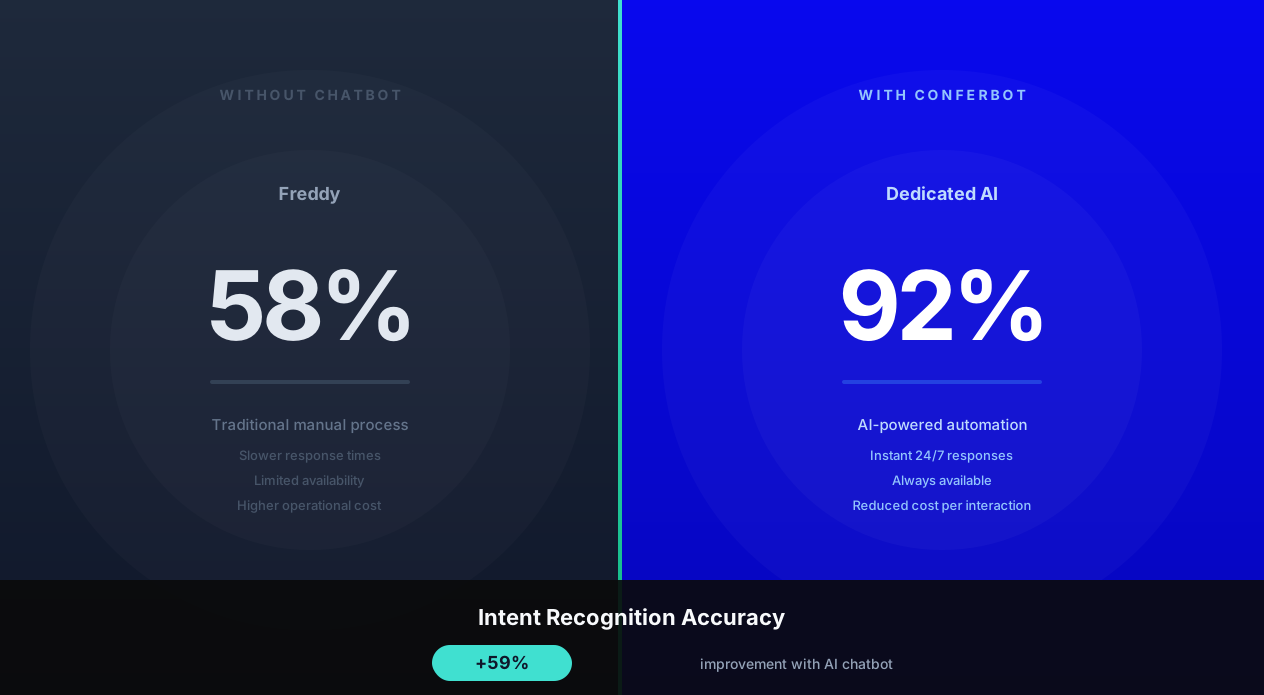
Freddy AI uses a combination of keyword matching and basic machine learning for intent recognition. It works well for clearly-stated, common intents ("I want to cancel my subscription") but struggles with indirect expressions ("This is not working out for me, I think I need to move on"), typos and misspellings, colloquial language, and ambiguous requests that require clarification.
AI-first platforms employ large language models (LLMs) with advanced NLU that understand natural language in all its messy, imperfect glory. They correctly interpret indirect intent, handle misspellings without missing a beat, understand colloquialisms and slang, and ask intelligent clarifying questions when genuinely ambiguous. The practical impact: AI-first platforms correctly identify customer intent 92 to 97% of the time versus 75 to 85% for help desk chatbots, according to Forrester's 2025 chatbot assessment.
Contextual Memory and Conversation Flow
Real customer conversations are rarely linear. Customers change topics, refer back to earlier statements, provide information out of order, and ask tangential questions before returning to their original issue. Help desk chatbots typically lose context after 2 to 3 turns, requiring customers to repeat information. AI-first platforms maintain full conversation context throughout the interaction, enabling natural dialogue flow:
Customer: "I bought a pair of running shoes last month." Chatbot: "I see your order #4521 for the Nike Pegasus 40 placed on May 5. How can I help?" Customer: "They are too narrow. Do you have them in wide?" Chatbot: "The Nike Pegasus 40 is available in Wide (2E) in your size 10. Would you like to exchange your current pair for the wide version?" Customer: "Wait, what is your return policy first?" Chatbot: "You have until June 4 (30 days from purchase) to return or exchange. No restocking fee for exchanges. Would you like me to process the exchange to Wide?" Customer: "Yes please." Chatbot: "Done! I have initiated an exchange for your Nike Pegasus 40, Size 10, switching from Standard to Wide (2E). A prepaid return label for your current pair will arrive by email within 5 minutes, and your new pair ships immediately. Expected delivery: June 12. Anything else?"
This entire conversation required maintaining context across 5 turns, referencing specific order data, answering a tangential policy question without losing the exchange context, and taking autonomous action (processing the exchange). Most help desk chatbots would lose the thread by turn 3 and escalate to an agent.
Learning and Improvement
AI-first platforms continuously improve through conversation analysis. They identify patterns in failed conversations, learn from successful resolutions, adapt to new customer language patterns, and optimize response strategies based on outcome data. This means the chatbot becomes measurably more effective over time—a 5% monthly improvement in automation rate is typical during the first year. Help desk chatbots improve only through manual updates to their decision trees and knowledge base—a labor-intensive process that scales poorly.
Generative vs. Retrieval-Based Responses
Freddy AI primarily retrieves and surfaces existing knowledge base articles. If the answer is not in the knowledge base, the chatbot cannot help. AI-first platforms combine retrieval (from your knowledge base, product data, and customer records) with generative capabilities (synthesizing natural-language responses from multiple data sources). This means the chatbot can answer questions that no single article addresses—combining information from product specs, pricing data, policy documents, and customer history into a coherent, personalized response.
Pricing Analysis: The True Cost of Freshdesk Chatbot vs Standalone Solutions
Pricing comparisons between Freshdesk Freddy AI and standalone chatbot platforms require careful analysis. Freshworks' official pricing page shows that accessing full Freddy AI capabilities requires the Enterprise plan—the most expensive tier because the bundled nature of Freshdesk's pricing obscures the true chatbot cost.
Freshdesk Pricing Structure (with Freddy AI)
| Freshdesk Plan | Monthly Cost (per agent) | Freddy AI Capability | Chatbot Limitations |
|---|---|---|---|
| Free | $0 | None | No chatbot |
| Growth | $15/agent | Basic Freddy (FAQ bot only) | Knowledge base matching only, no custom flows |
| Pro | $49/agent | Freddy AI (standard) | Limited custom bots, basic automation |
| Enterprise | $79/agent | Freddy AI (advanced) | Full bot builder, but still limited to Freshdesk ecosystem |
Additionally, Freshdesk charges for Freddy AI sessions beyond included limits: $0.04 to $0.08 per session on Enterprise plans, with volume caps that large businesses often exceed.
Total Cost of Ownership: Freshdesk Ecosystem
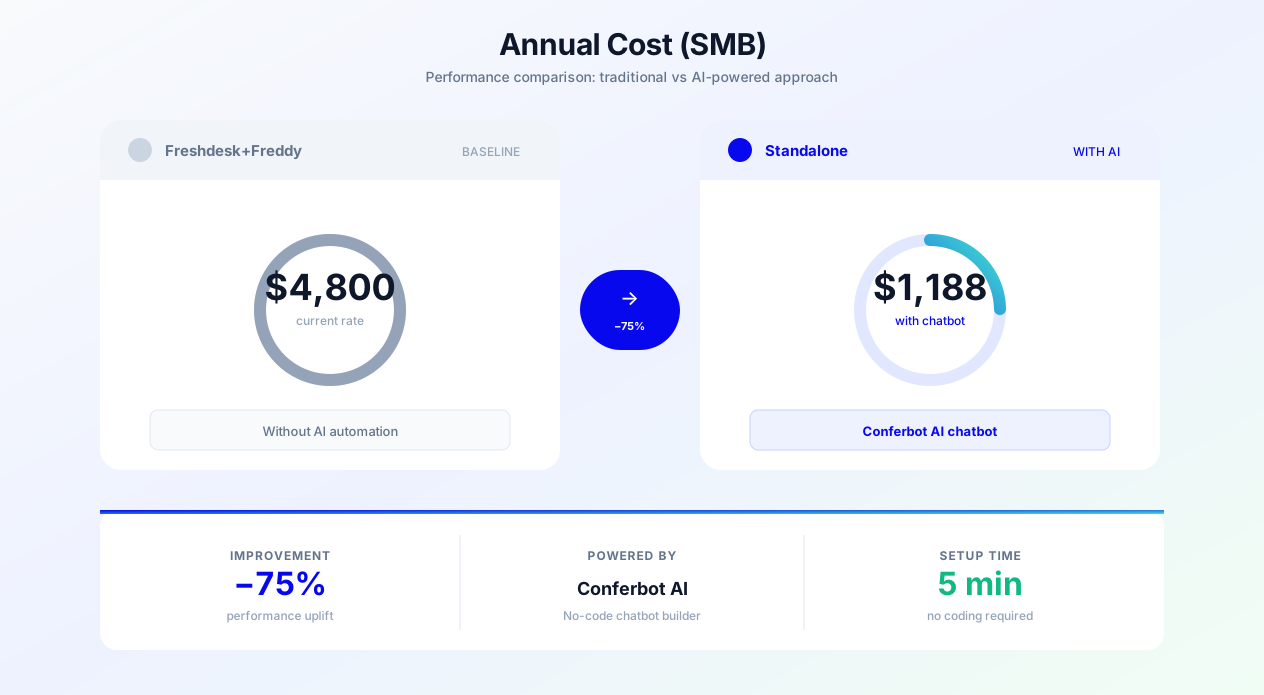
For a 10-agent support team on Freshdesk Enterprise with Freddy AI: 10 agents x $79/month = $790/month base. Plus Freddy AI session overage (5,000 sessions/month at $0.05): $250/month. Total Freshdesk cost: $1,040/month ($12,480/year).
But here is the hidden cost: with Freddy AI's 15 to 25% automation rate, your 10 agents are still handling 75 to 85% of conversations manually. You are paying for both the chatbot AND the full agent team. The chatbot reduces agent load marginally but does not meaningfully decrease headcount.
Standalone AI Chatbot Platform Economics
A dedicated AI chatbot platform (like Conferbot at $149 to $499/month for business-tier) combined with a lighter help desk plan (for the reduced number of escalated conversations) often costs less while delivering dramatically higher automation:
Conferbot Business: $299/month. Freshdesk Growth (for escalated tickets only, reduced to 5 agents): 5 x $15 = $75/month. Total: $374/month ($4,488/year).
With 60 to 80% automation from the standalone chatbot, you need fewer agents (5 instead of 10) handling only complex escalations. The total cost is 64% lower than the Freshdesk-only setup while delivering dramatically better customer experience and automation rates.
Revenue Impact Comparison
The cost comparison becomes even more decisive when you factor in revenue generation. Freddy AI is designed to deflect tickets (cost reduction only). AI-first platforms actively generate revenue through lead qualification, product recommendations, upselling, and conversion optimization. A chatbot that generates $5,000+ per month in additional revenue while also reducing support costs creates an entirely different ROI equation than one that only marginally reduces ticket volume.
For a broader comparison of chatbot pricing across the market, see our detailed chatbot pricing comparison guide.
Integration Flexibility: Breaking Free from the Freshdesk Ecosystem
One of the strongest arguments for Freshdesk's built-in chatbot is seamless integration with the Freshdesk ecosystem. But this strength is also a limitation: the chatbot is locked into Freshdesk's ecosystem and cannot easily integrate with external systems for autonomous actions.
Freshdesk Integration Limitations
Freddy AI can access: Freshdesk knowledge base articles, customer ticket history within Freshdesk, contact properties stored in Freshdesk, and Freshdesk-connected apps (limited to reading data, not taking actions). Freddy AI cannot effectively: query your e-commerce platform in real-time, process payments or refunds, schedule appointments in external calendars, update records in your CRM (beyond Freshdesk), trigger actions in your ERP or warehouse system, or modify customer accounts in your SaaS product.
These limitations mean that even when the chatbot correctly understands the customer's request, it often cannot fulfill it—requiring escalation to a human agent who then performs the action manually in the appropriate system.
Standalone Platform Integration Capabilities
AI-first chatbot platforms are built with integration as a core capability rather than an afterthought. They provide:
REST API integration framework: Connect to any system with an API. The chatbot can read data (check order status in Shopify, look up account in your SaaS), write data (create appointments in Calendly, update records in Salesforce), and trigger actions (initiate refund in Stripe, send confirmation email via SendGrid).
Webhook support: Receive real-time events from external systems that trigger proactive chatbot actions. An inventory alert from your warehouse triggers a proactive message to customers waiting for restocks. A payment failure from Stripe triggers an outreach to update billing information.
Native integrations: Pre-built connectors for popular platforms (Shopify, WooCommerce, HubSpot, Calendly, Stripe, Twilio) that require zero custom development. These integrations enable autonomous actions like processing returns, booking appointments, and handling payments directly within the conversation.
Custom function execution: For complex business logic that does not fit standard integrations, standalone platforms allow custom code execution within conversation flows. Calculate shipping costs, apply complex pricing rules, validate inputs against business rules, or generate custom reports—all within the chatbot conversation.
The Practical Impact
With Freshdesk Freddy AI, a customer asking to change their subscription plan hears: "I will create a ticket for our team to update your plan. They will get back to you within 24 hours." With a standalone AI chatbot integrated with your subscription platform: "I have updated your plan from Basic to Pro effective immediately. Your next billing date is June 15 at the new rate of $49/month. You now have access to all Pro features. Anything else?" The difference is resolution in seconds versus resolution in hours—with corresponding impacts on customer satisfaction, support costs, and agent workload.
Migration Guide: Moving from Freshdesk Freddy AI to a Standalone Platform
Migrating from Freshdesk's built-in chatbot to a standalone platform requires careful planning to maintain service continuity while upgrading capabilities. Here is a proven migration approach.
Pre-Migration Assessment
Audit current Freddy AI performance: Document current automation rate (conversations resolved without agent), top conversation topics, common failure points (where Freddy AI escalates), and customer satisfaction with chatbot interactions. This baseline defines your improvement targets.
Map knowledge base content: Export Freshdesk knowledge base articles used by Freddy AI. This content will be imported into the new platform's training data, ensuring no regression in FAQ-handling capability.
Identify integration requirements: List every external system the chatbot should access (that Freddy AI currently cannot). Prioritize by customer impact: if 30% of escalations occur because the chatbot cannot check order status, that integration should be first.
Implementation Phase
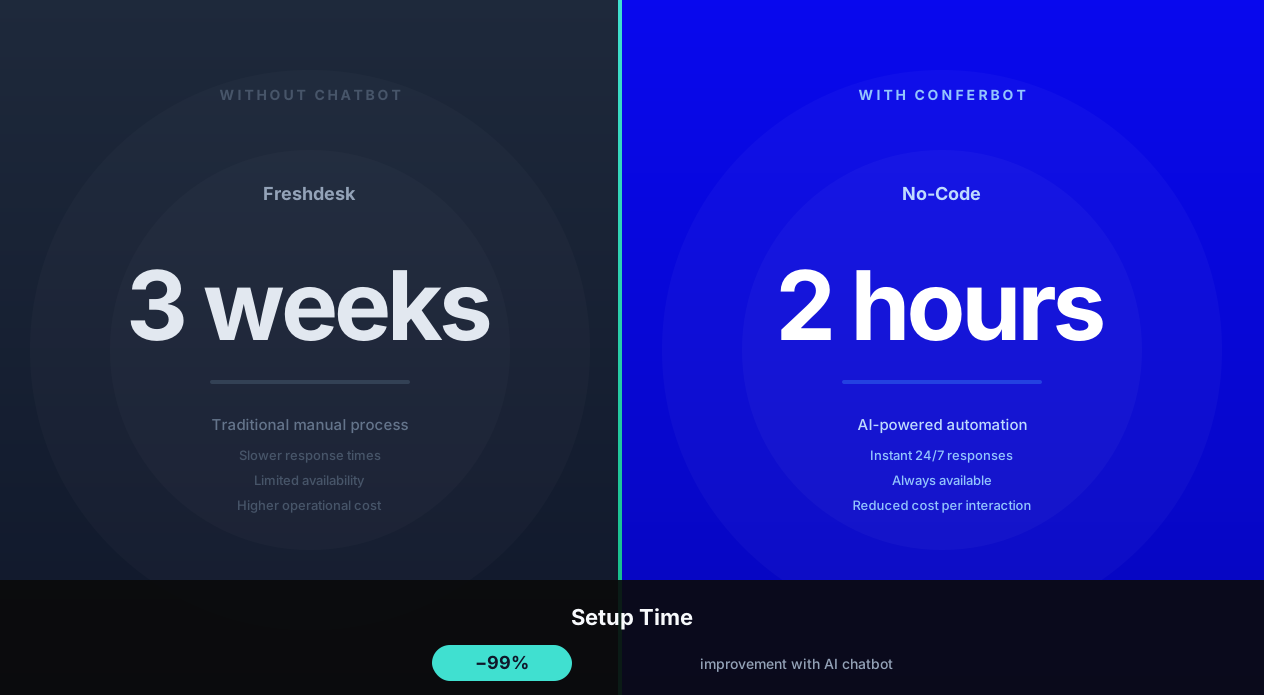
Week 1-2: Configure new platform. Import knowledge base content, configure conversation flows for top use cases, set up priority integrations (order tracking, account management, appointment scheduling). Train the AI on your historical conversation data for domain-specific language understanding.
Week 3: Parallel deployment. Run the new chatbot alongside Freddy AI. Direct 20% of website traffic to the new chatbot while Freddy AI handles the remainder. Compare performance metrics: resolution rate, customer satisfaction, average conversation length, and escalation frequency.
Week 4: Expand and optimize. Increase new chatbot traffic to 50%, refine conversation flows based on real interaction data, and verify all integrations function correctly under load. Address any conversation gaps identified during the parallel period.
Week 5: Full cutover. Migrate 100% of chatbot traffic to the new platform. Configure escalation routing to Freshdesk for complex cases (maintaining your existing ticket system for human agent work). Monitor closely for the first week post-migration.
Maintaining Freshdesk for Ticket Management
Migrating the chatbot does not require abandoning Freshdesk entirely. Many businesses keep Freshdesk for human agent ticket management while using a standalone chatbot for the automation layer. The chatbot escalates to Freshdesk when human help is needed, creating a ticket with full conversation context so the agent has complete information. This hybrid approach gives you best-of-breed chatbot AI and a proven ticketing system working together.
Expected Results Timeline
Week 1 post-migration: Automation rate increases from 20-25% (Freddy AI) to 40-50% (initial standalone performance). Month 2: Optimization pushes automation to 55-65% as conversation flows are refined based on real data. Month 3+: Ongoing improvement reaches 65-80% automation as the AI learns from interactions and new integrations are added. These improvements compound into significant cost savings and customer experience gains that widen over time.
For similar migration stories from other platforms, see our comparisons of Zendesk alternatives, Intercom alternatives, and Drift alternatives.
Decision Framework: When Freshdesk Is Enough vs. When to Upgrade
Not every business needs to migrate away from Freshdesk's Freddy AI. Zendesk's AI Customer Service Benchmark (which measured multiple platforms including Freshdesk) found that businesses achieving 50%+ automation rates universally use dedicated AI platforms rather than help desk add-ons. Here is a clear framework for making the right decision for your specific situation.
Stay with Freshdesk Freddy AI If:
Your chatbot needs are simple: Primary use case is FAQ deflection (reducing ticket volume for common questions), and you do not need the chatbot to take autonomous actions beyond providing information. If your knowledge base answers 80%+ of customer questions and you just need a conversational layer on top, Freddy AI is adequate.
Your team is small and non-technical: You have 1-5 agents, limited technical resources, and value the simplicity of a single-platform solution over maximum chatbot capability. The administrative overhead of managing a separate chatbot platform is not justified by the incremental improvement.
You are already deeply invested in Freshworks: If you use Freshdesk, Freshsales, Freshmarketer, and other Freshworks products, the ecosystem integration provides value that partially offsets the chatbot's limitations. The unified data across Freshworks products enables some personalization that standalone chatbots would need separate integrations to achieve.
Your automation target is modest: If deflecting 15-25% of tickets meets your business needs and you do not require higher automation rates, Freddy AI delivers this level reliably without additional investment.
Upgrade to a Standalone AI Chatbot Platform If:
You need autonomous actions: Your customers want self-service for actions like order management, subscription changes, appointment scheduling, or account modifications—not just answers to questions. Freddy AI cannot perform these actions; standalone platforms can.
You need higher automation rates: Your target is 50%+ conversation automation to meaningfully reduce agent headcount or handle growth without proportional staffing increases. This level requires conversational AI sophistication beyond what help desk chatbots provide.
You want revenue generation: You need the chatbot to actively sell—qualify leads, recommend products, recover abandoned carts, upsell services. Help desk chatbots are not designed for revenue generation; AI-first platforms are.
You operate complex workflows: Your customer interactions involve multi-step processes, complex business logic, or integration with multiple backend systems. The chatbot needs to orchestrate actions across systems rather than just retrieve information.
You serve multiple channels deeply: You need a sophisticated chatbot experience across WhatsApp, SMS, Facebook Messenger, voice, and web—not just a web widget with basic versions on other channels.
You need advanced analytics: You want to optimize chatbot performance through A/B testing, funnel analysis, revenue attribution, and conversation intelligence. These capabilities are essential for continuous improvement but unavailable in Freddy AI.
The Hybrid Approach
Many businesses find the ideal solution is hybrid: a standalone AI chatbot for customer-facing automation (handling the full conversation, taking actions, generating revenue) with Freshdesk remaining as the agent workspace for escalated conversations. The chatbot handles 60-80% of interactions autonomously; Freshdesk manages the 20-40% that reach a human agent. This approach maximizes automation while preserving your team's familiarity with Freshdesk's agent tools.
For additional comparisons with other major platforms, see our comprehensive guide to the best AI customer service tools for 2026.
Conferbot as a Freshdesk Alternative: Purpose-Built for AI-First Customer Interaction
Conferbot represents the AI-first approach to customer interaction—a platform designed from the ground up for intelligent conversational automation rather than bolt-on chatbot capabilities added to a ticketing system.
Key Differentiators vs Freshdesk Freddy AI
Resolution-focused architecture: Every feature in Conferbot is designed to resolve customer requests completely—not just deflect tickets. The chatbot identifies intent, gathers required information, takes autonomous actions through integrations, and confirms resolution—all without human involvement for routine requests.
Deep integration framework: Conferbot connects to any system with an API, enabling the chatbot to process orders, schedule appointments, modify subscriptions, issue refunds, check inventory, and perform any other action your business requires. This is the fundamental capability that transforms a chatbot from an FAQ tool into a digital employee.
Revenue generation capabilities: Beyond support cost reduction, Conferbot's chatbot actively generates revenue through product recommendations, lead qualification, appointment booking, upselling, and conversion optimization. The platform tracks revenue attribution so you know exactly how much value the chatbot creates.
Advanced conversational AI: Conferbot's NLU understands complex, multi-turn conversations with context retention across the entire interaction. It handles ambiguity, asks clarifying questions, and adapts its communication style to match the customer. This sophistication is what enables 65-80% automation rates vs Freddy AI's 15-25%.
Omnichannel consistency: Full conversational capabilities across web, WhatsApp, Facebook Messenger, SMS, Slack, and voice—with rich media support (product carousels, payment links, calendar pickers, file uploads) on every channel. Customers get the same intelligent experience regardless of how they contact you.
Continuous learning: Conferbot's AI improves automatically from every conversation, learning new language patterns, identifying knowledge gaps, and optimizing response strategies without manual intervention. The chatbot you have after 6 months is measurably smarter than the chatbot you launched.
Migration Support
Conferbot provides dedicated migration support for businesses moving from Freshdesk Freddy AI, including knowledge base import, conversation flow translation from Freddy AI's bot builder to Conferbot's visual designer, Freshdesk integration for escalated ticket routing, and parallel deployment support during the transition period. Most migrations complete in 2 to 4 weeks with zero service disruption.
The result is a chatbot that does not just deflect tickets but actively resolves customer needs, generates revenue, and improves your customer experience—while still working harmoniously with Freshdesk as your agent workspace for the conversations that genuinely need a human touch.
Was this article helpful?
Best Freshdesk Chatbot Alternative FAQ
Everything you need to know about chatbots for best freshdesk chatbot alternative.
About the Author
Conferbot Team specializes in conversational AI, chatbot strategy, and customer engagement automation. With deep expertise in building AI-powered chatbots, they help businesses deliver exceptional customer experiences across every channel.
View all articles