Why Driving Schools Are Adopting Chatbots in 2026
The driving school industry in the United States represents a $2.5 billion market with over 16,800 businesses serving approximately 4.1 million new drivers each year. Despite this scale, most driving schools operate with the same technology stack they used a decade ago: a phone line, a paper calendar, and a website with a contact form. The result is a business model that leaks revenue at every stage of the student journey — from initial inquiry to enrollment, from lesson scheduling to course completion.
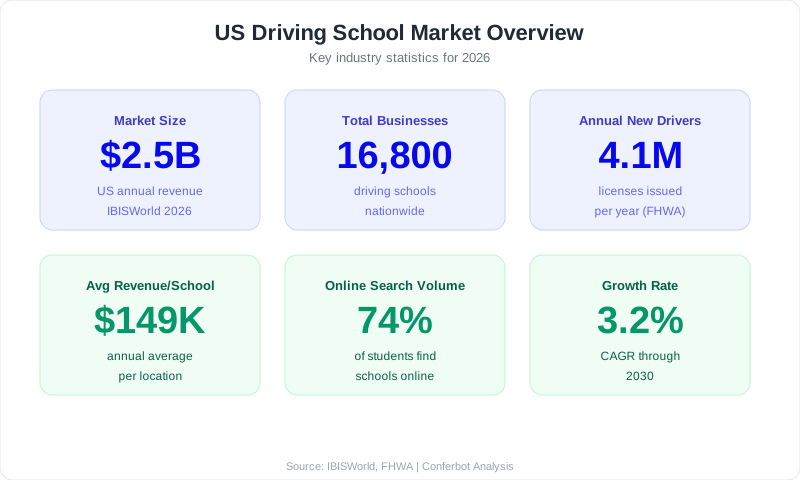
The fundamental challenge for driving schools is conversion. According to IBISWorld industry data, 74% of prospective students discover driving schools through online search. They land on a website, compare prices with 2-3 competitors, and make a decision within hours. The school that responds first — with clear pricing, available scheduling, and a frictionless enrollment path — wins the enrollment. The school that requires a phone call during business hours loses to the competitor with a chatbot.
Consider the typical prospective student: a 16-year-old whose parent is researching driving schools at 9 PM after dinner. They visit your website, see a phone number, but your office closed at 6 PM. They visit a competitor's website, engage with a chatbot, get instant answers about pricing, course options, and scheduling, and enroll on the spot. By the time your front desk calls them back the next morning, they are already booked elsewhere. This scenario plays out hundreds of times per year across the industry.
A driving school chatbot transforms this dynamic. It engages every website visitor instantly, answers the questions that determine enrollment decisions (pricing, scheduling, course structure, instructor availability), and converts prospects into enrolled students — at any hour, on any device. For a business where each student represents $500-$1,200 in revenue and the primary competitive differentiator is responsiveness, a chatbot is not a luxury feature. It is the difference between growing and stagnating.
This guide covers everything a driving school needs to know about deploying a chatbot: lead capture and enrollment automation, lesson scheduling and rescheduling, student communication and retention, review generation, and a detailed ROI model. Whether you run a single-car operation or a multi-location school with 20 instructors, this guide provides the complete playbook.
The stakes are particularly high for driving schools because of the industry's competitive dynamics. In most metropolitan areas, 8-15 driving schools compete for the same pool of new-driver students. The school that responds fastest to an inquiry, provides the clearest pricing, and offers the smoothest enrollment experience captures the student. Every other school — regardless of instructor quality, vehicle fleet, or pass rate — is left competing for the students that the first-responder did not convert. In a market where 74% of students find their school online, the website experience is the competitive battlefield, and the chatbot is the weapon that wins.
The financial impact extends beyond individual enrollment. Each student who completes the program and obtains their license becomes a potential referral source for siblings, friends, and coworkers. A driving school that enrolls 300 students per year at a 42% referral rate (achievable with chatbot engagement) generates 126 warm referral leads — each converting at roughly double the rate of cold traffic. This referral flywheel compounds over time, reducing the school's dependence on paid advertising and building a sustainable growth engine that competitors without chatbot engagement cannot replicate.
Lead Capture and Enrollment: Converting Inquiries Into Students
The enrollment funnel is where driving schools win or lose the revenue battle, a dynamic consistent with lead conversion research from HubSpot's marketing benchmarks. Most schools convert only 12% of phone inquiries into enrolled students — a rate that reflects the friction of phone-based sales. The student (or parent) calls, gets basic information, says they will think about it, and never calls back. The school has no way to follow up because they often did not collect contact information during the call.
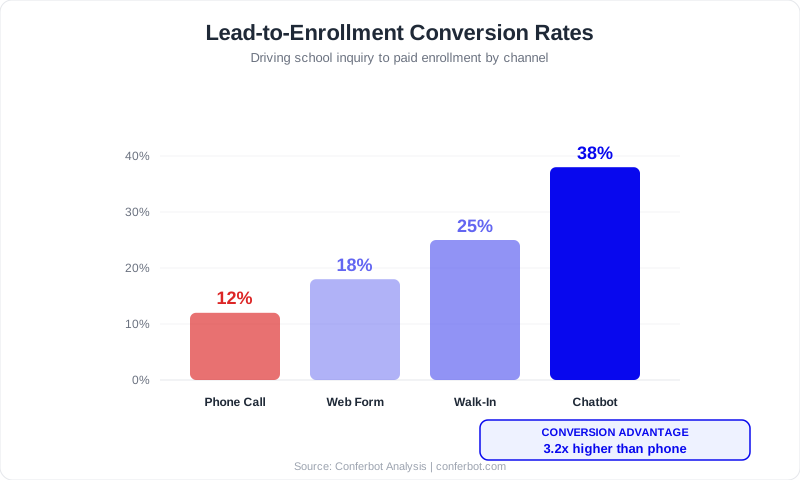
Why Chatbot Conversion Rates Are 3.2x Higher
The chatbot achieves a 38% conversion rate through several mechanisms that phone and form-based inquiries cannot replicate:
Instant response: The chatbot engages the moment a visitor lands on the website. There is no hold time, no voicemail, no callback wait. For a purchase decision that is often made within a single browsing session, instant engagement is the critical differentiator.
Structured qualification: The chatbot asks the right questions in the right order: age and license type needed (permit, license, defensive driving), preferred schedule (weekday, evening, weekend), course type (classroom + behind-the-wheel, online theory + in-car, refresher course), and budget considerations. Each answer narrows the recommendation to the best-fit program.
Immediate pricing transparency: Price is the number-one question prospective students ask. The chatbot provides package pricing instantly, with clear breakdowns of what is included: theory hours, behind-the-wheel hours, pickup/drop-off, test preparation, and vehicle use for the road test. Transparency builds confidence and reduces the "I need to compare prices" delay.
Enrollment in the same session: The chatbot can collect enrollment information — student name, parent/guardian contact (for minors), preferred start date, and payment — within the same conversation. The student goes from "I am curious" to "I am enrolled" in a single sitting, eliminating the dropout that occurs when enrollment requires a separate step.
Parent vs. Student Engagement
Driving schools serve a unique demographic split: the student is typically 15-17 years old, but the parent makes the purchasing decision and provides payment. The chatbot handles this by detecting the user type early: "Are you looking for driving lessons for yourself or for a family member?" Parent-facing flows emphasize safety record, instructor qualifications, insurance implications, and flexible scheduling. Student-facing flows emphasize the experience, instructor friendliness, and how quickly they can get their license. Both flows converge on the same enrollment path.
Lead Follow-Up for Non-Converters
For visitors who engage with the chatbot but do not enroll (roughly 62% of engaged visitors), the chatbot collects contact information and schedules automated follow-up. A sequence of 2-3 messages over the following week addresses common hesitations: pricing comparison guides, student testimonials, schedule flexibility assurances, and limited-time enrollment incentives. This drip sequence converts an additional 15-20% of initially undecided prospects — visitors who would have been permanently lost in a phone-only model. For schools looking to build a comprehensive lead generation playbook, the chatbot is the foundation.
Seasonal Enrollment Optimization
Driving school demand follows predictable seasonal patterns. Summer (June-August) is peak enrollment season as high school students use their break to complete driver education. January and September see secondary spikes as new semesters begin. November-December is typically the slowest period. The chatbot can present season-specific messaging to optimize enrollment throughout the year:
- Peak season (summer): "Summer classes are filling fast — only [X] spots remaining for the June session. Enroll now to secure your preferred schedule." Urgency-based messaging during peak season accelerates the enrollment decision.
- Shoulder season (fall/spring): "Fall classes offer smaller group sizes and more scheduling flexibility. Enroll now and get your license before the holidays." Value-based messaging highlights advantages of off-peak enrollment.
- Off-season (winter): "Winter enrollment special: save 15% on our complete driver education package when you enroll before January 31. Lock in your spring start date at today's prices." Discount-based messaging drives demand during slow periods.
Schools using seasonal chatbot campaigns report 20-30% more consistent enrollment throughout the year, reducing the feast-or-famine cycle that strains instructor scheduling and cash flow. The chatbot delivers these campaigns automatically based on calendar triggers, requiring no manual marketing effort from the school owner.
Lesson Booking and Schedule Management
Lesson scheduling is the operational heartbeat of every driving school — and it is the process most plagued by inefficiency. A typical driving school handles 40-80 lesson bookings per week through a combination of phone calls, text messages, and walk-in requests. The front desk or scheduling coordinator spends 3-5 hours daily managing this calendar, dealing with double-booking errors, instructor availability conflicts, and the constant churn of rescheduling requests.
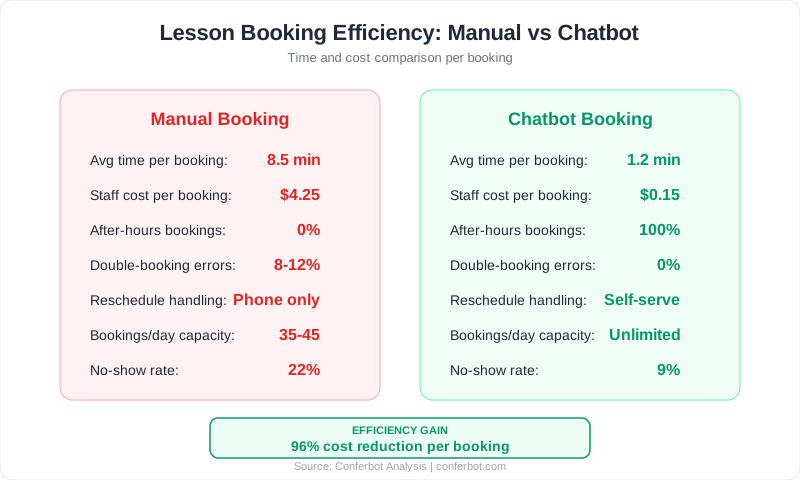
How Chatbot Scheduling Works
The chatbot connects to the school's scheduling system and provides real-time availability to students. The booking flow is straightforward:
- Lesson type selection: Behind-the-wheel lesson, classroom session, road test preparation, pre-test practice drive, or defensive driving class.
- Instructor preference: If the student has a preferred instructor, the chatbot shows that instructor's availability. If no preference, the chatbot shows all available slots sorted by the student's preferred time window.
- Time slot selection: The student selects from available slots. The chatbot shows only genuinely available times — eliminating the double-booking errors that plague phone-based scheduling.
- Pickup location: For behind-the-wheel lessons, the chatbot asks for the pickup address and confirms it is within the service area. It calculates drive time and adjusts the lesson window accordingly.
- Confirmation: The student receives immediate confirmation with the lesson date, time, instructor name, pickup location, and what to bring (permit, corrective lenses if applicable, comfortable shoes).
Rescheduling Self-Service
Rescheduling is where manual scheduling breaks down completely. A student texts "Can I move my lesson?" and the coordinator responds hours later with available options. The student is in class and does not respond until evening. The coordinator has gone home. The back-and-forth continues for days. The chatbot eliminates this entirely: the student says "I need to reschedule," sees available alternatives instantly, selects a new time, and receives confirmation — a process that takes 60 seconds instead of 2-3 days of texting.
Instructor Utilization Optimization
The chatbot can optimize instructor schedules by detecting gaps. If an instructor has a 2-hour gap between lessons, the chatbot can proactively offer that slot to students who need to reschedule or add lessons. This fill-rate optimization increases instructor utilization from the typical 65-70% to 80-85%, directly increasing revenue per instructor without adding any marketing cost.
Multi-Location Scheduling
For driving schools operating from multiple locations or serving multiple pickup zones, the chatbot adds a location layer to the booking flow. After selecting the lesson type, the student specifies their preferred pickup area or classroom location. The chatbot shows availability filtered by instructors who serve that zone, preventing the common problem of booking a lesson with an instructor who is on the opposite side of the city from the student's pickup address. Multi-location schools report that zone-aware scheduling reduces instructor dead time (driving between distant appointments) by 25-35%, which directly translates to additional lesson capacity and revenue.
Integration with DMV Test Scheduling
In states where driving schools can schedule DMV road tests on behalf of students, the chatbot can manage the test scheduling workflow. After the student completes their required hours, the chatbot prompts: "You have completed all behind-the-wheel requirements. Would you like us to schedule your DMV road test? We can book it at [Location] — typical wait times are 2-3 weeks." The chatbot collects necessary documentation confirmations and submits the scheduling request, removing yet another friction point from the student's path to licensure.
Automated Waitlist for Popular Times
Weekend and after-school time slots are perennially overbooked. The chatbot manages a waitlist for popular times and automatically notifies waitlisted students when a cancellation opens a slot. This fills cancellations that would otherwise result in lost instructor time and revenue.
Student Communication and Course Progress
Effective student communication is the difference between a 50% course completion rate and a 74% completion rate, reflecting engagement principles documented by the NHTSA's teen driving safety program. Driving school programs typically span 4-8 weeks, with students balancing lessons against school, work, extracurricular activities, and family obligations. Without proactive communication, students drift away — they miss a lesson, feel embarrassed, avoid rescheduling, and quietly drop out. The chatbot prevents this drift through structured, automated touchpoints.
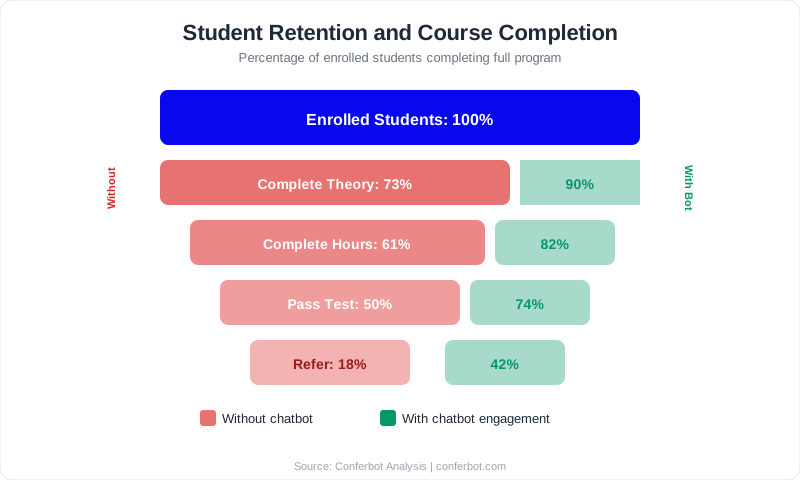
Pre-Lesson Reminders
The chatbot sends reminders at 24 hours and 2 hours before each lesson. The 24-hour reminder confirms the lesson time, instructor, and pickup location, and asks the student to confirm attendance. If the student cannot make it, the chatbot offers rescheduling immediately. The 2-hour reminder includes a practical checklist: "Remember to bring your permit, wear comfortable shoes, and make sure your pickup address is correct." These reminders reduce no-shows from 22% to 9%.
Post-Lesson Progress Updates
After each behind-the-wheel lesson, the chatbot sends a progress update: "Great lesson today! You have completed 6 of 10 behind-the-wheel hours. Skills practiced: parallel parking, highway merging. Next lesson: [date/time]." For parent-funded students, the chatbot can send a parallel update to the parent: "[Student] completed their 6th behind-the-wheel lesson today. They are making great progress on highway driving." Parents who feel informed about their investment are far less likely to allow their child to drop out.
Theory Progress and Quiz Preparation
For programs that include theory/classroom components, the chatbot can deliver study reminders, practice quiz questions, and DMV test preparation tips. A daily question delivered via chat ("What is the correct following distance at 55 mph?") keeps theory material fresh between classroom sessions and has been shown to improve first-attempt DMV written test pass rates by 15-25%.
Milestone Celebrations
The chatbot celebrates key milestones throughout the program: first behind-the-wheel lesson completed, theory section passed, halfway through driving hours, road test scheduled, and license obtained. These celebrations create positive associations with the school and encourage the student to continue when motivation dips — which most commonly occurs around the 60% completion mark.
Referral Automation
After course completion and license acquisition, the chatbot sends a congratulatory message and a referral offer: "Congratulations on getting your license! Know someone who needs driving lessons? Share this link for $50 off their enrollment — and you will receive a $25 thank-you credit." Students who complete their program through chatbot-engaged schools refer at 42% compared to 18% for non-chatbot schools — a 133% increase in referral volume that directly reduces customer acquisition cost.
Parent Communication Channel
For teen driving programs, the parent is often the stakeholder most concerned about progress — and the least informed. The chatbot provides a parallel communication channel for parents that keeps them engaged and confident in their investment:
- Enrollment confirmation: Parents receive a summary of the enrolled program, schedule, payment receipt, and what to expect during the course.
- Weekly progress updates: "This week, [Student] completed 2 behind-the-wheel lessons covering city driving and parking maneuvers. They have 6 of 10 required hours completed."
- Test readiness notification: "[Student] has completed all required hours and classroom sessions. Your instructor recommends scheduling the road test within the next 2-3 weeks. Would you like us to schedule it?"
- Billing reminders: For installment plans, the chatbot notifies parents of upcoming payment dates and provides one-tap payment links.
This parent communication layer serves a dual purpose: it reduces the anxiety that parents feel when they have limited visibility into a significant investment, and it prevents the scenario where a parent calls the school every week asking for updates — consuming staff time that could be spent on instruction or enrollment. Schools deploying parent-facing chatbot communication report 60-70% fewer inbound parent calls, which frees the front desk to focus on new enrollment activities. The parent's experience also drives referral behavior — a parent who felt informed and valued throughout the process is significantly more likely to recommend the school to other parents.
Pricing, Packages, and Payment Automation
Price is the single most asked question by prospective driving school students, a transparency expectation that the FTC's advertising guidelines reinforce for consumer-facing businesses and their parents. According to industry surveys, 89% of prospective students visit multiple driving school websites before enrolling, and the primary comparison criteria are price, schedule availability, and reviews. A chatbot that provides instant, transparent pricing removes the friction that causes prospects to "keep looking" and never return.
How the Chatbot Presents Pricing
The chatbot presents pricing contextually, based on the student's needs:
- Permit preparation only: Theory/classroom course pricing for students who need to pass the written test before getting their learner's permit.
- Complete package: Theory + behind-the-wheel hours + road test preparation. This is the most popular option and should be presented as the best value.
- Behind-the-wheel only: For students who completed theory online or through another provider and need only in-car instruction.
- Road test preparation: A focused 2-3 lesson package for students who have completed their hours but want extra practice before the test.
- Defensive driving: Court-mandated or insurance-discount courses, priced separately from new-driver programs.
- Adult driver education: Programs for students over 18, which typically have different hour requirements and pricing.
Payment Integration
The chatbot can process enrollment payments directly within the conversation — a critical capability because every additional step between "I want to enroll" and "payment complete" increases dropout risk. Payment options typically include full payment at enrollment (with a discount incentive), installment plans (split into 2-4 payments), and deposit-to-hold (a smaller upfront payment to reserve a spot, with the balance due before the first lesson).
Upselling and Add-Ons
After the student selects a base package, the chatbot can present relevant add-ons: extra behind-the-wheel hours beyond the minimum required, highway driving practice (in areas where highway driving is not included in the base program), night driving instruction, vehicle use for the road test, and expedited scheduling (guaranteed lessons within the next week). These add-ons typically represent $50-$200 in incremental revenue per student. A chatbot that presents them at the right moment in the enrollment flow achieves a 25-35% add-on attachment rate — significantly higher than the 8-12% achieved through verbal upselling during phone enrollment. This mirrors the broader pattern seen in AI chatbot upselling across industries.
Review Generation and Reputation Management
Online reviews are the primary trust signal for driving school selection. A Google Business Profile with 200 reviews and a 4.7 rating will outperform a competitor with 15 reviews and a 4.9 rating — volume signals reliability and recency. Yet most driving schools generate reviews passively, relying on the occasional student who decides to leave one unprompted. The chatbot systematizes this process.
Timing the Review Request
The chatbot sends the review request at the optimal moment: immediately after the student passes their road test and receives their license. This is the peak emotional high of the entire driving school experience — the student is thrilled, grateful, and most likely to share a positive review. Delaying the request by even a few days reduces response rates by 40-60% as the emotional intensity fades.
The message is simple and direct: "Congratulations on passing your road test! We are so proud of you. Would you take 30 seconds to share your experience on Google? Your review helps other students find us. [Direct Google review link]" The direct link is critical — it takes the student directly to the review input field, eliminating the navigation friction that kills review completion.
Handling Negative Feedback
Before routing to a public review, the chatbot asks a satisfaction question: "How would you rate your experience with [School Name]?" Students who select 4-5 stars are directed to Google. Students who select 1-3 stars are routed to a private feedback form: "We are sorry your experience was not great. Can you tell us what we could improve? Your feedback goes directly to our management team." This routing does not suppress negative reviews — students can still leave public reviews if they choose — but it gives the school an opportunity to address concerns privately before they become public. According to BrightLocal research, 88% of consumers trust online reviews as much as personal recommendations, making reputation management essential for driving schools.
Review Volume Impact
Schools using chatbot-automated review requests generate 4-6x more Google reviews per month than schools relying on verbal requests. For a school enrolling 25 students per month, this translates from 2-3 reviews per month (organic) to 10-15 reviews per month (chatbot-driven). Over a year, that is the difference between 30 and 150+ new reviews — a transformative impact on Google Business Profile visibility, local search ranking, and prospective student trust.
Leveraging Reviews for Social Proof in the Enrollment Flow
The chatbot does not just generate reviews — it leverages them throughout the enrollment conversation. When a prospective student asks about instructor quality, the chatbot can surface relevant testimonials: "Our instructors have a 4.8 average rating. Here is what a recent student said: 'My instructor made me feel completely comfortable behind the wheel. I passed on my first try!' — Sarah M., licensed May 2026." This real-time social proof addresses trust concerns that would otherwise stall the enrollment decision. Schools that embed review snippets in the chatbot enrollment flow report 10-15% higher conversion rates compared to flows that rely solely on pricing and scheduling information.
The chatbot can also request specific types of feedback after course completion: "Would you be willing to share your experience about how our instructors helped with your highway driving confidence?" These targeted review requests generate detailed, keyword-rich reviews that improve SEO for specific search terms like "patient driving instructor" or "highway driving lessons [city]." The reviews that prospective students find most persuasive are those that describe specific experiences — overcoming nervousness, mastering parallel parking, passing the road test on the first attempt — rather than generic five-star ratings. By guiding the review content, the chatbot builds a library of compelling social proof that compounds its enrollment impact over time.
ROI Model: The Business Case for Driving School Chatbots
The return on investment for a driving school chatbot is driven by five revenue streams, following the small business ROI methodology recommended by the U.S. Small Business Administration, each directly measurable through enrollment records and scheduling data.
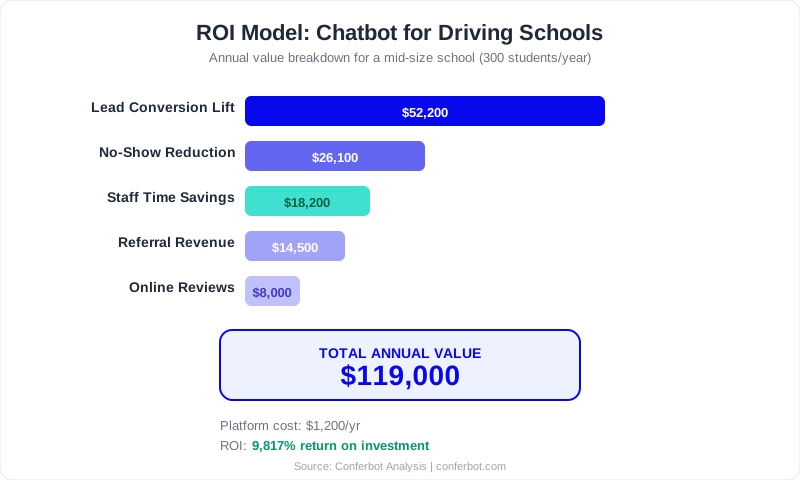
Revenue Stream 1: Lead Conversion Lift — $52,200/year
Improving conversion from 12% (phone) to 38% (chatbot) on 500 annual inquiries means converting 130 additional students. At an average enrollment value of $800:
- Additional enrollments: 500 x (0.38 - 0.12) = 130 students
- Revenue per student: $800 average (including add-ons)
- Conservative estimate (not all inquiries come through chatbot): 65 incremental students
- Annual impact: $52,200
Revenue Stream 2: No-Show Reduction — $26,100/year
Reducing lesson no-shows from 22% to 9% for a school with 4 instructors, each conducting 6 lessons per day at $75/lesson:
- Baseline missed: 24 daily lessons x 22% = 5.3 missed/day
- With chatbot: 24 x 9% = 2.2 missed/day
- Recovered: 3.1 lessons/day x $75 x 250 days x 45% (adjusted for partial fills) = $26,100
Revenue Stream 3: Staff Time Savings — $18,200/year
Automating enrollment inquiries, lesson booking, and rescheduling saves 3 hours/day of scheduling coordinator time:
- 3 hours/day x $20/hour x 250 days = $15,000 direct savings
- Plus: eliminated scheduling errors, faster processing, reduced phone costs
- Total value: $18,200/year
Revenue Stream 4: Referral Revenue — $14,500/year
Increasing referral rate from 18% to 42% of graduating students, with 300 graduates per year:
- Additional referrals: 300 x (0.42 - 0.18) = 72 referred students
- Referral conversion rate: 50% (warm leads convert higher)
- 36 additional students x $800 = $28,800 gross, minus $50 referral discount each
- Net annual referral revenue: $14,500
Revenue Stream 5: Online Reviews — $8,000/year
Improved Google Business Profile visibility from 4x review volume drives additional organic enrollment:
- Each position improvement in local pack drives 10-15% more impressions
- Estimated 10 additional organic enrollments x $800
- Annual review-driven revenue: $8,000
Total Annual ROI
| Revenue Stream | Annual Value |
|---|---|
| Lead conversion lift | $52,200 |
| No-show reduction | $26,100 |
| Staff time savings | $18,200 |
| Referral revenue | $14,500 |
| Online reviews | $8,000 |
| Total | $119,000 |
Against a chatbot platform cost of $1,200/year, the ROI exceeds 9,800%. Even discounted by 50%, the payback period is under one week.
Implementation Guide: From Template to Live
Deploying a driving school chatbot does not require technical expertise. Conferbot's no-code builder and education-specific templates allow most driving schools to be live within 3-5 days.
Day 1: Template Setup
Start from the template: Open Conferbot's driving school chatbot template. Customize the school name, branding, logo, and welcome message. The template includes pre-built flows for enrollment inquiries, lesson booking, pricing presentation, and student communication.
Configure course offerings: Enter your course types (teen driver education, adult program, defensive driving, road test prep), pricing for each, and included hours. Set up add-on options with pricing.
Configure instructors: For each instructor, enter their name, availability schedule, service area (for pickup locations), and any specializations (nervous drivers, highway driving, manual transmission).
Day 2: Schedule Integration
Connect your calendar: Link the chatbot to your scheduling system. If you use Google Calendar, Acuity, Calendly, or a custom scheduling tool, Conferbot's integrations handle the connection. The chatbot reads real-time availability and books directly into your calendar.
Set up payment: Connect Stripe, Square, or your preferred payment processor to enable in-chat enrollment payment.
Day 3: Testing
Test all flows: Have your front desk, each instructor, and 2-3 current students test the complete chatbot experience. Test enrollment, lesson booking, rescheduling, progress updates, and review requests.
Review pricing presentation: Ensure all package prices are correct and clearly presented. Test the add-on upsell flow to confirm it feels natural, not pushy.
Day 4-5: Launch
Embed on your website: Add the Conferbot script to every page. The chatbot greets visitors with: "Want to get your license? I can help you find the right driving course, check availability, and get enrolled — all in a few minutes."
Enable on WhatsApp: Many driving school inquiries come through WhatsApp, especially from parents in communities where WhatsApp is the primary messaging platform. Deploy the chatbot on WhatsApp for additional reach.
Staff training: Brief your scheduling coordinator and instructors on how the chatbot works. Show them where to find chatbot-collected enrollment data and how to update instructor availability.
Post-Launch: Ongoing Optimization
Review analytics weekly for the first month. Track: enrollment conversion rate by source, lesson booking completion rate, no-show rates before and after chatbot, popular inquiry topics not covered by the chatbot, and peak engagement times. Use these insights to refine messaging, add missing FAQ answers, and optimize the enrollment flow. Connecting with Conferbot's analytics dashboard provides real-time visibility into all these metrics.
Best Practices for Driving School Chatbots
These best practices are drawn from driving schools that have successfully deployed chatbots to increase enrollment, improve student retention, and generate more revenue per instructor.
1. Answer the Price Question Immediately
Do not gate pricing behind a form or phone call. The number one reason prospective students leave a driving school website is that they cannot find the price. The chatbot should provide package pricing within the first 2-3 exchanges. Transparency builds trust and keeps the prospect in your funnel instead of sending them to a competitor.
2. Address Parent Concerns Separately
Parents have different concerns than students. They want to know about safety records, instructor background checks, vehicle maintenance, insurance coverage, and what happens if their child needs extra lessons. The chatbot should detect parent inquiries and serve content that addresses these specific concerns.
3. Make Rescheduling Effortless
Lesson cancellations are inevitable — students are teenagers with busy, unpredictable schedules. The chatbot should make rescheduling a one-tap process. A student who can reschedule in 30 seconds is far less likely to drop out than one who needs to call the office and wait for a callback.
4. Send Pickup Reminders with Details
For behind-the-wheel lessons, the chatbot should send a reminder that includes the instructor's name, vehicle description (make, model, color), pickup time, and pickup location confirmation. This eliminates the confusion that leads to missed pickups and wasted instructor time.
5. Track Progress Visually
Students and parents should be able to ask the chatbot "How many hours do I have left?" at any time and receive a clear progress summary: hours completed, hours remaining, skills covered, and estimated completion date. Visual progress tracking motivates continued participation.
6. Offer Seasonal Promotions Through the Chatbot
Driving schools experience seasonal demand patterns — summer is peak enrollment season, and January-February is typically slow. The chatbot can promote off-season discounts and early enrollment specials to smooth demand: "Enroll now for spring classes and save 15%. Lock in your preferred schedule before summer rush."
7. Follow Up on Expired Leads
Prospects who engaged with the chatbot but did not enroll should receive a follow-up sequence. A simple 3-message sequence over two weeks (pricing reminder, student testimonial, limited-time offer) converts 15-20% of initially undecided prospects. These are warm leads that cost nothing to acquire — the chatbot already captured their information.
8. Collect Parent Testimonials
After a student completes the program and obtains their license, ask the parent for a testimonial: "How was your experience with [School Name]? Your feedback helps other parents make the right choice for their teen." Parent testimonials carry exceptional weight with the next generation of prospects, because parents trust other parents.
Was this article helpful?
About the Author
Conferbot Team specializes in conversational AI, chatbot strategy, and customer engagement automation. With deep expertise in building AI-powered chatbots, they help businesses deliver exceptional customer experiences across every channel.
View all articles