
Post Purchase Survey
Free B2B Services Chatbot Template
A complete post purchase survey chatbot template - deploy in minutes to automate conversations, capture leads, and provide 24/7 assistance.


How this template opens - rendered from its flow. Use the interactive preview to click through the full conversation.
What Is a Post-Purchase Survey Chatbot?
A post-purchase survey chatbot is a conversational AI tool that engages customers immediately after a purchase -- during the delivery window, upon order receipt, or after initial product use -- to collect structured feedback about the complete buying experience. Instead of sending a generic email survey 48 hours after delivery that competes with dozens of other inbox messages, the chatbot initiates a natural dialogue through the customer's preferred channel, capturing feedback while the purchase experience is fresh, emotions are high, and the customer is most receptive to engagement.
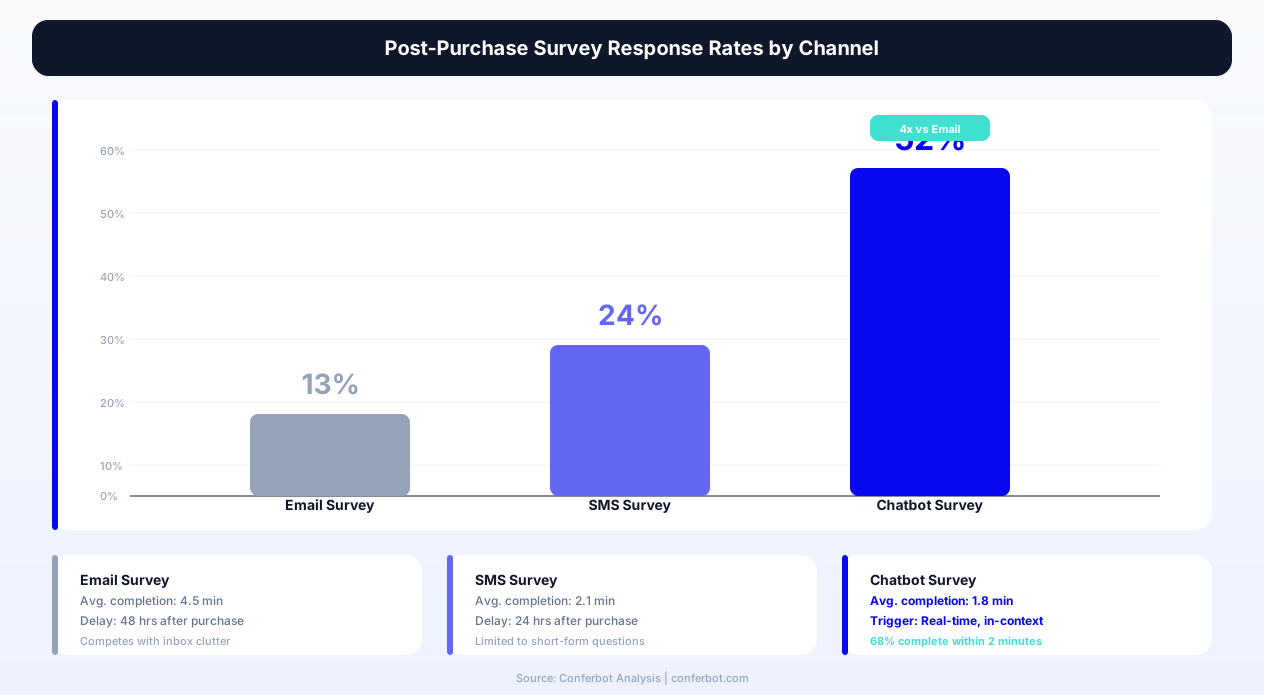
In the e-commerce landscape of 2026, post-purchase feedback is simultaneously the most valuable and most underutilized data source for growth. Every purchase is a moment of truth -- the customer has invested money and attention, their expectations are crystallized, and the gap between expectation and reality determines whether they become a repeat buyer, a vocal advocate, or a silent churner. Post-purchase surveys triggered via conversational chat capture dramatically more feedback than email-delivered surveys, and the large majority of respondents complete the chatbot survey within 2 minutes -- fast enough to capture genuine reactions without burdening the customer.
But the value of a post-purchase chatbot extends far beyond data collection. The chatbot transforms the post-purchase survey from a one-way extraction ("tell us about your experience") into a bidirectional engagement opportunity. Satisfied customers are guided toward review submission and referral programs. Dissatisfied customers are routed to resolution workflows before they leave a negative review. Neutral customers receive product tips and cross-sell recommendations that enhance their experience and drive repeat purchases. The survey itself becomes a retention and revenue tool.
Conferbot's AI chatbot builder provides a pre-built post-purchase survey template optimized for e-commerce businesses that need to close the feedback loop at scale. The template covers delivery experience assessment, product satisfaction scoring, review generation flows, referral trigger identification, repeat purchase intent measurement, and issue detection with automated resolution routing. It deploys across website, WhatsApp, SMS, and email channels with order-context personalization that makes every survey feel relevant and timely.
This page covers the complete post-purchase feedback strategy: optimal timing for different survey goals, question architecture that maximizes both insight quality and commercial value, integration with e-commerce platforms and CRM tools, review generation tactics, issue detection and recovery workflows, and deployment best practices for e-commerce brands of all sizes.
Why Post-Purchase Feedback Is the Most Valuable Data in E-Commerce
Post-purchase is the inflection point in the customer relationship -- the moment that determines whether a transaction becomes a relationship. Understanding why this moment is uniquely valuable for feedback collection changes how you approach survey design, timing, and follow-up actions.
The Emotional Amplification Window
Customers experience heightened emotional engagement in the 24-72 hours after receiving a purchase. Positive experiences generate gratitude, excitement, and social sharing impulse. Negative experiences generate frustration, buyer's remorse, and complaint motivation. Both emotional states produce richer, more detailed feedback than the neutral emotional baseline of a typical survey invitation. A chatbot survey delivered during this window captures the emotional texture of the experience -- specific details, vivid language, and genuine reactions -- that decay rapidly after the first few days.
The Silent Majority Problem
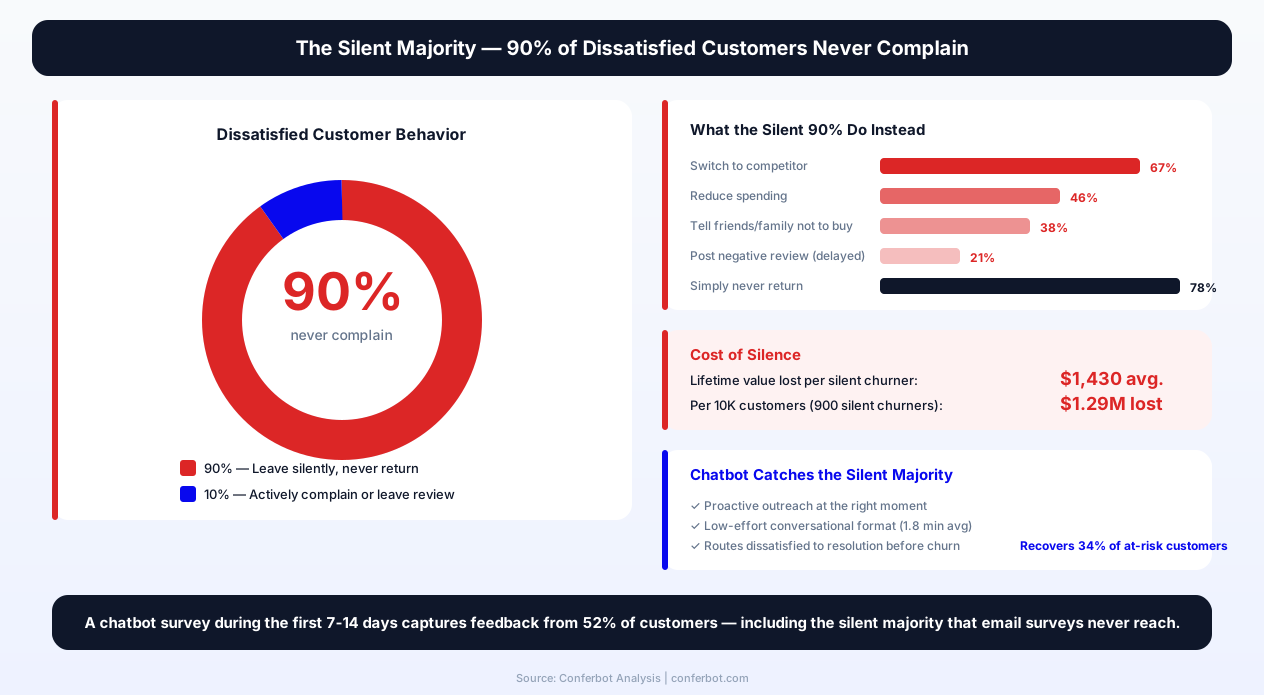
In 2026, only a small minority of dissatisfied customers proactively complain. The large majority simply do not return. They never leave a negative review; they never contact support; they never explain why they did not come back. They disappear silently, and the business never learns what went wrong. A post-purchase chatbot survey reaches this silent majority proactively, surfacing issues that would otherwise be invisible until they appear as declining retention metrics months later.
The Repeat Purchase Decision Window
The first 7-14 days after receiving a product is when the repeat purchase decision is being subconsciously formed. The customer is evaluating: "Was this worth it? Would I buy again? Would I buy from this brand again?" A chatbot survey during this window not only captures the assessment but actively shapes it -- by acknowledging the customer's experience, resolving any issues, and demonstrating that the brand cares about their satisfaction, the survey interaction itself positively influences the repeat purchase decision.
| Post-Purchase Data Point | Business Value | Traditional Method | Chatbot Method |
|---|---|---|---|
| Delivery experience rating | Logistics quality monitoring and carrier evaluation | Email survey (low response) | Chatbot survey (meaningfully higher response) |
| Product satisfaction score | Product quality assurance and listing accuracy | Review request email (low write-rate) | Guided review flow (meaningfully higher write-rate) |
| Issue detection | Prevents negative reviews and enables proactive recovery | Reactive support tickets | Proactive issue surfacing within 24-48 hours |
| Referral willingness | Identifies and activates organic growth engine | Generic referral program signup | Contextual referral ask after satisfaction confirmed |
| Repeat purchase intent | Revenue forecasting and retention marketing targeting | Behavioral prediction (60-day lag) | Self-reported intent (immediate signal) |
| Cross-sell receptivity | Identifies product recommendation opportunities | Algorithmic recommendation only | Preference-informed recommendation + timing |
| Packaging and unboxing feedback | Brand experience optimization | Almost never collected | Systematically collected during unboxing window |
| Price perception | Pricing strategy validation | Separate pricing survey | Embedded in post-purchase context |
The Dual Value of Post-Purchase Surveys
Unlike most survey types that are purely extractive (collecting data for the company's benefit), a well-designed post-purchase chatbot survey delivers value to both the company and the customer. The customer gets: a channel to report issues that gets immediate resolution, a sense that the brand cares about their experience, useful product tips or care instructions, and early access to relevant new products. The company gets: satisfaction data, review generation, issue detection, referral activation, and repeat purchase intelligence. This mutual value exchange is why chatbot post-purchase surveys achieve engagement rates that email surveys cannot match.
Key Features of Conferbot's Post-Purchase Survey Chatbot Template
Conferbot's post-purchase template is designed for e-commerce brands that need to close the feedback loop at scale while simultaneously driving reviews, referrals, and repeat purchases. Every feature serves a dual purpose: collecting insight and creating commercial value.
| Feature | What It Does | Data Value | Commercial Value |
|---|---|---|---|
| Order-context personalization | Pre-populates the chatbot with order details (product name, order date, delivery date) from your e-commerce platform | Enables product-specific and order-specific feedback analysis | Personalization meaningfully increases response rates |
| Multi-stage survey timing | Delivers different survey stages at different post-purchase moments (delivery confirmation, 3-day post-delivery, 14-day product use) | Captures time-sensitive data at the optimal moment for each data point | Multi-touch engagement builds relationship |
| Delivery experience module | Assesses delivery speed, packaging condition, carrier experience, and delivery communication quality | Monitors logistics partner performance and identifies systemic delivery issues | Fast issue detection prevents negative reviews |
| Product satisfaction scoring | Rates product quality, accuracy vs. listing description, value for money, and initial use experience | Product quality trending and listing accuracy monitoring | Identifies products needing listing updates |
| Guided review generation | Routes satisfied customers (4-5 star ratings) to review submission on your platform, Google, or marketplace | Increases review volume for product social proof | Satisfied customers convert to reviews at a meaningfully higher rate |
| Issue detection and escalation | Identifies dissatisfied customers, captures issue details, and routes to support for immediate resolution | Issue categorization and trending for quality improvement | Resolves issues before negative reviews are posted |
| Referral trigger activation | Presents referral offer to customers who express high satisfaction and willingness to recommend | Identifies natural advocates and referral conversion rates | Converts satisfaction into measurable referral revenue |
| Repeat purchase intent measurement | Asks about likelihood of repurchase and interest in related products | Cohort-level repeat purchase prediction | Feeds retention marketing with intent-qualified audiences |
| Photo review collection | Invites satisfied customers to share product photos for social proof | Authentic customer imagery for product pages | User-generated content drives meaningfully higher conversion |
| Cross-sell recommendation | Based on purchase history and expressed preferences, suggests complementary products | Cross-sell receptivity data by product category | Chatbot-delivered recommendations convert at a solid rate |
Intelligent Satisfaction Branching
The chatbot's core logic branches based on the customer's satisfaction signal, routing each customer to the highest-value follow-up path:
- Highly satisfied (5 stars / "Loved it") -- Review request, photo submission, referral offer, cross-sell recommendation
- Satisfied (4 stars / "Good") -- Brief follow-up on what would make it excellent, review request, product care tips
- Neutral (3 stars / "It was okay") -- Probe for specific improvement areas, product usage tips, satisfaction check-back scheduling
- Dissatisfied (1-2 stars / "Disappointed") -- Issue identification, immediate support routing, resolution offer, satisfaction recovery flow
This branching ensures that every customer interaction generates maximum value -- advocates are activated, moderate customers are nurtured, and unhappy customers are recovered -- all within a single automated conversation flow built through the visual flow builder.
Multi-Stage Timing Architecture
A single post-purchase survey misses important data because different aspects of the experience unfold at different times. Conferbot's template supports multi-stage survey delivery:
- Stage 1: Delivery confirmation (Day 0) -- "Your order arrived! How was the delivery experience?"
- Stage 2: Initial product use (Day 3-5) -- "You have had [product] for a few days now. How is it working for you?"
- Stage 3: Extended use assessment (Day 14-21) -- "After a couple weeks with [product], how satisfied are you overall?"
Each stage is brief (1-3 questions) and only triggers if the customer engaged with the previous stage or if the stage's specific data is business-critical. The multi-stage approach captures the full arc of post-purchase experience without overwhelming the customer with a lengthy single survey.
Ready to try Post Purchase Survey?
Deploy this template in under 10 minutes. No coding required.
Use This Template Free →Review Generation Engine: Converting Satisfaction into Social Proof
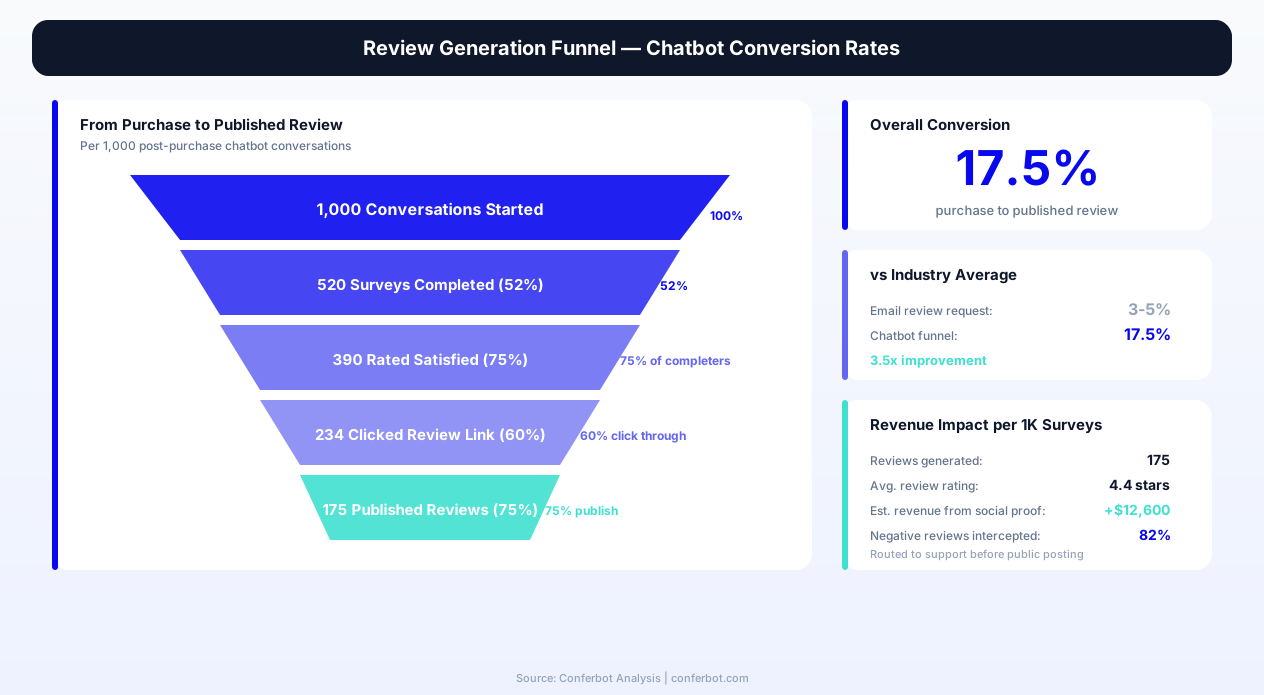
One of the most commercially valuable functions of the post-purchase chatbot is its ability to systematically convert customer satisfaction into public reviews. In 2026, the large majority of consumers read reviews before purchasing, and products with a healthy volume of reviews convert at a meaningfully higher rate than products with zero reviews. Yet the average e-commerce review request email generates a review from only a small share of recipients. The chatbot approach generates reviews from a substantially higher share of satisfied customers.
Why Chatbot Review Requests Outperform Email
The chatbot's review conversion advantage comes from three factors that email cannot replicate:
- Satisfaction confirmation before the ask -- The chatbot only asks for a review after confirming the customer is satisfied (4-5 stars). Email review requests go to every customer regardless of satisfaction, and dissatisfied customers receiving a review request are more likely to leave a negative review than they are to ignore it
- Momentum and micro-commitment -- By the time the chatbot asks for a review, the customer has already articulated what they liked about the product. Writing a review feels like a natural extension of the conversation rather than a new task
- Friction reduction -- The chatbot can pre-populate the review with the customer's own words from the conversation, requiring only a confirmation click rather than blank-page writing
The Review Generation Flow
The chatbot's review generation sequence for satisfied customers follows a proven conversion architecture:
- Satisfaction confirmation -- "We are glad you are enjoying [product]! Would you mind sharing your experience with a quick review?"
- Platform selection -- "Where would you like to leave your review?" [Your website / Google / Amazon / Trustpilot]
- Content assistance -- "Here is a draft based on what you shared: '[customer's own words from earlier in the conversation].' Feel free to edit or use as-is."
- Direct link delivery -- Provides a one-click link to the review submission page on the selected platform
- Gratitude and incentive -- "Thank you so much! As a thank-you, here is 10% off your next order." [Optional incentive]
Photo Review Collection
Photo reviews are the gold standard of social proof -- they generate meaningfully more trust and higher conversion impact than text-only reviews. The chatbot encourages photo submissions by asking satisfied customers: "Would you like to share a photo of [product]? Customer photos help other shoppers see the real product." The chatbot accepts photo uploads directly in the conversation (on WhatsApp and web widget channels) and routes them to your review platform or product page gallery with appropriate permissions.
Review Distribution Strategy
Not all reviews are equally valuable on all platforms. The chatbot can intelligently route review requests to the platforms where they will have the most impact:
- Products with < 10 reviews on primary platform -- Route to your primary marketplace (Amazon, Shopify store) to build critical mass
- Products with adequate marketplace reviews -- Route to Google Business Profile to improve local SEO and search visibility
- High-satisfaction, articulate customers -- Route to Trustpilot or G2 for detailed, high-credibility reviews that support brand authority
Proactive Issue Detection and Recovery Workflow
The fastest path to a negative review is a dissatisfied customer who has no easy way to resolve their issue. The post-purchase chatbot creates that easy path proactively -- surfacing problems before the customer resorts to public complaint channels.
The Issue Detection Pipeline
When a customer indicates dissatisfaction (1-2 star rating, negative language, or issue keywords), the chatbot activates an issue detection and resolution pipeline:
- Issue categorization -- The chatbot asks structured questions to categorize the issue: "What went wrong?" [Product damaged / Wrong item / Not as described / Delivery issue / Quality below expectations / Other]
- Detail capture -- Follow-up questions gather the specific details support needs for resolution: "Can you describe the issue?" and "Would a photo help us understand the problem?" (photo upload enabled)
- Urgency assessment -- "How urgently does this need to be resolved?" [Need immediate help / Within a day or two / Not urgent, just sharing feedback]
- Resolution preference -- "How would you like us to resolve this?" [Replacement / Refund / Discount on next order / Just want you to know for improvement]
- Immediate routing -- Based on issue type and urgency, the chatbot either resolves automatically (discount code delivery, instant refund initiation) or creates a prioritized support ticket with full context
Automated Resolution for Common Issues
For high-frequency, low-complexity issues, the chatbot can resolve without human intervention:
- Minor damage / cosmetic defect -- Automatically offers a replacement or partial refund based on configurable policies
- Late delivery -- Provides updated tracking information and a shipping credit
- Wrong size / variant -- Initiates an exchange flow with prepaid return label
- Below expectations (but not defective) -- Offers a discount on the next purchase and collects feedback for product listing improvement
These automated resolutions handle a large share of post-purchase issues without human support involvement, reducing support costs while dramatically improving resolution speed. For the customer, getting a resolution offer within 30 seconds of reporting an issue creates a positive service recovery experience that actually increases loyalty above pre-issue levels -- the service recovery paradox.
The Negative Review Prevention Impact
The financial value of proactive issue detection is substantial. A single negative review carries a real cost in lost potential revenue across future customers who see it. By surfacing and resolving issues before they become negative reviews, the chatbot prevents a meaningful number of negative reviews per 1,000 orders for Conferbot customers -- representing real protected revenue from negative review prevention alone, independent of the satisfaction and retention benefits of fast issue resolution.
Issue Trending and Quality Intelligence
Beyond individual issue resolution, the chatbot aggregates issue data into quality intelligence dashboards that reveal systemic problems:
- Product-level issue rates -- Which products generate the most complaints, and for what reasons?
- Category-level patterns -- Are delivery issues concentrated with a specific carrier? Are quality issues concentrated in a specific product category or supplier?
- Temporal patterns -- Are issue rates spiking after a recent batch or supplier change?
- Regional patterns -- Are certain regions experiencing more delivery issues, indicating logistics network problems?
This intelligence feeds directly into supply chain, logistics, and product quality improvement decisions, transforming individual customer complaints into organizational learning.
Referral Activation and Repeat Purchase Optimization
The post-purchase survey chatbot is uniquely positioned to activate two of the most valuable growth levers in e-commerce: referrals from satisfied customers and repeat purchases from the current buyer.
Contextual Referral Activation
Traditional referral programs suffer from poor activation rates because they are promoted generically -- a banner on the website, a link in the order confirmation email, or a static page that most customers never visit. The chatbot changes this by presenting the referral opportunity at the moment of peak satisfaction, in a conversational context where the customer has just articulated what they love about the product.
The referral flow activates only for customers who have expressed high satisfaction (4-5 stars) and responds positively to the referral prompt:
- Natural bridge -- "Since you are loving [product], would you like to share it with someone? They will get [discount], and you will get [reward]."
- Sharing mechanism -- The chatbot generates a unique referral link and offers sharing via WhatsApp, email, or social media -- the customer can share directly from the conversation
- Incentive delivery -- The referral reward (discount code, store credit, free product) is delivered when the referred friend completes their first purchase
E-commerce brands using Conferbot's contextual referral activation report substantially higher referral program participation rates among satisfied post-purchase survey respondents than for generic referral program promotional placements. The quality of referred customers is also higher: they show a meaningfully higher first-purchase conversion rate and higher lifetime value than non-referred customers.
Repeat Purchase Intent and Cross-Sell
The post-purchase survey captures explicit repeat purchase signals that improve retention marketing precision:
- "Will you buy from us again?" -- Segments customers into likely-repeaters (target for loyalty program), uncertain (target for re-engagement), and unlikely (investigate and learn from)
- "What other products interest you?" -- Captures explicit category interest that supplements algorithmic recommendation
- "When will you need to replenish?" -- For consumable products, captures reorder timing for precisely timed reorder reminders
This self-reported intent data is meaningfully more predictive of actual repeat purchase behavior than behavioral prediction models alone, because it captures the customer's conscious intention rather than inferring from past behavior patterns that may not repeat.
Smart Cross-Sell Within the Survey
For satisfied customers who engage through the full survey, the chatbot can present a contextual product recommendation:
"Customers who loved [purchased product] also love [recommended product]. Would you like to check it out?"
This recommendation is more effective than algorithmic email recommendations because it occurs in a conversational context where the customer has just confirmed satisfaction with their purchase, their trust is elevated, and they are already engaged in a dialogue with the brand. Chatbot-delivered cross-sell recommendations convert at a meaningfully higher click-through rate than email recommendation widgets, because the social proof ("customers who loved...") and conversational delivery reduce the commercial friction.
businesses worldwide use Conferbot templates to automate conversations
E-Commerce Platform Integration and Technical Setup
Conferbot's post-purchase chatbot integrates natively with major e-commerce platforms to enable order-context personalization, automated trigger timing, and data flow into your existing commerce stack.
Supported E-Commerce Platforms
- Shopify / Shopify Plus -- Native app integration with automatic order event triggers, product data pull, and customer profile sync. Installs in under 10 minutes from the Shopify App Store
- WooCommerce -- WordPress plugin integration with order status hooks, product metadata, and customer data sync
- BigCommerce -- API-based integration with webhook triggers on order status changes
- Magento / Adobe Commerce -- Enterprise integration with full order lifecycle event support
- Custom platforms -- REST API and webhook integration via Conferbot's API integration for any platform with order event capabilities
Order Event Trigger Configuration
The chatbot triggers based on order lifecycle events from your e-commerce platform:
- Order delivered -- Triggers delivery experience survey (recommended: 2-4 hours after delivery confirmation)
- Delivery + 3 days -- Triggers initial product satisfaction survey
- Delivery + 14 days -- Triggers extended use assessment and review request
- Order returned/exchanged -- Triggers return experience survey and issue capture
Order Context Personalization
The chatbot automatically personalizes every conversation with order context pulled from your e-commerce platform:
- Customer name for personal greeting
- Product name and image for specific feedback collection
- Order date and delivery date for timing-aware questions
- Order value for resolution policy calibration (higher-value orders may receive more generous resolution offers)
- Customer history (first-time vs. repeat) for conversation tone adjustment
Data Flow Architecture
Survey response data flows back to your commerce and marketing stack through native integrations:
- CRM/CDP sync -- Customer satisfaction scores, review status, referral participation, and repeat purchase intent are written to the customer profile in Klaviyo, Omnisend, HubSpot, or your CDP
- Review platform sync -- Reviews collected through the chatbot are pushed to Yotpo, Judge.me, Stamped.io, or your native review system
- Support platform sync -- Issue tickets are created in Zendesk, Gorgias, Freshdesk, or your support platform with full context
- Analytics sync -- Survey engagement and conversion data feeds into Google Analytics 4, Mixpanel, or your analytics platform for funnel analysis
Channel Delivery Options
The post-purchase survey can be delivered through the channel most likely to reach the customer:
- WhatsApp -- Highest engagement rates for mobile-first markets; delivered as a conversational message in the order tracking thread
- SMS -- High reach for markets with lower WhatsApp penetration; brief initial message with chatbot link
- Website widget -- Triggered when the customer returns to the site post-purchase; ideal for brands with high site revisit rates
- Email -- Embedded chatbot link in a branded post-purchase email; lower response than WhatsApp but broader reach
Before and After: Measuring Post-Purchase Survey Impact
E-commerce brands implementing Conferbot's post-purchase chatbot consistently report improvements across both customer insight metrics and commercial performance indicators within 90 days of deployment.
| Metric | Before Chatbot Survey | After Chatbot Survey (90 Days) |
|---|---|---|
| Post-purchase feedback response rate | Low (email) | Substantially higher (chatbot) |
| Average survey completion time | 4-6 minutes | 1.5-2.0 minutes |
| Monthly review volume | Baseline | Substantially higher |
| Average review rating | Skewed toward complaints | More representative of the full customer base |
| Photo review percentage | Low | Meaningfully higher |
| Issue detection speed | Days (when customer contacts support) | Days, but proactive rather than reactive |
| Negative review rate | Baseline | Meaningfully lower |
| Referral program activation rate | Low (generic placement) | Substantially higher (contextual ask) |
| 90-day repeat purchase rate | Baseline | Meaningfully higher |
| Support ticket volume (post-purchase) | Baseline | Meaningfully lower |
ROI Calculation Example
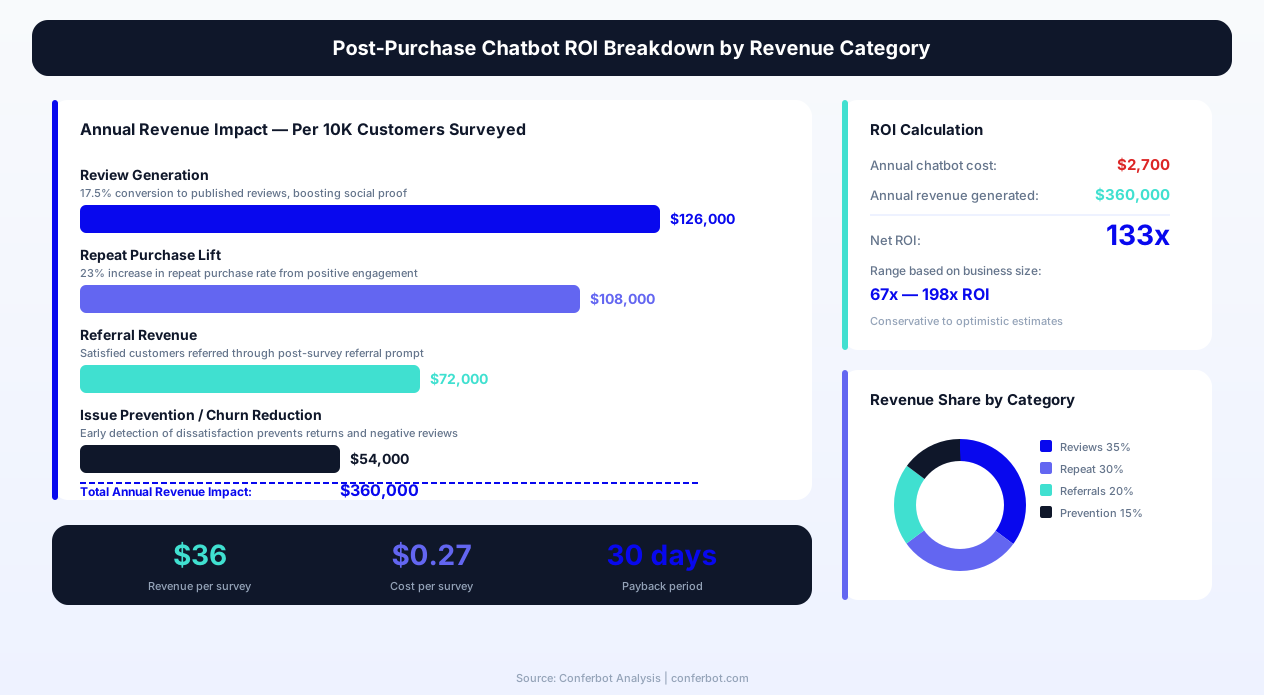
For a mid-size e-commerce brand processing 5,000 orders per month, the combined value comes from five sources: fewer negative reviews reaching publication, additional reviews generated driving higher conversion on reviewed products, referral revenue from contextual referral asks, a lift in repeat purchase rate across the order base, and reduced support ticket volume from proactive issue resolution. Together, these typically add up to a total monthly value well in excess of the chatbot's modest monthly platform cost, producing a strong return on investment.
Post-Purchase Survey Use Cases by E-Commerce Category
The optimal post-purchase survey configuration varies by product category because the purchase experience, evaluation timeline, and key feedback dimensions differ significantly across e-commerce verticals.
Fashion and Apparel
Fashion purchases have uniquely high return rates (20-30%) and sizing as the dominant issue driver. The chatbot configuration for fashion focuses on:
- Fit assessment -- "How did [product] fit?" [Too small / Slightly small / Perfect / Slightly large / Too large] -- this data improves size guide accuracy and reduces returns
- Material quality vs. expectation -- "How does the material compare to what you expected from the photos?" -- identifies listing accuracy issues
- Styling photo request -- "Would you share a photo wearing [product]? Customer photos help other shoppers choose the right size" -- generates the most valuable type of social proof for fashion
- Return prevention -- For customers indicating size issues, the chatbot can offer an exchange before the customer initiates a return, retaining the sale
Electronics and Technology
Electronics purchases require longer evaluation periods and technical setup assessment:
- Setup experience -- "How easy was it to set up [product]?" on day 1, assessing documentation quality and out-of-box experience
- Feature discovery -- On day 7, "Have you discovered [key feature]? Here is a quick tip..." -- combines feedback with activation
- Performance satisfaction -- On day 14, "How is [product] performing?" -- captures medium-term quality assessment
- Comparison to expectations -- "How does [product] compare to what you expected from the specs?" -- validates product listing accuracy
Food and Consumables
Consumable products need fast feedback loops because the replenishment cycle is short:
- Taste/quality assessment -- "How was [product]?" immediately after delivery while the experience is fresh
- Packaging quality -- "Did [product] arrive in good condition?" -- critical for perishables and fragile items
- Reorder timing -- "When do you think you will need more [product]?" -- powers precisely timed reorder reminders
- Variety interest -- "Would you like to try our [related flavor/variant]?" -- contextual cross-sell for consumable brands
Home and Furniture
High-consideration, high-value purchases with longer evaluation periods and assembly assessment:
- Assembly experience -- "How was the assembly process?" [Easy / Moderate / Difficult / Needed help] -- identifies instruction quality issues
- Room placement satisfaction -- "How does [product] look in your space?" with photo upload invitation -- generates aspirational UGC
- Value assessment -- "For the price, how would you rate the quality?" -- validates pricing for high-ticket items
- Extended satisfaction -- 30-day check-in for durability and long-term satisfaction assessment
Step-by-Step Deployment Guide for E-Commerce Brands
Deploying Conferbot's post-purchase chatbot requires e-commerce platform integration for order context and trigger automation. This guide covers setup from initial installation to optimization.
Phase 1: Platform Integration (15-30 Minutes)
- Create your Conferbot account and select the Post-Purchase Survey template from the Surveys category
- Connect your e-commerce platform -- Install the Shopify app, WooCommerce plugin, or configure the API integration for your platform
- Verify order data flow -- Confirm that order events (placed, shipped, delivered) are flowing correctly and order context (product names, customer names, order values) is populating in the chatbot
- Configure delivery channel -- Set up your preferred survey delivery channel (WhatsApp requires WhatsApp Business API connection; website widget requires script installation)
Phase 2: Survey Configuration (45-60 Minutes)
- Configure trigger timing -- Set the delay between delivery confirmation and survey delivery (recommended: 2-4 hours for delivery experience, 3-5 days for product satisfaction)
- Customize question wording -- Adjust the chatbot's tone and question phrasing to match your brand voice
- Set up review platform connection -- Configure the review generation flow to route to your review platform (Yotpo, Judge.me, Google, etc.)
- Configure issue resolution policies -- Set the automated resolution rules for common issue types (refund thresholds, replacement eligibility, discount amounts)
- Set up referral program integration -- Connect your referral program (ReferralCandy, Smile.io, or custom) for automated referral link generation
- Configure support escalation -- Connect to your support platform (Zendesk, Gorgias, etc.) for automated ticket creation on unresolved issues
Phase 3: Testing and Launch (1-2 Days)
- Place a test order and verify the complete flow from order delivery to survey trigger to response collection
- Test all satisfaction branches -- Walk through the highly-satisfied, neutral, and dissatisfied paths to verify correct routing
- Verify integration data flow -- Confirm that survey responses appear in your CRM, review platform, and support tools correctly
- Soft launch at 10% of orders -- Deploy to 10% of customers for 3-5 days to validate response rates and identify any issues
- Review initial data and adjust question wording, timing, or branching as needed
- Full launch -- Roll out to 100% of orders after soft launch validation
Phase 4: Ongoing Optimization
- Weekly review of key metrics -- Response rates, review generation rates, issue detection rates, referral activation
- Monthly A/B testing -- Test different question wording, timing, incentive offers, and review request approaches
- Quarterly strategy review -- Assess which product categories, customer segments, and delivery channels generate the highest survey engagement and commercial value
- Seasonal adjustment -- Adapt survey timing and question emphasis for peak seasons (holiday shipping delays, summer product categories)
For brands seeking expert guidance, Conferbot's e-commerce success team offers a complimentary post-purchase strategy session covering optimal timing configuration, review generation tactics, and issue resolution policy design for Growth and Enterprise plan customers.
Post Purchase Survey FAQ
Everything you need to know about chatbots for post purchase survey.
Why Use a Template vs Building from Scratch?
Templates give you a proven starting structure instead of a blank canvas.
| Factor | Conferbot Template | Build from Scratch | Hire a Developer |
|---|---|---|---|
| Time to deploy | 10 minutes | 2-8 hours | 2-6 weeks |
| Cost | Free | Your time | Custom dev quote |
| Proven flows | Yes, pre-built | No | Depends |
| Updates included | Automatic | Manual | Paid |
| Multi-channel | 8+ channels | 1 channel | Extra cost |
| Analytics | Built-in | Must build | Extra cost |
Related B2B Services Templates
Explore more chatbot templates like this one


Learn More About Chatbots
Go deeper on how b2b services chatbots work and how to pick the right builder.
Ready to Deploy Post Purchase Survey?
Start with a free-forever plan. No credit card required.