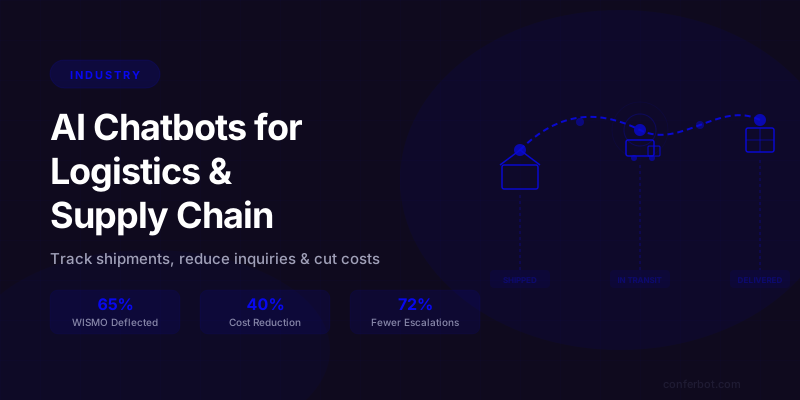
Why Logistics and Supply Chain Companies Need AI Chatbots: The $12 Trillion Communication Challenge
The global logistics and supply chain industry moves $12 trillion worth of goods annually and employs over 44 million people in the United States alone. Every shipment, whether it is a single parcel or a full container load, generates a cascade of communication touchpoints: booking confirmations, pickup notifications, transit updates, customs clearance status, delivery scheduling, proof of delivery, and exception handling. According to Gartner's supply chain technology research, the average logistics company handles 2,400 to 8,500 customer service inquiries per week, and 60 to 70% of those inquiries are a single question: "Where is my order?"
This WISMO (Where Is My Order/Shipment) tsunami consumes enormous resources. A mid-size 3PL (third-party logistics) provider with 200 customer service agents dedicates 120 to 140 of them primarily to answering tracking inquiries, a task that requires looking up a tracking number, checking the carrier's system, and relaying status information that already exists in digital form. At an average cost of $6 to $12 per customer service interaction, a company handling 6,000 weekly WISMO inquiries spends $1.9 to $3.7 million annually on a task that AI can handle in seconds at a cost of $0.05 to $0.15 per interaction.
But the opportunity extends far beyond WISMO deflection. AI chatbots for logistics enable proactive delay detection and customer notification (reducing complaint escalations by 72%), automated carrier coordination and pickup scheduling, self-service delivery rescheduling and address changes, returns initiation and processing, freight quote generation and booking, warehouse inventory inquiries, and increasingly, autonomous agent workflows that execute multi-step logistics processes without human intervention.

The financial case is overwhelming. DHL's logistics research division reports that AI-powered customer service in logistics reduces operational costs by 35 to 45% while improving customer satisfaction scores by 18 to 25 points. McKinsey's analysis of logistics automation projects that AI will create $1.3 to $2 trillion in annual value for the logistics sector by 2030, with customer-facing communication automation representing one of the fastest paths to realized value.
This guide covers the complete AI chatbot implementation for logistics and supply chain operations: real-time shipment tracking, proactive delay notifications, carrier and driver coordination, delivery scheduling and last-mile optimization, returns and claims processing, freight quote automation, warehouse communication, and the emerging frontier of autonomous agentic workflows. Whether you operate a parcel delivery service, a freight brokerage, a 3PL warehouse, or an enterprise supply chain, you will find strategies specific to your operational model. For complementary logistics chatbot strategies, see our existing guides on chatbot for logistics companies and chatbot for logistics and shipping.
Real-Time Shipment Tracking: Deflect 65% of WISMO Inquiries Instantly
Shipment tracking is the foundational chatbot capability for logistics companies. WISMO inquiries represent 60 to 70% of total customer service volume across the industry, and each one follows the same pattern: customer provides a tracking number or order reference, agent looks up the shipment in the TMS (Transportation Management System) or carrier portal, and relays status information. This is the definition of a task that should never require a human.
Multi-Carrier Tracking Integration
Logistics companies rarely use a single carrier. A typical 3PL or e-commerce fulfillment operation uses 5 to 15 carriers depending on shipment size, destination, speed requirements, and cost. The chatbot must integrate with all carriers to provide unified tracking regardless of which carrier is handling a specific shipment.
| Carrier Type | Major Carriers | API Integration Method |
|---|---|---|
| Parcel | UPS, FedEx, USPS, DHL Express | Tracking API with webhook updates |
| LTL Freight | XPO, Old Dominion, Estes, FedEx Freight | EDI 214 status messages + API |
| FTL/Truckload | Schneider, J.B. Hunt, Werner | API + ELD integration for real-time GPS |
| Ocean Freight | Maersk, MSC, CMA CGM, COSCO | Container tracking API + port data |
| Air Freight | FedEx, UPS, DHL, Emirates SkyCargo | AWB tracking API |
| Regional/Last-Mile | OnTrac, LaserShip, LSO, Veho | API (varies by carrier) |
The chatbot normalizes status data from all carriers into a consistent, customer-friendly format. Instead of carrier-specific jargon ("In transit to destination sort facility" vs "Out for delivery from local depot"), the chatbot translates every status into plain language: "Your package is at the local delivery center and will be delivered today between 2 PM and 6 PM."
Conversational Tracking Experience
The tracking conversation flow should be frictionless. The customer provides a tracking number, order number, or even just their name and email (for the chatbot to look up all active shipments). The chatbot responds with a comprehensive status update:
Example response: "Here is the status of your shipment #TRK-94827:
Current Location: Memphis, TN distribution center
Status: In transit (on schedule)
Shipped: May 28 via FedEx Ground
Estimated Delivery: June 2, 2026 by end of day
Last Scan: May 31, 8:42 AM, Departed Memphis facility
Your package is on track for delivery tomorrow. Would you like to: (1) Get a delivery notification when it arrives, (2) Change the delivery address, (3) Request a hold at the local FedEx facility, or (4) Ask another question?"

This response provides more information than a typical agent would share (most agents just relay the current status) and proactively offers next actions. The proactive options are critical because they address the follow-up questions that often require a second contact: delivery changes, hold requests, and notification preferences.
Predictive Delivery Windows
Beyond current status, the chatbot can provide predictive delivery information using historical transit data. If shipments from Memphis to the customer's ZIP code via FedEx Ground have historically taken 1.2 days with 95% on-time delivery, the chatbot can confidently state: "Based on current transit patterns, your package has a 95% likelihood of arriving tomorrow before 6 PM." This predictive capability is significantly more useful than the static estimated delivery dates provided by carrier tracking pages, which are often 1 to 2 day ranges.
Batch Tracking for B2B Customers
B2B logistics customers often track multiple shipments simultaneously. A retail buyer might have 50 open purchase orders with shipments in various stages. The chatbot handles batch tracking: "You have 47 active shipments. Here is a summary: 38 in transit (all on schedule), 6 delivered in the past 24 hours, 2 experiencing delays (PO #4821 delayed 1 day due to weather in Dallas, PO #4835 held at customs pending clearance documentation). Would you like details on the delayed shipments?" According to Capgemini last-mile research, B2B logistics customers spend an average of 4.2 hours per week manually tracking shipments. This batch summary capability dramatically reduces the time B2B customers spend managing inbound logistics.
Proactive Delay Detection and Customer Notification: Prevent Complaints Before They Happen
Reactive customer service waits for the customer to discover a problem and complain. Proactive customer service detects the problem first and notifies the customer before they even check. In logistics, this distinction is transformational. According to Statista's global shipping data, 23% of shipments experience some form of delay, and customers who discover delays themselves are 4.7 times more likely to file a formal complaint than customers who receive proactive notification. AI chatbots enable proactive delay detection and automated customer notification at scale.
Delay Detection Signals
The chatbot monitors multiple data sources to identify potential delays before they become customer-facing problems:
Carrier tracking exceptions: When a carrier's tracking system reports an exception (weather delay, mechanical issue, customs hold, address correction needed), the chatbot detects it within minutes and initiates the notification workflow.
Transit time anomalies: If a shipment that should have moved from Point A to Point B within 12 hours has not shown a new tracking scan in 18 hours, the chatbot flags it as a potential delay even before the carrier formally reports an exception.
Weather and event monitoring: The chatbot monitors weather systems, port congestion data, and major event disruptions (strikes, natural disasters, highway closures) that affect shipping lanes. When a weather system is projected to impact a transit corridor, the chatbot proactively identifies all shipments in that corridor and prepares notifications.
Carrier performance patterns: Historical data reveals that certain carrier-lane combinations have higher delay rates on specific days (e.g., Monday deliveries from a particular distribution center run 15% behind schedule). The chatbot adjusts delivery estimates accordingly and proactively notifies customers of adjusted timelines.
Automated Notification Workflows
When a delay is detected, the chatbot executes a multi-step notification workflow:
Step 1: Classify severity. Minor delay (1 day or less, no customer action needed), moderate delay (1-3 days, customer may want to adjust plans), severe delay (3+ days or shipment at risk, immediate attention needed).
Step 2: Compose personalized notification. "Hi [Customer Name], we detected that your shipment #[number] is experiencing a delay due to [specific reason]. Your original estimated delivery was [date]. The updated estimate is [new date]. We apologize for the inconvenience. [Action options based on severity]."
Step 3: Offer resolution options. For moderate delays: "Would you like to (1) Keep the current delivery with the updated timeline, (2) Upgrade to express shipping at no charge, or (3) Reroute to an alternate address?" For severe delays: route to a human agent with full context pre-loaded.

Step 4: Follow up. After the delay is resolved and the shipment delivered, the chatbot follows up: "Your delayed shipment #[number] was delivered today. We are sorry for the disruption. As a gesture of goodwill, here is a [credit/discount] for your next shipment." This follow-up converts a negative experience into a retention opportunity.
Business Impact of Proactive Notification
Companies implementing proactive delay notification report: 72% reduction in complaint escalations, 45% reduction in customer service call volume related to delays, 18-point increase in NPS (Net Promoter Score) from customers who received proactive notifications versus those who discovered delays themselves, and 15% higher customer retention rates. The chatbot does not prevent delays (that requires operational improvements), but it fundamentally changes the customer's experience of delays from frustrating to manageable.
Carrier Coordination and Pickup Scheduling: Streamline Operations Across Your Network
Behind the customer-facing communication layer, logistics companies coordinate constantly with carriers, drivers, and warehouse teams. These internal and partner-facing communications are equally ripe for chatbot automation.
Automated Pickup Scheduling
When a shipment is ready for pickup, the chatbot coordinates with the assigned carrier: "Pickup request for [Carrier]: 12 pallets, 8,400 lbs, Class 70 freight, ready at [Warehouse Address] after 2 PM today. Dock door #4 will be available. Estimated load time: 35 minutes. Please confirm driver ETA." The carrier confirms through the chatbot, and the warehouse team receives the confirmed pickup time.
For spot market shipments where a carrier has not been pre-assigned, the chatbot can broadcast pickup requests to your carrier network: "Available load: 22,000 lbs, Chicago to Atlanta, pickup tomorrow, refrigerated trailer required, target rate $2,800. Interested carriers please respond with rate and availability." Carrier responses are collected, compared, and presented to the logistics coordinator for final selection. This automated tendering process replaces dozens of individual phone calls and emails.
Driver Communication and Updates
Once a pickup is confirmed, the chatbot maintains communication with the driver throughout the shipment lifecycle: pickup confirmation and dock instructions, in-transit check-ins for long-haul shipments, delivery appointment confirmations, proof of delivery collection (photo upload through the chatbot), and exception reporting (damaged freight, refused delivery, access issues at the delivery site).
Drivers strongly prefer chatbot communication over phone calls because they can respond at their convenience (during rest stops or after delivery) rather than answering calls while driving. The documented nature of chatbot communication also eliminates the "he said, she said" disputes that arise from verbal-only driver communication.
Carrier Performance Monitoring
The chatbot collects data on every carrier interaction: response time to pickup requests, on-time pickup percentage, in-transit communication responsiveness, on-time delivery percentage, and claims rate. This data feeds into carrier scorecards that inform routing decisions. Carriers with consistently poor performance receive fewer loads, while high-performing carriers are offered premium lane opportunities. This performance-based allocation improves overall service quality over time.
Cross-Docking and Transfer Coordination
For LTL and multi-stop shipments, the chatbot coordinates transfers between facilities: "Shipment #LTL-7392 arriving at Dallas terminal at 3 PM. Contains 4 pallets for Houston next-day delivery. Please confirm trailer assignment for the 6 PM Houston departure." This real-time coordination reduces dwell time at transfer facilities and improves transit times on multi-leg shipments. For companies looking to build these types of automated operational workflows, our AI agent capabilities enable chatbots that can execute multi-step logistics processes autonomously.
Delivery Scheduling and Last-Mile Optimization: Reduce Failed Deliveries by 40%
The last mile is the most expensive segment of the delivery chain, representing 41% of total shipping costs according to industry research. Failed deliveries (recipient not home, wrong address, access issues) are the largest cost driver in last-mile operations, with each failed delivery attempt costing $12 to $17 in driver time, fuel, and reattempt logistics. AI chatbots reduce failed deliveries by 35 to 45% through self-service delivery scheduling and proactive coordination with recipients.
Self-Service Delivery Scheduling
Instead of assigning a vague delivery window ("Tuesday between 8 AM and 8 PM"), the chatbot enables recipients to select specific delivery windows: "Your package is scheduled for delivery Tuesday. Please choose your preferred delivery window: (1) Morning 8-11 AM, (2) Midday 11 AM-2 PM, (3) Afternoon 2-5 PM, (4) Evening 5-8 PM. If none of these work, you can (5) Reschedule to a different day or (6) Redirect to a pickup location."
This recipient-driven scheduling dramatically reduces failed deliveries because the recipient selects a window when they know they will be available. The logistics company benefits from better route density (deliveries clustered by time window and geography) and reduced reattempt costs.

Day-of Delivery Communication
On delivery day, the chatbot provides a series of updates that keep the recipient informed and prepared:
Morning notification: "Your package is out for delivery today. Current estimated delivery: 1:30 PM to 3:30 PM. We will send you a final update when the driver is 30 minutes away."
30-minute alert: "Your delivery driver is approximately 30 minutes away. Please ensure someone is available to receive the package. If you need to make a last-minute change, reply now."
Delivery confirmation: "Your package has been delivered. It was left at [location: front door / with doorman / in mailroom]. [Photo proof of delivery attached]. If you have any issues with your delivery, let us know."
Address Correction and Redirection
Address errors are a significant source of delivery failures. The chatbot catches and corrects address issues proactively. When the shipping address does not match USPS address validation databases, the chatbot contacts the recipient: "We are preparing to ship your order, but the address you provided may have an issue: [address]. Did you mean [suggested correction]? Please confirm or update your delivery address." This pre-shipment address validation prevents the cascade of costs associated with an incorrect address: failed delivery attempt, return to sender, customer complaint, and reshipping.
For packages already in transit, the chatbot offers redirection options when the recipient's situation changes: "I will not be home for delivery. Can you redirect to my office at [address]?" or "Please hold at the nearest pickup point." These self-service redirections eliminate the customer service calls and manual carrier coordination that traditionally handle delivery changes.
Safe Drop and Delivery Instructions
The chatbot collects delivery preferences that travel with the shipment: "Do you have specific delivery instructions? For example: leave at side door, ring doorbell, do not leave if not home, leave with neighbor at [unit number], or gate code [code]." These preferences are saved for future deliveries and transmitted to the carrier's driver communication system, ensuring consistent delivery experience across all shipments to that address. For businesses exploring broader chatbot scheduling capabilities, our appointment booking chatbot guide covers scheduling pattern design that applies to delivery window management.
Returns Processing and Claims Management: Automate the Reverse Logistics Workflow
Returns and claims are the most labor-intensive. UPS reverse logistics research shows that the cost of processing a return averages 59% of the original item price. customer service processes in logistics. A single return involves eligibility verification, return label generation, pickup or drop-off coordination, tracking the return shipment, processing the refund or exchange, and communicating status at each step. Claims add damage documentation, carrier liability assessment, and settlement negotiation. AI chatbots automate 70 to 80% of this workflow.
Automated Returns Initiation
The chatbot guides customers through the returns process with a structured conversation flow: "Which item would you like to return?" [Order lookup shows items eligible for return]. "What is the reason for the return?" [Wrong item / Damaged / Defective / Changed mind / Wrong size / Other]. Based on the reason and the company's return policy, the chatbot determines eligibility and next steps automatically.
For eligible returns, the chatbot generates a return shipping label, provides drop-off location options or schedules a pickup, sets expectations for refund processing time, and offers exchange alternatives: "Would you prefer a refund to your original payment method, or would you like to exchange for a different item?" This self-service return initiation handles 80% of returns without any human agent involvement.
Damage Claims Documentation
For damaged shipments, thorough documentation is critical for carrier claims. The chatbot guides the customer through the documentation process: "Please upload photos of: (1) The damaged item(s), (2) The packaging/box showing any visible damage, (3) The shipping label on the package." It then asks for a description of the damage, the original value of the items, and whether the customer has retained the damaged goods and packaging (required by most carriers for claims).
This structured documentation collection produces complete, carrier-compliant claims packages that dramatically improve claim approval rates. Logistics companies report that chatbot-collected claims documentation has a 78% first-submission approval rate versus 45% for claims initiated through email or phone (which typically have incomplete documentation requiring multiple follow-ups).
Return Tracking and Status Updates
Once a return is in transit, the chatbot provides tracking and status updates just as it does for outbound shipments: "Your return shipment has been received at our warehouse. Your refund of $89.50 will be processed within 2-3 business days and will appear on your credit card statement within 5-7 business days. Would you like a notification when the refund is processed?" This proactive return status communication eliminates the "Where is my refund?" inquiries that represent 15 to 20% of post-return customer contacts.
Freight Claims for B2B Shipments
B2B freight claims are significantly more complex than parcel returns. The chatbot manages the multi-party process: documenting damage on the delivery receipt (bill of lading), filing claims with the responsible carrier, tracking claim progress across 30-120 day carrier processing timelines, communicating settlement offers to the customer, and managing the replacement shipment if applicable. For B2B logistics customers, this claims automation reduces the administrative burden of freight damage by 60 to 75%. Our chatbot API integration documentation covers the technical details of connecting chatbot workflows with carrier claims portals and warehouse management systems.
Freight Quote Automation: From Hours of Rate Shopping to Instant Quotes
For freight brokerages and 3PL providers, quoting is the front door of the business. Every qualified quote request represents potential revenue. Yet the traditional quoting process is slow and labor-intensive: the customer describes their shipment, the pricing analyst looks up rates across multiple carriers, applies margins, accounts for accessorial charges, and sends a quote, a process that takes 2 to 8 hours for standard shipments and 1 to 3 days for complex multi-modal moves. AI chatbots compress this to minutes.
Instant LTL and FTL Quote Generation
The chatbot collects shipment details through a structured conversation: origin and destination (ZIP codes or city/state), commodity description and freight class, weight and dimensions (per pallet or total), pickup date and delivery requirements (standard, expedited, guaranteed), accessorial services needed (liftgate, inside delivery, residential delivery, appointment delivery), and special handling requirements (hazmat, temperature controlled, high value).
With this information, the chatbot queries your rate engine or TMS to generate quotes across available carriers. The customer receives a comparison:
"Here are your shipping options for 6 pallets, 4,200 lbs, Chicago to Los Angeles:
Economy (5-7 business days): $1,840 via XPO Logistics
Standard (3-5 business days): $2,190 via Old Dominion
Expedited (2-3 business days): $2,890 via FedEx Freight
Guaranteed Next Day: $4,450 via FedEx Priority Freight
All rates include fuel surcharge. Liftgate at delivery adds $95. Would you like to book any of these options, or do you need a custom quote for different requirements?"

Instant Parcel Rate Shopping
For parcel shipments, the chatbot provides instant rate comparisons across carriers: "Ship a 5 lb package, 12x10x8 inches, New York to Miami: USPS Priority Mail $12.80 (2-3 days), UPS Ground $14.20 (4 days), FedEx Home Delivery $13.95 (3-4 days), FedEx 2Day $22.50 (2 days). Which would you like?"
Custom and Complex Quotes
For shipments that exceed automated quoting capabilities (oversized freight, multi-modal international moves, project logistics), the chatbot collects all available information and routes the request to a pricing specialist with a complete brief: "This quote request requires manual pricing. Details: [complete shipment information]. Customer [name] prefers contact by [method] and needs the quote by [date]." This warm handoff ensures the pricing specialist has everything needed to prepare a quote without calling the customer back for basic information.
Quote Follow-Up and Booking Conversion
The chatbot tracks quote-to-booking conversion and automates follow-up. For quotes not booked within 24 hours: "Your freight quote from yesterday is still available. Rates are valid through [expiration date]. Would you like to book, or do you need an updated quote for different dates?" For expired quotes: "Your quote has expired, but I can generate an updated rate in seconds. Same shipment details, or do you have changes?" This automated follow-up recovers 15 to 25% of quotes that would otherwise expire unbooked. The conversion psychology behind these follow-up sequences aligns with the strategies described in our chatbot lead qualification guide, adapted for the logistics sales cycle.
Warehouse Communication: Connect the Floor to the Front Office in Real Time
Warehouse operations generate constant communication needs. According to MHI Annual Industry Report data, warehouse labor spends 22% of productive time on communication and coordination tasks rather than physical operations. between floor staff, management, customer service, and external partners. Inventory inquiries, order status checks, receiving notifications, and outbound shipping confirmations flow back and forth throughout the day. An AI chatbot connected to your WMS (Warehouse Management System) streamlines this communication.
Inventory Inquiry Automation
Customer service agents and sales teams frequently need real-time inventory information. The chatbot provides instant answers: "What is the current inventory for SKU #WH-4827?" Response: "SKU #WH-4827 (Widget Assembly, Blue, 12-pack): Available inventory: 2,847 units across 3 locations. Warehouse A: 1,200 units, Warehouse B: 1,100 units, Warehouse C: 547 units. Pending inbound: 3,000 units arriving June 5. Allocated to open orders: 890 units. Net available to promise: 1,957 units." This detailed response eliminates the chain of phone calls (agent calls warehouse manager, warehouse manager checks system, warehouse manager calls back agent) that traditionally handles inventory inquiries.
Receiving and Put-Away Notifications
When inbound shipments arrive, the chatbot notifies relevant parties: "Inbound receipt: PO #8421 from [Supplier], 48 pallets received at Dock Door 7. Contents verified against PO: 100% match, no discrepancies. Put-away in progress, estimated completion: 3 hours. Inventory will be available to pick by 4 PM today." Customers awaiting these goods receive automated notifications: "The inventory for your order #[number] has been received at our warehouse and will be available for fulfillment within 4 hours."
Order Fulfillment Status
The chatbot tracks orders through the warehouse fulfillment process: order received, allocated (inventory reserved), picked, packed, shipped (with carrier and tracking number). Each status transition can trigger notifications to the customer and internal teams. For B2B customers with high-volume, time-sensitive orders, this granular visibility into warehouse processing is a competitive differentiator that reduces customer anxiety and preempts status inquiry calls.
WMS Integration Points
| WMS Platform | Integration Capabilities |
|---|---|
| Manhattan Associates | Inventory, order status, receiving, shipping, labor |
| Blue Yonder (JDA) | Inventory, fulfillment, wave planning, labor |
| SAP EWM | Inventory, shipping, receiving, quality management |
| Oracle WMS Cloud | Inventory, order management, shipping |
| ShipHero / ShipBob | Inventory, orders, returns, multi-warehouse |
| 3PL Central (Extensiv) | Inventory, billing, orders, customer portal |
The chatbot reads data from these systems in real time, ensuring that every response reflects current warehouse conditions. For companies managing multiple warehouses, the chatbot provides a unified communication layer across all locations, so a customer or agent asking about inventory does not need to know which warehouse holds the stock. For a deeper exploration of how AI chatbots connect to external systems, see our chatbot API integration guide.
Autonomous Agent Workflows: The Next Frontier in Logistics AI
Traditional chatbots respond to questions. Autonomous AI agents take actions. In logistics, this distinction unlocks capabilities that go far beyond answering "Where is my package?" to actively managing logistics processes end to end. This is the most rapidly evolving capability in logistics AI, and companies implementing autonomous agent workflows today are gaining operational advantages that will compound over the coming years.
What Autonomous Agents Do in Logistics
An autonomous logistics agent does not just provide information, it executes multi-step workflows:
Delay mitigation: When the agent detects a shipment delay that will cause a customer to miss their required delivery date, it autonomously evaluates alternative options (expedited shipping, alternate carrier, alternate origin warehouse), calculates cost implications, selects the optimal resolution within pre-defined authority parameters, executes the change (rebooks the shipment, generates new labels, notifies the driver), and communicates the resolution to the customer, all without human intervention. A human agent is notified after the fact for oversight.
Carrier selection and booking: When a new shipment order enters the system, the autonomous agent evaluates available carriers based on cost, transit time, service reliability for that lane, current capacity, and customer-specific requirements, then books the optimal carrier, schedules the pickup, and generates all necessary documentation. The human logistics coordinator reviews exceptions only (no capacity available, rate exceeds threshold, special handling required).
Returns orchestration: When a customer initiates a return, the agent handles the entire workflow: verifies eligibility, generates the return label, schedules pickup or provides drop-off instructions, tracks the return shipment, triggers inspection upon receipt at the warehouse, processes the refund or exchange, and communicates each step to the customer. The entire return lifecycle is managed autonomously with human oversight for exception handling only.
Guardrails and Authority Levels
Autonomous agents require carefully defined authority parameters. These guardrails determine what the agent can do without human approval versus what requires human authorization:
| Action | Autonomous (Agent Decides) | Requires Human Approval |
|---|---|---|
| WISMO response | Always autonomous | Never |
| Delivery reschedule | Standard reschedule | Expedited upgrade at company cost |
| Return initiation | Within return policy | Outside return window exceptions |
| Carrier rebooking for delay | Under $500 incremental cost | Over $500 incremental cost |
| Refund processing | Under $200 standard refund | Over $200 or non-standard |
| Freight quoting | Standard lanes, standard rates | Custom rates, volume discounts |
These authority levels can be adjusted over time as the agent proves reliability. Companies typically start with narrow authority and expand as confidence grows. The autonomous agent architecture is covered in depth in our AI agent documentation, which explains how to design agent workflows with appropriate guardrails for different operational contexts.
Measuring Agent Effectiveness
Key metrics for autonomous logistics agents include: resolution rate without human intervention (target: 70 to 85% for standard scenarios), average resolution time (target: under 3 minutes for standard issues), cost savings per interaction compared to human handling, customer satisfaction for agent-resolved issues versus human-resolved issues (they should be equal or higher), and exception rate (percentage of interactions escalated to humans). Early adopters report that autonomous agents resolve logistics issues 8x faster than human agents at 15x lower cost, while maintaining equivalent or higher customer satisfaction scores.
ROI Model: Logistics Chatbot Financial Impact by Operation Type
The financial impact of AI chatbots in logistics varies by operation type but is consistently among the highest ROI applications of chatbot technology. Here are detailed models for three common logistics operation profiles.
E-Commerce Fulfillment / 3PL (500-2,000 daily shipments)
| Metric | Before Chatbot | After Chatbot | Impact |
|---|---|---|---|
| Weekly WISMO inquiries | 3,500 | 1,225 (to agents) | 65% deflection |
| Cost per inquiry | $8.50 | $0.12 (bot) / $8.50 (agent) | 78% cost reduction |
| Failed delivery rate | 8.2% | 4.9% | 40% reduction |
| Returns processing time | 4.2 days | 1.1 days | 74% faster |
| Customer satisfaction (CSAT) | 72 | 89 | +17 points |
| Quote-to-book conversion | 12% | 31% | 158% improvement |
Annual savings: WISMO deflection: 2,275 deflected inquiries/week x $8.38 savings x 52 weeks = $991,000. Failed delivery reduction: 1,650 fewer failures/year x $15 per failure = $24,750. Returns processing efficiency: $85,000 in labor savings. Total first-year savings: $1.1 million.
Annual investment: Conferbot enterprise plan plus integrations: $12,000/year. ROI: 9,100%
Freight Brokerage (200-500 loads/month)
| Metric | Before Chatbot | After Chatbot | Impact |
|---|---|---|---|
| Quote requests handled/day | 45 (manual) | 120 (bot + manual) | 167% increase in capacity |
| Average quote turnaround | 3.5 hours | 12 minutes (automated) | 95% faster |
| Quote-to-book rate | 14% | 28% | 100% improvement |
| Carrier tender time | 45 minutes | 8 minutes | 82% faster |
| Customer tracking inquiries/day | 85 | 25 (to agents) | 71% deflection |
Annual revenue impact: 75 additional automated quotes/day x 28% conversion x $2,800 average shipment x 20% gross margin x 250 business days = $2.94 million in additional gross profit. Customer service savings: $340,000/year. Total first-year impact: $3.28 million.
Annual investment: $8,000/year. ROI: 41,000%
Enterprise Supply Chain (Global Operations)
For enterprise supply chain operations with global shipping volumes, the chatbot serves as a unified communication layer across all logistics partners, carriers, customs brokers, and internal teams. The primary value drivers are: centralized visibility across multi-modal, multi-carrier shipments reducing manual tracking labor by 60%, proactive exception management reducing escalated customer issues by 72%, automated customs documentation reducing clearance delays by 35%, and supplier communication automation reducing procurement team email volume by 50%.
Enterprise annual impact: $5 to $15 million in combined operational savings, revenue protection, and customer retention value.
For a comprehensive framework on calculating chatbot ROI for any business model, see our Conferbot pricing page to evaluate which plan fits your logistics operation's volume and integration needs.
Was this article helpful?
AI Chatbot for Logistics and Supply Chain FAQ
Everything you need to know about chatbots for ai chatbot for logistics and supply chain.
About the Author

Conferbot Team specializes in conversational AI, chatbot strategy, and customer engagement automation. With deep expertise in building AI-powered chatbots, they help businesses deliver exceptional customer experiences across every channel.
View all articles