What Is Conversational AI and Why 2026 Is the Tipping Point
Conversational AI is the set of technologies that enable machines to engage in natural, human-like dialogue with people. It encompasses chatbots, voice assistants, virtual agents, and intelligent IVR systems -- any software that can understand human language, maintain context across a conversation, reason about the best response, and take actions on behalf of the user. While chatbots have existed in some form since the 1960s (starting with MIT's ELIZA), the conversational AI of 2026 is fundamentally different in capability, sophistication, and business impact.
The year 2026 represents a genuine tipping point for conversational AI adoption. Three converging forces have made this the moment when conversational AI transitions from competitive advantage to competitive necessity. First, large language models (LLMs) have reached the accuracy threshold where AI-handled conversations are indistinguishable from human-handled ones for 85% of routine inquiries. Second, platform costs have fallen to the point where businesses of every size -- from solo entrepreneurs to Fortune 500 enterprises -- can afford production-grade conversational AI. Third, consumer expectations have permanently shifted: Salesforce's 2026 Connected Customer Report found that 78% of consumers now expect instant responses to their inquiries, and 64% prefer messaging over phone calls for customer service.
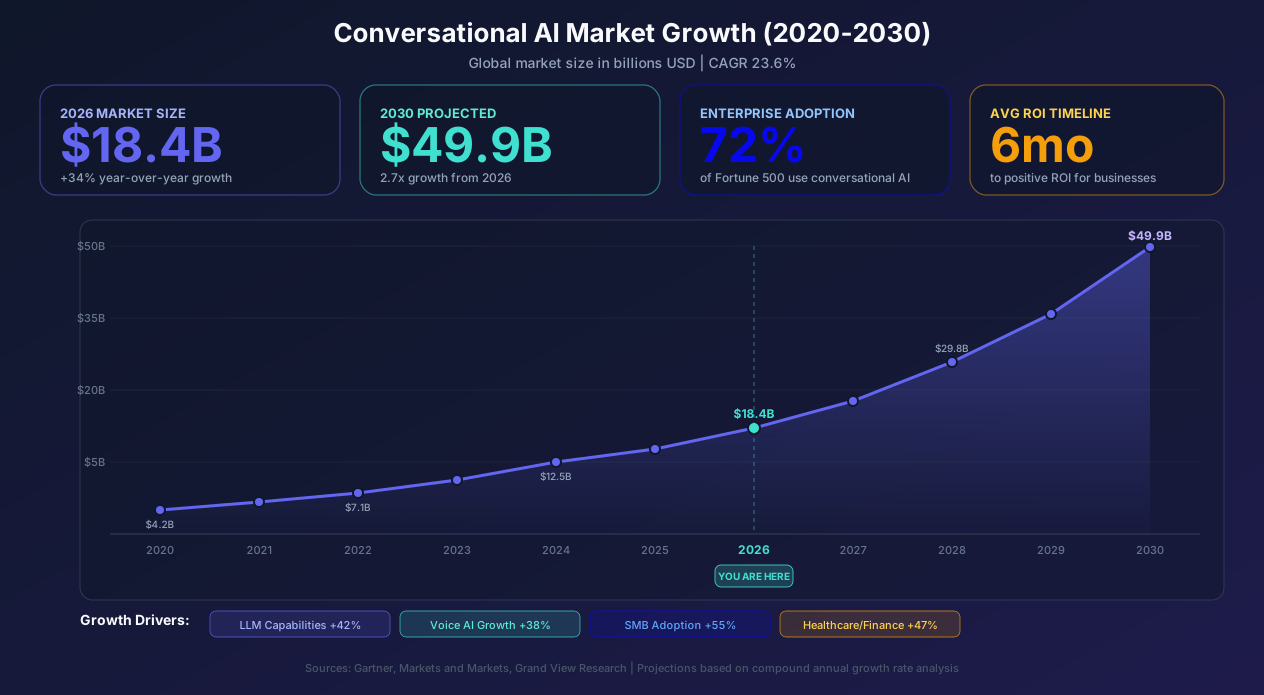
The conversational AI market reflects this tipping point. Global spending on conversational AI platforms reached $18.4 billion in 2026, growing 34% year-over-year, with projections reaching $49.9 billion by 2030. Enterprise adoption has surged to 72% among Fortune 500 companies, while small and mid-size business adoption has grown 55% in the past year alone -- the fastest-growing segment in the market.
This guide provides a comprehensive understanding of conversational AI in 2026: how the technology works at an architectural level, where it is being deployed across industries, how to decide between building and buying a solution, and a proven implementation roadmap that takes you from concept to production in 12 weeks or less. Whether you are a CTO evaluating technical architectures or a business owner exploring your first chatbot, this guide gives you the knowledge to make informed decisions.
Conversational AI Architecture: The 4-Layer Technology Stack
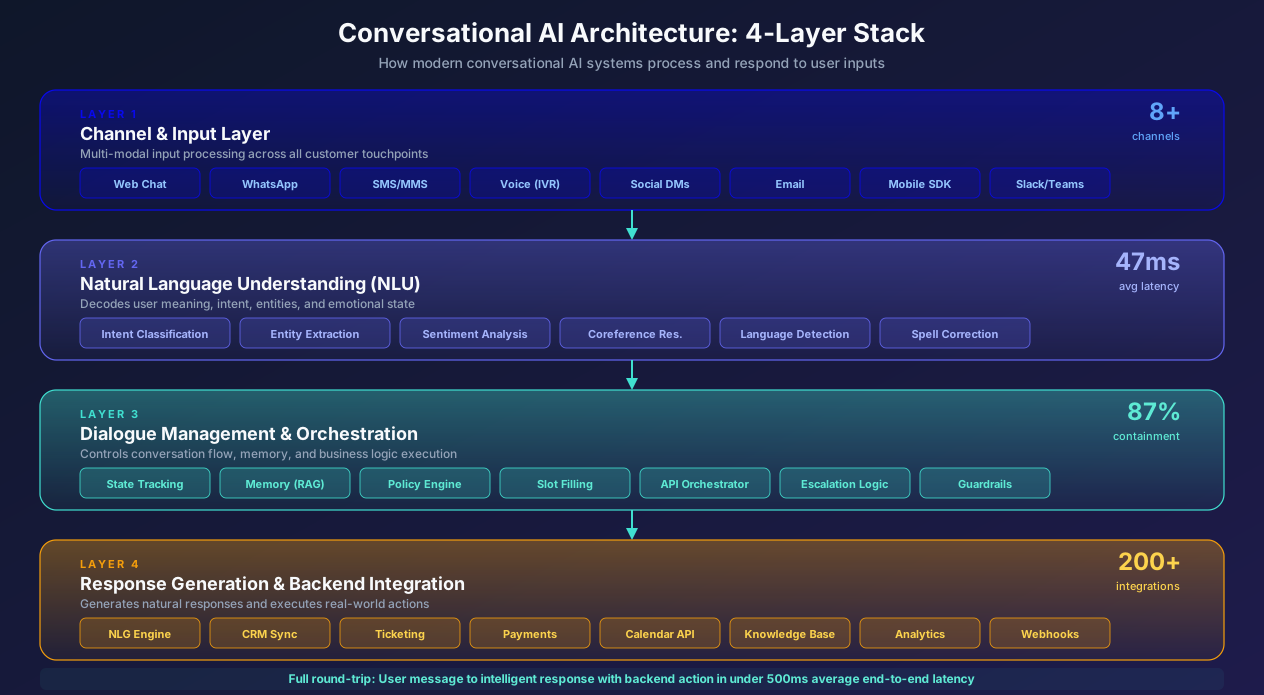
Understanding the architecture of conversational AI systems helps business leaders evaluate platforms, set realistic expectations, and communicate effectively with technical teams. Modern conversational AI systems are built on a 4-layer architecture, each layer handling a distinct aspect of the conversation pipeline.
Layer 1: Channel and Input Layer
The channel layer handles the interface between your customers and the AI system. It accepts input from multiple channels -- web chat widgets, WhatsApp, SMS, voice calls, social media DMs, email, mobile apps, and enterprise messaging platforms like Slack and Microsoft Teams -- and normalizes this input into a standard format that downstream layers can process. This normalization is critical because a customer saying "cancel my order" over voice, typing it in a web chat, or sending it via WhatsApp all need to reach the same NLU system.
The channel layer also handles channel-specific constraints and features. WhatsApp supports rich message templates with buttons and lists. Web chat supports file uploads and carousel cards. Voice channels require speech-to-text (STT) transcription before NLP processing. A well-designed channel layer abstracts these differences so that the core AI logic works identically regardless of how the customer reaches you.
In 2026, the most effective conversational AI deployments support 5-8 channels simultaneously, with consistent conversation history across all channels. A customer who starts a conversation on your website can continue it on WhatsApp without repeating any information -- the channel layer preserves context across channel switches.
Layer 2: Natural Language Understanding (NLU)
The NLU layer is the intelligence core of conversational AI. It processes the normalized input from the channel layer and extracts structured meaning: what the customer wants (intent), what details they provided (entities), how they feel about it (sentiment), and what language they are speaking. The NLU layer is covered in depth in our NLP chatbot guide, but here we focus on its role within the broader architecture.
Modern NLU layers use a multi-model ensemble approach. A fast, lightweight classifier handles high-confidence intents (simple greetings, FAQ questions) in under 10 milliseconds. A domain-specific BERT model handles medium-complexity queries in 15-50 milliseconds. An LLM (GPT-4, Claude, or similar) handles complex, ambiguous, or multi-turn queries in 200-800 milliseconds. This tiered approach optimizes both accuracy and latency: simple queries get instant responses, complex queries get thoughtful ones, and the system gracefully scales from thousands to millions of daily conversations.
The NLU layer also handles language detection and translation for multilingual deployments. When a customer writes in Spanish, the system detects the language, processes the query in the original language (not through machine translation, which loses nuance), and generates a response in the same language. Top platforms support 95+ languages with 90%+ accuracy in the top 30 languages.
Layer 3: Dialogue Management and Orchestration
Dialogue management is what distinguishes conversational AI from simple question-answer bots. This layer maintains conversation state, manages the flow of multi-turn dialogues, orchestrates business logic, and decides what the system should do next at each turn of the conversation. It is the "brain" that connects language understanding to real-world actions.
Key dialogue management components include:
State tracking: Maintaining a structured representation of the current conversation state -- what intents have been expressed, what entities have been collected, what actions have been taken, and what information is still needed. State tracking enables the system to handle interruptions ("Actually, wait, I also need to change my address") without losing context.
Memory and RAG (Retrieval Augmented Generation): Accessing relevant information from knowledge bases, previous conversations, customer profiles, and product databases to ground responses in accurate, up-to-date information. RAG prevents the AI from hallucinating by anchoring responses to verified source material.
Policy engine: Business rules that govern chatbot behavior -- when to escalate, what offers to make, what data to collect, and what actions to authorize. The policy engine ensures the AI operates within your business constraints while still delivering a natural conversational experience.
Slot filling: Systematically collecting all required information for an action (booking requires date, time, service type, and contact info) through natural conversation rather than rigid forms.
API orchestration: Coordinating calls to external systems -- CRM lookups, order management actions, payment processing, calendar booking, knowledge base queries -- and incorporating the results into the conversation flow.
Escalation logic: Determining when and how to transfer a conversation to a human agent, including routing to the right department, summarizing the conversation context, and managing the handoff seamlessly so the customer does not repeat information.
Layer 4: Response Generation and Backend Integration
The response generation layer creates the actual output the customer sees -- natural language text, rich media cards, action confirmations, and backend system updates. Modern systems use Natural Language Generation (NLG) powered by LLMs to create responses that are contextually appropriate, tonally consistent, and personalized to the specific customer and conversation.
This layer also handles the "action" side of conversational AI: updating CRM records, creating support tickets, processing payments, booking appointments, sending confirmation emails, triggering webhooks, and updating analytics dashboards. The integration capability of this layer determines how much real-world impact your conversational AI can have -- a bot that only provides information is helpful, but a bot that takes actions (books appointments, processes refunds, updates accounts) is transformational.
Chatbot vs. Conversational AI: Understanding the Critical Differences
The terms "chatbot" and "conversational AI" are often used interchangeably, but they represent fundamentally different levels of sophistication. Understanding this distinction is important for setting accurate expectations with stakeholders and selecting the right solution for your needs. For a detailed comparison of specific platforms, see our ChatGPT vs. chatbot platform guide.
Basic Chatbots: Menu-Driven Interactions
Basic chatbots (sometimes called "rule-based bots" or "decision tree bots") follow pre-defined conversation scripts. They present options, the user selects one, and the bot branches to the next set of options. There is no natural language understanding -- the user clicks buttons or types exact keyword matches. These bots are useful for simple, structured tasks (checking store hours, tracking a known order number) but fail when users ask questions in their own words, deviate from the expected flow, or have complex multi-part requests.
Capabilities of basic chatbots: Button-based navigation, keyword matching, simple FAQ lookup, form-like data collection. Limitations: Cannot understand natural language, no context retention between turns, single language only, rigid flow that frustrates users, 30-40% containment rate.
Conversational AI: Intelligent Dialogue Systems
Conversational AI represents a quantum leap beyond basic chatbots. These systems understand natural language (via NLU), maintain context across long conversations (via dialogue management), take autonomous actions (via API orchestration), learn from interactions (via continuous optimization), and adapt to individual users (via personalization engines). The difference is analogous to comparing a voice recording that says "press 1 for sales, press 2 for support" to an actual human receptionist who listens to your question, understands what you need, and either handles it directly or connects you with the right person.
Capabilities of conversational AI: Natural language understanding across 95+ languages, multi-turn context retention (50+ turns), sentiment-aware responses, autonomous action execution, proactive outreach, cross-channel continuity, continuous learning, 70-87% containment rate.
The Spectrum: Where Does Your Organization Need to Be?
The decision between basic chatbot and full conversational AI depends on your specific needs. If your use case involves fewer than 10 simple, structured tasks (checking hours, directing to department pages) and cost is the primary constraint, a basic chatbot may suffice. However, if you need to handle diverse customer inquiries in natural language, maintain context across conversations, integrate with backend systems to take actions, and deliver a customer experience that builds rather than erodes brand trust, conversational AI is the appropriate investment.
The market has spoken clearly: businesses deploying conversational AI see 2.8x higher customer satisfaction and 3.4x higher containment rates than those using basic chatbots, making the ROI case straightforward for any business handling more than 1,000 monthly customer interactions.
| Capability | Basic Chatbot | Conversational AI |
|---|---|---|
| Input Method | Button clicks, keyword matching | Free-form natural language, voice, images |
| Context Retention | Current session only | Cross-session, cross-channel memory |
| Language Support | 1 language | 95+ languages |
| Learning Ability | Static (manually updated) | Continuously improving from interactions |
| Backend Actions | Limited (form submission) | Full API orchestration (CRM, payments, calendar) |
| Emotional Intelligence | None | Sentiment analysis, tone adaptation, proactive escalation |
| Avg Containment Rate | 30-40% | 70-87% |
| Customer Satisfaction | 2.8-3.2/5 | 4.0-4.5/5 |
The 2026 Conversational AI Market: Growth, Players, and Trends
The conversational AI market in 2026 is characterized by explosive growth, rapid consolidation among platform providers, and accelerating adoption across every industry vertical. Understanding the market landscape helps business leaders identify opportunities, select the right partners, and anticipate competitive dynamics.
Market Size and Growth Trajectory
The global conversational AI market reached $18.4 billion in 2026, up from $13.7 billion in 2025 (34% YoY growth). The market is projected to reach $49.9 billion by 2030, representing a compound annual growth rate (CAGR) of 23.6%. This growth is driven by four primary factors: the maturation of LLM technology (enabling previously impossible conversation quality), declining platform costs (making conversational AI accessible to SMBs), increasing consumer preference for messaging over phone (shifting demand), and proven ROI data (removing executive skepticism about chatbot investments).
The fastest-growing segments within the market are voice-enabled conversational AI (growing 38% YoY as phone-to-AI transitions accelerate), SMB adoption (growing 55% YoY as no-code platforms lower barriers), and healthcare/financial services deployments (growing 47% YoY as compliance-ready platforms emerge).
Platform Categories
The conversational AI platform landscape in 2026 falls into five distinct categories:
Enterprise AI Platforms: Large-scale systems designed for Fortune 500 deployments. These platforms offer extensive customization, on-premises deployment options, and enterprise security certifications. They typically require 6-12 month implementations and $100,000+ annual contracts. Examples include Google Dialogflow CX, Amazon Lex, and Microsoft Azure Bot Service.
Mid-Market Conversational AI Platforms: Full-featured platforms that balance sophistication with usability. They offer LLM-powered NLU, visual flow builders, integration marketplaces, and analytics dashboards. Implementation takes 2-8 weeks, and pricing ranges from $500-$5,000/month. This category offers the best value for most businesses.
SMB-Focused No-Code Platforms: Platforms designed for small businesses and non-technical users. They provide template-based chatbot creation, one-click deployment to websites, and essential integrations (CRM, calendar, email). Platforms like Conferbot fall into this category, enabling businesses to deploy LLM-powered chatbots in days rather than months at $49-$499/month.
Vertical-Specific Solutions: Platforms built for specific industries (healthcare, real estate, legal) with pre-built compliance features, industry vocabulary, and specialized integrations. These platforms trade general flexibility for out-of-the-box domain expertise.
Open-Source Frameworks: Developer-focused tools (Rasa, Botpress) that provide maximum customization at the cost of significant technical effort. Best for organizations with dedicated AI engineering teams building proprietary conversational experiences.
Key Market Trends in 2026
Agentic AI convergence: The line between conversational AI and autonomous AI agents is blurring. Modern platforms increasingly support multi-step task completion where the AI independently researches, decides, and acts -- not just answers questions. This agentic AI approach is the most significant trend shaping the next generation of conversational AI.
Voice-first experiences: Voice-enabled conversational AI is the fastest-growing modality, driven by improvements in speech recognition accuracy (now 97%+ for English) and consumer comfort with voice interfaces. Businesses are deploying voice bots for phone support, replacing traditional IVR systems with natural language understanding.
Proactive AI: Conversational AI is shifting from reactive (waiting for customers to initiate) to proactive (initiating conversations based on user behavior, predicted needs, and business events). Proactive chatbots that engage visitors at the right moment see 3-5x higher engagement rates than passive widgets.
Composable AI architectures: Rather than monolithic platforms, businesses are assembling best-of-breed components -- choosing the best NLU, the best dialogue engine, the best analytics -- and composing them into custom stacks. This trend favors platforms with open APIs and robust integration capabilities.
Conversational AI Use Cases: What Works in Every Industry
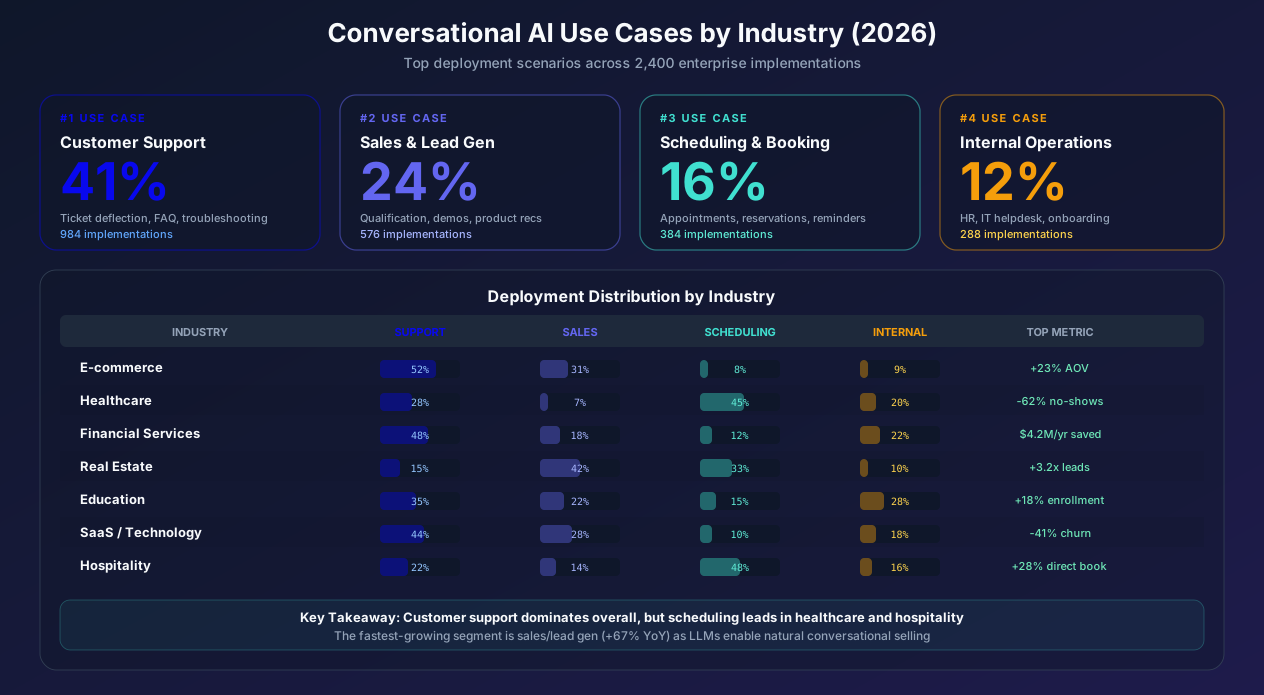
The applications of conversational AI span every industry, but the specific use cases that deliver the highest ROI vary significantly by sector. This section maps the top use cases to each major industry, based on data from 2,400 enterprise implementations analyzed in 2026.
E-commerce and Retail
E-commerce leads conversational AI adoption, with 52% of deployments focused on customer support (order tracking, returns processing, product information) and 31% on sales (product recommendations, cart recovery, promotional offers). The standout use case is conversational cart recovery: chatbots that engage abandoning shoppers with personalized incentives recover 15-25% of abandoned carts, generating an average 23% increase in average order value. For e-commerce-specific implementations, our e-commerce chatbot page details the full capability set.
Top use cases: Order tracking and status updates (automated via API), returns and exchanges processing, product recommendation engine, conversational cart abandonment recovery, size and fit guidance, post-purchase support and review solicitation.
Healthcare
Healthcare deployments are dominated by scheduling (45%) -- appointment booking, rescheduling, and reminder management -- because these tasks are high-volume, time-sensitive, and well-suited to automation. The standout metric is no-show reduction: chatbot-managed appointment reminders reduce no-shows by 62%, saving clinics an average of $150-$300 per avoided no-show. HIPAA-compliant conversational AI platforms handle patient intake, symptom pre-screening, and insurance verification while maintaining regulatory compliance.
Top use cases: Appointment scheduling and reminders, patient intake form automation, symptom pre-screening and triage, insurance verification, prescription refill requests, post-visit follow-up and satisfaction surveys.
Financial Services
Financial services focus heavily on customer support (48%) due to the high volume and high cost of banking and insurance inquiries. The key ROI driver is cost reduction: the average financial services support call costs $12-$35, and conversational AI automates 65-80% of routine inquiries (balance checks, transaction history, policy questions) at a fraction of the cost. Fraud detection is an emerging use case where conversational AI conducts real-time transaction verification through natural dialogue.
Top use cases: Account balance and transaction inquiries, fraud detection and transaction verification, loan pre-qualification and application assistance, policy comparison and recommendation, claims filing and status tracking, KYC (Know Your Customer) verification.
Real Estate
Real estate is unique in its heavy sales orientation (42% of deployments), using conversational AI to qualify property leads, schedule viewings, and provide instant property information. The standout metric is lead multiplication: real estate chatbots generate 3.2x more qualified leads than traditional web forms because they engage visitors 24/7, instantly qualify interest level, and schedule viewings before the lead goes cold.
Top use cases: Property search and matching based on criteria, lead qualification and scoring, viewing and open house scheduling, mortgage pre-qualification, neighborhood information and local amenities, rental application processing.
SaaS and Technology
SaaS companies deploy conversational AI primarily for customer support (44%) and sales (28%). The critical metric for SaaS is churn reduction: AI chatbots that detect usage drop-offs, proactively reach out with help, and guide customers through feature adoption reduce churn by 41%. For sales, conversational AI qualifies demo requests, answers product questions, and schedules sales calls -- handling the top of the funnel that previously required expensive SDR teams.
Top use cases: Technical support and troubleshooting, feature adoption guidance, in-app onboarding assistance, subscription management (upgrades, downgrades, cancellations), API documentation navigation, demo scheduling and sales qualification.
Hospitality and Travel
Hospitality prioritizes scheduling (48%) -- reservations, check-in/check-out, and concierge services. Conversational AI enables hotels and restaurants to offer instant booking confirmation, room upgrade suggestions, and local activity recommendations through the channels guests already use (WhatsApp, SMS). The key metric is direct booking increase: hotels using conversational AI on their websites see 28% more direct bookings, reducing commission payments to OTA platforms.
Top use cases: Reservation management and modification, check-in/check-out automation, room upgrade and upsell offers, restaurant booking and menu recommendations, local attraction and activity suggestions, guest feedback collection.
Conversational AI ROI: Hard Numbers by Industry
The return on investment for conversational AI varies by industry, deployment scope, and implementation quality -- but across all sectors, the ROI case is overwhelmingly positive. Here are the hard numbers from real deployments, providing a framework for calculating your own expected returns.
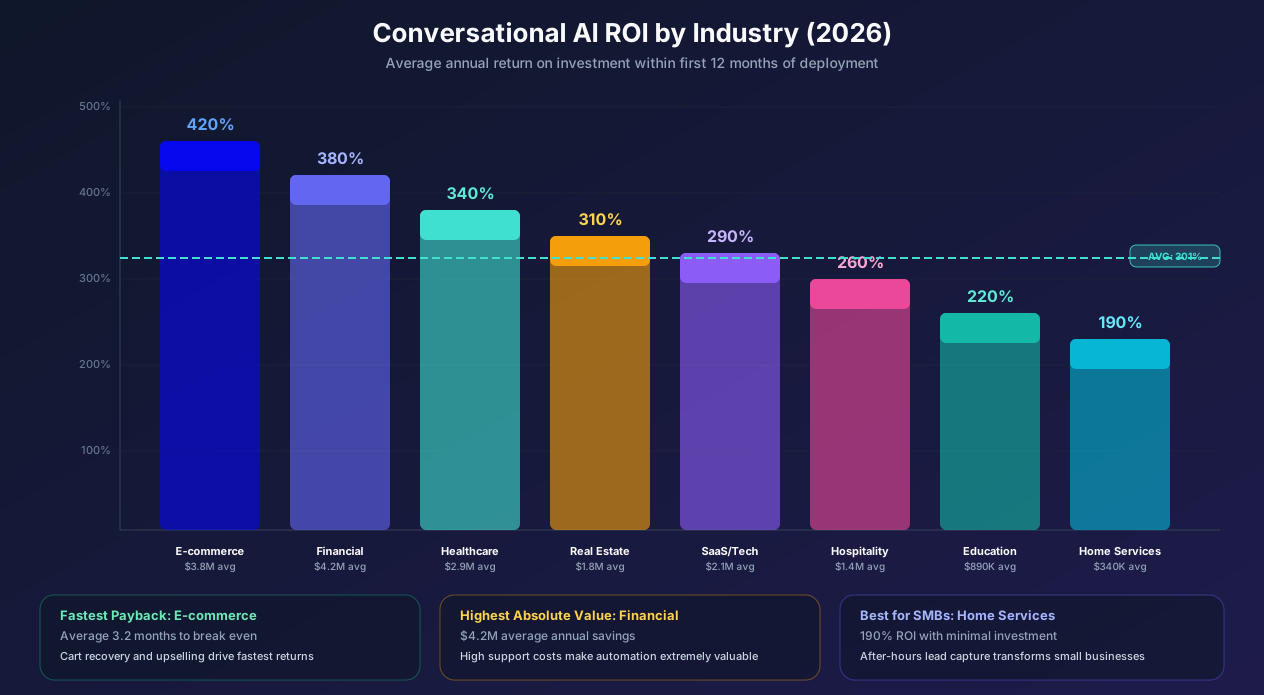
ROI by Industry
E-commerce leads with 420% average ROI in the first 12 months, driven by the combination of cost reduction (support automation) and revenue generation (cart recovery, upselling). A mid-size e-commerce business processing 50,000 monthly support interactions and $2 million in monthly revenue typically sees $3.8 million in annual value from conversational AI: $2.4 million in support cost savings plus $1.4 million in additional revenue from conversational selling.
Financial services delivers the highest absolute dollar value at $4.2 million average annual benefit, despite a lower percentage ROI (380%) due to higher implementation costs. The high per-interaction cost in financial services ($12-35 per call) means that automating even a moderate volume of interactions generates substantial savings.
Healthcare achieves 340% ROI with $2.9 million average annual benefit, primarily from no-show reduction ($150-300 saved per prevented no-show), administrative labor reduction, and improved patient throughput. Real estate achieves 310% ROI through lead generation and qualification automation, with the value concentrated in higher lead volume and faster response times.
Home services, while showing the lowest percentage ROI at 190%, represents the most accessible opportunity for small businesses. A local plumber, electrician, or cleaning company can deploy conversational AI for $49-$199/month and see $340,000 in annual value through after-hours lead capture, automated booking, and reduced missed calls -- a transformative impact for a small business operation.
ROI Calculation Framework
To calculate your specific expected ROI, assess three value categories:
1. Cost Savings (Direct): Current monthly support volume multiplied by current cost per interaction multiplied by expected chatbot containment rate (70-85%) multiplied by 12 months. Example: 20,000 interactions/month at $10 each with 75% containment = $1.8M annual savings.
2. Revenue Generation (Incremental): Monthly website visitors multiplied by chatbot engagement rate (typically 15-48%) multiplied by lead capture improvement over forms (typically 2-3x) multiplied by lead-to-customer rate multiplied by average deal value multiplied by 12 months. Example: 50,000 visitors/month with 30% engagement, 3x lead improvement, 10% close rate, $500 deal = additional $2.7M annual revenue.
3. Operational Efficiency (Indirect): Agent productivity improvement (chatbot handles routine queries, agents focus on complex issues), reduced training costs (chatbot handles common questions that new agents struggle with), reduced seasonal hiring needs (chatbot scales instantly), and improved data collection (structured conversation data for business intelligence). These indirect benefits typically add 20-40% to the direct ROI calculation.
Time to ROI
The average time to positive ROI for conversational AI deployments is 6 months across all industries, but this varies significantly based on implementation approach. Platform-based deployments (using solutions like Conferbot) achieve positive ROI in 1-3 months because setup costs are minimal and value accrues from day one. Custom-built solutions require 6-12 months due to higher upfront development costs. The fastest time to ROI observed is 3 days (a high-traffic e-commerce site deploying an LLM-powered chatbot on a no-code platform), and the slowest is 14 months (a complex enterprise deployment with custom integrations across 8 legacy systems).
Build vs. Buy: The Conversational AI Decision Framework
One of the most consequential decisions in conversational AI strategy is whether to build a custom solution in-house or buy a platform. This decision impacts cost, timeline, flexibility, maintenance burden, and long-term competitiveness. Here is a structured framework for making this decision.
When to Build Custom
Building conversational AI in-house makes sense under specific conditions: you have unique conversational requirements that no platform supports, you need complete control over data and model training (regulated industries with strict data sovereignty requirements), you have a dedicated AI/ML engineering team (minimum 3-5 engineers plus an ML specialist), you can accept a 6-12 month development timeline before production deployment, and you have the budget for $150,000-$500,000 in upfront development costs plus $50,000-$100,000 in annual maintenance.
The advantages of building are maximum customization, full data ownership, no platform dependency, and the ability to create proprietary conversational experiences that competitors cannot replicate. However, the risks are substantial: industry data shows that 60% of custom-built chatbot projects fail to reach production, and those that succeed require ongoing engineering investment to maintain and improve.
When to Buy a Platform
Buying a conversational AI platform is the right choice for the vast majority of businesses. It makes sense when you want to deploy within weeks rather than months, you lack dedicated AI/ML engineering resources, your use cases align with standard patterns (customer support, lead generation, scheduling), you want predictable monthly costs rather than large upfront investments, and you need continuous platform improvements without engineering effort on your part.
The advantages of buying are rapid deployment (1-4 weeks typical), lower total cost of ownership ($600-$60,000/year vs. $200,000-$600,000/year for custom), continuous improvement as the platform evolves, access to pre-built integrations, and the ability to focus your team's energy on core business activities rather than AI infrastructure. The primary risk is platform dependency -- you rely on the vendor's roadmap, pricing decisions, and continued operation.
The Hybrid Approach
Many successful organizations adopt a hybrid approach: they buy a platform for the core conversational AI capabilities (NLU, dialogue management, channel integration) and build custom components where they need unique differentiation (proprietary recommendation algorithms, custom industry models, bespoke integrations with legacy systems). This approach captures 80-90% of the platform benefits while preserving the ability to customize where it matters most.
Decision Matrix
| Factor | Build Custom | Buy Platform | Winner |
|---|---|---|---|
| Time to deployment | 6-12 months | 1-4 weeks | Buy (15x faster) |
| Upfront cost | $150K-$500K | $0-$5K | Buy (100x cheaper) |
| Annual maintenance | $50K-$100K | $600-$60K | Buy (5-80x cheaper) |
| Team required | 3-5 ML engineers | 1 non-technical admin | Buy |
| Customization depth | Unlimited | Platform-constrained | Build |
| Data control | Complete | Vendor-dependent | Build |
| Success rate | 40% reach production | 95% deploy successfully | Buy |
| Feature velocity | Limited by team size | Continuous platform updates | Buy |
For most businesses, the buy decision is clear on every dimension except customization depth and data control. If those two factors are non-negotiable requirements, building makes sense. For everyone else, the combination of 15x faster deployment, 95% success rate, and dramatically lower total cost makes platform-based deployment the rational choice.
12-Week Implementation Roadmap: From Zero to Production
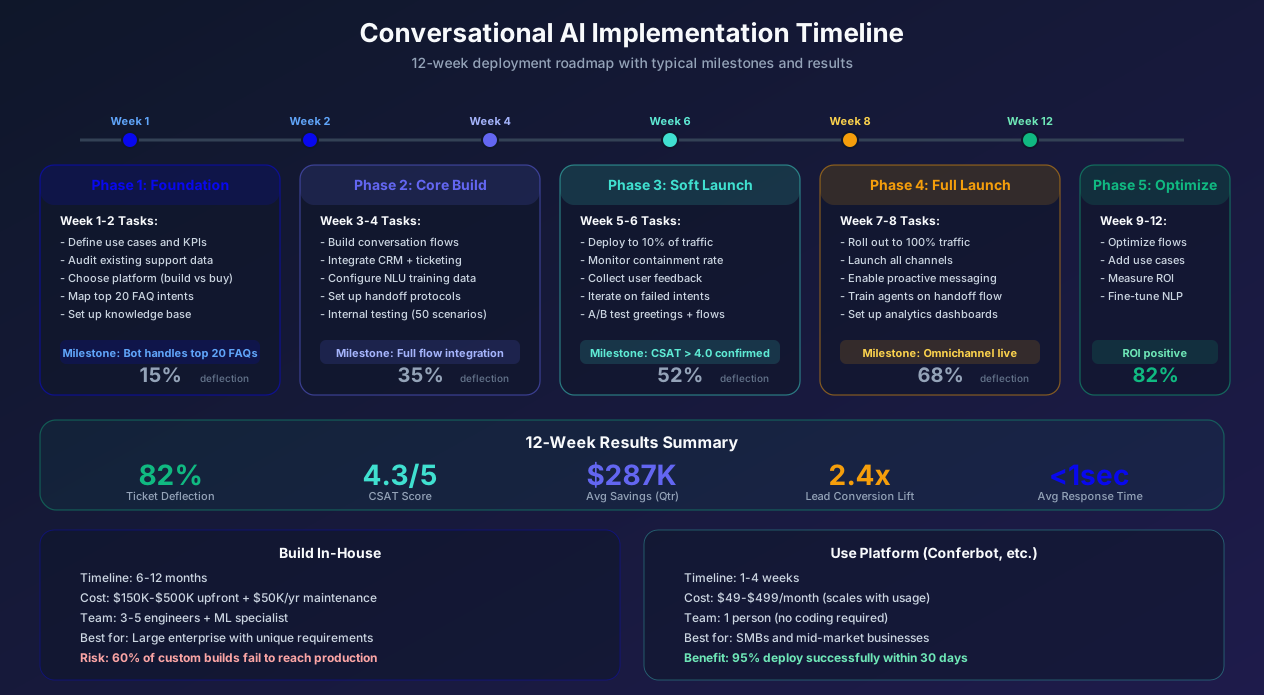
Implementing conversational AI successfully requires a structured approach that balances thoroughness with speed. This 12-week roadmap has been refined through hundreds of deployments and is designed to get you to production quickly while building a foundation for long-term optimization.
Phase 1: Foundation (Weeks 1-2)
The foundation phase establishes the strategic and technical groundwork for your deployment. Key activities include:
Use case prioritization: Analyze your existing customer interaction data to identify the top 20 intents by volume and complexity. Prioritize intents that are high-volume, low-complexity, and high-automation-potential. For most businesses, these include order status inquiries, FAQ questions, appointment scheduling, and basic account management.
KPI definition: Establish the metrics you will use to measure success. Primary KPIs should include containment rate (target: 70%+), customer satisfaction score (target: 4.0+/5.0), average response time (target: under 2 seconds), and escalation rate (target: under 25%). Secondary KPIs include lead capture rate, cost per interaction, and agent productivity improvement.
Knowledge base preparation: Compile and structure the information your chatbot needs to answer customer questions: FAQ documents, product information, policies, procedures, and company data. This content becomes the foundation for the chatbot's knowledge base. Well-organized content dramatically improves response accuracy.
Platform selection: Using the build vs. buy framework above, select your platform. Request demos from 2-3 shortlisted platforms, test them with real customer queries from your data, and evaluate based on accuracy, ease of use, integration capabilities, and pricing.
Milestone: By the end of Week 2, you should have a configured chatbot that correctly handles your top 20 FAQs with 90%+ accuracy. Expected containment at this stage: 15%.
Phase 2: Core Build (Weeks 3-4)
The core build phase adds conversation flows, integrations, and business logic that transform a basic FAQ bot into a functional virtual agent.
Conversation flow design: Build multi-turn conversation flows for your priority use cases. Each flow should handle the happy path (customer provides all needed information), clarification paths (chatbot asks follow-up questions), error paths (invalid input, system errors), and escape paths (customer wants to talk to a human).
System integration: Connect the chatbot to your critical business systems: CRM (Salesforce, HubSpot, Zoho), ticketing (Zendesk, Freshdesk), calendar (Google Calendar, Calendly), e-commerce (Shopify, WooCommerce), and communication (email, SMS). These integrations enable the chatbot to take real actions, not just provide information.
NLU optimization: Refine intent classification and entity extraction based on test results from Phase 1. Add training examples for intents that showed low confidence, configure custom entity types for your domain, and set up sentiment-triggered behaviors (empathy for frustration, upsell prompts for satisfaction).
Handoff protocol design: Design the process for transferring conversations to human agents. Include context summary generation (so agents do not ask questions the chatbot already answered), department routing based on intent classification, and priority queuing based on sentiment and customer value.
Milestone: Fully integrated chatbot that handles 5-10 conversation flows end-to-end, connected to CRM and ticketing systems. Expected containment: 35%.
Phase 3: Soft Launch (Weeks 5-6)
The soft launch deploys the chatbot to a limited audience for real-world validation before full rollout.
Deploy the chatbot to 10% of your traffic (or a specific segment, like one product line or geographic region). Monitor every conversation, tracking containment rate, customer satisfaction, failed intents, and escalation reasons. Collect and analyze customer feedback. Identify the top 10 failure patterns and address them through NLU adjustments, new conversation flows, or knowledge base updates. A/B test chatbot greetings, response tones, and flow designs to optimize engagement.
Milestone: Validated chatbot performance with real customers. CSAT confirmed above 4.0/5.0. Expected containment: 52%.
Phase 4: Full Launch (Weeks 7-8)
With soft launch validation complete, roll out to 100% of traffic across all channels. Enable proactive messaging (triggered by page behavior, time on site, or exit intent). Launch on additional channels (WhatsApp, social media, SMS) if applicable. Train your human agent team on the new handoff workflow. Configure analytics dashboards for real-time performance monitoring.
Milestone: Full omnichannel deployment live. Expected containment: 68%.
Phase 5: Optimize (Weeks 9-12 and Ongoing)
Optimization is where the real value compound occurs. Analyze conversation logs to identify new intents and entity patterns. Add new use cases based on customer demand (the chatbot's analytics will reveal what customers are asking for that the bot cannot yet handle). Fine-tune NLP models based on accumulated conversation data. Implement advanced features: personalized responses based on customer history, proactive outreach based on behavioral triggers, and predictive intent (anticipating what the customer needs before they ask).
Milestone: ROI-positive deployment with continuously improving performance. Expected containment: 82%. Average CSAT: 4.3/5.0. Average quarterly savings: $287,000.
The Future of Conversational AI: What Comes Next
Conversational AI is evolving rapidly, and the capabilities available in 2027-2028 will significantly expand what businesses can accomplish through automated conversations. Understanding these trends helps you make technology investments today that will remain relevant as the field advances.
Agentic Conversational AI
The most significant trend is the evolution from responsive chatbots to autonomous agents. Current conversational AI systems primarily respond to customer-initiated requests. Next-generation systems will operate as autonomous agents that independently identify problems, research solutions, coordinate across systems, and resolve issues -- with human oversight only for edge cases. A customer's subscription renewal failing due to an expired card will trigger the agent to send a personalized message suggesting an update, process the card change through conversation, retry the payment, and confirm renewal -- all without human involvement or customer complaint.
Emotional AI: Beyond Sentiment
Current sentiment analysis detects broad emotional categories. Advanced emotional AI in development can detect sarcasm, identify cultural communication norms (directness varies dramatically across cultures), predict emotional trajectory (detecting the early signs of a customer heading toward cancellation weeks before they express it), and generate emotionally intelligent responses that match the sophistication of the best human communicators. This capability will enable conversational AI to handle the most sensitive interactions -- complaints, cancellations, crisis communications -- with appropriate empathy and nuance.
Seamless Voice-Text Integration
The boundary between voice and text channels will dissolve. Customers will start conversations by voice (calling a number), continue by text (when they step into a meeting), and resume by voice (in the car after the meeting) -- all within a single continuous conversation with shared context. The conversational AI will automatically adapt its communication style to each modality (concise for voice, detailed for text) while maintaining perfect context continuity.
Industry-Specific AI Specialists
General-purpose conversational AI will give way to industry-specialized systems that deeply understand domain-specific language, regulations, workflows, and customer expectations. A healthcare conversational AI will understand medical terminology, comply with HIPAA automatically, integrate with EHR systems, and follow clinical communication best practices. A financial conversational AI will understand investment terminology, comply with SEC regulations, integrate with trading platforms, and communicate with the precision required for financial advice.
Preparing Your Organization
To position your organization for the future of conversational AI: invest in clean, structured customer data (the fuel for personalization and prediction), choose platforms with active R&D investments and regular capability releases, build internal expertise in conversational design (the skill of designing effective AI conversations), establish governance frameworks for AI-powered customer interactions, and treat conversational AI as an ongoing capability investment -- not a one-time project. The organizations that build conversational AI competency today will have a compounding advantage as the technology accelerates.
Was this article helpful?
Conversational AI in 2026 FAQ
Everything you need to know about chatbots for conversational ai in 2026.
About the Author
Conferbot Team specializes in conversational AI, chatbot strategy, and customer engagement automation. With deep expertise in building AI-powered chatbots, they help businesses deliver exceptional customer experiences across every channel.
View all articles