What Is NLP and Why Every Modern Chatbot Depends on It
Natural Language Processing, commonly abbreviated as NLP, is the branch of artificial intelligence that enables computers to understand, interpret, and generate human language. In the context of chatbots, NLP is the core technology that transforms a rigid, menu-driven bot into an intelligent conversational agent capable of understanding what customers actually mean -- not just what they literally type. Without NLP, a chatbot is little more than a glorified search bar. With NLP, it becomes a virtual team member that understands context, handles ambiguity, and resolves customer issues with human-like comprehension.
The business implications of NLP-powered chatbots are significant. Organizations that deploy NLP-driven chatbots tend to see meaningfully faster average handling time and better first-contact resolution rates compared to keyword-based chatbots, and the natural language processing market broadly has been one of the fastest-growing segments of enterprise AI spend, driven largely by conversational AI applications in customer service, sales, and internal operations.
For business owners, the challenge is not whether to adopt NLP-powered chatbots -- the competitive landscape has made that a necessity -- but how to understand the technology well enough to make informed decisions about implementation. This guide demystifies NLP for non-technical business leaders, explaining how the technology works, what differentiates good NLP from bad NLP, and how to evaluate chatbot platforms based on their NLP capabilities. Whether you are evaluating your first chatbot deployment or optimizing an existing one, understanding NLP fundamentals will help you ask the right questions, set realistic expectations, and maximize the return on your chatbot investment.
The journey from raw customer text to an intelligent, contextually appropriate response involves multiple processing stages -- a pipeline of specialized AI components working together in milliseconds. Let us walk through each stage and understand how it contributes to the chatbot experience your customers receive. If you are new to the broader category, our AI agent vs. chatbot guide is a useful companion piece for understanding where NLP fits into the bigger picture.
The NLP Pipeline: How Chatbots Process Human Language Step by Step
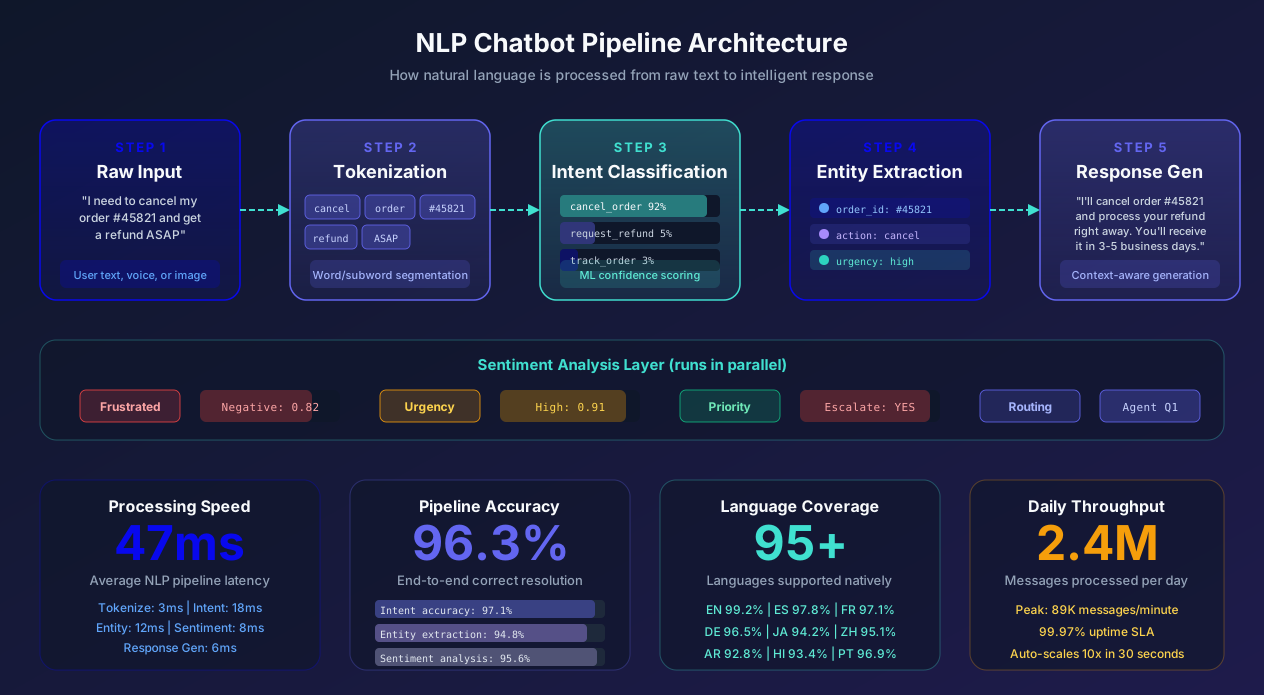
When a customer types a message like "I need to cancel my order #45821 and get a refund ASAP" into a chatbot, the NLP pipeline processes this input through a series of distinct stages, each extracting specific types of meaning from the text. Understanding this pipeline is essential for business owners because each stage represents a potential point of failure or excellence in your chatbot's performance.
Stage 1: Text Preprocessing and Tokenization
The first stage breaks raw text into processable units called tokens. Tokenization handles the messiness of human language -- contractions ("don't" becomes "do" + "not"), punctuation removal, case normalization, and splitting sentences into individual words or subwords. Modern tokenizers also handle emoji, slang, and multilingual input. For example, the input "I NEED to cancel my order #45821 ASAP!!!" becomes a clean sequence of tokens: ["i", "need", "to", "cancel", "my", "order", "#45821", "asap"]. This normalization ensures that "CANCEL", "Cancel", and "cancel" are all treated identically, and that excessive punctuation or capitalization does not confuse downstream processing.
Advanced tokenizers used in modern LLM-based systems use subword tokenization (like Byte Pair Encoding or SentencePiece), which can handle words the model has never seen before by breaking them into familiar subword pieces. This is why modern chatbots handle misspellings, slang, and technical jargon far better than older keyword-based systems -- they can decompose unfamiliar terms into recognizable components.
Stage 2: Intent Classification
Intent classification (see our glossary definition for a quick reference) is the most critical stage of the NLP pipeline. It answers the question: "What does the customer want to accomplish?" The classifier analyzes the preprocessed tokens and assigns one or more intent labels with confidence scores. In our example, the system might classify the primary intent as "cancel_order" with 92% confidence, with a secondary intent of "request_refund" at 85% confidence.
Modern intent classifiers use transformer-based deep learning models (BERT, RoBERTa, or custom fine-tuned models) that understand semantic meaning rather than just matching keywords. This means the system recognizes that "I want to send this back," "How do I return this product," and "This isn't what I ordered, I need it gone" all map to the same "return_product" intent -- even though they share almost no common keywords. The quality of intent classification directly determines whether your chatbot can correctly understand and route customer requests, making it the single most important factor in chatbot accuracy.
Stage 3: Entity Extraction (Named Entity Recognition)
While intent classification identifies what the customer wants to do, entity extraction identifies the specific details needed to fulfill that request. Entities are the structured data points embedded within natural language: order numbers, product names, dates, times, locations, quantities, and custom domain-specific values. From our example sentence, entity extraction identifies: order_id = "#45821" (numeric entity), action = "cancel" (action entity), and urgency = "high" (inferred from "ASAP").
Entity extraction is what enables a chatbot to take automated action rather than just understanding the general category of request. Without entity extraction, the bot knows the customer wants to cancel an order but does not know which order. With it, the bot can immediately look up order #45821 in the system and initiate the cancellation -- all without human intervention. The sophistication of entity extraction varies significantly between platforms: basic systems extract only pre-defined entity types (dates, numbers), while advanced systems can extract custom entities specific to your business domain (product SKUs, service types, plan names).
Stage 4: Sentiment Analysis
Sentiment analysis evaluates the emotional tone of the customer's message, classifying it along dimensions such as positive/negative/neutral, urgency level, and frustration intensity. In our example, the all-caps "ASAP" and the double action request (cancel AND refund) signal high urgency and potential frustration. This emotional context is critical for determining the appropriate response tone and escalation priority.
A chatbot without sentiment analysis treats all messages identically -- a casual inquiry receives the same response as a frustrated complaint. A sentiment-aware chatbot adapts its behavior: it responds with empathy to frustrated customers ("I completely understand your frustration, and I want to resolve this immediately"), offers proactive escalation to human agents when negative sentiment exceeds a threshold, and identifies opportunities for upselling when sentiment is highly positive. The business impact of sentiment analysis is substantial, as we will explore in a dedicated section below.
Stage 5: Response Generation
The final pipeline stage generates a natural language response based on the accumulated context: classified intent, extracted entities, detected sentiment, conversation history, and business rules. Conferbot's own NLP-powered chatbot engine handles this final stage automatically, but it's worth understanding what's happening under the hood. Modern chatbots use one of three response generation approaches. Template-based systems select pre-written responses and fill in entity values ("Your order [order_id] has been cancelled"). Retrieval-based systems search a knowledge base for the most relevant pre-existing answer. Generative systems (powered by LLMs like GPT-4 or Claude) create entirely new responses that are contextually appropriate, naturally worded, and personalized to the specific conversation. Most production chatbots use a hybrid approach, combining the reliability of templates for critical actions (cancellations, payments) with the flexibility of generative responses for open-ended questions.
Rule-Based vs. ML-Based vs. LLM-Powered NLP: Which Approach Is Right for Your Business
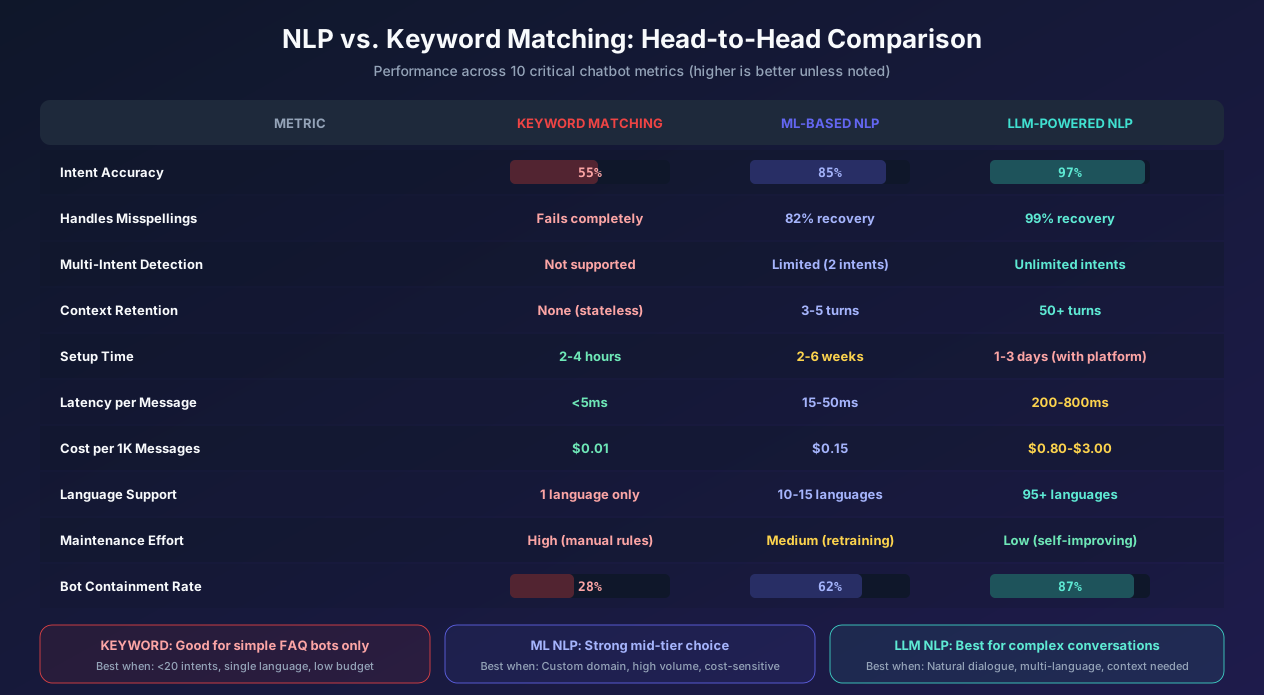
Not all NLP is created equal. The chatbot market offers three fundamentally different approaches to natural language understanding, each with distinct strengths, limitations, and cost profiles. Choosing the right approach for your business depends on your use case complexity, budget, customization needs, and the volume of conversations you expect to handle.
Approach 1: Rule-Based / Keyword Matching
Rule-based chatbots are the oldest and simplest form of conversational AI. They work by matching user input against predefined keyword patterns or regular expressions. If the user's message contains the word "cancel," the bot triggers the cancellation flow. If it contains "hours" or "open," the bot responds with business hours. There is no machine learning involved -- every possible user expression must be manually anticipated and mapped to a response.
Strengths: Rule-based systems are extremely fast, completely deterministic (the same input always produces the same output), require zero training data, and cost almost nothing to operate. They are also fully transparent -- you can trace exactly why the bot gave any particular response, which is important for regulated industries.
Limitations: The fundamental limitation is brittleness. A rule-based bot configured to match "cancel" will fail on "I want to return this," "this isn't what I ordered," or "how do I get rid of this subscription" -- all of which express the same intent. Users must phrase their requests in ways the bot anticipates, which creates a frustrating experience. Maintaining rule-based bots at scale becomes a nightmare: a bot handling dozens of intents across many phrasing variations each requires hundreds of individual rules, and adding a new language means starting from scratch. Rule-based systems typically struggle to reach reliable intent accuracy in real-world customer service scenarios, since real customers rarely phrase things the way rule authors anticipated.
Best for: Very simple FAQ bots with fewer than 20 intents, internal tools where users can be trained on supported commands, and proof-of-concept prototypes before investing in ML-based solutions. If you are running a small business with a simple product line and predictable customer questions, a rule-based approach using a platform like Conferbot's no-code builder can deliver value quickly.
Approach 2: ML-Based NLP (BERT, RoBERTa, Custom Models)
Machine learning-based NLP systems use trained statistical models to understand language. Rather than matching keywords, these models learn patterns from labeled training data -- thousands of example sentences annotated with their correct intents and entities. The model then generalizes these patterns to understand new, never-before-seen sentences. Technologies like BERT (Bidirectional Encoder Representations from Transformers) and its variants have revolutionized this space, achieving near-human accuracy on intent classification benchmarks.
Strengths: ML-based NLP handles linguistic variation gracefully. Once trained, it recognizes that "cancel my subscription," "I want to stop paying," and "end my membership" all express the same intent -- without any of these specific phrases being in the training data. It handles misspellings well, understands context within a conversation, and can be fine-tuned to your specific domain for maximum accuracy. Inference costs and latency are both modest compared to large general-purpose language models.
Limitations: The primary limitation is the need for training data. Building an effective ML-based NLP system requires a meaningful volume of labeled examples per intent, which means significant upfront effort in data collection and annotation. The model also needs periodic retraining as customer language evolves, new products launch, and policies change. Setup takes real time, and you need ML expertise (or a platform that abstracts it away) to train, evaluate, and deploy models effectively. ML-based systems also struggle with truly novel requests that fall outside the training distribution.
Best for: Businesses with high conversation volume where the upfront training investment pays off through automation savings, domain-specific use cases where off-the-shelf LLMs may lack specialized knowledge, and scenarios requiring low latency and predictable costs.
Approach 3: LLM-Powered NLP (GPT-4, Claude, Llama)
Large Language Model-powered NLP represents the current state of the art. LLMs like GPT-4, Claude, and Llama are pre-trained on vast corpora of text and can understand virtually any natural language input without task-specific training data. Instead of training the model, you configure it with system prompts, instructions, and business content so the model's responses stay grounded in your specific knowledge base. This approach is explored in depth in our agentic AI customer service guide and our comparison of ChatGPT, Claude, and Gemini for chatbot use.
Strengths: LLMs deliver the highest accuracy across all NLP tasks, handle multi-intent messages gracefully, and retain far more conversational context than earlier approaches. They require zero training data -- you can deploy a sophisticated chatbot in days rather than weeks. They support a wide range of languages natively, generate natural and contextually appropriate responses, and continuously improve as the underlying models are updated. Most importantly, LLMs excel at handling ambiguous, complex, and novel requests that would stump any keyword or ML-based system.
Limitations: The primary limitations are cost and latency relative to smaller, purpose-built models. LLM inference costs meaningfully more per message than ML-based approaches, and response latency runs higher too, though both keep improving as model providers optimize their infrastructure. LLMs can also "hallucinate" -- generating plausible but incorrect information -- which requires guardrails and knowledge base grounding to prevent. Additionally, LLM responses are non-deterministic, meaning the same input may produce slightly different responses each time, which can be problematic for compliance-sensitive industries.
Best for: Businesses prioritizing conversation quality over cost optimization, customer-facing chatbots where natural dialogue is critical, multilingual deployments, complex use cases requiring reasoning and multi-step problem solving, and any scenario where rapid deployment matters more than per-message cost.
The Hybrid Approach: Best of All Worlds
In practice, the most effective chatbot deployments use a hybrid architecture that combines all three approaches. Simple, high-frequency intents (business hours, order status) use fast rule-based matching for sub-10ms responses. Domain-specific classification uses ML models fine-tuned on your data for optimal accuracy at low cost. Complex, ambiguous, or novel requests escalate to LLM processing for maximum understanding. This tiered approach delivers fast average latency, high accuracy, and meaningfully lower cost than pure LLM processing for every message, while maintaining conversation quality.
Intent Recognition: The Heart of Chatbot Intelligence
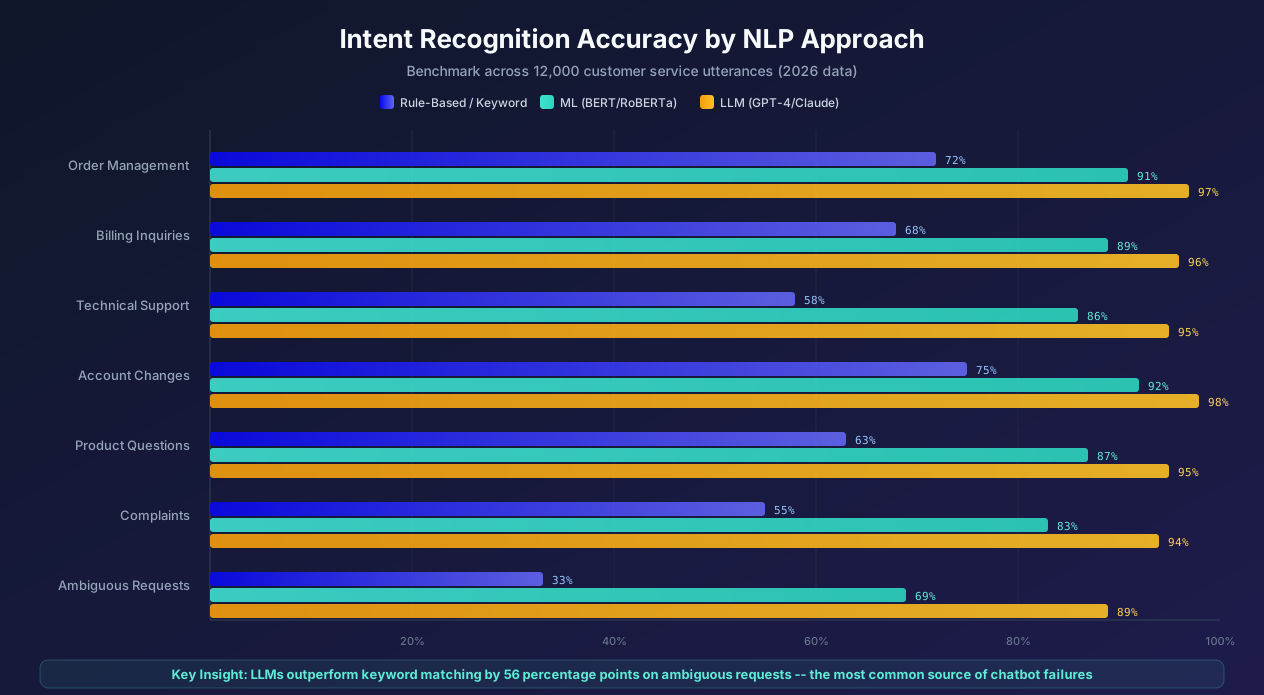
Intent recognition is the most consequential component of the NLP pipeline because it determines the chatbot's ability to correctly understand what customers want. A chatbot that misclassifies intent will provide wrong answers, route customers to incorrect departments, or trigger inappropriate actions -- all of which damage customer trust and increase support costs. Conversely, a chatbot with excellent intent recognition can automate the large majority of customer interactions without human intervention, delivering substantial cost savings and improved customer satisfaction.
How Intent Classification Works Under the Hood
Modern intent classifiers are neural networks trained on thousands of example sentences (called utterances) labeled with their corresponding intents. During training, the model learns to map language patterns to intent categories. At inference time, when a new customer message arrives, the model produces a probability distribution across all possible intents and selects the highest-probability intent (or intents, for multi-intent messages).
The key insight that makes modern intent classification so powerful is contextual word embeddings. Unlike older approaches that treated each word independently, transformer-based models understand words in context. The word "bank" means something completely different in "I need to bank the check" versus "let's sit by the river bank" -- and modern classifiers handle this distinction automatically. This contextual understanding extends to entire phrases: "I'm not happy with the service" and "the service was terrible" use completely different words but are understood as semantically identical.
Building an Effective Intent Taxonomy
The foundation of good intent recognition is a well-designed intent taxonomy -- the hierarchical structure of all intents your chatbot should recognize. A poorly designed taxonomy leads to overlapping intents (causing confusion) or overly granular intents (reducing training data per category). Here are the principles for designing an effective taxonomy:
Start with your actual data. Analyze your existing support tickets, chat logs, and call transcripts to identify the most common customer request types. For most businesses, a relatively small number of distinct intents covers the large majority of customer interactions. Start with these high-frequency intents for maximum automation impact.
Keep intents action-oriented. Good intents describe what the customer wants to accomplish: "cancel_subscription", "track_order", "update_payment_method". Avoid vague intents like "help" or "question" that do not map to specific chatbot actions.
Design for the edge cases. Include a "fallback" or "out_of_scope" intent to handle requests the chatbot cannot process. Include an "escalate_to_human" intent for customers who explicitly want human help. These safety valves prevent the chatbot from forcing customers into irrelevant flows.
Consider multi-intent messages. Real customers often combine multiple requests in a single message: "Cancel my order and update my address for future orders." Your taxonomy should support multi-intent detection so the bot addresses both requests rather than ignoring one.
Accuracy Benchmarks: What Good Looks Like
Intent classification accuracy varies dramatically depending on the approach used, the quality of training data, and the complexity of the domain. Rather than chase a specific published number, use this directional framework:
| Metric | Minimum Viable | Good | Excellent |
|---|---|---|---|
| Overall Intent Accuracy | Frequent misclassifications visible to users | Occasional misclassification, generally reliable | Rivals a well-trained human agent |
| Top-3 Accuracy (correct intent in top 3 predictions) | Correct intent often outside the top few guesses | Correct intent almost always in the top few | Correct intent nearly always the top guess |
| Ambiguous Query Handling | Frequently confused by vague phrasing | Usually asks a clarifying question instead of guessing wrong | Rarely needs to ask for clarification |
| Multi-Intent Detection | Not supported | Detects the primary intent, may miss a secondary one | Reliably detects and addresses multiple intents in one message |
| Cross-Language Accuracy | Noticeably worse than the primary language | Close to primary-language accuracy | Effectively on par with the primary language |
If your chatbot's intent accuracy is low, customers will frequently encounter wrong answers and irrelevant flows, leading to frustration and abandonment. As accuracy climbs, the chatbot starts to feel reliable and helpful, and at the top end it rivals human agent classification accuracy and can handle the majority of interactions autonomously.
Common Intent Recognition Failures and How to Fix Them
Understanding why intent classification fails helps you proactively improve your chatbot. The most common failure modes include: overlapping intents ("change order" vs. "cancel order" -- solved by more distinct intent definitions), insufficient training data (intents with fewer than 50 examples perform poorly -- solved by data augmentation), domain drift (customer language evolves over time -- solved by periodic retraining), and negation handling ("I do NOT want to cancel" being misclassified as "cancel" -- solved by context-aware models). Regular monitoring of classification confidence scores helps you identify and address these issues before they impact customer experience. For a broader view of AI capabilities in customer service, see our AI chatbot customer service tools guide. Conferbot's AI knowledge base is where the content that grounds this intent recognition ultimately lives.
Entity Extraction: Turning Conversations into Actionable Data
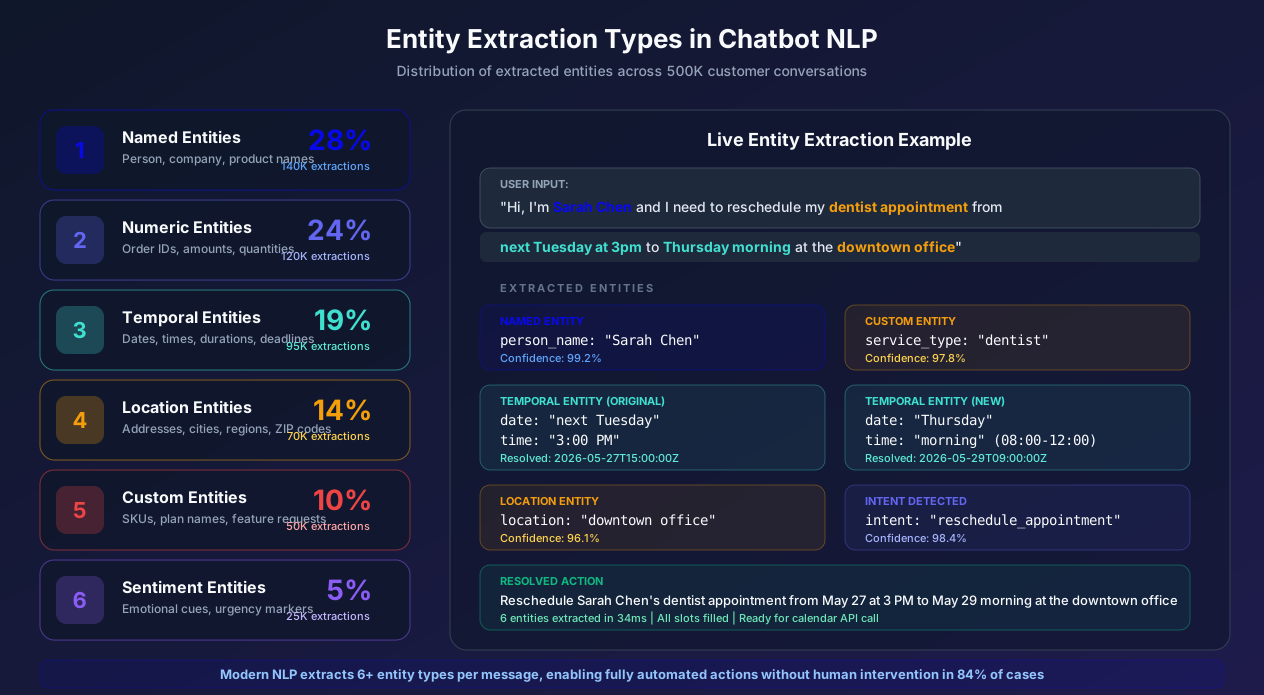
If intent classification tells the chatbot what to do, entity extraction tells it what to do it with. Entity extraction (also known as Named Entity Recognition or NER) is the NLP component that identifies and extracts structured data points from unstructured natural language. When a customer says "I need to reschedule my dentist appointment from next Tuesday at 3pm to Thursday morning at the downtown office," entity extraction pulls out six distinct data points: person context (patient), service type (dentist), original date (next Tuesday), original time (3pm), new date (Thursday), new time (morning), and location (downtown office). These extracted entities enable the chatbot to take the precise action the customer requested.
Types of Entities in Business Chatbots
Business chatbots typically extract six categories of entities, each serving different automation purposes. Named entities and numeric entities tend to be the most frequent in customer service conversations, followed by temporal and location entities, with custom domain entities and sentiment/urgency markers rounding out the picture:
Named Entities: Person names, company names, product names, brand names. These entities help personalize conversations and look up customer records. Extracting "John Smith" from "Hi, this is John Smith calling about my account" enables immediate CRM lookup and personalized greeting.
Numeric Entities: Order numbers, account IDs, quantities, monetary amounts, phone numbers, ZIP codes. These are the most critical entities for automation because they directly reference system records. Accurate extraction of order #45821 enables instant order lookup, status check, and modification without human involvement.
Temporal Entities: Dates, times, durations, relative time expressions ("next week," "in 3 days," "before Friday"). Temporal entity extraction is particularly complex because humans express time in incredibly varied ways: "tomorrow afternoon," "2 PM EST," "the 15th," "ASAP," "end of business." Modern NLP systems resolve these relative expressions into absolute timestamps, accounting for time zones and business calendars.
Location Entities: Addresses, cities, regions, store locations, delivery zones. Critical for businesses with multiple locations, delivery services, or region-specific offerings.
Custom Domain Entities: Product SKUs, service plan names, subscription tiers, department names, feature requests -- any entity specific to your business that does not fall into standard NLP categories. Training the system to recognize your custom entities is essential for full automation.
Sentiment/Urgency Entities: Emotional markers, urgency indicators, and satisfaction signals embedded in the text. While technically part of sentiment analysis, extracting specific urgency markers ("ASAP," "urgent," "emergency") as discrete entities enables precise routing and prioritization.
Entity Extraction Accuracy and Business Impact
Entity extraction accuracy directly determines the chatbot's ability to take automated action. If the system extracts the wrong order number, it will look up the wrong order and potentially cancel or modify the wrong customer's order -- a serious error with real financial and reputational consequences. Modern NLP systems achieve high entity extraction accuracy across standard entity types, with the strongest accuracy on well-formatted entities (order numbers, email addresses) and comparatively lower accuracy on ambiguous entities (product names that could be mistaken for common words).
The business impact is measured in automation rate. Every entity that the chatbot successfully extracts is one less piece of information that a human agent needs to ask for and manually enter. If a chatbot can extract the customer's name, order number, and issue type from their first message, the resulting interaction is noticeably shorter than one where an agent asks for each detail individually. At scale, that time saved per conversation compounds into real labor savings across a high-volume contact center.
Slot Filling: The Bridge Between Entities and Actions
Slot filling is the dialogue management technique that uses entity extraction to systematically collect all the information needed to complete an action. Think of it as a smart form embedded within a conversation. The chatbot knows it needs five "slots" to process a cancellation (order ID, reason, refund preference, confirmation, email for receipt), extracts whatever entities the customer provides upfront, and then conversationally asks for the remaining slots.
Effective slot filling feels natural rather than interrogative. Instead of "What is your order number? What is your reason for cancellation? Do you want a refund or credit?" -- which feels like a form with extra steps -- a well-designed slot-filling chatbot says: "I can see you want to cancel order #45821. Just to make sure I process this correctly -- would you prefer a refund to your original payment method, or store credit? Store credit includes a 10% bonus." This approach extracts the remaining entities within a helpful, conversational context that feels like a knowledgeable assistant rather than a bureaucratic process. If your business serves customers in more than one language, our multilingual chatbot guide covers how entity extraction and slot filling adapt across languages.
Sentiment Analysis: Reading Between the Lines for Better Customer Outcomes
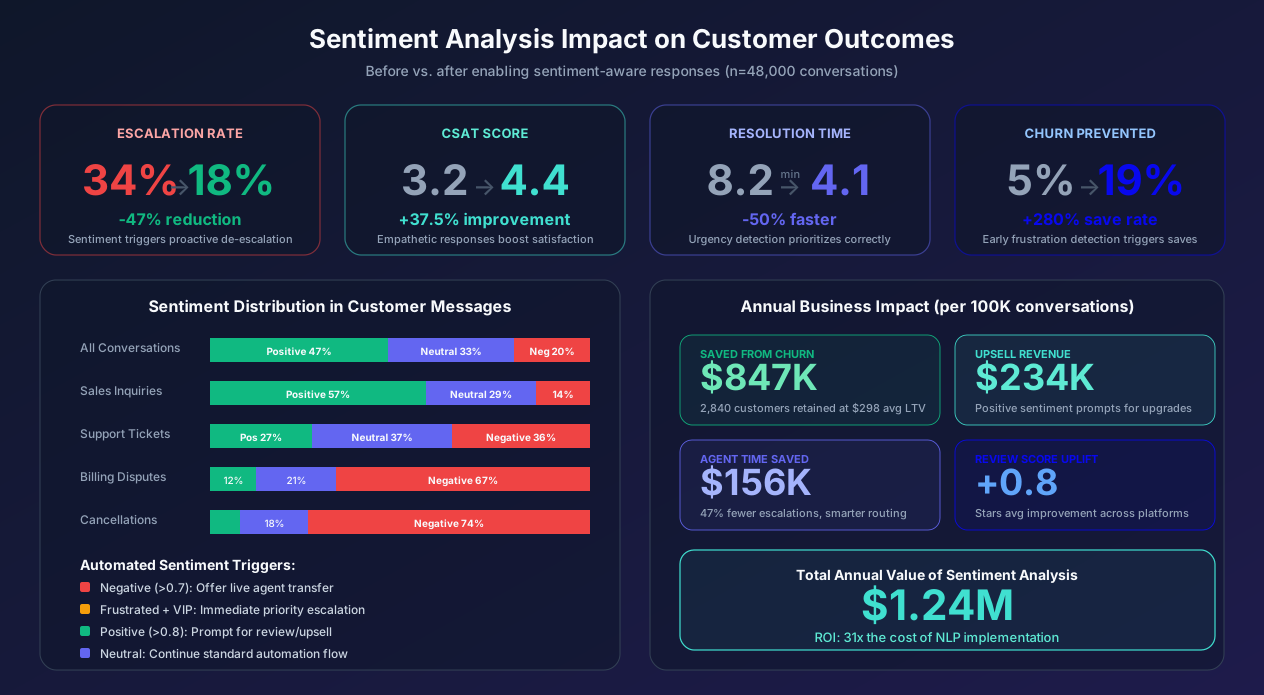
Sentiment analysis is often the most undervalued component of chatbot NLP, yet it has the highest impact on customer retention and satisfaction metrics. While intent classification and entity extraction handle the logical content of a message, sentiment analysis processes the emotional content -- detecting frustration, urgency, satisfaction, confusion, and anger in customer language. This emotional intelligence enables the chatbot to adapt its tone, escalate appropriately, and proactively intervene to prevent customer churn.
How Sentiment Analysis Works
Modern sentiment analysis goes far beyond simple positive/negative/neutral classification. Advanced systems analyze multiple emotional dimensions simultaneously:
Valence: The overall positive or negative tone, scored from -1.0 (extremely negative) to +1.0 (extremely positive). "I love this product" scores approximately +0.85; "this is the worst experience I've ever had" scores approximately -0.92.
Urgency: How time-sensitive the customer perceives their issue, scored from 0 (no urgency) to 1.0 (emergency). Markers include "ASAP," "immediately," "urgent," "I've been waiting for days," and temporal deadlines.
Frustration: The degree of customer annoyance or anger, distinct from general negativity. A customer might have a negative sentiment about a situation while remaining calm ("I'm disappointed with the delay") versus being actively frustrated ("This is ridiculous, I've called three times and nobody can help me").
Confusion: Whether the customer is unclear about how to proceed, what options are available, or what the chatbot is asking. Detected through hedging language ("I think," "maybe," "I'm not sure"), question repetition, and non-sequitur responses.
Satisfaction trajectory: Whether the customer's sentiment is improving or deteriorating over the course of the conversation. A customer who starts frustrated but becomes satisfied after receiving help is on a positive trajectory; a customer whose frustration increases with each interaction is at high churn risk.
Sentiment-Driven Chatbot Behaviors
The real power of sentiment analysis lies in the automated behaviors it triggers:
Tone adaptation: When negative sentiment is detected, the chatbot shifts from its standard efficient tone to an empathetic one. Instead of "Your order has been cancelled. Is there anything else?" it responds with "I completely understand your frustration with this experience. I've cancelled order #45821 and initiated your refund immediately. You should see it in your account within 3-5 business days. I want to make sure everything is resolved -- is there anything else I can help with?" This seemingly small adjustment noticeably improves CSAT scores.
Proactive escalation: When frustration exceeds a configured threshold, or when negative sentiment persists across several messages despite the chatbot's best efforts, the system automatically offers transfer to a human agent -- before the customer has to ask. This proactive approach is perceived as caring rather than reactive, and it prevents the worst customer experiences (the ones that generate social media complaints and negative reviews).
Churn prevention triggers: When a high-value customer (identified through CRM integration) exhibits cancellation intent combined with high frustration, the chatbot can immediately offer retention incentives: discounts, account credits, service upgrades, or direct connection to a retention specialist. Catching and responding to that combined signal, rather than only reacting after a cancellation request, meaningfully improves how many at-risk customers are actually saved.
Post-interaction routing: Positive sentiment at the end of an interaction triggers review requests ("I'm glad I could help! Would you mind leaving a quick review of your experience?") or upsell suggestions. Neutral or negative endings trigger follow-up surveys to identify improvement opportunities. See our glossary entry on sentiment analysis for a concise technical definition.
The ROI of Sentiment Analysis
The business case for sentiment analysis is compelling even without pinning down a single universal number. Businesses that enable sentiment-aware responses consistently report lower escalation rates, higher CSAT scores, faster average resolution times, and meaningfully better churn prevention than before, because the chatbot is now responding to how the customer feels, not just what they typed. The exact magnitude depends on your baseline and customer mix, but the direction is consistent enough across deployments that sentiment analysis is one of the higher-leverage NLP investments for a customer-facing chatbot.
Practical NLP Implementation: A Step-by-Step Guide for Businesses
Implementing NLP-powered chatbots does not require a team of machine learning engineers. Modern platforms like Conferbot abstract away the complexity of NLP, allowing business owners to deploy sophisticated conversational AI through intuitive no-code interfaces. However, understanding the implementation process helps you make better platform decisions and optimize your chatbot's performance over time.
Step 1: Define Your NLP Requirements (Week 1)
Before evaluating platforms, clearly define what you need NLP to accomplish. Audit your current customer interactions (support tickets, chat logs, call transcripts) to identify the top 20-30 intent categories that represent 80% of volume. Document the key entities that must be extracted for each intent (order numbers, dates, product names). Determine your language requirements -- will the chatbot serve customers in one language or multiple? Identify your accuracy requirements -- does your industry require near-perfect accuracy (healthcare, finance) or is 85-90% sufficient (general e-commerce)?
Step 2: Choose Your NLP Approach and Platform (Week 1-2)
Based on your requirements, select the appropriate NLP approach. For most businesses, a platform that offers LLM-powered NLP with no-code configuration is the optimal choice -- it delivers the highest accuracy with the lowest implementation effort. Key evaluation criteria include:
- Intent classification accuracy on your specific domain (request a proof-of-concept test with your real data)
- Entity extraction capabilities, especially for custom entity types specific to your business
- Sentiment analysis depth (basic pos/neg vs. multi-dimensional emotional intelligence)
- Language support and cross-language accuracy
- Integration capabilities with your existing tech stack (CRM, ticketing, knowledge base)
- Customization options for response tone, escalation rules, and business logic
- Analytics and monitoring tools for ongoing NLP performance tracking
- Pricing model alignment with your conversation volume and budget
Step 3: Configure and Train Your NLP System (Week 2-3)
With your platform selected, configure the NLP system. For LLM-based platforms, this involves writing system prompts that define the chatbot's personality, knowledge domain, and behavioral rules. Upload your knowledge base documents, FAQ content, and product information. Configure entity extraction rules for your custom entities. Set sentiment thresholds for escalation and tone adaptation. For ML-based platforms, provide labeled training data (50-500 examples per intent) and trigger the training process.
Step 4: Test Rigorously with Real Scenarios (Week 3-4)
Testing is where most chatbot deployments succeed or fail. Create a test set of 200-500 real customer messages (not made up examples) spanning all intents and entity types. Run these through the system and evaluate: Does the chatbot correctly identify the intent? Does it extract all relevant entities? Does it generate appropriate responses? Does it handle edge cases -- misspellings, multi-intent messages, out-of-scope requests, and emotional language? Target 90%+ accuracy on your test set before going live.
Step 5: Deploy Gradually and Monitor (Week 4-6)
Deploy the chatbot to a small percentage of traffic first. Monitor key NLP metrics in real-time: intent classification confidence distribution, entity extraction success rate, sentiment detection accuracy, fallback/escalation rate, and customer satisfaction scores. Compare chatbot-handled interactions against human-handled interactions on resolution rate, satisfaction, and time-to-resolution. Iterate on NLP configuration based on actual performance data.
Step 6: Optimize Continuously (Ongoing)
NLP performance is not a set-and-forget deployment. Customer language evolves, new products and services launch, and seasonal patterns change the distribution of intents and entities. Establish a monthly optimization cadence: review the top failed intents (messages where the chatbot escalated or provided wrong answers), add new training data or adjust prompts to address failure patterns, update the knowledge base with new product information, and retrain ML models if applicable. Businesses that actively optimize their NLP see an improvement in accuracy over the first 6 months compared to static deployments.
NLP Accuracy Benchmarks: How Your Chatbot Compares to Industry Standards
Measuring NLP performance requires tracking multiple metrics across different pipeline stages. Rather than anchor to a specific published benchmark number - which varies by vendor, model, and how it was measured - use this framework to evaluate your own chatbot's performance against itself over time and against your own pre-launch baseline.
Intent Classification: What Varies by Industry
Intent classification accuracy is not uniform across industries, and the pattern is fairly intuitive. Industries with well-defined, narrow request types (financial account types, healthcare appointment scheduling) tend to classify more reliably than industries with inherently ambiguous categories that blur into each other - returns versus exchanges in e-commerce, bug reports versus feature requests in SaaS, or course inquiries versus enrollment versus support in education. When you evaluate a chatbot platform, ask for a proof-of-concept test against your own historical support conversations rather than trusting a single headline accuracy figure, since that number is only meaningful in the context of your specific intent taxonomy.
Entity Extraction: What Varies by Structure
Entity extraction accuracy varies predictably by how structured the entity is. Well-structured entities like email addresses, phone numbers, and order IDs are extracted with near-perfect accuracy because their format is unambiguous. Semi-structured entities like dates, monetary amounts, and addresses are extracted reliably but occasionally require clarification because people express them in varied ways. Unstructured entities like product descriptions, symptom descriptions, and emotional states are the most challenging and represent the frontier of NLP improvement, because they require genuine language understanding rather than pattern matching.
Overall Chatbot Performance: The Metrics That Matter
| Metric | What Poor Looks Like | What Excellent Looks Like |
|---|---|---|
| Bot Containment Rate | Most conversations still need a human | The large majority resolve without a human |
| First-Contact Resolution | Users often need to follow up again | Most issues resolve in one interaction |
| Customer Satisfaction (bot interactions) | Noticeably below your human-agent CSAT | On par with or above your best human agents |
| Avg. Response Latency | Feels like a delay, not a conversation | Feels instantaneous |
| Fallback Rate | Frequently cannot understand the request | Rarely needs to say "I don't understand" |
| Escalation to Human | Most conversations get handed off | Escalation is the exception, not the norm |
These benchmarks provide a framework for evaluating your chatbot's NLP performance. If your chatbot is closer to the "poor" column on any metric, that is a clear area for NLP optimization. For more on measuring chatbot performance, our chatbot analytics guide covers the complete metrics framework, and Conferbot's built-in analytics track these metrics automatically.
The Cost of Poor NLP
It is worth thinking through the cost of subpar NLP to justify investment in optimization. Every failed intent classification results in either a wrong answer (damaging trust) or an unnecessary escalation to a human agent, and each of those escalations costs real money in agent time. The math is straightforward to run for your own business: multiply your current failure rate by your monthly message volume by your average cost per human-handled interaction, and you get a concrete monthly number that justifies the investment in improving NLP accuracy. Even modest accuracy gains compound into large savings at scale, which is why NLP optimization is one of the highest-leverage investments a customer service organization can make.
The Business ROI of NLP-Powered Chatbots: Numbers That Matter
For business owners, NLP is not an end in itself -- it is a means to measurable business outcomes. The quality of your chatbot's NLP directly impacts revenue, cost savings, customer satisfaction, and operational efficiency. Here is how to calculate and maximize the ROI of NLP-powered chatbots for your specific business.
Cost Reduction Metrics
The most immediate and quantifiable benefit of NLP chatbots is cost reduction through conversation automation. The calculation is straightforward: every conversation the chatbot handles without human intervention saves the cost of that human interaction, and human-handled interactions range from a basic chat inquiry up to a complex phone call at the high end.
Illustrative example: for a mid-size business handling 30,000 support interactions per month at an average cost of $12 per human interaction ($360,000/month), deploying an NLP chatbot that contains three-quarters of those conversations reduces human-handled interactions to 7,500 per month ($90,000) -- a savings of $270,000 per month. After accounting for chatbot platform costs, the net monthly savings remain substantial. The ROI calculation becomes even more favorable when factoring in 24/7 availability (no overtime costs), consistent quality (no training costs for new agents), and scalability (no hiring needed during seasonal peaks). Run the same math with your own conversation volume and cost-per-interaction to get a number specific to your business.
Revenue Generation Metrics
Beyond cost savings, NLP chatbots generate revenue through improved conversion rates and proactive engagement. Chatbots with strong NLP tend to capture meaningfully more leads than static forms because they engage visitors conversationally, qualify prospects in real time, and offer personalized recommendations. Sentiment-aware chatbots tend to increase upsell acceptance by identifying satisfied customers and presenting relevant offers at the optimal moment. After-hours lead capture -- only possible with 24/7 chatbot availability -- represents a meaningful share of total chatbot-generated leads for most businesses, since a lot of browsing and research happens outside business hours.
Customer Experience Metrics
The customer experience impact of NLP quality is measured through CSAT (Customer Satisfaction Score), NPS (Net Promoter Score), and CES (Customer Effort Score). Chatbots with excellent NLP achieve CSAT scores comparable to the best human agents. Poor NLP causes more harm than not having a chatbot at all, because customers feel unheard and misunderstood. The NPS impact runs in both directions: well-implemented NLP chatbots measurably improve NPS, while poorly implemented ones measurably hurt it.
Calculating Your Specific ROI
To estimate the ROI of improving your chatbot's NLP, use this formula: Annual ROI = (Conversations/month x Containment Rate x Cost per Human Interaction x 12) + (Additional Leads/month x Lead Value x 12) - (Annual Chatbot Platform Cost). Plug in your own numbers rather than an industry-wide assumption, since containment rate, interaction cost, and lead value all vary enormously by business - but for most businesses that take NLP quality seriously, the calculation comes out solidly positive within the first year, with improving returns as the NLP system optimizes through continuous learning and data accumulation.
The key insight is that NLP quality has an exponential rather than linear impact on ROI. Early accuracy improvements yield modest gains. Mid-range improvements yield substantial gains. The final push toward excellent accuracy yields transformative gains because the chatbot crosses the threshold of customer trust -- customers start relying on the chatbot rather than seeking human agents, fundamentally changing interaction patterns and cost structures.
The Future of NLP in Chatbots: What Business Owners Should Prepare For
NLP technology is advancing rapidly, and the chatbot capabilities available in 2027-2028 will make today's state of the art look primitive. Business owners who understand these trends can make forward-looking technology decisions that position their organizations for competitive advantage.
Multi-Modal NLP: Beyond Text
The next frontier of chatbot NLP is multi-modal understanding -- processing not just text but images, voice, video, and documents within the same conversation. A customer will be able to photograph a damaged product, upload it to the chatbot, and receive an instant assessment and return label -- all through NLP that understands visual content alongside text. Voice-based NLP is already approaching text accuracy, and by 2027, most chatbot platforms will offer seamless voice-to-text-to-action pipelines that feel as natural as speaking to a human agent.
Personalized Language Models
Current chatbots use general-purpose language models that are the same for every customer. Future NLP systems will maintain per-customer language models that learn individual communication preferences, vocabulary, sentiment patterns, and interaction history. A chatbot will know that Customer A prefers brief, technical responses while Customer B prefers detailed, conversational explanations -- and adapt automatically. This personalization extends to proactive outreach, where the chatbot initiates conversations based on predicted customer needs.
Real-Time NLP Optimization
Today's NLP systems require periodic manual retraining. Future systems will use reinforcement learning from human feedback (RLHF) to continuously optimize in real-time based on customer satisfaction signals. When a response generates a negative reaction, the system automatically adjusts. When a particular phrasing consistently produces positive outcomes, it is reinforced. This self-improving capability means NLP accuracy will continuously increase without human intervention.
Emotional Intelligence at Scale
Current sentiment analysis is relatively crude compared to human emotional intelligence. Advanced NLP systems in development can detect sarcasm, identify cultural communication norms, recognize when a customer is being polite but actually dissatisfied, and even predict emotional trajectory (detecting early signs of frustration before it escalates). This deeper emotional intelligence will enable chatbots to handle the most sensitive customer interactions -- complaints, cancellations, disputes -- with the empathy and nuance currently reserved for the best human agents.
Preparing Your Business
To prepare for these advances, prioritize platforms that are actively investing in NLP R&D, maintain clean and structured customer data via a solid knowledge base (the fuel for personalized language models), train your team to work alongside AI rather than competing with it, and build your chatbot deployment on a foundation of measurable KPIs that you can track as NLP capabilities improve. The businesses that treat NLP chatbot deployment as an ongoing capability investment -- rather than a one-time project -- will see the greatest returns as the technology matures.
Was this article helpful?
Build and deploy in 10 minutes. No coding needed.
Natural Language Processing for Chatbots FAQ
Everything you need to know about chatbots for natural language processing for chatbots.
About the Author
The Conferbot team writes about building, deploying, and improving AI chatbots.
View all articles