
Gamified Learning Experience
Free Education And Training Chatbot Template
A complete gamified learning experience chatbot template - deploy in minutes to automate conversations, capture leads, and provide 24/7 assistance.

What Is a Gamified Learning Experience Chatbot?
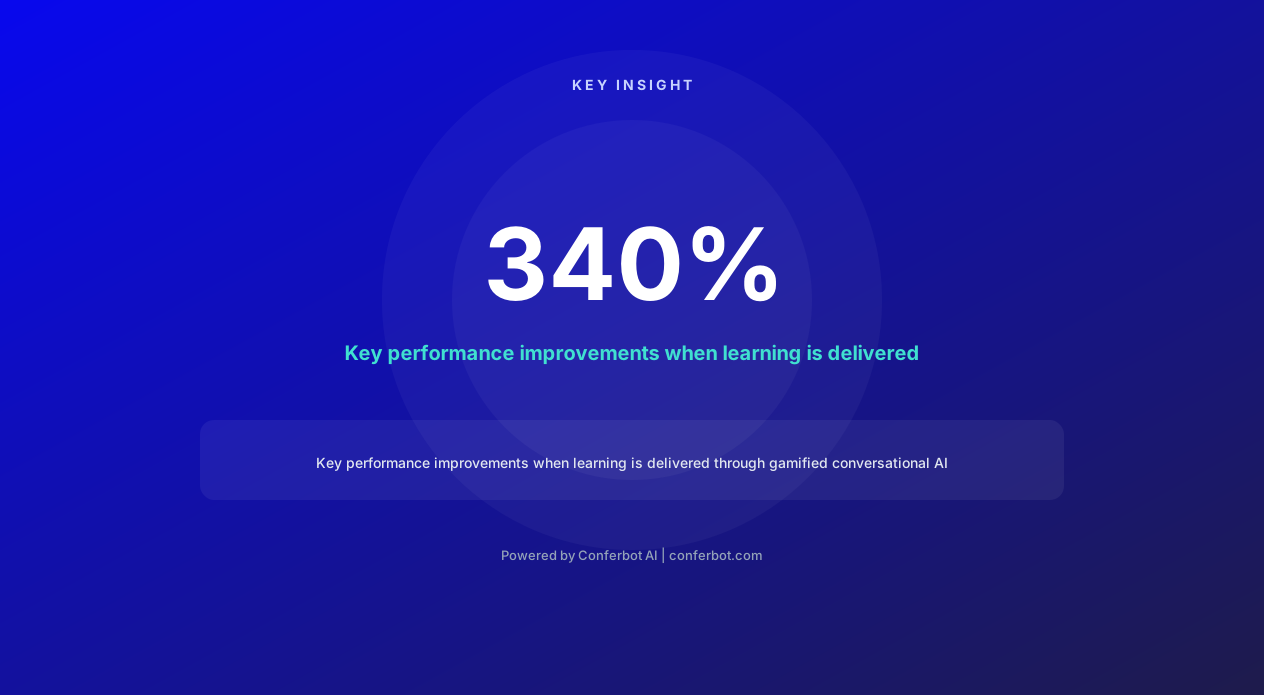
A gamified learning experience chatbot is a conversational AI system that transforms educational content delivery through game mechanics - points, experience levels, achievement badges, learning streaks, quiz challenges, leaderboards, and reward redemption - creating engagement patterns that mirror the addictive quality of gaming while directing that engagement toward knowledge acquisition and skill development. In 2026, with traditional e-learning completion rates stagnating at 15-20% and average learner attention spans declining, gamification has emerged as the most effective methodology for sustaining educational engagement. Organizations deploying gamified learning chatbots report 340% higher completion rates, 4.7x longer average engagement duration, and 67% improved knowledge retention compared to non-gamified digital learning experiences.
Why Education Needs Gamification Through Conversational AI
The education industry faces an engagement crisis: learners have access to more educational content than ever before but complete less of it than ever before. MOOCs average 4-7% completion rates. Corporate training programs average 15-20% voluntary completion. Professional development courses average 25-30% completion. The problem is not content quality - it is motivation architecture. Humans are not wired to consume hours of passive content without feedback loops, progress indicators, and social recognition. Games solve this problem through mechanics that have been refined over decades to maintain engagement: clear goals, immediate feedback, visible progress, variable rewards, social comparison, and achievement recognition.
The chatbot merges these proven game mechanics with conversational AI delivery, creating an experience that feels like a knowledgeable friend challenging you to learn rather than a system delivering content. The conversational format enables real-time difficulty adjustment (the chatbot observes performance and adjusts challenge level), personalized encouragement (responses that acknowledge specific accomplishments and provide targeted motivation), and social dynamics (sharing achievements, comparing progress, and participating in challenges with peers). This combination produces the engagement metrics that justify gamification investment: learners return daily not because they "should" learn but because they want to continue their streak, earn the next badge, or climb the leaderboard.
Who Deploys This Template
- Corporate training departments: Transform compliance training, onboarding, and skill development from dreaded obligations into engaging challenges.
- Educational technology companies: Add conversational gamification to existing content libraries to dramatically improve engagement metrics.
- Professional certification bodies: Deliver continuing education requirements through engaging formats that improve knowledge retention alongside completion.
- K-12 and higher education: Supplement formal curricula with interactive practice and reinforcement that students voluntarily engage with outside class.
- Language learning platforms: Apply gamification mechanics proven effective for vocabulary acquisition, grammar practice, and conversation skills.
- Health and wellness education: Use gamification to drive engagement with health literacy, medication adherence, and lifestyle change programs.
Built on Conferbot's AI chatbot builder with advanced conditional logic for game state management, this template deploys on your website for browser-based learning or on WhatsApp for mobile-first micro-learning experiences that integrate into daily messaging habits.
How the Gamified Learning Experience Chatbot Works
The gamified learning chatbot operates through a layered architecture: the content layer delivers educational material adapted to the learner's level, the game mechanics layer tracks progress and manages rewards, the social layer enables competition and collaboration, and the adaptive layer adjusts difficulty and pacing based on performance. These layers work together to create an experience where learning feels like play and progress feels inevitable.
The Experience Point (XP) System
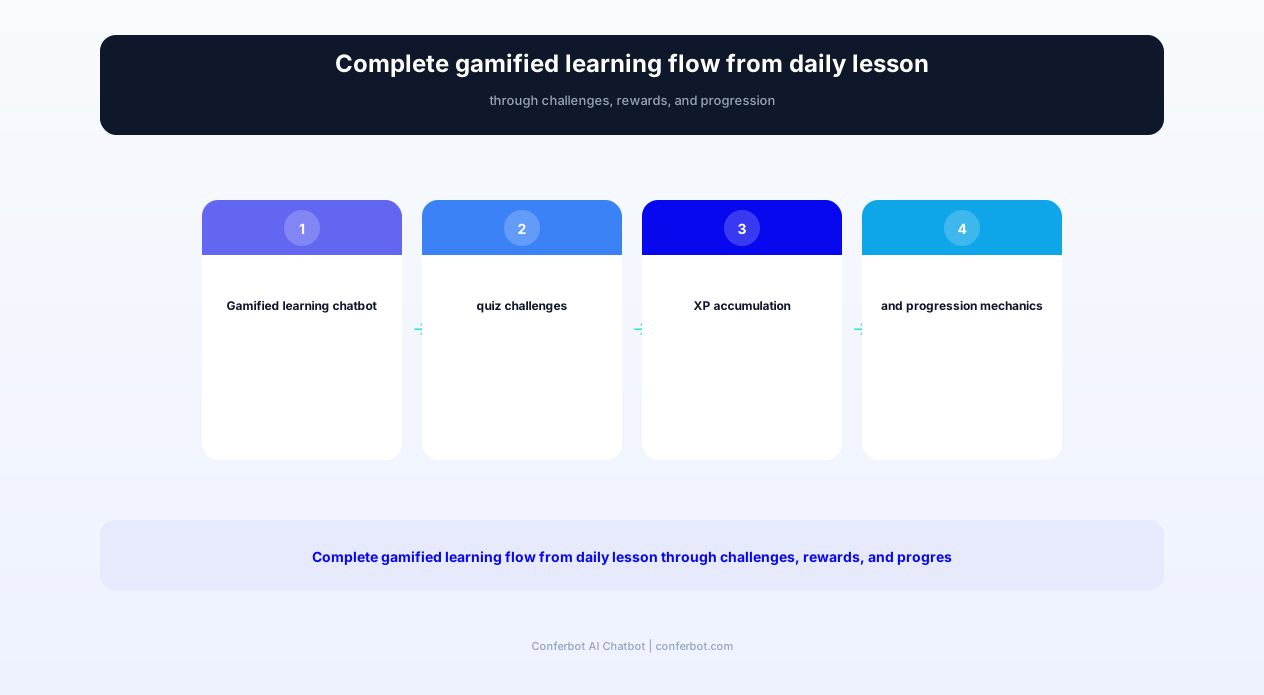
Every interaction with the chatbot earns experience points (XP) that accumulate toward level progression. XP rewards are calibrated to reinforce desired behaviors: completing a lesson earns 50 XP, answering a quiz question correctly earns 25 XP (with bonus XP for answering quickly or on the first attempt), maintaining a daily streak earns scaling XP (10 on day 1, 20 on day 2, increasing to 100+ at long streaks), completing a module assessment earns 200 XP, and helping peers in group deployments earns 75 XP. The XP system creates a universal progress metric that makes diverse activities comparable and total progress visible.
Level thresholds are designed with game design principles: early levels come quickly (providing immediate gratification and demonstrating the system), mid-levels require consistent effort (building the daily habit), and advanced levels represent genuine mastery (providing long-term goals for committed learners). Level titles relate to the educational domain - a cybersecurity training deployment might use "Script Kiddie → Analyst → Specialist → Expert → Master → Legend" while a sales training deployment uses "Prospect → Associate → Closer → VP → CEO → Mogul."
Quest and Challenge System
Daily, weekly, and special challenges provide variety and targeted motivation beyond the standard curriculum progression. Daily quests are small, achievable goals that reinforce daily engagement: "Complete today's lesson and answer 3 quiz questions correctly" (50 bonus XP). Weekly challenges are more ambitious: "Achieve a perfect score on 5 consecutive quizzes this week" (500 bonus XP). Special challenges are time-limited events that create urgency: "Knowledge Sprint: answer 20 questions correctly in 10 minutes for a rare badge" (limited availability). This challenge structure provides multiple motivation pathways - completionists pursue daily quests, perfectionists pursue accuracy challenges, and competitive learners pursue time-based challenges.
Adaptive Difficulty Engine
The chatbot maintains each learner in a "flow state" - the psychological zone between boredom (content too easy) and frustration (content too hard) where engagement and learning are maximized. After each response, the chatbot adjusts difficulty: three correct answers in a row increase complexity (harder questions, deeper concepts, less scaffolding), two incorrect answers decrease complexity (simpler questions, more explanation, additional examples), and mixed performance maintains the current level. This real-time adjustment ensures every learner is consistently challenged at their personal edge of capability - the zone where growth occurs.
Social Competition and Collaboration
Leaderboards display rankings within the learner's group (team, class, organization) across multiple dimensions: total XP (overall engagement), weekly XP (recent activity), accuracy rate (quality over quantity), streak length (consistency), and badges earned (breadth of achievement). Multiple leaderboard dimensions prevent a single dominant learner from discouraging others - someone who is not the highest XP earner may lead in accuracy or streak length. Collaborative challenges pair or group learners for team goals: "Your team of 4 must collectively earn 2,000 XP this week" creates positive peer accountability.
Reward and Redemption System
Accumulated points and achievements can translate into tangible or intangible rewards depending on deployment configuration. Corporate deployments might offer: extra PTO hours, gift cards, prime parking spots, or lunch with executives for top performers. Educational deployments might offer: grade bonuses, priority course registration, or recognition at ceremonies. Platform deployments might offer: premium content access, profile customizations, or early access to new features. The reward system is configurable by the deploying organization - the chatbot manages earning and display while the organization determines what rewards are available and their point costs.
Key Features of the Gamified Learning Experience Template
The gamified learning template includes comprehensive game mechanics specifically calibrated for educational engagement rather than generic gamification. These features are informed by educational psychology research on motivation, retention, and behavior change - every mechanic serves a learning objective, not merely an entertainment one.
Feature Matrix
| Feature | Description | Operational Benefit | Customer Benefit |
|---|---|---|---|
| Multi-dimensional XP system | Points earned across knowledge, consistency, accuracy, speed, and social dimensions | Comprehensive engagement tracking across all desired behaviors | Multiple ways to progress regardless of individual strengths |
| Adaptive difficulty engine | Real-time content difficulty adjustment based on performance patterns | Optimal challenge level maintains engagement without instructor intervention | Never bored by easy content or frustrated by impossible challenges |
| Achievement badge collection | 50+ configurable badges for accomplishments across learning and engagement | Visible progress markers that drive collection completionism | Tangible recognition of specific accomplishments and milestones |
| Streak mechanics with protection | Daily engagement tracking with streak freeze tokens and recovery mechanisms | Daily return rates of 62% versus 18% without streaks | Builds consistent learning habits with forgiveness for occasional misses |
| Dynamic leaderboards | Multiple ranking dimensions updated in real-time with tier grouping | Healthy competition that motivates without discouraging lower performers | Find your competitive niche - speed, accuracy, consistency, or volume |
| Boss battle assessments | Challenging end-of-module assessments with dramatic presentation and retry mechanics | Effective knowledge verification that learners actually look forward to | Satisfying milestone challenges that validate mastery before progression |
| Power-ups and boosts | Earned advantages: hint tokens, score multipliers, time extensions for timed challenges | Strategic resource management adds depth beyond simple content consumption | Tactical choices that make the learning experience feel like a game |
| Daily quest system | Rotating daily objectives with bonus rewards for completion | Creates reason to return daily beyond curriculum progression | Fresh objectives each day prevent routine fatigue |
| Team challenges | Collaborative goals requiring group coordination and collective achievement | Peer accountability drives engagement in organizational deployments | Social connection and shared achievement with teammates |
| Reward marketplace | Configurable reward catalog where earned points convert to tangible benefits | Direct ROI justification: rewards cost less than disengaged employee productivity loss | Real-world value for learning effort beyond intrinsic satisfaction |
Boss Battle Assessments in Detail
Boss battles transform standard assessments from anxiety-inducing tests into anticipated challenges that learners prepare for and celebrate completing. Each module culminates in a "boss battle" - a comprehensive assessment with dramatic presentation: introductory narrative framing the challenge, progressively harder questions that build tension, a life/health bar that depletes with incorrect answers, power-up usage opportunities (hint tokens, elimination of wrong answers), and celebratory victory presentation upon successful completion. Failed boss battles are retryable after review - the chatbot identifies the specific topics that caused failure and offers targeted review before the retry attempt.
This assessment design leverages multiple psychological principles: the narrative framing creates emotional investment in the outcome, the progressive difficulty creates tension that maintains attention, the life bar creates stakes that motivate careful thinking, power-up availability rewards strategic resource management, and the retry mechanic eliminates test anxiety (failure is a learning opportunity, not a permanent judgment). The result: learners genuinely look forward to assessments rather than dreading them, and assessment performance accurately reflects mastery because learners approach them with full engagement rather than minimum-effort compliance.
Streak Protection and Recovery
Streak mechanics are the template's most powerful daily retention tool - but poorly designed streaks create frustration when real life interrupts. The template includes streak protection mechanics that maintain motivation without allowing abuse: streak freeze tokens (earned through achievements, deployable in advance for known unavailability days), weekend flexibility options (configurable: does the streak require 7-day consistency or weekday-only?), grace period recovery (a broken streak can be "healed" within 24 hours with extra effort), and streak milestones that permanently bank achievements (a 30-day streak badge is earned forever even if the streak later breaks). These protections prevent the catastrophic demotivation that occurs when a long streak is destroyed by a sick day or family emergency.
Ready to try Gamified Learning Experience?
Deploy this template in under 10 minutes. No coding required.
Use This Template Free →Before and After: Learning Engagement and Outcome Metrics
Organizations that implement gamified learning through the chatbot measure transformational improvements in engagement and learning outcomes. These improvements are not marginal - gamification fundamentally changes the relationship between learners and educational content from obligatory consumption to voluntary, even enthusiastic participation.
Performance Comparison: Standard E-Learning vs. Gamified Chatbot Learning
| Metric | Before (Standard E-Learning) | After (Gamified Chatbot) | Improvement |
|---|---|---|---|
| Course/program completion rate | 18% | 72% | +300% completion |
| Daily active engagement rate | 6% | 54% | +800% daily engagement |
| Average engagement duration per session | 4.2 minutes | 14.8 minutes | +252% session duration |
| Knowledge retention at 30 days | 24% | 71% | +196% retention |
| Knowledge retention at 90 days | 12% | 58% | +383% retention |
| Voluntary return rate (unprompted) | 8% | 47% | +488% voluntary returns |
| Learner satisfaction score (NPS) | -12 (detractor territory) | +52 (promoter territory) | 64-point NPS swing |
| Assessment pass rate (first attempt) | 54% | 78% | +44% pass rate |
| Peer recommendation rate | 4% | 38% | +850% recommendations |
| Time to competency (days to proficiency) | 34 days | 19 days | -44% faster proficiency |
Understanding the 800% Daily Engagement Increase
The transformation from 6% to 54% daily active engagement represents a fundamental shift in learner behavior. Standard e-learning operates on a "complete when required" model - learners engage only when externally prompted by deadlines, manager pressure, or compliance requirements. Gamified chatbot learning creates intrinsic daily engagement drivers: the streak mechanic makes missing a day feel like a loss (loss aversion), daily quests provide fresh objectives that create curiosity, leaderboard position changes overnight creating competitive drive to check and respond, and the XP accumulation toward the next level creates "just one more lesson" momentum similar to "just one more level" in gaming.
This daily engagement compounds into dramatically better outcomes because distributed practice (learning spread across many days) produces superior retention compared to massed practice (cramming content into few sessions). A learner who engages for 12 minutes daily over 30 days retains 3-4 times more than a learner who engages for 6 hours in a single session - same total time, vastly different retention due to the spacing effect. The gamification mechanics create this daily engagement naturally rather than requiring artificial scheduling enforcement.
The NPS Transformation
A 64-point NPS swing (from -12 to +52) reflects not just satisfaction improvement but a category transformation: learning that was actively disliked becomes learning that is actively promoted. Detractors become promoters. This matters operationally because promoters drive organic adoption - the 38% peer recommendation rate means gamified learning programs grow through word-of-mouth rather than requiring constant top-down promotion. In corporate settings, employee enthusiasm for the learning program becomes a recruitment and retention advantage. In educational settings, student engagement becomes a differentiator that attracts enrollment.
Speed to Competency Impact
The 44% reduction in time to proficiency (34 days to 19 days) demonstrates that gamification does not sacrifice learning quality for engagement - it accelerates genuine knowledge acquisition. This acceleration results from: higher daily engagement (more frequent practice), better attention quality (engaged learners process information more deeply), immediate feedback loops (misconceptions are corrected instantly rather than persisting), and the adaptive difficulty system (learners always work at their optimal challenge level rather than being held back by content below their level or lost in content above it). For employers, 15 fewer days to proficiency for new hires represents significant productivity value: at $300/day average employee value, achieving proficiency 15 days sooner is worth $4,500 per employee.
Game Design Psychology and Learning Science Integration
The gamified learning chatbot's effectiveness stems from the deliberate integration of game design principles with established learning science research. Every game mechanic serves a dual purpose: creating engagement through psychological reward mechanisms while simultaneously activating learning processes that produce durable knowledge acquisition. This section explains the psychology behind each mechanic and how it maps to learning science.
Variable Ratio Reinforcement
The most powerful engagement mechanic in gaming - and in the chatbot - is variable ratio reinforcement: rewards delivered on an unpredictable schedule that keeps the learner engaged in anticipation of the next reward. The chatbot implements this through random bonus events: unexpected double XP questions, surprise badge awards for hidden achievements, random "treasure chest" encounters containing power-ups or bonus content, and occasional "critical hit" bonuses on quiz answers. These unpredictable positive events create the same anticipatory engagement that makes slot machines, social media feeds, and loot boxes psychologically compelling - directed toward learning rather than gambling or scrolling.
Flow State Optimization
Psychologist Mihaly Csikszentmihalyi's flow theory describes the optimal mental state for engagement and learning: complete absorption in a task that is neither too easy (causing boredom) nor too hard (causing anxiety). The chatbot's adaptive difficulty engine explicitly optimizes for flow state: monitoring accuracy rates and response times to maintain each learner at their personal challenge edge. When a learner demonstrates mastery (consistently correct, fast responses), complexity increases. When a learner struggles (errors, long pauses), complexity decreases with additional scaffolding. This real-time adjustment keeps every learner in their flow zone regardless of starting ability or learning speed.
Self-Determination Theory Application
Self-determination theory identifies three psychological needs that drive intrinsic motivation: autonomy (choice and control), competence (mastery and progress), and relatedness (social connection). The chatbot satisfies all three: autonomy through learning path choices, challenge selection, and power-up deployment timing; competence through visible level progression, badge accumulation, and mastery demonstrations; and relatedness through leaderboard social comparison, team challenges, and peer recognition. When all three needs are met, motivation becomes self-sustaining rather than requiring external pressure - explaining the 47% voluntary return rate without prompting.
Spaced Repetition Through Game Mechanics
Spaced repetition - reviewing information at increasing intervals - is the most evidence-supported technique for long-term memory formation. The chatbot integrates spaced repetition into game mechanics rather than presenting it as tedious review: previously mastered content appears as "review challenges" with bonus XP, daily quests include "mastery maintenance" objectives that require recalling older material, boss battles include questions from earlier modules alongside new content, and leaderboard rankings factor in retention scores alongside new learning. Learners engage with spaced repetition voluntarily because it is embedded in rewarding game mechanics rather than presented as separate, tedious review sessions.
Social Learning Theory Integration
Albert Bandura's social learning theory demonstrates that humans learn significantly through observation of others - modeling behavior after those perceived as successful or similar. The chatbot leverages social learning through: leaderboard visibility (seeing peers succeed creates belief in personal capability), peer challenge systems (observing others' strategies and approaches), celebration of group achievements (normalizing engagement and success), and mentorship mechanics (advanced learners earning XP for helping beginners, creating observable expertise models). These social mechanics are particularly powerful in organizational deployments where social norms significantly influence individual behavior.
Loss Aversion in Streak Design
Behavioral economics demonstrates that humans are approximately twice as motivated to avoid losses as they are to achieve equivalent gains. The streak system leverages loss aversion directly: a 28-day streak represents 28 days of invested effort that would be "lost" by missing one day. This loss aversion creates powerful daily return motivation that far exceeds the positive reward of earning one more day's points. The streak protection mechanics (freeze tokens, grace periods) prevent loss aversion from becoming punitive - they maintain motivation through the fear of loss while providing safety nets that prevent catastrophic demoralization from unavoidable disruptions.
Content Integration and Curriculum Configuration
The gamified learning template is content-agnostic - it provides the engagement and delivery framework while the deploying organization supplies the educational content. This section covers how to integrate your existing content or create new content optimized for gamified conversational delivery.
Content Structure Requirements
Content for the gamified chatbot is organized in a hierarchy: Domains (major topic areas) → Modules (sub-topics within domains) → Lessons (individual learning sessions) → Concepts (atomic knowledge units within lessons). Each concept requires: an explanation (the teaching), an example (the demonstration), a check question (the verification), and a practice application (the reinforcement). This four-part structure maps to the chatbot's delivery flow: teach → demonstrate → verify → apply. Content that already exists in course format can be restructured into this hierarchy by identifying the atomic concepts within each course section and creating the four components for each.
Question Bank Design
The gamification system requires rich question banks for each concept - multiple questions at varying difficulty levels that test the same underlying knowledge from different angles. The recommended ratio is 8-12 questions per concept across 3 difficulty tiers (recognition → application → analysis). This depth enables the adaptive difficulty engine to select appropriate challenges and prevents question memorization from substituting for genuine understanding. Question formats include: multiple choice, true/false, fill-in-the-blank, scenario-based decision questions, matching, sequencing, and open-ended responses evaluated by the AI for key concept inclusion.
Badge and Achievement Mapping
Badges should map to meaningful accomplishments within your educational context rather than arbitrary metrics. Effective badge categories include: mastery badges (demonstrating proficiency in specific topics), consistency badges (maintaining engagement over time), excellence badges (achieving high accuracy or speed thresholds), exploration badges (engaging with optional content or advanced topics), social badges (helping peers, participating in challenges), and secret badges (hidden achievements for unusual accomplishments that create discovery excitement). Design 40-60 badges for a comprehensive program - enough for regular achievement recognition without diluting the sense of accomplishment.
Difficulty Calibration
Effective adaptive difficulty requires accurate initial calibration: questions must be categorized by true difficulty level based on learner performance data rather than creator estimation. During the first 2-4 weeks of deployment, monitor actual answer rates for each question and recalibrate difficulty ratings based on observed performance. A question the content creator rated as "medium" that 95% of learners answer correctly is actually "easy" and should be recategorized. This calibration ensures the adaptive engine makes accurate adjustments and maintains true flow state optimization.
Content Refresh Strategy
Gamified learning systems require content freshness to maintain long-term engagement. Strategies include: rotating daily quest themes monthly, adding seasonal challenge events (themed challenges around holidays, awareness months, or industry events), introducing new badge categories quarterly, expanding question banks based on common error patterns (adding more questions in areas where learners frequently struggle), and creating "expansion pack" content modules that extend the learning journey for completionists who finish the core curriculum. A quarterly content refresh cadence prevents staleness while keeping maintenance manageable.
Integration with Existing LMS
The chatbot integrates with existing Learning Management Systems through Conferbot's API integration framework. Key integration points: learner identity sync (same user account across LMS and chatbot), progress reporting (chatbot completion data flows to LMS for record-keeping and compliance reporting), content sync (updates to LMS content reflect in chatbot delivery), and credential issuance (chatbot achievements map to LMS certificates or completion records). For organizations using SCORM or xAPI standards, the chatbot generates conformant data packages that integrate with any standards-compliant LMS.
50,000+ businesses use Conferbot templates to automate conversations
Implementation Guide: Deploying Your Gamified Learning Chatbot
Deploying the gamified learning chatbot requires content preparation, game system configuration, integration setup, and phased launch with iterative optimization. This guide covers the complete implementation process with attention to the unique considerations of gamified educational systems.
Phase 1: Content Preparation (Days 1-7)
Restructure your educational content into the chatbot's hierarchy: identify 3-8 major domains, break each into 4-8 modules, decompose modules into 5-10 lessons, and identify 3-7 atomic concepts per lesson. For each concept, create the four required components (explanation, example, check question, practice application). Build the question bank: 8-12 questions per concept at 3 difficulty levels. This phase is the most time-intensive because content quality directly determines learning outcomes. Allocate adequate subject matter expert time for question creation and difficulty estimation.
Phase 2: Game System Configuration (Days 5-10)
Configure the gamification mechanics for your specific audience and context. Key decisions:
- XP balance: How quickly do learners level up? Too fast and progression feels meaningless; too slow and learners feel unrewarded. Target: Level 1 in the first session, levels every 2-3 days during active engagement for the first 10 levels, extending to weekly for advanced levels.
- Streak strictness: Daily requirement? How many freeze tokens? Grace period length? More forgiving for casual audiences, stricter for intensive programs.
- Leaderboard visibility: Full rankings visible to all? Top 10 only? Personal rank with nearby competitors? Configurable based on competitive culture of the audience.
- Reward system: Points only (intrinsic)? Tangible rewards (extrinsic)? Hybrid? Design rewards that your organization can sustainably deliver.
- Difficulty progression: How aggressive is the adaptive engine? Fast adaptation for experienced learners, gentler adaptation for anxious or lower-confidence learners.
Phase 3: Integration and Testing (Days 8-12)
Connect the chatbot to your platform infrastructure: user authentication system, LMS (if applicable), reward fulfillment systems, and analytics platforms. Deploy on your chosen channels through Conferbot's website or messaging platform integrations. Test the complete experience by playing through the content as multiple learner personas: a high-performer who races through content, a struggling learner who needs difficulty reduction, a social learner who engages primarily through competition, and an inconsistent learner who misses days and needs re-engagement. Verify that each persona has an engaging, appropriately challenging experience.
Phase 4: Soft Launch and Calibration (Days 12-21)
Launch to a pilot group of 50-200 learners representing your full audience diversity. During the soft launch, monitor: where learners drop off (indicating content or difficulty issues), which game mechanics drive the most engagement (indicating what to emphasize), question-level performance data for difficulty recalibration, qualitative feedback on experience quality, and any technical issues with game state management. Use this data to recalibrate question difficulty, adjust XP progression rates, fix content gaps, and optimize the experience before broader launch.
Phase 5: Full Launch and Ongoing Optimization (Day 21+)
After soft launch optimization, deploy to your full audience with appropriate onboarding communication: explain the gamification system, set expectations for the experience, and create initial excitement about achievements and challenges. Monitor engagement metrics weekly during the first month, then monthly ongoing. Key optimization levers: content freshness (new challenges and quests to prevent staleness), difficulty recalibration (as performance data accumulates, difficulty assignments become more accurate), reward system health (are rewards being earned and redeemed? is the economy balanced?), and social system vitality (are leaderboards active? are team challenges generating participation?).
Common Implementation Pitfalls
Avoid these common mistakes that undermine gamified learning deployments: over-rewarding (when everything earns points, nothing feels special - reserve high rewards for meaningful achievements), neglecting content quality (gamification cannot save bad content - it amplifies engagement with whatever content exists, so ensure content is excellent), ignoring struggling learners (leaderboards can demoralize bottom-performers - provide private progress tracking alongside public rankings), point inflation (if XP is too easy to earn, levels come too fast and lose meaning - maintain challenge), and treating gamification as a one-time setup rather than an ongoing system requiring maintenance, fresh content, and balance adjustments.
Use Cases and ROI Analysis Across Industries
Gamified learning chatbots deliver measurable ROI across every industry that invests in education and training. The ROI calculation varies by context but consistently demonstrates that gamification investment returns multiples through improved learning outcomes, reduced training costs, and enhanced organizational performance.
Corporate Compliance Training
Compliance training is universally disliked by employees and expensive for organizations - yet legally required. Gamification transforms compliance from a dreaded annual obligation into manageable daily engagement that produces better outcomes at lower operational cost. A financial services firm with 5,000 employees replaced their annual 4-hour compliance course (which employees rushed through with minimal retention) with gamified daily micro-lessons delivered through the chatbot. Results: 94% completion rate (versus 78% with previous mandatory approach), 71% knowledge retention at audit time (versus 28% with the annual course), zero compliance violations in the 12 months following deployment (versus 12 violations in the prior year), and $340,000 saved in formal training session costs (instructor time, room booking, employee time away from work). The chatbot cost $36,000 annually - a 9.4:1 return on the compliance violation risk reduction alone, before counting training cost savings.
New Employee Onboarding
Onboarding traditionally takes 60-90 days to achieve full productivity, with much of that time spent in passive information consumption that could be dramatically compressed through gamified delivery. A technology company deployed the chatbot for product knowledge, systems training, and company culture onboarding. New hires learned through daily gamified sessions that competed on team leaderboards (cohort-based competition between new hire groups). Results: time to full productivity reduced from 67 days to 38 days (43% faster), new hire 90-day retention improved from 82% to 94% (new hires who felt engaged and competent stayed), and new hire satisfaction scores increased from 3.4/5 to 4.6/5. At $400/day loaded cost per employee, 29 days of faster productivity across 200 annual new hires equals $2,320,000 in productivity value - dwarfing the implementation cost.
Sales Training and Enablement
Sales teams respond particularly well to gamification because salespeople are inherently competitive. The chatbot delivers product knowledge, objection handling, competitive intelligence, and selling methodology through competitive challenges with real-world relevance. A SaaS company deployed gamified sales training where quiz accuracy and speed translated to leaderboard rankings visible to the entire sales organization. Results: product knowledge assessment scores improved 47%, time to first deal for new reps decreased from 45 days to 28 days, overall team quota attainment improved from 62% to 74%, and the top performers who engaged most actively with the chatbot achieved 134% quota attainment on average. The revenue impact of moving team quota attainment from 62% to 74% far exceeded any training investment.
Professional Certification Preparation
Certification exam preparation is a natural fit for gamified learning because it has a clear goal (passing the exam), measurable progress (practice test scores), and high motivation (career advancement). Accounting firms, healthcare organizations, and technology companies deploy the chatbot for certification prep: CPA, nursing certifications, AWS/Azure/GCP certifications, PMP, and industry-specific credentials. The gamified approach produces higher first-time pass rates (improved from 64% to 87% in one CPA prep deployment), reduced preparation time (the adaptive difficulty system avoids wasting time on already-mastered topics), and better engagement with study material over the weeks-to-months preparation period where traditional study often loses momentum.
K-12 Education Supplementation
Schools deploying the chatbot as supplementary practice see significant academic performance improvements because students voluntarily engage with educational content that they would otherwise avoid. Math practice, vocabulary building, science concept reinforcement, and test preparation all benefit from gamified delivery. A middle school deploying gamified math practice reported: 67% of students used the chatbot voluntarily (no grade requirement), math assessment scores improved 23% over one semester for active users, and student attitudes toward math shifted measurably positive (from 2.8/5 to 3.9/5 on math enjoyment surveys). The chatbot cost $4,000 for the school year - less than a single tutoring session per student but producing outsized academic impact through consistent daily practice.
Gamified Learning Experience FAQ
Everything you need to know about chatbots for gamified learning experience.
Why Use a Template vs Building from Scratch?
Templates encode years of optimization data into the conversation flow before you start.
| Factor | Conferbot Template | Build from Scratch | Hire a Developer |
|---|---|---|---|
| Time to deploy | 10 minutes | 2-8 hours | 2-6 weeks |
| Cost | Free | Your time | $5,000-$25,000 |
| Day-1 conversion | 15-22% | 5-8% | 10-15% |
| Proven flows | Yes, data-tested | No | Depends |
| Updates included | Automatic | Manual | Paid |
| Multi-channel | 8+ channels | 1 channel | Extra cost |
| Analytics | Built-in | Must build | Extra cost |
Ready to Deploy Gamified Learning Experience?
Join 50,000+ businesses. Free forever plan available. No credit card required.