Why Golf Courses Need AI Chatbots in 2026
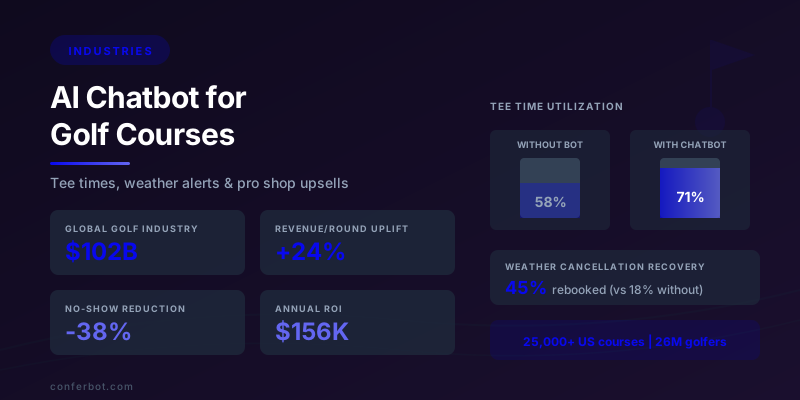
The global golf industry is a $102 billion market, and the United States accounts for nearly 40% of that value with over 25,000 golf courses serving approximately 26 million golfers, according to the National Golf Foundation (NGF). The industry has experienced a remarkable resurgence since 2020, with participation growing 18% and rounds played reaching record levels. New formats like Topgolf, simulator lounges, and 9-hole courses have attracted a younger, more diverse demographic that expects digital-first service experiences.
Yet the operational model at most golf courses has not evolved to match this changing demographic. Tee time booking still relies heavily on phone calls to the pro shop -- where the staff is simultaneously checking in players, selling merchandise, organizing carts, and answering questions about course conditions. The PGA of America estimates that the average golf course misses 25-30% of phone inquiries during peak hours, and each missed tee time represents $60-$200 in lost revenue depending on course type, day of week, and time of day.
The revenue model of a golf course makes chatbot automation particularly impactful. Unlike businesses with flexible capacity, a golf course has a fixed number of tee times per day -- typically 60-80 slots at 8-10 minute intervals over a 10-12 hour window. Every unfilled tee time is permanently lost revenue; it cannot be made up tomorrow. This perishable inventory model means that maximizing utilization is the single most important operational objective, and the chatbot addresses utilization from multiple angles: capturing bookings 24/7, reducing no-shows, rebooking cancellations quickly, and upselling higher-value rounds and add-on services.
This guide covers the complete chatbot implementation for golf courses: tee time booking automation, weather-based rebooking, pro shop upselling, tournament and event registration, membership management, no-show reduction, and a detailed ROI model. Whether you operate a public daily-fee course, a semi-private club, a resort course, or a private country club, this playbook provides the framework to increase revenue per round and improve the golfer experience through intelligent chatbot deployment.
The competitive pressure is accelerating. Third-party booking platforms like GolfNow, TeeOff, and Supreme Golf take 15-30% commission on booked rounds, incentivizing courses to drive direct bookings. Major course operators like Troon, KemperSports, and ClubCorp deploy proprietary apps and digital marketing that independent courses cannot match with limited technology budgets. A chatbot is the most cost-effective way for courses of all sizes to compete digitally -- providing instant booking, personalized communication, and proactive engagement at a fraction of the cost of custom app development.
Tee Time Booking Automation: Filling Every Slot
Tee time management is the core operational function of every golf course, and the booking process directly determines daily revenue. A well-managed 18-hole course offers approximately 70 tee times per day, each accommodating up to 4 players. At full utilization, that represents 280 player rounds per day. In reality, average utilization at US public courses is 55-65%, according to Golf Business Magazine utilization data, meaning 35-45% of available capacity goes unfilled on any given day. The chatbot attacks this utilization gap from every angle.

How the Chatbot Booking Flow Works
The chatbot guides golfers through a streamlined booking process that captures all necessary information in under 2 minutes:
- Date and time preference: "When would you like to play? We have availability this weekend and throughout next week." The chatbot presents available dates with a visual calendar and time slot selection.
- Group size: "How many players in your group? (1-4)" This determines whether the golfer is booking a solo round (which can be paired with other golfers), a twosome, threesome, or full foursome.
- Tee time selection: Based on date and group size, the chatbot presents available tee times with pricing. Dynamic pricing is common in golf -- morning prime-time slots cost more than afternoon rounds, weekends cost more than weekdays: "Saturday morning tee times: 7:30 AM ($89/player), 7:40 AM ($89/player), 8:20 AM ($89/player). Saturday afternoon: 1:10 PM ($69/player), 1:20 PM ($69/player)."
- Rate selection: For courses offering multiple rate categories: walking vs. riding (cart included), senior rates, junior rates, twilight rates. The chatbot applies the appropriate rate based on golfer profile and time selected.
- Add-on services: Cart rental (if not included), range balls, club rental, caddie request. "Would you like to add a bucket of range balls ($10) to warm up before your round?"
- Booking confirmation: Instant confirmation with tee time, group details, total cost, course policies (dress code, pace-of-play expectations), and driving directions.
Handling Singles and Open Spots
Solo golfers and groups of 2-3 create partial tee times that reduce revenue. The chatbot manages this by offering pairing options: "Your 8:00 AM tee time for 2 players has 2 open spots. Would you like us to pair your group with other golfers, or would you prefer to book the full foursome at a 10% premium to guarantee a private tee time?" The pairing option maximizes utilization; the premium private option generates higher per-tee-time revenue. Both options increase revenue compared to a half-empty tee time.
Standby and Waitlist Management
For sold-out prime tee times, the chatbot manages a standby list: "Saturday 8:00 AM is fully booked. Would you like to join the standby list? If a cancellation opens up, you will be the first to know. You are also welcome to book the 8:30 AM slot which is currently available." When a cancellation occurs, the chatbot instantly notifies the standby list in order, enabling rapid rebooking that prevents the tee time from going unfilled.
The Revenue Impact
Courses deploying chatbot tee time booking report a 12-18% improvement in utilization. For a course averaging 58% utilization with 70 daily tee times at $65 average revenue per player, increasing utilization to 71% means 9.1 additional rounds per day: 9.1 rounds x $65 x 280 operating days = $165,620 in annual incremental green fee revenue. Even at a conservative 8% utilization improvement, the annual impact exceeds $73,000. This booking automation aligns with the proven appointment scheduling methodology that maximizes capacity across service businesses.
Weather-Based Rebooking: Turning Cancellations Into Rescheduled Rounds
Weather is the golf course operator's greatest uncontrollable variable. A forecast of rain, thunderstorms, extreme heat, or high winds can trigger a wave of cancellations that devastates daily revenue. The traditional response is passive: golfers cancel, tee times go empty, and the revenue is lost. The chatbot transforms this dynamic by proactively managing weather-related disruptions before they become cancellations.
Proactive Weather Monitoring
The chatbot integrates with weather data services to monitor forecast conditions for the course's location. When weather conditions are likely to impact play, the chatbot takes proactive action rather than waiting for golfers to cancel:
48 hours before: If the forecast shows significant weather risk, the chatbot contacts golfers with upcoming tee times: "Heads up, [Golfer Name]! The forecast for Saturday is showing a 70% chance of afternoon thunderstorms. Your 1:30 PM tee time may be affected. Would you like to: (1) Move to an earlier morning tee time when skies are clearer, (2) Reschedule to Sunday when the forecast is sunny, or (3) Keep your current tee time and we will monitor conditions?"
Day-of morning update: For golfers who kept their tee times, the chatbot sends a morning update based on current conditions: "Good morning! Today's conditions: 72 degrees, partly cloudy, winds 8-12 mph from the southwest. Afternoon rain expected after 3 PM. Your 1:30 PM tee time should be clear, but we recommend moving at a good pace. The course is in excellent condition after yesterday's maintenance."
Active weather delays: If play is suspended due to weather, the chatbot notifies golfers on the course and those with upcoming tee times: "Play has been temporarily suspended due to lightning in the area. Please return to the clubhouse. We will notify you when play resumes. Estimated delay: 30-45 minutes based on radar."
The Rebooking Advantage
The critical insight is that a rescheduled round is not a lost round. Without proactive rebooking, a weather cancellation results in an empty tee time today and no guaranteed return visit. With chatbot rebooking, the golfer moves to an alternative date -- the course retains the revenue, and the golfer appreciates the proactive service. Courses using chatbot weather rebooking recover 45% of weather-related cancellation revenue through rescheduling, compared to a 15-20% organic rebook rate when golfers are left to cancel and rebook on their own.
Seasonal Weather Patterns
The chatbot can leverage seasonal weather patterns for strategic marketing. During spring rain seasons, it sends messages to golfers who typically play weekends: "Rain is forecast for Saturday, but Monday and Tuesday look perfect. Would you like to book a mid-week round at our weekday rate?" During peak summer heat, it promotes twilight rounds: "Beat the heat! Twilight tee times after 3 PM are $45 with cart included. Temperatures are 15 degrees cooler by late afternoon." These weather-responsive promotions fill otherwise underutilized time slots while providing genuine value to golfers, following the chatbot marketing methodology that drives engagement through relevance.

Course Condition Updates
Beyond weather, the chatbot can communicate course conditions that golfers care about: green speed (stimpmeter readings for competitive players), pin positions, temporary ground under repair, and cart restrictions (cart path only vs. 90-degree rule vs. fairway access). This information, delivered automatically before the round, enhances the golfer experience and demonstrates that the course takes conditions and communication seriously -- a differentiator that builds loyalty among discerning players.
Pro Shop Upselling: Increasing Revenue Per Round by 24%
The pro shop represents the highest-margin revenue opportunity at most golf courses. Equipment, apparel, accessories, and branded merchandise carry 40-60% margins compared to 25-35% on green fees. Yet pro shop sales depend almost entirely on impulse purchases during check-in or post-round browsing -- a narrow window that misses golfers who book online and head straight to the first tee.
Pre-Round Promotional Messages
The chatbot sends targeted promotional messages 24-48 hours before a golfer's tee time, when they are thinking about their upcoming round and most receptive to golf-related purchases:
Equipment and accessories:
- "Playing Saturday? We just received the new [Brand] driver -- stop by the pro shop before your round for a demo. We will have it set up on the range."
- "Reminder: Your tee time is tomorrow at 8:30 AM. We have a new selection of premium golf balls -- Titleist Pro V1 3-packs are $15.99 in the pro shop. Need anything before your round?"
- "Summer sun is no joke on the course. Our new UV-protection hats and sunglasses are 20% off this week. Perfect timing for your Saturday round!"
Seasonal and weather-based promotions:
- Hot weather: "Tomorrow's forecast: 95 degrees. Stay cool with our moisture-wicking shirts ($34.99) and insulated water bottles ($19.99). We also have cold towels at the turn for $5."
- Cold weather: "Bundle up! Our performance fleece vests and hand warmers are in stock. Perfect for your 7:30 AM tee time when it will be 52 degrees at start."
- Rain in forecast: "Prepare for Saturday's mixed forecast: rain jackets ($79.99), umbrella ($24.99), and waterproof hat ($29.99). Your round does not have to stop for a little rain!"

Post-Round Engagement
After the round, the chatbot sends a follow-up that combines feedback collection with targeted offers: "How was your round today? We hope you enjoyed the course! By the way, the [Brand] wedge you were admiring in the pro shop is on sale this week -- $129 (regularly $159). Would you like us to hold one for you?" This post-round message catches golfers in a high-engagement moment and converts browsing interest into sales.
Golf Lesson Promotion
The chatbot promotes golf lessons with the course's teaching professionals -- a high-margin service that also improves the golfer's experience and frequency of play: "Looking to improve your short game? Our PGA professional [Instructor Name] offers private lessons starting at $75/hour. Students who take lessons play 30% more rounds per year on average. Would you like to book a session?" This promotion can be triggered by specific events -- a golfer who has not played in 30 days may respond to a lesson offer differently than a golfer who plays weekly.
The Revenue Mathematics
Chatbot-driven pro shop promotion increases ancillary revenue per round by 24%. For a course averaging $12 in ancillary revenue per round (pro shop, food and beverage, range, lessons), a 24% uplift adds $2.88 per round. At 40,000 annual rounds: 40,000 x $2.88 = $115,200 in incremental ancillary revenue. Even a conservative 10% increase produces $48,000 annually -- a significant addition to the bottom line from a zero-cost communication channel. The upselling and cross-selling methodology shows consistent results across consumer-facing businesses.
Tournament and Event Registration Automation
Golf tournaments and outings are among the highest-revenue events a course hosts. According to the Club Management Association of America (CMAA), events represent a critical revenue driver. A 144-player charity scramble at $150 per player generates $21,600 in green fee and cart revenue alone, plus food and beverage, sponsor signage, and pro shop activity. Corporate outings, member tournaments, and league play collectively represent 15-25% of annual course revenue. The administrative burden of organizing these events, however, is substantial -- and the chatbot dramatically reduces that burden.
Tournament Registration Flow
The chatbot handles the complete registration process for each tournament type:
Charity and corporate outings:
- Event announcement with date, format, pricing, and beneficiary information
- Team registration: team captain name, player names, handicap information (if applicable), and special requests (cart needs, dietary restrictions for meals)
- Sponsorship information: presenting the available sponsorship levels (Hole Sponsor $250, Beverage Cart Sponsor $500, Title Sponsor $2,500) and collecting payment
- Payment processing and confirmation with event details, arrival time, and dress code
Member tournaments:
- Eligibility verification based on membership status and handicap index
- Division assignment (Championship flight, A flight, B flight, C flight) based on handicap range
- Tee time and pairing preferences ("Would you like to request a specific playing partner?")
- Side game enrollment (closest-to-pin, longest drive, skins game)
League play:
- Seasonal registration with league schedule, format, and fee structure
- Team formation or individual registration for pairing
- Weekly availability tracking and substitute player management
- Score posting and standings communication
Event Day Communication
On tournament day, the chatbot serves as the communication hub: "Good morning! Today is the [Tournament Name]. Your tee time is 8:30 AM (shotgun start). Please check in at the registration table by 8:00 AM. Format: 4-person scramble, 2 mulligans included. Closest to pin on holes 4, 8, and 14. Lunch and awards ceremony at 1:30 PM in the clubhouse." This pre-event message reduces confusion and ensures golfers arrive prepared.
Post-Event Follow-Up
After events, the chatbot sends results, photos, and re-engagement messages: "Congratulations to team [Name] for winning the [Tournament Name] with a score of 56! Here are the full results and photos from the event: [Link]. Save the date: Our next event is the [Next Tournament] on [Date]. Registration opens [Date]." This cycle of event communication keeps golfers engaged year-round and builds anticipation for upcoming events.
Revenue Impact
Courses using chatbot event management report a 20% increase in tournament participation due to frictionless registration and better communication. For a course hosting 12 events per year averaging 80 participants at $125 per player, a 20% participation increase generates: 12 events x 16 additional players x $125 = $24,000 in incremental annual event revenue. The administrative time savings -- estimated at 10-15 hours per event -- are equally valuable, freeing staff to focus on event execution quality rather than registration logistics. The website chatbot serves as the primary registration gateway for all course events.
No-Show Reduction: Recovering Lost Tee Time Revenue
No-shows are the silent revenue killer in the golf industry. Research from Golf Course Industry confirms the scale of the problem. The NGF estimates that no-show rates at public courses average 8-15% of booked tee times, and the rate is higher during periods of weather uncertainty. A course with 70 daily tee times and a 10% no-show rate loses 7 foursomes per day -- at $65 per player, that is $1,820 in daily lost revenue, or approximately $509,600 annually. Even capturing a fraction of this loss through chatbot-driven no-show reduction produces substantial revenue recovery.

Automated Reminder Sequence
The chatbot sends a multi-touch reminder sequence that significantly reduces no-show rates:
- 72 hours before: "Reminder: Your tee time at [Course Name] is this Saturday at 9:10 AM for 4 players. Please confirm your group is still coming, or let us know if you need to make changes."
- 24 hours before: "See you tomorrow! Your 9:10 AM tee time is confirmed for 4 players. Forecast: 78 degrees, partly cloudy -- perfect golf weather. Any last-minute changes? Please note our 24-hour cancellation policy."
- Morning of: "Good morning! Your tee time is 9:10 AM today. Starter will meet you on the first tee. Range opens at 7:00 AM for warmup. Have a great round!"
Cancellation Policy Enforcement
The chatbot enforces cancellation policies consistently -- something that pro shop staff, wary of confrontation, often fail to do. When booking, the chatbot clearly states: "Please note: tee times cancelled within 24 hours are subject to a $25 per player cancellation fee. This helps us offer tee times to other golfers." When a golfer cancels late, the chatbot applies the fee automatically and offers to rebook: "Your 9:10 AM tee time has been cancelled. A $25 per player late cancellation fee has been applied per our booking policy. Would you like to rebook for another day?"
The mere existence of a consistently enforced cancellation policy, communicated clearly at booking time, reduces casual no-shows by 30-40%. Golfers who know their card will be charged for a no-show are far more likely to either show up or cancel in advance -- giving the course time to fill the slot.
Rapid Rebooking of Cancelled Slots
When a cancellation occurs within the rebookable window, the chatbot immediately activates the standby list and sends targeted messages to golfers who have shown interest in similar tee times: "A 9:10 AM tee time just opened up for this Saturday! [Course Name] prime morning slot at the weekday rate of $65. Book now?" This real-time rebooking captures revenue that would otherwise be lost, and golfers on the standby list appreciate the first-notification advantage.
The Reduction Mathematics
Courses implementing chatbot reminders and cancellation policy enforcement reduce no-show rates by 38% on average. For a course with a 10% no-show rate on 280 daily player rounds: 280 x 10% x 38% reduction = 10.6 recovered player rounds per day. At $65 average: 10.6 x $65 x 280 operating days = $192,920 annually. More conservatively, recovering just 5 rounds per day through reminders and rebooking generates $91,000 per year. The chatbot's reminder system mirrors the appointment booking methodology that reduces no-shows across service businesses.
Membership Management for Private and Semi-Private Clubs
For private and semi-private golf courses, membership is the primary revenue stream. The Club Management magazine reports that membership retention is the top priority for 87% of club managers. Annual membership dues range from $2,000-$5,000 at semi-private clubs to $10,000-$100,000+ at premier private clubs, with food and beverage minimums, assessment fees, and initiation fees adding to the total. The chatbot manages both the acquisition and retention of these high-value membership relationships.
Membership Inquiry Handling
Prospective members researching clubs have specific questions that the chatbot answers immediately: membership categories and pricing (if publicly available), course amenities, practice facilities, social events, junior programs, and the application process. For private clubs that prefer discretion around pricing, the chatbot qualifies the prospect and schedules a tour: "Thank you for your interest in [Club Name]! We would love to show you our facilities. Our membership director can discuss our membership options and answer your questions during a private tour. What day works best for you?"
Member Communication and Services
For existing members, the chatbot serves as a concierge:
- Tee time booking: Members receive priority booking access and preferred rates automatically applied by the chatbot.
- Dining reservations: "Would you like to book a table in the clubhouse after your round? The Saturday dinner special is Prime Rib for $38."
- Guest policy management: "You have 3 of your 12 included guest rounds remaining for 2026. Would you like to book a guest round? Unaccompanied guest fees are $75; accompanied guest fees are $55."
- Statement and billing inquiries: "Your current statement balance is $[Amount]. Your next payment of $[Amount] is due on [Date]. Would you like to view an itemized statement?"
- Event RSVP: "The Member-Guest Invitational is June 14-15. Registration is $200 per team (member + guest). Would you like to sign up?"
Membership Renewal and Retention
The chatbot manages the annual renewal process starting 60 days before the renewal date. It highlights the value received during the year: "Your annual membership renewal is coming up on [Date]. This year, you played [X] rounds, attended [Y] social events, and used the practice facility [Z] times. Your effective cost per round was $[Amount]. We hope you have enjoyed the club and look forward to another great year!" This value reinforcement is particularly effective for members who may not realize how much they have used the club -- seeing a low per-round cost validates the membership investment.
For members who do not renew by the deadline, the chatbot triggers a retention sequence with personalized outreach that can include a courtesy call from the membership director for high-value accounts. This multi-touch approach maintains the personal relationship that defines private club membership while ensuring no renewal falls through the cracks. The analytics dashboard tracks membership health metrics in real time.
ROI Analysis: AI Chatbot for Golf Courses
The ROI for a golf course chatbot operates across six revenue dimensions. We model a mid-size public/semi-private course: 18 holes, 70 daily tee times, $65 average green fee, 40,000 annual rounds, 280 operating days.
Revenue Stream 1: Improved Tee Time Utilization -- $53,200/year
Chatbot booking increases utilization by 10% (conservative estimate between 8-18% range), adding 2.8 additional foursome equivalents per day:
- 2.8 foursomes x 4 players x $65 x 280 days x 10% improvement = $53,200
Revenue Stream 2: No-Show Recovery -- $47,320/year
38% reduction in no-show rate (from 10% to 6.2%), recovering approximately 2.6 rounds per day:
- 2.6 rounds x $65 x 280 days = $47,320
Revenue Stream 3: Pro Shop and Ancillary Upselling -- $28,800/year
24% increase in ancillary revenue per round on 40,000 annual rounds:
- $12 baseline ancillary x 24% uplift x 40,000 rounds x 25% attributable to chatbot = $28,800
Revenue Stream 4: Event and Tournament Growth -- $15,000/year
20% increase in tournament participation across 12 annual events:
- 12 events x 10 additional players x $125 = $15,000
Revenue Stream 5: Weather Rebooking Recovery -- $8,450/year
45% recovery of weather cancellations (estimated 50 weather-impacted days, 10 cancellations per day):
- 50 days x 10 cancellations x 45% recovery x 75% show rate x $65 = $8,450 (net of previous recovery baseline)
Revenue Stream 6: Direct Booking Savings -- $3,600/year
Shifting 5% of rounds from third-party platforms (15-30% commission) to direct chatbot booking:
- 40,000 rounds x 5% shift x $65 x 20% average commission savings x 55% margin = $3,600
Total Annual ROI
| Revenue Stream | Annual Value |
|---|---|
| Improved tee time utilization | $53,200 |
| No-show recovery | $47,320 |
| Pro shop and ancillary upselling | $28,800 |
| Event and tournament growth | $15,000 |
| Weather rebooking recovery | $8,450 |
| Direct booking savings | $3,600 |
| Total | $156,370 |
Against a chatbot platform cost of $1,200-$1,800/year with Conferbot pricing, the ROI exceeds 10,300%. The no-show reduction alone covers the chatbot cost 30x over.
Implementation Guide: Deploying a Golf Course Chatbot
Deploying a golf course chatbot follows a structured 7-day process using Conferbot's no-code builder and service business templates.
Day 1-2: Course Configuration
Customize the template with your course information: name, location, course description, number of holes, par, course rating/slope, and amenities. Enter your tee time structure: number of slots per day, interval spacing, booking windows (how far in advance golfers can book), and pricing tiers (weekday/weekend, morning/afternoon, senior/junior/twilight). Configure cancellation policies and no-show fees.
Day 3-4: Rate Structure and Promotions
Set up your complete rate card: green fees by day and time, cart fees, range ball pricing, rental club fees, and any membership rate categories. Configure weather-triggered messaging rules and seasonal promotion templates. Build the pro shop promotion calendar with new arrivals, seasonal deals, and equipment demo days.
Day 5: Integrations and Events
Connect your tee sheet management system if you use one (Club Prophet, GolfNow Operator, Lightspeed Golf, foreUP). Set up weather data integration for proactive alerts. Configure tournament registration templates for your annual event calendar. Set up Google review automation.
Day 6-7: Testing and Launch
Test the booking flow for common scenarios: weekend foursome, solo single looking for pairing, member tee time with guest, tournament registration. Verify rate calculations, reminder sequences, and weather alert triggers. Deploy on your website, Google Business Profile, and social media channels.
Best Practices for Golf Course Chatbots
- Lead with course conditions: Golfers care deeply about course condition. Include current condition updates in the chatbot: green speed, recent maintenance, pin positions for the day. This information builds trust and differentiates your course from competitors who offer no condition transparency.
- Personalize by player history: "Welcome back, [Name]! You played our back nine last Saturday. Would you like to book the front nine this weekend, or play the full 18?" History-based personalization builds the loyalty that drives repeat play.
- Handle the pace-of-play concern: Slow play is golfers' top complaint. The chatbot should communicate pace expectations and marshal procedures: "We maintain a 4-hour 15-minute pace policy. Our marshals are on course to ensure smooth play for everyone."
- Promote underutilized times: The chatbot should actively market low-utilization periods (weekday mornings, late afternoons) with value pricing. "Beat the crowds! Weekday morning tee times are just $45 with cart. The course is wide open Tuesdays and Wednesdays." This demand-shifting strategy improves overall utilization.
- Collect handicap data: Knowing a golfer's handicap enables more relevant communication -- advanced players receive competition and lesson offers, beginners receive playing tip content and beginner-friendly event invitations. Use the Conferbot feature set to build these personalized segments.
- Integrate loyalty programs: A points-based loyalty program managed through the chatbot -- 1 point per dollar spent on green fees, pro shop, and food -- creates stickiness that keeps golfers returning to your course rather than shopping around. "You have earned 450 loyalty points! That is enough for a free round. Would you like to redeem on your next visit?"
The golf industry is experiencing its strongest growth period in decades, with new players entering the game at record rates. Courses that deploy AI chatbots will capture a disproportionate share of this growth by providing the instant, digital-first booking and communication experience that the new generation of golfers expects. Start building your golf course chatbot with Conferbot's website chatbot builder today.
Was this article helpful?
AI Chatbot for Golf Courses FAQ
Everything you need to know about chatbots for ai chatbot for golf courses.
About the Author

Conferbot Team specializes in conversational AI, chatbot strategy, and customer engagement automation. With deep expertise in building AI-powered chatbots, they help businesses deliver exceptional customer experiences across every channel.
View all articles