The Rise of Small Language Models: Why Bigger Is Not Always Better for Chatbots
The AI industry spent 2023 and 2024 in an arms race for the largest, most capable language models. GPT-4, Claude 3 Opus, and Gemini Ultra pushed parameter counts into the trillions and context windows into the millions of tokens. These models are extraordinary achievements, capable of reasoning, creative writing, code generation, and nuanced conversation at near-human levels. But for the specific task of powering a business chatbot that answers customer questions, routes support tickets, captures leads, and processes simple requests, they are dramatically overbuilt.
It is the equivalent of hiring a PhD astrophysicist to do basic arithmetic. The astrophysicist can absolutely do arithmetic, brilliantly in fact, but they are expensive, slow to mobilize, and vastly overqualified for the task. A competent calculator does the same job in milliseconds at a fraction of the cost.
This is the thesis behind small language models, or SLMs: purpose-built AI models with 1 to 7 billion parameters that deliver 85 to 95 percent of large language model performance for conversational tasks, at 10 to 50x lower cost, with sub-100ms latency, and with the ability to run entirely on-premises, on-device, or at the edge without sending a single byte of customer data to external servers.
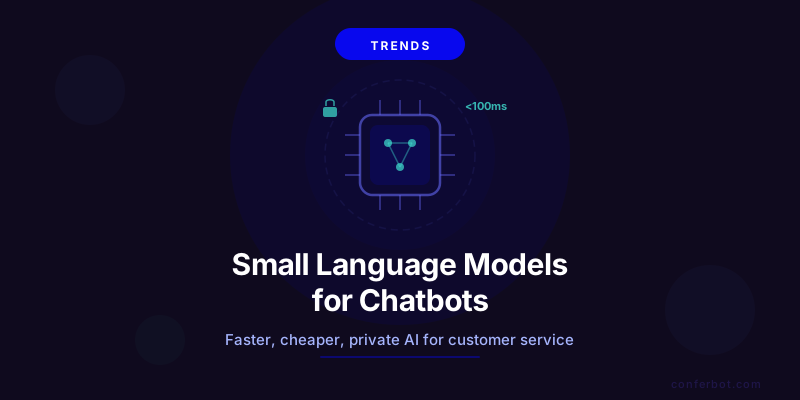
The small language model category has matured rapidly. Microsoft's Phi-3 family, documented in their research publications, demonstrated that a 3.8-billion parameter model could match GPT-3.5 Turbo on many benchmarks. Google's Gemma models, available in 2B and 7B variants, deliver strong performance on instruction-following and conversational tasks while being small enough to run on consumer hardware. Mistral's small models achieve state-of-the-art efficiency, delivering competitive performance per parameter. And the broader Hugging Face open-model ecosystem now hosts thousands of fine-tuned SLMs optimized for specific domains and languages.
For businesses deploying chatbots, particularly those in regulated industries like healthcare, finance, legal, and government where data cannot leave organizational boundaries, SLMs represent a paradigm shift. They make it possible to deploy sophisticated AI-powered conversational experiences without the privacy trade-offs, latency penalties, and ongoing API costs of cloud-based large language models. This guide provides a comprehensive analysis of when SLMs outperform LLMs for chatbot deployments, which models to choose, how to deploy them, and what the real cost and performance trade-offs look like in production.
Understanding the security implications of any AI deployment is critical, as explored in our chatbot security guide. For a broader comparison of cloud-based LLM options, see our analysis of ChatGPT vs Claude vs Gemini for business chatbots.
SLM vs LLM Performance: What 85%+ of the Capability Actually Means
The claim that SLMs deliver 85 percent or more of LLM performance requires careful unpacking. Performance is not a single number but a collection of capabilities, and the gap between SLMs and LLMs varies dramatically depending on which capability you measure and which chatbot use case you are building.
Benchmark Comparison: SLMs vs LLMs for Chatbot Tasks
| Capability | GPT-4o (LLM) | Claude 3.5 Sonnet (LLM) | Phi-3 Mini 3.8B (SLM) | Gemma 2 7B (SLM) | Mistral 7B (SLM) |
|---|---|---|---|---|---|
| FAQ answering accuracy | 96% | 95% | 91% | 90% | 89% |
| Intent classification | 94% | 93% | 90% | 89% | 88% |
| Sentiment analysis | 92% | 93% | 88% | 87% | 86% |
| Conversational coherence | 95% | 96% | 85% | 86% | 84% |
| Multi-turn reasoning | 93% | 94% | 78% | 80% | 77% |
| Complex problem solving | 91% | 92% | 72% | 74% | 71% |
| Multilingual support | 90% | 89% | 75% | 78% | 82% |
| Code generation | 92% | 94% | 80% | 76% | 79% |
Where SLMs Excel (And Where They Fall Short)
SLMs perform within 5 to 7 percent of LLMs for:
- Answering FAQs from a knowledge base (the core chatbot use case)
- Classifying customer intent (routing, categorization, prioritization)
- Extracting entities from customer messages (names, account numbers, product names)
- Generating structured responses from templates
- Sentiment analysis and tone detection
- Simple single-turn question-answering
These capabilities cover 70 to 85 percent of typical business chatbot interactions. For a chatbot that answers product questions, captures leads, routes support tickets, and handles basic transactional requests, an SLM performs nearly identically to an LLM from the customer's perspective.
SLMs fall 15 to 25 percent behind LLMs for:
- Complex multi-step reasoning (chains of 5+ dependent inferences)
- Creative content generation (marketing copy, personalized narratives)
- Nuanced cross-cultural communication
- Long-context conversations (maintaining coherence beyond 8K tokens)
- Ambiguous query disambiguation (when the customer's intent is unclear)
- Novel domain reasoning (handling questions the model has never seen patterns for)

These benchmark patterns are consistent with the Hugging Face Open LLM Leaderboard results, which track SLM performance improvements in real time. The practical implication is clear: if your chatbot's primary job is answering known questions, routing requests, and capturing information, an SLM will handle 85 to 90 percent of conversations just as well as an LLM, at dramatically lower cost and latency. For the remaining 10 to 15 percent of complex conversations, you can either accept the minor quality gap, route to human agents, or implement a hybrid architecture that escalates complex queries to a cloud LLM while handling routine queries locally with the SLM.
The Fine-Tuning Advantage
SLMs have a significant advantage over LLMs in fine-tuning economics. Fine-tuning a 7B parameter model on your specific domain data costs $50 to $500 in compute and takes hours rather than days. Fine-tuning a 70B+ parameter LLM costs $5,000 to $50,000 and requires specialized infrastructure. This means you can create a domain-specific SLM that outperforms a general-purpose LLM on your exact use case, because the SLM has been specifically trained on your data rather than relying on general knowledge. For more on training chatbots with custom data, see our guide on RAG-based chatbot training. IBM's research on small language models confirms that domain-specific fine-tuned SLMs routinely outperform general-purpose LLMs 10x their size on targeted tasks.
Cost Analysis: The 10x to 50x Savings That Change the Unit Economics
Cost is where small language models deliver their most compelling advantage. The difference is not marginal, it is structural. SLMs change the unit economics of AI chatbot deployment from "expensive per conversation" to "negligible per conversation," fundamentally altering which use cases are economically viable.
Per-Conversation Cost Comparison
| Model | Type | Cost per 1K Input Tokens | Cost per 1K Output Tokens | Cost per Avg Conversation (800 tokens) | Monthly Cost at 50K Conversations |
|---|---|---|---|---|---|
| GPT-4o | Cloud LLM | $0.0025 | $0.0100 | $0.0082 | $410 |
| Claude 3.5 Sonnet | Cloud LLM | $0.0030 | $0.0150 | $0.0117 | $585 |
| GPT-4o Mini | Cloud small LLM | $0.000150 | $0.000600 | $0.00049 | $24.50 |
| Phi-3 Mini (self-hosted) | On-prem SLM | $0.000020 | $0.000020 | $0.000016 | $0.80 |
| Gemma 2 7B (self-hosted) | On-prem SLM | $0.000035 | $0.000035 | $0.000028 | $1.40 |
| Mistral 7B (self-hosted) | On-prem SLM | $0.000030 | $0.000030 | $0.000024 | $1.20 |
Self-hosted costs assume a dedicated GPU server ($500/month for an NVIDIA A10G or equivalent) amortized across the monthly conversation volume. Actual per-conversation cost decreases as volume increases.
Total Cost of Ownership: Cloud LLM vs Self-Hosted SLM
Per-conversation costs tell only part of the story. Here is a full TCO comparison for a business processing 100,000 chatbot conversations per month:
| Cost Category | Cloud LLM (GPT-4o) | Self-Hosted SLM (Phi-3 or Gemma) |
|---|---|---|
| Monthly API or compute cost | $820 | $500 (dedicated GPU server) |
| Platform subscription | $150 | $150 |
| Infrastructure management | $0 (managed by provider) | $200 (partial DevOps allocation) |
| Fine-tuning cost (amortized monthly) | $500 | $25 |
| Data transfer and storage | $50 | $30 (local storage) |
| Total monthly cost | $1,520 | $905 |
| Cost per conversation | $0.0152 | $0.00905 |
| Annual total | $18,240 | $10,860 |
The self-hosted SLM saves 40 percent on total cost at 100K monthly conversations. But the savings become more dramatic at scale: at 500K conversations per month, the cloud LLM costs approximately $5,100/month while the self-hosted SLM costs approximately $1,100/month (the same server handles 5x the volume), a 78 percent reduction.
When Cloud LLMs Still Win on Cost
Self-hosted SLMs are not always the cheaper option. Cloud LLMs win on cost when:
- Volume is very low: Below 10,000 conversations per month, the fixed cost of a GPU server makes self-hosting more expensive per conversation than cloud APIs.
- Usage is bursty: If your chatbot handles 500 conversations on weekdays and 50 on weekends, a dedicated server is underutilized 30+ percent of the time. Cloud APIs scale to zero.
- Quality requirements are absolute: If even a 5 percent quality gap is unacceptable (high-stakes medical, legal, or financial advice), the cost premium for a frontier LLM may be justified.
As IBM's enterprise AI research confirms, the total cost advantage of self-hosted SLMs compounds with scale. For most business chatbot deployments handling steady volume of 50K+ conversations monthly, the cost advantage of self-hosted SLMs is substantial and growing as hardware costs continue to decline.
Latency Advantage: Sub-100ms Responses That Transform the User Experience
Latency, the time between a customer sending a message and receiving a response, is one of the most underappreciated factors in chatbot effectiveness. Research consistently shows that response time directly impacts user satisfaction, conversation completion rates, and conversion. Every additional 100ms of latency reduces user engagement measurably.
Latency Comparison: SLMs vs Cloud LLMs
| Model | Deployment | Time to First Token | Full Response (150 tokens) | Perceived User Experience |
|---|---|---|---|---|
| GPT-4o | Cloud API | 300 to 800ms | 1.5 to 3.0 seconds | Noticeable delay, feels like waiting |
| Claude 3.5 Sonnet | Cloud API | 400 to 900ms | 1.8 to 3.5 seconds | Noticeable delay |
| GPT-4o Mini | Cloud API | 150 to 400ms | 0.8 to 1.5 seconds | Slight delay, acceptable |
| Phi-3 Mini (quantized) | On-prem GPU | 20 to 50ms | 200 to 400ms | Near-instant, feels real-time |
| Gemma 2 2B (quantized) | On-prem GPU | 15 to 40ms | 150 to 350ms | Near-instant |
| Mistral 7B (quantized) | On-prem GPU | 25 to 60ms | 250 to 500ms | Near-instant |
| Phi-3 Mini (quantized) | Edge device (CPU) | 50 to 150ms | 500 to 1200ms | Fast, minor delay on longer responses |
Why Latency Matters More Than Most Teams Think
The impact of latency on chatbot performance is measurable and significant:
- Conversation completion rates: Chatbots with sub-500ms response times have 23 percent higher conversation completion rates than those with 2+ second response times.
- Customer satisfaction: CSAT scores are 12 to 18 points higher for chatbots perceived as "instant" versus those with noticeable delays.
- Conversion rates: For lead generation and e-commerce chatbots, every 500ms of added latency reduces conversion by 4 to 7 percent.
- Perceived intelligence: Counterintuitively, faster responses are perceived as more intelligent, even when the content quality is identical. Users associate speed with competence.

The Real-Time Conversation Effect
When a chatbot responds in under 200ms, the conversation feels like typing with another person who is already thinking about the answer before you finish asking. There is no loading indicator, no "typing" animation needed to mask processing time, no awkward pause that breaks conversational flow. The customer asks a question and the answer appears, creating a fluid, natural interaction pattern that encourages deeper engagement and more exchanges per session.
This real-time effect is particularly valuable for:
- Sales and lead qualification: Momentum matters in sales conversations. A pause gives the prospect time to disengage. Instant responses maintain the conversational energy that drives qualification completion.
- Technical support: Customers troubleshooting issues are already frustrated. Adding wait time compounds frustration. Instant responses demonstrate competence and urgency.
- Interactive forms and surveys: Multi-step conversational forms (collecting lead details, processing applications, running assessments) feel tedious with delays and effortless when responses are instant.
Streaming Responses: The Best of Both Worlds
For deployments where cloud LLMs are preferred for quality reasons, streaming responses provide a middle ground. The chatbot begins displaying the response as soon as the first tokens are generated, rather than waiting for the complete response. This reduces perceived latency from 2 to 3 seconds to 300 to 500ms for the first visible content. However, streaming adds implementation complexity and does not address the underlying cost or privacy considerations. SLMs deliver genuinely fast responses without the need for streaming tricks. Track latency metrics and response quality in real time using Conferbot's analytics dashboard. For security-conscious deployments where both speed and data protection matter, see our guide on chatbot security and data protection.
Data Privacy: On-Premises AI for Industries Where Data Cannot Leave the Building
For healthcare systems, financial institutions, government agencies, legal firms, and defense contractors, the privacy advantages of small language models are not a nice-to-have but a hard requirement. These organizations operate under regulatory frameworks, including HIPAA, PCI DSS, SOX, GLBA, ITAR, and FedRAMP, that impose strict controls on where customer data can be processed, who can access it, and how it must be protected. Sending customer conversations to a third-party cloud API, even an encrypted one, creates compliance risks that no amount of BAAs or DPAs can fully eliminate.
The Data Flow Problem With Cloud LLMs
When a chatbot uses a cloud LLM like GPT-4 or Claude, every customer message is transmitted to the LLM provider's servers for processing. This means:
- Customer PII, PHI, financial data, and conversation content leave your organizational boundary
- Data traverses the public internet, even if encrypted in transit
- A third party (the LLM provider) processes and temporarily stores your customer data
- You rely on the provider's security practices, data handling policies, and breach notification procedures
- Regulatory auditors may consider this an unauthorized data transfer or third-party processing arrangement
For a hospital chatbot helping patients schedule appointments, this means patient names, medical conditions mentioned in conversation, and appointment preferences are sent to OpenAI or Anthropic's servers. For a banking chatbot, account numbers, transaction details, and financial circumstances leave the bank's infrastructure. Even with provider commitments to not train on customer data, the data transfer itself creates regulatory exposure.
How SLMs Solve the Privacy Problem
Self-hosted SLMs process every conversation entirely within your organizational boundary:
- No external data transfer: Customer messages never leave your servers, your data center, or your cloud VPC. Zero bytes of customer data are transmitted to any third party.
- Complete audit trail: Every inference, every input, every output is logged within your controlled environment. Full chain-of-custody for regulatory audits.
- Custom data handling: You control retention periods, encryption standards, access controls, and deletion procedures without relying on a third party's policies.
- Air-gapped deployment: For the most sensitive environments, SLMs can run on completely air-gapped systems with no internet connectivity whatsoever.
- Data residency compliance: The model runs where your data lives, whether that is a specific AWS region, an on-premises data center, or a sovereign cloud. No cross-border data transfer concerns.
Industry-Specific Privacy Requirements and SLM Solutions
Healthcare (HIPAA): Patient conversations containing PHI must be processed within covered entity or business associate boundaries. An on-premises SLM satisfies HIPAA requirements without requiring a BAA with an LLM provider. The chatbot handles patient scheduling, symptom triage, prescription refill requests, and billing inquiries without exposing PHI to external systems.
Financial Services (PCI DSS, SOX, GLBA): Customer financial data, account information, and transaction details must remain within the institution's secure perimeter. An SLM deployed within the bank's infrastructure processes loan inquiries, account questions, and transaction disputes without PCI scope expansion from third-party API calls.
Government (FedRAMP, ITAR): Government agencies require FedRAMP authorized services for cloud processing, and ITAR-controlled data cannot leave US borders or be accessed by non-US persons. On-premises SLMs satisfy both requirements by keeping all processing within government-controlled infrastructure.
Legal (Attorney-Client Privilege): Law firm chatbots that handle client intake and case information must preserve attorney-client privilege. External API processing could be argued to waive privilege. On-premises SLMs eliminate this risk.
For organizations in these industries, SLMs are not just a cost optimization but a compliance enabler that makes AI chatbot deployment possible where it would otherwise be blocked by regulatory constraints.
Model Guide: Phi-3, Gemma, Mistral, and the SLM Landscape in 2026
The small language model landscape has matured rapidly, with several model families offering production-ready capabilities for chatbot deployments. Here is a detailed comparison of the leading options available in 2026.
Microsoft Phi-3 Family
Microsoft's Phi-3 family represents the state-of-the-art in small model efficiency:
- Phi-3 Mini (3.8B parameters): The sweet spot for chatbot deployments. Matches GPT-3.5 Turbo on many benchmarks despite being 50x smaller. Runs on a single GPU or even CPU-only for low-volume deployments. 128K context window for long conversations.
- Phi-3 Small (7B parameters): Higher quality for more demanding tasks. Strong multilingual capabilities. Runs on a single mid-range GPU.
- Phi-3 Medium (14B parameters): Near-frontier performance on reasoning tasks. Requires a higher-end GPU but still far smaller and cheaper than GPT-4 class models.
Best for: General-purpose customer service chatbots, FAQ answering, lead qualification, appointment scheduling. Excellent instruction-following for structured chatbot workflows.
Google Gemma Family
Google's Gemma models are optimized for responsible deployment:
- Gemma 2 2B: Ultra-lightweight model that runs on mobile devices and edge hardware. Suitable for simple FAQ chatbots with limited scope.
- Gemma 2 7B: Strong general-purpose performance with good multilingual support. Competitive with Phi-3 Small on most benchmarks.
- Gemma 2 27B: Premium small model with near-LLM quality on complex tasks. Requires a high-end GPU.
Best for: Multilingual chatbots, mobile-first deployments, organizations that prefer Google's ecosystem and safety tooling.
Mistral Models
According to Google's Gemma documentation, the Gemma family was specifically designed for responsible on-device deployment. Mistral AI has established itself as the efficiency leader in the open-weight model space:
- Mistral 7B: One of the first models to demonstrate that 7B parameters could compete with much larger models. Strong European language support. Well-suited for EU-based deployments where multilingual French, German, Spanish, and Italian support is critical.
- Mistral Small (Ministral): Purpose-built for edge and on-device deployment with exceptional efficiency per parameter.
Best for: European deployments, multilingual customer service, organizations prioritizing open-weight models with commercial licenses.
Head-to-Head Comparison for Chatbot Use Cases
| Criterion | Phi-3 Mini 3.8B | Gemma 2 7B | Mistral 7B |
|---|---|---|---|
| FAQ accuracy | 91% | 90% | 89% |
| Intent classification | 90% | 89% | 88% |
| Conversational coherence | 85% | 86% | 84% |
| Multilingual (10+ languages) | Good | Good | Strong (especially European) |
| Minimum hardware | 8GB VRAM GPU or CPU | 16GB VRAM GPU | 16GB VRAM GPU |
| Quantized minimum | 4GB RAM (4-bit) | 6GB RAM (4-bit) | 6GB RAM (4-bit) |
| Context window | 128K tokens | 8K tokens | 32K tokens |
| Commercial license | MIT (fully open) | Permissive (some restrictions) | Apache 2.0 |
| Fine-tuning ecosystem | Excellent (ONNX, GGUF, etc.) | Good (Keras, JAX) | Excellent (vLLM, TGI) |

Choosing the Right SLM for Your Chatbot
The selection depends on your priorities:
- Minimum cost and hardware: Phi-3 Mini 3.8B. Smallest footprint, runs on the cheapest hardware, strong performance for its size.
- Maximum quality (within SLM category): Gemma 2 27B or Phi-3 Medium 14B. Near-LLM quality but require better hardware.
- European multilingual: Mistral 7B. Best European language support among SLMs.
- Mobile or edge deployment: Gemma 2 2B or Phi-3 Mini quantized. Small enough for on-device inference.
- Maximum community and tooling: Mistral 7B. Largest community, most deployment tooling, most fine-tuned variants available on Hugging Face.
Deployment Architectures: From Single-Server to Hybrid SLM-LLM Systems
Deploying a small language model for chatbot inference requires different infrastructure than calling a cloud API. The good news is that the infrastructure is straightforward, increasingly commoditized, and far simpler than training-scale GPU clusters. Here are the three primary deployment architectures, from simplest to most sophisticated.
Architecture 1: Single-Server Deployment
The simplest architecture runs the SLM on a single server with a GPU. This is suitable for businesses handling up to 100,000 conversations per month:
Hardware: A single server with an NVIDIA A10G (24GB VRAM), T4 (16GB VRAM), or equivalent GPU. Available from any major cloud provider at $300 to $500 per month, or purchased as on-premises hardware for $3,000 to $8,000.
Software stack:
- Model serving: vLLM, llama.cpp, or TGI (Text Generation Inference by Hugging Face)
- API layer: FastAPI or Flask wrapper exposing a REST or WebSocket endpoint
- Model format: GGUF (quantized) for CPU inference or full-precision for GPU inference
- Monitoring: Prometheus and Grafana for latency, throughput, and error tracking
Performance: A single A10G running Phi-3 Mini (quantized) handles 50 to 100 concurrent conversations with sub-200ms response times. That is more than sufficient for the vast majority of business chatbot deployments.
Architecture 2: Scalable On-Premises Cluster
For larger deployments or high-availability requirements, a multi-server architecture with load balancing:
Components:
- 2 to 4 GPU servers behind a load balancer for redundancy and throughput
- Model registry for version management and rollback
- Auto-scaling based on queue depth (spin up additional inference replicas during peak hours)
- Health checks and automatic failover
Performance: Handles 500K+ conversations per month with 99.9% uptime and sub-100ms P95 latency.
Architecture 3: Hybrid SLM-LLM (Best of Both Worlds)
The most sophisticated architecture uses an SLM for the majority of conversations and routes complex queries to a cloud LLM. This combines SLM cost and privacy advantages with LLM quality for edge cases:
Routing logic:
- SLM handles the conversation by default (85 to 90% of interactions)
- Confidence scoring on each SLM response. If confidence falls below a threshold (indicating the SLM is uncertain), the query is routed to a cloud LLM
- Query complexity classification routes multi-step reasoning, ambiguous queries, or creative generation tasks to the LLM
- Customer tier routing sends VIP customers to the LLM for maximum quality
Privacy preservation in hybrid mode:
- PII is stripped or anonymized before sending to the cloud LLM
- Only the specific query that exceeded the SLM's confidence threshold is sent, not the full conversation history
- The cloud LLM response is processed locally before being returned to the customer
- Audit logs track which conversations used local vs cloud processing
This hybrid approach achieves 95 to 98 percent of LLM quality at 20 to 30 percent of pure LLM cost, with 85 to 90 percent of conversations processed entirely on-premises. It is the optimal architecture for organizations that want maximum quality without fully sacrificing privacy or cost control. Platforms like Conferbot offer a no-code AI chatbot builder that simplifies the integration process. For implementation details on connecting custom AI to your chatbot, explore our AI chatbot builder features.
Use Cases: Healthcare, Finance, and Other Industries Where SLMs Shine
Small language models unlock AI chatbot capabilities for industries that were previously blocked from adoption due to data privacy, regulatory compliance, or latency requirements. Here are the highest-impact industry use cases.
Healthcare: Patient Communication Without PHI Exposure
Healthcare organizations have been among the slowest to adopt AI chatbots, not because the technology is not useful but because HIPAA compliance made cloud-based LLMs a regulatory minefield. On-premises SLMs change the calculus entirely:
Appointment scheduling and triage: The chatbot handles appointment booking, rescheduling, and basic symptom triage using clinical guidelines encoded in the knowledge base. All patient data, including names, conditions, and appointment details, remains within the healthcare system's infrastructure.
Prescription refill requests: Patients request refills through the chatbot, which validates the request against pharmacy records and routes to the appropriate provider. No PHI leaves the system.
Insurance and billing inquiries: The chatbot answers questions about coverage, explains bills, and sets up payment plans using the patient's account data processed entirely on-premises.
Post-discharge follow-up: Automated check-ins after hospital discharge, monitoring recovery and flagging concerns for clinical review, all within the healthcare system's secure environment.
Performance with SLMs: A fine-tuned Phi-3 model trained on medical terminology and healthcare conversation patterns achieves 89 percent accuracy on patient inquiry classification, sufficient for routing and FAQ answering while maintaining appropriate safety guardrails that direct clinical questions to providers.

Financial Services: Banking Chatbots That Never Expose Account Data
Banks and financial institutions face PCI DSS, SOX, and GLBA requirements that restrict how customer financial data can be processed:
Account inquiries: Balance checks, transaction history, and statement requests processed entirely within the bank's secure infrastructure.
Loan and mortgage inquiries: The chatbot qualifies loan applicants, explains terms, and collects application information without any data leaving the bank's systems.
Fraud alert handling: Real-time fraud alerts processed and responded to locally, with sub-100ms latency that is critical for time-sensitive fraud prevention.
Financial advice and planning: Basic financial planning assistance and product recommendations based on the customer's account profile, processed on-premises to avoid exposing financial details.
Legal: Client Intake That Preserves Privilege
Law firms handling client intake through chatbots must preserve attorney-client privilege. External API processing could create a privilege waiver argument:
Client screening and intake: The chatbot collects case details, conflict-checks against existing clients, and routes to appropriate practice areas, all within the firm's infrastructure.
Case status updates: Clients check case progress, upcoming deadlines, and document requests through a chatbot that accesses the firm's case management system locally.
Government and Defense
Government agencies require FedRAMP authorization for cloud services, and defense contractors face ITAR restrictions. On-premises SLMs bypass both requirements:
Citizen services: Government chatbots handling benefits inquiries, permit applications, and general information requests process all citizen data within government-controlled infrastructure.
Internal knowledge management: Defense contractor chatbots that help engineers find technical documentation, policy information, and project details, all within classified or controlled environments.
Each of these use cases was previously impractical or prohibitively risky with cloud-based LLMs. To train your self-hosted SLM on domain-specific knowledge, our AI knowledge base feature provides the content management layer. SLMs make them not just possible but straightforward to implement.
Implementation Guide: Deploying Your First SLM-Powered Chatbot
Deploying an SLM-powered chatbot is more accessible than most teams expect. The infrastructure is simpler than training-scale ML operations, the models are available off the shelf, and the tooling ecosystem has matured to the point where a competent DevOps team can have a production deployment running in 1 to 2 weeks.
Step 1: Choose Your Model (Day 1)
Based on the model comparison above, select your SLM based on your priorities:
- Default recommendation: Phi-3 Mini 3.8B for most chatbot deployments. Best performance-per-parameter, smallest hardware requirements, MIT license.
- If you need strong multilingual: Mistral 7B or Gemma 2 7B.
- If you need mobile or edge: Gemma 2 2B or Phi-3 Mini (4-bit quantized).
Step 2: Set Up Infrastructure (Days 2 to 4)
For a single-server deployment:
- Provision a GPU-equipped server: AWS g5.xlarge ($0.58/hr), Azure NC4as T4 v3, or GCP g2-standard-4. Alternatively, use on-premises hardware with an NVIDIA GPU.
- Install the serving framework: vLLM (recommended for throughput), llama.cpp (recommended for CPU-only or quantized deployment), or Hugging Face TGI.
- Download the model weights from Hugging Face and load into the serving framework.
- Expose an API endpoint (REST or WebSocket) for your chatbot platform to connect to.
Step 3: Fine-Tune on Your Domain Data (Days 5 to 8)
Fine-tuning dramatically improves SLM performance for your specific use case:
- Collect training data: Export 500 to 5,000 examples of ideal chatbot conversations from your existing support transcripts, FAQ database, or manually written examples.
- Format for fine-tuning: Convert to instruction-response pairs matching your chatbot's conversational style and knowledge domain.
- Run fine-tuning: Use LoRA (Low-Rank Adaptation) for parameter-efficient fine-tuning. LoRA fine-tuning a 7B model on 2,000 examples takes 2 to 4 hours on a single GPU and costs under $50 in compute.
- Evaluate: Test the fine-tuned model against a held-out test set of 100+ examples. Measure accuracy, tone consistency, and hallucination rate.
Step 4: Connect to Your Chatbot Platform (Days 9 to 10)
Integrate the SLM inference endpoint with your chatbot platform:
- Configure Conferbot (or your platform of choice) to use your custom model endpoint instead of or alongside the default cloud LLM.
- Set up the RAG pipeline: connect your knowledge base, product catalog, or FAQ database to provide context for each query.
- Configure guardrails: response length limits, topic restrictions, fallback behaviors, and escalation triggers.
- Test the full pipeline end-to-end: customer message to chatbot platform to SLM inference to response delivery.
Step 5: Deploy and Monitor (Days 11 to 14)
- Deploy to production with monitoring for latency, throughput, error rates, and response quality.
- Set up automated quality sampling: randomly sample 2 to 5 percent of conversations for human review.
- Configure alerts for anomalies: latency spikes, error rate increases, or confidence score drops.
- Establish a retraining cadence: update the fine-tuned model monthly with new conversation data to improve over time.
Ongoing Optimization
After initial deployment, optimize continuously:
- Quantization experimentation: Test 4-bit, 5-bit, and 8-bit quantization to find the sweet spot between quality and speed for your workload.
- Batching optimization: Configure dynamic batching to maximize GPU utilization during high-traffic periods.
- Knowledge base updates: Keep the RAG knowledge base current with new products, policies, and frequently asked questions.
- Model upgrades: As new SLM releases arrive (the field moves fast), evaluate whether upgrading improves quality without increasing hardware requirements.
For organizations that prefer a managed approach, Conferbot's AI chatbot builder supports custom model endpoints, allowing you to point the platform at your self-hosted SLM for inference while using Conferbot's conversation management, analytics, and multi-channel delivery infrastructure. This gives you the privacy and cost benefits of self-hosted SLMs with the operational convenience of a managed chatbot platform. Explore the full capabilities on our pricing page.
The Future of SLMs: What Is Coming in 2026 and Beyond
The small language model category is evolving rapidly, with several trends that will further improve SLM viability for chatbot deployments over the next 12 to 24 months.
Trend 1: Model Efficiency Continues to Improve
Every new generation of SLMs delivers better performance at the same parameter count, or equivalent performance at a smaller size. Phi-3 Mini at 3.8B matches what required 13B parameters just 12 months earlier. This trajectory suggests that by mid-2027, a 2B parameter model will match today's 7B models, making on-device chatbot deployment on smartphones and tablets a mainstream capability.
Trend 2: Hardware Gets Cheaper and More Accessible
NVIDIA's entry-level AI GPUs (L4, T4) continue to drop in price, and AMD and Intel are releasing competitive inference accelerators. Cloud GPU costs have fallen 40 percent in the past year and are projected to fall another 30 percent by 2027. On-premises deployment costs are declining even faster as used enterprise GPUs enter the secondary market. The hardware barrier that historically limited self-hosted AI is dissolving.
Trend 3: Specialized Chatbot SLMs Emerge
We are beginning to see SLMs specifically optimized for conversational customer service rather than general-purpose language understanding. These chatbot-optimized models are trained on conversation data, customer service transcripts, and support interactions rather than general web text. They achieve higher chatbot-specific performance at even smaller sizes because they do not waste parameters on capabilities irrelevant to customer conversations.
Trend 4: Hybrid Architectures Become Standard
The hybrid SLM-LLM architecture described in this guide will become the default deployment pattern for production chatbots. Platforms will build native support for routing between local and cloud models based on query complexity, confidence scores, and privacy requirements. The concept of a single model powering all conversations will give way to intelligent model selection per query.
Trend 5: On-Device AI for Mobile Chatbots
Apple, Google, and Qualcomm are embedding AI inference capabilities directly into mobile chipsets. This enables chatbot experiences that run entirely on the user's device: zero latency, zero data transfer, zero privacy concerns. While still limited to simpler models (2B parameters or less), on-device chatbots will become viable for basic FAQ, appointment scheduling, and form completion within the next 18 months.
What This Means for Your Strategy
The SLM category is on a trajectory where it becomes the default choice for most chatbot deployments within 2 to 3 years, with cloud LLMs reserved for the most demanding use cases. Businesses that begin building SLM deployment capabilities now will be positioned to capture the full cost, latency, and privacy benefits as the technology matures. Those who wait will face a steeper learning curve when the transition becomes inevitable.
Start by evaluating SLMs for your lowest-complexity chatbot use case: an FAQ bot, a lead capture form, or an appointment scheduler. Once you are comfortable with the deployment and see the cost and performance benefits firsthand, expand to more complex use cases and eventually to a hybrid architecture that optimizes across the full range of conversation complexity.
To understand the full chatbot technology landscape including vector databases and RAG architectures, see our chatbot technology stack guide. For a broader perspective on the AI models powering modern chatbots, revisit our detailed comparison of ChatGPT vs Claude vs Gemini, and explore how custom training works with our RAG training guide.
Was this article helpful?
Small Language Models (SLMs) for Chatbots FAQ
Everything you need to know about chatbots for small language models (slms) for chatbots.
About the Author

Conferbot Team specializes in conversational AI, chatbot strategy, and customer engagement automation. With deep expertise in building AI-powered chatbots, they help businesses deliver exceptional customer experiences across every channel.
View all articles