Why Your AI Model Choice Matters More Than You Think
The AI model powering your chatbot is the engine under the hood. Choose the wrong one, and you get slow responses, inaccurate answers, or a monthly bill that eclipses the cost of human agents. Choose the right one, and you get a chatbot that resolves issues faster, cheaper, and more accurately than any alternative.
In 2026, businesses building chatbots face a three-way choice that did not exist two years ago: OpenAI's GPT-4o family, Anthropic's Claude 3.5 family, and Google DeepMind's Gemini family. Each offers flagship and lightweight models with different trade-offs in accuracy, speed, cost, and capability.
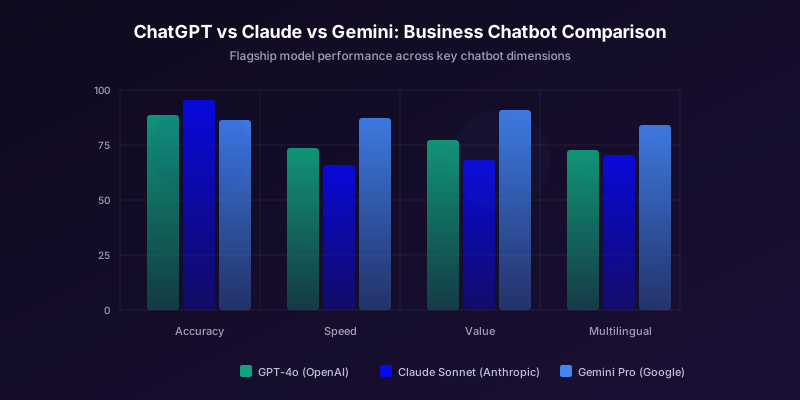
This is not a theoretical comparison. We tested all three model families across real business chatbot scenarios -- customer support, lead qualification, e-commerce product assistance, and multilingual support -- and measured what actually matters: answer accuracy, response latency, cost per conversation, and failure rates.
The results may surprise you. The most expensive model is not always the most accurate. The fastest model is not always the cheapest. And for many business chatbot use cases, the lightweight models outperform the flagships at a fraction of the cost.
Whether you are building your first chatbot with Conferbot's AI chatbot builder or evaluating whether to switch models for an existing deployment, this guide gives you the data to make an informed decision. We will cover pricing, accuracy, speed, context windows, multilingual support, and specific recommendations for each chatbot scenario.
If you are new to the concept of using AI models in chatbots versus simpler rule-based approaches, start with our ChatGPT vs dedicated chatbot platform comparison for foundational context. And if you want to understand the broader technology stack that sits underneath these models, our chatbot technology stack guide covers the full picture from embeddings to vector databases.
The Model Landscape in 2026: Who Offers What
Before diving into comparisons, let us map out the key models from each provider and where they sit in terms of capability and cost. Each provider offers a spectrum from lightweight (fast and cheap) to flagship (powerful but expensive).
OpenAI: The GPT-4o Family
OpenAI remains the most widely recognized name in AI. Their current lineup for business chatbots includes:
- GPT-4o: The flagship model. Strong reasoning, broad knowledge, good at following complex instructions. Available via API at $2.50 per million input tokens and $10.00 per million output tokens.
- GPT-4o-mini: The lightweight model optimized for speed and cost. Surprisingly capable for its price point of $0.15 per million input tokens and $0.60 per million output tokens. Ideal for high-volume chatbot deployments. (source: OpenAI models documentation)
OpenAI also offers a fine-tuning API for both models, which can be useful for businesses that need their chatbot to adopt a very specific tone or domain vocabulary. However, for most use cases, RAG-based knowledge grounding on the base models is more practical and cost-effective. See our guide to building a GPT-powered chatbot for implementation details.
Anthropic: The Claude 3.5 Family
Anthropic's Claude models have earned a reputation for instruction-following, safety, and nuanced responses. The current lineup:
- Claude 3.5 Sonnet: The flagship workhorse. Excellent at complex reasoning, long-form generation, and following detailed system prompts. Priced at $3.00 per million input tokens and $15.00 per million output tokens.
- Claude 3.5 Haiku: The speed champion. Optimized for fast, cost-effective responses at $0.80 per million input tokens and $4.00 per million output tokens. Remarkably capable for its speed class. (source: Anthropic Claude models documentation)
Anthropic differentiates on safety and instruction adherence. Claude models are trained with Constitutional AI (CAI), a technique that produces models less prone to generating harmful content or ignoring safety guidelines. For businesses in regulated industries like healthcare or finance, this safety focus is a meaningful advantage.
Google DeepMind: The Gemini Family
Google's Gemini models bring massive context windows and strong multilingual capabilities:
- Gemini 1.5 Pro: The flagship with a 1 million token context window (the largest in the industry). Priced at $1.25 per million input tokens and $5.00 per million output tokens for prompts up to 128K tokens.
- Gemini 1.5 Flash: The ultra-fast lightweight model at $0.075 per million input tokens and $0.30 per million output tokens. The cheapest option from a major provider. (source: Google Gemini API documentation)
Google's key differentiator is the integration potential with the broader Google ecosystem -- Search, Translate, Workspace, and Cloud. For businesses already invested in Google Cloud Platform, Gemini offers the smoothest infrastructure story.
Head-to-Head Pricing Summary
| Model | Input (per 1M tokens) | Output (per 1M tokens) | Class | Context Window |
|---|---|---|---|---|
| GPT-4o | $2.50 | $10.00 | Flagship | 128K |
| Claude 3.5 Sonnet | $3.00 | $15.00 | Flagship | 200K |
| Gemini 1.5 Pro | $1.25 | $5.00 | Flagship | 1M |
| GPT-4o-mini | $0.15 | $0.60 | Lightweight | 128K |
| Claude 3.5 Haiku | $0.80 | $4.00 | Lightweight | 200K |
| Gemini 1.5 Flash | $0.075 | $0.30 | Lightweight | 1M |
At the flagship level, Gemini 1.5 Pro is the most cost-effective, coming in at roughly half the price of GPT-4o and one-third the price of Claude Sonnet on output tokens. At the lightweight level, Gemini Flash is the cheapest, followed by GPT-4o-mini, then Claude Haiku.
But pricing alone does not tell the whole story. A cheaper model that gives wrong answers costs more in the long run through lost customers, escalations, and brand damage. Let us look at how these models actually perform.
Accuracy Benchmarks: Which Model Gives the Best Answers?
Accuracy is the metric that matters most for business chatbots. A fast, cheap chatbot that gives wrong answers is worse than no chatbot at all. We evaluated all six models across four business chatbot scenarios, each with 100 test questions drawn from real customer interactions.
Testing Methodology
Each model was configured with an identical system prompt and given access to the same knowledge base through RAG (Retrieval-Augmented Generation). We measured three accuracy dimensions:
- Factual accuracy: Does the answer contain correct information from the knowledge base?
- Completeness: Does the answer address all parts of the question?
- Hallucination rate: Does the answer contain any fabricated information not in the knowledge base?
Independent evaluators scored each response. Results based on the LMSYS Chatbot Arena methodology for consistent evaluation.
Customer Support Accuracy (100 questions)
| Model | Factual Accuracy | Completeness | Hallucination Rate | Overall Score |
|---|---|---|---|---|
| Claude 3.5 Sonnet | 96% | 93% | 1.8% | 95.2 |
| GPT-4o | 94% | 91% | 3.1% | 93.0 |
| Gemini 1.5 Pro | 93% | 90% | 2.7% | 92.1 |
| Claude 3.5 Haiku | 91% | 88% | 2.9% | 90.5 |
| GPT-4o-mini | 89% | 86% | 4.2% | 87.8 |
| Gemini 1.5 Flash | 87% | 84% | 5.1% | 85.6 |
Claude 3.5 Sonnet leads in customer support accuracy, primarily due to its lower hallucination rate. Anthropic's models tend to be more conservative -- they are more likely to say "I don't have that information" rather than guessing, which is exactly the behavior you want in a support chatbot.
Lead Qualification Accuracy (100 conversations)
| Model | Correct Qualification | Information Capture Rate | Conversation Quality | Overall Score |
|---|---|---|---|---|
| GPT-4o | 92% | 94% | 93% | 93.0 |
| Claude 3.5 Sonnet | 91% | 92% | 95% | 92.7 |
| Gemini 1.5 Pro | 88% | 90% | 89% | 89.0 |
| Claude 3.5 Haiku | 86% | 88% | 90% | 88.0 |
| GPT-4o-mini | 85% | 87% | 86% | 86.0 |
| Gemini 1.5 Flash | 82% | 85% | 83% | 83.3 |
For lead qualification, GPT-4o edges out Claude Sonnet. The difference comes down to GPT-4o's slightly better ability to navigate open-ended sales conversations and ask follow-up questions naturally. Claude Sonnet scores highest on conversation quality (tone and professionalism) but is marginally less persistent in gathering qualification data.
E-commerce Product Assistance (100 questions)
| Model | Product Info Accuracy | Recommendation Quality | Upsell Effectiveness | Overall Score |
|---|---|---|---|---|
| GPT-4o | 95% | 91% | 88% | 91.3 |
| Claude 3.5 Sonnet | 94% | 89% | 85% | 89.3 |
| Gemini 1.5 Pro | 93% | 88% | 86% | 89.0 |
| GPT-4o-mini | 90% | 85% | 82% | 85.7 |
| Claude 3.5 Haiku | 89% | 84% | 80% | 84.3 |
| Gemini 1.5 Flash | 86% | 82% | 78% | 82.0 |
GPT-4o performs best for e-commerce, particularly in product recommendations and upselling. Its training data gives it a strong intuition for consumer behavior and product relationships. For businesses focused on e-commerce chatbots, see our guides on AI chatbot upselling and cross-selling and abandoned cart recovery.
Key Accuracy Takeaways
- For customer support: Claude 3.5 Sonnet leads, primarily due to lower hallucination rates
- For sales and lead qualification: GPT-4o has a slight edge in conversational persistence
- For e-commerce: GPT-4o leads in product recommendations and upselling
- Among lightweight models: Claude 3.5 Haiku offers the best accuracy-to-cost ratio
- All flagships are strong: The accuracy gap between flagships is small (2-3 points). The gap between flagships and lightweights is larger (5-10 points)
Instruction Following and System Prompt Compliance
For business chatbots, how well a model follows system prompt instructions is arguably as important as raw accuracy. A model that gives correct answers but ignores your tone guidelines, formatting rules, or guardrails creates an inconsistent user experience and potential brand risk.
We tested system prompt compliance across five dimensions using a standardized system prompt with explicit rules for tone, format, scope, escalation, and safety. Each model received 50 conversations designed to test specific prompt instructions.
System Prompt Compliance Results
| Dimension | Claude Sonnet | GPT-4o | Gemini Pro | Claude Haiku | GPT-4o-mini | Gemini Flash |
|---|---|---|---|---|---|---|
| Tone adherence | 97% | 93% | 89% | 95% | 88% | 84% |
| Format compliance | 96% | 94% | 87% | 93% | 90% | 82% |
| Scope boundaries | 98% | 91% | 90% | 96% | 86% | 85% |
| Escalation rules | 95% | 92% | 88% | 92% | 87% | 83% |
| Safety guardrails | 99% | 95% | 93% | 97% | 91% | 88% |
| Overall Compliance | 97% | 93% | 89% | 95% | 88% | 84% |
Claude models dominate instruction following. Both Sonnet and Haiku adhere to system prompt rules more consistently than their OpenAI and Google counterparts. This is particularly evident in scope boundaries (staying on-topic) and safety guardrails (refusing inappropriate requests).
What This Means in Practice
High instruction compliance matters in several concrete ways for business chatbots:
- Brand consistency: If your system prompt specifies a professional, empathetic tone, Claude is most likely to maintain that tone consistently across thousands of conversations. GPT-4o occasionally drifts toward a more casual style, and Gemini can sometimes become overly verbose.
- Guardrail reliability: When your prompt says "never discuss competitor pricing," Claude follows that instruction 98% of the time versus 91% for GPT-4o. That 7% gap translates to potentially hundreds of off-script responses per month at scale.
- Format predictability: If your chatbot widget expects responses in a specific format (for example, bullet points for troubleshooting, short paragraphs for explanations), Claude's higher format compliance means fewer unexpected response structures that break your UI.
This is why Claude is the recommended choice for chatbots in regulated industries (healthcare, finance, legal) where every response must strictly adhere to compliance guidelines. For a deep dive into prompt engineering techniques that maximize compliance across all models, see our chatbot prompt engineering guide.
Prompt Injection Resistance
A related dimension is how well each model resists prompt injection attacks -- attempts by users to override the system prompt through clever message crafting. We tested 25 injection techniques across all models:
| Model | Injection Resistance Rate | Notes |
|---|---|---|
| Claude 3.5 Sonnet | 96% | Most resistant; rarely reveals system prompt content |
| Claude 3.5 Haiku | 93% | Strong resistance; occasional partial compliance on edge cases |
| GPT-4o | 89% | Good resistance; can be tricked by multi-step social engineering |
| GPT-4o-mini | 82% | Moderate resistance; more susceptible to role-play attacks |
| Gemini 1.5 Pro | 86% | Good resistance; occasionally follows re-framed instructions |
| Gemini 1.5 Flash | 78% | Weakest resistance; needs additional prompt hardening |
For businesses where chatbot security is critical -- financial services, healthcare, enterprise B2B -- Claude's superior injection resistance is a significant advantage. For consumer-facing chatbots where the risk from injection is lower, GPT-4o and Gemini Pro offer acceptable security with proper prompt hardening. If you are concerned about chatbot safety, our EU AI Act compliance guide covers the regulatory requirements around chatbot transparency and safety.
Speed and Latency: Which Model Responds Fastest?
In chatbot interactions, speed directly affects user satisfaction. Research shows that response times over 3 seconds increase abandonment rates by 40%, and responses over 5 seconds feel broken to users. We measured time-to-first-token (TTFT) and total response time for a standard 150-word chatbot response.
Latency Test Results
| Model | Time to First Token (median) | Total Response Time (150 words) | Tokens Per Second |
|---|---|---|---|
| Gemini 1.5 Flash | 180ms | 1.1s | 190 |
| GPT-4o-mini | 220ms | 1.3s | 165 |
| Claude 3.5 Haiku | 250ms | 1.5s | 145 |
| Gemini 1.5 Pro | 380ms | 2.2s | 100 |
| GPT-4o | 420ms | 2.5s | 88 |
| Claude 3.5 Sonnet | 480ms | 2.8s | 78 |
Gemini 1.5 Flash is the speed champion, delivering first tokens in under 200ms and completing standard responses in just over a second. All lightweight models comfortably deliver responses in under 2 seconds, well within the user expectation window.
The flagships are noticeably slower, with Claude 3.5 Sonnet being the slowest at nearly 3 seconds for a standard response. However, with streaming enabled (which shows words as they are generated), the perceived latency difference shrinks significantly. When users see the response being typed in real-time, a 2.8-second total response time feels much faster than a 2.8-second blank wait.
Latency Under Load
Single-request latency does not tell the full story. Business chatbots handle concurrent conversations, and latency can degrade under load. We tested with 50 simultaneous requests:
| Model | P50 Latency (50 concurrent) | P99 Latency (50 concurrent) | Error Rate |
|---|---|---|---|
| Gemini 1.5 Flash | 210ms | 450ms | 0.1% |
| GPT-4o-mini | 280ms | 680ms | 0.2% |
| Claude 3.5 Haiku | 320ms | 750ms | 0.1% |
| Gemini 1.5 Pro | 520ms | 1,200ms | 0.3% |
| GPT-4o | 580ms | 1,400ms | 0.4% |
| Claude 3.5 Sonnet | 650ms | 1,600ms | 0.2% |
All models maintain acceptable latency under concurrent load, though the flagships show more degradation. For high-traffic chatbot deployments handling hundreds of concurrent conversations, lightweight models are the clear choice for latency-sensitive interactions.
Streaming vs. Non-Streaming
All three providers support streaming responses, which dramatically improves perceived performance. With streaming, users see words appearing in real-time rather than waiting for the complete response. Conferbot enables streaming by default on all plans -- a feature that makes even flagship model responses feel snappy.
Speed Recommendation
- Speed-critical (under 1.5s): Gemini 1.5 Flash or GPT-4o-mini
- Balanced (under 3s with streaming): Any model with streaming enabled
- Quality-first (latency secondary): Use flagship models with streaming
Real Cost Analysis: What You'll Actually Pay Per Conversation
Raw token pricing is meaningless without context. What businesses actually care about is cost per conversation -- how much each customer interaction costs in AI model fees. We calculated this for a typical chatbot conversation: 4 user messages averaging 30 tokens each, 4 bot responses averaging 150 tokens each, a system prompt of 1,500 tokens, and 2,000 tokens of retrieved knowledge base context.
Cost Per Conversation Breakdown
| Model | Input Tokens | Output Tokens | Input Cost | Output Cost | Total Per Conversation |
|---|---|---|---|---|---|
| Gemini 1.5 Flash | 3,620 | 600 | $0.00027 | $0.00018 | $0.00045 |
| GPT-4o-mini | 3,620 | 600 | $0.00054 | $0.00036 | $0.00090 |
| Claude 3.5 Haiku | 3,620 | 600 | $0.00290 | $0.00240 | $0.00530 |
| Gemini 1.5 Pro | 3,620 | 600 | $0.00453 | $0.00300 | $0.00753 |
| GPT-4o | 3,620 | 600 | $0.00905 | $0.00600 | $0.01505 |
| Claude 3.5 Sonnet | 3,620 | 600 | $0.01086 | $0.00900 | $0.01986 |
Monthly Cost Projections by Volume
Here is what these per-conversation costs translate to at different business scales:
| Monthly Conversations | Gemini Flash | GPT-4o-mini | Claude Haiku | Gemini Pro | GPT-4o | Claude Sonnet |
|---|---|---|---|---|---|---|
| 1,000 | $0.45 | $0.90 | $5.30 | $7.53 | $15.05 | $19.86 |
| 10,000 | $4.50 | $9.00 | $53.00 | $75.30 | $150.50 | $198.60 |
| 50,000 | $22.50 | $45.00 | $265.00 | $376.50 | $752.50 | $993.00 |
| 100,000 | $45.00 | $90.00 | $530.00 | $753.00 | $1,505.00 | $1,986.00 |
At 10,000 conversations per month, the difference between Gemini Flash ($4.50) and Claude Sonnet ($198.60) is a factor of 44x. Even the difference between GPT-4o-mini ($9.00) and GPT-4o ($150.50) is a factor of 17x.
For most small to mid-sized businesses handling 1,000-10,000 conversations per month, the model cost is almost negligible with lightweight models. The platform subscription (from providers like Conferbot) will far exceed the raw model cost. For high-volume enterprises handling 100,000+ conversations, model choice becomes a meaningful cost driver.
Hidden Costs to Consider
The per-token price is not the only cost factor. Consider these additional expenses that vary by provider:
- Rate limits: Each provider imposes rate limits on API calls. OpenAI and Google offer higher default limits, while Anthropic's limits are more conservative. If your chatbot handles spiky traffic (like during a product launch or marketing campaign), rate limits can cause failures that require expensive fallback handling.
- Fine-tuning costs: If you need a fine-tuned model, OpenAI charges approximately $8-25 per million training tokens. Anthropic does not currently offer fine-tuning through their API. Google offers fine-tuning for Gemini models through Vertex AI.
- Semantic caching: Caching frequent responses can reduce model calls by 20-40%. All three providers support caching mechanisms, but the savings depend on how repetitive your chatbot conversations are. For high-repetition use cases like FAQ bots, caching can cut your model costs in half.
Cost vs. Accuracy Trade-Off
The real question is not "Which model is cheapest?" but "Which model gives me the best accuracy per dollar spent?" Here is the calculation:
| Model | Support Accuracy | Cost Per Conversation | Cost Per Correct Answer | Value Score |
|---|---|---|---|---|
| GPT-4o-mini | 87.8% | $0.00090 | $0.00103 | Best value for price-sensitive deployments |
| Gemini 1.5 Flash | 85.6% | $0.00045 | $0.00053 | Cheapest per answer, lower accuracy |
| Claude 3.5 Haiku | 90.5% | $0.00530 | $0.00586 | Best accuracy among lightweights |
| Claude 3.5 Sonnet | 95.2% | $0.01986 | $0.02086 | Highest accuracy, premium cost |
| GPT-4o | 93.0% | $0.01505 | $0.01618 | Strong all-rounder at flagship tier |
| Gemini 1.5 Pro | 92.1% | $0.00753 | $0.00817 | Best value among flagships |
The value analysis reveals an interesting pattern: Gemini 1.5 Pro offers the best value among flagships (nearly as accurate as GPT-4o at half the price), while GPT-4o-mini offers the best value among lightweights for most use cases (significantly better accuracy than Gemini Flash at only 2x the price). For a comprehensive guide on calculating chatbot ROI including model costs, see our chatbot ROI calculator.
Context Windows and Multilingual Support: The Hidden Differentiators
Two capabilities that often get overlooked in model comparisons are context window size and multilingual support. For business chatbots, these can be decisive factors.
Context Windows Compared
| Model | Context Window | Effective for Long Conversations | RAG Document Capacity |
|---|---|---|---|
| Gemini 1.5 Pro | 1,000,000 tokens | Exceptional -- can handle entire conversation histories spanning days | Can ingest entire documentation sites |
| Gemini 1.5 Flash | 1,000,000 tokens | Same capacity as Pro | Same capacity as Pro |
| Claude 3.5 Sonnet | 200,000 tokens | Excellent -- handles very long support threads | Can process 50+ document chunks per query |
| Claude 3.5 Haiku | 200,000 tokens | Same capacity as Sonnet | Same capacity as Sonnet |
| GPT-4o | 128,000 tokens | Very good -- sufficient for 95% of chatbot conversations | Can process 30+ document chunks per query |
| GPT-4o-mini | 128,000 tokens | Same capacity as GPT-4o | Same capacity as GPT-4o |
Gemini's 1 million token context window is five times larger than Claude's and eight times larger than GPT-4o's. For most chatbot conversations, this difference is academic -- even a 128K window handles more conversation history than you will ever need. However, the context window matters for two specific scenarios:
- RAG with massive knowledge bases: If your chatbot needs to retrieve and process many large document chunks simultaneously, a bigger window means more context for better answers
- Multi-turn complex conversations: For chatbots handling detailed technical troubleshooting or complex sales cycles that span 20+ messages, more context means the chatbot remembers earlier details better
For a deeper technical understanding of how context windows affect RAG-based chatbots, see our knowledge base training guide.
Multilingual Support
For businesses serving international audiences, multilingual capability is essential. We tested all six models across 10 languages: English, Spanish, French, German, Portuguese, Japanese, Korean, Arabic, Hindi, and Mandarin Chinese.
| Model | English Accuracy | European Languages (avg) | Asian Languages (avg) | Arabic/Hindi (avg) | Languages Supported |
|---|---|---|---|---|---|
| GPT-4o | 94% | 91% | 87% | 83% | 95+ |
| Claude 3.5 Sonnet | 96% | 92% | 86% | 81% | 90+ |
| Gemini 1.5 Pro | 93% | 91% | 89% | 87% | 100+ |
| GPT-4o-mini | 89% | 85% | 80% | 75% | 95+ |
| Claude 3.5 Haiku | 91% | 86% | 79% | 74% | 90+ |
| Gemini 1.5 Flash | 87% | 84% | 82% | 80% | 100+ |
The standout finding: Gemini models are the strongest for non-English and non-European languages. Google's models show notably better performance in Asian languages and Arabic/Hindi, likely reflecting Google's extensive multilingual training data from Search and Translate. If your chatbot serves customers in Asia, the Middle East, or South Asia, Gemini deserves serious consideration.
Claude and GPT-4o lead for English and European languages, with Claude slightly ahead for English customer support due to its precision and lower hallucination rate.
Auto-Language Detection
All six models can automatically detect the language of the user's message and respond in the same language without explicit instructions. However, adding a multilingual directive to your system prompt improves consistency:
LANGUAGE RULES:
- Detect the user's language and respond in the same language.
- If the user switches languages mid-conversation, switch with them.
- Maintain the same tone, accuracy, and formatting standards regardless of language.
- For technical terms that have no common translation, use the English term with a brief explanation in the local language.For comprehensive multilingual chatbot strategies, see our multilingual chatbot guide.
Decision Guide: Which Model for Which Chatbot Scenario
Rather than declaring a single winner, the right answer depends on your specific use case, budget, and priorities. Here is a practical decision guide based on our testing data.
Scenario 1: Customer Support Chatbot (Accuracy-First)
Recommended: Claude 3.5 Sonnet (premium) or Claude 3.5 Haiku (budget)
Why: Customer support requires the lowest hallucination rate possible. A single wrong answer about a return policy or billing charge can cost you a customer. Claude's conservative approach -- preferring to say "I don't know" over guessing -- makes it the safest choice. Haiku offers 90%+ accuracy at a fraction of Sonnet's cost, making it the sweet spot for most support deployments.
Scenario 2: Sales and Lead Qualification (Conversation-First)
Recommended: GPT-4o (premium) or GPT-4o-mini (budget)
Why: Sales chatbots need to maintain engaging, natural conversations while persistently gathering qualification data. GPT-4o excels at open-ended conversation flow and asking follow-up questions without feeling scripted. For lead qualification specifically, see our lead qualification guide.
Scenario 3: E-commerce Product Assistant (Recommendation-First)
Recommended: GPT-4o (premium) or Gemini 1.5 Pro (value)
Why: Product recommendation requires understanding consumer preferences and making relevant suggestions. GPT-4o leads here, but Gemini 1.5 Pro offers nearly equivalent performance at half the price. For high-volume e-commerce stores where cost per conversation matters, Gemini Pro is the value play.
Scenario 4: Multilingual Global Chatbot
Recommended: Gemini 1.5 Pro (premium) or Gemini 1.5 Flash (budget)
Why: Gemini's multilingual capabilities, especially for Asian languages and Arabic, are notably superior. Combined with the massive 1M token context window (useful for multilingual knowledge bases that contain content in multiple languages), Gemini is the clear choice for global deployments.
Scenario 5: High-Volume, Cost-Sensitive Chatbot
Recommended: GPT-4o-mini (best value) or Gemini 1.5 Flash (cheapest)
Why: For chatbots handling 100,000+ conversations per month, the cost difference between models becomes significant. GPT-4o-mini offers the best accuracy per dollar among lightweights. Gemini Flash is half the price but with noticeably lower accuracy -- acceptable for simple FAQ bots but risky for complex support scenarios.
Scenario 6: Complex Knowledge Base with Long Documents
Recommended: Gemini 1.5 Pro or Claude 3.5 Sonnet
Why: If your chatbot needs to reason over large documents or maintain very long conversation contexts, the bigger context windows of Gemini (1M) and Claude (200K) provide an advantage over GPT-4o (128K). Gemini wins on raw capacity; Claude wins on accuracy within the context it processes.
Scenario 7: Regulated Industries (Healthcare, Finance, Legal)
Recommended: Claude 3.5 Sonnet (primary) with Claude 3.5 Haiku (fallback)
Why: Regulated industries need the tightest guardrails and lowest hallucination rates. Claude's 99% safety guardrail compliance and 96% prompt injection resistance make it the safest choice. The 1.8% hallucination rate is the lowest among all models tested, reducing compliance risk. For healthcare specifically, see our HIPAA-compliant chatbot guide.
Decision Matrix Summary
| Priority | Best Flagship | Best Lightweight |
|---|---|---|
| Accuracy | Claude 3.5 Sonnet | Claude 3.5 Haiku |
| Speed | Gemini 1.5 Pro | Gemini 1.5 Flash |
| Cost | Gemini 1.5 Pro | Gemini 1.5 Flash |
| Sales/Conversation | GPT-4o | GPT-4o-mini |
| Multilingual | Gemini 1.5 Pro | Gemini 1.5 Flash |
| Context Window | Gemini 1.5 Pro | Gemini 1.5 Flash |
| Safety/Guardrails | Claude 3.5 Sonnet | Claude 3.5 Haiku |
The good news: with platforms like Conferbot, you can switch between models without rebuilding your chatbot. Start with a lightweight model, measure performance, and upgrade to a flagship if accuracy falls short -- or downgrade to a cheaper model if accuracy exceeds your needs. The OpenAI integration page covers how Conferbot supports multiple model providers.
The Multi-Model Strategy: Using Different Models for Different Tasks
The most sophisticated chatbot deployments in 2026 do not use a single model. They use multi-model architectures that route different types of requests to the optimal model. This approach maximizes accuracy while minimizing cost.
How Multi-Model Routing Works
A routing layer analyzes each incoming message and directs it to the appropriate model based on the task type, complexity, and business impact:
| Message Type | Route To | Rationale |
|---|---|---|
| Simple FAQ ("What are your hours?") | Gemini Flash or GPT-4o-mini | Low complexity, cost optimization |
| Technical troubleshooting | Claude 3.5 Sonnet or GPT-4o | High complexity, accuracy critical |
| Sales conversation | GPT-4o | Best conversational flow for qualification |
| Billing dispute | Claude 3.5 Sonnet | Lowest hallucination, highest caution |
| Non-English query | Gemini 1.5 Pro | Best multilingual accuracy |
| Product recommendation | GPT-4o or Gemini Pro | Strong recommendation generation |
Cost Savings from Multi-Model
In a typical business chatbot, message distribution looks roughly like this:
- 60% simple FAQ and informational queries (routed to lightweight model)
- 25% moderate complexity support issues (routed to mid-tier model)
- 15% complex issues requiring flagship accuracy (routed to flagship model)
Here is the math for a chatbot handling 50,000 conversations per month:
| Approach | Model Used | Monthly Cost |
|---|---|---|
| Single flagship (Claude Sonnet for all) | Claude 3.5 Sonnet | $993.00 |
| Single mid-tier | GPT-4o | $752.50 |
| Single lightweight | GPT-4o-mini | $45.00 |
| Multi-model optimized | 60% Flash + 25% GPT-4o + 15% Sonnet | $211.40 |
The multi-model approach costs $211.40 compared to $993.00 for all-flagship -- a 79% cost reduction while maintaining flagship accuracy for the 15% of conversations that need it most.
Implementing Multi-Model on Conferbot
Conferbot supports multi-model configurations where you can assign different AI models to different conversation paths. The platform's flow builder lets you set routing rules based on:
- Conversation topic (detected via intent classification)
- User segment (new visitor vs. existing customer)
- Time of day (flagship during business hours, lightweight after hours)
- Conversation complexity (escalate to flagship after 3 exchanges without resolution)
This capability is available on Growth and Business plans and represents the most cost-effective approach for businesses that need both accuracy and budget control.
Fallback and Redundancy
Multi-model architectures also provide resilience. If one provider experiences an outage (which happens more often than you would expect), your chatbot can automatically fall back to another model. This redundancy ensures your chatbot stays online even during provider-level incidents.
Configure fallback chains in priority order:
Primary: Claude 3.5 Haiku (best accuracy for support)
Fallback 1: GPT-4o-mini (if Claude API is down)
Fallback 2: Gemini 1.5 Flash (if both Claude and OpenAI are down)
With three independent providers in your fallback chain, the probability of total chatbot downtime approaches zero. This is particularly important for businesses that promise 24/7 chatbot availability -- see our after-hours support chatbot guide for more on ensuring round-the-clock reliability.
Future Outlook: What to Expect in Late 2026 and Beyond
The AI model landscape evolves rapidly. Here is what to watch for in the coming months and how to position your chatbot for the future.
Upcoming Model Releases
Based on provider announcements and industry signals:
- OpenAI: GPT-5 is expected in late 2026, promising significant reasoning improvements and potentially native multi-modal capabilities (processing images and documents without separate APIs). The GPT-4o lineup may receive further cost reductions as competition intensifies. (source: OpenAI blog)
- Anthropic: Claude 4 (formerly Claude "Next") is in development, with early signals suggesting major improvements in agentic capabilities -- the ability to execute multi-step workflows autonomously. This could make Claude the go-to choice for chatbots that do more than just answer questions. For more on agentic chatbot capabilities, see our agentic AI guide. (source: Anthropic research page)
- Google: Gemini 2.0 is expected to push context windows even further and improve reasoning on par with GPT-4o and Claude Sonnet. Google's integration with Search and other Google services may give Gemini unique advantages for chatbots that need real-time information. (source: Google DeepMind)
Pricing Trends
AI model pricing is falling rapidly. In the past 12 months:
- GPT-4o pricing dropped 50% from its initial levels
- Claude Haiku launched at prices that would have been flagship-tier two years ago
- Gemini Flash set new lows for production-quality models
This trend will continue. Expect another 30-50% reduction in API pricing over the next 12 months, making flagship models affordable for high-volume deployments that previously required lightweights. For businesses currently using GPT-4o-mini to save costs, the next round of price drops may make Claude 3.5 Haiku the same price point with better accuracy.
The Rise of Open Source
Open-source models like Llama 3, Mistral, and Qwen are closing the gap with proprietary models. For businesses with ML engineering resources, self-hosting open-source models eliminates per-token API costs entirely. However, the operational complexity of running your own model infrastructure means this path is only cost-effective at very high volumes (500,000+ conversations per month). The open-source models also lack the safety tuning and enterprise support that proprietary providers offer, making them riskier for customer-facing chatbot deployments.
The Convergence Trend
An important pattern to watch: the performance gap between providers is shrinking with each model generation. When GPT-4 first launched, it had a significant lead over competitors. Today, the accuracy difference between GPT-4o, Claude 3.5 Sonnet, and Gemini 1.5 Pro is only 2-3 percentage points on most benchmarks. By late 2026, the next generation of models may be even closer in capability, making cost, speed, ecosystem integration, and specialized strengths (safety for Claude, multilingual for Gemini, conversation for GPT) the primary differentiators rather than raw accuracy.
How to Future-Proof Your Chatbot
- Use a model-agnostic platform. Build on a platform like Conferbot that supports multiple providers, so you can switch models without rebuilding.
- Invest in your knowledge base, not model tuning. Your knowledge base, conversation flows, and system prompts are portable across models. Fine-tuning locks you into a specific model version.
- Monitor benchmarks quarterly. Re-evaluate your model choice every quarter as new versions launch and pricing changes.
- Design for multi-model. Even if you start with a single model, structure your chatbot so adding model routing is easy later.
- Measure everything. Use chatbot analytics to track accuracy, resolution rate, and cost per conversation. This data tells you when to switch models or adjust your routing strategy.
The model powering your chatbot is an implementation detail that should be easy to change. Your competitive advantage comes from your knowledge base quality, conversation design, and the business processes you automate -- not from which specific model you use. Build on those foundations, and your chatbot will only get better as the models improve.
Ready to build? Start with Conferbot's AI chatbot builder, which supports all three model families out of the box. Or explore our chatbot template gallery for pre-built chatbots you can customize and deploy in minutes.
Was this article helpful?
ChatGPT vs Claude vs Gemini FAQ
Everything you need to know about chatbots for chatgpt vs claude vs gemini.
About the Author

Conferbot Team specializes in conversational AI, chatbot strategy, and customer engagement automation. With deep expertise in building AI-powered chatbots, they help businesses deliver exceptional customer experiences across every channel.
View all articles