The Communication Bottleneck Costing Eye Care Clinics Millions
The United States is home to more than 44,000 optometry practices serving over 200 million patients annually, yet the industry faces a communication crisis that drains revenue and erodes patient loyalty. According to the American Optometric Association (AOA), the average optometry practice generates $725,000 in annual revenue, but loses an estimated $28,000-48,000 per year to preventable inefficiencies: missed appointment calls, overdue recall patients who never rebook, lens order status inquiries that tie up staff for hours, and insurance verification bottlenecks that slow every patient interaction.
The front desk of a typical eye care clinic handles between 40 and 80 phone calls per day. Industry research indicates that 31% of inbound calls to optometry offices go unanswered during peak hours, lunch periods, and after-hours windows. Each unanswered call from a prospective patient represents potential revenue lost to a competitor, and acquiring a new eye care patient costs $120-250 in marketing spend according to optometry practice management benchmarks. For established practices, losing an existing patient to a missed phone call is even more costly when you factor in the lifetime value of annual exams, contact lens refills, and eyewear purchases.
Meanwhile, patient expectations have shifted dramatically. A 2025 healthcare consumer survey by McKinsey Healthcare found that 74% of patients want the ability to book, cancel, or reschedule appointments online without calling. Among patients aged 25-44, the cohort most likely to wear contact lenses and purchase premium eyewear, 71% say they would switch providers for one offering better digital communication options. The gap between what patients expect and what most optometry clinics deliver is widening every quarter.
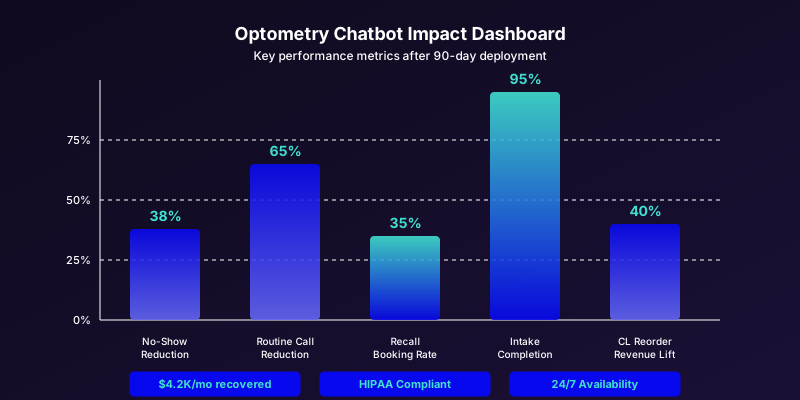
AI chatbots close this gap entirely. An optometry chatbot operates 24 hours a day, 365 days a year, handling appointment scheduling, annual recall reminders, lens order status inquiries, insurance verification, post-visit care instructions, and patient intake forms without adding staff. Clinics that deploy chatbots report a 38% reduction in no-show appointments, a 65% decrease in routine phone calls, and monthly savings of $4,200+ in recovered revenue and operational efficiency. For a broader view of healthcare chatbot applications, see our comprehensive healthcare chatbot guide.

This guide covers every aspect of deploying an AI chatbot in an optometry or eye care clinic, from appointment scheduling and recall campaigns to lens order tracking and HIPAA compliance, with specific ROI data, implementation timelines, and conversation design strategies that work for solo practitioners, group practices, and ophthalmology-optometry hybrid clinics alike.
Appointment Scheduling and No-Show Reduction: The 38% Improvement
No-shows represent the single most expensive operational problem in optometry. Research published in PubMed medical literature on ophthalmology and optometry appointment adherence finds that eye care clinics experience an average 15-22% no-show rate, with some practices in underserved areas reporting rates as high as 30%. Each no-show costs an optometry practice $175-300 in lost revenue when you factor in the reserved chair time, technician allocation, equipment preparation for dilated exams, and the opportunity cost of turning away other patients. For a practice scheduling 20 comprehensive exams per day, even a 17% no-show rate translates to $5,000-7,500 per month in lost revenue.
AI chatbots attack the no-show problem through a coordinated multi-channel approach that goes far beyond passive text reminders. For detailed appointment reminder strategies, see our appointment booking chatbot guide.
Interactive Confirmation Sequences for Eye Exams
The chatbot sends a carefully timed sequence of reminders at 72 hours, 24 hours, and 2 hours before the appointment, each with interactive response options tailored to eye care:
- 72-hour reminder: "Hi Maria, this is a reminder that your comprehensive eye exam with Dr. Patel is scheduled for Thursday at 2:00 PM. The exam takes about 45-60 minutes. If your eyes will be dilated, you may want to bring sunglasses and arrange a ride home. Reply CONFIRM to keep your appointment, RESCHEDULE if you need a different time, or CANCEL if you can't make it."
- 24-hour reminder: "Your eye exam is tomorrow at 2:00 PM at Vision Care Associates. Parking reminder: free lot behind the building. Bring your current glasses, contact lens boxes, and insurance card. Reply CONFIRM to let us know you'll be there."
- 2-hour reminder: "See you at 2:00 PM today! Please arrive 10 minutes early if you have new paperwork to complete. If anything has come up, reply RESCHEDULE and I'll find you a new time right now."
The critical difference between chatbot confirmations and passive reminders is the frictionless rescheduling path. Patients who would otherwise simply not show up are given a zero-effort way to move their appointment. When a patient replies RESCHEDULE, the chatbot immediately presents available slots and completes the rebooking in under 60 seconds. The cancelled slot is then automatically offered to patients on the waitlist or to overdue recall patients, recovering revenue that would otherwise be lost entirely.
Waitlist Automation and Same-Day Fills
When a cancellation occurs, the chatbot instantly notifies patients on the waitlist:
"Great news! An opening just became available for tomorrow at 10:30 AM with Dr. Patel for a comprehensive eye exam. Would you like to take this slot? Reply YES to book instantly."
Eye care clinics using waitlist automation recover 55-70% of cancelled slots, compared to 10-15% when staff manually call waitlisted patients. The speed advantage is decisive because the chatbot can notify the entire waitlist within seconds, while a staff member might take 45 minutes to work through a phone list.
After-Hours Scheduling Capture
According to eye care industry data, 42% of appointment booking attempts happen outside of business hours. Without a chatbot, these patients hit voicemail. Research shows that only 22% of patients who reach voicemail actually leave a message or call back the next day. A chatbot captures every one of these after-hours requests and converts them into confirmed appointments in real time. Deploy across your website and messaging channels for maximum after-hours coverage.
The Combined No-Show Impact
When you combine interactive confirmations, frictionless rescheduling, waitlist automation, and after-hours capture, the aggregate effect on no-show rates is dramatic. Eye care clinics using Conferbot's AI chatbot builder report no-show rate reductions from the industry average of 17% down to 10.5%, a 38% improvement, within the first 60 days of deployment. For a 20-exam-per-day practice, this translates to recovering 1.3 additional appointments daily, or roughly $4,200-5,800 per month in recovered revenue.

Patient Recall Campaigns: Bringing Overdue Patients Back Automatically
Patient recall is the lifeblood of an optometry practice. Unlike acute care visits, most eye care appointments are preventive and scheduled annually, meaning a practice must actively remind patients to return each year. The AOA recommends comprehensive eye exams every one to two years for adults aged 18-64 and annually for patients over 65 or those with risk factors like diabetes, glaucoma family history, or high myopia. Yet despite these guidelines, CDC vision health data shows that only 54% of Americans get an annual eye exam, and the average optometry practice has 30-45% of its patient base overdue for their next exam at any given time.
Traditional recall methods, postcards, phone calls, and generic emails, are expensive and increasingly ineffective. Postcards cost $0.75-1.50 each when you include printing and postage, with response rates of 2-5%. Phone recall campaigns require dedicated staff time and reach only patients who answer unknown numbers, which is a declining percentage every year. Generic email blasts land in spam folders and see open rates of 15-20% for healthcare communications.
Chatbot-Powered Recall Automation
An AI chatbot transforms recall from a manual, expensive process into an automated, personalized conversation. Here is how the recall sequence works:
30 days before the annual exam due date:
"Hi James, it's Vision Care Associates! Your annual comprehensive eye exam is due next month. Regular exams help us catch changes in your prescription, screen for glaucoma and macular degeneration early, and keep your vision sharp. Would you like to book your exam now? I have openings this week and next."
On the due date:
"James, your annual eye exam is now due. Last year Dr. Nguyen noted mild astigmatism changes and recommended annual monitoring. It's important to stay on schedule so we can track any progression. Want to book? I can find a time that works with your schedule."
30 days overdue:
"Hi James, you're now a month overdue for your annual eye exam. We want to make sure your prescription is current and your eye health is on track. If cost is a concern, we can check your VSP benefits; you likely have a fully covered exam waiting. Reply BOOK to schedule or BENEFITS to check your coverage."
90 days overdue:
"James, it's been over 3 months since your annual eye exam was due. Vision changes can happen gradually without you noticing, which is why regular exams matter. We're saving your patient file and records. Book a quick 45-minute exam and let's keep your vision in great shape. Any day this week work?"
Recall Response Rates: Chatbot vs. Traditional
| Recall Method | Cost Per Contact | Response Rate | Booking Rate |
|---|---|---|---|
| Postcards | $0.75-1.50 | 2-5% | 1-3% |
| Phone calls | $2.50-4.00 | 15-25% | 8-15% |
| Generic email | $0.02-0.05 | 15-20% open | 3-6% |
| AI Chatbot (multi-touch) | $0.05-0.15 | 45-60% | 22-35% |
The chatbot achieves dramatically higher booking rates because it combines the personalization of a phone call with the convenience of a text message, and it includes an instant booking path. A postcard tells the patient to call; the chatbot lets them book in two taps. For a practice with 2,000 patients overdue, a chatbot recall campaign that books 25% of them generates 500 additional exams, worth $75,000-100,000 in direct exam revenue plus downstream eyewear and contact lens sales.
Segmented Recall for Risk Populations
The chatbot can segment recall campaigns by clinical priority. Patients with diabetes, glaucoma suspects, high myopia, or macular degeneration family history receive more frequent and clinically specific recall messages:
"Hi Robert, as a diabetic patient, the American Optometric Association recommends annual dilated eye exams to screen for diabetic retinopathy. Early detection is key to preventing vision loss. Your exam is now due. Would you like to schedule this week?"
This clinical personalization increases recall response rates by an additional 15-20% for high-risk populations and demonstrates the standard of care documentation that protects the practice legally.
Lens Order Status and Optical Shop Automation
Lens order inquiries are among the most time-consuming and repetitive calls an optometry office receives. After a patient orders new glasses or contact lenses, the natural question is "When will my glasses be ready?" or "Has my contact lens order shipped?" These calls account for 20-30% of all inbound calls to practices with an in-house optical shop, and each call takes 3-5 minutes as the staff member looks up the order in the lab management system, checks the status, and relays the information.
Real-Time Order Status Lookup
The chatbot integrates with your optical lab management system or contact lens distributor portal to provide instant status updates:
"Hi Lisa, I checked on your order. Your progressive lenses with Crizal anti-reflective coating are currently at the lab. They were received on Monday and are in the lens grinding and polishing stage. Estimated completion: Wednesday. We'll text you the moment they arrive at our office for fitting. Is there anything else I can help with?"
For contact lens orders:
"Your order of Acuvue Oasys dailies (2 boxes, -3.25/-3.50) shipped yesterday via UPS. Tracking number: 1Z999AA10123456784. Estimated delivery: Friday. The boxes will arrive directly at your home. If you need to reorder, just let me know when you're running low and I can place the order."
Proactive Status Notifications
Rather than waiting for patients to call, the chatbot proactively notifies them at key milestones:
- Order placed: "Your eyeglass order has been placed with our lab partner. Estimated turnaround: 5-7 business days for progressive lenses with specialty coatings. I'll update you when they're ready."
- In production: "Update on your glasses: the lenses are being cut and polished today. Frame fitting is next. Still on track for Wednesday."
- Ready for pickup: "Great news! Your new glasses are ready for pickup. Our fitting hours are Mon-Fri 9-6, Sat 9-2. No appointment needed for pickup and adjustment. See you soon!"
- Post-pickup check-in (48 hours): "How are your new progressive lenses working? It typically takes 1-2 weeks to fully adjust. If you're experiencing headaches, dizziness, or the reading area feels too small, come in for a free adjustment. These issues are usually easy to fix."
Contact Lens Reorder Automation
For contact lens patients, the chatbot tracks supply duration and initiates reorder prompts at the right time:
"Hi David, based on your 90-day supply of Dailies Total1 ordered on March 1st, you're probably getting low on lenses. Would you like me to reorder? Your VSP plan covers a full year supply. Same prescription as last time (-2.75 both eyes), or did anything change?"
Practices that implement contact lens reorder automation through chatbots see a 30-40% increase in annual contact lens revenue because they capture reorders that patients would otherwise procrastinate on or fulfill through third-party online retailers. The chatbot keeps the patient within the practice's supply chain by making reordering effortless. Manage all of these order automations through Conferbot's AI chatbot builder with integrations to your EHR and optical POS systems.

Vision Insurance Verification and Benefits Explanation
Vision insurance is uniquely confusing compared to medical insurance. Patients often do not understand the difference between their medical plan (which covers eye diseases and conditions) and their vision plan (which covers routine exams, glasses, and contacts). According to the Vision Council of America, approximately 180 million Americans have some form of vision coverage, yet 40% of vision plan holders do not fully understand their benefits, and 25% fail to use their annual benefit before it expires. This represents a massive untapped revenue pool for optometry practices.
Instant Insurance Acceptance Check
The chatbot responds immediately to the most common insurance question:
"Yes, we accept VSP! With a typical VSP Choice plan, your benefits include: a covered-in-full comprehensive eye exam (with $15 copay), $150 frame allowance plus 20% off any amount over your allowance, standard single vision or lined bifocal lenses covered in full, and a $150 contact lens allowance if you prefer contacts over glasses. Your benefits reset every January 1st. Would you like to book an exam and use your benefits before they expire?"
For the major vision plans, the chatbot maintains specific benefit details:
| Vision Plan | Exam Copay | Frame Allowance | Lens Coverage |
|---|---|---|---|
| VSP Choice | $15 | $150 | SV/Bifocal covered |
| EyeMed Access | $10 | $130 | SV covered in full |
| Spectera/United | $10-20 | $100-150 | Standard SV covered |
| Davis Vision | $15 | Fashion/Designer tier | Polycarbonate SV |
| Medicare (medical) | 20% coinsurance | N/A (post-cataract only) | Medical conditions only |
Benefits Expiration Reminders
One of the highest-value chatbot automations for optometry is the benefits expiration reminder. Most vision plans reset on January 1st or on the member's enrollment anniversary. The chatbot identifies patients who have unused benefits and sends targeted reminders:
"Hi Sarah, our records show you haven't used your 2026 VSP benefits yet. Your plan includes a covered eye exam and $150 toward new frames, but these benefits expire on December 31st. Don't leave free benefits on the table! Would you like to book an exam this month? We have openings all week."
Practices that implement benefits expiration reminders through chatbots see a 20-30% increase in Q4 appointment volume as patients rush to use expiring benefits. This single automation can generate $25,000-50,000 in additional Q4 revenue for a mid-size practice.
Medical vs. Vision Insurance Routing
The chatbot intelligently routes patients to the correct insurance based on their reason for visit. A patient calling about blurry vision might need a routine refraction (vision plan) or could have a medical condition like cataracts, macular degeneration, or diabetic retinopathy (medical insurance). The chatbot asks clarifying questions to determine the correct billing path:
"To make sure we bill your visit correctly, I have a quick question: Are you coming in for a routine annual eye exam and possibly new glasses or contacts? Or are you experiencing a specific eye problem like pain, redness, sudden vision changes, or flashes and floaters?"
This routing prevents the most common billing error in optometry, filing a medical visit under a vision plan or vice versa, which causes claim denials and patient frustration. Proper routing improves first-pass claim approval rates by 15-20%. For a comprehensive look at building HIPAA-compliant insurance verification workflows, see our HIPAA-compliant AI chatbot guide.
Post-Visit Care Instructions and Follow-Up Automation
Eye care visits often require specific post-visit instructions that patients forget the moment they leave the office. Dilation aftercare, post-surgical instructions for LASIK referrals, contact lens care for new wearers, and medication schedules for eye infections or dry eye treatment all benefit enormously from chatbot-delivered, timed follow-up messages.
Dilation Aftercare
Approximately 60% of comprehensive eye exams include pupil dilation, and every dilated patient needs aftercare guidance. The chatbot delivers timed instructions:
- Immediately after: "Your pupils were dilated during today's exam. Your near vision will be blurry and you'll be light-sensitive for 4-6 hours. Wear your sunglasses outdoors, avoid driving if you feel unsafe, and don't read small print until the dilation wears off. This is completely normal."
- 4 hours later: "Your dilation should be wearing off by now. If your vision is still significantly blurry or light sensitivity hasn't improved after 8 hours, please let us know. For most people, everything returns to normal within 4-6 hours."
- 24 hours later: "Your eyes should be completely back to normal today. If you notice anything unusual with your vision that wasn't there before your exam, please reach out. Otherwise, we'll see you next year!"
New Contact Lens Wearer Instructions
First-time contact lens wearers need extensive coaching that cannot be fully delivered during a 30-minute fitting appointment. The chatbot provides a multi-day onboarding sequence:
Day 1: "Welcome to contact lenses! For your first day, wear them for no more than 4 hours. If you experience redness, pain, or excessive tearing, remove them and rest your eyes. Your eyes need time to adapt. I'll check in tomorrow."
Day 3: "How are your lenses feeling? By now you can extend wear to 6-8 hours. Remember to always wash your hands before touching your lenses, never sleep in them unless specifically told you can, and replace your lens case every 3 months."
Day 7: "You've made it a full week! You should be comfortable wearing your lenses 8-10 hours per day now. Quick quiz: are you rubbing your lenses with solution before storing, or just rinsing? Rubbing for 10 seconds per side removes 90% more bacteria. Let me know if you have questions!"
Day 14 (follow-up appointment reminder): "Your 2-week contact lens follow-up is due. Dr. Patel wants to check how your eyes are adapting and make sure the fit is perfect. Shall I book your follow-up?"
Dry Eye Treatment Protocol Follow-Up
Dry eye disease affects 16 million diagnosed Americans (with millions more undiagnosed), and treatment protocols require ongoing patient compliance. The chatbot reinforces treatment adherence:
"Hi Karen, just a friendly reminder about your dry eye routine: Use your preservative-free artificial tears 4 times daily (morning, lunch, afternoon, bedtime). Take your omega-3 supplement with meals. Apply the warm compress for 10 minutes before bed. How has your eye comfort been this week on a scale of 1-10?"
Tracking patient responses over time creates a symptom diary that the doctor can review at follow-up visits, enabling more informed treatment adjustments. Track all patient engagement metrics through chatbot analytics.

HIPAA Compliance for Eye Care Chatbots
Any chatbot that collects, stores, or transmits Protected Health Information (PHI), which includes patient names linked to eye conditions, prescriptions, treatment plans, insurance details, and appointment information, must comply with the Health Insurance Portability and Accountability Act (HIPAA). Violations carry penalties of $100 to $50,000 per violation, with annual maximums of $1.5 million per violation category. For an eye care clinic, a chatbot that mishandles patient data could result in catastrophic financial and reputational consequences. For a comprehensive guide to healthcare chatbot compliance, see our HIPAA-compliant AI chatbot guide.
Technical Requirements for HIPAA-Compliant Eye Care Chatbots
A HIPAA-compliant optometry chatbot must meet these technical standards:
- Encryption in transit: All data transmitted between the patient's device and the chatbot server must use TLS 1.2 or higher encryption across all channels including website, WhatsApp, and SMS.
- Encryption at rest: All stored PHI must use AES-256 or equivalent encryption. This includes conversation logs, patient intake data, prescription information, and uploaded insurance card images.
- Access controls: Role-based access ensures only authorized staff can view patient conversations. Front desk staff see scheduling data; clinical staff see prescription and health history; optical staff see frame selection and order details.
- Audit logging: Every access to PHI must be logged with timestamps and user identification, retained for six years per HIPAA requirements.
- Business Associate Agreement (BAA): Your chatbot vendor must sign a BAA accepting responsibility for protecting PHI. Conferbot provides BAAs as standard for all healthcare deployments.
Eye Care Specific PHI Considerations
Optometry chatbots handle categories of PHI that are specific to eye care:
- Prescription data: Eyeglass and contact lens prescriptions contain sphere, cylinder, axis, add power, and pupillary distance measurements. This data must be protected even though patients have a legal right to receive copies of their prescriptions under the FTC Eyeglass Rule and Contact Lens Rule.
- Diagnostic images: Retinal photos, OCT scans, and visual field test results that patients might request through the chatbot constitute sensitive medical images requiring encrypted transmission.
- Lens order details: Frame selections, lens type, coatings, and order status linked to a patient's name constitute PHI when combined with health-related information like prescription strength.
Notification Content Safeguards
Appointment reminders and order status notifications sent via SMS or push notification must not reveal specific health information:
- Correct: "Reminder: Your appointment at Vision Care Associates is tomorrow at 2 PM."
- Incorrect: "Reminder: Your diabetic eye exam with dilation is tomorrow at 2 PM."
- Correct: "Your order at Vision Care Associates is ready for pickup."
- Incorrect: "Your progressive bifocal glasses for your -6.50 prescription are ready."
Conferbot's platform is built with healthcare compliance as a foundational requirement, providing end-to-end encryption, HIPAA-compliant data storage, BAAs, and configurable access controls that meet the specific needs of eye care practices. Review our pricing plans to explore HIPAA-compliant options.
Digital Patient Intake for Eye Care: From Clipboards to Conversations
The traditional eye care intake experience, arriving 15 minutes early to fill out pages of medical history, ocular history, and insurance forms on a clipboard, frustrates patients and creates inefficiency for staff. According to practice management research, manual intake creates 10-15 minutes of data entry work per new patient for front desk staff, introduces an average of 3.5 errors per form from illegible handwriting and transcription mistakes, and delays the actual exam start by 15-25 minutes.
Eye Care Specific Intake Questions
The chatbot conducts a conversational intake 48 hours before the appointment that covers all required information in a friendly, step-by-step format:
- Personal and demographic information: Name, date of birth, address, phone, email, emergency contact, employer (for occupational vision needs).
- Vision history: Current glasses/contacts prescription (or prompt to bring current eyewear), date of last eye exam, any previous eye surgeries (LASIK, cataract, retinal), and current visual complaints (distance blur, reading difficulty, headaches, eye strain).
- Ocular health history: Previous diagnoses of glaucoma, macular degeneration, cataracts, retinal detachment, amblyopia, or strabismus. Family history of eye diseases (the chatbot asks specifically about first-degree relatives).
- Medical history: Diabetes (Type 1 or 2 with last A1C), hypertension, autoimmune conditions (rheumatoid arthritis, lupus, Sjogren's syndrome), current medications (especially blood thinners, Plaquenil/hydroxychloroquine, Flomax/tamsulosin, and steroids that affect eye health).
- Lifestyle and occupational information: Screen time per day, occupation (computer work, outdoor work, driving), hobbies requiring specific vision needs (reading, sports, crafts), and contact lens preferences.
- Insurance information: Vision plan carrier and member ID, medical insurance for possible medical findings, with the option to upload photos of both cards.
Conditional Logic for Clinical Relevance
The chatbot uses intelligent branching. If a patient reports diabetes, it asks about their last A1C, whether they see an endocrinologist, and when their last dilated diabetic eye exam was. If a patient takes Plaquenil for rheumatoid arthritis, the chatbot flags that a baseline retinal toxicity screening may be needed. If a patient reports a family history of glaucoma, the chatbot notes this for the doctor and asks whether the patient has had previous IOP (intraocular pressure) measurements.
This intelligent pre-screening ensures the doctor walks into the exam room with a complete clinical picture, reducing exam time by 5-8 minutes per patient while improving diagnostic thoroughness. Build these conditional intake flows with the AI chatbot builder.
Completion Rates
Paper intake forms achieve 68-78% completion in optometry settings, as patients skip questions they find confusing (particularly the ocular and family history sections). Chatbot-based intake achieves 93-97% completion because the conversational format guides patients through each question and provides context when needed. If a patient is unsure about a medication name, the chatbot can prompt: "No worries! You can check your medication bottles when you're home and reply back, or bring them to your appointment."

ROI Analysis: The $4,200+ Monthly Revenue Recovery Breakdown
The financial case for an optometry chatbot is compelling and measurable. Let us walk through the specific cost savings and revenue gains for a typical two-doctor optometry practice seeing 35-40 patients per day, with an in-house optical shop generating 55% of total revenue.
Cost Savings: Reduced Phone Volume
An optometry chatbot automates 65% of routine calls. For a clinic receiving 55 calls per day, that means 36 calls per day handled by the chatbot instead of staff. At an average call duration of 4.5 minutes and a front desk staff cost of $17-21/hour, each call costs approximately $1.28-1.58. Monthly savings from call automation: 36 calls x $1.43 average x 22 working days = $1,132/month.
Revenue Recovery: No-Show Reduction
A 38% reduction in no-shows from 17% to 10.5% means recovering approximately 20 appointments per month (based on 38 daily patients x 22 days x 6.5% recovery rate). At an average production value of $210 per comprehensive exam (exam fee plus average optical capture): $4,200/month in recovered revenue.
Revenue Growth: Recall Campaign Reactivation
A chatbot recall campaign that reactivates 25% of overdue patients translates to significant revenue. For a practice with 1,800 overdue patients, that is 450 reactivated exams per year or 37.5 per month. At $210 average production: $7,875/month in reactivated revenue. Even conservatively attributing 50% of this to the chatbot specifically (some patients would have returned anyway), that is $3,937/month.
Revenue Growth: Contact Lens Reorder Capture
Automated reorder reminders capture lenses that patients would otherwise purchase from online retailers or let lapse. Practices typically see a $1,500-2,500/month increase in contact lens revenue from reorder automation.
Revenue Growth: Benefits Expiration Conversions
Q4 benefits expiration reminders generate $6,000-12,000 in additional Q4 revenue (annualized: $1,500-3,000/month equivalent).
Efficiency Gains: Digital Intake
Eliminating manual data entry saves 12 minutes per new patient. For a practice seeing 40 new patients per month: 8 hours saved, approximately $160-170/month in direct labor.
Total ROI Summary
| Category | Monthly Impact |
|---|---|
| Phone volume reduction | $1,132 savings |
| No-show recovery | $4,200 revenue |
| Recall campaign reactivation | $3,937 revenue |
| Contact lens reorder capture | $2,000 revenue |
| Benefits expiration conversions | $2,250 revenue |
| Digital intake efficiency | $165 savings |
| Total monthly impact | $13,684 |
Against a chatbot platform cost of $99-299/month on Conferbot's pricing plans, the ROI is 45-138x. Eye care practices typically achieve positive ROI within the first week of deployment. The global eye care market, valued at $69 billion in the US alone according to IBISWorld industry data, continues growing as an aging population increases demand for vision services. For more on measuring chatbot returns, see our chatbot ROI calculator framework.
Implementation Guide: Go Live in 14 Days
Deploying an optometry chatbot does not require months of development or a dedicated IT team. With Conferbot's no-code chatbot builder, most eye care practices go from zero to fully operational in two weeks.
Days 1-3: Foundation Setup
- Account creation and channel configuration. Set up your Conferbot account and connect primary channels: website embed code installation and WhatsApp Business API connection.
- Knowledge base population. Document your clinic's FAQ content: accepted vision and medical insurance plans, office hours and locations, parking instructions, new patient procedures, what to bring to an exam, dilation information, and pricing for common services. Upload to the knowledge base.
- EHR/PMS integration. Connect to your practice management system (OfficeMate, Crystal PM, RevolutionEHR, Compulink, or EyeCloud Pro) through the integrations hub for real-time appointment availability and patient data sync.
Days 4-7: Core Flow Development
- Appointment scheduling: New and existing patient booking flows with exam type selection (comprehensive, contact lens fitting, medical eye exam, pediatric), provider preference, and calendar integration.
- Appointment reminders: Three-touch confirmation sequence (72h, 24h, 2h) with interactive CONFIRM/RESCHEDULE/CANCEL and dilation preparation tips.
- Insurance FAQ: Automated responses for vision plans, medical insurance routing, and benefits explanation with cost estimates for common services.
- New patient intake: Pre-visit conversational intake covering personal information, vision history, ocular health, medical history, medications, lifestyle factors, and insurance verification.
Days 8-10: Advanced Flows
- Patient recall campaigns: Multi-touch automated recall for annual exams with segmentation for diabetic, glaucoma, and high-risk patients.
- Lens order status: Integration with lab management and contact lens distributor systems for real-time order tracking and proactive status notifications.
- Contact lens reorder automation: Supply duration tracking with timed reorder prompts and prescription verification.
- Post-visit care sequences: Dilation aftercare, new contact lens wearer onboarding, dry eye treatment adherence, and post-referral follow-ups.
Days 11-14: Testing, Training, and Launch
- Internal testing: Have every staff member test the chatbot as a patient. Test edge cases: unusual insurance plans, complex scheduling, emergency eye complaints, Medicare billing questions.
- Staff training: Train front desk and optical staff on monitoring conversations, handling escalations, and reviewing the analytics dashboard.
- Soft launch: Enable for 50% of website traffic for 2-3 days, monitor performance, refine responses.
- Full launch: Deploy to 100% of traffic across all channels.
Post-Launch Metrics to Track
- Conversations initiated and completed
- Appointment bookings by channel and exam type
- No-show rate trend (weekly)
- Recall response rate and reactivation volume
- Lens order inquiries resolved without staff
- Contact lens reorder volume
- Insurance questions deflected from phone
- Patient intake completion rate and data quality
- After-hours booking volume
Most practices see the biggest improvements in the first 30 days as the chatbot captures previously-lost after-hours bookings and immediately starts reducing no-shows. From there, the recall campaign automation builds momentum over 90 days, progressively reactivating overdue patients and generating compounding revenue growth.
Was this article helpful?
Chatbot for Optometry and Eye Care Clinics FAQ
Everything you need to know about chatbots for chatbot for optometry and eye care clinics.
About the Author
Conferbot Team specializes in conversational AI, chatbot strategy, and customer engagement automation. With deep expertise in building AI-powered chatbots, they help businesses deliver exceptional customer experiences across every channel.
View all articles