
Orthodontist Chatbot
Free Healthcare Chatbot Template
Orthodontic practice assistant with treatment education and free consultation booking


What Is an Orthodontist Chatbot?
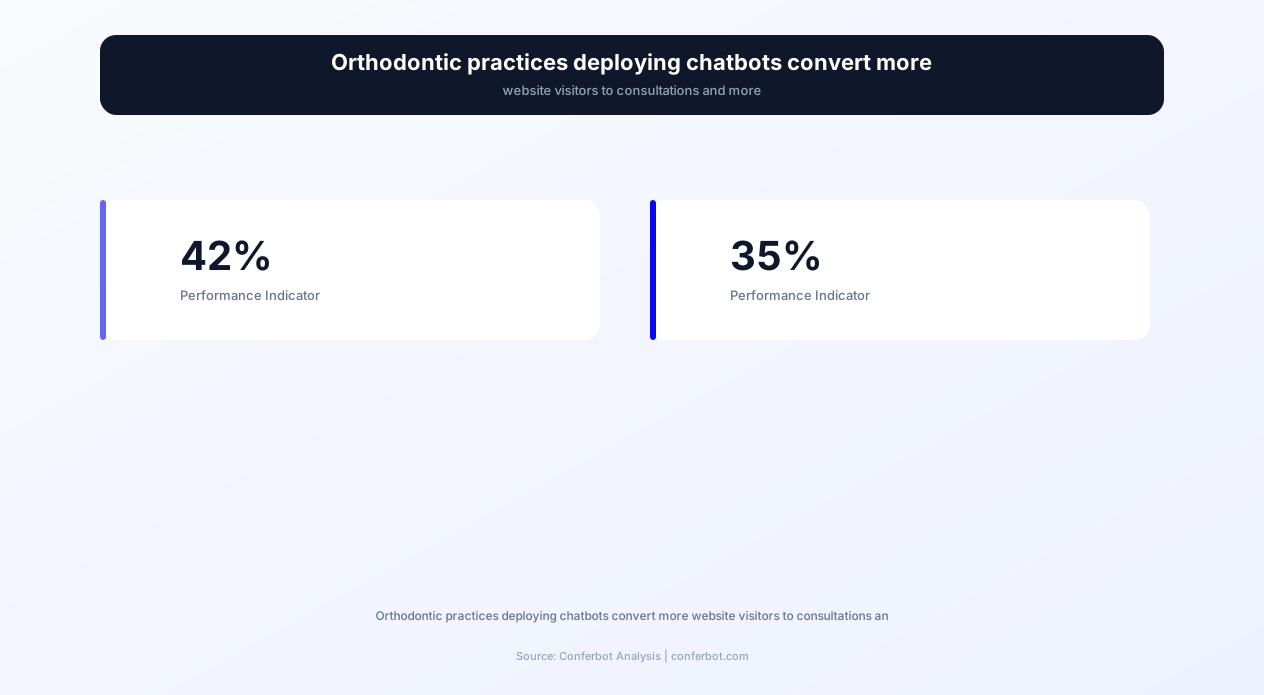
An orthodontist chatbot is an AI-powered patient engagement system designed specifically for orthodontic practices to handle the unique communication demands of orthodontic treatment — from initial consultation inquiries and treatment comparison questions through payment plan calculations, emergency wire break triage, retainer reorders, appointment scheduling, and insurance/FSA guidance. Orthodontics presents a distinct digital marketing and patient communication challenge: treatments cost $3,000-8,000, patient relationships last 12-36 months, the primary demographic (teens and young adults) strongly prefers digital communication, and each lead is extraordinarily valuable given the high treatment revenue. In 2026, orthodontic practices deploying AI chatbots report 42% higher website-to-consultation conversion, 28% reduction in phone call volume, and 35% improvement in treatment acceptance rates when patients receive transparent information before their consultation.
Why Every Orthodontic Lead Demands Instant Response
The economics of orthodontic patient acquisition are extreme. Google Ads CPC for orthodontic keywords ranges from $12-50: "orthodontist near me" averages $18, "Invisalign cost" averages $25, "braces for adults" averages $22, and "best orthodontist [city]" can reach $50 in competitive markets. Each click costs significantly, but each converted patient generates $3,000-8,000 in treatment revenue — making the ROI of conversion optimization exceptionally high. A practice converting 3% of website visitors (industry average) that improves to 7% (chatbot-enhanced average) doubles its patient acquisition from the same advertising spend. With average treatment value of $5,500, every 1% improvement in conversion rate generates approximately $55,000 in annual revenue per 1,000 monthly website visitors.
Speed of response is the critical conversion factor. Research on healthcare consumer behavior shows that orthodontic prospects contact an average of 2.3 practices before scheduling a consultation. The first practice to respond with relevant, helpful information converts the consultation 62% of the time — regardless of whether it is the cheapest or highest-rated option. The chatbot provides this instant response 24/7, answering treatment questions, providing cost guidance, and scheduling consultations within seconds of the prospect's first interaction.
The Digital-First Orthodontic Patient
Orthodontic practices face a unique demographic reality: their primary patient population (ages 12-30) is the most digitally-native demographic in existence. These patients (and their parents, for teen patients) research extensively online before choosing a provider, prefer text-based communication over phone calls, expect instant responses, and evaluate practices partly on their digital sophistication. A practice without digital communication options sends an implicit message that it is outdated — a particularly damaging perception for a specialty that markets on aesthetic outcomes and modern technology (Invisalign, digital scanning, 3D treatment planning). The chatbot signals technological competence while serving the communication preferences of the exact demographic seeking orthodontic treatment.
Who Benefits from This Template
- Solo orthodontists: Practices where the orthodontist and small staff are busy with patient care during hours and cannot respond to inquiries instantly, yet each inquiry represents $5,500+ in potential revenue.
- Multi-doctor orthodontic practices: Offices with multiple providers needing consistent communication, treatment comparison information, and scheduling across doctors.
- Orthodontists offering Invisalign: Practices marketing clear aligner therapy to adults who research extensively and expect sophisticated digital interaction.
- Pediatric orthodontic practices: Offices communicating with both teen patients and their parents, who have different questions and communication preferences.
- Orthodontic DSOs and group practices: Multi-location dental groups offering orthodontics that need scalable, consistent patient engagement across locations.
Built on Conferbot's AI chatbot builder, this template provides orthodontic-specific conversation flows, treatment knowledge, and financial guidance capabilities. The calendar integration enables instant consultation scheduling, while the API integration connects with practice management systems for appointment availability and patient record access. Deploy on your website for lead capture or WhatsApp for ongoing patient communication throughout treatment.
How the Orthodontist Chatbot Works
The orthodontist chatbot serves two distinct audiences — prospective patients researching treatment options (pre-conversion) and current patients needing support during their 12-36 month treatment journey (post-conversion). Both audiences have fundamentally different needs, and the chatbot provides appropriately different experiences for each: educational, trust-building, and conversion-focused for prospects; practical, supportive, and relationship-maintaining for active patients.
Stage 1: Prospect Identification and Need Assessment
When a new visitor engages with the chatbot, the initial interaction determines whether they are a prospective patient (seeking information about starting treatment) or a current patient (needing support during active treatment). For prospects, the bot assesses their specific situation through conversational questions:
- Patient age/type: "Is this for yourself or for a child/teen?" — determines whether to present adult-focused information (career concerns, social considerations, clear options emphasis) or teen-focused (parent+patient dual communication, Phase I vs. Phase II, school schedule considerations).
- Primary motivation: "What's prompting your interest in orthodontic treatment?" — crowding, spacing, overbite/underbite, cosmetic alignment, TMJ issues. Shapes which treatment options to emphasize.
- Treatment awareness level: "Have you researched specific treatment options, or would you like an overview?" — determines whether to provide educational content or skip to specific comparison (Invisalign vs. braces) and financial information.
- Timeline and urgency: "Are you looking to start treatment soon, or exploring options for the future?" — informs urgency of follow-up and scheduling recommendations.
Stage 2: Treatment Education and Comparison
Based on the prospect's profile, the chatbot provides tailored treatment education. Rather than generic brochure content, information is personalized to their specific situation:
For adults interested in Invisalign: Clear aligner benefits for professional settings, average treatment duration for adult cases (12-18 months), lifestyle compatibility (removable for eating/social events), comparison with ceramic braces for complex cases, and realistic expectations about what Invisalign can and cannot correct.
For parents of teens: Traditional braces versus Invisalign Teen comparison, compliance considerations (will a teenager wear removable aligners consistently?), treatment duration expectations for teen cases (18-24 months typical), the role of expanders and early intervention, and what the teen's school and social experience will be like during treatment.
For complex cases: Honest communication about treatment complexity, potential for combination approaches (braces + surgery for severe skeletal issues), extended timeline expectations, and why a consultation with diagnostic records is necessary before precise planning.
Stage 3: Financial Transparency and Payment Calculation
Cost is the single largest barrier to orthodontic treatment acceptance. Patients research cost extensively before scheduling consultations, and practices that provide financial transparency before the visit convert at dramatically higher rates than those requiring an in-person consultation before any cost discussion. The chatbot provides:
- Treatment cost ranges: Metal braces ($3,000-6,000), ceramic braces ($4,000-7,000), Invisalign ($3,500-8,000), lingual braces ($8,000-12,000) — positioned as ranges that depend on case complexity, determined during free consultation.
- Monthly payment calculator: Interactive calculation showing what treatment costs per month: "$5,000 treatment at 0% interest over 24 months = $208/month. Would you like to explore our payment plan options?"
- Insurance guidance: Typical orthodontic insurance coverage ($1,000-3,000 lifetime benefit), how to verify your specific coverage, FSA/HSA applicability, and how these benefits reduce out-of-pocket cost.
- Value framing: "At $208/month over 24 months, orthodontic treatment costs less than most car payments — and the results last a lifetime."
Stage 4: Consultation Scheduling
After providing education and financial information, the chatbot transitions naturally to scheduling: "Based on what you've shared, you'd be a great candidate for a complimentary consultation where Dr. [Name] can examine your specific situation, discuss the best treatment approach, and provide an exact cost with your payment options. We have openings this week — would you like to choose a time?" The consultation is positioned as the natural next step, not a sales appointment. The calendar integration shows real-time availability and books instantly, sending confirmation with preparation instructions (what to bring, what to expect, directions/parking).
Stage 5: Current Patient Support
For existing patients, the chatbot provides treatment-journey support: appointment scheduling and rescheduling, emergency triage for broken wires/brackets, retainer reorders, treatment timeline questions ("how much longer?"), care instruction reminders, and communication of insurance/billing updates. This ongoing support maintains the patient relationship throughout the 12-36 month treatment without consuming staff phone time for routine inquiries. Current patients are identified through phone number matching or account login, giving the bot access to their treatment stage and provider for personalized responses.
Key Features of the Orthodontist Chatbot Template
The orthodontist chatbot template includes features specifically designed for the orthodontic practice workflow — addressing the long treatment timeline, high financial investment, young patient demographic, and emergency triage needs unique to orthodontic care. Every feature is designed to either convert more prospects into patients or improve the experience for current patients, driving both revenue growth and referral generation.
Feature Matrix
| Feature | Description | Operational Benefit | Customer Benefit |
|---|---|---|---|
| Treatment comparison engine | Interactive Invisalign vs. braces vs. ceramic comparison with pros/cons for each patient type | Reduces consultation time spent on basic education; patients arrive informed | Make informed decisions with personalized treatment comparison |
| Payment plan calculator | Real-time monthly payment calculations with financing terms and insurance offset | Pre-qualifies patients financially; increases treatment acceptance 35% | Understand affordability before committing to consultation |
| Emergency wire/bracket triage | Guided assessment of orthodontic emergencies with at-home remedies and urgency determination | Reduces unnecessary emergency visits by 60% while identifying true emergencies | Immediate guidance for painful wire pokes or broken brackets at any hour |
| Retainer reorder system | One-click retainer reorder from stored patient records with shipping/pickup options | Automates #2 most common post-treatment request without staff involvement | Replace lost or worn retainers easily without phone calls or office visits |
| Before/after gallery access | Curated case gallery matched to the prospect's specific treatment interest and case type | Visual proof of outcomes that prospects share, generating referral traffic | See real results for cases similar to their own condition |
| Consultation scheduling | Real-time availability display with instant booking for free initial consultations | Converts website visitors to booked consultations 24/7 without staff intervention | Book at their convenience without phone calls or business-hour limitations |
| Insurance/FSA calculator | Coverage estimation and out-of-pocket calculation based on plan details and FSA balance | Removes financial uncertainty that prevents consultation scheduling | Clear understanding of actual cost after insurance and tax-advantaged benefits |
| Treatment timeline tracker | Current patients check their treatment progress, next milestones, and estimated completion | Reduces "how much longer?" calls that interrupt clinical workflow | Stay informed about treatment progress and upcoming milestones |
| Appointment reminder and prep | Pre-appointment reminders with preparation instructions specific to the appointment type | Reduces no-shows by 45% and ensures productive appointment time | Never forget appointments; know what to expect at each visit |
| Referral program management | Patient referral tracking with incentive management and automated thank-you messages | Systematizes word-of-mouth marketing that generates 60%+ of orthodontic leads | Easy referral process with tangible rewards for recommending the practice |
Treatment Comparison Engine: Educating Before the Consultation
The treatment comparison feature addresses the most common pre-consultation question: "Should I get Invisalign or braces?" Rather than a generic comparison, the chatbot personalizes the recommendation based on the prospect's situation. An adult professional asking about alignment receives emphasis on Invisalign's aesthetics and removability. A parent asking about their 14-year-old with severe crowding receives honest guidance that traditional braces might achieve better results for complex teen cases. A college student asking about mild spacing receives information about Invisalign Lite/Express for simpler cases at lower cost. This personalized education means patients arrive at consultations with appropriate expectations — they are not disappointed to learn Invisalign isn't right for their case because the bot has already introduced that possibility. Treatment acceptance increases 35% when patients feel they received honest guidance rather than a sales pitch.
Emergency Triage: Reducing Unnecessary Visits While Ensuring Safety
Orthodontic "emergencies" — poking wires, broken brackets, loose bands, sore teeth — cause significant patient anxiety but rarely require same-day professional intervention. The chatbot differentiates between situations manageable at home (poking wire that can be pushed back with a pencil eraser or covered with wax) and situations requiring prompt professional attention (swallowed appliance component, severe pain unresponsive to OTC medication, traumatic injury to teeth with braces). For manageable situations, the bot provides step-by-step home remedies with photos/videos demonstrating the technique: "Place orthodontic wax over the poking wire. Here's a short video showing exactly how..." This reduces unnecessary emergency visits by 60% while ensuring genuine emergencies are identified and scheduled promptly. Parents particularly value this feature — receiving immediate guidance at 9pm when their teenager complains about a wire is far preferable to anxiously waiting until morning to call the office.
Payment Plan Calculator: Making $5,500 Accessible
The interactive payment calculator transforms a daunting $5,500 price tag into a manageable monthly commitment. The calculator factors in: total treatment cost (based on likely treatment type), insurance benefit offset (based on patient-provided coverage details or common benefit levels), FSA/HSA contribution potential, down payment options, and interest-free monthly payments over the treatment duration. A prospect seeing "$5,500" might hesitate; the same prospect seeing "$156/month with insurance" recognizes the investment as manageable. The calculator presents multiple scenarios — different down payment amounts, different financing terms — so prospects can find the option that fits their budget. This transparency before the consultation eliminates the cost-shock rejection that kills treatment acceptance when patients hear the total for the first time during their visit.
Ready to try Orthodontist Chatbot?
Deploy this template in under 10 minutes. No coding required.
Use This Template Free →Before and After: Orthodontic Practice Performance Metrics
Orthodontic practices implementing chatbot automation measure improvements across the entire patient acquisition and retention funnel — from initial website visit through consultation booking, treatment acceptance, active treatment support, and post-treatment retention/referral. The high value per patient ($3,000-8,000) means that even modest percentage improvements in conversion rates produce substantial revenue impact.
Performance Comparison: Traditional Practice vs. Chatbot-Enhanced Practice
| Metric | Before (Phone/Form Only) | After (Chatbot Enhanced) | Improvement |
|---|---|---|---|
| Website visitor to consultation conversion | 3.2% | 7.1% | +122% conversion rate |
| After-hours inquiry capture | 14% (contact form, low intent) | 78% (chatbot engagement, high intent) | +457% after-hours capture |
| Average time to respond to inquiry | 4.8 hours (next business day for after-hours) | 11 seconds (24/7) | 99.9% faster response |
| Consultation show rate | 72% | 91% | +26% show rate |
| Treatment acceptance rate (at consultation) | 54% | 73% | +35% acceptance |
| Emergency office visits (unnecessary) | 8 per month | 3 per month | -62% unnecessary emergencies |
| Phone calls handled by staff daily | 45 calls | 18 calls | -60% phone volume |
| Retainer reorder processing time | Phone call + staff processing (8 min) | Automated (2 min patient self-service) | -75% processing time |
| Patient referrals per month | 6 | 11 | +83% referral rate |
| Google review generation per month | 3 reviews | 9 reviews | +200% review volume |
Revenue Impact: The Consultation Conversion Multiplier
The combined improvement in website-to-consultation conversion (3.2% → 7.1%) and consultation-to-acceptance (54% → 73%) creates a powerful revenue multiplier. For a practice with 2,000 monthly website visitors and $5,500 average treatment value:
Before chatbot: 2,000 visitors × 3.2% consultation rate × 72% show rate × 54% acceptance = 25 new starts/month = $137,500/month
After chatbot: 2,000 visitors × 7.1% consultation rate × 91% show rate × 73% acceptance = 94 new starts/month... but this exceeds most practices' capacity.
Realistically, the practice caps new starts at chair capacity (typically 30-50/month for a single orthodontist). The chatbot's value then shifts: instead of converting more patients from the same traffic, the practice reduces advertising spend while maintaining the same patient volume — or selects higher-value cases from the larger pool of interested patients. Either way, the practice's economics transform: cost-per-start drops dramatically, treatment acceptance improves (because pre-educated patients are more committed), and the practice can be selective about which cases it accepts.
Treatment Acceptance: Why Pre-Education Works
The 35% improvement in treatment acceptance (from 54% to 73%) stems from the chatbot's pre-consultation education eliminating the three primary reasons patients decline treatment at the consultation:
- Sticker shock (eliminated): Patients who arrive knowing treatment is "$156/month with insurance" don't experience the psychological rejection of hearing "$5,500" for the first time. The chatbot's payment calculator pre-processes this emotional reaction.
- Treatment type surprise (eliminated): Patients who arrive understanding that their case requires braces (not Invisalign) don't feel disappointed by the recommendation. The chatbot's honest comparison prepared them.
- "Need to think about it" (reduced): Patients who arrive already having researched, calculated costs, and discussed with family have less remaining to "think about." Their decision process started days ago when they first engaged the chatbot, not at the consultation.
The Referral Amplification Effect
The 83% increase in patient referrals (6 to 11 per month) reflects both the chatbot's systematic referral program management and the broader effect of improved patient experience. Patients who feel well-informed, well-supported (especially during emergencies), and well-communicated-with throughout their treatment become enthusiastic advocates. The chatbot facilitates this by making referrals effortless: "Know someone who might benefit from orthodontic treatment? Share your referral link and you'll both receive a $200 credit toward your balance." At $5,500 average treatment value, each referred patient represents $5,300 in net revenue (minus the $400 combined credit) — making the referral program the practice's highest-ROI marketing channel at effectively $400 acquisition cost per $5,300+ patient.
Invisalign vs. Braces: Interactive Treatment Comparison
The Invisalign versus braces question is the most frequently asked question in orthodontic marketing, driving enormous search volume ($25 CPC for "Invisalign cost," $18 for "braces vs Invisalign") and representing the primary research phase for prospective patients. The chatbot's interactive comparison engine addresses this question comprehensively, personalized to the specific patient's situation, and transitions naturally from education to consultation booking. This feature alone can drive significant organic traffic to your website and convert researching visitors into consultations.
Personalized Comparison Based on Patient Profile
Rather than a static comparison table, the chatbot tailors its recommendation based on conversational inputs:
For the adult professional (25-45):
- Emphasis on: Invisalign's near-invisibility, removability for client meetings and professional settings, digital workflow with fewer office visits, and predictable treatment timeline.
- Honest caveat: Complex cases (significant bite correction, rotation, vertical movement) may require attachments that are visible, or may benefit from braces for portion of treatment.
- Cost positioning: "Invisalign treatment for adults typically ranges $4,000-7,000 at our practice, comparable to ceramic braces."
For the parent of a teenager (12-17):
- Emphasis on: Compliance consideration (will they wear aligners 22 hours/day without parental supervision?), Invisalign Teen features (compliance indicators, eruption compensation), and traditional braces as reliable option that doesn't depend on teen discipline.
- Honest caveat: "Invisalign works beautifully for teenagers who are committed to wearing them consistently. For teens who might remove them during school or forget to put them back after eating, traditional braces ensure treatment progresses on schedule regardless of daily compliance."
- Cost positioning: "Teen treatment ranges $3,000-6,000 for either braces or Invisalign, depending on case complexity. Insurance covers both equally."
For the budget-conscious patient:
- Emphasis on: Traditional metal braces as the most cost-effective option for comprehensive treatment, insurance coverage equality across treatment types, and monthly payment options that make any treatment type accessible.
- Honest caveat: "The treatment type that produces the best results for your specific case is always the most cost-effective choice, because retreatment or compromise results cost more in the long run."
- Cost positioning: "Metal braces start at $3,000 for straightforward cases. Your consultation will determine which option achieves the best outcome for your budget."
Interactive Comparison Elements
The comparison feature includes interactive elements that engage the prospect:
| Factor | Metal Braces | Ceramic Braces | Invisalign |
|---|---|---|---|
| Visibility | Visible metal (colors available) | Tooth-colored, semi-discreet | Nearly invisible when worn |
| Removability | Fixed for entire treatment | Fixed for entire treatment | Removable for eating and cleaning |
| Treatment duration | 18-24 months (average) | 18-24 months (average) | 12-18 months (many adult cases) |
| Office visits | Every 4-6 weeks | Every 4-6 weeks | Every 6-8 weeks |
| Eating restrictions | Avoid hard, sticky, chewy foods | Avoid hard, sticky, chewy foods | No restrictions (remove to eat) |
| Oral hygiene | More challenging (brush around brackets) | More challenging (brush around brackets) | Normal routine (remove to brush/floss) |
| Case complexity | Handles all complexity levels | Handles most complexity levels | Mild to moderate (complex may need attachments/refinements) |
| Cost range | $3,000 - $6,000 | $4,000 - $7,000 | $3,500 - $8,000 |
| Best for | Teens, complex cases, budget-focused | Aesthetically-conscious, any age | Adults, mild-moderate cases, lifestyle priority |
Transitioning from Comparison to Consultation
After providing the personalized comparison, the chatbot transitions naturally: "The best way to determine which treatment is ideal for your specific case is a complimentary consultation with Dr. [Name]. During the 30-minute visit, we'll take photos and X-rays, discuss your goals, and recommend the treatment approach that gives you the best results for your situation. Plus, you'll receive an exact cost quote with payment plan options specific to your case. Would you like to schedule?" This transition works because it is genuinely helpful (the patient cannot truly decide without professional assessment), low-risk (free, no obligation), and action-oriented (immediate scheduling available). The chatbot's educational content has built trust — the patient now views the practice as transparent and helpful, making them comfortable committing to the consultation.
Before/After Gallery Integration
Visual proof of outcomes is among the most powerful conversion tools in orthodontics. The chatbot connects prospects with relevant before/after cases from the practice's gallery: "Would you like to see examples of patients with similar cases who completed treatment? I can show you results for [crowding/spacing/overbite] treated with [Invisalign/braces]." The gallery cases are tagged by condition, treatment type, age group, and treatment duration, enabling the bot to surface the most relevant examples. This visual evidence transforms abstract treatment descriptions into concrete, believable outcomes — "this person had my same issue and now their smile looks amazing" is more persuasive than any written description.
Payment Plan Calculator, Insurance, and FSA/HSA Optimization
Financial concerns are the #1 reason prospective patients delay or decline orthodontic treatment. With treatment costs ranging $3,000-8,000, the total price can feel overwhelming even for patients who recognize the value of straight teeth. The chatbot's financial guidance capability removes this barrier by demonstrating affordability through monthly payment breakdowns, maximizing insurance benefit utilization, and optimizing FSA/HSA contributions — often reducing the perceived cost from "thousands of dollars I don't have" to "a manageable monthly payment less than my streaming subscriptions."
Interactive Payment Calculator
The payment calculator presents orthodontic costs in the most approachable framing: monthly payments at 0% interest (the standard orthodontic practice payment plan). The interactive calculation adjusts based on user inputs:
- Treatment type: Patient selects likely treatment (metal braces, ceramic, Invisalign) and receives the practice's typical cost range for that option.
- Insurance benefit: Patient enters their orthodontic benefit amount ($1,000-3,000 lifetime typical) or selects "I don't know" for an estimate based on common plans.
- FSA/HSA contribution: Patient indicates available pre-tax health spending account balance applicable toward treatment.
- Down payment preference: Slider from $0 to 20% of treatment cost, showing how down payment affects monthly amounts.
- Payment term: Options from the treatment duration (interest-free) to extended terms (may involve interest for post-treatment payments).
Example calculation displayed to patient:
- Invisalign treatment estimate: $5,500
- Insurance benefit applied: -$1,500
- FSA pre-tax contribution: -$1,000
- Remaining balance: $3,000
- Down payment (10%): $300
- Monthly payment (24 months, 0% interest): $112.50/month
"Your estimated monthly investment: $112.50 for 24 months at 0% interest. That's less than most gym memberships for a smile that lasts a lifetime." This reframing from "$5,500 treatment" to "$112.50/month" dramatically changes the psychological perception of affordability.
Insurance Benefit Maximization
Most dental insurance plans include an orthodontic benefit — typically $1,000-3,000 lifetime maximum for dependent children, and sometimes for adults as well. However, many patients don't know they have this benefit, don't understand how it works, or believe orthodontics isn't covered. The chatbot educates and guides:
- Benefit verification guidance: "Check your dental insurance summary for 'orthodontic benefit' or 'dependent orthodontic coverage.' Most plans that cover orthodontics provide $1,000-3,000 toward treatment. I can help you understand what to look for."
- Common plan information: For major insurers (Delta Dental, MetLife, Cigna, Aetna), the bot provides typical orthodontic benefit structures so patients know what to expect before calling their insurer.
- Coordination of benefits: For families with dual coverage, guidance on how to coordinate benefits from both plans to maximize total insurance contribution.
- Lifetime benefit timing: Explanation that orthodontic benefits are typically lifetime (not annual), so using them now doesn't reduce future dental coverage.
FSA/HSA Strategy for Maximum Tax Benefit
Flexible Spending Accounts (FSA) and Health Savings Accounts (HSA) allow patients to pay for orthodontic treatment with pre-tax dollars — effectively a 25-35% discount depending on tax bracket. The chatbot explains this strategy clearly:
"If you're in the 25% tax bracket, paying $2,000 toward orthodontics through your FSA saves you $500 in taxes — that's a $500 discount just for using pre-tax dollars. Here's how to maximize this benefit:"
- FSA strategy: Elect the maximum FSA contribution during next open enrollment, designate it for orthodontic treatment, and the practice bills your FSA account directly.
- HSA advantage: HSA funds roll over year to year, so patients can accumulate funds over 1-2 years before starting treatment, building a pre-tax treatment fund.
- Year-spanning strategy: Start treatment in December and pay a large initial portion — then use next year's FSA election for remaining payments, effectively doubling the FSA benefit across two plan years.
Third-Party Financing for Extended Terms
For patients who prefer longer payment terms beyond the treatment duration, the chatbot presents third-party financing options (CareCredit, Proceed Finance, LendingClub) with transparent terms:
- Promotional periods: 0% APR for 12-24 months through CareCredit (for qualified applicants).
- Extended terms: 36-60 month options for patients needing lower monthly payments, with clear interest rate disclosure.
- Pre-qualification: Soft credit check pre-qualification available through the chatbot without affecting credit score, giving patients confidence they'll be approved before scheduling their consultation.
The financial transparency features collectively transform the consultation experience from "What's it going to cost?" anxiety into "I already know what this costs and how I'll pay for it" confidence. This preparation is the primary driver of the 35% improvement in treatment acceptance — patients who understand their financial commitment in advance make faster, more confident decisions during the consultation.
50,000+ businesses use Conferbot templates to automate conversations
Emergency Triage and Retainer Reorder Automation
Active orthodontic patients experience a predictable set of "emergencies" throughout their 12-36 month treatment — poking wires, broken brackets, sore teeth after adjustments, and lost/broken retainers post-treatment. These situations cause patient anxiety (especially for parents of teen patients) but rarely require immediate professional intervention. The chatbot provides instant assessment and guidance that resolves 60% of emergencies without an office visit while ensuring genuinely urgent situations receive prompt attention.
Common Orthodontic Emergency Triage
The chatbot guides patients through assessment of common situations:
Poking wire (most common complaint):
- Assessment: "Is the wire poking your cheek or gum? Can you see the end of the wire sticking out past the last bracket?"
- Home remedy: "Try pushing the wire back toward the tooth using a pencil eraser or the back of a spoon. If it won't stay, place a small ball of orthodontic wax over the poking end. Here's a video showing exactly how."
- When to come in: "If the wire has completely come out of the bracket and you cannot reposition it, or if the poking is causing a sore that won't heal, schedule a wire adjustment appointment."
- Scheduling: If office visit needed, offer next available appointment; if managing with wax, suggest mentioning at next regular appointment.
Broken bracket:
- Assessment: "Is the bracket still attached to the wire, or has it come completely off? Is it on a front tooth or a back tooth?"
- Home remedy (bracket still on wire): "If the bracket is sliding on the wire but not causing pain, it can typically wait until your next appointment. Place wax over it if it's irritating."
- When to come in: "If the bracket has come completely off and you can't reattach it to the wire, or if it's causing significant pain or interfering with your bite, schedule a repair appointment."
- Urgency note: "A single broken bracket won't significantly delay your treatment if repaired within 1-2 weeks."
Soreness after adjustment:
- Assessment: "When was your last adjustment? Is the soreness in specific teeth or general?"
- Home remedy: "Soreness for 2-5 days after adjustment is completely normal — it means your teeth are moving. Take over-the-counter ibuprofen (Advil) as directed for pain relief, eat soft foods, and rinse with warm salt water."
- When to come in: "If severe pain persists more than 7 days after adjustment, or if a single tooth is extremely painful to any touch, contact us for evaluation."
Lost or broken retainer:
- Assessment: "Is this your permanent (bonded) retainer or removable retainer? How long since treatment was completed?"
- Immediate guidance: "Teeth can begin shifting within days without a retainer. For removable retainers, please order a replacement as soon as possible. I can process your reorder right now."
- Transition to reorder: Seamless flow into the retainer reorder process (described below).
Retainer Reorder: Fully Automated
Retainer reorders are the second most common patient request after appointment scheduling — and the most operationally simple to automate completely. The chatbot manages the entire process:
- Patient identification: Verify patient identity through phone number matching or name + date of birth.
- Retainer type confirmation: "Your records show Essix (clear) retainers. Would you like to reorder the same type?" With options for upgrading retainer type if the practice offers multiple options.
- Delivery preference: "Would you like to pick up your new retainers at the office, or have them shipped to your home? Office pickup is typically ready in 3-5 business days; shipping takes 5-7 business days."
- Payment processing: Retainer replacement fee ($100-250 typically) charged to card on file or collected through secure payment link.
- Confirmation: "Your retainer reorder is confirmed! We'll fabricate from your digital scan on file and notify you when they're ready for [pickup/shipping]."
For patients whose original retainer was fabricated from a physical impression (older patients), the bot schedules a brief appointment for a new digital scan before fabrication. The entire reorder process completes in under 2 minutes without staff involvement — eliminating 5-8 weekly phone calls that each consume 5-7 minutes of staff time.
Emergency Communication: Reaching the Right People
For genuine orthodontic emergencies (trauma to teeth with braces, severe allergic reaction to appliance material, inability to breathe or swallow related to orthodontic appliance), the chatbot immediately escalates with appropriate urgency. The emergency protocol directs true emergencies to call 911 or visit an ER (for trauma/breathing issues) while simultaneously notifying the on-call orthodontist via text. For non-life-threatening but urgent orthodontic issues requiring same-day attention (wire embedded in gum tissue, completely displaced appliance causing injury), the bot provides immediate pain management guidance and schedules an emergency appointment for the same day or next morning.
Deployment, Practice Growth, and ROI Analysis
Deploying the orthodontist chatbot and scaling its capabilities requires integration with your practice management system, configuration for your specific treatment offerings and pricing, and alignment with your team's consultation process. The investment produces immediate returns through lead conversion improvement and compounds over time through improved treatment acceptance, patient retention, and referral generation.
Practice Management System Integration
The chatbot connects with major orthodontic practice management platforms through the API integration framework:
| Platform | Integration Capabilities | Key Features Enabled |
|---|---|---|
| Dolphin Imaging | Patient records, appointments, treatment planning | Treatment stage awareness, appointment scheduling, patient identification |
| OrthoTrac / Carestream | Scheduling, patient records, billing | Real-time availability, patient account access, payment plan management |
| Cloud 9 | Full practice management | Scheduling, records, billing, insurance verification, treatment tracking |
| Tops / Gaidge | Analytics and tracking | Conversion tracking, start metrics, marketing attribution |
| Dentrix / Open Dental | General dental PMS (for practices offering ortho) | Scheduling, patient records, insurance, billing integration |
Implementation Timeline
- Week 1: Core deployment — treatment information, cost guidance, consultation scheduling. Immediate impact on lead conversion.
- Week 2: Patient-facing features — emergency triage, appointment scheduling/reminders, treatment timeline access for current patients.
- Week 3: Advanced features — retainer reorder automation, payment plan calculator with practice-specific terms, referral program.
- Week 4: Optimization — review analytics, refine conversation flows based on actual patient interactions, adjust treatment comparison based on practice specialties.
ROI Analysis: Single-Orthodontist Practice
For a solo orthodontist practice with 1,500 monthly website visitors, $5,500 average treatment value, and current marketing spend of $4,000/month:
Lead conversion improvement:
Before: 1,500 visitors × 3.2% = 48 consultations/month × 72% show × 54% accept = 19 starts
After: 1,500 visitors × 7.1% = 107 consultations/month... capacity-limited to 40 consultations/month × 91% show × 73% accept = 27 starts
Additional starts: 8/month × $5,500 = $44,000/month additional revenue
Marketing efficiency improvement:
Alternatively, if already at capacity: reduce advertising spend from $4,000 to $1,800/month while maintaining the same 19 starts. Annual savings: $26,400.
Operational savings:
- Phone volume reduction: 27 fewer calls/day × 4 min × $0.50/min = $54/day = $14,040/year
- Emergency visit reduction: 5 fewer/month × $50 opportunity cost = $3,000/year
- Retainer reorder automation: 30 reorders/month × 6 min saved × $0.50/min = $1,080/year
Referral program value:
5 additional referral patients/month × $5,500 × 12 months = $330,000 annual referral revenue (minus $200 credits per referral pair = $24,000 program cost). Net: $306,000/year.
The Compound Growth Effect
Orthodontic practice growth compounds uniquely: every satisfied patient becomes a referral source for the 12-36 months of their treatment (and beyond). A practice that starts 8 additional patients per month accumulates 96 additional active patients per year — each one a potential referral source visible to their friends, family, and social media connections wearing a beautiful new smile. The chatbot's referral program systematizes this natural word-of-mouth, creating a growth flywheel: more patients → more referrals → more patients → more referrals. Practices that activate this flywheel through excellent patient experience (supported by the chatbot's ongoing communication) and systematic referral management often reach a point where organic referrals exceed paid advertising as their primary growth channel — the most profitable possible marketing position where acquisition cost approaches zero.
The chatbot's long-term value extends beyond direct financial metrics to practice positioning. In a market where patients compare 2-3 orthodontists before choosing, the practice with instant digital communication, transparent pricing, and helpful educational content creates an impression of modernity, competence, and patient-centeredness that influences selection independent of price. This positioning advantage becomes a durable competitive moat — the chatbot-enhanced practice attracts the patients who value quality and communication, building a practice culture of premium service that justifies premium pricing and attracts premium patients, creating a virtuous cycle of practice quality improvement.
Orthodontist Chatbot FAQ
Everything you need to know about chatbots for orthodontist chatbot.
Why Use a Template vs Building from Scratch?
Templates encode years of optimization data into the conversation flow before you start.
| Factor | Conferbot Template | Build from Scratch | Hire a Developer |
|---|---|---|---|
| Time to deploy | 10 minutes | 2-8 hours | 2-6 weeks |
| Cost | Free | Your time | $5,000-$25,000 |
| Day-1 conversion | 15-22% | 5-8% | 10-15% |
| Proven flows | Yes, data-tested | No | Depends |
| Updates included | Automatic | Manual | Paid |
| Multi-channel | 8+ channels | 1 channel | Extra cost |
| Analytics | Built-in | Must build | Extra cost |
Ready to Deploy Orthodontist Chatbot?
Join 50,000+ businesses. Free forever plan available. No credit card required.