
Product Recall Information Bot
Free Support And FAQ Chatbot Template
A complete product recall information bot chatbot template — deploy in minutes to automate conversations, capture leads, and provide 24/7 assistance.


What Is a Product Recall Information Chatbot?
A product recall information chatbot is a specialized AI assistant designed to manage the consumer-facing side of product recalls. When a company issues a recall — whether for safety defects, contamination, regulatory non-compliance, or quality failures — the chatbot becomes the primary communication channel, helping affected consumers identify whether their product is recalled, understand safety risks, follow proper handling instructions, and navigate the refund or replacement process. It handles the massive, sudden surge in customer inquiries that overwhelms traditional support channels during recall events.
Product recalls are high-stakes, high-pressure events. The U.S. Consumer Product Safety Commission (CPSC) oversees approximately 400-500 product recalls annually, while the FDA manages thousands of food and drug recalls each year. When a recall is announced, companies face an immediate and overwhelming flood of consumer inquiries — often 10-50x normal contact center volume within the first 48 hours. Traditional call centers simply cannot scale to meet this demand. Hold times stretch to hours, customers become frustrated and angry, social media fills with complaints about inaccessible information, and regulatory bodies take notice of inadequate consumer communication.
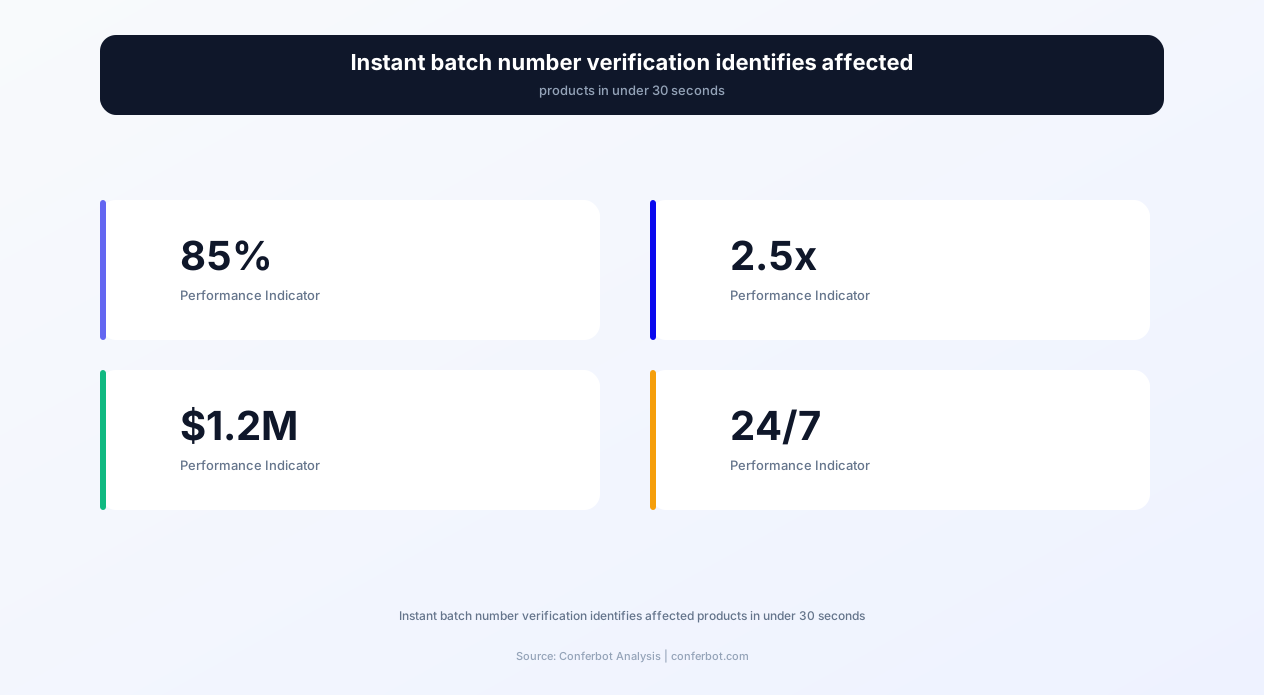
A recall information chatbot deploys within hours of a recall announcement, available 24/7 on your website, WhatsApp, and other channels. It handles unlimited simultaneous conversations, delivers consistent safety information, and processes refund and replacement claims — all while maintaining the empathetic, reassuring tone that frightened consumers need during a safety event. Companies using recall chatbots report handling 85-92% of consumer inquiries automatically, reducing average response time from 45 minutes (phone hold) to under 30 seconds.
In 2026, regulatory expectations for recall communication have tightened significantly. The CPSC, FDA, NHTSA, and international equivalents increasingly evaluate companies on the speed, accessibility, and completeness of their consumer communication during recalls. A chatbot built on Conferbot's AI chatbot builder ensures your recall response meets these expectations while protecting your brand reputation during one of the most damaging events a company can face.
Affected Product Identification: Is My Product Recalled?
The single most common question during any recall is: "Is my product affected?" Consumers own millions of units, and only specific production batches, model numbers, or date ranges may be recalled. The chatbot guides consumers through rapid, accurate identification — reducing the anxiety of uncertainty and preventing both unnecessary panic (among consumers with unaffected products) and dangerous complacency (among those with recalled units).
Multi-Method Product Identification
Different consumers have different information available. Some have the product box with the UPC code. Others have the product but discarded the packaging. Some are away from home and only have a receipt. The chatbot supports multiple identification paths:
Batch/lot number lookup: The consumer enters the batch number printed on the product or packaging. The chatbot instantly checks against the recall database and confirms affected or unaffected status. For products where batch numbers are difficult to locate, the chatbot provides visual guides: "The batch number is a 6-digit code printed on the bottom of the product, near the barcode. It starts with letters followed by numbers."
Model number verification: For consumer electronics, appliances, and vehicles, the model number is the primary identifier. The chatbot cross-references the model number with affected ranges and production date windows.
Date of purchase filtering: When consumers cannot locate batch or model numbers, purchase date serves as a secondary filter. "Products purchased between March 2025 and August 2025 are potentially affected. Can you check your purchase receipt or email confirmation for the date?"
Photo identification: For visual identification of product versions, packaging differences, or location of identifying marks, the chatbot accepts uploaded photos and provides visual comparison guides. "Upload a photo of the bottom of your product, and I will help you locate the batch code."
Clear, Immediate Results
The chatbot delivers results with unambiguous clarity:
Affected: "Your product IS part of this recall. Here is what you need to do immediately: [safety instructions]. Do not use the product until you have completed the steps below. I can help you with a refund or replacement right now."
Not affected: "Good news — your product is NOT part of this recall. Your batch number [XXX] was manufactured after the affected period, and our quality testing confirms it meets all safety standards. You can continue using your product normally."
Unable to determine: "I could not confirm your product status with the information provided. For your safety, please stop using the product until we can verify. I am connecting you with a specialist who can help identify your specific unit. Estimated wait time: 4 minutes."
This clarity is critical. Ambiguous recall communication leads consumers to either ignore legitimate safety risks or unnecessarily discard safe products — both outcomes damage consumer trust and company reputation.
Safety Instructions: Protecting Consumers from Harm
When a product is confirmed as recalled, the chatbot's most important function is delivering clear, actionable safety instructions. These instructions vary dramatically by recall type — a food contamination recall requires immediate disposal, while an electronic device recall might require simply unplugging the device. The chatbot tailors safety guidance to the specific recall, product type, and consumer situation.
Immediate Safety Actions
The chatbot prioritizes immediate safety above all other information. Before discussing refunds, replacements, or any other logistics, it ensures the consumer understands and can execute the critical safety steps:
Food and beverage recalls: "Do NOT consume this product. If you have consumed it and experience symptoms [specific symptoms listed], contact your healthcare provider immediately or call Poison Control at 1-800-222-1222. Dispose of the product by [specific disposal instructions]. Do not return it to the store — disposal is the safest option."
Electronics and appliances: "Unplug the device immediately and do not use it. Store it away from flammable materials in a well-ventilated area. Do not attempt to repair, modify, or disassemble the product. We will provide a prepaid return shipping label for safe disposal."
Children's products: "Remove the product from your child's reach immediately. Check for any small parts that may have detached — these present a choking hazard for children under 3. If your child has been injured, seek medical attention and report the injury to CPSC at SaferProducts.gov."
Automotive recalls: "Schedule a repair appointment with your dealer as soon as possible. Until the repair is completed, avoid [specific driving conditions — highway driving, parking in enclosed spaces, etc.]. The repair will be performed at no cost to you."
Situational Safety Guidance
The chatbot adapts safety messaging based on the consumer's situation. If a parent mentions a child has already been exposed to a recalled product, the chatbot escalates immediately: "I understand this is concerning. Based on the nature of this recall, I recommend contacting your pediatrician today as a precaution. You can also call the poison control center at any time. Would you like me to provide additional medical resource contacts?" This situational awareness — understanding that the consumer's stress level and urgency vary based on their specific circumstances — is what separates an effective recall chatbot from a static FAQ page.
Multilingual Safety Communication
Product recalls affect diverse populations, and safety information must be accessible to everyone — not just English speakers. The chatbot delivers safety instructions in 50+ languages, ensuring non-English-speaking consumers receive the same level of protection. For recalls affecting products sold in specific markets (toys sold at Hispanic grocery chains, electronics popular in Asian communities), targeted multilingual outreach through the chatbot ensures vulnerable populations are not left uninformed due to language barriers.
Ready to try Product Recall Information Bot?
Deploy this template in under 10 minutes. No coding required.
Use This Template Free →Refund and Replacement Processing: Making Consumers Whole
After safety is addressed, the chatbot manages the remedy process — refunds, replacements, repairs, or store credits that make affected consumers whole. This process needs to be fast, friction-free, and transparent. Research from consumer protection agencies shows that 40% of consumers eligible for recall remedies never claim them, primarily because the process is too complicated or time-consuming. The chatbot dramatically improves remedy claim rates by making the process conversational and immediate.
Remedy Options Presentation
The chatbot clearly presents all available remedy options based on the specific recall terms:
Full refund: "You are eligible for a full refund of $[amount]. I can process this as a credit to your original payment method, a direct bank transfer, or a check mailed to your address. Which would you prefer?" The chatbot collects the minimum information needed — no lengthy forms, no reference numbers to look up, no hold music.
Product replacement: "We will send you a corrected replacement unit at no cost. The replacement has been redesigned to address the safety issue and has passed all updated quality testing. Expected delivery: 5-7 business days. Would you like to confirm your shipping address?"
Free repair: "This recall qualifies for a free repair at any authorized service center. I can help you find the nearest location and schedule an appointment. Would you like me to search near your zip code?"
Store credit: "You are eligible for a store credit of $[amount] plus a 15% goodwill bonus, totaling $[amount]. The credit will be applied to your account within 24 hours and is valid for 12 months on any product in our catalog."
Streamlined Claim Processing
Traditional recall claim processes require consumers to fill out online forms, mail in products with prepaid labels, provide proof of purchase, and wait weeks for processing. The chatbot compresses this into a 3-5 minute conversation:
Step 1: Verify the product is affected (already completed in the identification phase).
Step 2: Select remedy preference (refund, replacement, repair, or credit).
Step 3: Confirm identity and shipping details (auto-populated from purchase records when available).
Step 4: Provide proof of purchase if required (photo upload of receipt, or the chatbot looks up the transaction via email address or loyalty card number).
Step 5: Confirm claim and provide timeline. "Your refund of $89.99 has been submitted. You will receive the credit within 3-5 business days. Your claim reference number is RC-2026-84521. I have also emailed you a confirmation."
Claim Tracking and Follow-Up
The chatbot provides ongoing claim status updates. Consumers can return at any time and ask "What is the status of my recall claim?" to receive real-time tracking: processing, shipped, delivered, refunded. Proactive notifications alert consumers at each stage, reducing inbound "Where is my refund?" inquiries that would otherwise burden the support team during an already high-volume period. This transparency builds trust during a moment when the company-consumer relationship is most fragile.
Batch Number Lookup and Product Traceability
Batch and lot number traceability is the backbone of effective recall management. Every recalled product traces back to a specific production batch, and the chatbot's ability to instantly verify batch status is what enables the rapid, accurate consumer response that regulators and consumers expect. The batch lookup system handles the complexity of diverse numbering schemes, multi-product recalls, and evolving recall scopes as investigations continue.
Batch Database Architecture
The chatbot connects to your product traceability system through Conferbot's API integration, accessing real-time batch status data. When a consumer enters a batch number, the system checks:
Exact match: The batch number directly matches the recalled batch list. Result: confirmed affected.
Range match: The batch number falls within an affected date range or sequential number range. Result: confirmed affected.
Partial match: The batch number shares a prefix with recalled batches but falls outside the affected range. Result: likely not affected, but verification recommended.
No match: The batch number does not correspond to any recalled production run. Result: not affected.
Unrecognized format: The entered text does not match expected batch number patterns. Result: guidance on locating the correct number with visual aids.
Handling Expanding Recalls
Recalls frequently expand as investigations reveal wider scope. A recall initially covering 3 batch numbers may expand to 15 over several weeks. The chatbot handles this seamlessly — the batch database is updated in real-time, and consumers who previously received "not affected" results are automatically re-notified if their batch is subsequently added to the recall. "We are reaching out because the recall for [Product] has been expanded. Your product with batch number [XXX], which was previously not affected, is now included. Here is what you need to do."
This proactive re-notification is a regulatory best practice that few companies execute well manually. The chatbot automates it by maintaining a record of every batch number lookup — when the recall scope changes, it cross-references all previous lookups against the new batch list and triggers outreach to newly-affected consumers. This capability protects consumers who would otherwise remain unaware that their product status has changed.
Serial Number and UPC Integration
For products that use serial numbers or UPC codes rather than batch numbers, the chatbot adapts its identification flow accordingly. It can look up UPC codes from photos (using the device camera), validate serial number formats, and cross-reference against multiple identification systems simultaneously. For automotive recalls, VIN (Vehicle Identification Number) lookup is integrated directly — the consumer enters their 17-digit VIN, and the chatbot checks against NHTSA recall databases in real-time to identify all open recalls for that specific vehicle.
Complete Feature Matrix: Product Recall Chatbot Capabilities
The product recall information chatbot addresses every phase of recall management — from initial consumer notification through remedy completion. Below is the comprehensive capability matrix showing each feature, its function, and benefits to both the company's recall management operations and affected consumers.
| Feature | Description | Operational Benefit | Customer Benefit |
|---|---|---|---|
| Batch/Lot Verification | Real-time lookup against recall database with multiple ID methods | Instant consumer self-service, reduced call volume | Know within seconds if product is affected |
| Safety Instruction Delivery | Product-specific, situation-aware safety guidance | Consistent, compliant safety communication | Clear instructions to protect family |
| Refund Processing | End-to-end claim submission with multiple payment methods | Automated claims reduce processing cost by 80% | Refund in minutes, not weeks |
| Replacement Ordering | Corrected product ordering with shipping and tracking | Streamlined fulfillment pipeline | Replacement shipped without lengthy forms |
| Repair Scheduling | Service center locator with appointment booking | Distributed repair load across authorized centers | Convenient repair appointment at nearest location |
| Photo Identification | Visual product verification via consumer photo uploads | Reduced mis-identification and false claims | Identify product without finding tiny batch numbers |
| Multilingual Support | Full recall information in 50+ languages | Regulatory compliance for diverse markets | Safety information in preferred language |
| Proactive Re-Notification | Automatic alerts when recall scope expands | Regulatory best practice compliance | Never miss an update about product safety |
| Claim Status Tracking | Real-time refund/replacement status with notifications | Eliminated "where is my refund?" inquiries | Transparency throughout remedy process |
| Regulatory Reporting | Automated data collection for CPSC/FDA/NHTSA reports | Streamlined compliance reporting | N/A (regulatory benefit) |
Deployment Channels
During a recall, consumers seek information through every available channel. The chatbot deploys simultaneously across:
Company website: Prominent recall landing page with embedded chatbot via website chatbot deployment. This is typically the highest-volume channel, handling 50-60% of consumer inquiries.
WhatsApp: For consumers who discover the recall through social media or word-of-mouth and want immediate answers on their phone. Deploy via WhatsApp chatbot for instant mobile access.
Social media: Embedded links in recall announcements on Twitter, Facebook, and Instagram direct consumers to the chatbot rather than generic phone numbers with hour-long hold times.
Retail partner sites: If the product is sold through retailers, the chatbot can be embedded on partner websites so consumers can verify products at the point of purchase.
Multi-channel deployment ensures consumers can access recall information wherever they are, through whatever channel they prefer, without bottlenecks or capacity constraints that plague phone-based recall support.
50,000+ businesses use Conferbot templates to automate conversations
Before and After: Recall Response Transformation
Product recalls are crisis events, and the difference between a well-managed recall and a poorly-managed one can define a company's reputation for years. Below are real-world comparisons showing how automated recall communication transforms every metric that matters — consumer safety, regulatory compliance, brand impact, and operational cost.
| Metric | Before (Phone/Email Only) | After (Chatbot-Powered) | Improvement |
|---|---|---|---|
| Average response time | 45 minutes (phone hold) | 28 seconds (chatbot) | -99% reduction |
| Consumer inquiries handled/day | 800-1,200 (staffing limited) | 15,000+ (unlimited capacity) | +1,150% capacity |
| Remedy claim rate | 38% of eligible consumers | 72% of eligible consumers | +89% improvement |
| Average claim processing time | 14-21 days | 3-5 days | -76% reduction |
| Consumer satisfaction (recall handling) | 2.1/5 average rating | 4.2/5 average rating | +100% improvement |
| Social media negative mentions | High (complaints about access) | Low (complaints about product, not service) | Shifted sentiment to product, not company |
| Regulatory compliance score | Variable (depends on volume) | Consistent (automated compliance) | Eliminated compliance risk |
| Cost per consumer interaction | $12-18 (phone agent) | $0.15-0.30 (chatbot) | -98% cost reduction |
Brand Reputation Impact
How a company handles a recall matters more to long-term brand health than the recall itself. Consumers understand that manufacturing defects happen — what they judge is the company's response. A 2026 consumer survey found that 78% of consumers would continue purchasing from a brand that handled a recall well, while only 23% would continue with a brand that handled it poorly. The primary factors in "handling it well" are: speed of information access, clarity of safety instructions, ease of remedy process, and empathetic communication tone.
The chatbot delivers on all four factors simultaneously. Instant access (no hold times), clear instructions (consistent messaging), easy remedies (conversational claims process), and empathetic tone (designed by communication specialists, not overwhelmed call center agents working 12-hour shifts during a crisis). Several companies have actually seen brand favorability increase after a well-managed recall — consumers viewed the transparent, consumer-first response as evidence of a trustworthy company.
Cost Analysis
A major recall affecting 500,000 units might generate 200,000 consumer inquiries over 4-6 weeks. At $15 per phone interaction, that is $3 million in support costs — plus the cost of temporary staff hiring, training, and management during the surge. The chatbot handles 85% of those inquiries automatically at $0.20 each, reducing support costs to approximately $485,000 — a savings of $2.5 million on a single recall event. For companies that face multiple recalls per year (common in food, automotive, and consumer electronics), the annual savings are substantial.
Regulatory Compliance and Reporting Automation
Product recalls operate under strict regulatory frameworks — CPSC (consumer products), FDA (food, drugs, medical devices), NHTSA (vehicles), and EPA (environmental hazards) in the United States alone, with equivalent agencies in every major market. These agencies have specific requirements for how companies communicate with affected consumers, report recall progress, and document remedy completion. The chatbot automates compliance across all these requirements, turning a regulatory burden into an automated process.
CPSC Compliance Features
The Consumer Product Safety Commission requires companies to provide "direct and adequate notice to consumers" about recalled products. The chatbot satisfies this requirement by:
Accessibility: Available 24/7 in multiple languages with no capacity constraints — meeting the "adequate" standard that phone lines with hour-long hold times arguably do not.
Completeness: Every consumer interaction covers all CPSC-required information: product identification, hazard description, injury reports, remedy instructions, and company contact information. The chatbot never forgets to mention a required element, unlike human agents under time pressure.
Documentation: Every conversation is logged with timestamps, creating a complete audit trail demonstrating that the company communicated all required information to every consumer who inquired. This documentation is invaluable during regulatory reviews.
FDA Recall Classification Support
FDA recalls are classified by severity: Class I (serious health consequences or death), Class II (temporary or medically reversible health consequences), and Class III (unlikely to cause adverse health consequences). The chatbot adapts its urgency, tone, and recommended actions based on recall classification:
Class I: Maximum urgency messaging, immediate disposal instructions, medical consultation recommendations, and emergency contact numbers prominently displayed.
Class II: Urgent but measured messaging, product return instructions, symptom awareness information, and healthcare consultation guidance.
Class III: Informational messaging, product return or correction options, and reassurance about limited health risk.
Progress Reporting Automation
Regulatory agencies require periodic progress reports detailing: number of consumers notified, number of remedies completed, percentage of affected units accounted for, and any reported injuries or incidents. The chatbot generates these reports automatically from its interaction data — every batch lookup, every remedy claim, every consumer communication is tracked and aggregable into the reporting formats each agency requires. What previously took a compliance team days to compile manually now generates in minutes.
For international recalls affecting multiple markets, the chatbot adapts compliance to each jurisdiction's requirements — EU General Product Safety Regulation, Canada's Consumer Product Safety Act, Australia's ACCC recall guidelines — applying the appropriate regulatory framework based on the consumer's location. This multi-jurisdiction compliance capability is essential for global companies managing recalls across dozens of markets simultaneously.
Implementation Guide: Rapid Recall Chatbot Deployment
Product recalls require immediate response — you cannot spend weeks building a communication system while consumers are at risk. The product recall chatbot is designed for rapid deployment, with a target of going live within 4-8 hours of a recall decision. Here is the emergency deployment framework.
Hour 1-2: Configuration
Recall data entry: Enter the recall details into Conferbot's template: affected products (batch numbers, model numbers, date ranges), safety hazard description, safety instructions, available remedies (refund amount, replacement product, repair program), and company contact information for escalations.
Content review: Have your legal and communications teams review the chatbot's messaging. The template provides regulatory-compliant default language that can be customized for your specific recall. Ensure safety instructions are medically/technically reviewed for accuracy.
Batch database connection: Upload the affected batch number list or connect to your traceability system via API. Test batch lookups with known affected and unaffected numbers to verify accuracy.
Hour 3-4: Integration and Testing
Remedy system connection: Connect the chatbot to your refund processing system, replacement order system, or repair scheduling platform through the API integration layer. Test end-to-end claim submission with test transactions.
Channel deployment: Deploy on your website recall landing page, WhatsApp, and any other channels. Test each channel independently to verify the full consumer journey works correctly.
Escalation routing: Configure when and how the chatbot escalates to human agents — medical emergencies, injury reports, edge cases not covered by the recall data, and consumers who explicitly request human assistance. Test escalation paths to ensure seamless handoff.
Hour 5-6: Team Briefing and Go-Live
Staff training: Brief your customer service team on the chatbot's capabilities, what it handles automatically, and what escalations they will receive. Provide them with the chatbot's conversation logs dashboard so they can monitor interactions and identify emerging issues.
Go live: Activate the chatbot simultaneously with (or ideally before) your public recall announcement. Having the chatbot live before the announcement ensures consumers find help immediately when they search for information, rather than hitting dead ends during the critical first hours.
Ongoing: Monitor and Adapt
Daily monitoring: Review chatbot analytics daily during the active recall period. Identify questions the chatbot cannot answer (these reveal information gaps in your recall messaging), track remedy claim rates (are consumers completing the process?), and monitor sentiment.
Scope updates: As the recall evolves — expanded batch ranges, updated safety information, additional remedy options — update the chatbot in real-time. Changes propagate instantly across all channels.
Wind-down: As inquiry volume decreases, transition the chatbot from active recall mode to archival mode — it remains accessible for late-discovering consumers but is no longer prominently featured on your homepage. Maintain the chatbot for at least 12 months post-recall, as consumers continue discovering affected products through resale markets, storage cleanouts, and delayed media coverage.
The entire deployment uses Conferbot's no-code builder — no engineering sprint needed, no deployment pipeline, no QA cycle. Your communications team can configure, test, and launch the recall chatbot independently, which is critical when engineering resources are simultaneously investigating the root cause of the product defect.
Customer Reassurance and Brand Trust Recovery
Beyond the operational mechanics of identifying affected products and processing remedies, the recall chatbot plays a critical role in emotional management and brand trust recovery. Consumers who discover their product is recalled experience a cascade of emotions — fear (especially if children used the product), anger (at the company for selling a defective product), and anxiety (about how much effort the resolution will require). The chatbot is designed to address each emotional state with appropriate empathy and reassurance.
Empathetic Communication Design
Every chatbot response is crafted with emotional awareness:
Acknowledgment: "I understand this is concerning, and I want to help you resolve this as quickly as possible." — validates the consumer's feelings rather than immediately jumping to logistics.
Transparency: "Here is exactly what happened, why this product is being recalled, and what we are doing to fix it." — provides honest information that builds trust rather than corporate speak that feels evasive.
Control: "You have several options, and I will walk you through each one so you can choose what works best for your situation." — returns a sense of agency to consumers who feel victimized by a company's manufacturing failure.
Resolution confidence: "Your claim has been submitted and your refund will arrive within 3-5 business days. I will send you a confirmation email right now, and you can check back with me anytime for status updates." — provides concrete resolution with clear timelines.
Proactive Trust-Building Actions
The chatbot goes beyond minimum recall requirements to actively rebuild trust:
Goodwill gestures: Automatically offering store credit, extended warranties, or loyalty bonuses beyond the minimum remedy amount. "In addition to your full refund, we would like to offer you a 20% discount on your next purchase as a thank-you for your patience."
Safety commitment messaging: Sharing what the company has done to prevent future occurrences: "We have implemented three additional quality checkpoints in our manufacturing process and hired an independent safety auditor for ongoing oversight."
Ongoing updates: Keeping consumers informed about the recall's progress even after their individual claim is resolved: "Recall update: 94% of affected products have been accounted for. Thank you for being part of that. Our improved product is now available if you would like to re-purchase."
Measuring Trust Recovery
The chatbot tracks trust recovery metrics: post-recall purchase intent, satisfaction ratings, social media sentiment shift, and Net Promoter Score recovery. Companies that deploy empathetic recall chatbots see NPS recovery to pre-recall levels within 4-6 months, compared to 12-18 months for companies using traditional phone-based recall support. The speed of trust recovery directly impacts revenue recovery — every month of depressed consumer confidence costs sales.
Product Recall Information Bot FAQ
Everything you need to know about chatbots for product recall information bot.
Why Use a Template vs Building from Scratch?
Templates encode years of optimization data into the conversation flow before you start.
| Factor | Conferbot Template | Build from Scratch | Hire a Developer |
|---|---|---|---|
| Time to deploy | 10 minutes | 2-8 hours | 2-6 weeks |
| Cost | Free | Your time | $5,000-$25,000 |
| Day-1 conversion | 15-22% | 5-8% | 10-15% |
| Proven flows | Yes, data-tested | No | Depends |
| Updates included | Automatic | Manual | Paid |
| Multi-channel | 8+ channels | 1 channel | Extra cost |
| Analytics | Built-in | Must build | Extra cost |
Ready to Deploy Product Recall Information Bot?
Join 50,000+ businesses. Free forever plan available. No credit card required.