What Is Agentic AI? The Shift from Reactive Chatbots to Autonomous Agents
The customer service industry is undergoing its most significant transformation since the introduction of live chat. Agentic AI represents a fundamental evolution beyond traditional chatbots — these are autonomous AI systems that can reason about problems, use tools, maintain memory across interactions, and execute multi-step workflows without human intervention for each decision point.
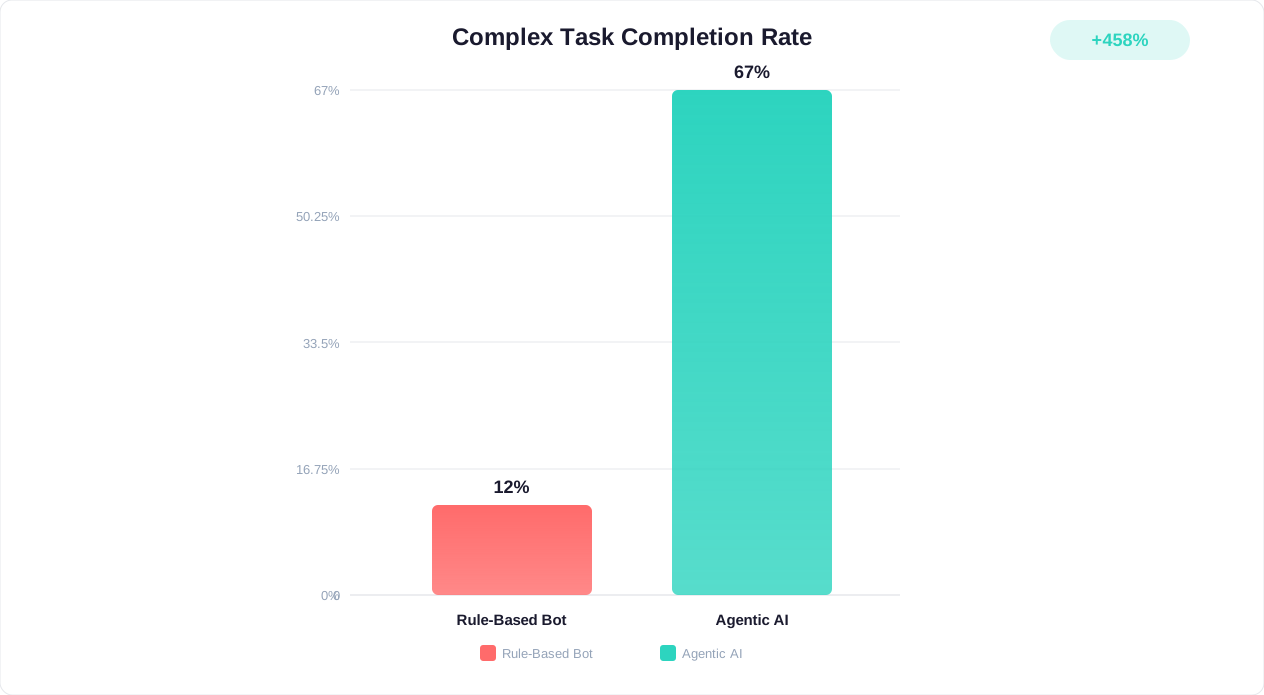
Unlike conventional chatbots that follow scripted decision trees or even modern LLM-powered bots that generate conversational responses, agentic AI systems possess agency — the ability to independently determine what actions to take, in what order, and how to adapt when initial approaches fail. A traditional chatbot answers questions. An agentic AI system solves problems.
Consider a customer who contacts support about a damaged product received yesterday. A traditional chatbot might gather the order number and escalate to a human agent. An agentic AI system, by contrast, can autonomously:
- Verify the customer's identity and pull up the order
- Check the delivery timeline against shipping carrier data
- Assess the claim against the company's refund policy
- Process a replacement shipment through the fulfillment system
- Generate a return label and email it to the customer
- Update the CRM with the interaction summary
- Flag the supplier if the product has recurring damage reports
All of this happens in a single conversation, in under two minutes, without any human agent involvement. According to Gartner's 2025 predictions, by 2028, 33% of enterprise software applications will include agentic AI, up from less than 1% in 2024. The customer service vertical is leading this adoption curve because the use cases are well-defined, measurable, and offer immediate ROI.
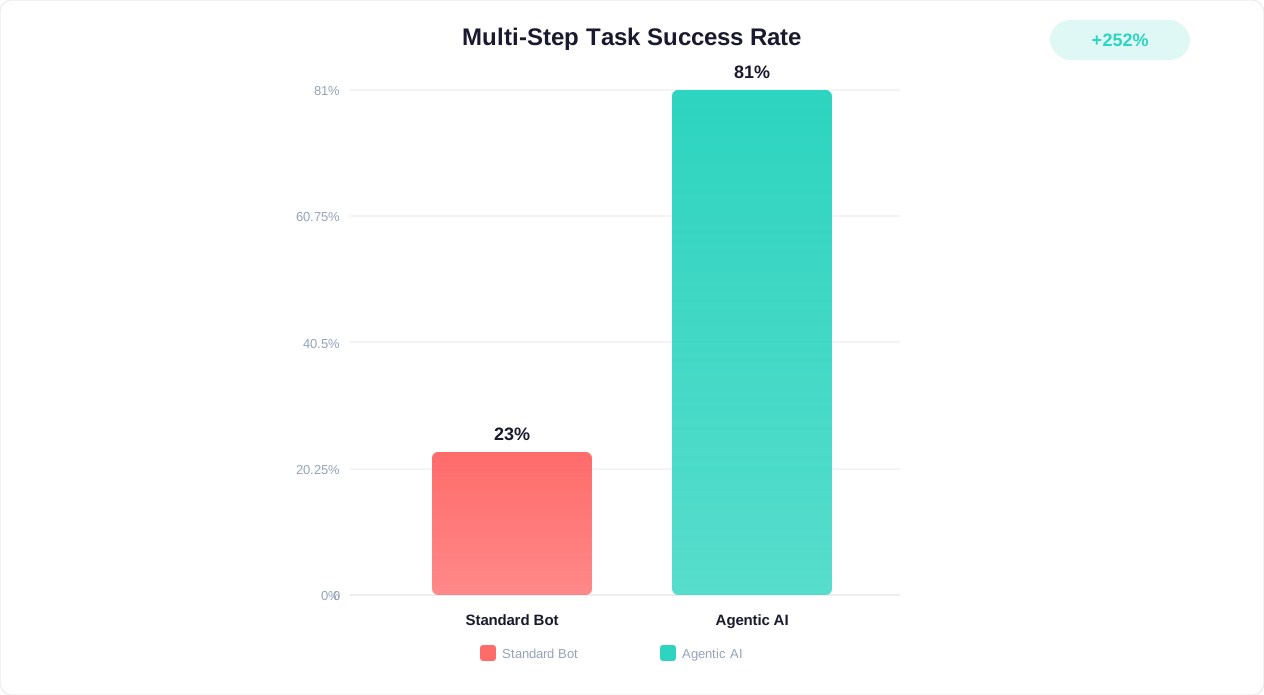
The market data confirms this trajectory. A McKinsey analysis estimates that generative AI and agentic systems could automate 60-70% of current customer service tasks, representing $400 billion in annual productivity gains globally. Early adopters are already seeing 40-60% reductions in average handle time and 25-35% improvements in first-contact resolution when deploying agentic architectures versus traditional chatbot systems.
For businesses already using chatbot platforms like GPT-powered chatbots, agentic AI represents the next evolutionary step — moving from conversational interfaces that assist humans to autonomous systems that independently resolve customer issues end-to-end. Understanding this distinction is crucial for any organization planning its customer service technology roadmap for 2026 and beyond.
Agentic AI vs. Traditional Chatbots: A Detailed Comparison
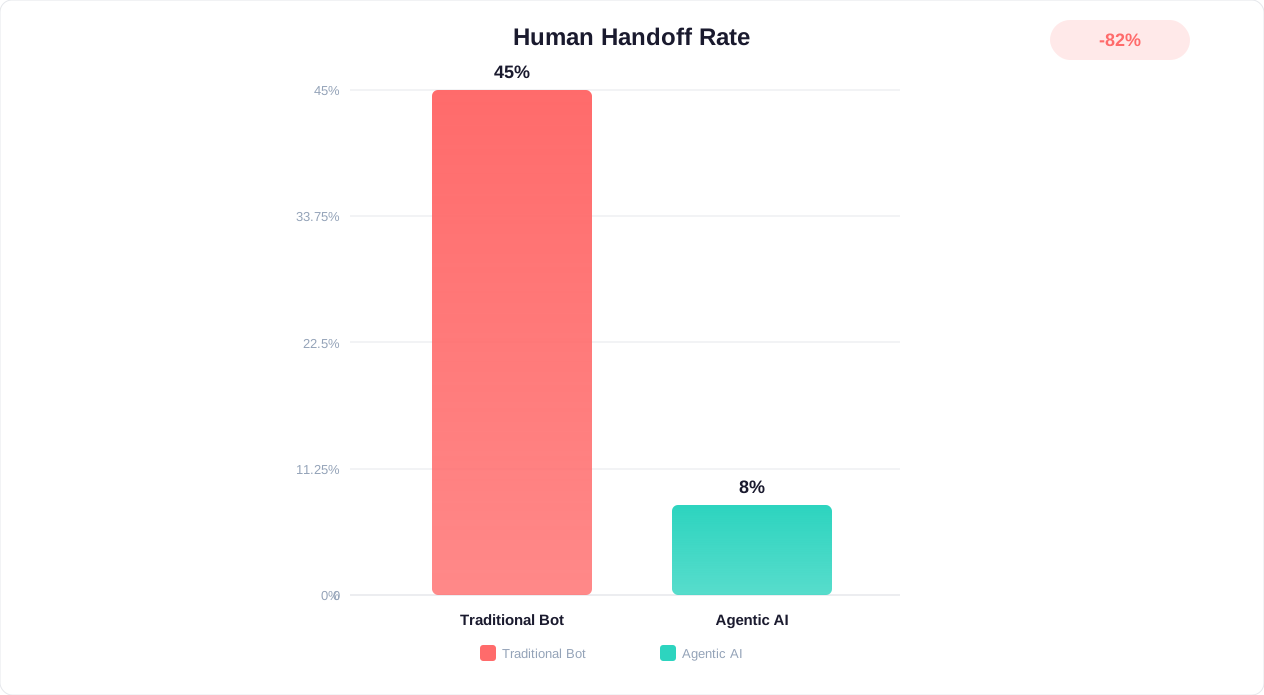
The difference between agentic AI and traditional chatbots is not merely incremental, as Gartner's AI research classifies this as a paradigm shift — it represents a paradigm shift in how automated systems interact with customers and back-end systems. Understanding these differences is essential for making informed technology decisions.
The Capability Spectrum
| Capability | Rule-Based Chatbot | LLM-Powered Chatbot | Agentic AI System |
|---|---|---|---|
| Response Generation | Scripted templates | Dynamic natural language | Dynamic + action-oriented |
| Decision Making | Fixed decision trees | Context-aware suggestions | Autonomous reasoning with tool use |
| Memory | Session-only variables | Conversation context window | Long-term episodic + semantic memory |
| Tool Use | Pre-configured API calls | Limited function calling | Dynamic tool selection and chaining |
| Error Recovery | Fallback to human | Retry or escalate | Self-correction, alternative strategies |
| Multi-Step Tasks | Not supported | Limited (2-3 steps) | Complex workflows (10+ steps) |
| Learning | Manual updates only | Prompt tuning | Continuous improvement from outcomes |
| Autonomy Level | None (fully scripted) | Low (generates text only) | High (plans, acts, evaluates) |
The Architecture Difference
A traditional chatbot operates on a simple input-output loop: the customer sends a message, the bot processes it against its rules or model, and returns a response. Each turn is essentially independent, with limited state carried between messages.
An agentic AI system operates on a perceive-reason-act loop (often called a ReAct loop):
- Perceive: Take in the customer's message plus all available context (order history, account status, previous interactions, current system state)
- Reason: Analyze the situation, identify what needs to happen, and plan a sequence of actions. This often involves chain-of-thought reasoning where the agent explicitly works through the problem
- Act: Execute one or more actions — call APIs, update databases, send emails, generate documents — then observe the results
- Evaluate: Assess whether the actions achieved the goal. If not, reason about what went wrong and try an alternative approach
This loop continues until the customer's issue is fully resolved or the agent determines that human escalation is necessary. The key distinction is that agentic systems take actions in the real world — they do not merely suggest actions for humans to take.
When Each Approach Is Appropriate
Not every customer interaction requires agentic AI. The technology is most valuable for:
- High-volume, multi-step processes: Refund processing, subscription changes, account troubleshooting
- Cross-system workflows: Issues requiring data from CRM, billing, shipping, and product systems simultaneously
- Judgment-dependent resolution: Cases where the right answer depends on evaluating multiple policies and exceptions
- Time-sensitive escalations: Situations where speed of resolution directly impacts customer satisfaction and retention
For simpler use cases — FAQs, basic lead capture, appointment scheduling — a well-configured rule-based or LLM-powered chatbot remains perfectly adequate and more cost-effective. The key is matching complexity of the solution to complexity of the problem. As we discussed in our AI agent vs. chatbot comparison, the distinction lies in autonomy and action-taking capability rather than mere conversational ability.
Agentic AI Architecture: Tool Use, Memory, and Reasoning Systems
Building an effective agentic AI system for customer service requires understanding its core architectural components. Unlike deploying a chatbot (which primarily needs conversational training data and some API integrations), agentic systems require careful design of multiple interdependent subsystems.
1. The Reasoning Engine (The "Brain")
At the core of every agentic AI system is a reasoning engine — typically a large language model (LLM) enhanced with structured prompting techniques. The reasoning engine serves as the agent's decision-making center, determining:
- What the customer's actual goal is (intent disambiguation)
- What information is needed to resolve the issue
- Which tools to use and in what sequence
- Whether the current approach is working or needs adjustment
- When to escalate to a human agent
Modern agentic systems use techniques like chain-of-thought prompting, tree-of-thought reasoning, and self-reflection to improve decision quality. The reasoning engine is not a single LLM call — it is an orchestrated series of calls with different system prompts optimized for planning, execution, and evaluation.
2. Tool Use Framework
Tools are the bridge between reasoning and action. An agentic AI customer service system typically has access to 15-40 discrete tools, each representing a specific capability:
| Tool Category | Example Tools | Actions Enabled |
|---|---|---|
| Data Retrieval | Order lookup, account query, knowledge base search | Access customer and product information |
| Transaction Processing | Refund initiation, subscription modification, credit application | Make changes to customer accounts |
| Communication | Email sender, SMS sender, ticket creator | Reach out through additional channels |
| Verification | Identity check, payment verification, address validation | Confirm customer identity and data accuracy |
| Escalation | Agent routing, priority flagging, supervisor notification | Involve humans when appropriate |
| Analytics | Sentiment analyzer, satisfaction predictor, churn risk scorer | Assess customer state and risk |
Each tool is defined with a clear schema (inputs, outputs, preconditions, side effects) that the reasoning engine uses to determine when and how to invoke it. The agent can chain multiple tools together dynamically — for example, calling the order lookup tool, then the refund policy checker, then the refund processor, then the email sender — all within a single customer interaction.
3. Memory Systems
Agentic AI systems employ multiple layers of memory that far exceed the simple session variables used by traditional chatbots:
- Working memory: The current conversation context, including all messages exchanged and tools called in this session. Limited by the LLM's context window but actively managed through summarization
- Episodic memory: Records of past interactions with this specific customer. "Last time this customer called, they had a shipping issue that took three transfers to resolve — prioritize speed this time."
- Semantic memory: General knowledge about products, policies, and procedures. Updated as policies change without retraining the base model
- Procedural memory: Learned patterns of successful resolution strategies. "For subscription downgrades, offering a temporary discount has a 43% retention rate versus 12% for immediate processing."
These memory systems allow agentic AI to provide genuinely personalized service. A customer who previously expressed frustration with automated systems might be routed to a more concise, action-focused interaction style, while a customer who enjoys conversational engagement gets a warmer, more explanatory approach.
4. Planning and Execution Framework
The planning layer takes the reasoning engine's decisions and structures them into executable workflows. This involves:
- Goal decomposition: Breaking a complex customer request into manageable sub-tasks
- Dependency resolution: Determining which sub-tasks must happen sequentially versus which can happen in parallel
- Contingency planning: Pre-computing alternative paths if primary actions fail (e.g., if the preferred shipping method is unavailable, automatically check the next option)
- Progress tracking: Monitoring execution against the plan and communicating status to the customer
This architecture enables the kind of complex, multi-step problem solving that was previously only possible with experienced human agents. Platforms like Conferbot are evolving toward this architecture, integrating knowledge base training with tool-use capabilities to enable progressively more autonomous customer service workflows.
Implementing Agentic AI: A Step-by-Step Guide for Customer Service Teams
Deploying agentic AI in customer service is not a flip-the-switch operation, requiring the phased approach that McKinsey's digital transformation research recommends. It requires careful planning, phased implementation, and continuous refinement. Here is a practical roadmap based on successful deployments across enterprise and mid-market organizations.
Phase 1: Foundation (Weeks 1-4)
Step 1: Audit your current support operations. Before building anything, map your existing customer service workflows in detail. Document:
- The 20 most common customer issues (by ticket volume)
- The average number of steps required to resolve each issue type
- Which back-end systems agents access during resolution
- Current resolution times, escalation rates, and satisfaction scores
- Edge cases and exceptions that require human judgment
Step 2: Define your automation boundary. Not everything should be automated, even with agentic AI. Establish clear criteria for which workflows are candidates for full automation versus human-assisted automation versus human-only resolution. Factors include:
- Financial risk (refunds above a certain threshold may require approval)
- Emotional sensitivity (bereavement-related requests, complaints about discrimination)
- Legal liability (medical advice, financial guidance)
- Complexity that requires creative problem-solving beyond available tools
Step 3: Prepare your tool ecosystem. Agentic AI is only as capable as the tools available to it. Ensure your back-end systems have well-documented APIs that enable:
- Read access to customer data, order history, and account information
- Write access for processing refunds, updating subscriptions, creating tickets
- Proper authentication and rate limiting for automated access
- Audit trails for all actions taken by the AI system
Phase 2: Pilot Deployment (Weeks 5-8)
Step 4: Start with a single, high-volume workflow. Choose one workflow that is: high volume (50+ occurrences per day), well-defined (clear success criteria), low risk (reversible actions if something goes wrong), and multi-step (3-7 actions required). Common starting workflows include order status inquiries with proactive resolution, subscription modification requests, and standard refund processing within policy limits.
Step 5: Implement with human-in-the-loop oversight. During the pilot phase, the agentic system should operate with a "shadow mode" or approval gate:
- The agent reasons through the problem and proposes a solution
- Before executing any write action (refunds, account changes), it presents the plan to a human reviewer
- The reviewer approves, modifies, or rejects the proposed action
- Approved actions execute automatically; rejections feed back into the learning system
This approach lets you validate the agent's reasoning before granting full autonomy. Track approval rates — when the agent's proposals are approved 95%+ of the time for a given workflow, it is ready for autonomous operation on that workflow.
Phase 3: Expansion (Weeks 9-16)
Step 6: Grant progressive autonomy. As confidence builds, expand the agent's authority progressively:
| Autonomy Level | Capabilities | Oversight |
|---|---|---|
| Level 1: Informational | Answer questions, retrieve data, provide status updates | None required |
| Level 2: Transactional (Low Risk) | Process refunds under $50, update preferences, create tickets | Spot-check sampling (10%) |
| Level 3: Transactional (Medium Risk) | Process refunds $50-$500, modify subscriptions, apply credits | Exception-based review |
| Level 4: Complex Resolution | Multi-system workflows, policy exception decisions, cross-team coordination | Outcome monitoring + anomaly detection |
Step 7: Expand to additional workflows. With each successful workflow, add the next-highest-volume use case. Typical expansion sequences include: order issues (first), then billing questions, then technical troubleshooting, then account management, then complaint resolution.
Phase 4: Optimization (Ongoing)
Step 8: Implement continuous learning. The agent should improve over time based on:
- Resolution outcomes (did the customer's issue actually get resolved?)
- Customer satisfaction signals (post-interaction survey scores, repeat contacts)
- Human override patterns (when reviewers consistently modify the agent's approach, that is a training signal)
- Efficiency metrics (are resolution times decreasing? Are fewer tools being called unnecessarily?)
Organizations using platforms like Conferbot can leverage built-in analytics and metrics tracking to monitor these signals and continuously refine agent performance through the business data training capabilities.
Real-World Use Cases: Agentic AI Handling Complex Customer Workflows
The true value of agentic AI becomes clear when examining how it handles scenarios that would require multiple human agents, system switches, and significant time investment with traditional approaches.
Use Case 1: Autonomous Refund Processing with Policy Evaluation
Scenario: A customer contacts support saying they received a defective product and want a refund. The item was purchased 45 days ago, and the company's standard return window is 30 days.
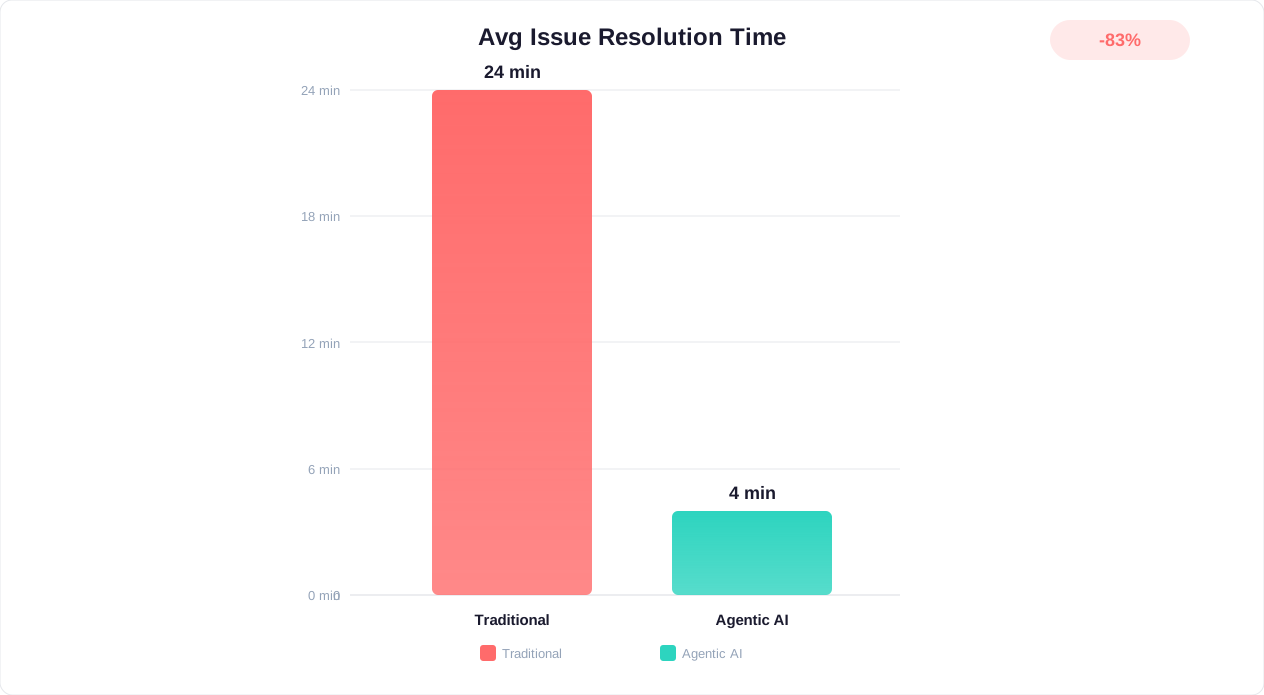
Traditional chatbot approach: Collect order number, inform customer the return window has passed, escalate to human agent. Time: 15-20 minutes including agent queue wait.
Agentic AI approach:
- Verify customer identity via email/order number lookup (5 seconds)
- Pull complete order details including product, shipping timeline, and delivery confirmation (3 seconds)
- Check product defect history — this specific product has a 12% defect rate in the current batch (2 seconds)
- Evaluate against refund policy: standard window is 30 days, BUT policy exception allows 60-day returns for manufacturing defects confirmed by defect rate data (1 second)
- Determine resolution: Full refund qualifies under defect exception policy. No need for product return given known batch issue (1 second)
- Process refund to original payment method (3 seconds)
- Send confirmation email with refund timeline (2 seconds)
- Log interaction, update product quality tracking, flag batch for review if threshold exceeded (2 seconds)
Total resolution time: 19 seconds. Zero human involvement. Customer satisfied.
Use Case 2: Multi-System Technical Troubleshooting
Scenario: A SaaS customer reports that their team cannot access a specific feature that worked yesterday.
Agentic AI approach:
- Identify the customer's account and subscription tier
- Check system status dashboard — no global outages reported
- Query the feature's access control system — discover the feature requires a specific permission role
- Check the account's role assignments — find that a recent bulk role update (initiated by the customer's admin yesterday) inadvertently removed the required permission from 15 team members
- Present the diagnosis: "Your admin ran a role update yesterday at 3:47 PM that removed Feature X access from 15 team members. I can restore access for all affected users now."
- Upon customer confirmation, batch-update role assignments
- Verify access is restored by running a permission check
- Send summary to the customer's admin with details of what changed and a recommendation for preventing future accidental permission changes
Use Case 3: Proactive Escalation with Full Context Handoff
Scenario: A customer is upset about a billing discrepancy and the conversation reveals an edge case not covered by existing policies.
Agentic AI approach:
- Acknowledge the billing discrepancy and validate the customer's frustration
- Investigate: Pull billing history, identify that a promotional rate was applied inconsistently due to a system migration
- Determine that while the agent could apply a credit, the root cause (system migration bug) may affect other customers and warrants human review
- Initiate escalation with a rich context package: full conversation summary, root cause analysis, affected account details, similar accounts potentially impacted, and a recommended resolution
- Route to a specialized billing agent (not general queue) based on issue classification
- Inform the customer: "I have identified a system issue that caused your billing discrepancy. I am connecting you with our billing specialist who will resolve this with full context of what I have found — you will not need to repeat anything."
This is the kind of intelligent escalation described in our chatbot-to-human handoff best practices guide — the agent does not simply give up; it adds significant value before escalating by diagnosing the issue and preparing a complete handoff package. The human agent receives a brief that would have taken them 10-15 minutes to compile on their own.
Use Case 4: Cross-Channel Workflow Orchestration
Scenario: A customer starts a conversation on a healthcare portal about rescheduling an appointment, but the resolution requires coordination across scheduling, insurance verification, and provider availability systems.
Agentic AI approach:
- Pull patient's upcoming appointments and identify the one to reschedule
- Check provider availability for the requested new time
- Verify insurance coverage for the new date (some plans have frequency limits)
- Identify a conflict: the preferred time slot requires a different provider who is in-network but at a different location
- Present options: "Your preferred time is available with Dr. Smith at the Oak Street location (4 miles from your usual office). Alternatively, Dr. Johnson has availability at your regular location on [alternate dates]. Both are covered by your plan."
- Process the customer's choice, update all systems, send calendar invite and parking directions for the new location if applicable
These use cases demonstrate why agentic AI delivers ROI that traditional chatbots cannot match — they resolve issues that previously required 2-3 human agents, multiple system logins, and 15-45 minutes of total handle time, all within a single automated conversation lasting under two minutes.
Choosing an Agentic AI Platform: Evaluation Criteria and Vendor Landscape
The agentic AI platform market is evolving rapidly, with Forrester's AI platform evaluations tracking the competitive landscape, with both established customer service vendors and new AI-native startups competing for market share. Selecting the right platform requires evaluating capabilities across multiple dimensions.
Essential Platform Capabilities
| Capability | Why It Matters | What to Look For |
|---|---|---|
| Tool Integration Framework | Agent needs to interact with your existing systems | Pre-built connectors, custom API support, OAuth/webhook support |
| Reasoning Transparency | You need to understand why the agent made specific decisions | Visible chain-of-thought logs, decision audit trails |
| Memory Architecture | Personalization and context continuity across interactions | Long-term storage, cross-session context, customer profiles |
| Guardrail Framework | Prevent harmful, incorrect, or unauthorized actions | Configurable policies, output filters, action approval gates |
| Human Escalation | Seamless handoff when agent reaches its limits | Context preservation, intelligent routing, warm transfer support |
| Analytics and Monitoring | Track performance, identify issues, measure ROI | Resolution rate tracking, CSAT correlation, cost-per-resolution metrics |
| Compliance Controls | Meet regulatory requirements (GDPR, HIPAA, SOC 2) | Data residency options, encryption, audit logs, BAA availability |
| Multi-Channel Support | Unified agent across all customer touchpoints | Web chat, WhatsApp, email, voice, social media integration |
Build vs. Buy Considerations
Organizations face a fundamental choice: build a custom agentic system using foundation model APIs, or adopt a platform that provides the agentic framework out of the box.
Building custom (using raw LLM APIs + orchestration frameworks):
- Pros: Maximum flexibility, no vendor lock-in, full control over reasoning logic
- Cons: 6-12 month development timeline, requires AI engineering expertise, ongoing maintenance burden, need to build guardrails from scratch
- Best for: Large enterprises with dedicated AI teams and unique workflow requirements
Adopting a platform (agentic AI customer service platform):
- Pros: Faster deployment (weeks vs. months), pre-built guardrails, vendor manages model updates, proven at scale
- Cons: Less flexibility for edge cases, potential vendor lock-in, recurring subscription costs
- Best for: Mid-market companies, businesses without large AI engineering teams, organizations prioritizing time-to-value
Vendor Landscape (2026)
The current market includes several categories of vendors:
- AI-native customer service platforms: Purpose-built for agentic customer service from the ground up. These offer the most advanced reasoning capabilities but may lack integration breadth
- Established chatbot platforms adding agentic capabilities: Platforms like Conferbot that are evolving their existing chatbot infrastructure to support tool use, memory, and autonomous workflows. These offer the advantage of proven reliability plus progressive enhancement
- Horizontal AI orchestration frameworks: General-purpose agent frameworks (LangChain, AutoGen, CrewAI) that can be customized for customer service. Powerful but require more engineering effort
- Enterprise service management suites: Traditional platforms (Salesforce, Zendesk, ServiceNow) adding AI agent layers to their existing ecosystems
When evaluating vendors, request proof of end-to-end resolution — not just conversation handling but actual workflow completion. Many vendors demonstrate impressive conversational AI but lack the tool integration depth needed for true autonomous resolution. Ask for case studies showing measurable reductions in human agent involvement for specific workflow types, and examine their approach to the best AI customer service tools landscape.
Risks, Guardrails, and Safety: Deploying Agentic AI Responsibly
Granting AI systems the authority to take autonomous actions in customer service creates risks that do not exist with passive chatbots. An agentic system that makes a mistake does not just provide a wrong answer — it can process incorrect refunds, modify the wrong accounts, or escalate inappropriately. Robust guardrails are not optional; they are the foundation of responsible deployment.
Key Risks in Agentic Customer Service
| Risk Category | Example | Potential Impact |
|---|---|---|
| Unauthorized Actions | Processing a refund that exceeds policy limits | Financial loss, policy erosion |
| Hallucinated Information | Citing a non-existent policy to justify a decision | Customer confusion, legal liability |
| Prompt Injection | Customer manipulates the agent into revealing system prompts or taking unintended actions | Security breach, unauthorized access |
| Cascading Errors | One incorrect action triggers a chain of additional incorrect actions | Multi-system data corruption |
| Privacy Violations | Agent accesses or reveals information about the wrong customer | GDPR/CCPA violations, trust damage |
| Bias Amplification | Agent applies policies differently based on customer demographics | Discrimination claims, reputational damage |
Essential Guardrail Framework
A comprehensive guardrail system operates at multiple levels:
1. Input Guardrails (Before Reasoning)
- Identity verification gates: Require authentication before allowing access to any account-specific information or actions
- Prompt injection detection: Screen customer inputs for manipulation attempts (jailbreaks, system prompt extraction, role-play attacks)
- Scope enforcement: Reject requests that fall outside the agent's defined operational domain
2. Reasoning Guardrails (During Processing)
- Policy constraint engine: Hard-code business rules that the reasoning engine cannot override (maximum refund amounts, required verification steps, prohibited actions)
- Confidence thresholds: If the agent's confidence in its plan drops below a configurable threshold, require human review before executing
- Action budgets: Limit the number and type of actions the agent can take per interaction (prevents runaway execution loops)
3. Output Guardrails (Before Customer-Facing Response)
- Content filters: Screen generated responses for inappropriate content, incorrect information, or policy contradictions
- Tone monitoring: Ensure responses maintain appropriate professionalism and empathy levels
- Commitment verification: Before the agent makes a promise to the customer ("I will process your refund"), verify the action can actually be completed
4. Action Guardrails (Before System Interactions)
- Approval gates for high-risk actions: Actions above certain thresholds require human approval before execution
- Reversibility requirements: Prefer reversible actions over irreversible ones. If an action cannot be undone, require additional confirmation
- Rate limiting: Prevent the agent from making an unusually high number of transactions in a short period (could indicate a logic error or manipulation)
Monitoring and Observability
Beyond preventive guardrails, you need comprehensive monitoring to catch issues that slip through:
- Real-time dashboards: Track resolution rates, escalation rates, customer satisfaction, and anomalous patterns
- Alert systems: Automatic notifications when metrics deviate from expected ranges (sudden spike in refunds, drop in satisfaction scores)
- Conversation auditing: Random sampling of autonomous resolutions for human quality review
- Outcome tracking: Monitor whether AI-resolved issues stay resolved or generate follow-up contacts (indicating the resolution was incomplete or incorrect)
These safety considerations align with broader compliance requirements discussed in our GDPR compliance guide. For organizations in regulated industries, guardrails must also satisfy industry-specific requirements — NIST AI Risk Management Framework provides useful guidance for structuring your risk assessment approach.
ROI Benchmarks: Measuring the Business Impact of Agentic AI
The financial case for agentic AI in customer service is compelling when properly measured. Unlike traditional chatbots that primarily reduce costs through deflection (answering simple questions that would otherwise reach agents), agentic AI delivers value through resolution — actually solving problems that previously required expensive human intervention.
Cost Comparison: Traditional vs. Agentic AI Resolution
| Metric | Human Agent | Traditional Chatbot | Agentic AI |
|---|---|---|---|
| Cost per resolution | $8-$15 | $0.50-$2 (simple queries only) | $0.75-$3 (complex issues included) |
| Average handle time | 8-12 minutes | 2-3 minutes (before escalation) | 1-4 minutes (full resolution) |
| First-contact resolution rate | 70-75% | 25-35% (rest escalated) | 75-85% |
| Available hours | Shift-dependent (8-16h) | 24/7 | 24/7 |
| Issues resolved per hour | 4-6 | N/A (simple queries only) | 30-60 |
| Customer satisfaction (CSAT) | 78-85% | 60-70% | 80-88% |
ROI Calculation Framework
To calculate ROI for an agentic AI deployment, consider these primary value drivers:
Direct cost savings:
- Reduction in human agent FTEs needed for Level 1 and Level 2 support
- Elimination of after-hours staffing costs (agentic AI provides consistent quality 24/7)
- Reduced training costs (agents focus on complex, high-value interactions rather than routine processing)
Revenue impact:
- Faster resolution reduces churn (a Forrester study found that a 1-point improvement in CX Index scores translates to $175M-$311M in incremental revenue for a large enterprise)
- 24/7 availability captures revenue that would be lost to abandoned interactions outside business hours
- Proactive issue detection and resolution prevents escalations that drive churn
Operational efficiency:
- Human agents focus on genuinely complex cases, improving job satisfaction and reducing turnover (support agent turnover averages 30-45% annually; reducing this by even 10% saves significant recruitment and training costs)
- Consistent policy application reduces exceptions, credits, and one-off accommodations that erode margins
- Data from agent interactions provides product and process improvement insights at scale
Real-World ROI Data Points
Based on published case studies and industry benchmarks from 2025-2026:
- E-commerce (mid-market): 45% reduction in cost-per-resolution, 60% reduction in average handle time, payback period of 4 months
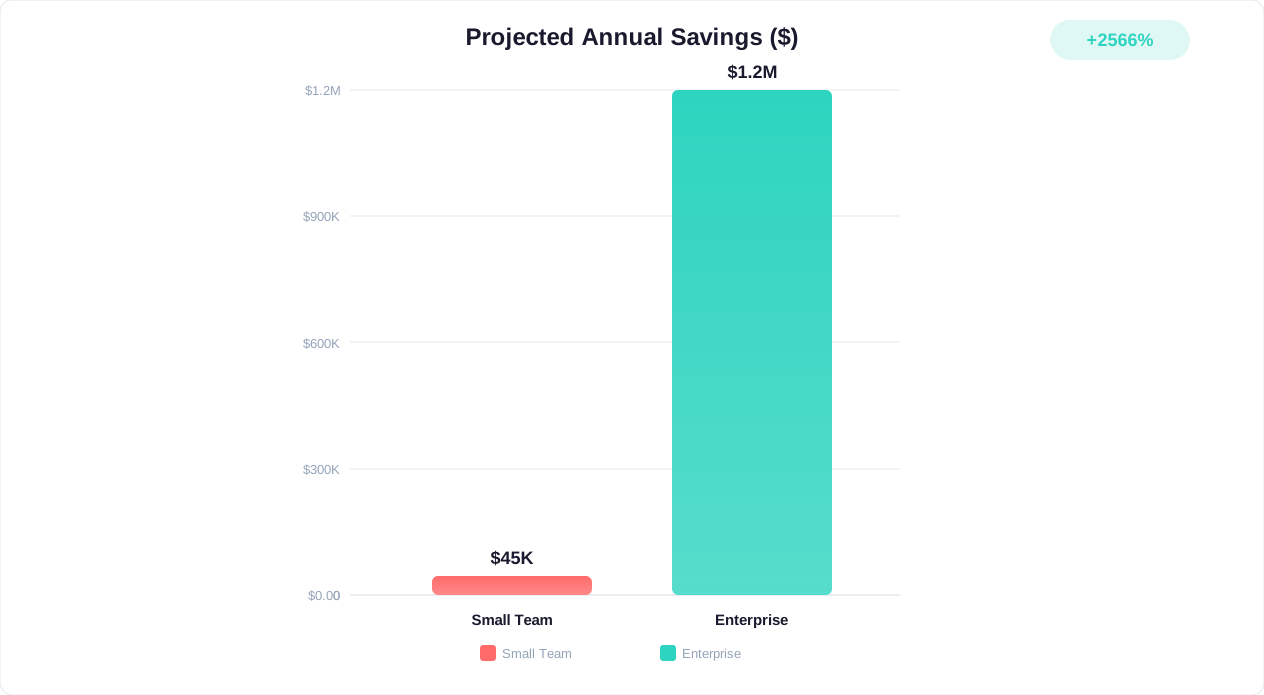
- SaaS (enterprise): 35% improvement in first-contact resolution, 28% reduction in ticket volume reaching human agents, annual savings of $2.1M for a 50-agent support team
- Financial services: 52% of routine account inquiries fully automated, compliance violation rate decreased by 73% (agent applies policies consistently), 6-month payback
- Healthcare: 40% reduction in appointment scheduling costs, 25% decrease in no-show rates through proactive AI-managed reminders and rescheduling, significant HIPAA compliance improvement through consistent data handling
Measuring Success: Key Performance Indicators
Track these KPIs to validate your agentic AI ROI:
- Autonomous resolution rate: Percentage of issues resolved without any human involvement (target: 60-80% of eligible workflows)
- Cost per resolution: Total platform cost divided by number of issues resolved (should decrease month-over-month as the agent handles more complex cases)
- Customer effort score (CES): How easy customers find it to get their issues resolved (lower is better)
- Time to resolution: From first customer message to confirmed resolution (target: under 5 minutes for 80% of automated resolutions)
- Escalation quality: When the agent does escalate, does the human agent resolve it faster thanks to the context provided? (Target: 40%+ reduction in post-escalation handle time)
Organizations looking to benchmark their current chatbot performance before upgrading to agentic capabilities should review our guide on chatbot analytics and metrics to track to establish baseline measurements.
The Future of Agentic AI in Customer Service: 2026-2030 Outlook
The agentic AI landscape is evolving at a pace that makes even recent deployments feel preliminary. Understanding where the technology is heading helps organizations make infrastructure decisions today that will not require wholesale replacement tomorrow.
Near-Term Evolution (2026-2027)
Multi-agent collaboration: Rather than a single agent handling everything, we are moving toward teams of specialized agents that collaborate. A "triage agent" determines the issue type and routes to specialized agents (billing agent, technical agent, retention agent) that have deeper domain expertise and tool access. This mirrors how human support teams are organized but operates at machine speed.
Proactive service: Current agentic AI is reactive — it responds when customers reach out. Next-generation systems will monitor customer data streams and initiate contact before issues arise. Detecting that a customer's payment is about to fail, proactively reaching out to update payment information, and preventing a service disruption entirely.
Voice-native agents: While most current implementations are text-based, voice-capable agentic AI is rapidly maturing. These systems combine real-time speech recognition, natural language understanding, tool use, and speech synthesis to handle phone calls autonomously — with the reasoning capabilities of agentic systems rather than the rigid IVR trees of legacy phone systems. Our voice chatbot guide explores the current state of this technology.
Medium-Term Developments (2027-2029)
Continuous learning from outcomes: Current systems improve through manual tuning and periodic retraining. Future agents will learn from every interaction outcome in real-time, automatically adjusting their strategies based on what works. A resolution approach that leads to repeat contacts will be automatically deprioritized in favor of approaches that produce lasting resolution.
Cross-company agent networks: Agentic systems from different companies will communicate directly. A customer's shipping issue might be resolved by their retailer's agent negotiating directly with the carrier's agent — no human involvement on either side. Standards for inter-agent communication protocols are already being developed.
Emotional intelligence: Advanced multimodal systems will read emotional cues (tone of voice, typing patterns, word choice) and adjust their approach dynamically. A frustrated customer gets a more concise, action-oriented experience. A confused customer gets more detailed explanations. This goes beyond basic sentiment analysis into genuine emotional awareness and adaptive interaction design.
Long-Term Vision (2029-2030)
Autonomous service operations: The end state is not just AI agents handling customer interactions but AI systems managing the entire service operation — forecasting demand, allocating resources, identifying systemic issues, implementing fixes, and continuously optimizing the customer experience with minimal human oversight. Humans shift from doing the work to setting the strategy and reviewing outcomes.
According to IDC research, global spending on AI-centric systems will reach $632 billion by 2028, with customer service remaining one of the top three investment categories. Organizations that build agentic AI capabilities now will have a significant competitive advantage as these technologies mature — they will have the data, the workflows, and the organizational muscle memory to adopt each advancement quickly rather than starting from scratch.
For businesses beginning their journey today, the practical starting point is building a strong chatbot foundation with robust tool integrations and clean data pipelines. Platforms like Conferbot provide this foundation, enabling organizations to start with intelligent chatbot automation and progressively upgrade to more autonomous agentic capabilities as the technology matures and their confidence grows. The key is choosing infrastructure that supports this evolution rather than locking you into today's capabilities. Start by reducing support tickets with chatbot automation and expand toward full agentic autonomy as your workflows and guardrails mature.
Was this article helpful?
Agentic AI for Customer Service FAQ
Everything you need to know about chatbots for agentic ai for customer service.
About the Author

Conferbot Team specializes in conversational AI, chatbot strategy, and customer engagement automation. With deep expertise in building AI-powered chatbots, they help businesses deliver exceptional customer experiences across every channel.
View all articles