The US Chatbot Disclosure Landscape: 78 Bills, 27 States, and Counting
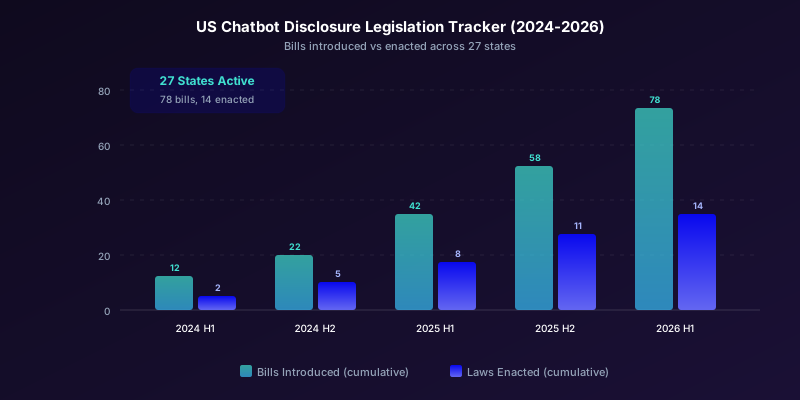
The United States is experiencing an unprecedented wave of AI chatbot legislation at the state level. As of mid-2026, 78 chatbot-related bills have been introduced across 27 states, with 14 enacted into law, 23 actively moving through legislative committees, and the remainder in various stages of consideration. This legislative surge -- documented by the National Conference of State Legislatures AI legislation tracker -- represents the most significant US regulatory development for chatbot operators since the California Consumer Privacy Act reshaped data handling practices in 2020.
Unlike the European Union's centralized approach through the EU AI Act, the US is building its AI regulatory framework state by state, creating a patchwork of requirements that varies by jurisdiction in scope, specificity, and penalty severity. For businesses operating chatbots that serve customers across multiple states -- which includes virtually every company with a website -- this patchwork demands careful navigation. A chatbot that complies perfectly with California's SB 243 may still violate disclosure requirements in Illinois or Colorado, and the Federal Trade Commission maintains its own enforcement authority under existing consumer protection law that applies nationwide.
The core question for every business deploying a customer-facing chatbot in 2026 is straightforward: does your chatbot clearly tell users they are talking to a machine, not a human? The answer to that question determines your compliance status in the majority of jurisdictions. But the specifics of what "clearly" means, when the disclosure must occur, what language is required, and what penalties apply for failure differ significantly across states. For businesses already navigating the EU's requirements, our EU AI Act compliance guide covers the international dimension that intersects with these US state laws.

This guide provides the complete compliance roadmap for US chatbot operators: a state-by-state breakdown of enacted and pending disclosure laws, deep analysis of California's landmark SB 243, FTC enforcement trends and guidance, required disclosure language templates, a compliance implementation checklist, penalty structures and enforcement mechanisms, and strategies for building a chatbot that satisfies the strictest requirements across all jurisdictions simultaneously. Whether you operate in a single state or serve customers nationwide, this guide ensures your chatbot meets every applicable disclosure obligation.
California SB 243: The Gold Standard for Chatbot Disclosure Requirements
California Senate Bill 243, signed into law in 2025 and fully enforceable since January 1, 2026, establishes the most comprehensive chatbot disclosure framework in the United States. As with the California Consumer Privacy Act (CCPA) and the California Privacy Rights Act (CPRA) before it, SB 243 is setting the de facto national standard that other states are using as a template for their own legislation. According to analysis from Orrick, Herrington & Sutcliffe's technology law practice, at least 9 of the 14 enacted state chatbot laws borrow substantially from SB 243's framework.
What SB 243 Requires
The law applies to any "covered entity" operating an "automated conversational system" that communicates with California residents. The key provisions are:
1. Mandatory Bot Identity Disclosure (Section 3(a)): Any person or entity that uses a chatbot to communicate with a person in California must clearly and conspicuously disclose that the communication is being conducted by a bot, not a human being, at the beginning of the interaction.
2. Disclosure Timing (Section 3(b)): The disclosure must occur before the bot engages in any substantive communication with the user. A chatbot that answers a question and then discloses its nature in the second message does not comply. The disclosure must be the first thing the user sees or among the first elements presented.
3. Clear and Conspicuous Standard (Section 3(c)): The disclosure must be "clear and conspicuous," defined as reasonably noticeable and understandable to an average user. Small-print disclaimers, buried terms of service references, and ambiguous language like "powered by AI" without explicit bot identification do not satisfy this standard.
4. Ongoing Availability (Section 3(d)): The user must be able to determine at any point during the conversation that they are communicating with a bot. This can be satisfied through persistent visual indicators (badges, labels) or through a mechanism that allows the user to ask and receive confirmation of the bot's nature.
5. Human Escalation Disclosure (Section 3(e)): If the chatbot transfers the conversation to a human agent, this transition must be clearly communicated to the user.
Who Is Covered
SB 243 applies broadly to any business that operates a chatbot communicating with California residents, regardless of where the business is headquartered. The law uses a "market reach" test: if your chatbot is accessible to and used by California residents, you are covered. Given that California has 39 million residents (12% of the US population), virtually every national chatbot deployment is subject to SB 243.
Enforcement and Penalties
SB 243 is enforced by the California Attorney General's office and local district attorneys. The penalty structure includes: civil penalties of up to $2,500 per violation (each non-disclosed interaction is a separate violation), injunctive relief requiring the business to modify or shut down non-compliant chatbots, and a private right of action allowing individual consumers to sue for actual damages plus statutory damages of $1,000 per violation. The private right of action is particularly significant because it enables class action lawsuits. A chatbot that interacts with 10,000 California residents without proper disclosure faces potential class action exposure of $10 million or more in statutory damages alone.

SB 243 Compliant Disclosure Examples
Compliant: "Hi! I am an AI chatbot, not a human. I can help you with product questions, order tracking, and returns. Type 'agent' anytime to speak with a person." This satisfies all five requirements: bot identity, timing (first message), clarity, ongoing awareness (agent option), and implicitly establishes the human escalation path.
Not Compliant: "Welcome to our support chat! How can I help you today?" with a small footer note reading "Powered by AI." This fails the clear and conspicuous test (footer text is not reasonably noticeable) and does not explicitly disclose that the user is communicating with a bot.
Not Compliant: A chatbot named "Sarah" with a human avatar photo that discloses AI nature only when directly asked. This fails the timing requirement (disclosure must precede substantive communication) and the proactive disclosure requirement.
State-by-State Disclosure Requirements: Where You Must Comply and How
Beyond California, 13 additional states have enacted chatbot disclosure laws as of mid-2026, with 23 more bills actively progressing through state legislatures. The requirements vary in scope and specificity, creating compliance challenges for businesses operating nationally. This section provides a comprehensive comparison based on tracking data from the NCSL state AI legislation database.
States With Enacted Chatbot Disclosure Laws
| State | Law / Bill | Effective Date | Disclosure Requirement | Penalty | Private Action |
|---|---|---|---|---|---|
| California | SB 243 | Jan 1, 2026 | Clear and conspicuous bot identity before substantive interaction | $2,500/violation + injunction | Yes ($1,000/violation) |
| Colorado | SB 24-205 | Feb 1, 2026 | Disclosure when AI makes or substantially influences consequential decisions | Under UCPA enforcement | No (AG only) |
| Illinois | AI Transparency Act | Jan 1, 2026 | Notification that AI is being used in real-time communication | $5,000/first; $10,000/subsequent | Yes (actual damages) |
| Connecticut | SB 2 | Oct 1, 2025 | AI system disclosure for consumer-facing deployments | $5,000/violation | No |
| Texas | HB 1709 | Sep 1, 2025 | Bot disclosure in commercial transactions | Under DTPA enforcement | Yes (via DTPA) |
| New York | AI Consumer Protection Act | Mar 1, 2026 | Prominent disclosure of automated system use | $10,000/violation | No (AG only) |
| Washington | AI Transparency Act | Jul 1, 2026 | Clear disclosure of AI interaction nature | Under CPA enforcement | Yes (via CPA) |
| Virginia | AI Disclosure Act | Jul 1, 2026 | Bot identity disclosure for customer-facing AI | $2,500/violation | No |
| Massachusetts | AI Transparency Bill | Jan 1, 2026 | Disclosure of AI use in consumer communications | Under 93A enforcement | Yes (via Ch. 93A) |
| Maryland | Online Safety Act (AI provisions) | Oct 1, 2025 | Bot disclosure in online communications | $5,000/violation | No |
| Minnesota | AI Governance Act | Aug 1, 2026 | AI system transparency for consumer interactions | $7,500/violation | No |
| New Jersey | AI Disclosure Act | Mar 1, 2026 | Clear notification of chatbot nature | Under CFA enforcement | Yes (via CFA) |
| Oregon | AI Consumer Notification Act | Jan 1, 2026 | Prominent bot identity disclosure | $3,000/violation | No |
| Tennessee | ELVIS Act (AI provisions) | Jul 1, 2024 | Disclosure when AI simulates human interaction | Under existing fraud statutes | Yes |
Key Variations Across States
Trigger Scope: California and Illinois require disclosure for all chatbot interactions with consumers. Colorado's SB 24-205 only requires disclosure when the chatbot makes or substantially influences "consequential decisions" (credit, employment, insurance, housing, healthcare, education). This means a standard FAQ chatbot in Colorado has no disclosure obligation, while the same chatbot in California does.
Definition of "Clear and Conspicuous": California defines it explicitly. Most other states use the term without a specific definition, leaving interpretation to courts and regulators. New York's law adds a "prominent" requirement that suggests disclosure must be visually emphasized (bold text, separate line, or contrasting color).
Human Escalation: California and Connecticut explicitly require disclosure when transitioning from AI to human. Most other states do not address this specifically, creating ambiguity about whether a seamless handoff without notification violates the general disclosure requirement.
Private Right of Action: Six states allow individual consumers or consumer classes to sue for chatbot disclosure violations. The remaining states rely exclusively on attorney general or agency enforcement. The private right of action states carry significantly higher compliance risk because a single plaintiff's attorney can launch a class action without waiting for a state investigation.
States With Pending Legislation (Watch List)
23 additional bills are actively progressing through state legislatures. The most significant pending bills are in Florida (HB 917, broad AI transparency), Georgia (SB 481, consumer AI notification), Pennsylvania (HB 1234, automated communication disclosure), Ohio (SB 367, AI consumer protection), and Arizona (HB 2701, bot disclosure in commercial transactions). Businesses operating in these states should monitor legislative progress and plan for compliance, as most of these bills are expected to pass by late 2026 or early 2027.
FTC Enforcement: The Federal Backstop That Applies Everywhere
While state laws create a patchwork of specific requirements, the Federal Trade Commission provides a federal enforcement baseline that applies to chatbot operators nationwide. The FTC has not passed chatbot-specific legislation, but it does not need to: Section 5 of the FTC Act prohibits "unfair or deceptive acts or practices" in commerce, and the FTC has made clear through enforcement actions, blog posts, and public guidance that operating a chatbot that misleads consumers about its nature constitutes a deceptive practice.
FTC's AI and Chatbot Enforcement Position
The FTC's approach to chatbot disclosure has evolved through a series of public statements and enforcement signals:
April 2023 -- "Keep your AI claims in check" blog post: The FTC warned that companies claiming products are "AI-powered" must be transparent about what that means and must not deceive consumers about whether they are interacting with AI or humans.
August 2023 -- AI and deception enforcement policy: The FTC stated that using AI to deceive consumers about the nature of interactions constitutes a Section 5 violation, regardless of intent. Even if a company does not deliberately hide the chatbot's AI nature, failing to disclose it when consumers would reasonably expect a human interaction is deceptive.
2024-2025 -- Enforcement actions: The FTC brought enforcement actions against several companies for AI-related deception, including cases involving chatbots that impersonated human customer service agents. While the specific companies involved were in health and financial services, the legal reasoning applies across industries.
2026 -- Updated guidance: The FTC's updated AI guidance explicitly recommends that chatbot operators "clearly and prominently disclose when consumers are interacting with an AI system" and notes that this disclosure should occur "before the consumer engages in substantive interaction with the system."
What Makes a Chatbot "Deceptive" Under FTC Standards
The FTC applies a three-part test for deceptive practices that maps directly to chatbot disclosure:
- Representation or omission: Does the chatbot represent or imply that it is human, or omit the fact that it is AI? A chatbot with a human name, human photo, and conversational style that mimics human customer service agents creates an implied representation of human interaction.
- Materiality: Would the consumer's behavior differ if they knew they were talking to AI? The FTC has argued that yes, consumers make different decisions when they know they are interacting with AI versus a human -- they may ask different questions, provide different information, or seek human assistance for complex issues.
- Reasonable consumer standard: Would a reasonable consumer be misled? The FTC uses a "reasonable consumer" standard, not a "most sophisticated consumer" standard. If a reasonable person opening a chat widget on your website could think they are talking to a human, the lack of disclosure is deceptive.
FTC Penalty Authority
FTC enforcement carries significant financial consequences:
| Enforcement Mechanism | Penalty | Application to Chatbots |
|---|---|---|
| Consent decree | No fine (first offense); mandatory compliance changes | Most common initial action; requires implementing disclosure |
| Civil penalty (repeat / willful) | Up to $50,120 per violation (2026 adjusted) | Each chatbot interaction without disclosure is a separate violation |
| Restitution | Consumer refunds for transactions influenced by deception | If consumers purchased products influenced by non-disclosed AI interaction |
| Injunction | Court order to modify or shut down the chatbot | Immediate business impact if chatbot is a primary sales/support channel |
The FTC's penalty authority has teeth. A chatbot processing 5,000 conversations per month without disclosure, multiplied by $50,120 per violation, creates astronomical theoretical exposure. In practice, the FTC typically negotiates consent decrees with reasonable remediation requirements and reduced penalties, but the theoretical maximum provides significant negotiating leverage.

FTC vs State Law: Understanding the Overlap
FTC enforcement and state chatbot laws operate independently and concurrently. A chatbot that violates California's SB 243 may also face FTC scrutiny under Section 5, and vice versa. Compliance with state law does not immunize against FTC action if the FTC determines that the state-compliant disclosure is still inadequate under its own deception standards. The practical implication: design your disclosure to meet the strictest applicable standard, not the minimum.
For businesses that also operate chatbots in the EU, the interaction between FTC guidance, state laws, and the EU AI Act creates a three-layer compliance challenge. Our EU AI Act compliance guide addresses the international dimension, while this guide focuses on the US landscape. The good news: a disclosure that meets California SB 243's clear-and-conspicuous standard will satisfy FTC expectations and comply with virtually every state law enacted or pending.
Required Disclosure Language: Templates That Satisfy Every Jurisdiction
One of the most common compliance failures is using disclosure language that is technically present but legally insufficient. Analysis from SiteGPT's chatbot compliance research found that 41% of chatbots audited had some form of AI disclosure, but only 18% met the "clear and conspicuous" standard required by California and recommended by the FTC. The gap between having a disclosure and having a compliant disclosure is where most businesses fail.
The Anatomy of a Compliant Disclosure
A legally compliant chatbot disclosure must include four elements:
- Explicit bot identification: The word "bot," "AI," "automated," or equivalent. Vague terms like "virtual assistant" or "smart helper" are insufficient because they do not unambiguously convey non-human nature.
- Negation of human identity: An explicit statement that the user is NOT talking to a human. "I am an AI chatbot" is good. "I am an AI chatbot, not a human" is better because it eliminates any remaining ambiguity.
- Functional description: What the chatbot can do, which sets expectations and reduces frustration when it reaches its limits.
- Human alternative: How to reach a human if the user prefers. This is explicitly required in California and recommended by the FTC.
Jurisdiction-Safe Templates
These templates are designed to satisfy the strictest requirements across all 14 enacted state laws, FTC guidance, and pending legislation. Use them as-is or adapt them to your brand voice while preserving the four required elements.
Template 1: Universal Standard (Recommended for All Businesses)
"Hi! I am an AI chatbot -- not a human. I can help with [list 2-3 capabilities]. If you would prefer to speak with a person, type 'human' at any time. How can I assist you?"
Template 2: E-Commerce
"Welcome! I am an automated AI assistant, not a human agent. I can help you find products, track orders, and answer questions about our policies. Need a real person? Just say 'agent' and I will connect you. What can I help you find?"
Template 3: Professional Services (Law, Finance, Healthcare)
"Hello. I am an AI-powered assistant and not a human representative. I can provide general information and schedule appointments, but I cannot give professional advice. For specific legal/financial/medical questions, I will connect you with a licensed professional. How may I direct your inquiry?"
Template 4: Home Services / Local Business
"Hey there! I am an AI assistant for [Business Name] -- I am not a human, but I can help with pricing, scheduling, and answering common questions 24/7. Want to talk to our team directly? Type 'call me' and we will reach out. What do you need help with?"
Template 5: SaaS / Tech Support
"Hi! I am [Bot Name], an AI support bot -- not a human. I can troubleshoot common issues, walk you through features, and check your account status. For complex technical issues, type 'escalate' to reach our support team. What is going on?"
Widget Label Requirements
The chat widget trigger button -- the element users click to open the chatbot -- is the first opportunity for disclosure and may be required by some state interpretations of "before substantive interaction." Replace generic labels with disclosure-forward alternatives:
| Non-Compliant Label | Compliant Alternative | Reasoning |
|---|---|---|
| Chat with us | Chat with our AI Assistant | Identifies AI nature before conversation opens |
| Need help? | AI Help Available 24/7 | Identifies AI nature and sets availability expectation |
| Live Chat | AI Chat (Human Available) | Corrects false "live" implication; notes human option |
| Talk to an Expert | Ask our AI Bot | Replaces "expert" (implies human) with explicit bot identification |
| Support | AI-Powered Support | Adds AI identification to neutral label |
Persistent Disclosure Mechanisms
California's ongoing availability requirement (Section 3(d)) means the disclosure cannot simply be a first message that scrolls off screen during a long conversation. Implement at least one persistent mechanism: a fixed "AI Chatbot" badge visible at all times in the chat header, an "AI" indicator next to the bot's name in each message bubble, or a subtle but visible footer within the chat window stating "You are chatting with an AI." The Conferbot chatbot builder includes built-in persistent disclosure badges that satisfy this requirement without custom development.
Penalties and Enforcement: What Non-Compliance Actually Costs in Each State
Understanding the penalty landscape is essential for making rational compliance investment decisions. The financial exposure from chatbot disclosure violations varies dramatically across states, from nominal per-violation penalties to class-action-enabling private rights of action that can generate eight-figure exposure.
Penalty Comparison by Enforcement Model
| Enforcement Model | States | Max Penalty Per Violation | Who Can Enforce | Class Action Risk |
|---|---|---|---|---|
| AG-only, fixed penalty | CT, VA, MD, OR, MN | $2,500 - $10,000 | Attorney General only | None |
| AG-only, existing consumer law | CO, WA | Per state consumer protection act | Attorney General only | Low (via state CPA) |
| AG + private right of action | CA, IL, TX, MA, NJ, TN | $1,000 - $50,120 | AG + individual consumers | High |
| Federal (FTC) | Nationwide | $50,120 per violation | FTC | N/A (FTC action only) |
The Class Action Multiplier
In the six states with private rights of action, the real financial risk is not the per-violation penalty -- it is the multiplication effect when a plaintiff's attorney aggregates thousands of violations into a class action. Consider this scenario:
A mid-sized e-commerce company operates a chatbot without SB 243-compliant disclosure. The chatbot handles 15,000 conversations per month with California residents. Over 6 months before the violation is discovered, that is 90,000 non-disclosed interactions. At the statutory damage rate of $1,000 per violation, the class action exposure is $90 million. Even if the case settles at 5% of face value (common for consumer class actions), the settlement is $4.5 million -- not including attorney fees, injunctive relief costs, and reputational damage.
This is not hypothetical. Consumer privacy class actions under the California Consumer Privacy Act generated over $1.8 billion in settlements in 2024-2025, and plaintiff attorneys have explicitly identified chatbot disclosure violations as their next target because the violations are easy to prove, affect large numbers of consumers, and carry statutory damages that make small per-violation claims economically viable through aggregation.
Risk Stratification by Business Type
Not all businesses face equal enforcement risk. The factors that increase risk include: high chatbot conversation volume (more potential violations), presence in private-right-of-action states (especially California), chatbot interactions that involve commercial transactions (purchases, bookings, financial decisions), use of human names or avatars without disclosure (actively deceptive vs. merely omissive), and industry regulatory oversight (financial services, healthcare, and real estate chatbots receive extra scrutiny from industry-specific regulators).
Businesses with low conversation volume operating in AG-only enforcement states face minimal practical risk, though compliance remains legally required. Businesses with high volume in California, Illinois, or Texas face significant and immediate risk that justifies treating compliance as an urgent priority.

Recent Enforcement Actions
While chatbot-specific enforcement is still emerging, several early cases provide guidance on regulatory priorities. In late 2025, the California AG's office issued compliance letters to 23 companies operating chatbots without disclosure, giving them 30 days to comply before formal enforcement. All 23 complied, avoiding penalties but establishing that the AG's office is actively monitoring. In early 2026, the Illinois AG brought a consent decree against a financial services company whose chatbot collected personal financial information while impersonating a human advisor, resulting in a $750,000 settlement. The FTC's 2025 action against a health supplement company that used chatbot "doctors" to recommend products without disclosing their AI nature resulted in a $2.3 million penalty and mandatory consumer refunds.
The enforcement trend is clear: regulators are starting with egregious cases (active human impersonation in sensitive sectors) and expanding to broader non-compliance. Companies that proactively comply avoid being in the second wave of enforcement. For a comprehensive view of chatbot security and compliance risks beyond disclosure, see our chatbot security risks and prevention guide.
Implementation Checklist: Achieving Multi-State Compliance in One Afternoon
According to compliance research from SiteGPT's chatbot regulatory analysis, businesses that implement a "comply to the strictest standard" approach spend 70% less time on ongoing compliance management than those maintaining per-state configurations. The good news about chatbot disclosure compliance is that for the vast majority of businesses, the implementation is straightforward. Because disclosure requirements across states share a common core -- tell users they are talking to a bot, not a human -- a single well-designed disclosure framework satisfies all jurisdictions simultaneously. Here is the step-by-step implementation process.
Phase 1: Audit (30 Minutes)
- Inventory all chatbots. List every chatbot your organization operates: website support bot, lead generation bot, WhatsApp bot, Facebook Messenger bot, internal helpdesk bot, SMS bot. Include chatbots operated by third-party vendors on your behalf.
- Identify state exposure. Determine which states your chatbot serves. For website chatbots, this is effectively all 50 states unless you geo-block specific states (not recommended). For in-store kiosks or location-specific deployments, exposure is limited to the deployment state.
- Assess current disclosure. Open each chatbot as a new user and document: Does the chatbot disclose its AI/bot nature? When does the disclosure appear? Is it clear and conspicuous? Is there a persistent indicator? Is human escalation available and disclosed?
- Identify gaps. Compare current state against the California SB 243 standard (the strictest). Any gap between your current disclosure and the SB 243 requirements is a compliance gap.
Phase 2: Implement Disclosure (60-90 Minutes)
- Configure first-message disclosure. Add or update the chatbot's opening message to include explicit bot identification, negation of human identity, functional description, and human escalation option. Use Template 1 from Section 5 as your starting point.
- Update widget labels. Change chat trigger buttons from generic labels ("Chat with us") to AI-identifying labels ("Chat with our AI Assistant").
- Add persistent AI indicator. Configure a visible badge, icon, or label that remains visible throughout the conversation identifying the chatbot as AI-powered.
- Configure human handoff disclosure. When the chatbot transfers to a human agent, add a clear transition message: "You are now being connected to [Agent Name], a human member of our team."
- Verify mobile rendering. Test all disclosures on mobile devices (iOS and Android) to ensure text is readable, badges are visible, and labels are not truncated.
Phase 3: Documentation (30 Minutes)
- Create a compliance record. Document: date of implementation, specific changes made, screenshots of compliant chatbot interface (desktop and mobile), list of chatbot deployments covered, state laws addressed.
- Update privacy policy. Add a section describing your use of AI chatbots, what data they collect, and how users can request human interaction. While not required by all chatbot disclosure laws, this complements your GDPR compliance and demonstrates good faith.
- Train relevant staff. Brief customer service managers and marketing teams on the disclosure requirements. Ensure they understand that removing or modifying disclosure elements creates compliance risk. Document the training with date and attendees.

Phase 4: Ongoing Monitoring (15 Minutes Monthly)
- Test disclosures monthly. Open each chatbot as a new user and verify all disclosure elements are functioning. Platform updates, theme changes, and configuration modifications can inadvertently remove or alter disclosure elements.
- Monitor legislative developments. Check the NCSL tracker quarterly for new state laws. Subscribe to at least one AI regulatory newsletter for real-time updates on enforcement actions.
- Review chatbot analytics. Use your chatbot analytics dashboard to monitor whether disclosure is appearing correctly across all sessions and whether human escalation requests are being handled properly.
- Re-assess with changes. Any time you modify chatbot flows, add new capabilities, change platforms, or expand to new channels, re-verify disclosure compliance.
The total time investment for achieving multi-state compliance is approximately 2 to 3 hours for the initial implementation and 15 to 30 minutes monthly for ongoing monitoring. Compare this to the potential penalty exposure of millions of dollars, and the ROI of compliance is effectively infinite.
Industry-Specific Disclosure Requirements: Financial Services, Healthcare, and Real Estate
Three industries face chatbot disclosure obligations that go beyond general state laws due to sector-specific regulations enforced by specialized regulators. If your chatbot operates in financial services, healthcare, or real estate, you must satisfy both the general disclosure laws and the industry-specific requirements simultaneously.
Financial Services
Financial services chatbots face additional disclosure requirements from multiple regulators:
SEC (Securities and Exchange Commission): Chatbots that provide investment information must disclose their AI nature AND include disclaimers that the information is not personalized investment advice. The SEC's 2025 AI guidance specifically addresses robo-advisors and chatbots, requiring clear disclosure of automated decision-making and human oversight availability.
FINRA (Financial Industry Regulatory Authority): FINRA's communications rules require that chatbots operated by broker-dealers be clearly identified as automated systems and that any recommendations be presented with appropriate risk disclosures.
State banking regulators: Several states (New York, California, Illinois) have additional disclosure requirements for chatbots operated by licensed financial institutions, particularly regarding disclosure of automated credit decisions.
Colorado SB 24-205 specifics: Colorado's law specifically addresses AI in high-risk decision-making including credit, insurance, and employment. Financial chatbots in Colorado must not only disclose their AI nature but also explain how AI influences any consequential financial decision and provide an appeal mechanism for AI-influenced decisions.
Healthcare
Healthcare chatbots operate under HIPAA in addition to state disclosure laws. Key additional requirements include: disclosure that the chatbot cannot provide medical diagnoses or treatment recommendations (unless supervised by a licensed professional), HIPAA-compliant data handling for any health information shared during the conversation, and clear identification of any AI-generated health content with appropriate disclaimers. Our detailed compliance guide covering data privacy addresses the intersection of healthcare data requirements with chatbot disclosure obligations.
Real Estate
Real estate chatbots face Fair Housing Act considerations in addition to state disclosure laws. A chatbot that steers potential buyers toward or away from specific neighborhoods based on demographic characteristics -- even unintentionally through AI bias -- violates the Fair Housing Act regardless of disclosure compliance. Real estate chatbots must disclose AI nature, avoid discriminatory steering in property recommendations, comply with state real estate advertising regulations, and include fair housing statements required by HUD.
Multi-Industry Compliance Matrix
| Requirement | General Business | Financial Services | Healthcare | Real Estate |
|---|---|---|---|---|
| Bot identity disclosure | Required | Required | Required | Required |
| Human escalation option | Required (CA, CT) | Required (all states) | Required (all states) | Required (CA, CT) |
| Limitations disclaimer | Recommended | Required | Required | Required |
| Decision explanation | Not required | Required (CO, IL) | Recommended | Not required |
| Appeal mechanism | Not required | Required (CO) | Not required | Not required |
| Bias testing | Not required | Recommended | Recommended | Required (Fair Housing) |
| Data handling disclosure | Per CCPA/state | Per GLBA + state | Per HIPAA + state | Per state |
Businesses in regulated industries should treat the industry-specific requirements as the compliance floor, not the ceiling. Building disclosure mechanisms that exceed minimum requirements demonstrates good faith and provides a buffer against evolving regulatory interpretation. For detailed GDPR intersection analysis that applies to healthcare and financial chatbots, see our GDPR compliance guide.
Future-Proofing Your Chatbot: Preparing for the Next Wave of AI Regulation
As the Orrick technology regulatory team has noted, the US AI regulatory trajectory mirrors the data privacy trajectory of 2015-2020 in both pace and pattern. The 78 bills across 27 states represent the beginning, not the end, of US chatbot regulation. The trajectory is unmistakable: more states will enact disclosure requirements, existing laws will be amended to be more stringent, enforcement will intensify as regulatory capacity builds, and federal legislation is likely within the next 2 to 3 years. Forward-thinking businesses are building compliance infrastructure that accommodates this trajectory rather than chasing individual state requirements reactively.
Predicted Regulatory Trajectory (2026-2028)
| Timeline | Predicted Development | Impact on Chatbot Operators |
|---|---|---|
| Late 2026 | 10+ additional states enact disclosure laws | Near-universal US coverage; national compliance becomes standard |
| Early 2027 | First major class action settlements under SB 243 | Establishes penalty benchmarks; accelerates compliance urgency |
| Mid 2027 | Federal AI transparency bill introduced | Potential national floor that supersedes weaker state laws |
| Late 2027 | States begin requiring explainability for AI decisions | Chatbots making recommendations must explain reasoning |
| 2028 | Federal legislation enacted or advanced | National uniform standard; potentially preempts some state laws |
Architecture for Compliance Agility
Rather than hardcoding disclosure text into your chatbot, build an architecture that allows rapid compliance updates:
1. Centralized disclosure configuration: Store all disclosure text, badge settings, and widget labels in a centralized configuration that can be updated across all chatbot instances simultaneously. When a new state law requires modified language, you change one configuration rather than editing every chatbot flow.
2. Geo-aware disclosure: Implement the ability to serve different disclosure messages based on user location. While the recommended approach is to use the strictest standard universally, geo-aware disclosure provides flexibility for jurisdictions with unique requirements. For example, Colorado's SB 24-205 requires decision-explanation disclosures that are not required elsewhere -- you may want to add these only for Colorado users rather than adding them universally.
3. Compliance logging: Log every disclosure event -- when it was displayed, what text was shown, which user saw it, and whether the user acknowledged it. This audit trail is invaluable during enforcement investigations and essential for demonstrating compliance in class action litigation.
4. Version-controlled disclosure: Maintain dated versions of your disclosure text with effective dates. When laws change and you update disclosure language, keep records of what was displayed during each period. This protects against claims that older, non-compliant language was used during periods when newer language was actually in effect.
The "Comply to the Strictest" Strategy
The most efficient long-term strategy is to design your chatbot's disclosure to meet the strictest currently enacted standard -- California SB 243 -- and use that as your universal baseline. This approach eliminates the complexity of managing jurisdiction-specific disclosures, ensures compliance as new states enact laws (which are typically equal to or less strict than California's), reduces the legal risk of accidentally serving the wrong disclosure to the wrong state's resident, and positions your chatbot for eventual federal legislation (which will likely use California's standard as a model, following the pattern of the CCPA influencing federal privacy discussions).
The incremental cost of using the strictest standard universally versus the minimum required in each state is effectively zero -- the disclosure text is slightly longer, but the implementation effort is identical. The risk reduction, however, is substantial. Businesses that comply to the California standard have zero compliance gaps in any US jurisdiction with enacted or pending legislation.
For businesses that want to explore how their chatbot platform handles compliance configuration, visit our pricing page to compare compliance features across plan tiers. All Conferbot plans include built-in disclosure configuration that meets the requirements described throughout this guide.
Was this article helpful?
AI Chatbot Disclosure Laws by State FAQ
Everything you need to know about chatbots for ai chatbot disclosure laws by state.
About the Author

Conferbot Team specializes in conversational AI, chatbot strategy, and customer engagement automation. With deep expertise in building AI-powered chatbots, they help businesses deliver exceptional customer experiences across every channel.
View all articles