Why Educational Institutions Need AI Chatbots in 2026
Educational institutions — from K-12 schools to universities to online learning platforms — face a growing mismatch between student expectations and institutional capacity. Today's students are digital natives who expect instant, personalized responses to their questions. They are accustomed to the responsiveness of e-commerce chatbots and banking apps, and they bring those expectations to their interactions with schools and universities.
Yet most educational institutions operate with constrained budgets and limited administrative staff. The average university admissions office processes thousands of inquiries per enrollment cycle, financial aid offices handle hundreds of calls per week, and student services desks field repetitive questions about deadlines, registration, and campus resources all day, every day.
AI chatbots bridge this gap by providing instant, accurate, personalized responses to the questions that consume the most administrative time — while simultaneously improving the student experience. Institutions that have deployed chatbots report remarkable results: 40-60% reduction in routine inquiry volume, 25-35% improvement in enrollment conversion rates, and significant increases in student satisfaction scores.
The applications span the entire student lifecycle. Education chatbots guide prospective students through the enrollment process, help current students navigate academic requirements and campus resources, assist with financial aid applications, deliver course information, and support alumni engagement — all available 24/7 through the institution's website and messaging channels like WhatsApp.
All institutional information — from course catalogs to financial aid guides — can be centralized in a knowledge base that powers accurate, consistent responses. The edtech market has also embraced chatbots enthusiastically. Online learning platforms use conversational AI to onboard new learners, recommend courses based on goals and skill levels, provide study support, and reduce course dropout rates through proactive engagement. With an AI knowledge base and advanced AI capabilities, education chatbots can even serve as tutoring assistants, answering subject-specific questions and explaining complex concepts in accessible language.
This guide covers the most impactful use cases for education chatbots, with practical implementation strategies for institutions of every size and type. Whether you are a small private school or a large public university system, these strategies will help you deploy a chatbot that genuinely improves the student experience while reducing administrative burden.
Enrollment and Admissions Automation
The enrollment funnel is where education chatbots deliver some of their most dramatic results. Prospective students have questions at every stage — from initial program research to application submission to enrollment confirmation — and the speed and quality of responses directly impact whether they choose your institution or a competitor.
The Enrollment Journey Chatbot
A well-designed enrollment chatbot guides prospective students through the complete admissions process:
Awareness and discovery stage:
- "What programs do you offer in computer science?" — The chatbot presents program options with descriptions, career outcomes, and links to detailed curriculum pages.
- "What are the admission requirements?" — Instant, accurate information about GPA requirements, test scores, prerequisites, and application deadlines.
- "How much does tuition cost?" — Tuition and fee breakdowns by program, with information about financial aid and scholarship opportunities.
Application stage:
- Walk prospective students through the application process step by step
- Answer questions about required documents (transcripts, letters of recommendation, essays)
- Provide real-time application status updates
- Send reminders about approaching deadlines for incomplete applications
Decision and enrollment stage:
- Guide admitted students through the enrollment confirmation process
- Assist with housing applications, orientation registration, and course selection
- Connect students with academic advisors for program-specific questions
- Answer questions about campus life, student organizations, and support services
Impact on Enrollment Metrics
Universities using enrollment chatbots report compelling improvements:
- Inquiry response time: Reduced from 24-48 hours (email) to under 30 seconds (chatbot)
- Application completion rate: Improved by 15-25% through proactive reminders and step-by-step guidance
- Melt rate reduction: 10-20% fewer admitted students "melt" (fail to enroll) thanks to sustained engagement between admission and enrollment
- Admissions staff efficiency: 40-60% fewer routine inquiries, allowing staff to focus on personalized outreach to high-priority prospects
Deploy your enrollment chatbot on your website and WhatsApp to reach prospective students through their preferred channels. International students in particular benefit from WhatsApp-based enrollment support, as it is often their primary communication platform and eliminates the barrier of international calling. Build your enrollment flows with the no-code chatbot builder to iterate quickly as enrollment cycles evolve.
Education Chatbot Applications: Impact by Department
Different departments within an educational institution benefit from chatbot automation in distinct ways. This comparison helps administrators prioritize deployments based on their institution's most pressing needs and resource constraints.
| Department | Top Use Case | Inquiry Deflection Rate | Student Satisfaction Impact | Implementation Time |
|---|---|---|---|---|
| Admissions | Application guidance & deadlines | 50-65% | High (faster response) | 2-3 weeks |
| Financial Aid | FAFSA help & award explanations | 40-55% | Very High (reduces anxiety) | 3-4 weeks |
| Registrar | Course registration & schedules | 55-70% | High (24/7 access) | 3-5 weeks |
| Student Services | Campus info & resource referrals | 60-75% | Moderate | 1-2 weeks |
| IT Help Desk | Password resets & WiFi issues | 65-80% | High (instant resolution) | 1-2 weeks |
| Library | Hours, resources & research help | 50-65% | Moderate | 1-2 weeks |
IT Help Desk and Student Services typically offer the fastest deployment with the highest deflection rates, making them ideal starting points for institutions new to chatbot technology. Admissions and Financial Aid deliver the greatest strategic value for enrollment growth but require more content preparation and system integration work.
24/7 Student Support and Campus Services
Current students have an endless stream of questions about academic policies, campus resources, administrative processes, and student life. These questions follow predictable patterns — the same topics come up hundreds or thousands of times each semester — yet answering them consumes enormous staff resources. A student support chatbot provides instant, consistent answers to these common questions while freeing staff for more complex student needs.
Academic Support
The chatbot serves as an always-available academic resource:
- Registration and scheduling: Course availability, registration dates, add/drop deadlines, waitlist information, and schedule planning assistance
- Degree requirements: Required courses, elective options, credit hour requirements, and progress-toward-degree information for each program
- Academic policies: Grading policies, academic probation criteria, grade appeal processes, transfer credit evaluation, and withdrawal procedures
- Tutoring and academic resources: Writing center hours, tutoring availability, library resources, study group information, and academic coaching services
- Exam information: Final exam schedules, exam policies, testing center locations and hours
Campus Life and Services
Beyond academics, students need information about the practical aspects of campus life:
- Dining: Meal plan information, dining hall hours and menus, dietary accommodation options
- Housing: Room assignment information, maintenance request submission, roommate change processes, move-in and move-out dates
- Health services: Health center hours, appointment scheduling, insurance information, mental health resources and crisis support referrals
- Transportation: Shuttle schedules, parking permit information, bike share availability, rideshare partnerships
- IT support: WiFi connectivity, email setup, LMS access issues, printing services, software downloads
Mental Health and Wellness Support
One of the most sensitive and important applications of education chatbots is supporting student mental health. While a chatbot should never replace professional counseling, it can provide valuable first-line support:
- Resource directory: Instantly connect students with counseling services, crisis hotlines, and peer support programs
- Wellness check-ins: Periodic, optional check-ins that help students reflect on their wellbeing and identify when they might benefit from professional support
- After-hours guidance: When counseling centers are closed, the chatbot provides immediate crisis resources, coping strategies, and the assurance that help is available
Student support chatbots should be designed with empathy and appropriate escalation protocols. Any interaction that suggests a student is in crisis should immediately provide crisis hotline numbers and, where possible, alert designated staff members. The chatbot's role in these situations is to ensure the student knows help is available and how to access it — never to attempt counseling. Deploy across your website and student-facing platforms for maximum accessibility.
Course Information and Academic Advising Support
Choosing the right courses is one of the most consequential decisions students make, yet many institutions provide insufficient support for this process. Academic advisors are often overwhelmed, available only during limited office hours, and stretched too thin to provide the personalized guidance every student needs. A course information chatbot supplements human advisors by providing instant access to course details and preliminary guidance.
Course Discovery and Details
The chatbot serves as an interactive course catalog that responds to natural language queries:
- "What electives can I take for my marketing major?" — Lists available electives with descriptions, prerequisites, and when they are typically offered
- "Is PSYCH 201 offered in the spring?" — Real-time availability with section details, instructor information, and enrollment status
- "What are the prerequisites for Advanced Data Science?" — Complete prerequisite chain with the student's completion status
- "Which professors teach Organic Chemistry?" — Instructor information with student rating summaries (where permitted)
Schedule Planning Assistance
The chatbot helps students build balanced, feasible schedules:
- Conflict detection: Identify time conflicts between desired courses and suggest alternatives
- Workload balancing: Warn students when their selected courses represent an unusually heavy or light course load
- Requirement tracking: Show which degree requirements each potential course fulfills, helping students make strategic choices
- Wait-list management: Alert students when spots open in waitlisted courses and facilitate instant enrollment
Career-Connected Course Recommendations
Powered by advanced NLP, the chatbot can connect academic choices to career outcomes:
- "I want to work in cybersecurity — what should I study?" — The chatbot recommends relevant majors, minors, certificates, and specific courses based on industry requirements and alumni career data
- "What jobs can I get with a Psychology degree?" — Career pathway information with salary ranges, job market data, and recommended specializations
- "Should I minor in Business or Statistics?" — Comparative analysis based on the student's major, career interests, and remaining credit hours
Supporting Academic Advisors
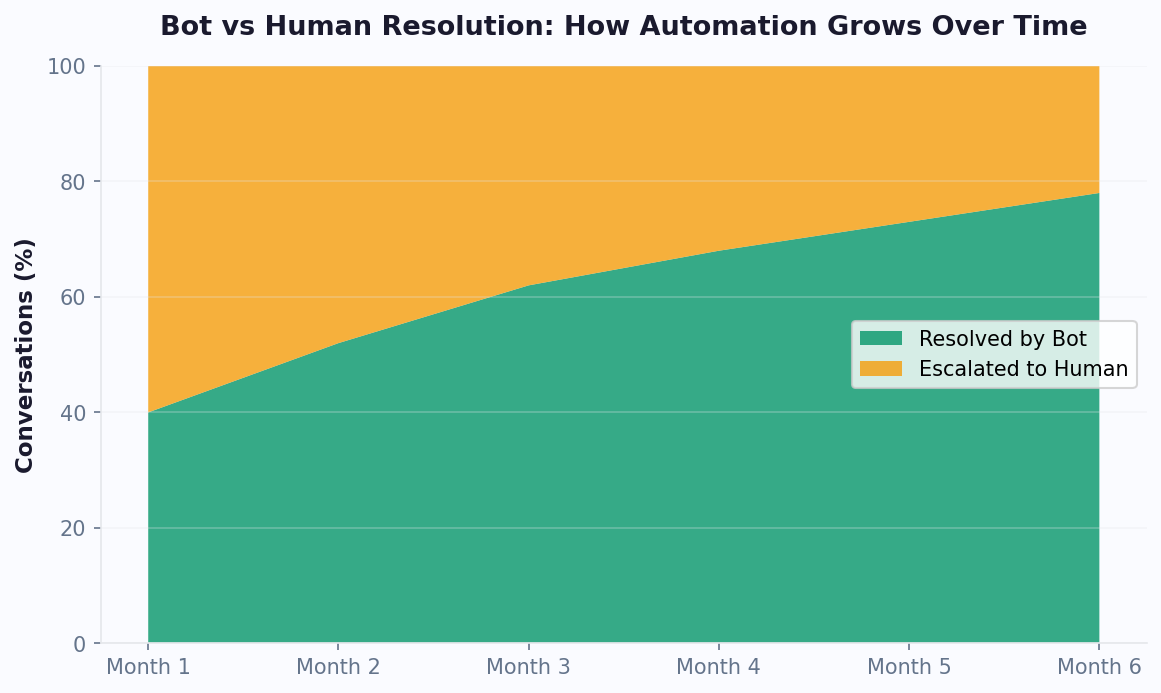
The chatbot does not replace academic advisors — it amplifies their effectiveness. By handling routine course information queries (which account for 50-70% of advising inquiries), the chatbot frees advisors to focus on the complex, high-impact conversations that truly require human judgment: career planning, academic difficulty interventions, graduate school preparation, and personal mentorship. When students do meet with their advisor, they come better informed and with more focused questions, making the advising session more productive for both parties. Integrate the chatbot with your Student Information System (SIS) through API integrations to provide personalized, real-time information based on each student's academic record and degree program.
Financial Aid and Scholarship Assistance
Financial aid is one of the most complex and anxiety-inducing aspects of the education experience. Students and families navigate confusing terminology, strict deadlines, complicated forms, and uncertain timelines — often with limited understanding of the process. A financial aid chatbot demystifies this process and ensures students do not miss critical deadlines or opportunities.
FAFSA and Application Support
The chatbot guides students through the financial aid application process step by step:
- Eligibility pre-screening: "Am I eligible for federal financial aid?" — The chatbot asks basic eligibility questions (citizenship, enrollment status, academic progress) and provides a preliminary assessment.
- FAFSA guidance: Walk students through the FAFSA form section by section, explaining what each question asks and where to find the required information. This conversational approach is especially valuable for first-generation college students who may not have family guidance on the process.
- Document checklists: Provide personalized checklists of required documents based on the student's situation (tax returns, W-2s, immigration documents, verification forms) with clear instructions for submission.
- Deadline management: Proactive reminders for federal, state, and institutional financial aid deadlines. Priority deadlines are highlighted with urgency messaging.
Scholarship Discovery
Many students miss scholarship opportunities simply because they do not know they exist. The chatbot matches students with relevant scholarships based on their profile:
- Institutional scholarships: Merit-based, need-based, and departmental scholarships available through the institution
- External scholarships: Third-party scholarship opportunities matched to the student's major, demographics, interests, and achievements
- Application guidance: For each scholarship, the chatbot provides eligibility criteria, application requirements, deadlines, and tips for strong applications
Award Package Understanding
When financial aid awards are released, the chatbot helps students understand their packages:
- "What does 'Federal Subsidized Loan' mean?" — Clear, jargon-free explanations of each award type (grants, scholarships, work-study, subsidized loans, unsubsidized loans)
- "How much will I owe after graduation if I take these loans?" — Loan repayment calculators that show total repayment amounts, monthly payments, and repayment timeline
- "Can I appeal my financial aid award?" — Information about the appeals process, qualifying circumstances, and required documentation
Reducing Summer Melt
"Summer melt" — the phenomenon of admitted students failing to enroll — is heavily driven by financial aid confusion and unresolved financial barriers. Institutions using chatbots for proactive financial aid outreach during the summer months report 15-25% reductions in summer melt. The chatbot checks in with admitted students about their financial aid status, helps resolve outstanding issues, and ensures students understand how to finalize their enrollment despite financial concerns. Deploy through WhatsApp for maximum reach, as many students are more responsive to messaging than email during the summer. Use calendar booking to let students schedule financial aid counseling sessions directly through the chatbot.
Chatbots for Online Learning and EdTech Platforms
Online learning platforms face a unique challenge: without the physical campus environment, in-person interactions, and built-in community, student engagement and completion rates suffer significantly. The average MOOC completion rate is below 10%, and even paid online programs see 40-60% dropout rates. Chatbots are one of the most effective tools for combating this engagement crisis in online education.
Learner Onboarding
The first few hours of an online learning experience are critical — students who do not engage early are unlikely to complete the course. An onboarding chatbot ensures every new learner starts strong:
- Platform orientation: Guide new users through the learning management system (LMS), showing them how to access courses, submit assignments, participate in discussions, and get help.
- Goal setting: "What do you hope to achieve with this course?" — The chatbot helps learners articulate their goals and creates a personalized study plan.
- Learning style assessment: Brief questions about preferred learning methods (video, reading, interactive exercises) to recommend the optimal approach.
- Technical requirements: Verify that the learner's device and internet connection meet course requirements, and troubleshoot any issues.
Study Support and Tutoring
Powered by advanced NLP models, education chatbots can provide subject-specific support:
- Concept explanation: Students can ask the chatbot to explain difficult concepts in simpler terms, with examples and analogies tailored to their level of understanding.
- Practice problems: Generate practice questions based on the current module, provide immediate feedback on answers, and explain correct solutions.
- Study guidance: "I have a quiz on Chapter 5 tomorrow — how should I prepare?" — The chatbot suggests a study strategy based on the chapter content and the student's performance history.
- Writing support: Help with structuring essays, understanding assignment rubrics, and improving writing clarity (without writing the assignment for the student).
Engagement and Retention Interventions
The chatbot monitors learner behavior and intervenes when engagement drops:
- Inactivity alerts: If a student has not logged in for 3+ days during an active course, the chatbot sends a friendly check-in: "Hey! We noticed you haven't visited Module 4 yet. Need help with anything or just a reminder to jump back in?"
- Progress celebrations: Acknowledge milestones (completing a module, passing a quiz, reaching the halfway point) to maintain motivation.
- Difficulty detection: If a student repeatedly struggles with a topic (failed quiz attempts, long time on a module), the chatbot proactively offers additional resources and support.
- Community connection: Connect struggling or disengaged students with study groups, peer mentors, or instructor office hours.
EdTech platforms using proactive engagement chatbots report 20-35% improvements in course completion rates — a transformative impact on learner outcomes and platform revenue. The chatbot acts as a persistent, patient, always-available learning companion that ensures no student falls through the cracks. Use chatbot analytics to monitor engagement patterns and continuously optimize your intervention strategies.
Implementing an Education Chatbot: Best Practices and Roadmap
Deploying a chatbot in an educational setting requires thoughtful planning around student privacy, institutional culture, and integration with existing systems. Here is a practical implementation guide for educational institutions of any size.
Phase 1: Planning (Weeks 1-2)
- Identify priority use cases. Survey your administrative and student services teams to identify the highest-volume inquiries. Admissions, financial aid, and registration are typically the top three.
- Student privacy compliance. Review FERPA (Family Educational Rights and Privacy Act) requirements for student data. Determine which chatbot functions will access student records and establish appropriate authentication and consent mechanisms.
- Stakeholder engagement. Brief faculty, staff, and student government on the chatbot initiative. Address concerns about impersonality and emphasize that the chatbot handles routine queries to free staff for meaningful interactions.
- Content audit. Compile existing FAQ documents, website content, and knowledge base articles that will form the chatbot's initial content. Identify gaps where new content needs to be created.
Phase 2: Build (Weeks 3-5)
- Build foundational flows. Start with general information (hours, locations, contacts, deadlines), then add admissions FAQ, financial aid FAQ, and registration support. Use a no-code chatbot builder for rapid development without IT bottlenecks.
- Integrate with student systems. Connect the chatbot to your SIS (Student Information System), LMS (Learning Management System), and CRM for personalized responses through API integrations. Start with read-only integrations (retrieving information) before enabling write operations (submitting forms, changing registrations).
- Design escalation paths. Define clear handoff procedures to appropriate departments: admissions inquiries to admissions counselors, financial aid questions to financial aid advisors, academic issues to academic advisors. Include department-specific escalation schedules and contact methods.
- Create multilingual support. For institutions with diverse student populations or international recruitment, configure the chatbot to support relevant languages.
Phase 3: Test and Launch (Weeks 6-8)
- Beta test with students. Recruit a diverse group of student testers (different majors, years, backgrounds) to test the chatbot and provide feedback. Pay special attention to whether the chatbot's tone feels appropriate and helpful.
- Staff training. Train all student-facing departments on how the chatbot works, what it can and cannot do, how escalations are handled, and how to provide feedback for chatbot improvement.
- Phased rollout. Launch on your website first, targeting the admissions and student services pages. Add WhatsApp for international student support. Expand to additional pages and use cases based on performance data.
Measuring Success
Track these KPIs by department and overall:
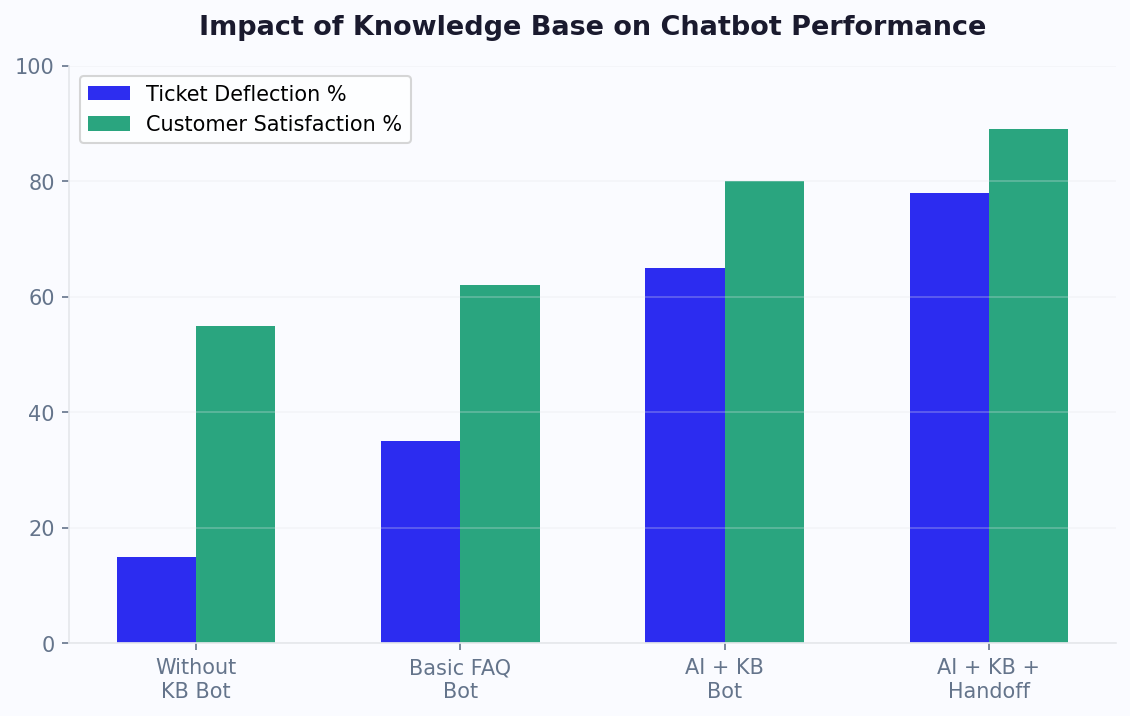
- Inquiry deflection rate: Percentage of student queries resolved without staff intervention (target: 40-60%)
- Student satisfaction: Post-interaction ratings (target: 4.0+/5.0)
- Response time: Average time from question to answer (target: under 30 seconds)
- Enrollment conversion: Application-to-enrollment rate for chatbot-engaged vs. non-engaged prospects
- Staff time savings: Hours per week reclaimed from routine inquiries
The most successful education chatbot implementations treat the chatbot as a living resource that evolves with each semester. Update content for new academic years, add answers for newly emerging questions, and continuously refine conversation flows based on student feedback and analytics. Institutions that maintain and improve their chatbot over time see compounding benefits — higher deflection rates, better student satisfaction, and increasingly sophisticated capabilities that serve the institution's strategic goals.
Education Chatbot ROI: Cost Savings, Enrollment Impact, and Benchmark Data
Educational institutions operate under significant budget pressure, making ROI justification essential for technology investments. According to Gartner's higher education technology research, institutions that deploy AI-powered student service automation achieve average cost-per-inquiry reductions of 65-80% while simultaneously improving student satisfaction scores by 15-25%.
Cost Savings by Institution Size
| Metric | Small College (2,000 students) | Mid-Size University (15,000 students) | Large University (40,000+ students) |
|---|---|---|---|
| Annual student inquiries | 25,000-40,000 | 150,000-250,000 | 500,000-800,000 |
| Current cost per inquiry | $8-12 | $10-15 | $12-18 |
| Annual inquiry handling cost | $250,000-480,000 | $1.5M-3.75M | $6M-14.4M |
| Chatbot deflection rate (year 1) | 45-55% | 50-60% | 55-65% |
| Annual cost savings | $100,000-220,000 | $680,000-2M | $3M-8.5M |
| Chatbot platform cost | $6,000-18,000/yr | $24,000-60,000/yr | $60,000-150,000/yr |
| ROI multiple | 12-17x | 20-35x | 35-57x |
Enrollment Impact Data
According to HubSpot's education marketing research, prospective students who receive responses within 5 minutes are 8x more likely to complete an application than those who wait 24+ hours. For institutions where each enrolled student represents $15,000-50,000 in annual tuition revenue, even a small improvement in enrollment conversion delivers massive financial impact:
- Application completion rate improvement: 15-25% with chatbot guidance during the application process
- Melt rate reduction: 10-20% fewer admitted students failing to enroll (worth $150,000-1M+ for a mid-size university)
- International student conversion: 30-40% improvement in international application-to-enrollment rates when multilingual chatbot support is available
Comparative Technology ROI in Higher Education
According to Statista's education technology data, chatbots deliver the highest ROI of any student-facing technology investment when measured by cost-per-interaction reduction:
| Technology | Annual Cost | Primary Benefit | Measurable ROI |
|---|---|---|---|
| AI chatbot | $6,000-150,000 | Inquiry deflection + enrollment support | 12-57x |
| CRM system | $50,000-300,000 | Enrollment management | 3-8x |
| LMS upgrade | $100,000-500,000 | Teaching delivery | 2-4x |
| Student portal | $200,000-1M | Self-service administration | 2-5x |
| Call center staffing | $300,000-1.5M | Human inquiry handling | 1-2x |
Student Satisfaction Benchmarks
Research from G2's platform review data shows that education chatbots consistently score 4.1-4.5/5.0 in student satisfaction when they meet three criteria: instant response (under 5 seconds), accurate information (grounded in verified institutional data), and easy human escalation (2 clicks or fewer).
For institutions beginning their chatbot journey, our customer support automation guide provides foundational principles that translate directly to educational contexts. The knowledge base training guide explains how to structure institutional content for optimal AI performance. And for schools evaluating whether to deploy on WhatsApp for international student outreach, our WhatsApp chatbot guide covers the technical setup and compliance considerations. See also our K-12 school chatbot guide for strategies specific to primary and secondary education.
Institutions that invest in continuous chatbot improvement through regular content updates and flow optimization consistently outperform those that deploy once and neglect ongoing maintenance. Assign a dedicated staff member to review chatbot analytics monthly, update knowledge base content after each policy change, and expand conversation flows based on frequently asked questions that the bot cannot yet answer.
Was this article helpful?
AI Chatbots for Education FAQ
Everything you need to know about chatbots for ai chatbots for education.
About the Author
Conferbot Team specializes in conversational AI, chatbot strategy, and customer engagement automation. With deep expertise in building AI-powered chatbots, they help businesses deliver exceptional customer experiences across every channel.
View all articles