
GDPR Compliance Checker
Free Legal and Compliance Chatbot Template
Enhance your data protection efforts with Conferbot's GDPR Compliance Checker. Experience real-time compliance assessments, actionable insights, and 24/7 support to safeguard your organization against data breaches and regulatory penalties.



What Is a GDPR Compliance Checker Chatbot?
A GDPR compliance checker chatbot is an AI-powered assistant that guides organizations through the ongoing operational requirements of the General Data Protection Regulation through automated dialogue, structured workflows, and real-time compliance verification. Rather than leaving compliance teams to manually track consent records, field data subject requests through inboxes, and maintain breach logs in spreadsheets, the chatbot centralizes all of these obligations in a conversational interface that any staff member can use without specialist GDPR training.
In 2026, GDPR enforcement is no longer limited to high-profile fines against major platforms. Supervisory authorities across EU member states have significantly increased the volume of investigations into mid-size businesses, with particular focus on consent management failures, inadequate data subject request handling, and missed 72-hour breach notification windows. The average cost of a GDPR fine for a business with under 250 employees now exceeds 40,000 euros when penalties, legal costs, and remediation expenses are combined. A compliance chatbot does not eliminate legal risk, but it creates the documented, systematic processes that regulators expect to see as evidence of accountability.
The chatbot addresses GDPR compliance across three operational domains that are most frequently cited in enforcement actions: lawful basis and consent management, data subject rights fulfilment, and personal data breach response. For each domain, it provides guided workflows, automated record-keeping, deadline tracking, and escalation pathways to qualified data protection professionals. It is a compliance operations tool, not a substitute for legal advice, and should be deployed as part of a broader data protection program overseen by a qualified Data Protection Officer or legal counsel.
Conferbot's AI chatbot builder enables legal and compliance teams to configure the GDPR compliance checker without writing code, integrating it with existing business systems through the API integration layer to pull consent records, process request queues, and log breach notifications automatically.
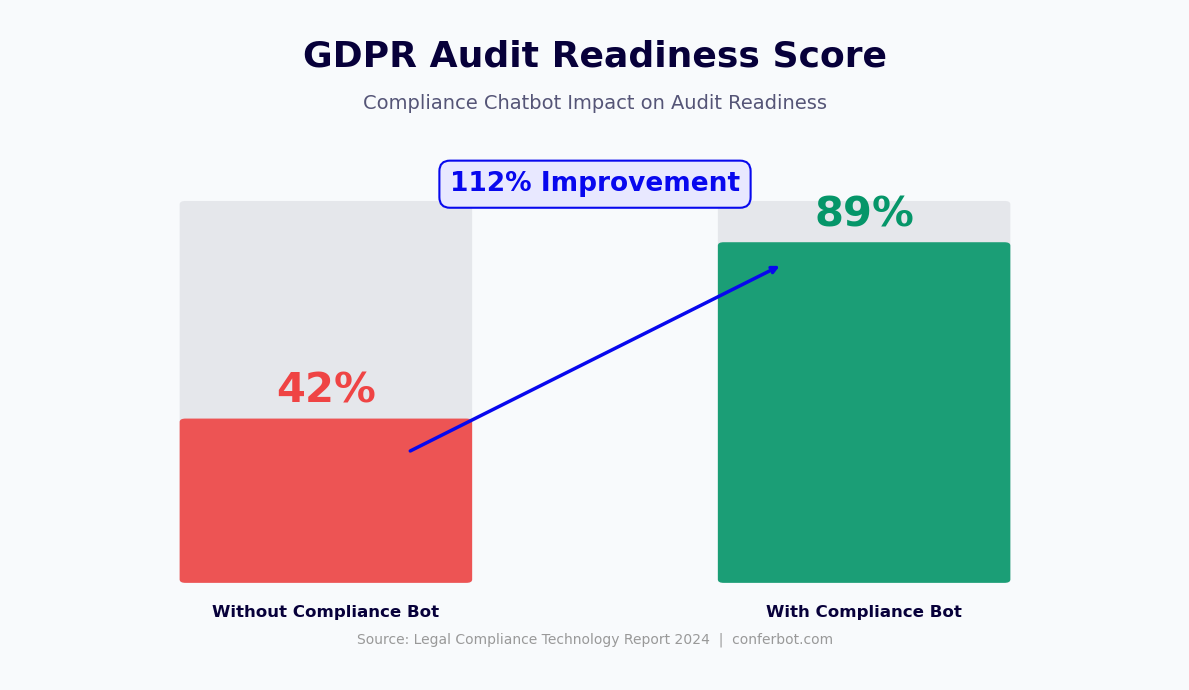
How It Works: Consent Management, Data Subject Requests, and Breach Notification
The GDPR compliance checker operates across three core workflows that correspond to the three areas of greatest operational complexity for most organizations. Each workflow is designed to be usable by non-specialist staff while maintaining the audit trail and documentation standards required for regulatory accountability.
Consent Management Workflow
Consent under GDPR requires that it be freely given, specific, informed, and unambiguous. Operationally, this means organizations need to capture consent in a format that can be demonstrated to a regulator, link it to the specific processing purpose it covers, record the time and mechanism of collection, and honour withdrawal requests within a reasonable timeframe. The chatbot manages this through a consent intake flow that:
- Presents a layered consent request covering each distinct processing purpose separately, in plain language that meets the GDPR's intelligibility standard
- Records consent with timestamp, channel, consent text version, and individual identifier, creating a granular audit record for each consent instance
- Flags consent that does not meet the GDPR's positive opt-in requirement -- pre-ticked boxes, bundled consent across multiple purposes, or consent obtained as a condition of service where it is not genuinely required
- Manages consent withdrawal requests through the same conversational interface, triggering downstream system updates to suppress processing within the required timeframe
- Tracks consent expiry where processing purposes require periodic re-consent, and automatically initiates renewal flows before expiry
Data Subject Request Handling
GDPR grants individuals eight distinct rights -- access, rectification, erasure, restriction of processing, data portability, objection, rights related to automated decision-making, and the right to withdraw consent. Each carries a one-month response deadline (extendable to three months for complex requests with notification). Manual handling of these requests through email inboxes creates missed deadlines, inconsistent responses, and inadequate documentation. The chatbot structures request handling through:
- Request intake: The individual submits their request through the chatbot interface, selecting the right type and providing the information needed to identify them in the organization's systems. The bot confirms receipt and logs the 30-day deadline.
- Identity verification: The bot initiates the identity verification workflow -- requesting documentation appropriate to the sensitivity of the data involved and the channel through which the request was submitted.
- Routing to data owners: Once identity is verified, the request is routed to each internal system owner who holds data about the individual. Each owner receives a structured task with the request type, requester details, and deadline.
- Response compilation and review: Responses from data owners are consolidated in the bot's interface. The DPO or compliance officer reviews the compiled response before dispatch.
- Deadline monitoring: The bot tracks days remaining against the deadline and escalates at 20 days (review prompt), 25 days (escalation to DPO), and 29 days (urgent alert) to prevent missed deadlines.
Personal Data Breach Notification
The 72-hour window for notifying a supervisory authority following discovery of a personal data breach is one of GDPR's most operationally demanding requirements. The chatbot provides a breach triage and notification workflow that guides the responding team through the assessment from the moment a potential breach is identified:
- Initial triage: A guided questionnaire determines whether the incident involves personal data, whether a breach has occurred within the GDPR definition, and whether the breach is likely to result in a risk to individuals' rights and freedoms -- the threshold for supervisory authority notification.
- Severity scoring: The bot applies a risk matrix to classify the breach by severity (low / medium / high / critical) based on data categories affected, number of individuals, and likely consequences.
- Notification drafting: For notifiable breaches, the bot pre-populates a supervisory authority notification using Article 33's required content fields and routes it to the DPO for review and submission.
- Individual notification: Where the breach is likely to result in a high risk to individuals (the threshold for Article 34 notification), the bot drafts the individual notification letters and manages the dispatch workflow.
- Breach register entry: All breaches -- including those below the notification threshold -- are logged in the organisation's breach register with the full triage record, rationale for notification or non-notification, and remediation steps taken.
Key GDPR Articles Covered by the Compliance Checker
The GDPR compliance checker is built around the articles that generate the highest volume of operational compliance work and enforcement activity. The following table maps each supported article to the specific chatbot functionality that addresses its requirements.
| GDPR Article | Requirement | Chatbot Functionality | Enforcement Risk Without It |
|---|---|---|---|
| Article 5 — Principles | Lawfulness, fairness, transparency, purpose limitation, data minimisation, accuracy, storage limitation, integrity and confidentiality | Processing activity audit questionnaire, retention schedule management, data minimisation assessment | Foundational violation underpinning most enforcement actions |
| Article 6 — Lawful basis | Each processing activity must have a documented lawful basis | Lawful basis selection guide, processing register population, legitimate interests assessment (LIA) template | Processing without lawful basis is the most common enforcement citation |
| Article 7 — Consent | Specific, informed, freely given, unambiguous consent with withdrawal rights | Consent capture flow, consent record management, withdrawal processing | Invalid consent is cited in 34% of EU fines |
| Articles 13-14 — Transparency | Privacy notice requirements for data collected directly and indirectly | Privacy notice gap analysis, transparency checklist against required content elements | Inadequate transparency information triggers significant fines |
| Articles 15-22 — Data subject rights | All eight data subject rights with one-month response deadline | Full data subject request workflow as described in the how it works section | Rights fulfilment failures are the most common individual complaint leading to investigation |
| Article 25 — Privacy by design | Data protection by design and by default in new processing activities | New project privacy impact assessment (PIA) flow, default settings compliance checklist | Increasingly cited in fines related to new product launches and system changes |
| Article 30 — Records of processing | Documented records of all processing activities for organisations with 250+ employees (and others in specific circumstances) | Processing activity register creation and maintenance, annual review prompts | Missing ROPA is an immediate enforcement indicator |
| Article 33 — Breach notification to authority | 72-hour notification to supervisory authority for notifiable breaches | Breach triage workflow, notification drafting, deadline tracking | Late or absent breach notification carries significant automatic penalty risk |
| Article 35 — DPIA | Data Protection Impact Assessment for high-risk processing | DPIA trigger assessment, structured DPIA template, DPO consultation workflow | Missing DPIA for high-risk processing is an enforcement trigger in its own right |
| Articles 44-49 — Transfers | Requirements for lawful transfer of personal data outside the EEA | Transfer mechanism checker, SCCs status tracker, adequacy decision monitor | Unlawful international transfers generate some of the largest GDPR fines |
Records of Processing Activities (ROPA) Management
Article 30 requires organisations to maintain a documented record of all personal data processing activities. The chatbot guides each data owner through a structured questionnaire to populate their processing activity entries: purposes of processing, categories of data, categories of individuals, recipients, international transfers, retention periods, and security measures. The ROPA is maintained as a live document, with the bot prompting review of each entry annually and flagging entries where circumstances have changed -- a new vendor added, a processing purpose discontinued, a retention period not yet defined. The completed ROPA is exportable in a format that satisfies supervisory authority requests for records.
Data Protection Impact Assessments (DPIAs)
The bot includes a DPIA trigger assessment that runs whenever a new processing activity is logged or an existing one is substantially modified. The trigger assessment evaluates the nine criteria from the European Data Protection Board's DPIA guidelines -- large-scale processing, systematic monitoring, sensitive data categories, automated decision-making with legal effects, and others -- and determines whether a full DPIA is required. Where a DPIA is required, the bot initiates the structured assessment workflow and routes the draft to the DPO for consultation before the processing begins.
Ready to try GDPR Compliance Checker?
Deploy this template in under 10 minutes. No coding required.
Use This Template Free →Use Cases: SaaS Businesses, E-Commerce, and HR Departments
GDPR compliance obligations apply to any organisation that processes the personal data of EU residents, regardless of where the organisation is based. The specific compliance priorities and operational pain points differ significantly across industry contexts. Here is how the compliance checker addresses the distinct needs of three of the most common deployment environments.
SaaS Businesses: Vendor Data Processing and Customer Rights
SaaS companies process personal data in two directions simultaneously: they process customer and user data within their own platform (making them a data controller), and they act as a data processor for their customers' end-user data (where their customers are the controllers). Managing both roles creates distinct compliance obligations that many SaaS businesses conflate, leading to inadequate data processing agreements, insufficient security measures, and unclear liability allocation.
The compliance checker addresses SaaS-specific requirements through:
- DPA management: A workflow for identifying which customer relationships require a data processing agreement under Article 28, generating DPA templates pre-populated with the organisation's processing details, and tracking DPA execution status across the customer base
- Sub-processor management: Tracking of all sub-processors used to deliver the service, monitoring for changes in sub-processor terms or certifications, and automating the customer notification obligation when sub-processors change
- Security questionnaire handling: A structured response system for the GDPR-related security questionnaires that enterprise customers send during vendor due diligence, reducing the time compliance teams spend on repetitive documentation requests
- Product feature compliance checks: A pre-launch compliance checklist for new product features that collect or process personal data, ensuring privacy by design and by default is assessed before deployment rather than after
E-Commerce: Marketing Consent and Cookie Compliance
E-commerce businesses face GDPR compliance pressure primarily around marketing consent -- email, SMS, and retargeting -- and cookie and tracking technology compliance under the ePrivacy Directive (which operates alongside GDPR). The compliance checker provides:
- Marketing consent audit: Assessment of existing consent records against GDPR's valid consent requirements, identifying records that are invalid (double opt-in not completed, consent obtained under a bundled tick-box, consent records missing granular purpose information) and flagging them for re-consent campaigns
- Cookie consent management: Review of cookie implementation against ePrivacy and GDPR requirements, verification that analytics and advertising cookies are only dropped after affirmative consent, and monitoring of consent management platform (CMP) configuration
- Right to erasure for customer data: A streamlined erasure request handling workflow that connects to the e-commerce platform, CRM, and email marketing system to identify and delete all data associated with the requesting individual across every system
- Data portability for purchase history: A structured data portability workflow providing customers with a machine-readable export of their account data, purchase history, and preference records
HR Departments: Employee Data and Recruitment Records
Employee personal data is among the most sensitive category of data an organisation holds, and employment data processing under GDPR involves particular complexity because the power imbalance between employer and employee makes consent an unreliable lawful basis for most employment-related processing. HR-specific compliance requirements include:
- Lawful basis mapping for HR processing: A guided assessment of each HR processing activity -- payroll, performance management, disciplinary records, monitoring, recruitment -- against the available lawful bases and documentation of the appropriate basis for each
- Recruitment data retention: Structured retention schedules for unsuccessful applicant data, with automated deletion triggers and suppression lists to prevent re-use of expired applicant records
- Employee data subject requests: A dedicated workflow for employee access and erasure requests that accounts for the competing obligations in employment law -- records that must be retained by law cannot be erased even in response to a valid erasure request, and the bot guides the HR team through this exception correctly
- International transfer management for global HR: Assessment and documentation of personal data transfers to group companies outside the EEA, including the implementation and tracking of intra-group transfer mechanisms
Integration with DPO Workflows and Compliance Teams
The GDPR compliance checker is designed to operate as an extension of the DPO's function, not as a replacement for it. The bot handles the operational volume -- intake, triage, documentation, deadline tracking -- while the DPO focuses on judgment, escalation decisions, and regulatory relationships. Here is how the integration between the bot and the DPO workflow is structured.
DPO Dashboard and Priority Queue
The DPO receives a consolidated view of all active compliance tasks through the bot's management interface: open data subject requests with days remaining, active breach assessments with current status, DPIA consultations awaiting sign-off, and processing activities with gaps in required documentation. Tasks are prioritised by regulatory deadline and severity, ensuring the DPO's attention goes to the items with the highest risk if unresolved. The dashboard connects to Conferbot's analytics dashboard for portfolio-level compliance reporting.
Escalation Pathways and Notification Channels
The bot's escalation logic is configurable per workflow and per severity level. A standard data subject access request approaching its deadline sends a reminder to the compliance team member assigned to the request. A personal data breach classified as high-severity bypasses the queue and sends an immediate notification to the DPO and General Counsel through every configured channel simultaneously. The WhatsApp integration is used for time-sensitive escalations because of its notification delivery reliability and near-universal availability on DPO and legal team devices.
Supervisory Authority Communication Preparation
When a supervisory authority issues an inquiry or requests information -- whether as part of an investigation, a complaint response, or a routine audit -- the bot's document compilation tools significantly reduce the time required to respond. Processing register exports, consent audit reports, breach notification records, data subject request logs, and DPIA documentation are all generated in structured formats designed to satisfy supervisory authority information requests without requiring manual document assembly.
Third-Party and Vendor Compliance Management
Article 28 requires that data controllers only use processors that provide sufficient guarantees of GDPR compliance. Managing this obligation across a vendor portfolio of any size requires systematic tracking of processor compliance status: DPA execution, certification status (ISO 27001, SOC 2), sub-processor lists, and incident notification arrangements. The bot maintains a vendor compliance register and prompts review of each processor entry annually or when a processor notifies a material change to their data processing arrangements. Integration with the organisation's procurement system through the API integration panel enables automatic addition of new vendors to the compliance review queue when they are onboarded.
Staff Training and Awareness
GDPR accountability requires that staff handling personal data receive appropriate training. The compliance checker includes a staff-facing conversational training module covering the organisation's key GDPR obligations, how to identify and report a potential data breach, how to respond to a data subject request received by any channel, and the organisation's data protection policies. Training completion is tracked per employee with timestamps and module scores, creating the documented training record that demonstrates staff competence to a supervisory authority. Refresher training reminders are sent automatically on the configurable annual or biannual schedule.
GDPR Penalty Data and the Cost Case for Compliance Automation
GDPR enforcement has matured significantly since the regulation came into force. Fines are no longer reserved for egregious data breaches at large organisations. In 2026, supervisory authorities across Europe are issuing fines for operational compliance failures -- inadequate consent management, missed data subject request deadlines, and poorly documented processing activities -- at businesses of all sizes. Understanding the enforcement landscape is essential for building the internal case for compliance investment.
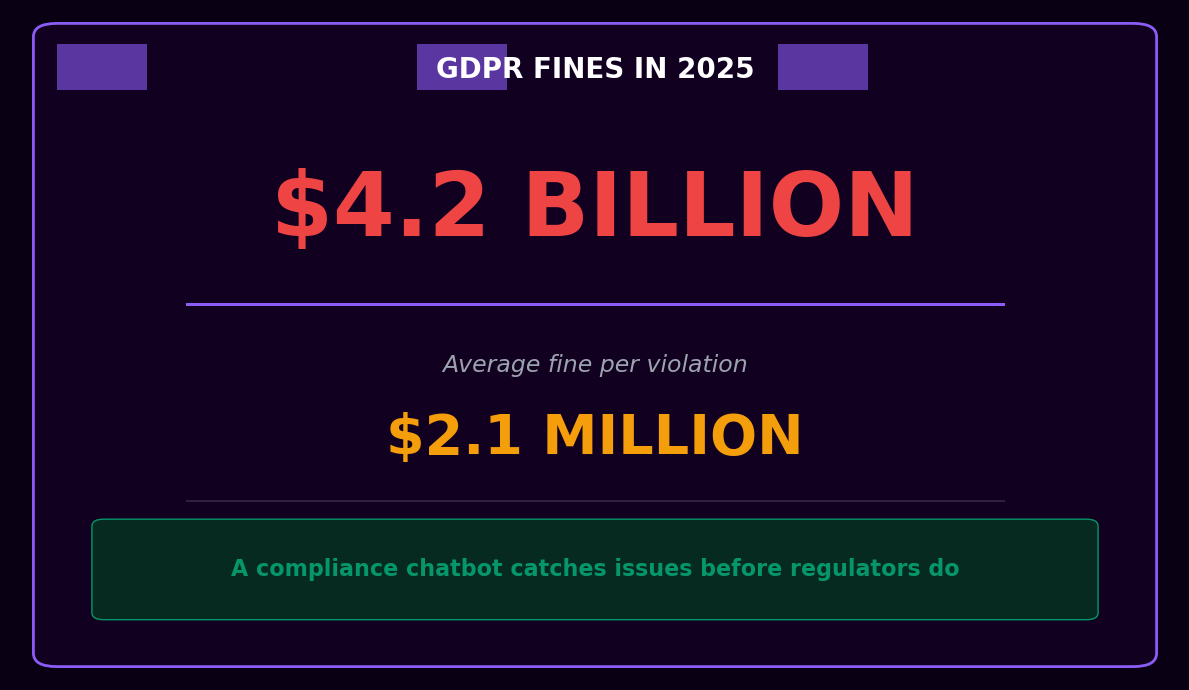
Enforcement Statistics and Fine Distribution
| Violation Category | % of Total Fines Issued | Average Fine (SME) | Average Fine (Large Enterprise) |
|---|---|---|---|
| Insufficient legal basis / consent failures | 34% | 28,000 euros | 4.2 million euros |
| Non-compliance with data subject rights | 22% | 18,500 euros | 1.8 million euros |
| Insufficient technical / organisational measures | 19% | 35,000 euros | 6.1 million euros |
| Breach notification failures | 12% | 22,000 euros | 2.4 million euros |
| Unlawful international data transfers | 8% | 41,000 euros | 310 million euros |
| Insufficient transparency / privacy notices | 5% | 12,000 euros | 890,000 euros |
The Cost of Reactive vs. Proactive Compliance
The fully-loaded cost of a GDPR enforcement action extends well beyond the headline fine. Legal costs for responding to a supervisory authority investigation typically run 15,000-80,000 euros depending on complexity and jurisdiction. Remediation costs -- re-building non-compliant consent flows, implementing data subject request processes, appointing a DPO -- add 20,000-150,000 euros for organisations that have not invested in compliance infrastructure. Reputational damage from a public enforcement action produces measurable customer churn in B2C businesses, with post-enforcement customer retention rates typically 8-15% below baseline for the six months following a public decision.
A compliance automation platform that prevents enforcement actions generates a return that is disproportionate to its cost. For a mid-size SaaS business with 50,000 EU users, the annual risk-weighted expected cost of an enforcement action -- probability of investigation multiplied by expected fine and associated costs -- typically exceeds 30,000 euros. Compliance automation at a fraction of that cost reduces the probability of investigation significantly by creating the documented processes that supervisory authorities look for as evidence of accountability.
The 72-Hour Breach Notification Window: Operational Reality
The 72-hour breach notification window under Article 33 is one of the most operationally difficult GDPR requirements because it demands an organised response from an organisation that has just experienced a disruptive security incident. Without a prepared workflow, the 72 hours are consumed by incident containment, internal communication, and trying to understand what happened -- leaving no time to prepare the supervisory authority notification. With the compliance checker's breach triage workflow, the notification assessment and draft can be completed within 4-8 hours of incident discovery, leaving ample time for DPO review, legal sign-off, and submission within the deadline. Late breach notification was cited as an aggravating factor in 67% of the enforcement decisions that included breach notification failures in 2026.
Building the Internal Business Case
Use Conferbot's pricing page to understand the platform cost relative to your organisation's GDPR risk profile. For most organisations with more than 5,000 EU data subjects, the risk-adjusted ROI of compliance automation is positive within the first year. Present the business case to senior leadership using the enforcement statistics above, the fully-loaded cost model for an enforcement action, and the specific operational gaps identified by the compliance checker's initial assessment workflow.
50,000+ businesses use Conferbot templates to automate conversations
Setup Guide: Deploying the GDPR Compliance Checker
Deploying the GDPR compliance checker is structured as a phased implementation that starts with the highest-priority compliance gaps and expands to full operational coverage. The initial deployment covering consent management and data subject request handling can be completed in under a week. Full deployment including ROPA management, DPIA workflows, and international transfer tracking typically takes two to three weeks.
Step 1: Compliance Gap Assessment (Day 1-2)
Begin with the bot's initial compliance assessment questionnaire, which covers all ten Article 5 principles and maps the organisation's current processes against the requirements for each. The assessment identifies which compliance areas have adequate processes, which have partial processes with gaps, and which have no formal processes at all. This gap analysis becomes the implementation priority list: areas with no formal processes represent the highest regulatory risk and should be addressed first.
Step 2: Consent Management Configuration (Day 2-3)
Configure the consent management module by mapping each processing purpose the organisation relies on consent for. For each purpose, define the consent text (which must meet the intelligibility standard -- clear, plain language that a layperson can understand), the consent mechanism (opt-in checkbox, affirmative click, verbal confirmation with record), and the withdrawal pathway. Connect the consent management module to your web forms, CRM, and email marketing platform through the API integration panel to enable automatic consent record synchronisation.
Step 3: Data Subject Request Workflow Setup (Day 3-4)
Map all the systems that hold personal data about your data subjects. For each system, identify the system owner responsible for responding to data subject requests and configure their role in the request routing workflow. Set up the identity verification requirements appropriate to your risk profile. Configure the deadline alert thresholds and notification channels -- the website chatbot provides the public-facing request intake interface, while internal escalations route through your configured DPO notification channel.
Step 4: Breach Response Workflow Configuration (Day 4-5)
Configure the breach triage questionnaire with your organisation's specific data categories, processing systems, and risk thresholds. Define the severity classification criteria -- what constitutes a high-risk breach in your specific context (categories of data you hold, volumes, likely consequences for your data subjects). Enter your supervisory authority's notification portal details and contact information. Test the full breach workflow end-to-end with a simulated incident before going live.
Step 5: ROPA Population (Week 2)
Schedule a series of 30-minute working sessions with each data owner across the organisation to populate processing activity entries in the records of processing activities. The bot guides each data owner through the Article 30 fields with plain-language prompts. A typical organisation with 15-25 distinct processing activities can complete the initial ROPA population in three to five working sessions spread across a week.
Step 6: Staff Training Deployment and Launch (Week 2-3)
Deploy the staff training module to all employees who handle personal data. Configure the training completion tracking and set the annual refresher reminder schedule. Embed the public-facing data subject request interface on your website and link it from your privacy notice. Connect the management interface to the DPO's dashboard and configure the analytics reporting for the compliance metrics your organisation needs to track.
EU AI Act Considerations for AI-Powered Compliance Tools
The EU Artificial Intelligence Act, which entered into force in August 2024 and is being phased in through 2026, introduces a risk-based regulatory framework for AI systems deployed in the EU that intersects with GDPR in several important ways. Organisations deploying AI-powered compliance tools -- including chatbot-based GDPR compliance checkers -- need to understand how the AI Act applies to their use case and what obligations it creates alongside their existing GDPR compliance programme.
AI Act Risk Classification for Compliance Chatbots
The AI Act classifies AI systems by risk level: unacceptable risk (prohibited), high risk (extensive obligations), limited risk (transparency obligations), and minimal risk (no specific obligations beyond existing law). A GDPR compliance checker chatbot that guides users through compliance processes and provides information falls into the limited-risk category under the AI Act's current classification framework -- it is an AI system that interacts with natural persons and must therefore comply with the AI Act's transparency obligations for such systems.
Specifically, limited-risk AI systems that interact with natural persons must:
- Inform users that they are interacting with an AI system, unless this is obvious from context
- Not be designed to deceive users about their AI nature
- Comply with applicable sector-specific regulation (in this case, GDPR) in addition to the AI Act's transparency requirements
Intersection with GDPR: AI-Assisted Decision-Making
Where a GDPR compliance checker makes or substantially contributes to decisions that affect individuals -- for example, an automated assessment of whether a data subject request meets the criteria for the relevant right -- Article 22 GDPR's provisions on automated individual decision-making may apply. Article 22 restricts decisions based solely on automated processing that produce legal or similarly significant effects on individuals. For compliance chatbot deployments, this means ensuring that consequential compliance decisions -- whether a breach is notifiable, whether an erasure request is valid, whether consent is sufficient -- involve human review and are not made by the AI system alone.
Data Protection Impact Assessment for AI Systems
Deploying an AI system that processes personal data -- including personal data about your employees' compliance activities and data subjects' requests -- will in many cases require a DPIA under Article 35 GDPR. The DPIA trigger assessment built into the compliance checker includes an AI deployment assessment that evaluates whether the specific AI tool you are deploying requires a DPIA and, if so, initiates the DPIA workflow for the AI deployment itself. This ensures the meta-requirement is addressed: the tool you are using to manage GDPR compliance is itself GDPR-compliant.
AI Act Compliance Timeline and Preparation
| AI Act Provision | Applicability Date | Relevant for Compliance Chatbots | Preparation Action |
|---|---|---|---|
| Prohibited AI practices ban | February 2025 | Not applicable (compliance chatbots do not fall in prohibited categories) | Confirm classification |
| GPAI model obligations | August 2025 | Relevant if underlying LLM is a general-purpose AI model | Review provider's AI Act compliance documentation |
| High-risk AI system obligations | August 2026 | Potentially applicable if chatbot is used in employment or law enforcement contexts | Conduct risk classification assessment |
| Limited-risk transparency obligations | August 2026 | Applicable -- chatbots interacting with natural persons require disclosure | Implement AI disclosure in chatbot interface |
For organisations managing both GDPR and AI Act compliance, the compliance checker's assessment framework will be updated as the AI Act's implementing acts and guidance from the European AI Office are published. Connect the compliance checker with Conferbot's API integration layer to receive automated compliance update notifications when regulatory requirements relevant to your deployment profile change.
GDPR Compliance Checker FAQ
Everything you need to know about chatbots for gdpr compliance checker.
Why Use a Template vs Building from Scratch?
Templates encode years of optimization data into the conversation flow before you start.
| Factor | Conferbot Template | Build from Scratch | Hire a Developer |
|---|---|---|---|
| Time to deploy | 10 minutes | 2-8 hours | 2-6 weeks |
| Cost | Free | Your time | $5,000-$25,000 |
| Day-1 conversion | 15-22% | 5-8% | 10-15% |
| Proven flows | Yes, data-tested | No | Depends |
| Updates included | Automatic | Manual | Paid |
| Multi-channel | 8+ channels | 1 channel | Extra cost |
| Analytics | Built-in | Must build | Extra cost |
Related Legal and Compliance Templates
Explore more chatbot templates in this category





Ready to Deploy GDPR Compliance Checker?
Join 50,000+ businesses. Free forever plan available. No credit card required.