Why Tutoring Services Need a Chatbot in 2026
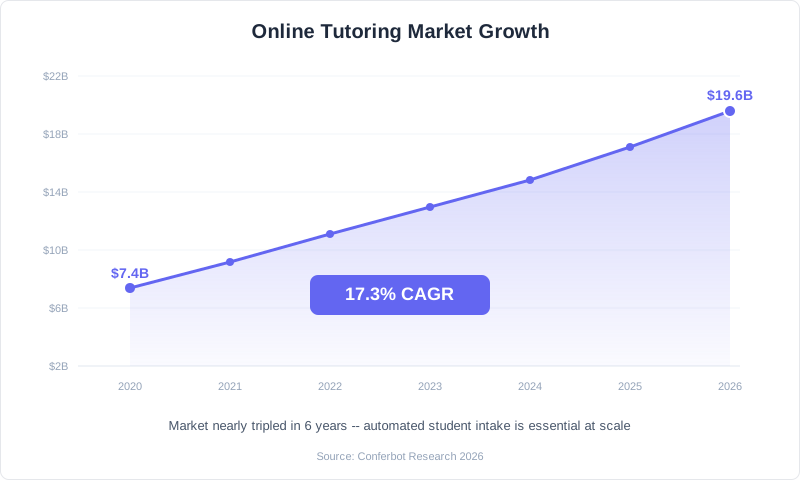
The tutoring industry is experiencing unprecedented growth. According to Grand View Research, the global online tutoring market is projected to exceed $200 billion by 2028, driven by increasing demand for personalized education, the normalization of online learning after the pandemic, and growing parental investment in academic support. In the United States alone, more than 40% of K-12 students use some form of tutoring, and the average family spends $1,500 to $4,000 per year on tutoring services.
But growth creates operational challenges. Every new student inquiry requires a multi-step process: understanding what subject and level the student needs help with, assessing their current academic situation, matching them with an appropriate tutor based on subject expertise and schedule compatibility, coordinating trial sessions, collecting parent or guardian information for minors, processing enrollment paperwork, and setting up a recurring session schedule. For a tutoring center handling 50 to 100 inquiries per week, this enrollment process consumes enormous administrative time -- time that should be spent delivering educational value.
The problem is compounded by timing. Parents researching tutoring do so outside business hours. A mother who sees her child struggling with algebra homework at 8 PM on a Wednesday night opens Google and searches for math tutors. She visits three tutoring websites, fills out inquiry forms on two of them, and bookmarks the third. By the time your office opens at 9 AM Thursday and calls her back, she has already enrolled her child with the competitor who responded first -- or she has moved on to other priorities and the urgency has faded.
A tutoring service chatbot eliminates this delay entirely. It engages the parent or student the moment they arrive on your website, gathers the information needed to match them with the right tutor, answers their questions about pricing and scheduling, and can even book a trial session -- all within a 3-5 minute conversation at 8 PM on a Wednesday when no human staff member is available. The chatbot becomes your always-on enrollment coordinator, ensuring that no inquiry goes unanswered and no motivated parent cools off while waiting for a callback.
This guide covers everything tutoring businesses need to build and deploy an effective enrollment chatbot: intake and qualification flows, tutor matching logic, parent communication strategies, pricing presentation, trial session scheduling, multi-subject handling, and the ROI analysis that justifies the investment. Whether you run a single-location tutoring center, an online tutoring platform, a test prep company, or a network of independent tutors, these strategies will help you convert more inquiries into enrolled students while dramatically reducing your administrative burden.
The Enrollment Funnel: Where Tutoring Services Lose Students
Understanding where and why potential students drop out of your enrollment funnel is essential to fixing the problem. Tutoring services typically lose prospects at four critical points, and a chatbot addresses each one.
Loss Point 1: Initial Response Time
Research on lead response times from Harvard Business Review consistently shows that businesses responding within 5 minutes are 21 times more likely to qualify a lead than those responding within 30 minutes. For tutoring services, the window is even tighter because the parent's urgency is driven by an immediate emotional trigger -- watching their child struggle with homework, receiving a disappointing report card, or realizing a standardized test is 6 weeks away. That urgency fades quickly. If your response comes 12 hours later via email, the motivation that drove the initial inquiry has dissipated. A chatbot responds in under 2 seconds, capturing the parent at peak motivation.
Loss Point 2: Information Gathering Friction
Enrollment forms are the second biggest conversion killer. A parent who clicks "Get Started" and encounters a form with 15 fields -- student name, grade, school, subjects, schedule preferences, learning goals, address, phone, email, parent name, how did you hear about us -- abandons 60-70% of the time. The form feels like work, not progress. A chatbot gathers the same information conversationally, one question at a time, making the process feel like a helpful dialogue rather than a bureaucratic hurdle. Chatbot-style intake achieves 3-4x higher completion rates than static forms.
Loss Point 3: Tutor Matching Delay
After an inquiry comes in, someone on your team must review the student's needs, check tutor availability, and propose a match. This process takes 24-48 hours at many tutoring services. During that delay, the parent may enroll elsewhere or simply lose the motivation to act. A chatbot with access to your tutor database can suggest a match in real time: "Based on your daughter's need for Algebra 2 help and her availability on Tuesday and Thursday evenings, I'd recommend Sarah, who has a Master's in Mathematics and 5 years of experience teaching high school algebra. Would you like to schedule a trial session with Sarah?"
Loss Point 4: Pricing Hesitation
Many tutoring services hide their pricing, requiring a phone call or consultation to learn the cost. While this approach is intended to create a sales opportunity, it actually deters a significant percentage of parents who want to compare options before committing to a conversation. A chatbot can present pricing transparently while framing the value: "Our one-on-one tutoring sessions are $60 per hour. Most students meet 1-2 times per week. We offer a 10% discount for packages of 10 or more sessions. Your first session is a complimentary assessment so we can understand your child's needs -- there is no obligation." This transparency builds trust and pre-qualifies families based on budget before any human time is invested.
The Compound Effect of Funnel Losses
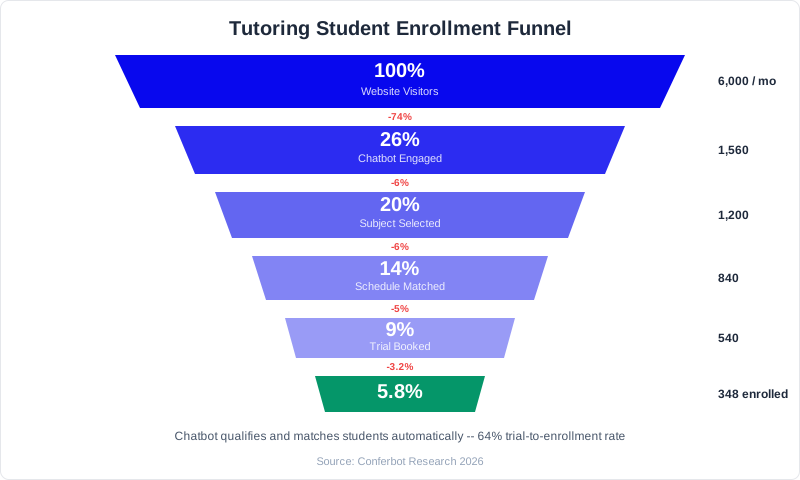
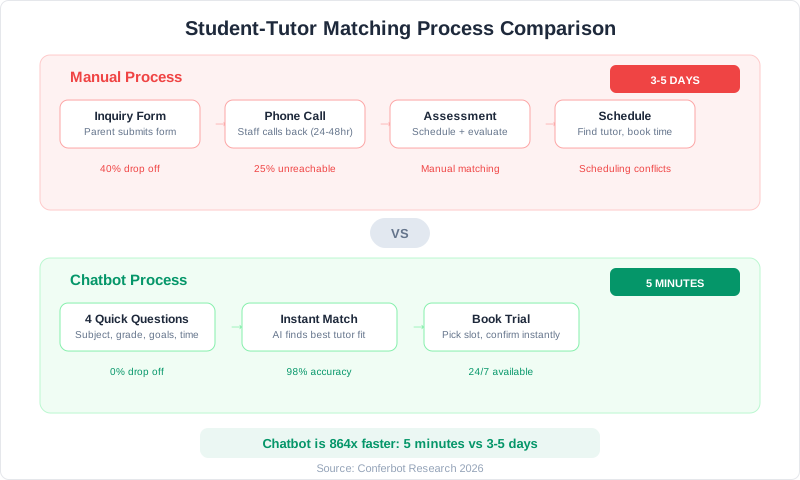
Consider a tutoring service that receives 100 inquiries per month. With typical funnel losses: 40% never receive a timely response (lost: 40). Of the remaining 60, 50% abandon during the information gathering process (lost: 30). Of the remaining 30, 30% drop off during the tutor matching delay (lost: 9). Of the remaining 21, 25% are deterred by unclear pricing (lost: 5). Final enrollments: 16 out of 100 inquiries -- a 16% conversion rate. A chatbot that addresses all four loss points can realistically improve this to 30-40%, doubling or tripling enrollment from the same inquiry volume.
Student Intake and Qualification: The Chatbot Conversation Flow
The intake conversation is the foundation of your tutoring chatbot, addressing the personalized learning needs that the National Center for Education Statistics (NCES) identifies as critical for student success. It must be thorough enough to enable tutor matching but fast enough that parents do not lose patience. The optimal flow takes 3-5 minutes and collects everything needed to propose a tutor match and schedule a trial session.
Step 1: Welcome and Intent Identification
"Welcome to [Tutoring Service Name]! Are you looking for tutoring for yourself or for your child?" This opening question immediately identifies whether you are speaking with a parent (the decision-maker and payer) or a student (who may be the decision-maker for college students or the influencer for younger students). The chatbot adapts its language accordingly -- more professional and outcome-focused for parents, more encouraging and relatable for students.
Step 2: Subject and Level Assessment
"What subject does [student name] need help with?" Present categories with specific options:
- Mathematics: Elementary Math, Pre-Algebra, Algebra 1, Algebra 2, Geometry, Pre-Calculus, Calculus, Statistics, AP Math courses
- Science: General Science, Biology, Chemistry, Physics, AP Science courses, Earth Science
- English/Language Arts: Reading Comprehension, Grammar and Writing, Essay Writing, Literature, AP English
- Test Preparation: SAT, ACT, GRE, GMAT, LSAT, MCAT, AP Exams, State Standardized Tests
- Foreign Languages: Spanish, French, Mandarin, Japanese, German, ESL/ELL
- Other: Computer Science, History, Economics, Music Theory, Study Skills
"What grade level is your child in?" Grade level combined with subject provides the data needed for tutor matching. A student in 8th-grade Algebra 1 needs a different tutor than a student in 11th-grade Calculus, even though both fall under "math."
Step 3: Current Situation Assessment
"How would you describe [student name]'s current situation with [subject]?" with options like:
- Struggling significantly -- failing or close to failing
- Getting by but wants to improve grades
- Doing well but wants to excel or prepare for advanced courses
- Preparing for a specific test (SAT, ACT, AP exam, etc.)
- Needs help getting started with a new subject
This question serves two purposes: it helps match the student with a tutor whose teaching style fits the situation (a struggling student needs patience and fundamentals; an excelling student needs challenge and enrichment), and it sets expectations for the parent about what tutoring can realistically achieve.
Step 4: Schedule Preferences
"What days and times work best for tutoring sessions?" Present common options:
- Weekday afternoons (3-6 PM)
- Weekday evenings (6-9 PM)
- Saturday mornings
- Saturday afternoons
- Sunday
- Flexible -- we can work around tutor availability
"Do you prefer in-person sessions, online sessions, or either?" This question is critical because it determines whether you are matching from your local tutor pool or your full roster of online tutors. Online-flexible students can be matched faster because the tutor pool is larger.
Step 5: Contact Information
"Great, I have a good picture of what [student name] needs. To match you with the right tutor and schedule a complimentary assessment session, I will need: Parent/guardian name, email address, and phone number." For adult students seeking their own tutoring, adjust accordingly. The chatbot explains why each piece of information is needed, reducing friction: "We will use your email to send tutor match suggestions and your phone number for session reminders."
Step 6: Additional Context (Optional)
"Is there anything else that would help us find the perfect tutor? For example, does your child have any learning differences we should know about, or specific goals like improving a grade by end of semester?" This open-ended question catches important details that structured questions miss: IEP accommodations, gifted program participation, specific teacher requirements, upcoming deadlines, or family circumstances that affect scheduling.
Automated Tutor Matching: Finding the Right Fit in Real Time
The magic of a tutoring chatbot lies in its ability to propose a tutor match within the conversation rather than after a 24-48 hour review period. Real-time matching transforms the enrollment experience from a multi-day process into a single, satisfying interaction.
Building the Tutor Database
Effective matching requires a structured tutor database with the following fields for each tutor:
- Subject expertise: List of subjects and levels they can teach (e.g., Algebra 1 through Calculus, AP Physics)
- Grade level range: Elementary, middle school, high school, college, adult learners
- Availability: Weekly schedule of open time slots, updated in real time
- Teaching mode: In-person only, online only, or both
- Location: For in-person matching, the tutor's service area or center location
- Teaching style: Patient and methodical (for struggling students), challenging and fast-paced (for advanced students), test-prep focused, etc.
- Credentials: Education level, certifications, years of experience
- Specializations: Learning differences, ESL, gifted students, specific test prep
- Client ratings: Average rating and review highlights
- Availability status: Accepting new students or waitlisted
The Matching Algorithm
The chatbot's matching logic works through a series of filters, narrowing the tutor pool from your full roster to the 1-3 best matches:
- Subject and level filter: Eliminates tutors who do not teach the required subject at the required level. This is the most restrictive filter.
- Schedule compatibility: Compares the student's preferred times with each remaining tutor's available slots. No schedule overlap means no match, regardless of qualifications.
- Mode preference: If the student requires in-person, filter to local tutors. If online, the full roster is available.
- Teaching style fit: Match the student's situation (struggling, improving, excelling, test prep) with tutors whose teaching style fits.
- Availability status: Filter to tutors currently accepting new students.
- Ranking: From the remaining pool, rank by client ratings, experience, and credential relevance.
Presenting the Match
The chatbot presents the top match conversationally: "Based on what you have told me, I would recommend David for your son's Algebra 2 tutoring. David has a Master's degree in Mathematics, 7 years of tutoring experience, and specializes in helping high school students build confidence in advanced math. He has a 4.9 out of 5 rating from 47 families. He has availability on Tuesday evenings at 6:30 PM and Thursday evenings at 7:00 PM -- both of which fit your schedule. Would you like to schedule a complimentary assessment session with David?"
If the parent wants to see alternatives: "Absolutely! Here are two other great options: Maria, who has 4 years of experience and availability on Monday and Wednesday evenings, and James, who specializes in AP-level math and is available Saturday mornings. All three are excellent -- would you like to learn more about any of them?"
When No Match Is Available
If no tutor matches the student's specific needs and schedule, the chatbot handles it gracefully: "I do not have an immediate match for AP Chemistry on Thursday evenings, but I have two options for you. First, we have Dr. Williams available for AP Chemistry on Wednesday evenings -- would a different day work? Second, I can add you to our priority list and notify you as soon as a Thursday evening AP Chemistry tutor becomes available, which usually takes 3-5 days. Which would you prefer?" This approach retains the lead rather than sending them to a competitor.
Parent Communication: Building Trust Through the Chatbot
For K-12 tutoring, the parent is the decision-maker, the payer, and the person who needs the most reassurance. A tutoring chatbot must communicate effectively with parents who are often anxious about their child's academic performance and uncertain about whether tutoring is the right investment. The chatbot's tone, transparency, and expertise determine whether parents trust it enough to take the next step.
Addressing Parent Concerns Proactively
Parents come to a tutoring website with specific concerns and anxieties. The chatbot should address the most common ones within the natural flow of conversation:
"Is tutoring really worth the money?" The chatbot responds with data: "Research from the RAND Corporation shows that high-dosage tutoring (2-3 sessions per week) can improve student performance by the equivalent of moving from the 50th percentile to the 66th percentile. Our students see an average grade improvement of 1.5 letter grades within one semester. We also offer a satisfaction guarantee -- if you are not seeing progress after the first month, we will adjust the approach or provide additional sessions at no charge."
"How do I know the tutor is qualified?" The chatbot builds confidence: "All of our tutors undergo a rigorous vetting process that includes credential verification, subject matter testing, background checks, and a supervised teaching demonstration. Our average tutor has 5+ years of experience and a 4.7 out of 5 satisfaction rating. During the free assessment session, you will see your child's tutor in action and can decide if the fit is right."
"My child has a learning difference (ADHD, dyslexia, etc.). Can you help?" The chatbot reassures: "Absolutely. Several of our tutors specialize in working with students who have learning differences. They use evidence-based strategies tailored to each student's learning style. During the intake, we will make sure to match your child with a tutor experienced in their specific needs. Would you like to tell me more about your child's learning profile so we can find the best match?"
"How long until we see improvement?" The chatbot sets realistic expectations: "Most families begin to see noticeable improvement within 4-6 weeks of consistent tutoring (1-2 sessions per week). The first few sessions focus on assessment and building rapport. By weeks 3-4, your child's tutor has identified the specific gaps and is working through them systematically. By week 6, most students show measurable improvement in test scores and homework completion. We provide progress updates after every 4 sessions so you can track your child's growth."
Progress Reporting Through the Chatbot
After enrollment, the chatbot becomes a communication channel for ongoing parent engagement. After every fourth session, it sends a progress summary: "Hi Mrs. Chen, here is a quick update on Alex's math tutoring with David. Over the last 4 sessions, they have covered quadratic equations and factoring. David reports that Alex is showing strong improvement in problem-solving confidence and his quiz scores have improved from C- to B range. The next focus area will be systems of equations. Would you like to discuss anything with David?"
This proactive communication keeps parents informed without requiring the tutor to spend time on administrative reporting. It also reduces cancellations by consistently demonstrating the value of ongoing sessions.
Payment and Scheduling Communication
The chatbot handles the practical aspects of parent communication: payment reminders ("Your next session package is due on the 15th. Would you like to renew your 10-session package at the 10% discounted rate?"), schedule changes ("David will be unavailable next Tuesday. Would you like to reschedule to Wednesday at the same time, or skip this week?"), and holiday scheduling ("Our tutoring center will be closed December 23-January 2 for the holidays. Would you like to schedule extra sessions the week before to keep momentum going?").
Step-by-Step: Building a Tutoring Service Chatbot with Conferbot
Building a tutoring enrollment chatbot, aligned with the digital transformation trends the U.S. Department of Education's Office of Educational Technology promotes, on Conferbot's no-code platform takes approximately 2 hours. Here is the complete implementation guide.
Step 1: Define Your Subject and Tutor Catalog (20 Minutes)
Create a structured list of every subject and level you offer, organized by category. For each subject-level combination, identify which tutors are qualified and available. This catalog becomes the foundation of your matching system. Store tutor profiles with their credentials, availability, teaching style, and ratings.
Step 2: Build the Intake Conversation Flow (30 Minutes)
Using Conferbot's visual flow builder, create the student intake conversation. Start with the welcome message and intent question (tutoring for self vs. child), then build branching paths for subject selection, grade level, current situation assessment, schedule preferences, mode preference (online/in-person), and contact information collection. Use conditional logic at each step -- selecting "Test Prep" as the subject category should branch to a list of specific tests rather than grade levels.
Step 3: Configure the Tutor Matching Logic (20 Minutes)
Set up the matching system that connects intake data to tutor profiles. Conferbot's conditional logic allows you to filter tutors by subject, level, availability, and mode, then present the top match within the conversation. For simpler setups, you can use decision-tree logic that maps common subject-level combinations to specific tutors. For larger operations with dozens of tutors, integrate with your tutor management database via API.
Step 4: Set Up Trial Session Scheduling (15 Minutes)
Connect the chatbot to your scheduling system (Calendly, Acuity, Google Calendar, or your custom platform). Configure it to show only available time slots that match both the student's preferences and the recommended tutor's schedule. The chatbot should present 3-4 options: "David is available for a complimentary 30-minute assessment session on Monday at 4:30 PM, Wednesday at 5:00 PM, or Saturday at 10:00 AM. Which works best?"
Step 5: Load Your Knowledge Base (15 Minutes)
Add answers to the 30-40 most common questions parents and students ask: pricing details, cancellation policy, tutor qualifications, session format, online platform requirements (Zoom, Google Meet), refund policy, group tutoring options, homework help availability, test prep timelines, and your teaching methodology. Load these into the knowledge base so the chatbot can answer naturally during conversation.
Step 6: Configure Integrations (15 Minutes)
Connect the chatbot to your CRM or student management system so that every inquiry creates a new student record with all collected data. Set up email and SMS notifications for your enrollment team when a new qualified inquiry comes in. Configure automated confirmation emails for scheduled trial sessions. If you use a tutoring-specific platform like TutorCruncher, Teachworks, or My Tutor Platform, connect the chatbot to push enrollment data directly into your existing workflow.
Step 7: Deploy Across Channels (10 Minutes)
Deploy the chatbot on your website -- especially your homepage, subject-specific pages, and landing pages for paid advertising campaigns. Also deploy on WhatsApp for parents who prefer messaging and on Facebook for inquiries from social media. Test every conversation path thoroughly: a parent inquiring about elementary math, a high school student looking for SAT prep, a college student needing calculus help, and a parent with a child who has learning differences.
Step 8: Train Your Team and Launch (15 Minutes)
Brief your tutors and administrative staff on the chatbot system. They should know that new inquiries will arrive with complete intake data, that trial sessions may be pre-scheduled, and that the chatbot handles routine follow-ups. Clarify the handoff process for complex situations the chatbot routes to a human. Then launch and monitor the first week's performance using Conferbot analytics.
ROI Analysis: The Business Case for a Tutoring Enrollment Chatbot
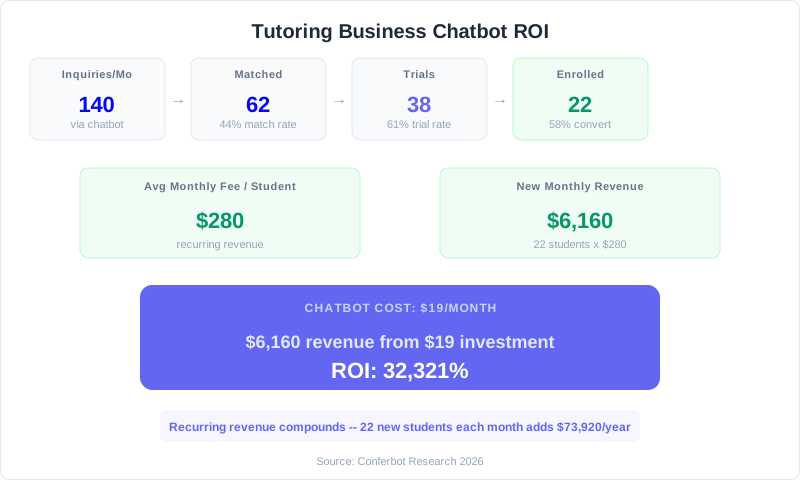
Tutoring business owners and directors need to see the numbers. Let us build a comprehensive ROI model for a mid-size tutoring service to demonstrate exactly how a chatbot impacts enrollment and revenue.
Business Profile
- Type: Tutoring center with online and in-person options
- Tutors: 15 active tutors
- Monthly inquiries: 80
- Current conversion rate (inquiry to enrolled student): 18%
- Monthly new enrollments: 14.4
- Average monthly revenue per student: $480 (2 sessions/week at $60/session)
- Average student retention: 6 months
- Student lifetime value: $2,880
Chatbot Investment
- Platform subscription: $100-$200/month
- Initial setup time: 4-6 hours (staff time for configuration and knowledge base loading)
- Ongoing optimization: 2-3 hours/month
- Total monthly cost: $150 (midpoint)
Impact on Enrollment Funnel
Without chatbot:
- 80 inquiries per month
- Timely response to 60% (48 get a response within 4 hours)
- 32 abandoned during information gathering (form friction)
- 24-48 hour tutor matching delay loses another 20%
- Final enrollments: ~14 (18% of inquiries)
With chatbot:
- 80 inquiries per month (same volume)
- 100% receive an instant response (no lost inquiries due to response time)
- Conversational intake achieves 70% completion (vs. 40% for forms)
- Real-time tutor matching eliminates the matching delay entirely
- Transparent pricing pre-qualifies families by budget
- Trial session scheduling within the conversation captures commitment
- Final enrollments: ~28 (35% of inquiries)
Revenue Impact
- Additional monthly enrollments: 14 (28 vs. 14 baseline)
- Additional monthly revenue per new cohort: 14 x $480 = $6,720
- Cumulative monthly revenue by month 6: As each month's cohort retains, revenue compounds. Month 1: $6,720. Month 2: $13,440. Month 3: $20,160. Month 6: $40,320 in additional monthly revenue above baseline.
- First-year additional revenue: Approximately $282,000 (cumulative across 12 monthly cohorts with 6-month average retention)
Administrative Time Savings
- Time per manual inquiry processing: 20-30 minutes (phone call, data entry, tutor matching research, follow-up)
- Monthly inquiries: 80
- Monthly time saved: 80 x 25 minutes = 33 hours
- At $25/hour administrative cost: $825/month saved
- Annual administrative savings: $9,900
Total First-Year ROI
- Additional enrollment revenue: ~$282,000
- Administrative time savings: $9,900
- Total benefit: ~$291,900
- Chatbot cost: $1,800 (12 months x $150)
- Net benefit: ~$290,100
- ROI: 16,117%
Even using the most conservative assumptions -- halving the enrollment improvement and reducing retention to 4 months -- the chatbot still delivers over $90,000 in first-year net benefit. For a tutoring service, the chatbot is not an expense; it is the single highest-ROI investment available for growing enrollment.
Handling Multi-Subject Needs and Test Preparation
Many students need help in multiple subjects, and test preparation has its own unique workflow. A well-designed chatbot handles both scenarios without creating a confusing or lengthy conversation.
Multi-Subject Enrollment
When a parent mentions multiple subjects -- "My daughter needs help with both math and English" -- the chatbot handles this efficiently. It collects information for each subject in sequence: "Let's start with math. What level is your daughter at in math?" then "And for English, what specific area does she need help with -- reading comprehension, writing, grammar, or literature?" The chatbot then runs the matching algorithm for each subject, which may or may not result in the same tutor.
If one tutor can cover both subjects: "Great news -- our tutor Sarah specializes in both Algebra 2 and English Composition for high school students. She could work with your daughter on both subjects, which simplifies scheduling. Would you like to set up a trial session with Sarah?"
If different tutors are needed: "For Algebra 2, I would recommend David (Master's in Mathematics, 4.9 rating). For AP English, I would recommend Jennifer (former AP English teacher, 4.8 rating). We can schedule both tutors on the same day if you'd like to minimize trips -- David at 4:00 PM and Jennifer at 5:00 PM. How does that sound?"
Test Preparation Workflows
Test prep inquiries require a different conversation flow than subject tutoring because they are time-bound and goal-specific. The chatbot adapts:
"When is the test scheduled?" This determines how much preparation time is available and how intensive the tutoring needs to be. An SAT six months away calls for 1-2 sessions per week. An ACT three weeks away requires an intensive crash course.
"Has your child taken a practice test? If so, what was the score?" This baseline score helps set realistic improvement goals and identify which sections need the most attention. "A practice score of 1150 with strong reading but weaker math suggests we should focus 70% of sessions on math strategies."
"What is your target score?" Combined with the baseline, this determines the intensity and duration of the program. "To improve from 1150 to 1350 in 3 months, we would recommend 2 sessions per week focused on math problem-solving strategies and test-taking techniques, plus weekly practice tests."
The chatbot then matches the student with a test prep specialist rather than a general subject tutor, and presents a structured program rather than open-ended sessions: "Our SAT Prep Program includes 24 sessions over 12 weeks, 4 full-length practice tests with score analysis, and targeted strategy work on your weakest sections. The program is $1,200 (a 17% savings over individual session pricing). Would you like to schedule an assessment session to get started?"
College Admissions Consulting
For tutoring services that also offer college admissions consulting, the chatbot identifies these opportunities: "Since your daughter is preparing for the SAT and is currently in her junior year, you might also be interested in our College Admissions Consulting package, which includes essay review, application strategy, and school list development. Would you like information about that?" This cross-sell adds significant revenue from families already in the enrollment pipeline.
Summer Intensive Programs
The chatbot promotes seasonal programs during relevant periods: "Summer is a great time to get ahead! Our Summer Math Intensive covers one full year of curriculum in 8 weeks -- students enter the fall semester a year ahead of their classmates. We also offer summer reading programs, SAT/ACT boot camps, and enrichment courses in coding and creative writing. Would you like details on any of these programs?"
Communication Channels and Preferences for Education
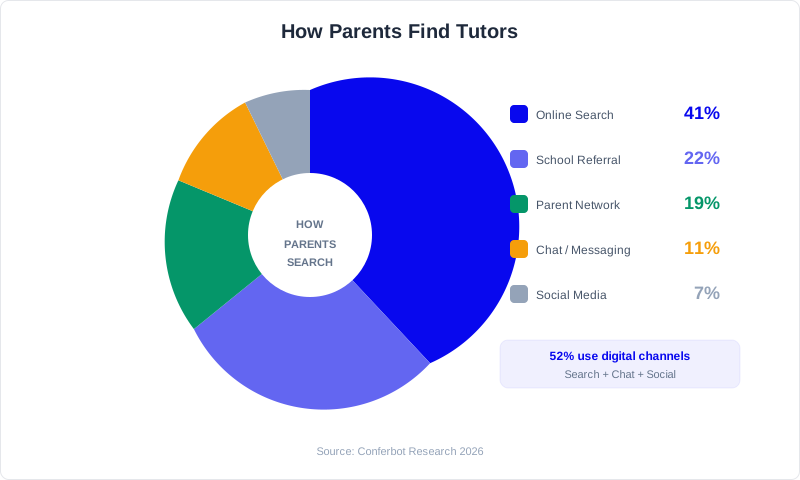
According to the National Center for Education Statistics, student support service usage has grown steadily since 2020. Tutoring services serve a diverse audience -- parents of elementary students, parents of high schoolers, college students, adult learners, and even corporate training managers. Each audience has distinct communication preferences, and a successful chatbot strategy meets each segment on their preferred channel.
Parents of K-8 Students
Parents of younger students are typically aged 30-45 and tend to prefer a mix of website research and direct communication. They visit your website, read reviews, compare options, and then want to engage with someone (or something) that addresses their specific child's needs. They value reassurance, credentials, and safety. The chatbot should emphasize tutor background checks, supervised sessions, and progress reporting. Many parents in this group also respond well to WhatsApp and SMS for ongoing communication after enrollment.
Parents of High School Students
Parents of high schoolers are often more focused on outcomes -- grade improvement, test scores, college readiness. They are more budget-conscious because tutoring competes with other extracurricular investments. The chatbot should lead with results data: average grade improvements, test score increases, and college acceptance outcomes for past students. These parents are also more likely to be influenced by their child's preference, so the chatbot should be prepared for scenarios where the student initiates the inquiry and the parent follows up.
College Students
College students searching for tutoring help are typically doing so independently and prefer instant, mobile-friendly communication. They are less concerned about credentials and more focused on availability, subject-specific expertise, and cost. The chatbot can be more casual and direct with college students: "Need help with Organic Chemistry? We have three tutors with advanced degrees in Chemistry available this week. Sessions are $55/hour for college-level subjects. Want to see their profiles?" College students are also more likely to engage via Instagram DMs or WhatsApp than through a traditional website form.
Adult Learners
Adults seeking tutoring for professional development (CPA exam prep, coding bootcamp support, language learning) or personal enrichment have distinct needs. They are self-motivated, time-constrained, and willing to pay premium rates for high-quality instruction. The chatbot should emphasize flexibility, expertise, and convenience: "Our CPA exam tutors have passed all four sections and have an 85% first-attempt pass rate among their students. We offer sessions as early as 6 AM and as late as 10 PM to fit your work schedule."
Corporate Training Managers
Some tutoring services also serve corporate clients who need training for their employees. The chatbot should identify corporate inquiries early and route them appropriately: "Are you looking for individual tutoring or training for a group or organization?" Corporate inquiries typically involve larger contracts and should be routed to a sales representative, but the chatbot can collect preliminary information about group size, subject matter, budget range, and timeline before the handoff. Conferbot's live chat handoff makes this transition smooth.
Multi-Channel Deployment Strategy
Based on these audience preferences, deploy your chatbot across multiple channels:
- Website: Primary channel for all audiences. Deploy on homepage, subject-specific pages, pricing page, and testimonials page.
- WhatsApp: Essential for ongoing parent communication and popular with college students.
- Instagram: Effective for reaching high school and college students who discover tutoring services through social media.
- Facebook: Reaches parents who are members of local parenting groups and education-focused communities.
- SMS: Best for appointment reminders and quick scheduling communications with enrolled families.
Student Retention and Ongoing Engagement Through the Chatbot
Enrollment is just the beginning. The real revenue in tutoring comes from student retention, echoing the broader customer retention economics that Harvard Business Review has quantified -- keeping students enrolled for months or years rather than losing them after a few sessions. A chatbot that supports ongoing engagement significantly extends average student tenure and lifetime value.
Session Reminders and Scheduling
The chatbot sends automated session reminders 24 hours and 2 hours before each tutoring appointment. Like nail salons, tutoring services suffer from no-shows and late cancellations that waste tutor time and reduce revenue. Automated reminders with one-tap confirm and reschedule options reduce no-show rates by 25-35%. When a student needs to reschedule, the chatbot offers the tutor's next available slot instantly, keeping the momentum going rather than creating a gap that leads to disengagement.
Progress Check-Ins
Every 4 sessions (approximately bi-weekly for twice-a-week students), the chatbot sends a progress check-in to the parent: "Hi Mrs. Patel, here is a quick update on Aiden's math tutoring. Over the last 4 sessions, David and Aiden have worked through quadratic equations and are making great progress. Aiden's confidence with word problems has improved significantly. David recommends continuing at the current pace. Would you like to discuss anything or schedule a parent-tutor call?" These proactive updates demonstrate value, address concerns before they lead to cancellation, and keep the parent engaged in the tutoring process.
Seasonal Re-Enrollment
The chatbot manages seasonal transitions that are natural churn points for tutoring services. At the end of each school semester, it reaches out: "The fall semester is ending soon. Would you like to continue tutoring through the winter break, or would you prefer to pause and resume in January? Many of our students use the break for catch-up or get-ahead sessions -- would you like to add extra sessions during the holidays?" This proactive outreach turns a potential cancellation point into a renewal opportunity.
Referral Programs
Satisfied parents are the best source of new students, and the chatbot automates the referral process. After a positive progress update, it follows up: "We are so glad Aiden is doing well! If you know any other families looking for tutoring help, our referral program gives you and the referred family each one free session when they enroll. Would you like your personal referral link?" Chatbot-automated referral programs generate 15-25% of new enrollments for well-run tutoring services.
Review and Testimonial Collection
After significant milestones -- a grade improvement, a strong test score, or a 3-month enrollment anniversary -- the chatbot requests a review: "Aiden has been tutoring with us for 3 months and has improved his math grade from a C to a B+. We would love to share his success! Would you be willing to leave a quick review on Google? It helps other families find the right tutoring support." A direct link to the review page makes it effortless. Positive reviews drive organic search visibility and social proof that accelerates future enrollment.
Upselling Additional Services
As the chatbot learns about the student's profile, it identifies appropriate upselling opportunities: "Since Aiden is doing so well in Algebra 2, would he be interested in starting SAT prep? Students who begin prep in their junior year typically see the strongest score improvements. We offer a Junior Year SAT Prep Program that fits alongside regular tutoring sessions." These cross-sells increase student lifetime value while providing genuine educational value.
The Future of AI in Tutoring Services
The intersection of AI and education is one of the most exciting frontiers in technology. Tutoring chatbots will evolve from enrollment tools into active participants in the learning process, fundamentally expanding what tutoring services can offer.
AI-Powered Learning Diagnostics
Future chatbots will conduct preliminary learning assessments within the enrollment conversation. Instead of booking a separate assessment session, the chatbot will present a brief adaptive quiz that identifies the student's specific knowledge gaps in real time: "I would like to ask a few quick questions to understand where we can help the most. What is the solution to 3x + 7 = 22?" Based on the student's responses, the chatbot generates a diagnostic report that pinpoints exact topic areas where the student needs support, allowing the first tutoring session to be productive immediately rather than spending the first 1-2 sessions on assessment.
Adaptive Homework Help
Between tutoring sessions, chatbots will provide on-demand homework help using AI. A student stuck on a chemistry problem at 9 PM can ask the chatbot, which provides guided hints rather than direct answers: "Let us work through this together. What is the first step in balancing a chemical equation?" This Socratic method approach supplements tutoring sessions and keeps students engaged between appointments. It also generates data on which topics the student struggles with, informing the tutor's session planning.
Real-Time Tutor Performance Analytics
AI will analyze student outcomes across your tutor roster to identify which tutors produce the best results for which types of students. A tutor who excels with struggling students may not be the best match for advanced learners, and vice versa. Machine learning models trained on enrollment data, session logs, and outcome metrics will continuously refine tutor matching accuracy, leading to better student outcomes and higher retention rates.
Personalized Learning Path Generation
Based on the assessment data and the student's goals, the chatbot will generate a personalized learning plan: "To improve Aiden's Algebra 2 grade from a C to a B+ by end of semester, here is the recommended plan: Sessions 1-4 will focus on quadratic functions and graphing. Sessions 5-8 will cover polynomial operations. Sessions 9-12 will address rational expressions. Each session includes practice problems and a progress check. The plan adapts based on Aiden's pace." This structured approach gives parents confidence that there is a clear path to their child's goals.
Multilingual Support
As tutoring services expand to serve diverse communities, chatbots will offer seamless multilingual conversations. A parent who is more comfortable in Spanish, Mandarin, or Vietnamese can interact with the chatbot in their preferred language while the student receives English-language tutoring. This removes a barrier that currently prevents many immigrant families from accessing tutoring services.
Getting Started Today
The tutoring services that build chatbot enrollment systems today are positioning themselves for these advanced capabilities tomorrow. Every interaction generates data that trains better matching algorithms. Every enrolled student provides outcome data that improves diagnostic accuracy. Every parent conversation reveals what communication patterns drive retention.
Start with the fundamentals: build an intake flow, configure tutor matching, set up trial session scheduling, and deploy on your website. Build your tutoring enrollment chatbot on Conferbot today, and within 30 days you will have clear data on how many qualified families your current process has been losing. The investment is minimal -- an hour of setup and $100-$200 per month. The impact on your enrollment pipeline will be impossible to ignore. Every inquiry that goes unanswered or responds to too slowly is a student who needed your help and a family that took their tuition dollars elsewhere. A chatbot makes sure that never happens again.
Was this article helpful?
About the Author
The Conferbot team specializes in conversational AI, chatbot strategy, and customer engagement automation. With deep expertise in building AI-powered chatbots, they help businesses deliver exceptional customer experiences across every channel.
View all articles