
Compare the cost of running a fully human-staffed live chat team versus a hybrid model with an AI chatbot handling routine queries. Adjust the inputs to match your business.
Select your industry for pre-filled benchmarks
Configure Your Inputs
Cost Comparison Results
Save 3 agents and $8,581/month with AI-powered hybrid chat
No credit card required. Free 14-day trial.
How This Calculator Works
Three-step cost comparison grounded in real support operation benchmarks.
Human Agent Cost Modeling
We calculate the fully-loaded cost of each live chat agent — base salary, benefits (typically 25-35% of salary), training time, software licenses, and management overhead. The model accounts for concurrent chat limits (2-4 chats per agent), shift coverage requirements, and utilization rates to give you an accurate cost-per-interaction figure.
AI Chatbot Cost Modeling
The chatbot cost model includes platform subscription fees, initial setup and training investment, and ongoing maintenance hours. Unlike human agents, chatbots scale to unlimited concurrent conversations at no marginal cost, operate 24/7 without overtime, and deliver sub-second response times.
Hybrid Approach Optimization
The hybrid model analyzes your conversation mix to determine the optimal automation ratio. It routes high-volume, repetitive queries to the chatbot while preserving human agents for complex, emotional, or high-value interactions. The result: lower total cost, faster response time, and higher satisfaction.
Why the Live Chat vs Chatbot Decision Matters
The choice between live chat and chatbot support is one of the most impactful decisions a customer service leader can make. It directly affects your operating budget, customer satisfaction scores, agent morale, and your ability to scale. Get it right, and you build a support operation that grows efficiently with your business. Get it wrong, and you either overspend on labor or frustrate customers with inadequate automation.
The live chat vs chatbot debate has shifted dramatically in recent years. Early chatbots were clunky, keyword-matching systems that frustrated more customers than they helped. Today, AI-powered agents understand natural language, remember context across a conversation, and resolve complex multi-step queries without human intervention. This leap in capability has changed the calculus entirely.
Consider the math: a single human live chat agent costs $35,000-$55,000 per year fully loaded and handles 2-4 concurrent conversations during an 8-hour shift. To provide 24/7 coverage, you need at minimum 4-5 agents per seat — driving annual costs above $150,000 for round-the-clock chat on a single channel. An AI chatbot, meanwhile, handles unlimited concurrent conversations across every timezone for a flat monthly fee.
But cost is not the only factor. Human agents excel in situations that require empathy, creative problem-solving, upselling, and navigating emotionally charged interactions. When a customer is upset about a billing error or needs help choosing between complex product options, a skilled human agent can turn a negative experience into brand loyalty. Chatbots, no matter how advanced, still struggle with these nuanced scenarios.
This is why the hybrid model has emerged as the dominant strategy among high-performing support teams. Deploy an AI chatbot as the first point of contact to handle the 60-80% of conversations that are routine — order tracking, return policies, password resets, pricing questions. When the chatbot detects a query it cannot resolve confidently, or when a customer explicitly requests a human, it seamlessly escalates to a live chat agent with full conversation context.
The benefits of this approach are multiplicative. Your chatbot deflects the high-volume simple queries, which means your human agents spend their time on conversations that actually require human judgment. Agent job satisfaction increases because they handle interesting, challenging work instead of answering the same five questions hundreds of times per week.
For website chat support, the hybrid model is particularly powerful. Website visitors arrive with a wide range of intent — some are browsing and have quick questions, while others are deep in a purchase decision and need detailed guidance. E-commerce businesses that implement this model consistently report conversion rate improvements of 15-25% alongside support cost reductions of 40-60%.
The key insight our calculator reveals is that the optimal split between chatbot and human handling depends on your specific conversation mix, average handle time, and business goals. A SaaS company with technical support queries might automate 50-60% of chats, while a retail business with straightforward order-related questions might automate 80-90%. There is no universal ratio — which is exactly why modeling your specific numbers matters.
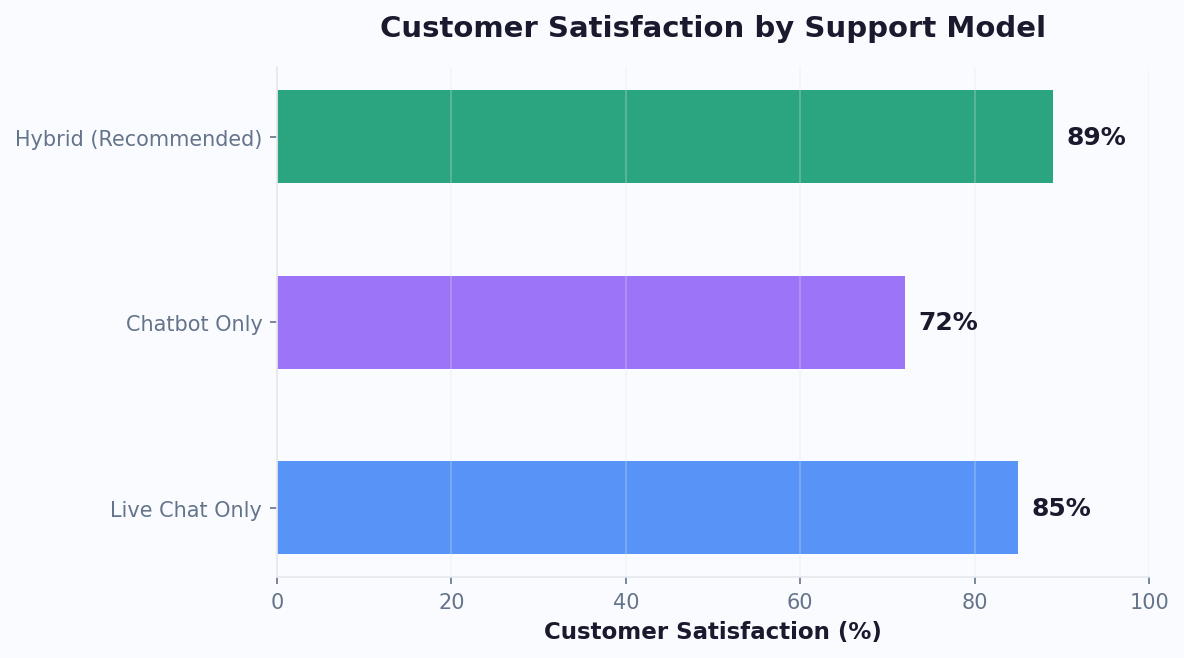
Companies using a hybrid chat model report 35% lower support costs and 12% higher CSAT scores compared to pure live chat — because customers get instant answers for simple queries and human empathy for complex ones.
Source: Forrester Research
Cost Per Interaction by Channel
Compare support costs and resolution rates across different channels and deployment models.
How to Optimize Your Chat Strategy
Build a hybrid system that balances cost efficiency with customer satisfaction.
Start With High-Volume Queries
Export your last 90 days of chat transcripts and categorize them by topic. Identify the 10-15 most frequent query types with predictable answers. Automating just these top queries typically handles 40-50% of total volume immediately.
Train AI on Real Conversations
Use your best-performing agent responses as training data. Feed high-satisfaction conversations into your AI chatbot so it learns the tone and problem-solving patterns your customers respond well to.
Set Clear Escalation Rules
Define explicit triggers for bot-to-human handoff: sentiment drops, billing disputes, explicit requests for a human, or two failed resolution attempts. Every escalation should transfer full conversation context via live chat.
Monitor Handoff Quality
Track handoff rate (target: 20-35%), post-handoff CSAT, time-to-agent-pickup, and percentage of escalations where the bot could have resolved the issue. Review weekly to refine your automation rules progressively.
Live Chat vs Chatbot FAQ
Everything you need to know about chatbots for live chat vs chatbot.
Understanding Live Chat vs Chatbot Economics: What the Numbers Mean
The live chat vs chatbot decision directly impacts your operating budget, customer satisfaction, and ability to scale. A single human live chat agent costs $35,000-$55,000 per year fully loaded and handles 2-4 concurrent conversations during an 8-hour shift. To provide 24/7 chat coverage on a single channel, you need 4-5 agents minimum, pushing annual costs above $150,000. An AI chatbot handles unlimited concurrent conversations for a flat $99-$499 monthly fee, operates 24/7 without overtime, and delivers sub-second response times. For businesses handling 500+ monthly chat sessions, chatbots typically cost 60-80% less than human agents.
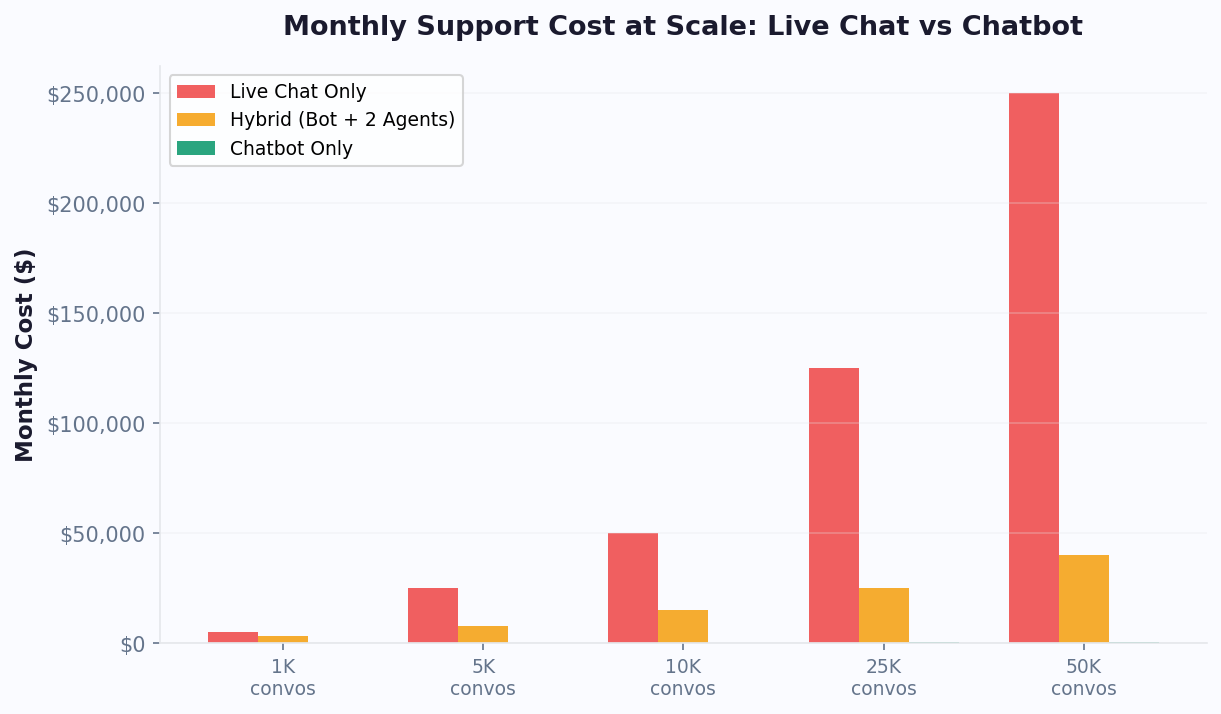
The hybrid model has emerged as the dominant strategy because it combines the strengths of both approaches. The chatbot handles 60-80% of conversations that are routine (order tracking, return policies, password resets, pricing questions) at $0.50 per interaction. Human agents focus on the 20-40% of conversations requiring empathy, creative problem-solving, or complex judgment at $6-12 per interaction. The blended cost per interaction drops to $2-4, roughly 50-65% lower than pure human live chat, with higher satisfaction because customers get instant answers for simple queries and expert help for complex ones. Companies using this model through integrated live chat report 35% lower support costs and 12% higher CSAT.
Resolution rate is the key quality metric. Human agents achieve 80-85% first-contact resolution. AI chatbots resolve 70-78% of queries they handle. But hybrid setups reach 88-92% resolution because the chatbot handles routine queries perfectly while humans tackle nuanced issues with full context from the bot conversation. The handoff quality matters enormously: when the bot transfers a conversation to a human with complete history, the agent does not need to re-gather information, cutting escalated handle times by 30%. Review the chatbot vs live chat comparison guide for detailed implementation strategies.
How to Use This Calculator
Enter the number of live chat agents you currently employ (or plan to hire), their average fully loaded salary, monthly chat volume, and the percentage of chats you estimate can be automated. The calculator compares three models side by side: pure human live chat, pure AI chatbot, and a hybrid approach. It accounts for agent salaries, benefits, training, software licenses, chatbot platform fees, setup costs, and management overhead. The output shows per-interaction cost for each model, total annual cost, projected savings from hybrid or AI-only approaches, and the optimal human-to-bot ratio for your specific volume and complexity mix.
Industry Benchmarks
| Model | Cost per Interaction | Resolution Rate |
|---|---|---|
| Pure human live chat | $6-$12 | 80-85% |
| Pure AI chatbot | $0.50-$1.00 | 70-78% |
| Hybrid (bot + human) | $2-$4 | 88-92% |
| Phone support | $12+ | 85% |
Live Chat vs Chatbot Cost Formula Explained
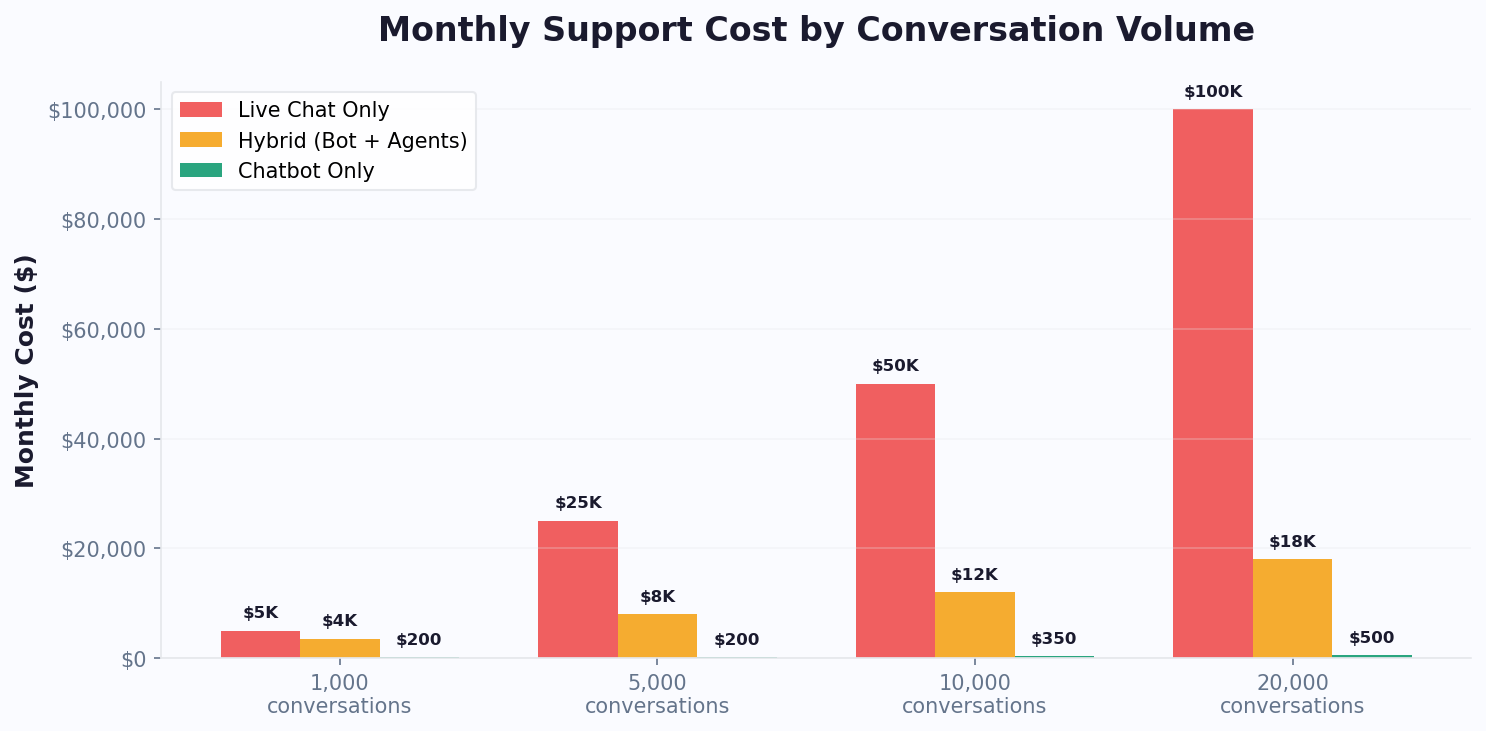
The comparison formula is: Human Cost = Agents x Fully Loaded Salary; Bot Cost = Platform Fee + (Escalated Volume x Agent Cost per Escalation); Savings = Human Cost - Bot Cost. For a worked example, a company with 8 live chat agents at $48,000 each handles 12,000 monthly chats. Pure human cost: $384,000/year. With a hybrid model where the chatbot handles 70% (8,400 chats at $0.50 = $4,200/month) and 3 agents handle 30% (3,600 escalated chats), plus the platform fee of $400/month, the hybrid annual cost is $144,000 + $50,400 + $4,800 = $199,200. Annual savings: $184,800, a 48% reduction. The 5 agents freed can be redeployed to sales support, proactive outreach, or VIP account management.
 Tips to Improve Your Results
- Analyze your last 90 days of chat transcripts to identify the 10-15 most frequent query types. Automating just these top queries typically handles 40-50% of total volume immediately.
- Train your AI chatbot on your best-performing agent responses. Use high-satisfaction conversations as training data so the bot learns the tone and problem-solving patterns your customers respond well to.
- Define explicit escalation triggers: sentiment drops, billing disputes, explicit requests for a human, or two failed resolution attempts. Every escalation should transfer full conversation context to the agent.
- Track handoff rate (target: 20-35%), post-handoff CSAT, and time-to-agent-pickup. Review weekly to progressively refine automation rules and expand the chatbot's capability.
- Use analytics to track cost per interaction for both bot-resolved and human-resolved conversations. This data reveals where automation delivers the highest ROI and where human agents add the most value.
Ready to see these numbers in action? Start your free Conferbot account and deploy a chatbot in under 10 minutes. Track all these metrics automatically with our built-in analytics dashboard.
Related Calculators
Calculate total savings from automating your customer support with AI chatbots.
Calculate →Model the cost of supporting customers across chat, email, phone, and social media.
Calculate →Estimate how many support tickets an AI chatbot can deflect from your queue.
Calculate →Continue Exploring
Explore features, connect third-party tools, and browse ready-made templates.
Один Чат-бот,
Все Каналы
Ваш чат-бот работает на WhatsApp, Messenger, Slack и ещё 6 платформах. Создайте один раз — используйте везде.
View All Channels