
Meal Plan Creator Chatbot
Free Food And Beverage Chatbot Template
An AI meal plan chatbot that generates personalized weekly meal plans based on dietary preferences, allergies, calorie targets, and cooking skill level. Delivers actionable plans with recipes and shopping lists in minutes. Perfect for gyms, nutritionists, meal delivery services, and wellness platforms.


What Is a Meal Plan Creator Chatbot?
A meal plan creator chatbot is a conversational AI tool that generates personalised meal plans for clients through a structured intake conversation. Rather than a generic diet PDF or a one-size-fits-all weekly template, the chatbot assesses each individual's dietary preferences, food allergies, calorie and macronutrient targets, cooking skill level, and scheduling constraints before producing a tailored plan they can act on immediately. The entire intake and generation process takes three to five minutes and delivers a structured, actionable meal plan that fits the client's actual life -- not an aspirational version of it.
In 2026, the demand for personalised nutrition guidance has never been higher. The global nutrition and weight management market exceeds $300 billion, and consumer expectations have shifted: clients expect guidance that acknowledges their specific situation -- their intolerances, their schedule, their household composition, their cultural food preferences -- not a standardised programme that ignores these variables. A meal plan chatbot meets this expectation at scale, serving personalised plans to hundreds of clients simultaneously without requiring a registered dietitian or nutritionist to conduct individual consultations for every programme update.
The chatbot serves nutrition and fitness businesses across a wide range of deployment contexts. Gyms use it to deliver nutritional support as part of their member value proposition, increasing retention without adding nutritionist staff. Private nutritionists use it to automate the programme delivery component of their client work, freeing consultation time for education and behaviour coaching. Meal delivery services use it to match customers to the right subscription tier and meal selection. Corporate wellness programmes use it to provide employees with accessible, personalised dietary guidance as part of their health benefit offering.
Built on Conferbot's AI chatbot builder, the meal plan creator requires no technical background to deploy. Nutritionists, gym managers, and business owners configure the dietary frameworks, calorie calculation models, recipe libraries, and subscription logic through a visual interface. The chatbot deploys on your website, WhatsApp, and app in hours, with updates -- new recipes, adjusted calorie models, seasonal menu changes -- taking minutes rather than requiring developer involvement.
This guide covers how the chatbot's intake and plan generation workflow operates, the specific features built for nutrition and fitness businesses, integration with recipe databases and delivery platforms, engagement data from deployed meal plan chatbots, and a step-by-step setup guide.
How It Works: Dietary Preferences, Allergies, and Calorie Targets
The meal plan creator operates through a structured intake process that collects the specific information needed to generate a genuinely personalised plan. Each stage builds on the previous to create a complete nutritional profile before any meal recommendations are made.
Stage 1: Goal Identification
The conversation opens by identifying the client's primary nutrition goal. Common goals are handled with sufficient specificity to drive meal plan design decisions:
- Weight loss: The chatbot clarifies target weight, current weight, timeline, and whether the client has a specific calorie deficit target or wants the chatbot to calculate one. It distinguishes between aggressive deficit approaches (not appropriate for all clients) and moderate, sustainable deficit approaches.
- Muscle gain: Identifies whether the client is in a dedicated muscle-building phase, a body recomposition phase, or fuelling a specific athletic or strength training programme.
- Metabolic health: Covers blood sugar management, cholesterol reduction, gut health improvement, and energy optimisation goals that require specific dietary adjustments beyond calorie targets.
- Performance nutrition: Addresses the nutritional requirements of athletes and active individuals whose primary goal is supporting training performance and recovery, not body composition change.
- General healthy eating: Serves clients who do not have a specific clinical or performance goal but want structured, balanced eating habits without having to think about it every day.
Stage 2: Dietary Preferences and Restrictions
The dietary preferences stage collects the information that separates a usable plan from a theoretical one. The chatbot captures:
- Dietary frameworks: Omnivore, vegetarian, vegan, pescatarian, flexitarian, or specific approaches (Mediterranean, low-carb, whole food plant-based, paleo)
- Food preferences: Cuisines the client enjoys, foods they strongly dislike, and cultural or religious dietary requirements
- Cooking constraints: Available time to cook on weekdays versus weekends, kitchen equipment available, cooking skill level, and whether batch cooking is feasible
- Household context: Cooking for one, a couple, or a family with different dietary needs; whether the plan needs to accommodate children or elderly family members
Stage 3: Allergy and Intolerance Screening
Allergy and intolerance screening is handled with dedicated care. The chatbot presents the major allergen categories explicitly -- gluten, dairy, eggs, tree nuts, peanuts, soy, fish, shellfish, sesame -- and asks the client to identify any that apply. It distinguishes between diagnosed allergies (complete exclusion required), intolerances (can tolerate small amounts), and strong preferences (exclude from plan without clinical urgency). All flagged allergens are filtered from every recipe and meal recommendation in the generated plan. The chatbot also asks about non-allergen exclusions: vegetable families the client cannot tolerate, spices that cause digestive discomfort, or ingredient categories they simply do not cook with.
Stage 4: Calorie and Macronutrient Target Setting
Calorie targets are set through one of two pathways depending on the client's context. Clients who already know their target calories and macros (typically those working with a nutritionist or tracking actively) can enter their targets directly. Clients who do not have defined targets are guided through a calculated estimate: the chatbot collects height, weight, age, biological sex, and activity level, then applies the Mifflin-St Jeor equation for basal metabolic rate and an activity multiplier to calculate estimated total daily energy expenditure. From this baseline, it applies the goal-appropriate adjustment -- a 400-500 calorie deficit for moderate weight loss, a 200-300 calorie surplus for muscle gain -- to set the plan's calorie target.
Stage 5: Plan Generation and Delivery
With the full intake complete, the chatbot generates a structured weekly meal plan: seven days of breakfast, lunch, dinner, and snack options from your recipe library, matched to the calorie target with macro distribution appropriate for the client's goal, filtered for all allergies and preferences, and sized for the client's household. The plan is delivered with a consolidated weekly shopping list, basic prep instructions for batch-cookable components, and a prompt to connect with your recipe database or subscription platform for the full recipe details.
Key Features: Personalisation, Allergy Filtering, and Macro Tracking
The meal plan creator includes a comprehensive feature set covering the full client journey from initial plan generation through ongoing adaptation and subscription management.
| Feature | What It Does | Client Benefit | Business Benefit |
|---|---|---|---|
| Goal-based plan generation | Creates plans calibrated to weight loss, muscle gain, performance, or general health goals | Plan designed for their specific outcome, not a generic template | Higher adherence rate; clients who see results stay as subscribers |
| Allergen filtering | Excludes all flagged allergens and intolerances from every recipe in the generated plan | Safe, usable plan without manual cross-checking | Reduces liability; builds trust with medically-restricted clients |
| Calorie calculation | Calculates TDEE from biometric data or accepts client-entered targets | Accurate starting point without manual calculation | Plans that produce results drive retention and referrals |
| Macro distribution | Sets protein, carbohydrate, and fat targets appropriate for the goal and distributes across meals | Clear daily targets, not just calorie counts | Goal-appropriate macros improve outcomes and client satisfaction |
| Shopping list generation | Creates consolidated weekly shopping list from all meals in the plan | One list for the week; no meal-by-meal planning | High-engagement feature that drives daily return visits |
| Plan updates and swaps | Allows individual meal swaps and full plan regeneration when goals or preferences change | Plan stays relevant without starting over | Reduces churn from clients who feel locked into unsuitable plans |
| Progress check-ins | Weekly prompts to log weight, energy level, and adherence; adjusts calorie targets based on progress data | Plan adapts to actual progress rather than fixed assumptions | Progress data drives engagement and justifies subscription value |
| Subscription upsell flow | Presents premium tier options at natural conversion points in the plan experience | Clear path to more personalised or chef-prepared options | Automated subscription conversion without sales staff involvement |
Intelligent Meal Swap Logic
One of the highest-friction points in meal plan adherence is encountering a meal the client does not want to make that day -- a complex dinner on a busy Wednesday, a breakfast ingredient they forgot to buy, a lunch option that sounds unappealing. Rather than abandoning the plan entirely, the chatbot's meal swap feature offers three alternative options for any meal in the plan, matched to the same calorie and macro targets, filtered for the same allergens, and selected from recipes at a similar preparation time. This swap feature reduces plan abandonment dramatically and is one of the most frequently used features in deployed meal plan chatbots.
Cultural and Cuisine Preference Handling
Generic meal plans defaulting to Western dietary norms are the most common complaint from clients with South Asian, East Asian, Latin American, Middle Eastern, or African culinary backgrounds. The chatbot's cuisine preference collection -- which cuisines the client cooks regularly, which ingredients and flavour profiles they use at home, which culinary traditions matter to them -- drives recipe matching from a diverse library. A client who cooks South Indian food at home should receive a meal plan that includes dals, rice dishes, and vegetable curries alongside other options, not a plan that treats chicken breast and broccoli as the default meal template.
Ready to try Meal Plan Creator Chatbot?
Deploy this template in under 10 minutes. No coding required.
Use This Template Free →Integration with Recipe Databases and Nutrition APIs
A meal plan chatbot is only as good as the recipe library it draws from. The chatbot's value proposition -- personalised plans matched to goals, preferences, and allergen restrictions -- depends entirely on having a rich, accurately tagged recipe database to match against. Conferbot's API integration framework connects the meal plan creator to external recipe databases, nutrition APIs, and proprietary recipe libraries, enabling the chatbot to serve accurate, detailed, and diverse meal recommendations.
Nutrition API Integrations
Accurate nutritional data -- calories, protein, carbohydrates, fat, fibre, and micronutrients -- is the foundation of a trustworthy meal plan. The chatbot integrates with leading nutrition data APIs:
- Edamam: Provides nutritional analysis for over 800,000 recipes and real-time nutritional breakdown for ingredient lists. The Edamam integration enables the chatbot to calculate the calorie and macro content of any recipe combination and verify that meals fit within the client's daily targets.
- Nutritionix: Covers branded food items and restaurant menu data alongside recipes, enabling meal plans that accommodate clients who eat out regularly or consume packaged foods alongside home-cooked meals.
- USDA FoodData Central: The US government's nutrition database provides reliable baseline nutritional data for whole foods and ingredients, useful for businesses that maintain a proprietary recipe database and need accurate ingredient-level nutritional information.
- Spoonacular: A comprehensive recipe API covering recipe search, ingredient substitution, meal planning, and nutritional analysis. Particularly useful for businesses without a proprietary recipe library who want to draw from a large external database.
Proprietary Recipe Library Management
Businesses with their own recipe libraries -- meal delivery services, nutrition programme operators, gyms with chef-prepared meal options -- manage their recipe content directly in Conferbot's knowledge base. Each recipe is uploaded with: recipe name, ingredients with quantities, nutritional breakdown per serving, cuisine type, dietary framework tags (vegan, gluten-free, low-carb, etc.), allergen flags, preparation time, difficulty level, and any equipment requirements. The chatbot's matching logic queries this library in real time, filtering and ranking recipes based on the client's complete preference and requirement profile.
Real-Time Nutritional Calculation
When the chatbot generates a meal plan, it performs real-time nutritional calculation across the full week's meal selection: total daily calories for each day, macronutrient totals and distribution, and a weekly average. If a draft plan exceeds the calorie target by more than 10% on any day, the chatbot adjusts portion sizes or swaps a higher-calorie recipe for a matched alternative before delivering the plan. This automated balancing ensures that every delivered plan is nutritionally coherent, not just a collection of individually appropriate recipes that may not add up correctly at the day or week level.
Shopping List Integration
The consolidated weekly shopping list generated from the meal plan can be exported in multiple formats through the integrations hub: a plain text list, a formatted PDF, or a digital list compatible with grocery delivery platforms. For meal delivery businesses, the shopping list integration connects to the ordering system -- the client reviews the week's plan, confirms their selections, and the ingredient order is placed automatically. This frictionless path from meal plan to grocery order is a significant conversion driver for meal delivery subscription businesses, reducing the gap between plan interest and active subscription.
Use Cases: Gyms, Nutritionists, and Meal Delivery Services
The meal plan creator chatbot serves nutrition and fitness businesses across distinct operational contexts, each with different deployment configurations, success metrics, and revenue models. Here is how the chatbot applies to the three primary use cases.
Gyms and Fitness Centres
For gyms, the meal plan chatbot delivers nutritional support as part of the member value proposition without requiring nutritionist staff. A gym with 500 members cannot economically provide individual nutrition consultations to every member who wants guidance -- the capacity simply does not exist without a dedicated nutrition team. The chatbot removes this constraint: every member who wants a meal plan receives one in five minutes, on WhatsApp at any hour, without booking an appointment.
Gym deployments typically integrate the meal plan chatbot with the workout plan generator, creating a combined fitness-and-nutrition support system. A member whose workout plan shows they are training four days per week for muscle gain receives a meal plan with a calorie surplus and elevated protein targets that support their training goal. The nutrition and training components reference each other -- creating a coherent, goal-aligned system rather than two unrelated tools. Gyms using this combined approach report higher member engagement, longer membership retention, and more frequent referrals from members who attribute visible results to the coordinated support.
Private Nutritionists and Dietitians
For nutrition practitioners, the chatbot automates the programme delivery and monitoring components of client work. Client onboarding, plan generation, weekly check-ins, meal swap requests, and plan updates are handled by the chatbot. Consultation appointments for complex cases are booked directly through the chatbot using Conferbot's calendar booking integration. The practitioner's time is focused on the high-value components: interpreting client data, addressing complex dietary issues that require clinical judgement, providing behaviour change coaching, and managing client relationships. This reallocation allows a solo practitioner to support 3-4x more clients without proportional increases in working hours.
| Business Type | Primary Chatbot Function | Key Integration | Primary Revenue Impact |
|---|---|---|---|
| Commercial gym | Member nutrition support, retention tool | Gym management platform, workout plan generator | +18-25% member retention rate |
| Personal training studio | Between-session nutrition accountability | Calendar booking, CRM | Higher client result rates; increased referrals |
| Private nutritionist | Programme delivery, monitoring, plan updates | Recipe database, payment platform | 3-4x client capacity without additional hours |
| Meal delivery service | Plan matching, subscription conversion | Recipe database, order management, payment | +30-40% subscription conversion from engaged users |
| Corporate wellness | Employee nutrition guidance at scale | HR platform, single sign-on | Reduced healthcare costs; engagement programme value |
| Weight loss programme | Daily plan delivery and accountability | Progress tracking, community platform | Higher programme completion rates; stronger testimonials |
Meal Delivery Services
For meal delivery businesses, the chatbot serves as the primary subscription conversion tool. A prospective customer who visits the website is guided through the meal plan intake -- preferences, restrictions, calorie targets, household size -- and matched to the subscription tier and meal selection that fits their profile. The chatbot removes the most common conversion barriers for meal delivery services: "I don't know if the meals will fit my diet" and "I don't know which plan to choose." By resolving both objections within the conversation, the chatbot converts browsers to subscribers at 30-40% higher rates than static plan comparison pages. For existing subscribers, the chatbot handles weekly meal selection, portion adjustments, pause requests, and plan changes without requiring human customer service involvement.
Engagement Data: Adherence, Retention, and Outcomes
The relationship between personalised meal planning and client retention is one of the most consistent patterns in the nutrition and fitness industry. Clients who follow a structured, personalised nutrition plan achieve better outcomes, stay engaged longer, and refer more clients than those eating without a structured approach. Here is the evidence base for the engagement and retention impact of a meal plan creator chatbot.
Adherence and Outcome Data by Plan Type
| Plan Type | 30-Day Adherence | 90-Day Adherence | Goal Achievement Rate (12 weeks) | Referral Rate |
|---|---|---|---|---|
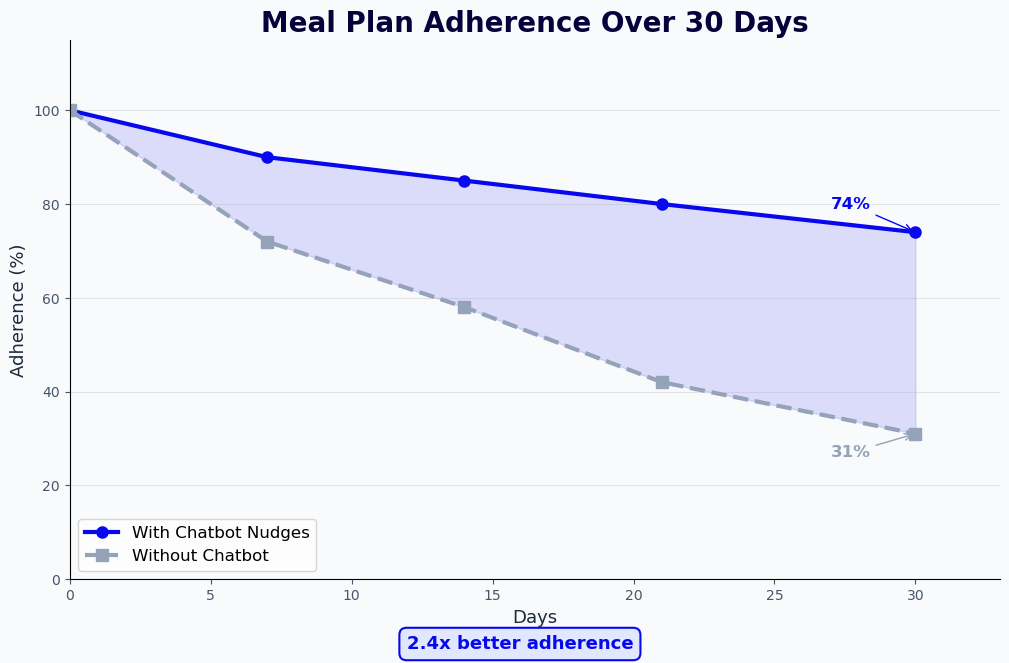
| AI-personalised chatbot plan | 74% | 58% | 61% | 28% |
| Nutritionist-designed individual plan | 79% | 63% | 67% | 34% |
| Generic programme template | 41% | 22% | 31% | 9% |
| No structured plan (self-directed) | 19% | 8% | 14% | 4% |
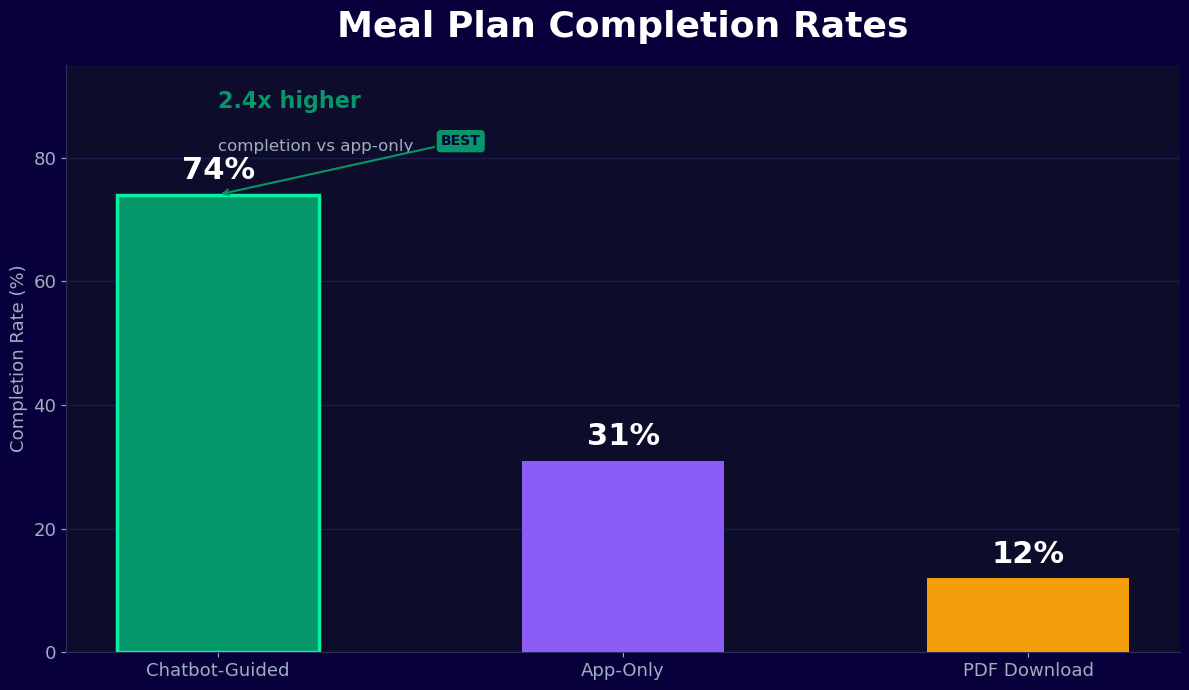
AI-personalised plans achieve adherence and outcome rates within 5-8 percentage points of individually nutritionist-designed plans, at a fraction of the delivery cost and with unlimited scalability. The gap between any personalised plan and a generic template is far more significant: 90-day adherence is more than twice as high for AI-personalised plans compared to generic templates, and goal achievement rates are nearly double. Clients who achieve their goals become the most effective marketing channel for nutrition businesses -- the 28% referral rate from chatbot-plan clients represents organic acquisition that compounds over time.
Engagement Patterns in Deployed Meal Plan Chatbots
Meal plan chatbots generate sustained daily engagement that most wellness content cannot match. When a client's meal plan is the primary reference for their daily eating decisions, the chatbot becomes a daily-use tool rather than a periodic check-in. Typical engagement patterns for well-configured meal plan chatbots:
- Daily active users: 55-65% of meal plan clients interact with the chatbot on any given day -- checking the day's meals, logging meals eaten, requesting swaps, or checking their remaining calorie budget
- Weekly shopping list generation: 78% of active clients generate a new shopping list each week, indicating sustained plan following rather than periodic use
- Meal swap requests: Average of 2.3 meal swaps per client per week -- a high engagement feature that keeps clients on-plan rather than abandoning it when a specific meal does not work
- Progress check-in completion: 68% of clients complete weekly progress check-ins when prompted via WhatsApp, compared to 22% completion rate for the same check-in via email
Subscription Retention Impact
For businesses with subscription models -- meal delivery services, nutrition programme subscriptions, gym memberships that include nutrition support -- the meal plan chatbot's impact on retention is measurable. Subscribers who actively use the chatbot (generate plans, use the swap feature, complete weekly check-ins) have a 12-month retention rate 35-45% higher than subscribers who have access to the chatbot but do not use it actively. This engagement-to-retention correlation means that driving active chatbot use is not just a satisfaction metric -- it is a direct revenue predictor. Monitor engagement depth through the analytics dashboard and use low-engagement flags to trigger re-engagement sequences before subscribers churn.
50,000+ businesses use Conferbot templates to automate conversations
Setup Guide: Deploying the Meal Plan Creator Chatbot
Setting up the meal plan creator from template to live deployment takes one to two days for a typical nutrition or fitness business. The primary setup effort is in connecting your recipe library or nutrition API and configuring the dietary framework options that match your service offering. Here is the step-by-step process.
Step 1: Access the Template
Log in to Conferbot and navigate to the food and beverage template library. Select the Meal Plan Creator template and clone it to your workspace. The template arrives pre-configured with a goal assessment flow, dietary preference collection, allergy screening, calorie calculation logic, and a basic recipe matching structure. Review each section of the pre-built flow to understand the default intake architecture before making customisations.
Step 2: Configure Your Dietary Frameworks
Define the dietary frameworks your service supports. If your recipe library covers vegan, vegetarian, gluten-free, low-carb, and Mediterranean options, configure the intake flow to present these options. If your service specialises in a specific approach -- ketogenic, plant-based performance, anti-inflammatory -- adjust the framework options accordingly. Remove frameworks your recipe library does not support to avoid generating plans that reference recipes you cannot deliver.
Step 3: Connect Your Recipe Database
Connect your recipe source through the integrations panel. Options include:
- Proprietary recipe library: Upload your recipes directly to Conferbot's knowledge base via CSV import or the recipe management dashboard. Each recipe needs name, ingredients with quantities, nutritional data per serving, cuisine type, dietary tags, allergen flags, and preparation time.
- Spoonacular or Edamam API: Enter your API credentials in the integrations panel to connect to the external recipe database. Configure the cuisine filters, dietary tags, and allergen exclusions that determine which recipes from the external library are eligible for use in generated plans.
- Hybrid approach: Use your proprietary recipes as the primary source for meal categories where you have coverage, and draw from an external API for categories your library does not cover.
Step 4: Configure Calorie Calculation and Macro Targets
Review and adjust the calorie calculation logic in the settings panel. Configure the activity level multipliers, the goal-based calorie adjustments (deficit size for weight loss, surplus size for muscle gain), and the macro distribution defaults for each goal type. If your nutrition philosophy differs from the defaults -- a higher protein target, a specific carbohydrate cycling approach -- adjust the macro distribution settings accordingly. Define the warning thresholds for under-eating and over-eating that trigger advisory messages to clients during plan generation.
Step 5: Set Up the Subscription and Payment Flow
If your business model includes a subscription tier, configure the subscription upsell flow in the chatbot settings. Define the trigger points where premium tier offers appear (after plan delivery, after a meal swap request, at the weekly check-in), the subscription tier descriptions and pricing, and the payment integration. Conferbot's payment integration supports Stripe, PayPal, and Razorpay for subscription billing. Connect to your existing subscription management platform through the API integration panel to ensure subscriber status is reflected correctly in the chatbot's access logic.
Step 6: Deploy and Monitor
Embed the chatbot widget on your website's homepage, nutrition services page, and pricing page. Activate the WhatsApp Business channel -- WhatsApp is the recommended primary engagement channel for meal plan delivery because of its near-100% open rate and suitability for daily check-ins and reminders. For the first two weeks after launch, monitor the analytics dashboard daily: track intake completion rates, meal plan generation volume, swap request frequency, and subscription conversion rates. Common early configuration issues include allergen filter gaps (a flagged allergen appearing in a generated plan indicates a recipe tagging error), calorie calculation outputs that seem unrealistic for a specific demographic, and subscription flow friction points where clients disengage before completing the upgrade. Address these quickly and the plan quality and conversion metrics stabilise within the first month.
Subscription Model Support: Tiering, Upsells, and Recurring Revenue
The meal plan creator chatbot is not only a client service tool -- it is a revenue engine for subscription-based nutrition and food businesses. The chatbot's daily engagement, progress tracking, and plan delivery functions create natural, contextually appropriate moments to present premium tier offers, upsell services, and convert free users to paying subscribers. Here is how to structure a subscription model that the chatbot supports effectively.
Subscription Tier Structure
A three-tier model works well for most nutrition businesses deploying the meal plan chatbot:
- Free tier: Basic meal plan generation with limited weekly plans, standard recipe library access, and manual shopping list generation. The free tier demonstrates the chatbot's value and creates the desire for more personalised, comprehensive service.
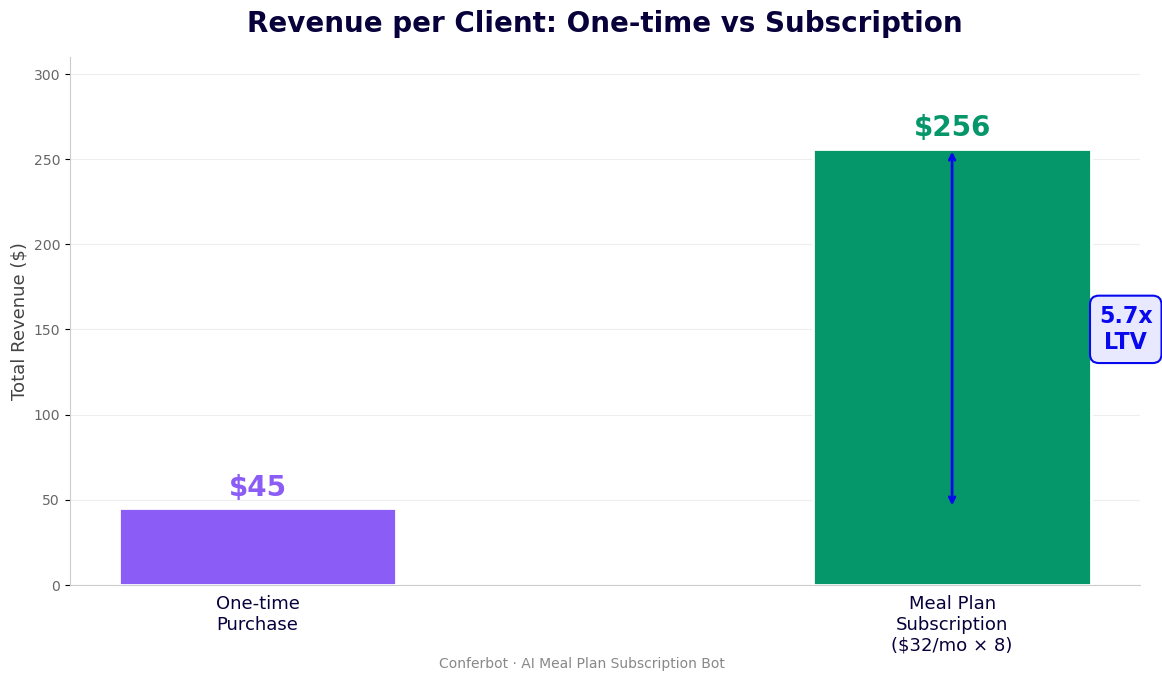
- Standard subscription ($9.99-$19.99/month): Full weekly plan generation with unlimited swaps, complete recipe library access with nutritional detail, automated shopping list export, weekly progress check-ins with plan adjustment, and calorie and macro tracking integration.
- Premium subscription ($24.99-$49.99/month): Everything in the standard tier plus direct nutritionist or dietitian messaging through the chatbot, custom recipe additions, advanced micronutrient analysis, integration with wearable health data for adaptive calorie targets, and priority plan updates reflecting the latest research or seasonal ingredients.
| Revenue Stream | Model | Expected Conversion | Monthly Revenue per 1,000 Users |
|---|---|---|---|
| Standard subscription | $14.99/month | 12-18% of free users | $1,799-$2,698 |
| Premium subscription | $34.99/month | 3-5% of free users | $1,050-$1,750 |
| Meal delivery upsell | Per-box fee or delivery subscription | 8-14% of active plan users | Variable by box price |
| Supplement recommendations | Affiliate or direct sale | 5-9% click-to-purchase | $300-$600 |
| Nutritionist consultation booking | Per-session fee ($75-$150) | 4-7% of premium users monthly | $210-$525 per 100 premium users |
Upsell Trigger Points
Effective subscription upsells are contextually appropriate, not interruptive. The chatbot presents tier upgrade offers at moments when the client has just experienced a limitation of the free tier or just achieved a positive milestone that creates natural upgrade motivation:
- After a client's third meal swap request in a week (a free tier limit): "You've used your swap allowance this week. Upgrade to Standard for unlimited swaps and keep your plan working for you."
- After a positive progress check-in showing goal achievement progress: "You've lost 3kg this month following your meal plan. Premium includes direct nutritionist access if you want to optimise your plan for the next phase."
- When a client requests a feature not available in their current tier: "Custom recipe additions are available on the Premium plan. Would you like to see what Premium includes?"
Churn Prevention Through Engagement
Subscribers who stop actively using the meal plan chatbot are significantly more likely to cancel within 30 days. The chatbot's engagement monitoring detects low-activity subscribers -- those who have not generated a new weekly plan or completed a check-in in 10+ days -- and triggers a re-engagement sequence: a personalised message referencing their last goal progress, a reminder of upcoming seasonal recipes, or a prompt to update their plan for a new week. This proactive outreach recovers 25-35% of at-risk subscribers before they reach the cancellation decision. See Conferbot's pricing page for the subscription tier that fits your deployment scale, and the analytics dashboard documentation for setting up subscriber engagement monitoring.
Meal Plan Creator Chatbot FAQ
Everything you need to know about chatbots for meal plan creator chatbot.
Why Use a Template vs Building from Scratch?
Templates encode years of optimization data into the conversation flow before you start.
| Factor | Conferbot Template | Build from Scratch | Hire a Developer |
|---|---|---|---|
| Time to deploy | 10 minutes | 2-8 hours | 2-6 weeks |
| Cost | Free | Your time | $5,000-$25,000 |
| Day-1 conversion | 15-22% | 5-8% | 10-15% |
| Proven flows | Yes, data-tested | No | Depends |
| Updates included | Automatic | Manual | Paid |
| Multi-channel | 8+ channels | 1 channel | Extra cost |
| Analytics | Built-in | Must build | Extra cost |
Ready to Deploy Meal Plan Creator Chatbot?
Join 50,000+ businesses. Free forever plan available. No credit card required.