
Staffing Agency Chatbot
Free HR and Recruiting Chatbot Template
A recruitment chatbot for staffing agencies that screens candidates, collects resumes, matches job seekers to open positions, and helps employers submit staffing requests. Designed for staffing firms, temp agencies, and recruitment companies to automate candidate intake and employer inquiries 24/7.
What Is a Staffing Agency Chatbot?
A staffing agency chatbot is an AI-powered conversational assistant that automates the front-line operations of a staffing firm -- screening job seekers, capturing employer staffing requests, matching candidates to open positions, and managing the high-volume intake process that defines temporary and permanent placement agencies. It replaces the phone queue, walk-in intake forms, and manual email triage that consume recruiter hours with a 24/7 conversational interface that handles both sides of the staffing marketplace simultaneously.

Staffing agencies operate in a fundamentally different model from corporate recruiting teams. A corporate recruiter fills roles for one employer; a staffing agency manages a two-sided marketplace where candidate supply must constantly be matched against employer demand across dozens of active job orders. The volume is staggering: mid-sized staffing firms process 200-500 new candidate registrations per week while simultaneously managing 50-150 active job orders from client companies. Every interaction that can be automated without sacrificing quality directly increases a recruiter's capacity to place candidates and generate revenue.
In 2026, the staffing industry faces compressed margins and rising candidate expectations. Job seekers expect instant responses -- they are not willing to wait for a callback that comes three days after they registered. Employers expect pre-screened, interview-ready candidates delivered within 24-48 hours of submitting a staffing request. A chatbot addresses both expectations: candidates receive immediate engagement and qualification confirmation, while employers get instant acknowledgment and faster time-to-presentation because the candidate screening happened in real time rather than in batch.
This template is purpose-built for the staffing agency workflow. Unlike a generic job application chatbot that handles one role at a time, the staffing agency chatbot captures candidate preferences across multiple dimensions -- industry, employment type, experience level, availability, and location -- to enable ongoing matching against a rotating portfolio of job orders. It is not a single-use application form; it is the first step in an ongoing placement relationship. Built on Conferbot's AI chatbot builder with natural language processing, the template deploys on your agency website, WhatsApp, and social channels without any development resources. It integrates with the staffing-specific ATS and CRM platforms that agencies already use, creating candidate records that are immediately actionable for your recruiting team.
How the Recruitment Automation Chatbot Works
The staffing agency chatbot manages a dual-path conversation flow that recognizes the two distinct user types who visit a staffing agency's digital presence: job seekers looking for placement and employers looking for staff. Each path is designed to capture the specific information required to take immediate action -- registering a candidate in the talent pool or creating a staffing request for the sales team to fulfill.
Job Seeker Path: From First Contact to Talent Pool
When a job seeker engages the chatbot, the conversation follows a structured qualification sequence that mirrors what an experienced intake coordinator would ask during a phone registration. The chatbot begins by identifying the candidate's target industry -- office and administrative, industrial and warehouse, healthcare, information technology, or hospitality -- because industry determines which recruiter team will manage the candidate and which job orders are relevant matches. Next, employment type preference captures whether the candidate seeks permanent placement, part-time work, temporary or contract assignments, or temp-to-hire positions where they can prove their value before being converted to a permanent employee.
Experience level qualification follows, ranging from entry level through five-plus years. This is not merely informational -- it directly determines pay rate ranges the candidate can expect and the job orders they are eligible for. A candidate with five years of warehouse management experience matches fundamentally different orders than an entry-level candidate seeking their first warehouse role. The chatbot then captures availability: immediately available candidates are flagged as high-priority for urgent fill orders, while candidates with specific start dates are matched to upcoming assignments.
Contact information collection -- name, email, and phone number -- completes the registration. The phone number is particularly critical in staffing because placement often moves on same-day timelines; a candidate who cannot be reached by phone within hours of a match may lose the opportunity to a faster responder. The chatbot confirms all captured information, sets expectations for recruiter follow-up timing, and creates a complete candidate record in the staffing CRM ready for immediate matching against open job orders.
Employer Path: Staffing Request Intake
Employers arriving on the agency website with a staffing need follow a separate path designed to capture enough information for the sales team to respond intelligently. The chatbot asks how many positions need filling -- from a single role to ten-plus for large-scale projects -- and the urgency level, from immediate needs to ongoing workforce planning. Company name and contact details are captured with appropriate business context, and the request is routed to the account management team with a priority flag based on the volume and urgency indicators.
Application Status Path
A third path handles the most common inbound inquiry that consumes recruiter phone time: existing candidates checking on their application or placement status. Rather than requiring a live recruiter to field these calls, the chatbot provides clear instructions for status inquiries and directs candidates to the appropriate communication channel, freeing recruiter time for revenue-generating placement activities.
All three paths feed into Conferbot's analytics dashboard, giving agency leadership visibility into candidate registration volume, employer inquiry trends, and conversion rates at each stage of the intake funnel.
Key Features: Candidate Screening, Job Matching, and Employer Portal
The staffing agency chatbot template delivers capabilities specifically designed for the operational rhythms of placement agencies -- high-volume candidate processing, rapid job order fulfillment, and the dual-marketplace management that distinguishes staffing from single-employer recruiting.
| Feature | What It Does | Agency Benefit | User Benefit |
|---|---|---|---|
| Dual-path intake | Separate conversation flows for job seekers and employers | No mixed inquiries clogging a single queue | Relevant questions from the first interaction |
| Industry-based routing | Candidates categorized by target industry at first touch | Automatic assignment to the correct recruiting team | Matched to industry-specific opportunities immediately |
| Availability flagging | Immediately available candidates flagged as priority | Urgent fill orders matched to ready candidates first | Faster placement for candidates ready to start now |
| Employment type filtering | Captures perm, temp, contract, and temp-to-hire preferences | Only present candidates for roles matching their preference | No irrelevant job offers for wrong employment type |
| Employer request capture | Structured intake of staffing volume, urgency, and contact info | Sales team receives actionable requests with priority scoring | Fast acknowledgment and clear timeline for presentation |
| 24/7 registration | Candidates register outside business hours | Never miss a candidate who browses at 11 PM | Register on their own schedule without waiting for callbacks |
| Multi-channel deployment | Website, WhatsApp, Facebook Messenger, SMS | Capture candidates from every traffic source | Register through preferred communication channel |
| CRM integration | Auto-creates candidate and client records in staffing CRM | Zero manual data entry from chatbot registrations | Information captured once, never asked to repeat it |
Intelligent Candidate Matching
Beyond simple data collection, the chatbot's structured intake creates a candidate profile that can be immediately matched against open job orders in the agency's system. When a candidate registers as an immediately available, experienced warehouse worker seeking temp-to-hire positions, the system can instantly surface the three job orders that match those criteria. This matching happens in real time rather than waiting for a recruiter to manually review the registration and search for open orders. The result: faster time-to-presentation for employers and faster time-to-placement for candidates -- the two metrics that most directly impact agency revenue.
Priority Scoring for Recruiters
Not all registrations are equal. A candidate who is immediately available, has five years of experience, and is seeking work in an industry where the agency has ten urgent openings is worth reaching out to within the hour. A candidate with a start date three weeks out, entry-level experience, and interest in an industry where the agency has no current openings can be added to the talent pool for future matching. The chatbot's structured data capture enables automatic priority scoring that tells recruiters exactly where to focus their limited outreach time. Connect priority scoring to your recruiter workflow through Conferbot's integration framework to push high-priority candidates directly to recruiter task queues.
Employer Request Intelligence
On the employer side, the combination of position volume and urgency creates a natural priority matrix. A request for ten immediate warehouse workers is flagged differently than a single ongoing need for a part-time receptionist. The sales team sees employer requests ranked by revenue potential (volume times urgency), enabling them to respond to high-value requests first while ensuring all inquiries receive acknowledgment within the committed timeframe. This structured approach replaces the chaotic voicemail and email triage that characterizes most agency intake processes.
Ready to try Staffing Agency Chatbot?
Deploy this template in under 10 minutes. No coding required.
Use This Template Free →Benefits for Staffing Agencies and Recruiters
Staffing agencies operate on a fundamentally different economic model than corporate HR departments. Every hour a recruiter spends on administrative intake is an hour not spent on the revenue-generating activity of matching and placing candidates. The staffing agency chatbot directly addresses this economic reality by automating the highest-volume, lowest-complexity interactions while preserving recruiter time for the relationship-building and negotiation work that drives placements.
Recruiter Capacity Expansion
A typical staffing recruiter manages a desk of 30-60 active candidates while simultaneously fielding 15-25 new registrations per week. Each new registration takes 10-15 minutes of phone time for basic intake: verifying identity, capturing preferences, explaining the process, and entering data into the CRM. At 20 registrations per week, that is 200-300 minutes -- nearly five hours -- of recruiter time consumed by data collection that the chatbot handles in zero recruiter minutes. Those five hours per recruiter per week translate directly to additional placement capacity: more phone screens with matched candidates, more client relationship calls, more revenue-generating activity.
After-Hours Candidate Capture
Staffing agencies serve candidates who are often currently employed in shift work, service roles, or industrial positions. These candidates browse job opportunities during breaks, commutes, and evenings -- times when agency offices are closed. Without a chatbot, a candidate who visits the agency website at 9 PM sees a form or a "call us during business hours" message. By morning, they may have already registered with a competing agency that had a 24/7 intake process. The chatbot captures these after-hours registrations with the same qualification data that a phone intake would collect, ensuring no candidate is lost to timing.
Reduced Time-to-Fill for Employers
Employer satisfaction in staffing is driven primarily by one metric: how quickly the agency can present qualified candidates after receiving a job order. The chatbot's real-time candidate intake creates a continuously refreshed talent pool with structured, searchable qualification data. When an employer submits a request for five immediately available warehouse workers with forklift certification, the agency's system already contains candidates who registered within the past 48 hours with exactly those qualifications -- pre-screened and ready for presentation. This is fundamentally faster than the traditional model where an employer request triggers a recruiter to begin sourcing, which introduces days of delay before the first candidate is presented.
Consistent Candidate Experience
Staffing agencies live and die on reputation within candidate communities. A single negative experience -- unreturned calls, lost registrations, irrelevant job offers -- spreads through word of mouth in tight-knit industry communities and damages the candidate supply that fuels the business. The chatbot ensures every candidate receives the same professional, prompt, and thorough intake experience regardless of when they register, which recruiter team is handling their industry, or how busy the office is on any given day. This consistency builds the candidate loyalty that generates referrals and repeat placements -- the most profitable source of candidate supply for any staffing agency.
Data-Driven Agency Management
Every chatbot interaction generates structured data that feeds into agency analytics. Leadership gains visibility into candidate registration trends by industry and employment type, peak registration times, conversion rates from website visitor to registered candidate, employer inquiry volume, and the correlation between response time and placement success. This data enables evidence-based decisions about recruiter allocation, marketing spend, and industry specialization strategy. Track all intake metrics through Conferbot's analytics dashboard with custom reporting for staffing KPIs.
Time-to-Fill and Cost-per-Hire Impact Data
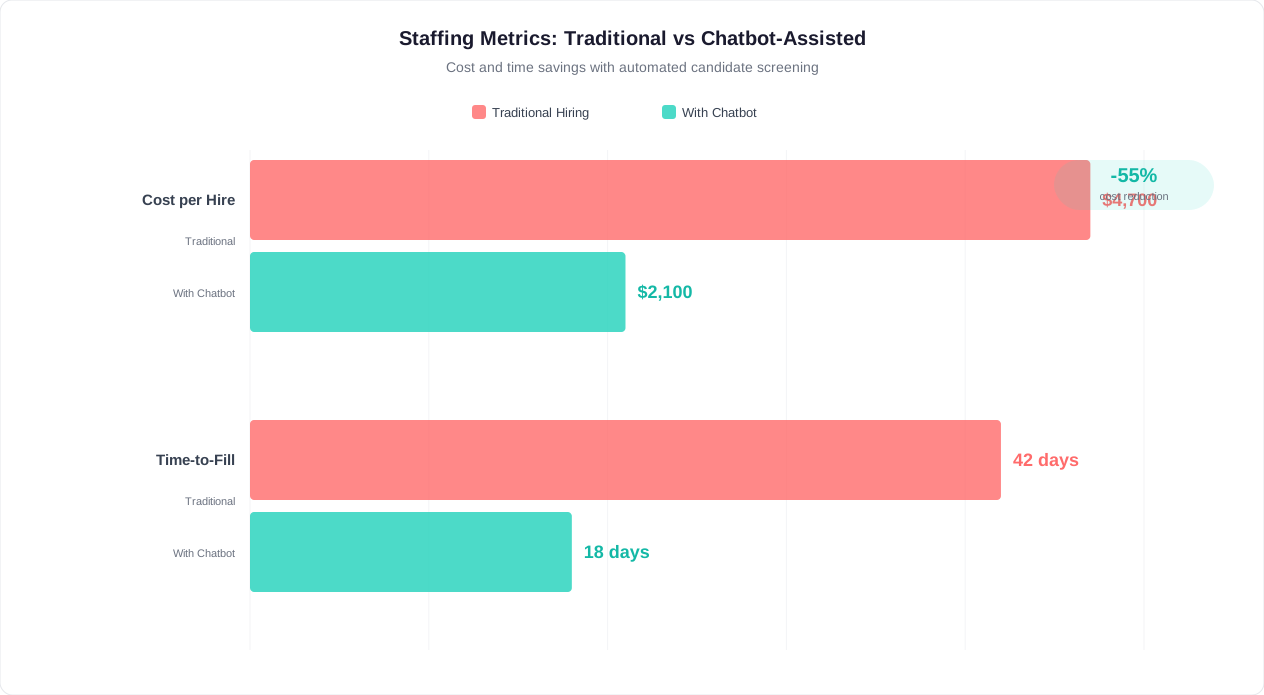
Staffing agencies measure success through a small set of operational metrics that directly correlate with revenue: time-to-fill (how quickly a job order is fulfilled), fill rate (what percentage of job orders are successfully filled), cost-per-hire (the agency's internal cost to make a placement), and gross margin per placement. A chatbot that automates candidate intake impacts all four metrics by compressing the intake-to-match cycle, increasing the volume of registered candidates available for matching, and reducing the recruiter hours consumed per placement.
Time-to-Fill Reduction Analysis
| Process Step | Manual Process | Chatbot-Assisted Process | Time Saved |
|---|---|---|---|
| Candidate initial intake | 10-15 min phone call during business hours | 3-5 min chatbot conversation, any time | 7-10 min per candidate |
| CRM data entry | 5-8 min manual entry per candidate | Automated on conversation completion | 5-8 min per candidate |
| Candidate-to-recruiter assignment | Next business day (batch review) | Real-time routing based on industry | 4-16 hours |
| Employer request intake | 15-20 min phone call + email follow-up | 5 min chatbot + auto-routed to account team | 10-15 min per request |
| Candidate availability verification | Phone tag across multiple candidates | Pre-captured at registration (structured data) | 2-4 hours per job order |
| Total time-to-first-presentation | 2-4 business days | Same day to next business day | 1-3 days faster |
Cost-per-Hire Impact
The internal cost of making a placement includes recruiter salary time, advertising costs to attract candidates, CRM and technology costs, and office overhead. Of these, recruiter time is the largest variable cost and the one most directly impacted by chatbot automation. For a recruiter earning $65,000 annually who processes 20 registrations per week at 15 minutes each, the annual cost of intake alone is approximately $8,450 in salary time. Automating this intake through the chatbot recovers that time for placement-generating activities. If the recruiter converts even 10% of recovered time into additional placements at an average fee of $3,500 per placement, the revenue impact exceeds $29,000 annually -- per recruiter.
Fill Rate Improvement
Fill rate -- the percentage of job orders successfully fulfilled -- is the single most important metric for staffing agency profitability. Unfilled orders represent zero revenue and damaged client relationships. The chatbot improves fill rates through two mechanisms: a larger, fresher talent pool (more candidates registered with current availability data) and faster matching speed (candidates matched to orders before they accept positions elsewhere). Agencies implementing automated intake consistently report fill rate improvements of 8-15 percentage points, driven primarily by the availability of immediately-ready candidates who registered outside business hours and would otherwise have been missed entirely.
Recruiter Productivity Metrics
| Metric | Before Chatbot | After Chatbot | Change |
|---|---|---|---|
| New candidate registrations per week | 80-120 (limited by phone capacity) | 180-300 (24/7 automated) | +125% volume |
| Recruiter time on intake per week | 5-7 hours per recruiter | 0.5-1 hour (review only) | -85% time spent |
| Time from registration to first match | 2-3 business days | Same day (automated matching) | -65% faster |
| Candidate drop-off (registered but never placed) | 45-55% | 30-38% | -15 points |
| Employer response time (request to first contact) | 4-8 hours | 1-2 hours | -70% faster |
These metrics compound over time. More registrations feed a larger talent pool, which improves fill rates, which increases employer satisfaction, which generates more job orders, which attracts more candidates seeking active agencies. The chatbot's automation creates a virtuous cycle that scales agency operations without proportional headcount increases. Monitor all staffing KPIs through Conferbot's real-time analytics with custom dashboards for agency leadership.
Improving Candidate Experience with Conversational AI
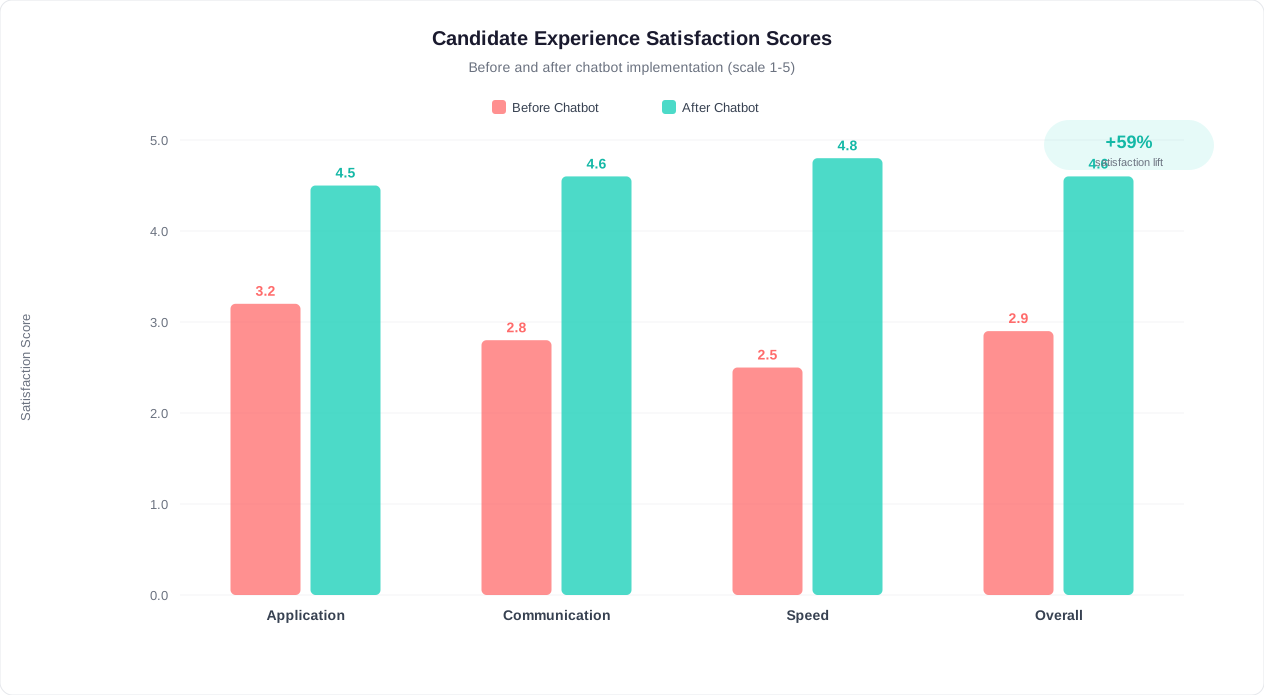
In the staffing industry, candidates are not just applicants -- they are the product. A staffing agency's ability to attract, retain, and re-deploy talent is its core competitive advantage. Candidate experience directly determines whether a job seeker registers with your agency or a competitor, whether they respond promptly when matched to an opportunity, and whether they refer friends and colleagues to your firm. The chatbot transforms the registration experience from a transaction into a conversation that builds loyalty from the first interaction.
The Problem with Traditional Staffing Intake
Traditional staffing agency intake creates friction at every step. A candidate visits the agency website and finds a PDF application form to download, print, and bring to the office. Or they find a phone number with a note to call during business hours. Or they fill out a web form and receive an automated email saying "a recruiter will contact you within 2-3 business days." In 2026, this experience feels archaic compared to the instant, conversational interfaces candidates use for everything else -- ordering food, booking rides, messaging friends. The gap between candidate expectations and agency delivery drives registration abandonment and pushes candidates toward agencies that offer a modern intake experience.
Conversational Intake vs. Form-Based Intake
Research on conversational interfaces consistently shows that people provide more complete and accurate information in a chat format than in a form format. Forms feel like paperwork; conversations feel like engagement. The staffing chatbot leverages this psychology: instead of presenting a wall of 20 form fields, it asks one question at a time in a conversational cadence. Candidates perceive the interaction as shorter and more engaging even when the information collected is identical to what a form would capture. Completion rates for chatbot-based staffing registration typically exceed 75%, compared to 30-45% for equivalent web form registrations -- meaning the chatbot captures twice as many candidates from the same website traffic.
Immediate Acknowledgment and Expectation Setting
The single largest source of candidate dissatisfaction in staffing is the silence gap between registration and first recruiter contact. A candidate registers on Monday, hears nothing Tuesday, begins to wonder if their registration was received on Wednesday, and registers with a competing agency on Thursday. The chatbot eliminates this uncertainty by providing immediate, specific confirmation at the end of every conversation: "Your registration is complete. A recruiter specializing in warehouse and industrial roles will contact you within 24 hours to discuss current openings that match your availability." This specificity -- naming the industry specialization, committing to a timeline, and confirming what the next interaction will cover -- replaces anxiety with confidence.
Mobile-First Registration for Shift Workers
Staffing agencies disproportionately serve candidates in shift-based, hourly, and frontline roles -- populations that are overwhelmingly mobile-first in their digital behavior. These candidates do not sit at desktops during business hours filling out applications. They browse on phones during lunch breaks, commutes, and between shifts. The chatbot's conversational interface is inherently mobile-optimized: short messages, single-tap choices for structured questions, and no form fields that require precise typing on small screens. For agencies targeting warehouse, hospitality, or healthcare workers, WhatsApp deployment allows candidates to register entirely within their primary messaging app without ever visiting a website or downloading anything.
Building Long-Term Candidate Relationships
Unlike corporate recruiting where a candidate applies once for one role, staffing relationships are ongoing. A candidate may be placed multiple times over months or years, with periods of availability between assignments. The chatbot's initial registration is the beginning of a relationship, not a one-time transaction. The structured preference data captured -- industry, employment type, experience level, availability patterns -- creates a candidate profile that enables personalized re-engagement when new opportunities arise. Candidates who had a positive initial experience are significantly more likely to respond when the agency reaches out with a new match, creating a reactivation pipeline that reduces the need for constant new-candidate acquisition.
50,000+ businesses use Conferbot templates to automate conversations
Integration with ATS and HR Platforms
Staffing agencies run on specialized technology stacks that differ significantly from corporate HR systems. While corporate recruiting uses general-purpose ATS platforms like Greenhouse or Lever, staffing firms rely on purpose-built staffing software that manages the two-sided marketplace: candidate records, client company accounts, job orders, placements, timesheets, and payroll. The staffing agency chatbot integrates with these staffing-specific platforms to ensure that every chatbot registration creates an immediately actionable record in the agency's operational system.
Staffing-Specific Platform Integrations
| Platform | Integration Type | Data Synced | Automation Capability |
|---|---|---|---|
| Bullhorn | REST API | Candidate records, job orders, placements, notes | Auto-create candidate, match to open orders, trigger workflow |
| JobAdder | REST API | Candidates, contacts, jobs, placements | Create candidate with tags, assign to recruiter pipeline |
| Vincere | REST API | Candidate profiles, company records, job orders | Register candidate, create employer lead, log activities |
| CEIPAL | REST API | Candidates, requisitions, submissions, placements | Auto-submit candidates to matching requisitions |
| Avionte | API + Webhooks | Talent records, job orders, assignments | Create talent profile, flag availability, match to orders |
| TempWorks | API Integration | Employee records, job orders, dispatch | Register employee, update availability, trigger dispatch matching |
Bullhorn Integration Deep Dive
Bullhorn is the dominant CRM and ATS platform in the staffing industry, used by over 10,000 staffing firms globally. The chatbot's Bullhorn integration creates a complete candidate record on conversation completion: first and last name, email, phone, source (tagged as "Chatbot - Website" or channel-specific), industry category as a custom field, employment type preference, experience level, availability date, and the conversation timestamp. The candidate is automatically assigned to the recruiter team that handles their selected industry, with a task created in Bullhorn's activity feed prompting the assigned recruiter to follow up within the committed timeframe.
For employer requests, the integration creates a new company record (or updates an existing one based on company name matching) and logs a sales activity with the staffing request details: number of positions, urgency, and contact information. The account manager assigned to that client receives an automatic notification with priority scoring based on the volume and urgency combination captured in the chatbot conversation.
Webhook-Based Real-Time Routing
Beyond creating records, the integration supports webhook-based routing that enables real-time action on chatbot registrations. When a candidate registers as immediately available in an industry where the agency has urgent fill orders, a webhook triggers an automated matching process that surfaces the top-matching job orders and pushes them to the recruiter's queue with candidate details attached. This transforms the registration event from a passive data entry moment into an active placement opportunity -- the recruiter receives a notification that says "New candidate registered: 5 years warehouse experience, forklift certified, available immediately. Three matching orders attached." The recruiter's first action is reviewing the match, not entering data or searching for orders.
Multi-System Data Flow
Many staffing agencies operate multiple systems beyond their core ATS: separate payroll platforms, background check services, skills testing tools, and client-facing portals. Conferbot's integration framework supports multi-system data flow from a single chatbot interaction. A candidate registration can simultaneously create a record in Bullhorn, trigger a background check invitation via Checkr or Sterling, send a skills assessment link via Criteria Corp, and add the candidate to an email nurture sequence in the agency's marketing automation platform. This orchestration ensures that from the moment a candidate completes the chatbot conversation, every downstream system has the data it needs to process that candidate through the agency's operational pipeline without manual intervention at any stage.
Getting Started with Your Staffing Chatbot
Deploying a staffing agency chatbot does not require a technology project, developer resources, or changes to your existing staffing CRM. Conferbot's no-code platform enables agency operations managers or recruiters to configure, test, and launch a fully functional intake chatbot within a single business day. Here is the complete setup process from template to live deployment.
Step 1: Clone the Template (10 Minutes)
Sign up at app.conferbot.com and select the Staffing Agency Chatbot template from the HR and Recruiting category. The template includes the complete dual-path conversation flow -- job seeker registration with industry, employment type, experience, and availability qualification, plus employer staffing request intake with volume, urgency, and contact capture. Clone it to your workspace and you have a working chatbot immediately ready for customization with your agency's branding, industries, and messaging.
Step 2: Customize Industries and Preferences (30 Minutes)
Update the industry options to reflect the verticals your agency actually staffs. If your agency specializes in healthcare and light industrial, remove the industries you do not serve and add specific sub-categories that help recruiters route candidates accurately -- for example, splitting "Healthcare" into "Nursing," "Allied Health," and "Medical Administration." Customize employment type options if your agency has specific offerings like direct hire only, or if you operate seasonal staffing programs that warrant their own category. Update the experience level options if your industry has specific seniority definitions that differ from the generic template defaults.
Step 3: Brand the Experience (20 Minutes)
Replace "TalentBridge Staffing" with your agency name in the logo text. Update the tagline to reflect your agency's positioning. Adjust the color scheme to match your brand guidelines -- the header background color, bot message color, and option bubble colors can all be set to your brand palette. Upload your agency logo if using a custom avatar. The goal is a chatbot that feels like a native extension of your agency's website rather than a third-party tool.
Step 4: Connect Your Staffing CRM (1 Hour)
In Conferbot's integrations hub, connect your staffing CRM -- Bullhorn, JobAdder, Vincere, or another platform. Configure the field mapping: which chatbot data fields map to which CRM fields. Set up recruiter assignment rules based on the industry selection: candidates who select "Healthcare" are assigned to recruiter team A, candidates who select "Industrial" are assigned to team B. Configure the employer request routing to your sales or account management team. Test the integration end-to-end by completing a test registration and verifying the CRM record is created correctly with all fields populated and the correct team assignment applied.
Step 5: Deploy to Your Channels (30 Minutes)
Generate the web widget embed code and add it to your agency website -- both the homepage and the "Find Work" or "Register" pages where candidates land. For agencies with heavy WhatsApp or SMS candidate communication, configure those channels through Conferbot's omnichannel platform to enable chatbot registration directly in messaging apps. If your agency runs job board ads that link to your website, ensure the chatbot is visible on the landing pages those ads point to -- this is where the highest-intent candidate traffic arrives and where immediate engagement has the greatest impact on registration conversion.
Step 6: Train Your Team and Monitor (First 2 Weeks)
Brief your recruiting team on how chatbot registrations will appear in the CRM and what follow-up timeline candidates have been promised. The chatbot commits to recruiter contact within 24 hours -- your team needs to honor that commitment to maintain candidate trust. Monitor the analytics dashboard daily for the first two weeks: track completion rates to identify any question where candidates drop off, review the industry and employment type distribution to verify it matches your actual job order portfolio, and confirm that CRM records are being created correctly with proper team routing. Most agencies make two to three minor adjustments to question wording or option lists in the first week before the flow stabilizes. After that initial calibration period, the chatbot runs autonomously with minimal maintenance unless your agency's service offerings change.
Staffing Agency Chatbot FAQ
Everything you need to know about chatbots for staffing agency chatbot.
Why Use a Template vs Building from Scratch?
Templates encode years of optimization data into the conversation flow before you start.
| Factor | Conferbot Template | Build from Scratch | Hire a Developer |
|---|---|---|---|
| Time to deploy | 10 minutes | 2-8 hours | 2-6 weeks |
| Cost | Free | Your time | $5,000-$25,000 |
| Day-1 conversion | 15-22% | 5-8% | 10-15% |
| Proven flows | Yes, data-tested | No | Depends |
| Updates included | Automatic | Manual | Paid |
| Multi-channel | 8+ channels | 1 channel | Extra cost |
| Analytics | Built-in | Must build | Extra cost |
Ready to Deploy Staffing Agency Chatbot?
Join 50,000+ businesses. Free forever plan available. No credit card required.