
Home Care Services Chatbot
Free Senior Care Chatbot Template
A compassionate home care services chatbot that helps families find the right care for their loved ones. Guides visitors through care type selection, scheduling preferences, special needs assessment, and connects them with a care coordinator for a personalized assessment.

What Is a Home Care Services Chatbot?
A home care services chatbot is an AI-powered conversational assistant that helps families navigate the complex process of finding, evaluating, and arranging in-home care for aging loved ones. It guides families through care needs assessment, matches them with qualified caregivers, manages scheduling and coordination, facilitates family communication, and assists with insurance and Medicaid eligibility -- all through a compassionate, easy-to-use chat interface that is available 24 hours a day.
Arranging home care is one of the most stressful experiences families face. In 2026, over 53 million Americans serve as unpaid family caregivers according to the AARP, and the average family caregiver spends 24 hours per week providing care while simultaneously navigating a confusing landscape of care options, insurance coverage, and provider selection. The decision to bring professional caregivers into a loved one's home is emotional, urgent, and often made under crisis conditions -- after a fall, a hospital discharge, or a sudden decline in health. Families searching for care at 11 PM after a hospital discharge do not get callbacks until the next business day, if at all. Meanwhile, the care need is immediate.
The home care services chatbot addresses this urgency gap by providing immediate, knowledgeable support whenever families need it. Built on Conferbot's AI chatbot builder with natural language processing, it deploys on your website, WhatsApp, and Facebook Messenger -- meeting families on the platforms they use when searching for care solutions. Whether your organization is a home care agency serving a local market, a franchise network covering multiple regions, or a care management platform connecting families with providers, this chatbot creates the responsive, compassionate first interaction that families deserve during a difficult time.
This guide covers how the care needs assessment works, caregiver matching, scheduling and care coordination, family communication portals, insurance and Medicaid assistance, lead generation for home care agencies, and a complete setup guide.
Care Needs Assessment: Understanding What Each Family Needs
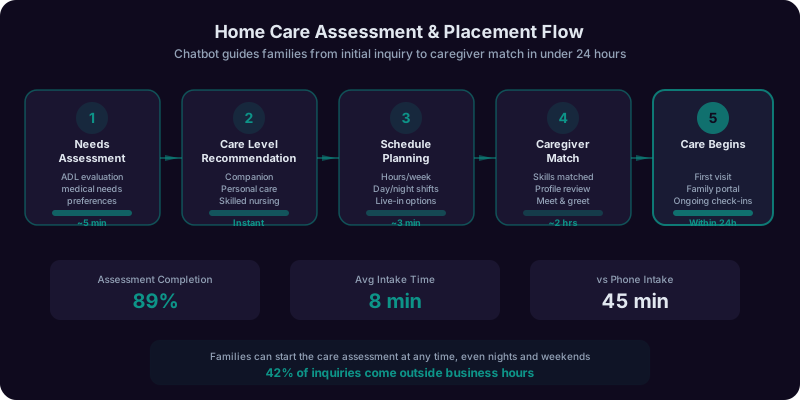
The care needs assessment is the foundation of effective home care placement. It determines what level of care is needed, how many hours per week, what specific services are required, and what caregiver qualifications are necessary. The chatbot conducts this assessment through a guided conversation that feels supportive rather than clinical, collecting the information your care coordinators need while making the family feel heard and understood.
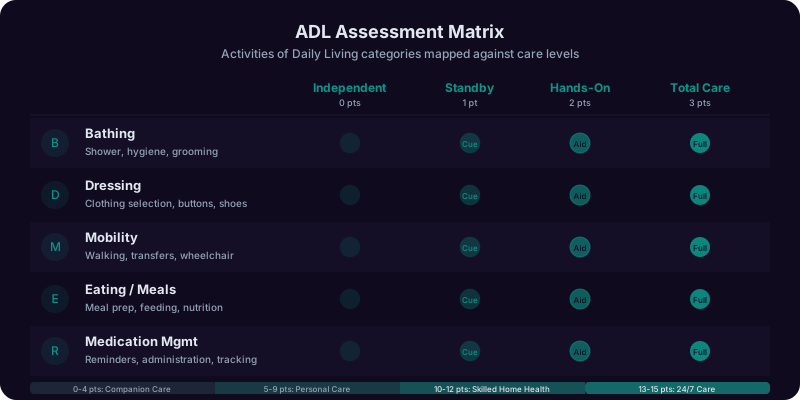
Activities of Daily Living (ADL) Assessment
The chatbot assesses the care recipient's ability to perform the core activities of daily living that determine care level. "I would like to understand what kind of help your loved one needs. Let me ask about a few daily activities. Can they bathe and dress independently, or do they need some assistance?" The chatbot walks through the standard ADL categories: bathing and grooming, dressing, toileting, transferring (moving from bed to chair, etc.), eating, and mobility/ambulation. For each activity, it captures whether the person is fully independent, needs supervision or reminders, needs physical assistance, or is fully dependent. This ADL assessment maps to standard care levels used in the home care industry and helps determine whether the family needs companion care, personal care, skilled nursing, or a combination.
Instrumental Activities of Daily Living (IADL) Assessment
Beyond basic ADLs, the chatbot assesses instrumental activities that support independent living: medication management, meal preparation, light housekeeping, laundry, grocery shopping, transportation, managing finances, and using the telephone or technology. "How about meals? Does your mom prepare her own meals, or does she need help with cooking?" These IADL needs often drive the number of care hours required -- a person who is mostly independent with ADLs but cannot drive or cook may need four to six hours of daily support, while someone needing full ADL assistance may require 24-hour care.
Medical and Cognitive Conditions
The chatbot asks about medical conditions that affect care planning: "Does your loved one have any of the following conditions?" and presents options including Alzheimer's or dementia, Parkinson's disease, diabetes, heart conditions, stroke recovery, chronic pain, mobility limitations, and recent surgery or hospital discharge. For cognitive conditions, the chatbot asks additional questions about wandering risk, sundowning behavior, and communication challenges. This medical information determines caregiver qualification requirements -- a client with dementia needs a caregiver trained in dementia care techniques, while a post-surgical client may need a certified nursing assistant or home health aide.
Schedule and Environment Assessment
The chatbot determines the care schedule needed: "What hours does your loved one need care? Some families start with a few hours per day, while others need overnight or around-the-clock support." It captures the desired start date (often urgent: "as soon as possible" or "when they are discharged from the hospital on Thursday"), the weekly schedule, and whether overnight or live-in care is needed. It also asks about the home environment: single-story or multi-story home, accessibility features (grab bars, wheelchair ramps), pets in the home, and whether other family members are present during care hours. This environmental information helps match the right caregiver and ensures safety for both the client and caregiver.
Assessment Summary and Care Recommendation
After completing the assessment, the chatbot generates a structured care plan summary: "Based on what you have shared, here is what I recommend: Your mother needs personal care assistance 6 hours per day, 5 days per week. She needs a caregiver with experience in Alzheimer's care who can assist with bathing, dressing, meal preparation, medication reminders, and light housekeeping. I recommend starting with weekday daytime coverage and evaluating whether weekend care is needed after the first two weeks." This summary gives the family a clear picture of the care plan and prepares them for the next step: caregiver matching. The assessment data syncs to your care management system through Conferbot's API integration for your care coordinator's review.
Caregiver Matching: Finding the Right Person for Each Family
The caregiver-client match is the single most important factor in care quality and family satisfaction. A great caregiver match results in long-term care relationships, client wellbeing, and family peace of mind. A poor match results in rapid caregiver turnover, client stress, and family dissatisfaction. The chatbot's matching system goes beyond basic qualifications to consider personality compatibility, language preferences, and care philosophy.
Qualification-Based Matching
The chatbot's first matching layer filters caregivers based on the hard qualifications identified in the assessment: certification level (companion caregiver, certified nursing assistant, home health aide, licensed practical nurse), specific condition experience (dementia care, post-surgical care, hospice support), availability for the required schedule, geographic proximity to the client's home, and years of experience. This qualification filter ensures that every caregiver presented to the family meets the minimum requirements for safe, competent care.
Preference and Compatibility Matching
Beyond qualifications, the chatbot collects preferences that affect the care relationship: "Does your mother have a language preference for her caregiver?" "Is gender preference important for personal care assistance?" "Does she enjoy conversation and companionship, or does she prefer a quieter presence?" "Are there any personality traits that are especially important -- patience, humor, firmness, gentleness?" These preferences are matched against caregiver profiles that include personality assessments, language skills, and client feedback from previous placements. Families who receive preference-matched caregivers report 35-50% higher satisfaction scores and experience 60% less caregiver turnover compared to qualification-only matching.
Caregiver Profile Presentation
The chatbot presents two to three matched caregiver profiles to the family for review. Each profile includes the caregiver's first name and photo, years of experience and certifications, specific relevant experience (e.g., "5 years of Alzheimer's care experience with 3 clients"), languages spoken, a brief personal statement from the caregiver, and client ratings from previous placements. "I have found three caregivers who match your mother's needs. Maria has 8 years of experience in dementia care, speaks English and Spanish, and has a 4.9 rating from 12 families. She is available for your requested schedule. Would you like to learn more about Maria, or would you like to see the other options?" This presentation gives families agency in the selection process while ensuring every option is pre-vetted and qualified.
Meet-and-Greet Scheduling
Once a family expresses interest in a caregiver, the chatbot schedules a meet-and-greet visit. "Let's arrange a time for you and your mother to meet Maria. This is a no-commitment introduction so everyone can make sure it is a good fit. When would be a good time? Maria is available Tuesday and Wednesday between 10 AM and 2 PM." The meet-and-greet is a critical step in building trust -- families who meet their caregiver before care begins report significantly higher comfort levels and lower early-cancellation rates. The chatbot follows up after the meet-and-greet to collect feedback: "How did the meeting with Maria go? Is she a good fit, or would you like to meet another caregiver?"
Ready to try Home Care Services Chatbot?
Deploy this template in under 10 minutes. No coding required.
Use This Template Free →Scheduling and Care Coordination: Managing the Logistics of Daily Care
Home care scheduling is complex: regular weekly schedules, caregiver time-off and backup coverage, holiday scheduling, medical appointment transportation, and last-minute changes. The chatbot manages this complexity so families and caregivers always know who is coming, when, and what the plan is for each visit.
Weekly Schedule Management
The chatbot maintains the care schedule and communicates it to all parties. Families see the weekly schedule in their chat: "This week's schedule: Monday-Friday, 9 AM - 3 PM with Maria. Saturday: No care scheduled. Sunday: No care scheduled." Caregivers receive their schedule with client-specific notes: visit time, care tasks for the day, any special instructions (doctor appointment at 2 PM, daughter visiting at noon), and any changes from the regular routine. Schedule changes can be requested through the chatbot by either the family or the caregiver, with automatic notifications to all affected parties.
Backup Caregiver Management
When the primary caregiver is unavailable -- vacation, illness, or personal emergency -- the chatbot automatically activates the backup caregiver plan. "Maria will not be available this Thursday and Friday. Your backup caregiver, Angela, will cover those days. Angela has 6 years of experience in dementia care and has reviewed your mother's care plan. Here is Angela's profile." The backup caregiver receives the client's care plan and any special instructions through the chatbot before the substitution visit. Families are notified immediately when a substitution is needed and can approve or request a different backup. This automated backup system prevents gaps in care that can be dangerous for clients and stressful for families.
Visit Documentation and Care Notes
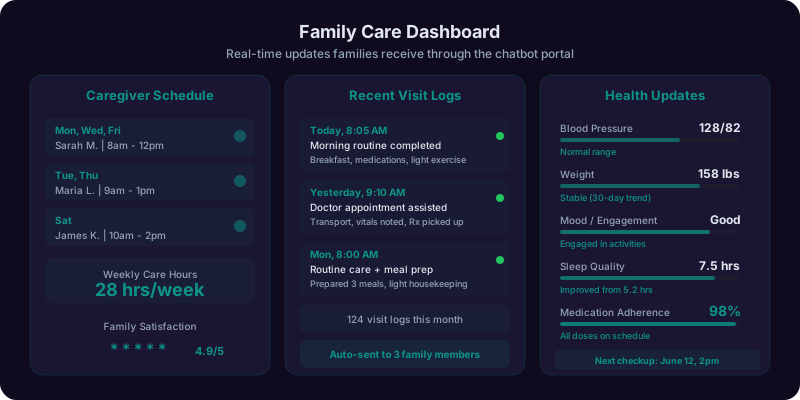
After each visit, caregivers submit visit notes through the chatbot: arrival and departure time, tasks completed (bathing, meal prep, medication reminders, etc.), the client's mood and condition observations, any concerns or changes noted, and vitals if applicable (blood pressure, blood sugar, temperature). These notes are stored in the client's care record and shared with family members who have access. "Today's care note from Maria: Mom had a great day. She ate a full breakfast and lunch, we took a 15-minute walk in the garden, and she was in good spirits. Blood pressure 128/82. She mentioned her left knee was a little sore -- I made sure she rested it this afternoon." These daily notes provide families with peace of mind and create a documented care record that is valuable for physician visits and care plan reviews.
Medical Appointment Coordination
The chatbot manages medical appointment logistics. Family members can add upcoming appointments to the care schedule, and the chatbot ensures the caregiver is informed and prepared. "Your mother has a cardiology appointment on March 15th at 2 PM at Dr. Chen's office. Maria will accompany her. Does your mother need wheelchair transport, or can she ride in a regular car?" After the appointment, the caregiver documents any physician instructions or medication changes through the chatbot, and the family receives a summary. This coordination ensures continuity between medical care and daily home care -- a critical factor in preventing hospital readmissions and managing chronic conditions. Track care hours, visit completion rates, and client satisfaction through Conferbot's analytics dashboard.
Family Coordination: Keeping Everyone Informed and Involved
Home care decisions rarely involve a single family member. Adult children, siblings, and other relatives often share responsibility for a parent's care, and keeping everyone informed and aligned is one of the most challenging aspects of the caregiving experience. The chatbot serves as a family communication hub that ensures all authorized family members receive consistent information and can participate in care decisions.
Family Portal Access
Multiple family members can connect to the care chatbot, each receiving real-time updates and the ability to interact. The primary contact (typically the family member who arranged care) grants access to additional family members: "Your brother wants to stay updated on Mom's care. I can add him to the family chat so he receives daily care notes, schedule updates, and can communicate with the care team. Want to send him an invitation?" Each family member receives care notes, schedule information, and can ask questions through their own chat conversation. Permissions are configurable: some family members may have full access to modify schedules and communicate with caregivers, while others have read-only access for updates.
Daily and Weekly Summaries
The chatbot sends automated summaries to keep family members informed without requiring them to check in daily. Daily summaries include the caregiver's visit notes, any concerns flagged, and the next day's schedule. Weekly summaries provide a broader view: total care hours delivered, notable observations across the week, upcoming appointments, and any schedule changes for the following week. "Weekly update for Mom's care: Maria provided 30 hours of care this week. Mom's appetite was good Monday through Wednesday but decreased Thursday and Friday -- Maria noted she seemed more tired than usual. Upcoming: cardiology appointment Tuesday at 2 PM." These summaries keep distant family members connected and informed, reducing the anxiety that comes from not knowing how a loved one is doing day to day.
Family Decision Support
When care needs change, the chatbot facilitates family discussion and decision-making. "Maria and your care coordinator have noticed that Mom is having more difficulty with stairs. They recommend adding a stairlift or moving her bedroom to the first floor, and increasing care hours from 6 to 8 hours per day to provide additional supervision. I have shared this recommendation with all family members. Would you like to schedule a family call to discuss?" The chatbot can collect input from each family member asynchronously -- especially valuable when family members are in different time zones or have conflicting schedules -- and summarize the family's collective decision for the care coordinator.
Emergency Communication
In emergency situations -- a fall, a medical event, or a sudden change in condition -- the chatbot immediately notifies all family members with a clear, factual message: "URGENT: Maria reports that Mom fell in the kitchen at 10:15 AM. She is conscious and alert but complaining of hip pain. Maria has called 911 and is staying with her. I will update you as soon as there is more information." Emergency notifications are sent through the fastest available channel (push notification, SMS, WhatsApp) to ensure all family members are informed immediately. The chatbot continues to relay updates as the situation develops, reducing the frantic phone-tree calling that typically follows an emergency.
Insurance Verification and Medicaid Assistance
Paying for home care is one of the most confusing aspects of the process. Families often do not understand what their insurance covers, whether Medicaid applies, what the out-of-pocket costs will be, or how to access benefits they are entitled to. The chatbot provides clear, accurate guidance on coverage options and helps families navigate the financial side of care with confidence.
Insurance Coverage Assessment
The chatbot asks about the care recipient's insurance coverage: "Let's figure out how to pay for care. Does your mother have any of the following? Medicare, Medicaid, long-term care insurance, veterans benefits (VA), or private health insurance?" Based on the response, the chatbot provides accurate, specific guidance about what each insurance type covers for home care. "Medicare covers home health aide services when they are prescribed by a doctor as part of a home health plan of care. This typically includes skilled nursing, physical therapy, and limited home health aide services -- but it does not cover ongoing personal care or companion services. Let me check whether your mother's situation qualifies."
Medicaid Home Care Benefits
For families with Medicaid coverage, the chatbot explains the specific home care benefits available in their state. Medicaid home care programs vary significantly by state -- some states offer comprehensive home and community-based services (HCBS) waivers that cover extensive in-home care, while others have more limited programs. "In [State], Medicaid covers personal care services through the Home and Community-Based Services waiver. This can include up to 40 hours per week of personal care assistance, including bathing, dressing, meal preparation, and medication reminders. There is typically a waiting list for this program. Want me to help you understand the application process?" The chatbot provides state-specific Medicaid information based on the care recipient's location and guides families through the application process, documentation requirements, and expected timelines. For families who are not yet on Medicaid, the chatbot assesses potential eligibility based on income and asset thresholds and provides guidance on the application process.
Long-Term Care Insurance
For families with long-term care insurance (LTCI), the chatbot guides them through the claims process. "Your mother's long-term care insurance policy likely has an elimination period -- a waiting period before benefits begin, typically 30-90 days. The policy probably covers a daily benefit amount for home care services. Do you have a copy of the policy? I can help you understand the specific benefits and start the claims process." The chatbot collects policy information and generates the documentation needed for claims submission: care assessment results, physician's statement of need, and caregiver credentials. This claims support significantly reduces the 30-60 day delay that families typically experience when navigating LTCI claims on their own.
Veterans Benefits
For veterans and their spouses, the chatbot provides information about VA home care benefits including the Aid and Attendance pension benefit, which provides up to $2,431 per month (in 2026) for veterans who need regular assistance with daily activities. "Your father's military service may qualify him for the VA Aid and Attendance benefit, which can cover a significant portion of home care costs. This benefit is available to wartime veterans who need help with activities of daily living. Want me to walk you through the eligibility requirements?" The chatbot guides families through the VA application process and connects them with accredited VA claims agents when the application requires professional assistance.
Cost Transparency
The chatbot provides clear, upfront cost information based on the care plan: "Based on your mother's care plan -- 30 hours per week of personal care -- here is an estimate of costs and coverage." It breaks down hourly rates, weekly and monthly totals, insurance coverage amounts, and the estimated out-of-pocket cost. "Estimated weekly cost: $900 (30 hours at $30/hour). Medicaid HCBS waiver may cover up to $720/week. Estimated out-of-pocket: $180/week." This transparency builds trust and helps families plan financially, which is especially important for care arrangements that may continue for months or years. Refer families to Medicare.gov and Medicaid.gov for official coverage details.
50,000+ businesses use Conferbot templates to automate conversations
Lead Generation for Home Care Agencies: Converting Inquiries into Clients
For home care agencies, the chatbot is a powerful lead generation and conversion tool that captures inquiries 24/7, qualifies them with detailed assessment data, and delivers warm leads to care coordinators who can close the placement. In an industry where response time directly correlates with conversion, the chatbot ensures no inquiry goes unanswered.
24/7 Inquiry Response
Home care inquiries are inherently urgent -- families searching for care are often in crisis and need help immediately. The chatbot responds to every inquiry instantly, regardless of the time of day. Research in the home care industry shows that agencies that respond to inquiries within five minutes convert at 3-5x the rate of those that respond within 24 hours. The chatbot's instant response captures families in their moment of need and begins building the trust and confidence that leads to a placement. Agencies using the chatbot report capturing 40-60% more qualified leads because they are responding to the 60% of inquiries that arrive outside of business hours.
Pre-Qualified Lead Delivery
Every lead the chatbot delivers to your care coordination team is pre-qualified with detailed assessment data: the care recipient's ADL and IADL needs, medical conditions, cognitive status, desired care schedule, insurance coverage, geographic location, and urgency level. Your care coordinator receives a complete profile rather than just a name and phone number, enabling a more productive initial consultation. "New inquiry from Jennifer about care for her mother, age 82, in [City]. Alzheimer's diagnosis, needs personal care assistance 6 hours/day, 5 days/week. Has Medicaid HCBS waiver. Requested start date: as soon as possible." This pre-qualification saves 15-20 minutes per inquiry and allows care coordinators to focus their expertise on care plan development and family counseling rather than basic intake.
Lead Scoring and Prioritization
The chatbot scores leads based on urgency (immediate need vs. future planning), care hours requested (higher hours = higher lifetime value), insurance coverage (Medicaid-covered leads have faster conversion), and the prospect's engagement level (how many assessment questions they completed, whether they viewed caregiver profiles). High-scoring leads trigger immediate notifications to on-call care coordinators, while lower-scoring leads enter a nurture sequence. This prioritization ensures your team's limited time is spent on the leads most likely to convert and most urgently in need.
Competitive Differentiation
In a competitive home care market, the chatbot differentiates your agency by providing an immediate, knowledgeable, and compassionate response that families remember. While competitors are sending inquiries to voicemail, your chatbot is conducting a full care assessment, showing caregiver profiles, and scheduling consultations. Families consistently report that the agency that responds first and most helpfully gets their business. The chatbot ensures that agency is yours. Monitor lead volume, conversion rates, and response time metrics through Conferbot's analytics dashboard.
Quality Assurance and Safety Monitoring
Home care involves vulnerable populations, and quality assurance is not just a business metric -- it is a safety imperative. The chatbot incorporates quality monitoring, incident reporting, and satisfaction tracking that protect clients and give families confidence in the care being provided.
Client Satisfaction Monitoring
The chatbot conducts regular satisfaction check-ins with family members: weekly during the first month of a new placement and monthly thereafter. "How is the care going this week? On a scale of 1-5, how would you rate: the caregiver's attentiveness, punctuality, communication, and the quality of care tasks (meals, personal care, etc.)?" Low scores trigger immediate escalation to the care coordinator for intervention. The chatbot also asks open-ended questions: "Is there anything you would like the caregiver to do differently?" This continuous feedback loop catches issues before they become complaints and enables proactive care plan adjustments.
Incident Reporting
Caregivers report incidents through the chatbot: falls, medication errors, behavioral changes, skin breakdown, missed meals, or any event that deviates from normal care. "Incident report from Maria: Mrs. Johnson fell in the bathroom at 2:30 PM. She was attempting to stand from the toilet without waiting for assistance. She landed on her left side. No visible injuries, but she is complaining of soreness in her left hip. I helped her to her chair and applied ice. Family has been notified." Incident reports are timestamped, documented in the client's care record, and immediately shared with the care coordinator and family. This systematic incident reporting creates an audit trail for regulatory compliance and enables pattern analysis -- if a client is falling repeatedly, the care plan needs modification.
Caregiver Performance Tracking
The chatbot aggregates caregiver performance data: punctuality (on-time arrival percentage), visit completion rates, care note quality and timeliness, family satisfaction scores, and incident frequency. High-performing caregivers are recognized and considered for difficult or high-value placements. Caregivers with declining performance metrics are flagged for supervisory review and additional training. This data-driven performance management improves care quality across the agency and provides documentation for caregiver evaluations.
Regulatory Compliance Documentation
Home care agencies are regulated at the state level, with requirements for care documentation, incident reporting, care plan reviews, and caregiver credential maintenance. The chatbot generates compliance-ready documentation: timestamped visit records, care plan review summaries, incident reports in the required format, and caregiver certification tracking with expiration alerts. This automated compliance documentation reduces the administrative burden on agency staff and ensures the agency is always prepared for regulatory audits.
Setup Guide: Deploy Your Home Care Services Chatbot
Home care agencies and care management organizations can deploy a fully functional chatbot in one to two days using Conferbot's no-code platform. Here is the complete setup process.
Step 1: Configure Service Offerings (1 Hour)
Enter your agency's service categories: companion care, personal care, skilled nursing, dementia care, post-surgical care, respite care, and any specialty programs. For each service, provide a description, hourly rate range, minimum hours, and caregiver qualification requirements. Configure your service area by zip code or city so the chatbot only accepts inquiries from areas you serve. If you serve multiple regions with different pricing, configure region-specific rates.
Step 2: Build the Care Assessment Flow (1-2 Hours)
Customize the care needs assessment using Conferbot's AI chatbot builder. The template includes standard ADL and IADL assessment questions that you can modify to match your agency's intake process. Add any agency-specific questions (primary physician information, pharmacy details, emergency contacts). Configure the care recommendation logic: which combination of ADL/IADL needs maps to which service level and care hours recommendation. Test the assessment flow to ensure the recommendations align with your clinical team's judgment.
Step 3: Load Caregiver Profiles (1-2 Hours)
Enter your available caregiver profiles: name, photo, certifications, years of experience, condition specialties, languages spoken, availability, and a brief personal statement. Configure the matching algorithm weights: how much to prioritize certification match, experience level, language preference, geographic proximity, and personality compatibility. You can also import caregiver data from your agency management system through Conferbot's API integration.
Step 4: Configure Insurance and Pricing Information (1 Hour)
Enter your state-specific Medicaid program information, accepted insurance plans, VA benefit guidance, and long-term care insurance claims process. Configure pricing tiers by service type and region. Set up the cost calculator that generates estimates based on the care plan. This insurance and pricing configuration is the most agency-specific step and should be reviewed by your billing or compliance team for accuracy.
Step 5: Set Up Family Communication and Quality Monitoring (30 Minutes)
Configure the family portal permissions, daily and weekly summary templates, satisfaction survey schedule, and incident reporting workflows. Set up notification routing so that different types of alerts reach the right staff member: new inquiries to care coordinators, schedule changes to scheduling staff, incidents to the clinical supervisor, and satisfaction concerns to the client services manager.
Step 6: Deploy and Test (30 Minutes)
Deploy the chatbot to your website, WhatsApp, and Facebook Messenger. Run through the complete family journey: conduct a care assessment, view matched caregivers, schedule a consultation, and test the family communication features. Have your care coordination team review the assessment output and caregiver recommendations for clinical appropriateness. Then go live and start responding to family inquiries 24/7. Monitor performance through Conferbot's analytics dashboard and optimize the assessment flow based on real family interactions.
Use Cases: How Home Care Organizations Use the Chatbot
The home care services chatbot adapts to different organizational models, sizes, and care specialties. Here are applications across the home care industry.
Single-Location Home Care Agencies
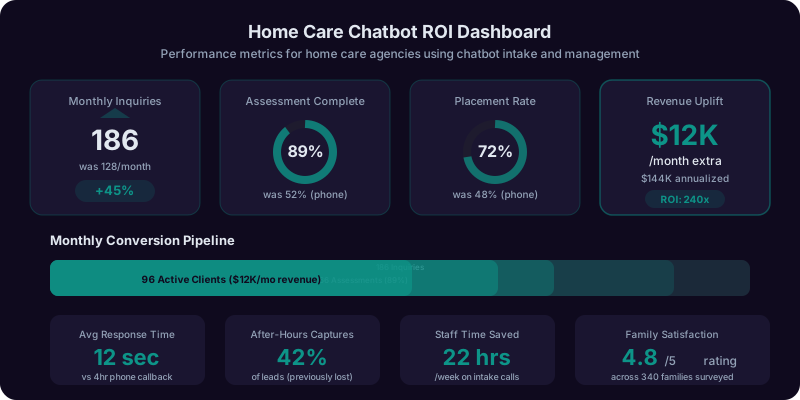
A local home care agency serving a single metropolitan area deploys the chatbot to capture after-hours inquiries and pre-qualify leads for the care coordination team. Before the chatbot, the agency missed 40% of website inquiries because they arrived outside of business hours. With the chatbot responding 24/7, inquiry-to-consultation conversion rates increased from 25% to 55%, and the agency added 15-20 new clients per month compared to 8-10 previously. The care coordinator's time shifted from initial intake calls (now handled by the chatbot) to in-depth family consultations and care plan development.
Multi-Location Franchise Networks
A national home care franchise network deploys a single chatbot across all franchise locations. The chatbot determines the caller's location through zip code and routes the inquiry to the nearest franchise office with the assessment data already completed. This provides a consistent brand experience across all locations while ensuring local care coordinators receive pre-qualified leads relevant to their service area. Franchise networks using the chatbot see 30-40% higher lead volume per location and more consistent client satisfaction scores across the network because the initial assessment experience is standardized.
Hospital Discharge Planning
A home care agency partners with local hospitals to embed the chatbot in the discharge planning process. When a patient is being discharged with home care needs, the hospital discharge planner shares a chatbot link with the family. The family completes the care assessment through the chatbot while still at the hospital, and the agency receives a pre-qualified referral with complete clinical and scheduling information. "Your mother is being discharged from [Hospital] on Thursday. We have a caregiver ready to begin care at your home on Friday morning. Here is her profile." This hospital integration reduces the gap between discharge and care initiation from an average of five to seven days to one to two days, which significantly reduces hospital readmission risk.
Specialized Care Programs
Agencies specializing in specific conditions -- dementia care, pediatric home care, post-surgical recovery -- use the chatbot's assessment to qualify prospects for their specialty programs. A dementia care agency configures the chatbot with detailed cognitive assessment questions that go beyond the standard intake: stage of dementia, specific behavioral symptoms, wandering risk, communication abilities, and family caregiver burnout level. This specialized assessment demonstrates the agency's expertise to families and ensures that only appropriate referrals reach the clinical team. Families searching for specialized care often contact multiple agencies -- the agency that demonstrates the deepest understanding of their specific situation wins the placement. The chatbot ensures your agency makes that impression from the very first interaction.
ROI and Business Impact for Home Care Agencies
The home care services chatbot delivers measurable improvements in lead conversion, operational efficiency, and client satisfaction that directly impact agency revenue and growth.
Lead Conversion and Revenue Impact
| Metric | Without Chatbot | With Chatbot | Impact |
|---|---|---|---|
| Inquiry response time | 4-24 hours | Instant (24/7) | 100% response rate |
| After-hours inquiry capture | 0-20% | 100% | 40-60% more leads |
| Inquiry-to-consultation conversion | 20-30% | 50-65% | 2x conversion rate |
| Consultation-to-placement conversion | 40-55% | 60-75% | 15-20 point improvement |
| Average time from inquiry to placement | 5-10 days | 2-4 days | 50-60% faster |
| Client retention rate (annual) | 70-78% | 82-90% | 10-12 point improvement |
| Family satisfaction score | 3.8/5 | 4.5/5 | 18% improvement |
Operational Efficiency
The chatbot's pre-qualification saves care coordinators 15-20 minutes per inquiry on basic intake, which translates to 10-20 hours per week for a busy agency processing 40-60 inquiries. This time is redirected to in-depth family consultations, care plan development, and quality monitoring -- higher-value activities that drive better outcomes and higher client satisfaction. The automated scheduling and communication features save an additional 5-10 hours per week of administrative coordination. For a mid-size agency, the chatbot eliminates the equivalent of a full-time administrative position while improving the quality of every family interaction.
Client Lifetime Value
Home care clients represent significant lifetime value -- the average home care placement lasts 12-18 months with average weekly spend of $600-1,200. The chatbot's impact on client retention (10-12 point improvement) translates directly to revenue: for an agency with 100 active clients, a 10-point retention improvement means 10 fewer clients lost per year, representing $312,000-$624,000 in preserved annual revenue. Combined with higher lead conversion rates that add new clients, the chatbot's total revenue impact typically exceeds $500,000 annually for mid-size agencies.
Start building your home care services chatbot today with Conferbot's AI chatbot builder -- it is free to get started and helps you serve more families with the compassionate, responsive care experience they deserve.
Home Care Services Chatbot FAQ
Everything you need to know about chatbots for home care services chatbot.
Why Use a Template vs Building from Scratch?
Templates encode years of optimization data into the conversation flow before you start.
| Factor | Conferbot Template | Build from Scratch | Hire a Developer |
|---|---|---|---|
| Time to deploy | 10 minutes | 2-8 hours | 2-6 weeks |
| Cost | Free | Your time | $5,000-$25,000 |
| Day-1 conversion | 15-22% | 5-8% | 10-15% |
| Proven flows | Yes, data-tested | No | Depends |
| Updates included | Automatic | Manual | Paid |
| Multi-channel | 8+ channels | 1 channel | Extra cost |
| Analytics | Built-in | Must build | Extra cost |
Ready to Deploy Home Care Services Chatbot?
Join 50,000+ businesses. Free forever plan available. No credit card required.