
Voice of Customer (voc) Analysis
Free B2B Services Chatbot Template
A complete voice of customer (voc) analysis chatbot template — deploy in minutes to automate conversations, capture leads, and provide 24/7 assistance.
-analysis-cover.svg)


What Is a Voice of Customer (VoC) Analysis Chatbot?
A Voice of Customer (VoC) analysis chatbot is a conversational AI tool that collects, analyzes, and reports on customer feedback through natural dialogue rather than traditional survey forms. It combines the structured data collection of formal surveys (NPS scores, CSAT ratings, effort scores) with the richness of open-ended conversation, extracting themes, sentiments, and actionable insights from every customer interaction. The result is a feedback system that captures what customers actually think and feel, not just what fits in a checkbox.
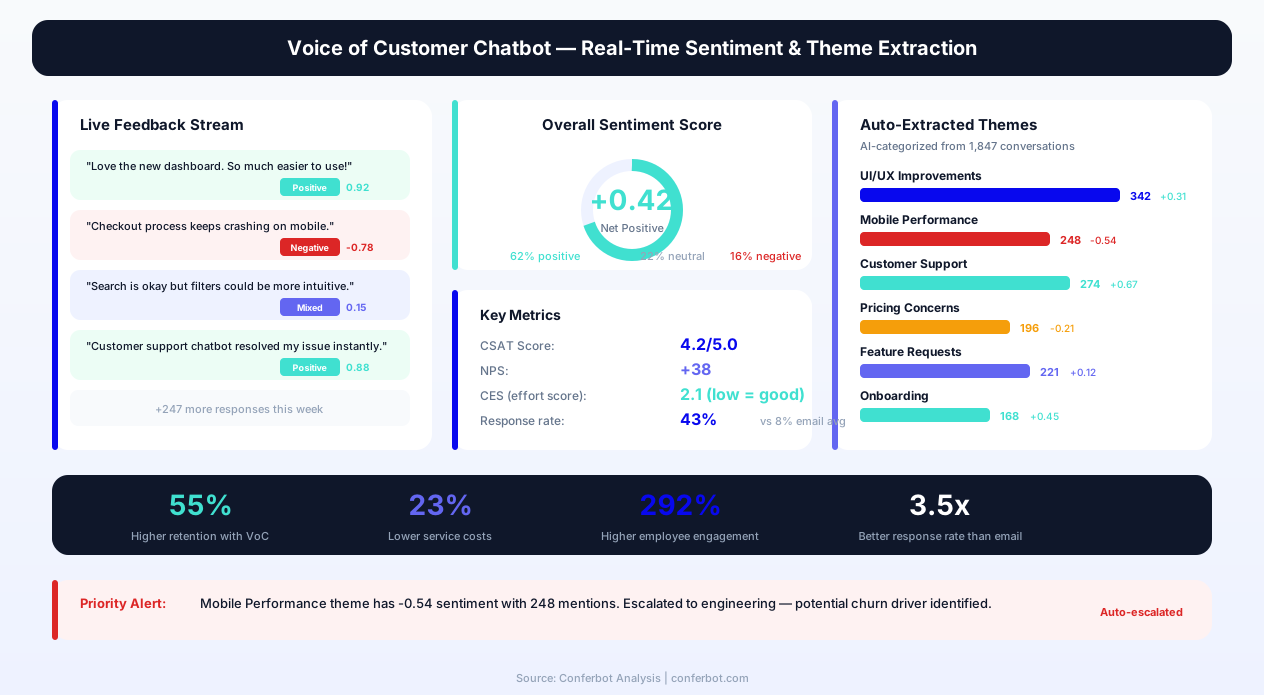
The business case for VoC programs is well-established. In 2026, organizations with mature VoC programs achieve 55% higher customer retention rates, 23% lower service costs, and 292% higher employee engagement compared to organizations without structured feedback programs. Yet most VoC programs underperform because they rely on survey methods that produce low response rates, shallow insights, and analysis backlogs that delay action on feedback. The average email survey achieves a 5-15% response rate; conversational VoC chatbots achieve 35-55% -- a 3.5x improvement that transforms the statistical reliability and actionability of collected feedback.
Traditional VoC approaches also suffer from the "survey paradox": the customers most likely to respond are those with extreme experiences (very satisfied or very dissatisfied), while the critical middle segment -- passively satisfied customers at risk of switching, or mildly frustrated customers who have not yet escalated -- rarely bothers with surveys. A chatbot deployed in context (post-purchase, post-support, in-product) catches these middle-segment customers in moments of natural engagement, when providing feedback feels effortless rather than like an additional task on their to-do list.
Conferbot's AI chatbot builder enables customer experience teams to deploy VoC chatbots that handle the complete feedback lifecycle: collection through conversational dialogue, analysis through real-time sentiment scoring and theme extraction, measurement through standardized metrics (NPS, CSAT, CES), and action through automated follow-up triggers and routing. The platform's NLP engine understands customer sentiment beyond keyword matching, detecting frustration, satisfaction, confusion, and urgency from conversational context. Integration with API systems ensures feedback flows into CRM, support, and product management platforms where it drives decisions.
Why VoC Programs Matter: The Revenue Impact of Customer Listening
Voice of Customer is not a satisfaction survey program -- it is a business intelligence system that drives revenue, reduces churn, and informs strategic decisions. Understanding the full business impact justifies the investment in conversational VoC infrastructure.
Retention and Revenue Protection
Customer acquisition costs have increased 60% over the past five years. In 2026, acquiring a new customer costs 5-7x more than retaining an existing one. VoC programs protect revenue by identifying dissatisfied customers before they churn -- the warning signs are present in their feedback weeks or months before cancellation, but only if someone is listening. A chatbot that captures this early dissatisfaction and routes it to retention teams enables intervention at the moment when saving the customer is still possible.
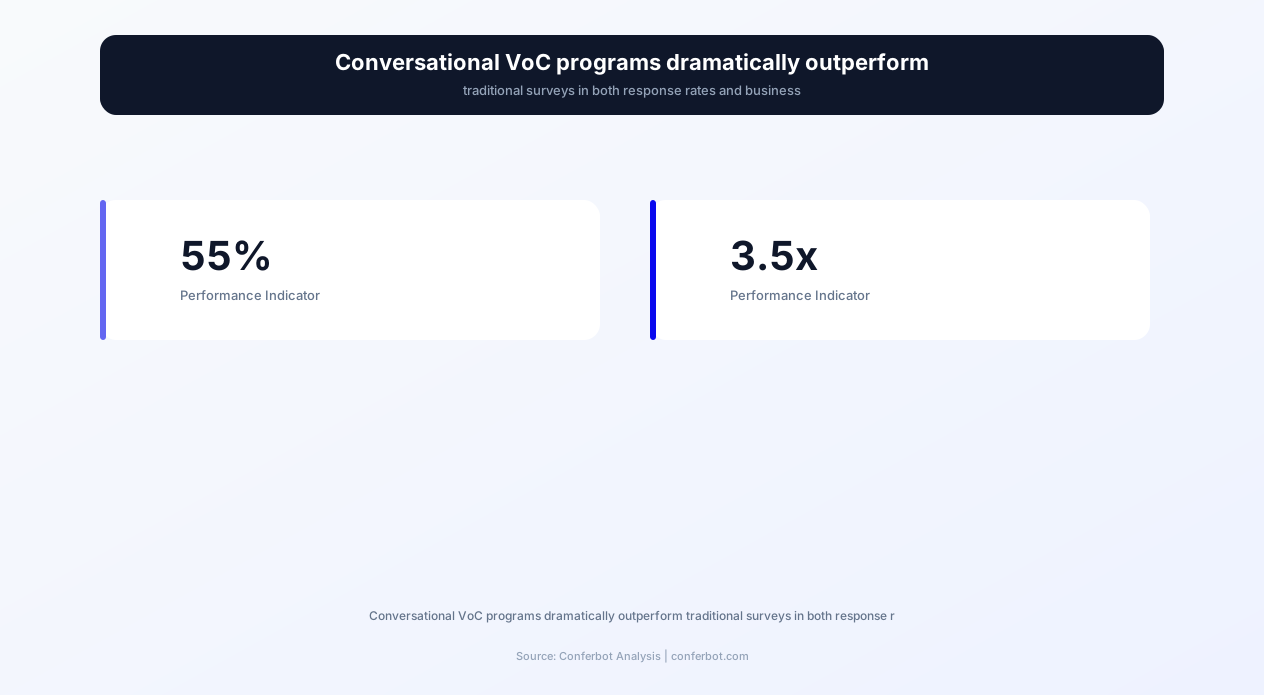
- 55% higher retention: Organizations with mature VoC programs retain significantly more customers year-over-year
- 25% higher revenue per customer: Feedback-driven product improvements increase customer lifetime value
- 34% lower churn rate: Early detection and intervention prevent losses before they occur
- 2.5x higher NPS: Companies that act on feedback achieve dramatically higher promoter scores
Product Development Intelligence
Customer feedback is the most reliable source of product development direction. Feature requests buried in support tickets, pain points expressed in casual conversation, and workarounds customers invent to compensate for product gaps -- all contain intelligence that shapes roadmap priorities. A VoC chatbot that systematically captures, categorizes, and quantifies this feedback provides product teams with demand data that replaces opinion-based prioritization with evidence-based decision-making. The conversational format captures nuance that surveys miss: not just "I want feature X" but "I need to accomplish Y and cannot do it because Z is missing."
Operational Cost Reduction
VoC programs reduce costs by identifying process failures before they scale. When five customers report the same onboarding confusion, fixing the process prevents hundreds of support tickets. When feedback reveals a confusing billing statement, redesigning it reduces payment disputes. The feedback-to-action cycle creates a continuous improvement loop that eliminates recurring problems at their source rather than repeatedly addressing their symptoms through expensive support interactions.
Competitive Intelligence
Customer feedback often contains references to competitor products, alternative solutions, and market alternatives. A VoC chatbot that captures and categorizes competitive mentions provides marketing and product teams with intelligence about competitive positioning, feature gaps, pricing sensitivity, and switching triggers. This intelligence is organic and unsolicited -- more reliable than commissioned market research because it reflects genuine customer perspectives rather than responses to researcher-designed questions.
How the VoC Analysis Chatbot Works
The chatbot operates through a continuous cycle of collection, analysis, and action that transforms individual customer conversations into organizational intelligence. Each stage is designed to maximize both response quality and actionability.
Stage 1: Contextual Trigger and Engagement
The chatbot initiates feedback conversations at moments of natural relevance -- not randomly or on arbitrary schedules. Triggers include:
- Post-purchase (24-48 hours): Captures initial product/service impressions while experience is fresh
- Post-support interaction: Measures resolution satisfaction and effort immediately after ticket closure
- Product milestone: Engages after the customer achieves key activation or usage milestones
- Renewal approaching (30-60 days): Gauges satisfaction before the renewal decision point
- Inactivity detection: Reaches out when usage patterns suggest disengagement
- Feature release: Collects feedback on new capabilities from active users
Timing matters enormously -- a satisfaction question asked 2 hours after a support interaction captures the emotional reality of that experience. The same question asked 2 weeks later captures a rationalized, diluted version. Contextual triggers ensure feedback reflects genuine experience rather than faded memory.
Stage 2: Conversational Collection
The chatbot conducts a structured but natural conversation that combines quantitative measurement (NPS, CSAT, CES scores) with qualitative exploration. The conversation adapts based on the score given:
- High scores (Promoters, 5/5 CSAT): Explore what drives satisfaction, capture testimonial-quality language, identify referral willingness
- Middle scores (Passives, 3-4/5 CSAT): Probe for improvement opportunities, identify what would move the score up, detect competitive considerations
- Low scores (Detractors, 1-2/5 CSAT): Understand the problem, capture urgency level, offer immediate escalation to support or management
Each follow-up question is generated contextually -- the chatbot does not ask generic "tell us more" questions. It references the specific topic the customer raised and asks targeted follow-ups that produce actionable specificity.
Stage 3: Real-Time Sentiment Analysis
As customers type responses, the chatbot's AI integration performs real-time sentiment analysis that goes beyond positive/negative classification. It detects:
- Emotional intensity: Mild frustration vs. rage; mild satisfaction vs. delight
- Urgency indicators: Language suggesting imminent churn ("I'm looking at alternatives," "this is the last straw")
- Topic sentiment: Separate sentiment scores for different aspects (product quality positive, support experience negative)
- Comparative sentiment: References to previous experience, competitors, or expectations
Stage 4: Theme Extraction and Categorization
Individual feedback responses are automatically categorized into themes using natural language understanding. Themes are not pre-defined categories that force feedback into boxes -- they emerge from the actual language customers use, grouped by semantic similarity. Common theme categories include product functionality, pricing/value, support quality, onboarding experience, reliability/uptime, user interface, documentation, and competitive comparison. Theme frequency and sentiment trending reveals emerging issues before they become crises.
Stage 5: Automated Action and Routing
The chatbot does not just collect and analyze -- it acts. Configurable triggers initiate workflows based on feedback content:
- Detractor alert: Immediately notifies customer success team when a high-value customer gives a low score
- Bug report detection: Routes feedback describing product issues to engineering triage
- Feature request capture: Adds validated feature requests to the product backlog with customer count
- Testimonial capture: Flags exceptionally positive feedback for marketing use (with permission)
- Escalation trigger: Connects customers expressing urgent frustration to live support immediately
Ready to try Voice of Customer (voc) Analysis?
Deploy this template in under 10 minutes. No coding required.
Use This Template Free →Key Features of the VoC Analysis Chatbot Template
The template includes features designed for the specific demands of continuous VoC programs -- where response rate matters, analysis must be real-time, and insights must drive action without manual intervention.
| Feature | Description | Operational Benefit | Customer Benefit |
|---|---|---|---|
| Multi-metric measurement | NPS, CSAT, CES, and custom metrics collected through conversational interactions | Comprehensive measurement without survey fatigue from multiple separate surveys | Customers answer once and provide data for multiple metrics simultaneously |
| Adaptive follow-up | AI-generated contextual questions based on score and initial response content | Captures specific, actionable feedback rather than generic comments | Customers feel heard because questions relate to what they actually said |
| Real-time sentiment scoring | Continuous sentiment analysis during conversation with emotional intensity detection | Identifies urgent situations immediately without waiting for manual review | Frustrated customers get escalated to support immediately rather than waiting |
| Automated theme extraction | NLP-based categorization of feedback into emergent themes with frequency and sentiment tracking | Eliminates manual coding of open-ended responses (historically 20+ hours/month) | Feedback drives visible product improvements because themes are actionable |
| Verbatim capture and indexing | Exact customer language preserved and searchable with context, sentiment, and metadata tagging | Provides authentic customer voice for product decisions, marketing, and training | Customer exact words influence decisions rather than analyst interpretations |
| Trend detection and alerting | Identifies emerging themes, sentiment shifts, and anomalies across the feedback stream | Surfaces problems within hours rather than waiting for monthly reporting cycles | Issues get fixed faster because they are detected faster |
| Close-the-loop automation | Automated follow-up messages when actions are taken on feedback (issue fixed, feature shipped) | Demonstrates responsiveness that increases future feedback participation | Customers see that their feedback produces results, building trust and loyalty |
| Segment analysis | Feedback analysis by customer segment (plan tier, tenure, geography, industry, account size) | Identifies segment-specific issues invisible in aggregate data | Each segment gets attention to their specific needs rather than one-size-fits-all |
| Competitive intelligence capture | Automatic detection and categorization of competitor mentions in feedback | Provides organic competitive intelligence without commissioned research | Product improvements address actual competitive gaps customers experience |
| Integration ecosystem | Bi-directional sync with CRM, support platforms, product management tools, and BI systems | Feedback data enriches every system without manual data transfer | Customer history is complete across all touchpoints, enabling personalized service |
Adaptive Follow-Up: The Key to Actionable Insights
The difference between usable and unusable feedback often comes down to specificity. "Your product is confusing" is not actionable. "I could not find the export button and spent 20 minutes looking before giving up" is immediately actionable. Traditional surveys produce the former because they ask generic follow-up questions ("Please tell us more about your experience"). The VoC chatbot produces the latter because it asks contextual follow-ups generated by AI: "You mentioned the interface was confusing -- which specific area were you trying to navigate?" This targeted probing transforms vague dissatisfaction into precise product intelligence.
Close-the-Loop: The Retention Multiplier
Closing the loop -- following up with customers to let them know their feedback produced action -- is the single most powerful retention mechanism in any VoC program. Customers who give feedback and see results become significantly more loyal than customers who never gave feedback at all. The chatbot automates this loop: when a reported issue is resolved or a requested feature ships, it sends a personalized message to every customer who mentioned that issue, acknowledging their contribution and inviting them to try the improvement. This mechanism transforms feedback from a one-way extraction into a collaborative relationship.
Before and After: Measurable Impact of Conversational VoC
Organizations that transition from traditional survey-based VoC to conversational chatbot-based collection report significant improvements across response rates, insight quality, action speed, and business outcomes. These metrics represent composite results from CX teams using Conferbot's VoC template across B2B SaaS, e-commerce, and professional services.
| Metric | Before (Email Surveys) | After (VoC Chatbot) | Improvement |
|---|---|---|---|
| Survey/feedback completion rate | 12% | 42% | +250% (3.5x) |
| Qualitative response length (avg words) | 8 words | 47 words | +488% |
| Time from feedback to action | 21 days (monthly reporting cycle) | 4 hours (real-time routing) | -99% |
| Actionable insights per 100 responses | 15 (most too vague to act on) | 68 (targeted follow-up produces specificity) | +353% |
| Customer retention (feedback participants) | 72% | 89% | +24% |
| Monthly analyst hours for feedback coding | 80 hours | 4 hours (review automated themes) | -95% |
| Detractor recovery rate (save from churn) | 18% (detected too late) | 52% (real-time escalation) | +189% |
| NPS score (program participants vs. non) | +22 (baseline) | +41 (after close-the-loop program) | +86% |
Why Response Rates Increase 3.5x
The response rate improvement is driven by multiple factors. First, context: the chatbot engages customers at relevant moments (immediately after an experience) rather than at arbitrary times (when an email happens to arrive). Second, channel: the feedback happens in the same interface the customer already uses (website, WhatsApp, in-app) rather than requiring a channel switch (open email, click link, load survey page). Third, experience: conversational feedback feels like being heard rather than filling out a form. Fourth, brevity: the chatbot asks one question at a time, reducing the perceived burden compared to a multi-page survey that shows "page 3 of 7" in the header.
Why Insight Quality Improves 353%
The shift from 15 to 68 actionable insights per 100 responses results from the chatbot's adaptive follow-up capability. When a customer says "the interface is slow," a traditional survey moves to the next question. The chatbot asks "Which part of the interface feels slow -- page loads, search results, or something else?" The customer responds "Search takes forever when I have more than 50 products." Now engineering knows exactly what to fix: search performance degrades at scale. That specificity is the difference between an insight gathering dust in a report and an insight that produces a sprint ticket and a measurable improvement.
Revenue Attribution
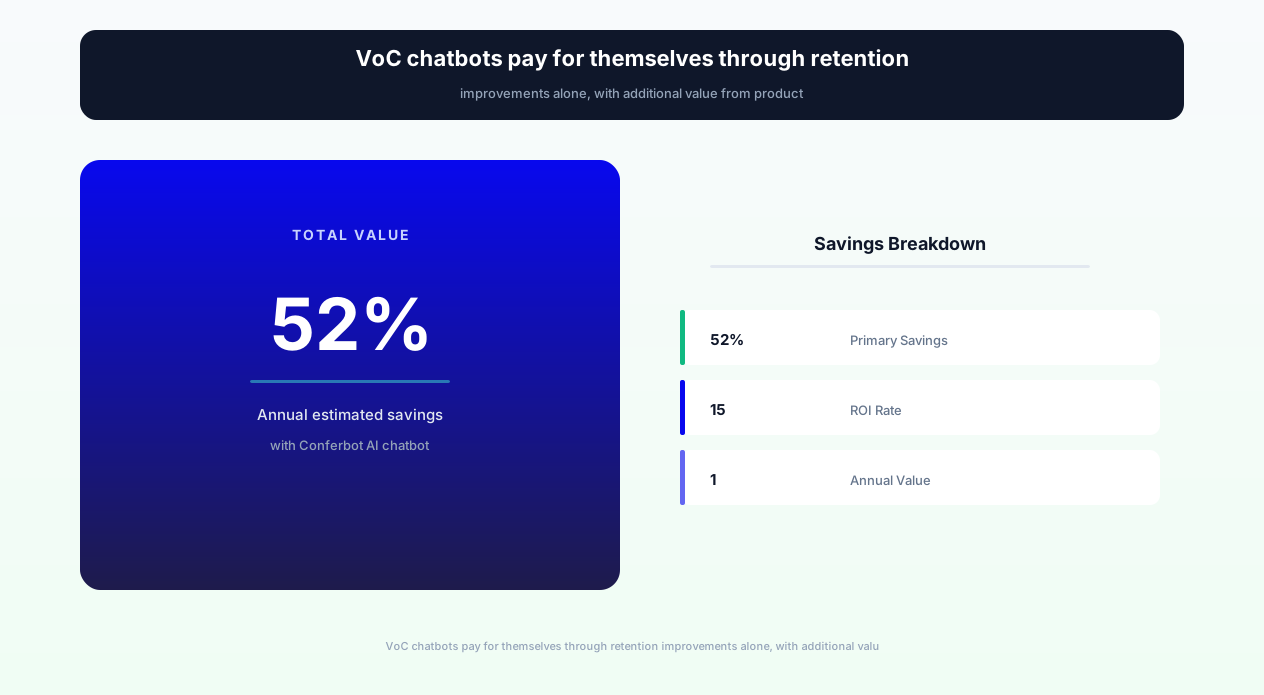
For a SaaS company with $10M ARR and 8% annual churn, the VoC chatbot's contribution to retention (improving retention from 72% to 89% among program participants, assuming 60% of customers participate) prevents approximately $600,000 in annual churn. Against a platform cost of $12,000-$36,000/year, the ROI from retention alone exceeds 15:1 -- before counting the value of product intelligence, competitive insights, and operational cost reduction.
Use Cases Across Industries and Functions
VoC chatbots serve any organization that needs to understand customer experience at scale. Here is how the template adapts to different industries and functional deployments.
B2B SaaS and Technology
SaaS companies deploy VoC chatbots at multiple touchpoints in the customer lifecycle: post-onboarding (measuring activation success), post-support (measuring resolution quality), in-product (measuring feature satisfaction), and pre-renewal (measuring retention risk). The chatbot identifies expansion opportunities (customers who love the product but need more seats/features) as readily as it identifies churn risks. Integration with customer success platforms (Gainsight, Totango, ChurnZero) enables health scores enriched with real-time feedback data. Deployment on website and in-app widgets reaches users in their natural context.
E-Commerce and Retail
Retail VoC chatbots capture the post-purchase experience: product quality perception, delivery satisfaction, packaging impressions, and return reasons. They operate at a scale (hundreds of thousands of transactions) that makes human follow-up impossible and email surveys ineffective. The chatbot identifies product quality issues before they become return spikes, delivery problems before they damage brand perception, and product-market fit signals that inform merchandising decisions. Deployment on WhatsApp reaches customers through their mobile messaging platform of choice.
Healthcare and Patient Experience
Healthcare organizations use VoC chatbots to measure patient experience across the care journey: appointment booking ease, wait time perception, provider interaction quality, treatment outcome satisfaction, and billing process experience. The conversational format captures patient concerns that formal surveys miss -- particularly from elderly patients or those with limited health literacy who struggle with form-based surveys. Compliance with HIPAA requires specific data handling configurations available in the template's healthcare deployment mode.
Financial Services
Banks, insurance companies, and wealth management firms deploy VoC chatbots after high-stakes interactions: account opening, loan application decisions, claims processing, and portfolio reviews. These moments carry significant emotional weight for customers, and the feedback captured reveals both process improvement opportunities and relationship risk factors. For financial services, the chatbot's ability to detect urgency and escalate immediately is critical -- a frustrated customer with a $2M account requires different response velocity than a frustrated customer with a checking account.
Hospitality and Travel
Hotels, airlines, and travel companies use VoC chatbots for real-time service recovery. When a hotel guest reports a problem through the chatbot during their stay, staff can resolve it before checkout -- preventing the negative review that would otherwise follow. Post-stay feedback captures overall experience while memories are fresh, and competitive comparisons reveal positioning relative to alternatives. The multi-language capability is essential in hospitality, where guests speak dozens of languages and feedback quality depends on linguistic comfort.
Professional Services
Consulting firms, agencies, and professional service providers deploy VoC chatbots at project milestones and engagement conclusions. Client satisfaction feedback informs team performance evaluation, process improvement, and business development strategy. The chatbot captures relationship health indicators that predict retention: Is the client feeling heard? Are deliverables meeting expectations? Would they recommend the firm? This intelligence is particularly valuable in professional services where individual client relationships represent significant revenue concentration.
50,000+ businesses use Conferbot templates to automate conversations
Setup and Configuration Guide
Deploying the VoC chatbot requires configuration of feedback triggers, conversation flows, analysis parameters, and action routing. Here is the implementation path from template to production VoC program.
Step 1: Define Feedback Moments (Triggers)
Identify the customer journey moments where feedback is most valuable and most likely to be provided. Map your customer lifecycle and select 3-5 trigger points for initial deployment. Common starting configurations:
- Transactional: Post-purchase, post-support, post-onboarding -- feedback on specific interactions
- Relational: Quarterly or semi-annual relationship health checks independent of specific interactions
- Event-based: Feature releases, price changes, service disruptions -- feedback on specific events
Configure trigger timing precisely -- post-support feedback should fire 2-4 hours after ticket resolution (enough time for the customer to verify the fix, but soon enough that the experience is fresh). Post-purchase timing depends on product type: digital products warrant 24-hour follow-up; physical products need 5-7 days for delivery and initial use.
Step 2: Configure Measurement Framework
Select your primary metrics and configure the chatbot's measurement approach:
- NPS (Net Promoter Score): Relationship metric measuring recommendation likelihood; best for relational surveys
- CSAT (Customer Satisfaction): Transactional metric measuring specific interaction satisfaction; best for post-support and post-purchase
- CES (Customer Effort Score): Process metric measuring ease of accomplishing a goal; best for evaluating self-service and support efficiency
- Custom metrics: Product-specific measurements tailored to your particular customer experience dimensions
Step 3: Design Conversation Flows
For each trigger point, design the conversation flow that the chatbot will follow. The template provides research-backed flow structures for each metric type, but customization ensures the conversation matches your brand voice and collects information specific to your needs. Key design principles: start with the quantitative score (one question, immediate commitment), follow with adaptive qualitative exploration (AI-generated follow-ups), and close with a forward-looking question ("What is the one thing we could do to improve?").
Step 4: Configure Action Routing
Define what happens with different feedback types:
- Detractor scores: Route to customer success for retention intervention
- Product issues: Route to engineering/product team via Jira, Linear, or Asana integration
- Feature requests: Add to product backlog with customer count and priority scoring
- Testimonials: Route to marketing for case study and review cultivation
- Urgent escalation: Connect to live support immediately via live chat handover
Step 5: Integration Setup
Connect the VoC chatbot to your operational systems via API integration:
- CRM: Enrich customer records with feedback data (Salesforce, HubSpot)
- Customer success: Feed health scores with real-time feedback (Gainsight, Totango)
- Product management: Route feature requests and bug reports (Jira, ProductBoard, Aha!)
- Business intelligence: Stream feedback data for dashboarding (Tableau, Looker, Power BI)
- Support: Trigger escalations and enrich ticket context (Zendesk, Intercom)
Step 6: Deploy and Monitor
Launch on your chosen channels -- website widget, in-app embed, WhatsApp, or email-triggered -- and monitor key operational metrics: response rate, completion rate, average response time, qualitative response depth, and action routing accuracy. Use the first two weeks of data to refine conversation flows, adjust trigger timing, and calibrate sentiment thresholds for escalation triggers.
Analytics, Dashboards, and Reporting
A VoC program is only as valuable as the insights it surfaces and the actions it drives. The template includes comprehensive analytics and reporting capabilities designed for CX teams, product managers, executives, and operational leaders.
Real-Time Dashboard
The live dashboard displays current feedback metrics including rolling NPS/CSAT/CES scores, sentiment trend lines, active theme volumes, escalation queue status, and response rate health. Alerts notify team members when metrics breach defined thresholds -- a sudden NPS drop of 5+ points, a new theme emerging rapidly, or a high-value account giving a detractor score. This real-time visibility replaces the traditional model of monthly VoC reports that are already outdated by the time they reach decision-makers.
Theme Analysis and Trending
The theme extraction engine identifies and tracks feedback themes over time, revealing whether issues are growing, stable, or resolving. Each theme includes sentiment distribution (what percentage of mentions are positive, negative, or neutral), representative verbatims (actual customer quotes), volume trend (increasing, stable, decreasing), and correlation with key metrics (does this theme correlate with low NPS scores?). Product teams use theme analysis to prioritize roadmap items based on actual customer impact rather than internal assumptions.
Segment Comparison
Analytics can be segmented by any customer attribute: plan tier, tenure, geography, industry, company size, acquisition channel, or custom segments. Segment comparison reveals that enterprise customers love feature A but SMB customers find it confusing, or that customers acquired through partner channels have systematically lower satisfaction than direct-acquired customers. These segment-specific insights enable targeted improvements rather than one-size-fits-all changes that may improve one segment's experience while degrading another's.
Executive Reporting
Automated executive reports summarize VoC program performance for leadership audiences: headline metric movements, top emerging themes, significant wins (issues resolved, feedback-driven improvements shipped), and strategic recommendations. Reports are generated weekly or monthly on configurable schedules and distributed to stakeholder lists automatically. The executive format emphasizes trends and decisions rather than raw data, making feedback intelligence accessible to non-analysts.
ROI Tracking
The analytics track the revenue impact of VoC-driven actions: retention improvements from detractor intervention, expansion revenue from identified upsell opportunities, cost reduction from process fixes driven by feedback, and competitive win rate improvements from product enhancements informed by customer intelligence. This ROI tracking justifies continued VoC investment and demonstrates the CX team's contribution to business outcomes in language that resonates with finance and executive stakeholders.
Integrations and Technology Ecosystem
A VoC chatbot delivers maximum value when feedback data flows seamlessly into the systems where decisions are made and actions are taken. The template supports a comprehensive integration ecosystem designed for enterprise CX technology stacks.
CRM Integration (Salesforce, HubSpot)
Feedback data enriches CRM contact and account records with real-time satisfaction signals. Sales teams see customer sentiment before renewal conversations. Account managers understand relationship health across their portfolio. The CRM integration enables segment analysis based on any CRM attribute and supports triggered workflows (e.g., create a task for the account manager when a key account gives a detractor score).
Customer Success Platforms (Gainsight, Totango, ChurnZero)
VoC data feeds directly into customer health scores, providing a real-time sentiment signal alongside usage data, support ticket volume, and engagement metrics. This integration enables health score models that incorporate how the customer feels alongside what the customer does -- a critical distinction because behavioral data alone misses the "quietly dissatisfied" customer who uses the product out of necessity while actively evaluating alternatives.
Product Management Tools (Jira, ProductBoard, Aha!, Linear)
Feature requests and bug reports identified in feedback are automatically routed to product management platforms as tracked items. Each item includes the customer's verbatim description, their account details, the frequency of similar requests from other customers, and a suggested priority based on customer value and sentiment urgency. This integration transforms the product backlog from an internally-generated wishlist into a demand-validated queue ordered by actual customer impact.
Business Intelligence (Tableau, Looker, Power BI)
Raw and analyzed feedback data streams into BI platforms for custom dashboarding, cross-functional analysis, and integration with other business data sources. CX teams that combine VoC data with revenue data, usage data, and operational data uncover correlations invisible in any single dataset -- for example, that customers who report "onboarding confusion" in their first 30 days have 3x higher churn at month 6, enabling targeted intervention during the onboarding window.
Communication Platforms (Slack, Teams)
Real-time feedback notifications delivered to Slack or Teams channels keep entire teams aware of customer sentiment. A #customer-feedback channel that streams noteworthy responses -- both positive and negative -- creates organizational empathy and keeps customer voice present in daily team communication. Configurable filters ensure the channel receives signal, not noise: only responses above a sentiment threshold, from accounts above a value threshold, or containing specific themes.
Voice of Customer (voc) Analysis FAQ
Everything you need to know about chatbots for voice of customer (voc) analysis.
Why Use a Template vs Building from Scratch?
Templates encode years of optimization data into the conversation flow before you start.
| Factor | Conferbot Template | Build from Scratch | Hire a Developer |
|---|---|---|---|
| Time to deploy | 10 minutes | 2-8 hours | 2-6 weeks |
| Cost | Free | Your time | $5,000-$25,000 |
| Day-1 conversion | 15-22% | 5-8% | 10-15% |
| Proven flows | Yes, data-tested | No | Depends |
| Updates included | Automatic | Manual | Paid |
| Multi-channel | 8+ channels | 1 channel | Extra cost |
| Analytics | Built-in | Must build | Extra cost |
Ready to Deploy Voice of Customer (voc) Analysis?
Join 50,000+ businesses. Free forever plan available. No credit card required.