
Local Attraction Recommender Chatbot
Free Travel And Hospitality Chatbot Template
An AI chatbot that recommends local attractions, restaurants, activities, and hidden gems based on visitor preferences, location, and available time. Personalizes suggestions based on interests, group type, and budget. Perfect for tourism boards, hotels, travel agencies, and destination marketing organizations.
What Is a Local Attraction Recommender Chatbot?
A local attraction recommender chatbot is a conversational AI tool deployed by hotels, resorts, tourism boards, and destination management companies to guide guests toward the experiences, activities, and venues that best match their interests — and to handle booking, ticketing, and transportation arrangement within a single conversation. For hospitality businesses in 2026, this capability directly addresses one of the most common guest complaints: arriving at a destination without a plan and receiving generic recommendations that do not reflect personal preferences.
The traditional hotel concierge desk has always served this function, but at limited scale: one concierge can handle a small number of guests at once, operates during desk hours only, and tends to recommend the same handful of popular attractions regardless of the guest's specific interests. A chatbot concierge handles unlimited simultaneous guests around the clock, asks specific questions to understand each guest's preferences, and surfaces recommendations that genuinely match what that particular guest is looking for — not what every guest before them received.
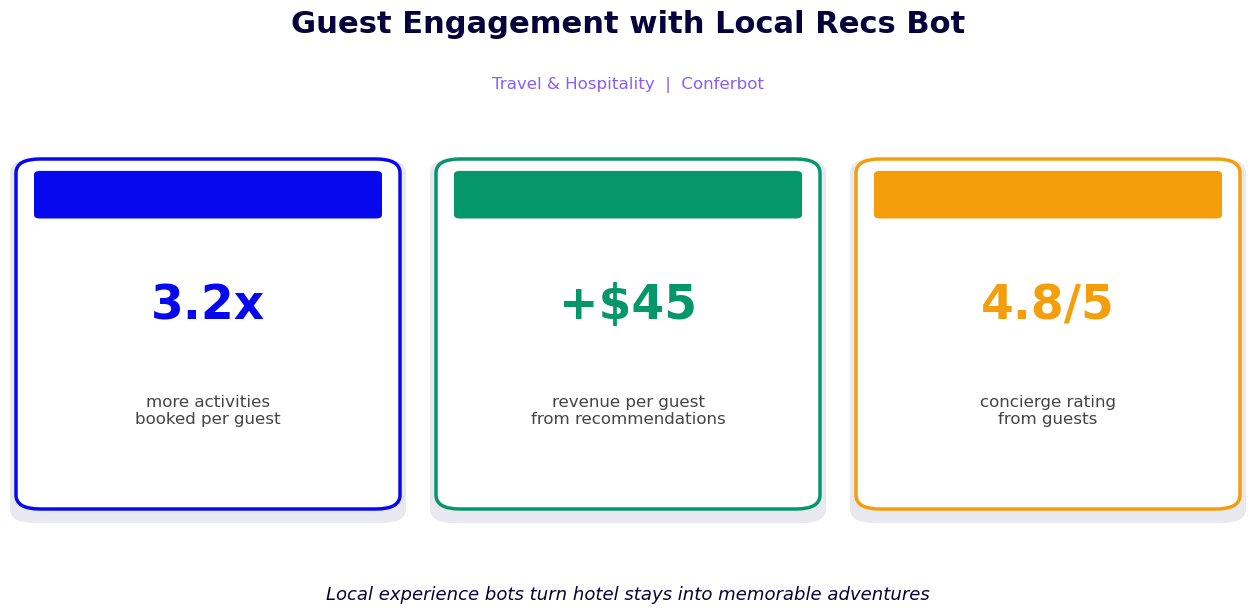
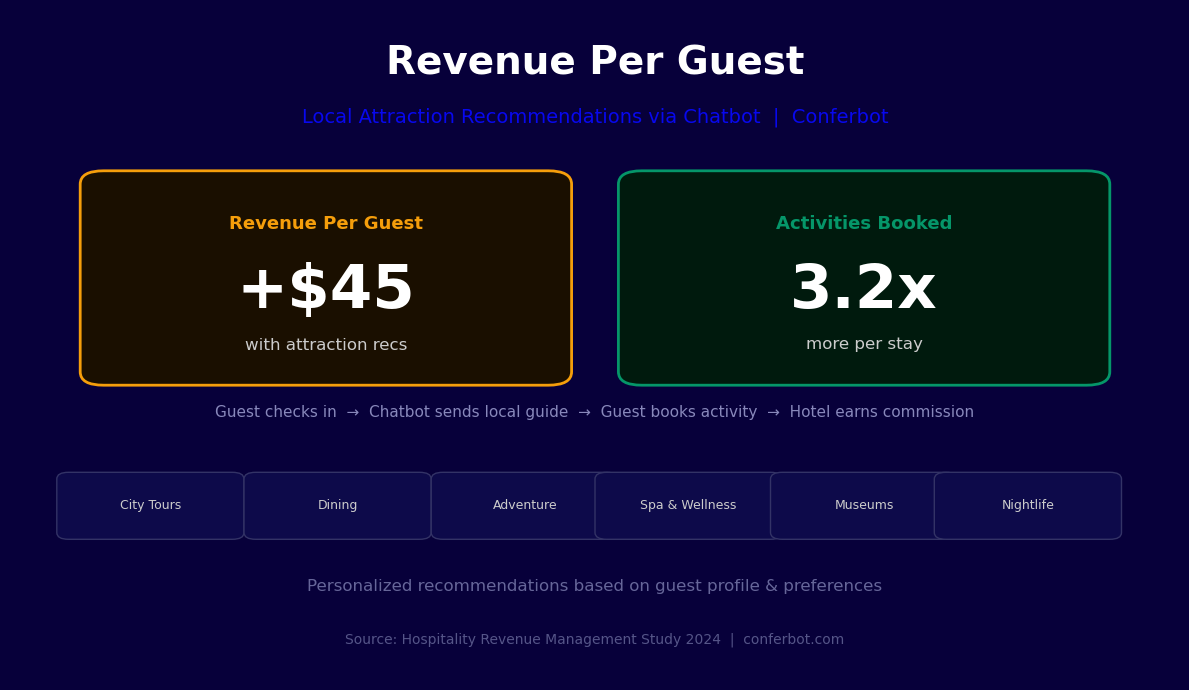
The commercial opportunity for hotels is significant. Guests who are actively helped to plan activities spend 25-40% more on ancillary services — tours, restaurant reservations, spa bookings, transportation — than guests left to plan independently. A hotel that captures even a portion of this activity booking through in-house channels retains the commission that would otherwise flow to OTAs and third-party booking platforms. Beyond revenue, activity recommendations that work well generate the specific, experience-rich reviews that drive future bookings: "The concierge chatbot recommended a sunset boat tour I never would have found — best part of the trip."
Built on Conferbot's AI chatbot builder, the local attraction recommender deploys on your hotel website, in your property app, via WhatsApp pre-arrival, and on in-room QR codes for on-demand access throughout the stay. The recommendation library is fully configurable and updated by your concierge team without technical assistance.
How the Local Attraction Recommender Works
The chatbot moves through a preference discovery conversation before surfacing any recommendations. This sequence ensures that every suggestion is genuinely relevant to the guest's interests, travel party composition, and available time — rather than a generic list of "top 10 things to do."
Phase 1: Guest and Stay Profiling
The conversation begins by establishing who the guest is traveling with (solo, couple, family with young children, group of friends) and the character of their stay (relaxing, adventurous, cultural, food-focused, or a mix). These two data points alone dramatically narrow the recommendation space: a family with children has a completely different set of appropriate activities than a couple on a romantic weekend, even in the same destination.
Phase 2: Preference and Constraint Collection
The chatbot collects the practical constraints that shape what is actually possible: how many days remain in the stay, what the guest's daily activity budget is, whether they have transportation (car rental, willingness to use ride-share), and any specific interests or must-see items they already have in mind. It uses NLP processing to interpret free-text preferences — "something outdoors but not too strenuous, ideally with a view" — and maps them to the appropriate recommendation categories in the destination library.
Phase 3: Curated Recommendation Delivery
Based on the collected profile, the chatbot surfaces 3-5 recommendations per category the guest expressed interest in, with brief descriptions that explain why each matches their specific preferences. Recommendations are not generic — they reference the guest's stated interests: "Given your interest in local food and markets, the Saturday morning farmers market at Harbor Square is the most authentic experience in the area and only a 10-minute walk from the property." This specificity builds trust and converts passive reading into active planning.
Phase 4: Booking and Arrangement
Once a guest expresses interest in an activity, the chatbot moves to booking. For activities with live inventory — tours, cooking classes, boat trips, spa treatments — it checks real-time availability and completes the booking within the conversation. For restaurant reservations, it connects via calendar booking integration to OpenTable, Resy, or the property's preferred reservation partner. For transportation, it can arrange hotel car service, pre-booked taxis, or provide ride-share guidance with estimated costs and pickup instructions.
Phase 5: Itinerary Consolidation
As the guest books or saves activities across the conversation, the chatbot compiles everything into a day-by-day itinerary that can be delivered as a WhatsApp message, email summary, or PDF. This itinerary includes booking confirmations, addresses, opening times, and any preparation notes (dress code, advance payment, meeting point). The consolidated itinerary is the most practical deliverable a guest receives from a concierge interaction — it replaces the scraps of paper and browser tabs with a single organized plan.
Key Features: Personalization, Live Availability, and Multi-Channel Delivery
The local attraction recommender includes features that address the specific operational and experience requirements of hotel and tourism concierge services. These capabilities distinguish an effective recommendation tool from a basic FAQ bot with a list of nearby attractions.
Dynamic Recommendation Library
The recommendation library is the core content layer of the chatbot and is fully managed by the hotel's concierge or marketing team without technical assistance. Each attraction entry includes a description, category tags (outdoor, cultural, food, family, romantic, adventure), opening hours, booking requirement, price range, distance and travel time from the property, seasonal availability, and the specific guest profile it suits best. Concierge teams add and update entries as new venues open and seasonal events begin — ensuring the chatbot always reflects current, curated local knowledge rather than static content that ages poorly.
Seasonal and Time-of-Day Intelligence
The chatbot is aware of the current season and time of day when surfacing recommendations. A guest asking for outdoor activity suggestions on a rainy afternoon receives covered or indoor alternatives rather than garden recommendations. Seasonal events — a local food festival in September, a ski season that opens in December, a summer beach concert series — appear in recommendations only during the relevant period. This temporal awareness makes the recommendations feel like they come from someone who actually lives in the destination, not from a database that does not know what month it is.
Integrated Booking Across Categories
| Category | Booking Method | Integration | Guest Experience |
|---|---|---|---|
| Tours and experiences | Live inventory booking | Viator, GetYourGuide, local operator API | Confirmation in conversation, no redirect |
| Restaurant reservations | Real-time table booking | OpenTable, Resy, SevenRooms | Party size, time, dietary preferences captured |
| Spa and wellness | Property calendar booking | Direct property PMS integration | Treatment selection, therapist preference, room charge option |
| Hotel transportation | Scheduled service request | Property concierge queue | Pickup time, destination, vehicle preference confirmed |
| Tickets (museums, events) | Affiliate ticketing links | Eventbrite, local venue partners | Pre-purchase link with price and availability shown |
Multi-Language Support
International hotels serve guests in dozens of languages. The local attraction recommender supports multilingual conversations, detecting the guest's language from their initial message and responding in kind. Recommendation descriptions, booking confirmation messages, and itinerary summaries are delivered in the guest's language. This capability is not cosmetic — a guest who struggles to communicate their preferences to an English-only tool receives generic recommendations; a guest who can express themselves fully receives genuinely personalized ones. The omnichannel delivery via Conferbot's omnichannel platform ensures consistent experience across the hotel website, WhatsApp, and in-room QR channels.
Ready to try Local Attraction Recommender Chatbot?
Deploy this template in under 10 minutes. No coding required.
Use This Template Free →Revenue Impact: Ancillary Spend and Commission Capture
For hotels, the local attraction recommender is not just a guest experience enhancement — it is a revenue instrument. The economics of ancillary spend capture are straightforward, and the opportunity is substantial at almost any property scale.
Ancillary Spend Activation
The average hotel guest spends $85-$140 per day on activities, dining outside the property, and local transportation during their stay. A portion of this spend is currently captured by OTA experience platforms (Viator, Airbnb Experiences, GetYourGuide) and local booking apps — at zero benefit to the hotel. A chatbot that intercepts this planning conversation at the property level and routes activity bookings through hotel-affiliated channels captures the commission on that spend: typically 15-25% for tour and experience operators, and a portion of the restaurant reservation fee for OpenTable-style partners.
Spa and On-Property Revenue
For properties with spa, fitness, or dining facilities, the chatbot serves as a proactive upsell channel. A guest asking about relaxation activities is a natural candidate for a spa recommendation. A guest planning a special-occasion dinner is offered the property's own restaurant alongside external options, with a clear value proposition — convenience, charging to the room, no transportation needed. Hotels report 18-28% increases in on-property spa and dining spend when proactive recommendations are delivered at the right moment in the guest's planning conversation.
Quantified ROI Example
| Metric | Baseline (No Chatbot) | With Recommendation Chatbot | Impact |
|---|---|---|---|
| Guests using concierge services | 15-22% of guests | 45-60% of guests | 2.5-4x engagement increase |
| Activity bookings per stay | 0.8 | 1.9 | +1.1 incremental bookings |
| Average commission per booking | $12 | $12 | Same rate, more volume |
| Monthly incremental commission (200-room property at 70% occupancy) | — | $3,850-$6,400 | New revenue stream |
| On-property F&B uplift per activated guest | — | $28-$45 | Incremental per guest |
| Guest satisfaction (activity quality) | 3.8/5.0 | 4.5/5.0 | +0.7 point increase |
Review Quality and Future Booking Impact
Guests who have exceptional local experiences — discovered through personalized concierge recommendations — write reviews that are disproportionately valuable for future bookings. Reviews mentioning specific experiences ("the rooftop dining recommendation was unforgettable") signal high-quality service and local knowledge in a way that generic five-star reviews do not. These experience-specific reviews have been shown to increase booking conversion rates by 12-18% for comparable properties, generating long-term revenue that dwarfs the direct commission value of any individual booking.
Use Cases: Hotels, Tourism Boards, and Destination Apps
The local attraction recommender template serves multiple types of organizations in the tourism and hospitality ecosystem, each with a distinct deployment model and measure of success.
Hotel and Resort Deployment
Hotels deploy the chatbot as a digital concierge available to guests from pre-arrival through check-out. Pre-arrival engagement — a WhatsApp message sent 48 hours before check-in inviting guests to start planning their stay — produces the highest engagement rates because guests are actively thinking about the trip. In-room QR codes on the bedside table activate the chatbot for guests who want to plan same-day activities. Check-in desk tablets or kiosks with the chatbot embedded capture guests who prefer to plan immediately after arrival. Each touchpoint uses the same chatbot with the same recommendation library, ensuring consistent quality across all access points.
Tourism Board and CVB Deployment
Convention and visitors bureaus (CVBs) and regional tourism boards deploy the chatbot on destination websites to convert research-phase visitors into booked travelers. A visitor researching "things to do in [city]" who encounters a chatbot that asks about their interests and travel dates — then builds a personalized 3-day itinerary — is far more likely to book accommodation in that destination than a visitor who finds a static list of attractions. CVBs that have deployed recommendation chatbots report 35-50% improvements in website-to-booking conversion for visitors who engage with the chatbot versus those who do not.
Destination Management Companies
DMCs that curate premium itinerary experiences for group travelers and corporate clients deploy the chatbot as a pre-trip engagement tool and an in-destination reference. Corporate event attendees arriving in an unfamiliar city use the chatbot to find dining options, evening activities, and transportation within the parameters of what the DMC has pre-approved. This keeps group members within curated options while giving them the feeling of independent exploration — a balance that is difficult to achieve without a conversational tool that responds to individual preferences in real time.
Vacation Rental Platforms
For Airbnb-style short-term rental platforms and vacation rental managers, the chatbot deploys as a property-specific guide that combines house rules and operational information with hyper-local neighborhood recommendations that a local host would provide. Guests who feel genuinely guided in an unfamiliar neighborhood give higher reviews, generate fewer support requests ("where can I find a grocery store?"), and rebook at higher rates. The chatbot via WhatsApp is particularly effective for vacation rental guests because it uses the channel they already expect for host communication.
Managing and Updating Recommendation Content
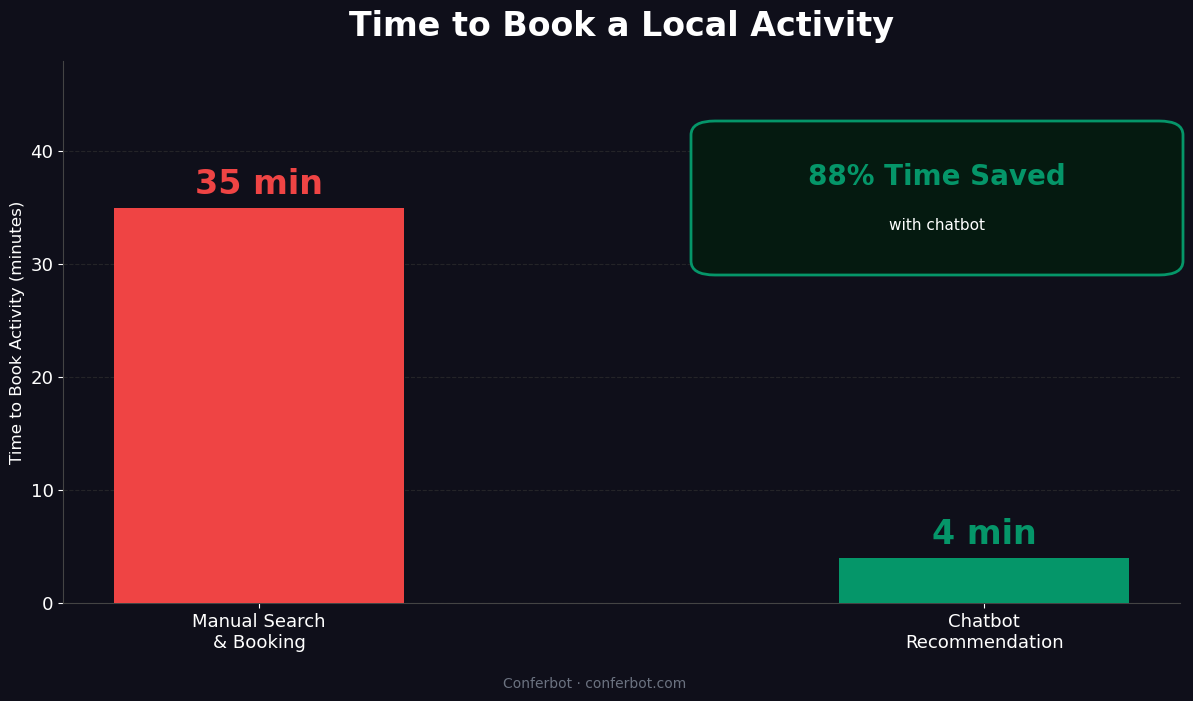
The quality of a local attraction recommender depends entirely on the quality and currency of its recommendation library. A chatbot recommending a restaurant that closed six months ago, or an attraction that is currently under renovation, damages guest trust more than providing no recommendation at all. This section covers how to build and maintain a recommendation library that stays current and delivers genuine value.
Building the Initial Library
Start with 15-25 recommendations across the categories most relevant to your primary guest profile. For a business hotel, prioritize restaurants, evening entertainment, and fitness options. For a family resort, lead with family-friendly activities, children's attractions, and casual dining. For a boutique cultural property, emphasize museums, galleries, markets, and local culinary experiences. Each entry should include a genuine reason why a guest matching a specific profile would enjoy it — not just a description of what the attraction is, but why it is the right choice for a particular type of traveler.
Seasonal Update Cadence
Maintain a quarterly review schedule for the recommendation library. Each quarter, audit the entire library: verify that all attractions are still operating, update hours and pricing, add seasonal events coming up in the next quarter, and remove or update entries that have changed significantly. This 2-3 hour quarterly investment keeps the library fresh and prevents the degradation that occurs when chatbot content is treated as a one-time setup task rather than an ongoing editorial responsibility.
Concierge Team Contribution
The most valuable content in the recommendation library is the kind that front-desk concierge staff accumulates through daily guest interactions — the specific question a returning guest asked, the hidden spot that gets five-star mentions in reviews, the restaurant that just opened last month and is already exceptional. Build a process for concierge team members to submit additions and updates to the chatbot library through a simple form or internal tool. The chatbot becomes more useful with every contribution, and the team members who contribute feel ownership over the tool's quality.
Using Analytics to Improve Recommendations
The analytics dashboard surfaces which recommendations guests engage with most, which ones result in bookings, and which conversation paths end without a booking. Low engagement on a specific recommendation suggests the description does not match how guests think about that type of experience. High engagement with no bookings suggests a friction point in the booking path. Review these patterns monthly and make targeted improvements — refining descriptions, adjusting category tags, or improving the booking handoff for high-interest attractions that are not converting.
50,000+ businesses use Conferbot templates to automate conversations
Setup Guide: Deploying a Local Attraction Recommender for Your Property
Deploying the local attraction recommender involves building the recommendation library, configuring booking integrations, and launching across the guest touchpoints most relevant to your property type. Most hospitality teams complete a full deployment in 3-5 days.
Step 1: Define Your Guest Profile and Categories
Begin by characterizing the types of guests your property typically hosts and the activity categories they most commonly seek. A resort serving adventure travelers needs different categories than an urban boutique hotel serving cultural tourists. Define 4-7 categories that cover your primary guest interests. These become the top-level navigation options in the chatbot's recommendation flow — "Looking for outdoor adventures, cultural experiences, dining, or something else?" — ensuring the first response the guest receives is immediately relevant.
Step 2: Build and Tag Your Recommendation Library
Create entries for 20-30 local attractions, restaurants, activities, and experiences across your defined categories. For each entry, apply the guest-profile tags that determine when it is recommended (family, couple, solo, group), the price range tag (budget, mid-range, premium), and the seasonality flag if applicable. Write the recommendation description in the voice of a knowledgeable local — specific, enthusiastic, and honest about what makes this experience particularly good for the guest type being matched.
Step 3: Configure Booking Integrations
Connect the booking actions that are most relevant to your recommendation categories. For tour and experience bookings, set up the Viator or GetYourGuide affiliate links or direct operator API connections. For restaurant reservations, connect OpenTable, Resy, or your preferred reservation partner through the API integration layer. For on-property spa and dining, connect to your PMS or booking calendar. Test each booking integration with a complete test transaction before going live.
Step 4: Deploy Across Guest Touchpoints
Deploy the chatbot widget on your hotel website's local area and activities pages. Configure the WhatsApp Business channel for pre-arrival guest messaging. Create the QR code assets for in-room deployment on bedside cards, welcome packets, or room information cards. For each channel, customize the greeting message to match the context — a website visitor sees "Planning your visit?" while a guest who receives a WhatsApp message 48 hours before arrival sees "Welcome to [City] — let's plan your stay."
Step 5: Launch and Iterate
Go live and monitor performance weekly for the first month. Track which recommendation categories generate the most engagement, which bookings the chatbot completes versus where guests drop off, and what free-text queries guests enter that the chatbot does not match to a recommendation. Unmatched queries are a library gap signal — if 30 guests per month are asking about cycling routes and you have no cycling recommendation, that is an addition to make immediately. Continuous library improvement driven by actual guest demand is what makes the chatbot increasingly valuable over time. View all performance metrics through Conferbot's analytics dashboard and explore pricing plans to match your property's conversation volume.
Local Attraction Recommender Chatbot FAQ
Everything you need to know about chatbots for local attraction recommender chatbot.
Why Use a Template vs Building from Scratch?
Templates encode years of optimization data into the conversation flow before you start.
| Factor | Conferbot Template | Build from Scratch | Hire a Developer |
|---|---|---|---|
| Time to deploy | 10 minutes | 2-8 hours | 2-6 weeks |
| Cost | Free | Your time | $5,000-$25,000 |
| Day-1 conversion | 15-22% | 5-8% | 10-15% |
| Proven flows | Yes, data-tested | No | Depends |
| Updates included | Automatic | Manual | Paid |
| Multi-channel | 8+ channels | 1 channel | Extra cost |
| Analytics | Built-in | Must build | Extra cost |
Ready to Deploy Local Attraction Recommender Chatbot?
Join 50,000+ businesses. Free forever plan available. No credit card required.