
Sales Lead Qualification Assistant
Free B2B Services Chatbot Template
A complete sales lead qualification assistant chatbot template — deploy in minutes to automate conversations, capture leads, and provide 24/7 assistance.


What Is a Sales Lead Qualification Assistant Chatbot?
A sales lead qualification assistant chatbot is an AI-powered conversational agent that evaluates every inbound lead against your sales criteria the moment they engage — scoring them on Budget, Authority, Need, and Timeline (BANT), matching them to your Ideal Customer Profile (ICP), and routing qualified prospects to the right sales rep with full context. It replaces the days-long process of email back-and-forth and SDR phone tag with an instant, intelligent conversation that gets leads from "interested" to "qualified" in under 3 minutes.
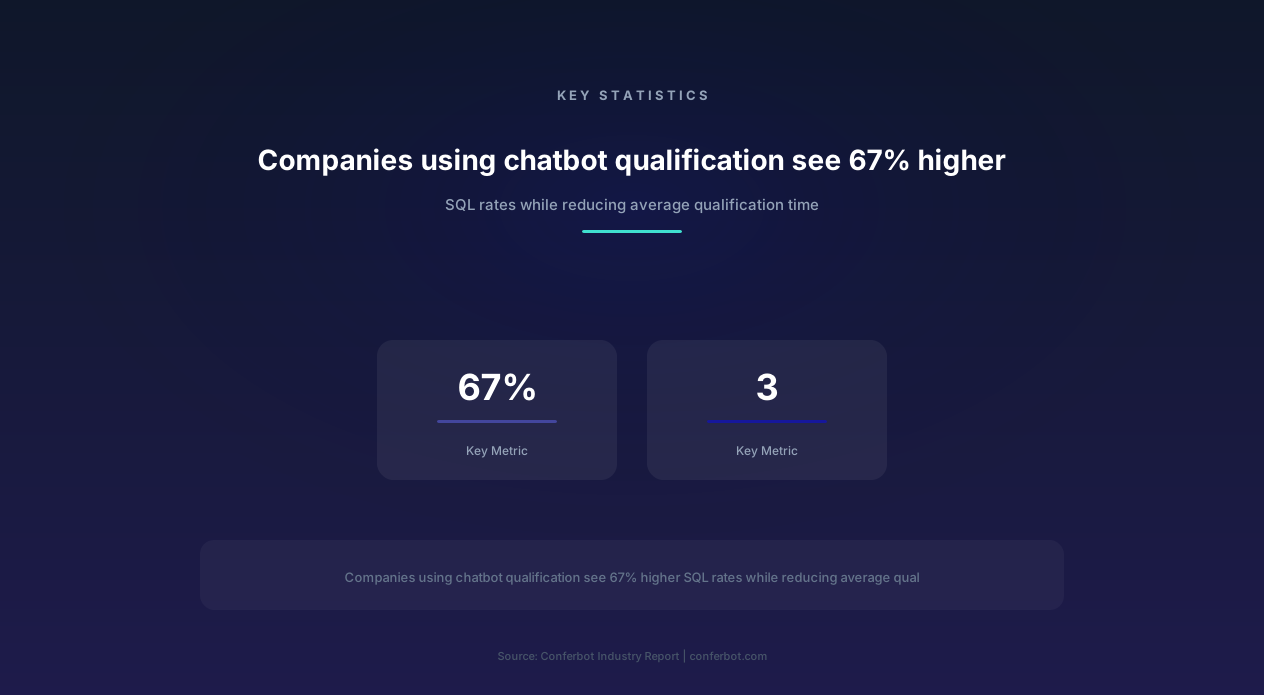
The problem with traditional lead qualification is fundamentally one of speed and consistency. InsideSales.com research shows that responding to a lead within 5 minutes makes you 21x more likely to qualify them compared to responding after 30 minutes. Yet the average B2B company takes 42 hours to respond to an inbound lead (Harvard Business Review). That is not a gap — it is a canyon. Every hour of delay costs you qualified pipeline, because your competitors are reaching those same prospects faster.
The $1.3 Trillion Problem of Unqualified Pipelines
Forrester Research estimates that B2B companies waste $1.3 trillion annually pursuing leads that will never close. The root cause: inconsistent qualification. When 10 different SDRs apply 10 different interpretations of "qualified," your pipeline fills with opportunities that look promising on paper but stall in mid-stage because fundamental fit issues were never identified upfront. A chatbot applies identical criteria to every lead, every time, producing a pipeline where "qualified" actually means qualified.
Consider what happens at most companies today: A visitor fills out a form on your website. An auto-response email goes out. The lead enters a queue. An SDR picks it up 4-48 hours later. They send a personalized email. The prospect may reply within a day, or a week, or never. If they reply, the SDR attempts to schedule a qualification call. After 2-3 scheduling attempts, a 15-30 minute call happens where the SDR asks the same questions every time. The SDR logs notes in the CRM (sometimes). The lead gets scored and routed (eventually). Total time from first touch to qualified status: 3-14 days. Total SDR time consumed: 45-90 minutes per lead.
The Chatbot Alternative: 3 Minutes, Not 3 Days
With a qualification assistant chatbot, the same process compresses to a single real-time conversation. The visitor engages with the bot on your website, landing page, or ad click-through. The bot asks targeted qualification questions in natural conversation. Within 3 minutes, the lead is scored, enriched with firmographic data, and routed: hot leads get instant calendar booking with an AE, warm leads receive SDR follow-up within 2 hours, and cold leads enter automated nurture. The CRM is updated. The rep is notified. The lead is still actively engaged and at peak intent.
This is not incremental improvement — it is a structural transformation of how your sales funnel operates. Explore how Conferbot's AI chatbot builder makes this transformation accessible without engineering resources.
BANT Scoring and ICP Matching: How the Bot Evaluates Every Lead
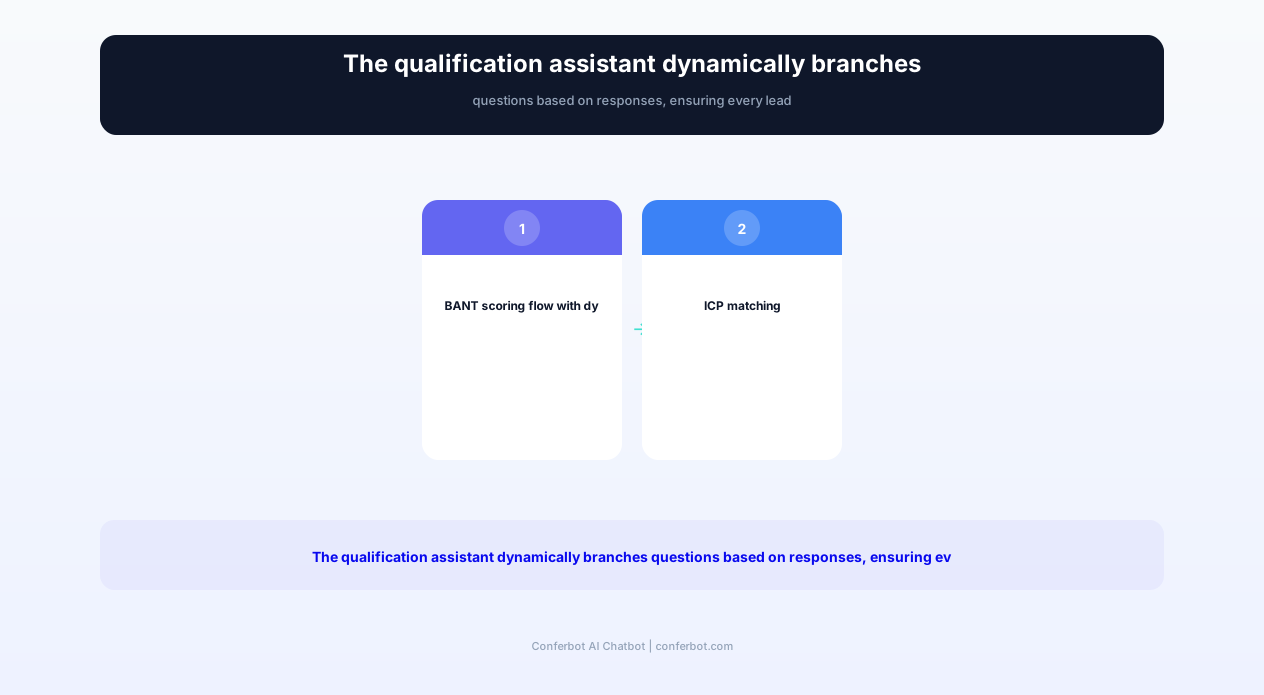
The qualification assistant does not ask questions randomly — it follows a proven scoring framework adapted for conversational AI. Every question serves a specific scoring purpose, and the bot dynamically adjusts its questioning path based on answers received. A CEO of a 500-person company gets different follow-up questions than an individual contributor at a 10-person startup, because their qualification paths diverge immediately after the Authority dimension is assessed.
BANT Scoring Framework
| Dimension | What the Bot Assesses | High Score (3 pts) | Medium Score (2 pts) | Low Score (1 pt) |
|---|---|---|---|---|
| Budget | Available budget, spending authority, current investment in similar solutions | Budget defined, matches your pricing | Budget exists but needs approval | No budget allocated, price-shopping |
| Authority | Decision-making power, buying committee position, ability to sign | Final decision-maker or budget owner | Key influencer who can champion internally | End user with no buying influence |
| Need | Pain severity, problem urgency, impact of not solving | Active pain costing money now, urgent fix needed | Recognized problem, planning solution for Q+1 | Exploring options, no defined problem |
| Timeline | Purchase urgency, contract end dates, trigger events | Buying within 30 days, active evaluation | Decision in 30-90 days, building business case | 6+ months out, no deadline pressure |
ICP Matching Criteria
Beyond BANT scoring, the bot checks ICP fit across firmographic and technographic dimensions. ICP matching determines whether a lead could become a successful customer — not just whether they want to buy, but whether they should. A lead with perfect BANT scores but terrible ICP fit (wrong industry, too small, missing technical prerequisites) wastes sales time even if they close, because they churn within 3-6 months. The bot checks:
- Company size: Employee count and revenue range against your success-profile sweet spot
- Industry vertical: Whether your product serves their specific industry with relevant features and case studies
- Technology stack: Compatibility with their existing tools (CRM, marketing automation, data infrastructure)
- Geographic coverage: Whether you support their region, language, and compliance requirements
- Growth trajectory: Whether their growth rate suggests they will expand into your product or outgrow it
Dynamic Question Branching
The bot's intelligence shows in how it adapts the conversation based on early answers. If a prospect identifies as the CEO of a 200-person company, the bot skips authority questions (assumed high), focuses heavily on business impact and timeline, and uses executive-appropriate language. If someone identifies as an individual contributor researching options, the bot probes for who the economic buyer is, what the internal approval process looks like, and whether a champion exists who would drive the purchase internally. This adaptive approach keeps conversations relevant and efficient — high-authority leads complete qualification in under 2 minutes because redundant questions are eliminated.
Composite Scoring and Threshold Logic
The final qualification score combines BANT points (0-12) with ICP fit multiplier (0.5x to 1.5x). A lead with BANT score 10 but poor ICP fit (multiplier 0.6) nets a final score of 6 — routed to SDR follow-up rather than direct AE booking. A lead with BANT score 7 but excellent ICP fit (multiplier 1.4) nets 9.8 — qualifying for immediate AE engagement because ICP-aligned leads convert at 3x the rate of misaligned leads even with lower initial BANT scores. This nuanced scoring outperforms simple threshold models by 40% in predicting actual closed-won outcomes.
See how intelligent scoring connects to automated meeting scheduling via Conferbot's calendar booking integration.
Key Features: Conversational Intelligence, CRM Enrichment, and Lead Routing
The qualification assistant combines conversational AI with enterprise sales operations capabilities. It is not just a form replacement — it is a complete qualification operations layer that handles scoring, enrichment, routing, scheduling, and handoff in a single seamless interaction. Here is the complete feature set.
Feature Matrix
| Feature | Description | Sales Impact | Setup Complexity |
|---|---|---|---|
| Real-time BANT scoring | Scores leads on Budget, Authority, Need, Timeline as conversation progresses; can escalate mid-conversation when threshold hit | 67% higher SQL rate vs. manual qualification | 5 min (adjust thresholds) |
| ICP matching engine | Validates firmographic and technographic fit against your ideal customer profile definition | 3x higher close rate on ICP-matched leads | 15 min (define ICP criteria) |
| Firmographic enrichment | Auto-enriches lead data from Clearbit/Apollo/ZoomInfo using email domain; reduces question burden | 40% fewer questions needed; better data quality | 10 min (connect enrichment API) |
| Intelligent lead routing | Routes qualified leads to correct rep by territory, industry vertical, deal size, or round-robin | 25% faster first-meeting scheduling | 10 min (configure routing rules) |
| Instant calendar booking | High-scoring leads book meetings with assigned AE directly in conversation; shows live availability | 35% higher show rates vs. email-booked meetings | 5 min (connect calendar) |
| CRM auto-population | Creates contacts, deals, and activities in HubSpot/Salesforce with all qualification data mapped | Zero manual data entry; 100% capture rate | 10 min (OAuth + field mapping) |
| Multi-channel deployment | Same qualification flow on website, WhatsApp, Messenger, landing pages, and ad click-throughs | Captures leads wherever they engage | 5 min per channel |
| Live handoff with context | Hot leads or complex questions trigger immediate transfer to human rep with full transcript visible | No context loss; rep picks up informed | 5 min (set handoff triggers) |
| A/B testing framework | Test different question sequences, scoring weights, and routing thresholds simultaneously | 15-20% improvement in qualification accuracy over 90 days | Ongoing optimization |
| Disqualification nurture | Unqualified leads receive relevant content and enter nurture sequences rather than dead-ending | 22% re-qualification rate within 12 months | 10 min (configure nurture content) |
Conversational Intelligence: Understanding What Prospects Really Mean
The bot's NLP engine interprets prospect responses beyond literal text. When someone says "we are still figuring out the budget," the system recognizes this as low-to-medium budget confidence — not zero budget. When a prospect says "I brought this to my VP last week and she is excited," the bot identifies both the authority chain (VP is likely the economic buyer) and internal championing (the prospect is an active advocate). This nuanced interpretation produces more accurate scoring than rigid keyword matching and avoids the false negatives that cause qualification bots to miss good leads.
Objection Handling Within Qualification
Prospects do not always answer questions directly. They push back: "Why do you need to know our budget?" or "I'd rather not say who else is involved." The qualification bot handles these objections naturally, explaining why each piece of information helps deliver a better experience, offering to continue without the specific data point (and adjusting the score accordingly), or reframing the question in a less direct way. This graceful objection handling maintains conversion rates above 75% through the full qualification sequence — compared to 40-50% completion for rigid form-based approaches.
Connect qualification data to your sales pipeline using Conferbot's API integration capabilities for custom CRM and sales automation platforms beyond HubSpot and Salesforce.
Ready to try Sales Lead Qualification Assistant?
Deploy this template in under 10 minutes. No coding required.
Use This Template Free →CRM Enrichment and Pipeline Automation: From Conversation to Closed-Won
Lead qualification data is worthless if it sits in a chatbot platform and never reaches your sales team's workflow. Conferbot's qualification assistant treats the CRM as the single source of truth — every qualification conversation results in a fully enriched CRM record with structured scoring data, conversation highlights, and automated next-step triggers. No copy-pasting, no spreadsheet intermediaries, no data left behind.
HubSpot Integration: Qualification to Pipeline in 10 Seconds
When a qualification conversation completes, the following HubSpot actions fire automatically:
- Contact creation/update: Email-based deduplication checks for existing contacts. New contacts are created with full qualification data. Existing contacts are updated with fresh scoring, preserving historical data in a timeline note.
- Custom property population: BANT scores (B:3, A:2, N:3, T:2), composite score (10/12), ICP match percentage (87%), and qualification timestamp are written to custom HubSpot properties — making lead scoring data available in lists, workflows, and reports.
- Deal creation with stage assignment: Qualified leads trigger deal creation at the appropriate pipeline stage. High-scoring leads enter "Sales Qualified - Meeting Scheduled." Medium leads enter "Marketing Qualified - SDR Follow-Up." This eliminates the lifecycle stage ambiguity that plagues many CRM implementations.
- Task assignment: Time-sensitive tasks are created for the assigned rep: "Call within 2 hours" for warm leads, "Review and reach out this week" for nurture-track leads.
- Workflow enrollment: Leads automatically enter the appropriate HubSpot workflow: immediate AE outreach sequence, SDR multi-touch cadence, or long-term nurture drip.
Salesforce Integration: Enterprise-Grade Pipeline Automation
The Salesforce integration maps to the standard Lead/Contact/Opportunity model with full support for custom objects:
- Lead record: New prospects create Salesforce Leads with Source set to the specific chatbot campaign, Status set based on qualification score, and all BANT fields populated in custom fields.
- Lead conversion: Leads scoring above the High threshold are automatically converted to Contact + Opportunity, skipping the manual conversion step that often delays pipeline movement.
- Opportunity staging: Opportunities are created at the correct stage with Amount estimated from the budget discussion, Close Date projected from timeline answers, and Next Step populated with the scheduled meeting details.
- Activity logging: The full chatbot transcript is logged as a completed Activity on the record, giving any rep who touches the lead full context of the qualification conversation.
Pipeline Automation: What Happens After Qualification
| Score Range | Classification | Automated Action | Rep Experience |
|---|---|---|---|
| 10-12 (Hot) | Sales Qualified Lead (SQL) | Meeting booked, deal created, Slack alert to AE, 15-min prep brief generated | AE receives calendar invite + qualification summary + suggested talking points |
| 7-9 (Warm) | Marketing Qualified Lead (MQL+) | SDR task created, personalized follow-up sequence enrolled, lead scored in CRM | SDR sees lead in priority queue with context and suggested outreach approach |
| 4-6 (Cool) | Marketing Qualified Lead (MQL) | Nurture sequence enrolled, content delivered, 60-day re-qualification scheduled | Appears in weekly SDR review digest; no immediate action required |
| 1-3 (Cold) | Unqualified | Polite disqualification message, helpful content shared, yearly re-check scheduled | Logged for reporting only; no rep time consumed |
Data Quality Impact
CRM data quality degrades when humans are responsible for data entry. SDRs skip fields they consider low-priority, misspell company names, leave notes in inconsistent formats, and forget to update deal stages. The qualification bot achieves 100% field completion, consistent formatting, and real-time updates because data entry happens at the moment of collection — not as an afterthought hours later. Over 6 months, teams using the qualification bot report CRM data completeness improving from 45% to 97%, making pipeline forecasting dramatically more accurate.
Deploy qualification across all your lead sources using Conferbot's website chatbot and WhatsApp channels — every channel feeds the same CRM pipeline with identical data quality.
Conversion Metrics and ROI: What Sales Teams Actually Measure
Sales leaders care about one thing: pipeline that converts to revenue. The qualification assistant directly impacts the metrics that matter most — speed to lead, MQL-to-SQL conversion rate, meeting show rate, and ultimately close rate. Here is the data from B2B companies deploying Conferbot's qualification assistant across various deal sizes and sales cycles in 2026.
Key Performance Benchmarks
| Metric | Without Qualification Bot | With Qualification Bot | Improvement |
|---|---|---|---|
| Average time to qualify a lead | 3-5 days (email + call scheduling) | 3 minutes (real-time conversation) | 99.9% faster |
| Lead response time | 42 hours average | Under 30 seconds | 5,040x faster |
| MQL-to-SQL conversion rate | 13% | 22% (67% improvement) | +9 percentage points |
| SQL-to-meeting rate | 55% | 78% | +23 percentage points |
| Meeting show rate | 62% | 84% | +22 percentage points |
| Qualification consistency (cross-rep variance) | ±35% scoring variance | 0% variance (same criteria applied) | Perfect consistency |
| SDR time per qualified lead | 45-60 minutes | 5-10 minutes (review + personalize) | 80% time savings |
| Leads qualified per day (capacity) | 30-50 per SDR | Unlimited via bot + 50 high-touch via SDR | 10x+ capacity |
ROI Model: Mid-Market B2B SaaS ($15K ACV)
A B2B SaaS company with 800 monthly inbound leads, $15,000 average ACV, and 4 SDRs ($70,000 fully loaded each = $280,000/year). Current funnel: 13% MQL-to-SQL (104 SQLs) → 45% SQL-to-opportunity (47 opps) → 22% close rate = 10 deals/month = $150,000 monthly ARR from inbound.
After deploying the qualification bot: 22% MQL-to-SQL (176 SQLs) → 55% SQL-to-opportunity (97 opps, higher because better qualification = better fit) → 25% close rate (improved because pipeline quality is higher) = 24 deals/month = $360,000 monthly ARR from inbound. That is $210,000/month in additional recurring revenue ($2.52M ARR) from the same lead volume.
Additionally, the 4 SDRs now spend 80% less time on initial qualification, redirecting that capacity toward high-value activities: multi-threaded outreach to enterprise accounts, relationship building with champions, and pipeline acceleration calls. The net result is that your existing team produces the output of a 12-person SDR org — without 8 additional $70,000 salaries.
The Hidden ROI: Pipeline Quality
Beyond raw conversion numbers, consistent qualification dramatically improves pipeline forecasting accuracy. When every opportunity entering Stage 2 has been scored identically, your VP of Sales can forecast with confidence rather than padding for "the deals that probably shouldn't be in pipeline but someone was optimistic." Companies report forecast accuracy improving from ±30% to ±10% within one quarter of deploying consistent chatbot qualification — which cascades into better hiring decisions, more accurate capacity planning, and stronger board relationships.
Setup Guide: From Template to First Qualified Lead in 45 Minutes
Deploying a qualification assistant does not require weeks of configuration or sales operations consulting. Conferbot's template provides the complete infrastructure — you customize the criteria, connect your tools, and go live. Here is the step-by-step deployment process that teams complete in under an hour.
Step 1: Define Your ICP and Qualification Criteria (15 Minutes)
Before configuring the bot, document three things clearly:
- Ideal Customer Profile: Company size range (employees/revenue), target industries, geographic coverage, technology requirements, and minimum deal size threshold. Be specific — "50-500 employees in B2B SaaS, North America, using HubSpot or Salesforce, minimum $10K ACV opportunity" is actionable. "Small to medium businesses" is not.
- BANT thresholds: What specific budget range constitutes High/Medium/Low for your product? What titles count as decision-makers vs. influencers? What timeline triggers urgency?
- Routing rules: Who handles Hot leads? Warm? Does routing follow territory, product line, deal size, or round-robin?
Step 2: Customize Qualification Questions (10 Minutes)
The template ships with battle-tested question sets for B2B qualification. Review and adjust for your market:
- Opening engagement: How the bot introduces itself and sets expectations for the conversation
- Budget exploration: Dollar ranges, spending on current solutions, investment appetite
- Authority identification: Role, team structure, who else would be involved in a decision
- Need assessment: Current challenges, what prompted the visit, impact of not solving
- Timeline clarity: Urgency drivers, decision deadlines, contract expiration dates
- Disqualification questions: Hard stops that immediately exit the qualification flow (students, competitors, wrong geography)
Step 3: Connect CRM and Calendar (10 Minutes)
Navigate to Integrations and connect your CRM (HubSpot or Salesforce) via OAuth. Map qualification fields to CRM properties using the visual field mapper. Connect your team's calendar via calendar booking integration so qualified leads book meetings in real time. Test the connection by creating a sample contact.
Step 4: Configure Routing and Notifications (5 Minutes)
Set up routing rules that determine which rep receives each qualified lead. Options include territory mapping (EMEA leads → EMEA team), deal-size routing (enterprise → senior AEs), product routing (specific product interest → product specialist), or round-robin for flat teams. Configure notification channels — Slack for instant alerts, email for summary digests.
Step 5: Deploy Across Channels (5 Minutes)
Install the chatbot on your highest-traffic lead generation pages: pricing page, demo request page, feature pages, and homepage. For multi-channel deployment, activate the same qualification flow on WhatsApp for inbound leads from WhatsApp ads and on Messenger for social media lead generation. Each channel can have customized opening messages while sharing the same scoring logic.
Step 6: Run Validation Tests (5 Minutes)
Execute three test conversations simulating different lead profiles: a perfect-fit hot lead (verify meeting gets booked and CRM record is complete), a warm but not-yet-ready lead (verify SDR notification and nurture enrollment), and an out-of-ICP visitor (verify graceful disqualification and content delivery). Check that all CRM records, calendar events, and notifications fire correctly.
For teams managing complex multi-step qualification, Conferbot's AI chatbot builder supports unlimited conversation branching, conditional logic, and dynamic scoring adjustments without any code.
50,000+ businesses use Conferbot templates to automate conversations
Optimization: Improving Qualification Accuracy Week Over Week
A qualification bot that never improves is a qualification bot that gradually becomes less effective as your market, product, and ICP evolve. The highest-performing sales teams treat their qualification logic as a living system — reviewing data monthly, adjusting thresholds quarterly, and A/B testing continuously. Here are the optimization levers that drive the most impact.
Validate Scoring Against Closed-Won Data
The most important optimization is feedback-loop validation. Every 30 days, pull your closed-won deals from the prior 90 days and check: did the qualification bot score them as Hot when they first engaged? If High-scoring leads close at 32% but Medium-scoring leads close at 28%, your threshold between High and Medium is not discriminating effectively. Either tighten the High criteria or investigate which Medium-scored attributes actually predict success. Over 6 months of monthly calibration, top teams achieve 85%+ correlation between bot qualification score and eventual close outcome.
Analyze Conversation Drop-Off
If 30% of prospects abandon the qualification conversation at a specific question, that question is either too invasive, confusing, or appearing at the wrong point in the conversation. Common culprits:
- Budget questions too early: Asking about budget before establishing value creates resistance. Move budget to question 4-5 instead of question 2.
- Authority questions that feel invasive: "Are you the decision-maker?" feels judgmental. Rephrase as "Who else would typically be involved in evaluating a solution like this?"
- Open-ended questions that are too broad: "Tell me about your challenges" overwhelms. Offer multiple-choice options that the prospect can elaborate on if they choose.
Scoring Weight Optimization
Default BANT weighting treats all four dimensions equally (25% each). But your specific market may have different predictive weights. SaaS companies often find that Timeline is the strongest close predictor (a prospect with a defined deadline closes 4x more often than one without, regardless of other scores). Enterprise companies find Authority most predictive (if you are not talking to the economic buyer or their champion, nothing else matters). Adjust weights based on your closed-won analysis to improve scoring accuracy by 20-30%.
Question Sequence A/B Testing
The order in which questions are asked materially affects both completion rate and scoring accuracy. Test variations:
- Leading with pain (Need) before budget: builds emotional investment before asking about money
- Leading with timeline: quickly identifies urgency level and adjusts conversation depth accordingly
- Leading with a value statement: "Companies like yours typically save $X with us" before any qualifying questions
Monthly Optimization Checklist
| Activity | Frequency | Expected Impact | Time Required |
|---|---|---|---|
| Score vs. close-rate validation | Monthly | 5-10% scoring accuracy improvement | 30 minutes |
| Drop-off analysis and question refinement | Bi-weekly | 10-15% completion rate improvement | 20 minutes |
| Scoring weight adjustment | Quarterly | 15-25% predictive accuracy improvement | 45 minutes |
| New disqualification pattern identification | Monthly | Fewer false-positive SQLs reaching AEs | 15 minutes |
| ICP criteria refresh | Quarterly | Alignment with current market conditions | 1 hour |
| Competitor question updates | Quarterly | Accurate competitive positioning data in CRM | 20 minutes |
Feedback from Sales Reps
Your AEs and SDRs provide the most valuable qualification feedback because they see what happens after the bot hands off. Create a simple feedback mechanism: after every meeting with a bot-qualified lead, the rep rates qualification quality (1-5) and notes any missing context. A pattern of "the bot qualified them as Hot but they had no idea about pricing" indicates the budget question is not surfacing accurate information. A pattern of "great qualification but wrong rep assigned" indicates routing rules need adjustment.
Explore advanced optimization through Conferbot's API integration for custom scoring models, and AI chatbot builder for no-code conversation flow adjustments.
Comparison: Qualification Bot vs. SDRs vs. Forms vs. Lead Scoring Tools
Companies evaluating a qualification chatbot often ask how it compares to existing approaches. The honest answer: it does not replace everything — it replaces the high-volume, repetitive qualification work while freeing human reps for the high-value relationship work that actually requires a person. Here is a detailed comparison across the four most common qualification approaches in 2026.
Head-to-Head Comparison
| Capability | Qualification Chatbot | Human SDR Team | Static Lead Forms | Predictive Lead Scoring |
|---|---|---|---|---|
| Response time | Under 30 seconds, 24/7 | 4-48 hours (business hours) | Instant submission, delayed follow-up | Instant scoring, delayed action |
| Qualification depth | Deep (10-15 contextual questions, adaptive) | Deep (unlimited questions, intuition) | Shallow (5-7 static fields) | Inferred (no direct questioning) |
| Consistency | Perfect (same criteria every time) | Variable (rep-dependent interpretation) | Perfect (same fields) | High (algorithm-based) |
| Scalability | Unlimited concurrent conversations | 1 conversation per rep at a time | Unlimited submissions | Unlimited scoring |
| Cost per qualified lead | $0.50-$2.00 | $50-$150 (loaded SDR time) | $0.10 (but low qualification) | $5-$20 (tool subscription) |
| Data quality | 100% field completion, structured | 60-80% completion, inconsistent format | 40-60% completion (optional fields skipped) | Inferred data, no direct input |
| Prospect experience | Conversational, immediate value | Personal, but often delayed | Impersonal, transactional | Invisible (no interaction) |
| Objection handling | Pre-programmed responses, NLP understanding | Adaptive, creative, empathetic | None | None |
| Complex deal navigation | Good for initial qualification | Excellent for multi-threaded deals | Cannot handle complexity | Cannot interact with prospects |
| 24/7 availability | Yes | Business hours only (without global team) | Yes (form submission) | Yes (background scoring) |
The Optimal Model: Bot + Human Hybrid
The highest-performing sales organizations in 2026 use a hybrid model: the chatbot handles initial qualification (first 3 minutes), then routes to humans for relationship building, complex objection handling, and deal advancement. This hybrid captures the bot's advantages (speed, consistency, scale, cost) while preserving the human advantages (creativity, empathy, complex negotiation). The bot does not replace SDRs — it makes each SDR 4-5x more productive by eliminating the repetitive initial qualification that consumes 60-70% of their time today.
When to Use Each Approach
- Chatbot only: High-volume inbound with clear qualification criteria, SMB/mid-market deals under $25K, simple product/pricing, high lead-to-close velocity
- Chatbot + SDR handoff: Mid-market to enterprise, deals $25K-$200K, moderate complexity, multiple stakeholders
- SDR-led with bot support: Enterprise accounts $200K+, complex multi-year deals, relationship-driven buying, C-suite selling
- Forms + scoring: Low-intent content downloads, newsletter signups, top-of-funnel where qualification is premature
Most B2B companies find that 70-80% of their inbound leads can be fully qualified by the bot without any SDR involvement, with the remaining 20-30% benefiting from the hybrid handoff approach. The net result: your SDR team focuses exclusively on the leads that need human attention while the bot qualifies everything else instantly.
Sales Lead Qualification Assistant FAQ
Everything you need to know about chatbots for sales lead qualification assistant.
Why Use a Template vs Building from Scratch?
Templates encode years of optimization data into the conversation flow before you start.
| Factor | Conferbot Template | Build from Scratch | Hire a Developer |
|---|---|---|---|
| Time to deploy | 10 minutes | 2-8 hours | 2-6 weeks |
| Cost | Free | Your time | $5,000-$25,000 |
| Day-1 conversion | 15-22% | 5-8% | 10-15% |
| Proven flows | Yes, data-tested | No | Depends |
| Updates included | Automatic | Manual | Paid |
| Multi-channel | 8+ channels | 1 channel | Extra cost |
| Analytics | Built-in | Must build | Extra cost |
Ready to Deploy Sales Lead Qualification Assistant?
Join 50,000+ businesses. Free forever plan available. No credit card required.