
Pharmacy Medication Chatbot
Free Healthcare Chatbot Template
Pharmacy assistant for refills, transfers, delivery, and medication questions


What Is a Pharmacy Medication Chatbot?
A pharmacy medication chatbot is an AI-powered conversational assistant designed specifically for retail pharmacies, independent drugstores, and pharmacy chains to automate the high-volume routine interactions that consume pharmacist and technician time — prescription refill requests, drug interaction inquiries, medication availability checks, insurance coverage questions, prescription transfers, delivery scheduling, pharmacist consultation booking, and side effect information requests. In 2026, pharmacies face an unprecedented operational challenge: prescription volumes continue rising (4.7 billion prescriptions filled annually in the US alone), pharmacist shortages are worsening, and patients increasingly expect instant digital service. The pharmacy chatbot addresses all three pressures simultaneously — handling 65-80% of incoming inquiries automatically while freeing pharmacists to focus on clinical services and complex patient consultations that require professional judgment.
The Pharmacy Operational Crisis: Why Automation Is Essential
Pharmacists spend approximately 25% of their working time handling routine phone inquiries — refill status checks, store hours, medication availability, and transfer requests — that require no clinical expertise. With the average pharmacy receiving 150-300 phone calls daily and each call consuming 3-5 minutes of staff time, this represents 7.5-25 hours of daily staff capacity dedicated to repetitive information delivery. Meanwhile, patients calling for these routine matters experience 8-15 minute hold times during peak periods, driving frustration and potential transfer of prescriptions to competitors offering better digital experiences. The chatbot resolves this tension by handling routine inquiries instantly and 24/7, while routing clinical questions to pharmacists who now have capacity to provide the consultative care that differentiates excellent pharmacies.
The financial pressure is equally compelling. Pharmacy keywords in digital advertising cost $8-25 per click — among the highest CPC rates in healthcare. A single missed phone call from a patient seeking to transfer prescriptions to your pharmacy represents $2,000-5,000 in annual prescription revenue lost to a competitor. The chatbot ensures zero missed inquiries, instant response to transfer requests, and 24/7 availability that captures patients who search for pharmacy services outside business hours.
Why 88% of Prescriptions Are Perfect for Automation
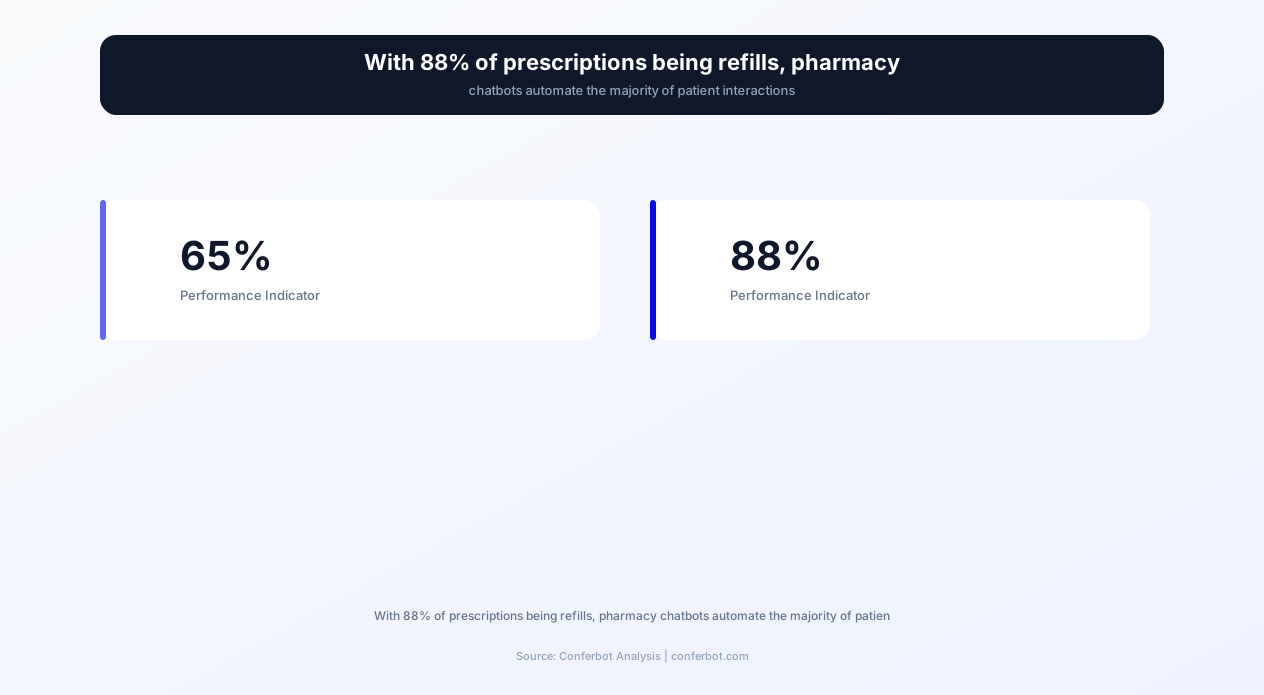
The pharmacy industry has a unique characteristic that makes it exceptionally suitable for chatbot automation: 88% of all prescriptions filled are refills, not new prescriptions. Refill requests are inherently repetitive, predictable, and rule-based — the patient needs the same medication at the same dose at predictable intervals. This means the overwhelming majority of prescription-related interactions follow patterns that automation handles perfectly. The chatbot knows when a patient's refills are due, can process the request instantly, notify the patient when the prescription is ready, and even schedule delivery — without any pharmacist involvement in the standard refill workflow.
Who Benefits from This Template
- Independent community pharmacies: Single-location pharmacies competing against chain convenience by offering superior digital patient experience without hiring additional staff.
- Pharmacy chains (2-50 locations): Multi-store operations needing consistent patient communication and centralized refill management across locations.
- Compounding pharmacies: Specialty pharmacies that need to manage complex consultation scheduling, custom medication inquiries, and preparation timelines.
- Mail-order and delivery pharmacies: Pharmacies where the entire interaction is remote and digital experience quality directly determines patient retention.
- Hospital outpatient pharmacies: Pharmacies serving discharged patients who need refill management, medication counseling, and insurance navigation assistance.
Built on Conferbot's AI chatbot builder, this template integrates with pharmacy management systems through the API integration to access prescription records, inventory status, and insurance information in real-time. Deploy on your website for patients browsing pharmacy services or on WhatsApp where patients can easily share photos of prescription labels and insurance cards.
How the Pharmacy Medication Chatbot Works
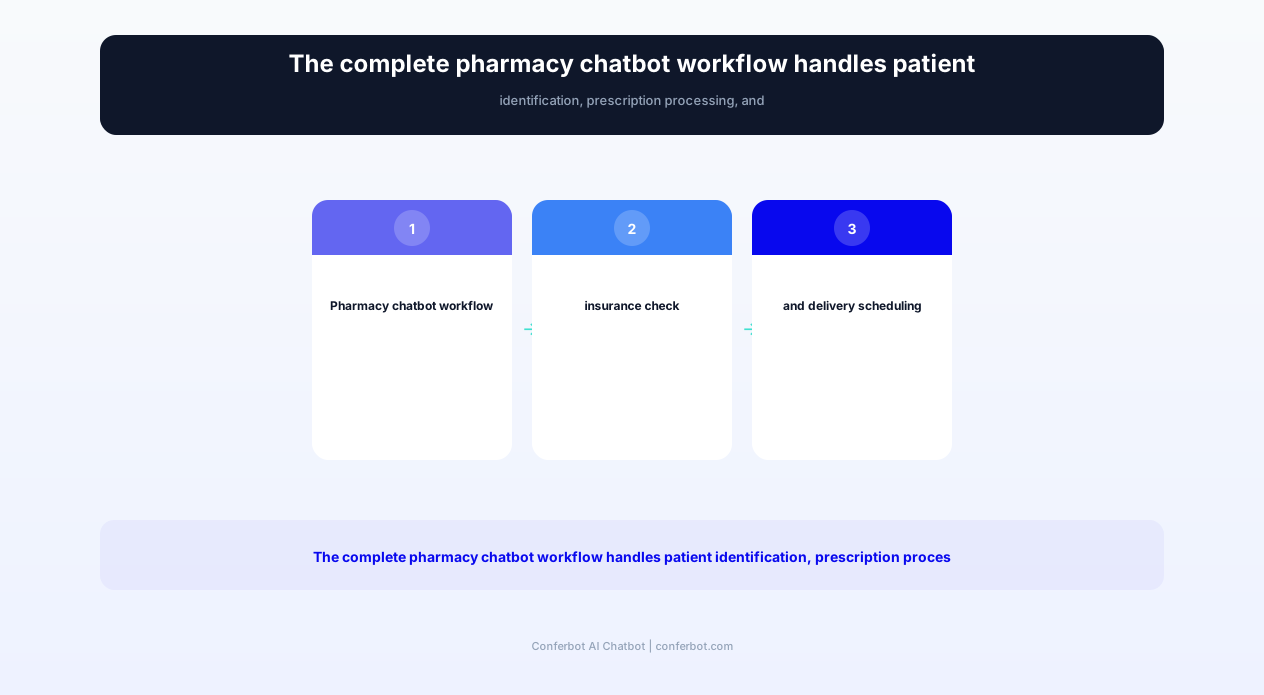
The pharmacy chatbot operates as a comprehensive patient service platform that handles the complete spectrum of pharmacy interactions — from initial inquiry through prescription fulfillment and ongoing medication management. The system combines HIPAA-compliant patient identification with pharmacy management system integration to provide personalized, accurate service that reflects each patient's specific prescriptions, insurance coverage, and medication history.
Stage 1: Patient Identification and Authentication
Every pharmacy interaction requires patient identification to access prescription records and provide personalized service. The chatbot implements HIPAA-compliant verification through multiple methods: date of birth combined with last name (minimum viable identification), prescription number lookup, phone number on file verification, or insurance member ID. For returning patients who have previously verified identity through the chatbot, session persistence enables recognition without full re-verification for a configurable time window (typically 24-72 hours). The identification process is conversational rather than form-based: "I'd be happy to help with your prescription. Could you provide your date of birth and last name so I can pull up your records?" This approach maintains compliance while avoiding the clinical coldness of institutional verification procedures.
Stage 2: Intent Recognition and Service Routing
After identification, the chatbot determines the patient's need through natural language understanding. The system recognizes major service categories and their natural language variations:
- Refill requests: "I need to refill my blood pressure medication" / "refill Rx 4523891" / "I'm running low on my metformin"
- Availability checks: "Do you have lisinopril 10mg in stock?" / "Is my prescription ready?" / "When will my medication be available?"
- Insurance questions: "Does my insurance cover Ozempic?" / "What's my copay for this medication?" / "Can you check if there's a generic alternative my plan covers?"
- Drug interaction inquiries: "Can I take ibuprofen with my current medications?" / "Are there interactions between metformin and the new antibiotic?"
- Transfer requests: "I want to transfer my prescriptions from CVS" / "I'm moving — can you transfer to your downtown location?"
- Pharmacist consultation: "I need to speak with a pharmacist about my medications" / "I have questions about side effects"
Stage 3: Service Execution
Once intent is identified, the chatbot executes the appropriate service workflow. For refill requests, it verifies remaining refills on the prescription, checks medication inventory, processes the refill through the pharmacy management system, and provides an estimated ready time. For availability checks, it queries real-time inventory and provides immediate confirmation or offers alternatives (ordering with delivery timeline, suggesting equivalent medication at another location, or transferring to a location with stock). For insurance questions, it accesses formulary information to verify coverage, provide copay estimates, and suggest covered alternatives when the requested medication is not covered or requires prior authorization.
Stage 4: Fulfillment Communication
After a refill request is processed, the chatbot manages fulfillment communication: confirmation that the refill has been received and is being processed, notification when the prescription is ready for pickup, or delivery tracking when home delivery is selected. Ready notifications include pickup instructions (drive-through availability, store hours, identification requirements) and prompt for additional items ("Would you like to pick up any other prescriptions that are ready?"). The bot also manages waitlist communication — when a medication is temporarily out of stock, it notifies the patient immediately when supply is received rather than requiring the patient to call back and check.
Stage 5: Ongoing Medication Management
Beyond individual transactions, the chatbot provides ongoing medication management support: refill reminders sent at appropriate intervals before the patient runs out (calculated from dispensing date, day supply, and typical early refill allowance), adherence check-ins for patients on chronic medications, drug interaction alerts when new prescriptions are added to their profile, and seasonal health reminders (flu shot availability, vaccine boosters due). This proactive outreach transforms the pharmacy-patient relationship from transactional (patient calls when they need something) to relational (pharmacy proactively ensures continuous medication access and safety). The calendar integration enables scheduling pharmacist consultations, immunization appointments, and medication therapy management sessions directly through the chatbot.
Key Features of the Pharmacy Medication Chatbot Template
The pharmacy chatbot template includes capabilities specifically designed for the regulatory requirements, clinical responsibilities, and operational workflows unique to pharmacy practice. Every feature balances patient convenience with pharmaceutical safety, HIPAA compliance, and pharmacist professional standards.
Feature Matrix
| Feature | Description | Operational Benefit | Customer Benefit |
|---|---|---|---|
| Automated refill processing | Patient-initiated refill requests verified against remaining refills and processed through PMS | Eliminates 40% of incoming phone calls (refill requests) | Refill submitted in 30 seconds versus 8-15 min phone hold time |
| Drug interaction screening | Real-time interaction checks between patient's current medications and inquired substances | Prevents harmful dispensing before pharmacist verification stage | Peace of mind knowing OTC purchases are safe with current medications |
| Insurance formulary lookup | Coverage verification, copay estimation, and generic alternative suggestions based on plan | Reduces insurance-related phone calls and prior authorization surprises | Know costs upfront before prescriptions are filled |
| Prescription transfer intake | Complete transfer information collection: pharmacy name, phone, Rx numbers, patient info | Captures transfer patients 24/7 with zero friction; each worth $2K-5K annually | Simple process to move prescriptions without calling both pharmacies |
| Medication availability check | Real-time inventory verification with alternatives if out of stock | Eliminates wasted trips and time-consuming stock check phone calls | Know whether medication is available before driving to pharmacy |
| Delivery scheduling | Address verification, time window selection, and delivery tracking for prescription delivery | Fills delivery slots efficiently and reduces failed delivery attempts | Convenient home delivery with chosen time window |
| Pharmacist consultation booking | Appointment scheduling for MTM, immunizations, medication reviews, and counseling | Fills clinical service appointment slots that generate additional revenue | Dedicated pharmacist time without waiting in line |
| Side effect information | Evidence-based side effect profiles with severity guidance and when to seek medical attention | Reduces non-urgent pharmacist interruptions while ensuring safety escalation | Immediate access to medication information at any hour |
| Refill reminder automation | Proactive notifications before patient runs out, calculated from fill date and day supply | Increases refill capture rate and medication adherence scores | Never unexpectedly run out of critical medications |
| Prior authorization status | Real-time PA status tracking with updates when approved, denied, or requiring additional info | Reduces PA-related phone calls that currently interrupt workflow | Transparency on why a medication is delayed and when to expect resolution |
Drug Interaction Checking in Detail
The drug interaction feature is the chatbot's most safety-critical capability. When a patient asks "Can I take naproxen with my current medications?" the system cross-references the inquired substance against all active prescriptions on the patient's profile. The interaction database covers drug-drug, drug-food, drug-supplement, and drug-condition interactions with severity classifications (contraindicated, major, moderate, minor). For contraindicated or major interactions, the bot immediately advises against use and recommends pharmacist consultation. For moderate interactions, the bot provides specific guidance (timing separation, monitoring recommendations) while noting the pharmacist can provide personalized assessment. For minor interactions or no interactions, the bot confirms safety with appropriate disclaimers. This feature prevents harm while demonstrating the pharmacy's commitment to patient safety — building trust and loyalty.
Insurance Navigation and Cost Transparency
Insurance formulary complexity is a major source of patient frustration and pharmacy phone calls. The chatbot's insurance feature addresses this directly by accessing formulary databases for major PBMs (Express Scripts, CVS Caremark, OptumRx, and others). When a patient asks about coverage for a specific medication, the bot provides: tier level and copay/coinsurance amount, preferred alternatives if the medication is non-preferred, prior authorization requirements and typical approval timelines, quantity limits and step therapy requirements, and manufacturer coupon or patient assistance program availability. This transparency reduces surprise costs at pickup (which cause abandonment and patient frustration), enables proactive discussion with prescribers about formulary-preferred alternatives, and positions the pharmacy as a helpful financial navigator rather than simply a dispenser.
Prescription Transfer: Capturing High-Value Patients
Every prescription transfer represents $2,000-5,000 in annual revenue (average patient fills 12+ prescriptions annually with average revenue of $180-420 per fill after PBM reimbursement). Traditional transfer processes require the patient to call both pharmacies during business hours — creating friction that often prevents otherwise motivated patients from switching. The chatbot removes this friction entirely: the patient provides their current pharmacy's name and their prescription numbers (or just the pharmacy name if they don't have Rx numbers), and the bot collects all required transfer information, queues the transfer for pharmacist processing, and confirms when prescriptions are successfully transferred. Available 24/7, the bot captures transfer-motivated patients at their moment of intent rather than losing them to the phone-call-during-business-hours barrier.
Ready to try Pharmacy Medication Chatbot?
Deploy this template in under 10 minutes. No coding required.
Use This Template Free →Before and After: Pharmacy Operations Performance
Pharmacies implementing chatbot automation consistently measure significant improvements across operational efficiency, patient satisfaction, revenue capture, and pharmacist workload distribution. These metrics reflect the reallocation of staff time from repetitive information delivery to clinical services that improve patient outcomes and generate higher-margin revenue.
Performance Comparison: Traditional Pharmacy vs. Chatbot-Enhanced Pharmacy
| Metric | Before (Phone/In-Person Only) | After (Chatbot Automation) | Improvement |
|---|---|---|---|
| Daily phone calls handled by staff | 185 calls | 65 calls (complex only) | -65% phone volume |
| Average hold time for patients calling | 11.3 minutes | 1.8 minutes (only routed calls) | -84% wait time |
| Refill request processing time | 3.5 minutes (phone) to 4+ hours (voicemail) | 28 seconds (automated) | -87% processing time |
| After-hours inquiry capture | 0% (voicemail, often ignored) | 100% (instant bot response) | Complete after-hours coverage |
| Prescription transfers captured monthly | 12 (business-hours phone only) | 38 (24/7 frictionless intake) | +217% transfer capture |
| Pharmacist time on routine questions | 25% of shift | 8% of shift | -68% routine interruptions |
| Clinical service appointments (MTM, vaccines) | 8 per week | 22 per week | +175% clinical revenue |
| Medication adherence rate (chronic patients) | 62% | 79% | +27% adherence improvement |
| Patient satisfaction score (NPS) | +24 | +58 | +34 point NPS improvement |
| Average prescription revenue per month | $142,000 | $178,000 | +25% revenue growth |
Revenue Impact: Transfer Capture Economics
The most immediate revenue impact comes from improved prescription transfer capture. Before chatbot deployment, transfers require patients to call during business hours, navigate a phone tree, and provide detailed information to staff — a process most patients defer or abandon. With the chatbot available 24/7 and reducing the transfer process to a simple conversation, capture rates increase dramatically. At an average annual revenue of $3,500 per transfer patient, the improvement from 12 to 38 monthly transfers represents $91,000 in additional annual revenue — a figure that compounds as transferred patients remain loyal year over year. The chatbot's instant response to after-hours transfer inquiries is particularly valuable: 40% of prescription transfer requests originate outside business hours (patients researching alternatives in the evening), and without the chatbot, these potential patients find a competitor who responds immediately.
Clinical Service Revenue Expansion
When pharmacists spend 25% of their shift answering routine phone calls, they lack capacity for revenue-generating clinical services. The chatbot's liberation of pharmacist time enables expansion of appointment-based clinical services: medication therapy management ($50-100 per session, often reimbursable), immunizations ($25-75 per shot), point-of-care testing (A1C, cholesterol, rapid strep/flu), health screenings, and medication counseling sessions. The chatbot's scheduling capability fills these appointment slots efficiently — suggesting consultations when patients express confusion about medications, proactively offering vaccine appointments during appropriate seasons, and scheduling MTM sessions for patients on 4+ chronic medications. The 175% increase in clinical appointments represents both improved patient care and significant revenue diversification beyond traditional dispensing margins.
Medication Adherence and Star Ratings Impact
For pharmacies participating in Medicare Part D networks, medication adherence rates directly impact Star Ratings — which determine preferred network status, patient attribution, and performance-based reimbursement. The chatbot's proactive refill reminders, sent before patients run out of medication, improve adherence rates from 62% to 79% for managed patients. This improvement can elevate pharmacy Star Ratings by 0.5-1.0 stars, which translates to preferred network status with major PBMs, increased patient volume, and performance bonuses. The financial impact of a Star Rating improvement varies by pharmacy volume but typically represents $50,000-200,000 annually in additional revenue and reimbursement for mid-size pharmacies.
HIPAA Compliance and Patient Data Security
Pharmacy chatbot deployment requires rigorous attention to HIPAA (Health Insurance Portability and Accountability Act) compliance, as every patient interaction potentially involves Protected Health Information (PHI) — prescription records, diagnosis codes, insurance details, and medication histories. The template implements comprehensive technical, administrative, and physical safeguards that meet or exceed HIPAA requirements while maintaining the conversational ease that patients expect from digital interactions.
Technical Safeguards
- Encryption in transit: All data between the patient's device and the chatbot platform is encrypted using TLS 1.3 — the same encryption standard used by major banking institutions. No PHI is ever transmitted in plaintext.
- Encryption at rest: Conversation logs, patient records, and prescription data stored within the chatbot system are encrypted with AES-256 encryption. Encryption keys are managed through hardware security modules (HSM) with access limited to authorized system processes.
- Access controls: Patient records are accessible only after successful identity verification. Staff access to conversation logs requires role-based authentication with minimum necessary access principles enforced.
- Audit logging: Every access to PHI — whether by patient, chatbot system, or pharmacy staff — is logged with timestamp, user identity, data accessed, and action performed. Logs are immutable and retained for the HIPAA-required minimum of 6 years.
- Automatic session termination: Patient sessions expire after configurable inactivity periods (default 15 minutes), requiring re-verification to access records. This prevents unauthorized access if a patient leaves a device unattended.
- Data minimization: The chatbot requests and displays only the minimum PHI necessary for each interaction. A refill request shows medication name and pickup time — not the full medication history, diagnosis, or prescriber information unless specifically needed.
Administrative Safeguards
Beyond technical measures, HIPAA compliance requires administrative controls:
- Business Associate Agreement (BAA): Conferbot executes a BAA covering the chatbot platform's handling of PHI, establishing legal responsibility for data protection.
- Risk assessments: Regular security risk assessments identify potential vulnerabilities in the chatbot system, with documented remediation plans for identified risks.
- Workforce training: Pharmacy staff accessing chatbot analytics or conversation logs receive HIPAA training specific to digital communication channels.
- Incident response: Documented procedures for breach detection, containment, notification, and remediation in compliance with the HIPAA Breach Notification Rule.
- Policy documentation: Written policies covering chatbot PHI handling, retention, disposal, and access that integrate with the pharmacy's existing HIPAA compliance program.
Patient Communication Safeguards
The chatbot implements patient-facing safeguards that protect PHI during conversations:
- Verification before disclosure: No PHI is ever disclosed until the patient's identity is verified through approved methods. This prevents information disclosure if someone other than the patient initiates a chatbot conversation.
- Sensitive information handling: Highly sensitive information (HIV medications, psychiatric prescriptions, substance abuse treatment) receives additional protection layers per 42 CFR Part 2 requirements where applicable.
- Clear consent collection: Patients provide documented consent for digital communication during their first chatbot interaction, with options to specify communication preferences (what types of information may be communicated, which channels are authorized).
- Opt-out mechanisms: Patients can opt out of proactive communications (refill reminders, health notifications) at any time through the chatbot interface, with immediate effect.
Pharmacy Management System Integration Security
The chatbot's connection to your pharmacy management system (PioneerRx, Computer-Rx, QS/1, PharmaServ, or others) through the API integration implements additional security layers: encrypted API connections, minimum-privilege access (the chatbot can read prescription status and submit refill requests but cannot modify prescription records), rate limiting to prevent data extraction attempts, and IP whitelisting for API endpoint access. The integration architecture ensures that a compromise of the chatbot interface cannot provide unauthorized access to the full pharmacy management system — the principle of defense in depth applied to pharmacy operations.
Prescription Refill Management and Medication Adherence
Prescription refill management is the chatbot's highest-volume function, handling the 88% of prescriptions that are refills through an automated workflow that benefits patients (convenience, never running out), pharmacies (reduced phone volume, improved adherence metrics), and the healthcare system (better outcomes from consistent medication use). The refill management system goes beyond simple request processing to provide comprehensive medication adherence support that improves patient health outcomes and pharmacy performance metrics.
Intelligent Refill Timing
The chatbot calculates optimal refill timing for each patient's medications based on multiple factors: original fill date, day supply dispensed, insurance early refill allowance (typically 7-10 days before exhaustion), patient's stated preference for reminder timing, and historical refill patterns. A patient filling a 30-day supply of atorvastatin on March 1 would receive a refill reminder around March 21-23 — early enough to process and pick up before running out, but not so early that insurance rejects the claim as too soon. For controlled substances with strict refill timing (exactly 30 days for Schedule II), the chatbot calculates the earliest allowable refill date and notifies the patient on that exact day.
Multi-Medication Synchronization
Patients on multiple chronic medications (average Medicare patient takes 4.5 prescriptions) often have different refill dates for each medication, requiring multiple pharmacy visits per month. The chatbot identifies sync opportunities and offers medication synchronization: adjusting quantities to align all prescriptions to a single monthly refill date. "I notice you have prescriptions due on the 5th, 12th, and 23rd of each month. Would you like us to synchronize these to a single pickup date? This would mean one trip per month instead of three." Medication synchronization improves adherence rates by 20-30% (it is easier for patients to remember one monthly pickup than three), increases pharmacy efficiency (fewer partial-fill transactions), and generates additional clinical consultation revenue (the pharmacist conducts a comprehensive medication review during the sync appointment).
Adherence Monitoring and Intervention
The chatbot monitors refill patterns to identify non-adherence before it becomes a health risk. When a patient fails to request a refill within the expected window (overdue by 5+ days), the bot initiates a gentle outreach: "Hi [Patient], I notice your [medication] refill may be due. Would you like me to process a refill for pickup or delivery?" This proactive outreach catches patients who forgot, got busy, or are experiencing barriers to refill (cost, side effects, inconvenience). When patients respond with reasons for non-adherence, the chatbot provides appropriate support:
- Cost barrier: Suggest generic alternatives, manufacturer coupons, patient assistance programs, or pharmacy discount programs.
- Side effects: Provide side effect management tips for common issues and schedule pharmacist consultation for persistent problems.
- Perceived ineffectiveness: Encourage discussing concerns with prescriber and explain why consistent use is important for the specific condition.
- Logistical barriers: Offer delivery service, synchronize to more convenient dates, or suggest automatic refill enrollment.
Automatic Refill Program Management
For patients who prefer completely hands-off medication management, the chatbot manages automatic refill enrollment: identifying eligible medications (chronic, stable-dose prescriptions — excluding PRN medications and controlled substances), obtaining patient consent for auto-refill, processing refills automatically at the calculated optimal date, and notifying patients when prescriptions are ready. The chatbot handles the edge cases that make auto-refill programs operationally complex: prescriptions nearing their last refill (alerting the patient to request prescriber renewal), medications requiring annual lab work before renewal, dosage changes that interrupt the auto-refill pattern, and seasonal medications that should pause during off-seasons.
Adherence Reporting for Star Ratings
For pharmacies whose reimbursement is influenced by performance metrics (Medicare Part D Star Ratings, PBM network quality measures), the chatbot's adherence management directly impacts financial outcomes. The Proportion of Days Covered (PDC) metric — which measures whether patients have medication available throughout the year — determines adherence ratings for three key categories: diabetes medications (PDC ≥ 80%), cholesterol medications (PDC ≥ 80%), and hypertension medications (PDC ≥ 80%). The chatbot's proactive refill reminders, barrier identification, and medication synchronization consistently improve PDC rates by 15-25 percentage points across the pharmacy's patient population. This improvement translates directly to higher Star Ratings, preferred network status, and performance-based reimbursement that can exceed $100,000 annually for pharmacies with significant Medicare Part D volume.
50,000+ businesses use Conferbot templates to automate conversations
Prescription Delivery and Transfer Management
Prescription delivery and pharmacy transfers represent two high-value service categories where chatbot automation provides exceptional ROI. Delivery services expand the pharmacy's accessible patient base beyond driving distance (critical for elderly and mobility-limited patients), while transfer capture converts competitor patients into long-term revenue streams. Both services benefit from the chatbot's 24/7 availability, frictionless process design, and ability to handle the administrative details that make these services operationally complex.
Prescription Delivery Scheduling
The pharmacy delivery chatbot manages the complete delivery workflow from request through confirmation:
- Delivery eligibility check: Verifies the patient's address is within delivery zone, confirms prescriptions are ready for delivery (filled, checked, and staged), and checks for controlled substance regulations that may prohibit delivery in certain jurisdictions.
- Address verification: Confirms delivery address on file or collects new address with apartment/suite numbers, gate codes, and special delivery instructions (leave at door, require signature, ring doorbell).
- Time window selection: Presents available delivery windows based on route optimization, driver availability, and patient preference. Options typically include same-day (if ordered before cutoff time), next-day morning or afternoon, and specific date/time for planned deliveries.
- Delivery confirmation: Sends confirmation with expected delivery window, driver tracking link when in transit, and delivery completion notification with photo proof (if contactless delivery selected).
- Follow-up: Post-delivery satisfaction check, reminder about next refill due date, and invitation to schedule recurring delivery for patients who prefer ongoing home delivery service.
The delivery scheduling integrates with route optimization systems to batch deliveries efficiently, minimizing cost per delivery while meeting patient-requested time windows. For pharmacies using third-party delivery services (ScriptDrop, Nimble, or local courier services), the chatbot interfaces with the delivery platform's API to schedule pickups and provide patients with tracking information. The chatbot's delivery management reduces failed delivery attempts by 58% compared to phone-scheduled deliveries, because it collects complete address details including access codes and delivery preferences that phone conversations often miss.
Prescription Transfer: Complete Intake Process
Prescription transfers are among the most administratively complex pharmacy operations — requiring specific information about the transferring pharmacy, prescription details, patient verification, and insurance coordination. The chatbot simplifies this for patients while collecting everything the pharmacy needs to execute the transfer:
- Current pharmacy identification: Name and location of the pharmacy currently holding prescriptions. The bot's database includes pharmacy addresses and phone numbers for major chains, eliminating the need for patients to look up their current pharmacy's details.
- Prescription identification: Which specific prescriptions to transfer. The bot can handle "all of my prescriptions" (transferring everything) or specific medications by name. For patients unsure of their prescriptions, the bot suggests they check their current pharmacy's app or medication bottles.
- Insurance information: Current insurance card details to ensure seamless billing at the new pharmacy. The bot accepts photo uploads of insurance cards for automatic data extraction.
- Preference capture: Pickup vs. delivery preference, preferred location (for multi-store pharmacies), communication preferences, and auto-refill enrollment interest.
- Transfer processing: Information is queued for pharmacist action during business hours, with the patient receiving confirmation when each prescription is successfully transferred and filled.
Why Transfers Are Critical Revenue Events
The average patient who transfers prescriptions brings $3,500 in annual prescription revenue, maintains the relationship for 4.2 years on average (total lifetime value: $14,700), and generates additional revenue through clinical services, OTC purchases, and front-end sales during pharmacy visits. With pharmacy advertising costs of $8-25 per click for keywords like "pharmacy near me" or "prescription transfer," the chatbot's ability to convert transfer-interested patients at the moment of intent — without advertising cost — represents exceptional marketing efficiency. The 24/7 availability is particularly important for transfers: patients research pharmacy alternatives in the evening after a poor experience, and the pharmacy that responds immediately captures their intent before it fades or a competitor responds first.
Managing Complex Transfer Scenarios
The chatbot handles transfer complexity that often confuses patients and creates phone callbacks:
- Controlled substance restrictions: Explains that Schedule II medications cannot be transferred (requiring new prescriptions) while Schedule III-V can transfer within state regulations.
- Interstate transfers: Identifies state-specific transfer regulations and notifies patients when transfers between certain states require additional steps.
- Partial quantities: Manages transfers of prescriptions with remaining fills versus requesting new prescriptions for medications with no remaining refills.
- Insurance network verification: Confirms the patient's insurance is accepted before transfer, preventing the frustrating scenario of transferring prescriptions only to discover the new pharmacy is out-of-network.
Deployment, PMS Integration, and ROI Analysis
Deploying a pharmacy chatbot requires integration with existing pharmacy management systems, attention to regulatory compliance, staff training for the hybrid human-bot workflow, and clear ROI expectations for pharmacy ownership. This section provides the practical implementation roadmap and financial justification framework for pharmacy operators evaluating chatbot automation.
Pharmacy Management System Integration
The chatbot's value depends on real-time integration with your pharmacy management system (PMS) — the platform that manages prescription records, inventory, patient profiles, and insurance adjudication. The template connects with major PMS platforms:
| PMS Platform | Integration Depth | Key Capabilities | Pharmacy Type |
|---|---|---|---|
| PioneerRx | Full bidirectional API | Rx status, refill submission, inventory check, patient lookup, adherence data | Independent pharmacies |
| Computer-Rx | Full bidirectional API | Prescription management, inventory, patient communications, delivery coordination | Independent and specialty |
| QS/1 (NRx) | API integration | Patient records, Rx processing, will-call status, inventory availability | Chain and independent |
| PharmaServ | API integration | Prescription workflow, clinical alerts, patient messaging, adherence tracking | Health-system pharmacies |
| Enterprise (McKesson/BD) | Custom integration | Varies by configuration; typically Rx status, refill, and patient messaging | Large chains |
For PMS platforms without direct API access, the chatbot can operate in a semi-automated mode: collecting patient requests and queuing them for staff processing, without real-time record access. This mode still eliminates phone call volume and provides 24/7 request capture, though it lacks the instant prescription status and inventory verification of fully integrated deployments.
Implementation Timeline
Typical deployment follows a phased approach:
- Week 1-2: Core deployment — FAQ responses, store information, general medication questions, consultation booking. Immediate phone volume reduction from information-seeking calls.
- Week 3-4: Patient identification and refill requests — connect to PMS for prescription record access, enable self-service refill submission.
- Week 5-6: Advanced features — insurance lookups, drug interaction checking, delivery scheduling, transfer intake automation.
- Week 7-8: Proactive features — refill reminders, adherence monitoring, medication synchronization recommendations.
ROI Analysis for Pharmacy Operators
The financial case for pharmacy chatbot deployment is compelling across multiple revenue and cost dimensions:
Cost savings (staff time recovery):
Phone volume reduction of 65% (120 fewer calls/day × 4 min average × $0.50/min staff cost) = $240/day = $7,200/month in recovered staff capacity. This capacity is redeployed to clinical services, not eliminated — producing revenue rather than cost alone.
Revenue capture (transfers):
Additional 26 transfers/month × $3,500 annual value = $91,000 in first-year revenue, with cumulative value growing as patients remain year over year.
Clinical service expansion:
14 additional clinical appointments/week × $65 average revenue = $910/week = $47,320/year in clinical service revenue enabled by pharmacist time liberation.
Adherence-driven performance bonuses:
Star Rating improvement from adherence gains: $50,000-$200,000 annually depending on Medicare Part D volume (varies significantly by pharmacy).
Reduced patient attrition:
Patient satisfaction improvement (NPS +34 points) correlates with 15-20% reduction in patient attrition. For a pharmacy with 3,000 active patients, retaining an additional 60-80 patients annually at $3,500 each = $210,000-$280,000 in preserved revenue.
Total first-year financial impact for a mid-size independent pharmacy typically ranges from $200,000-$450,000 when combining cost savings, revenue capture, clinical expansion, and attrition reduction. Deployment costs are recovered within 30-60 days, making the chatbot one of the highest-ROI technology investments available to pharmacy operators in 2026. Connect the pharmacy chatbot with your website chatbot and WhatsApp chatbot for omnichannel patient access that meets patients wherever they prefer to communicate.
Pharmacy Medication Chatbot FAQ
Everything you need to know about chatbots for pharmacy medication chatbot.
Why Use a Template vs Building from Scratch?
Templates encode years of optimization data into the conversation flow before you start.
| Factor | Conferbot Template | Build from Scratch | Hire a Developer |
|---|---|---|---|
| Time to deploy | 10 minutes | 2-8 hours | 2-6 weeks |
| Cost | Free | Your time | $5,000-$25,000 |
| Day-1 conversion | 15-22% | 5-8% | 10-15% |
| Proven flows | Yes, data-tested | No | Depends |
| Updates included | Automatic | Manual | Paid |
| Multi-channel | 8+ channels | 1 channel | Extra cost |
| Analytics | Built-in | Must build | Extra cost |
Ready to Deploy Pharmacy Medication Chatbot?
Join 50,000+ businesses. Free forever plan available. No credit card required.