
Return and Exchange Assistant Chatbot
Free Support And FAQ Chatbot Template
An AI returns chatbot that handles the entire return and exchange process -- eligibility checks, return label generation, refund tracking, and exchange processing. Reduces return-related support tickets by 70% while improving customer satisfaction. Perfect for e-commerce, retail, and DTC brands.


What Is a Return and Exchange Assistant Chatbot?
A return and exchange assistant chatbot is an AI-powered conversational tool that automates the end-to-end reverse logistics workflow for e-commerce and retail businesses. It handles every customer interaction from the moment a return request is initiated through eligibility verification, return merchandise authorization (RMA) issuance, prepaid shipping label generation, and final resolution -- whether that means a refund, exchange, or store credit. The entire process runs without involving a human support agent for the vast majority of cases.
Returns are one of the most operationally expensive and customer-relationship-sensitive processes in retail. In 2026, average return rates across e-commerce categories sit at 16-30%, and the cost of processing each return -- including reverse shipping, inspection, restocking or liquidation, and the customer service labor involved -- ranges from $15 to $45 per unit. A return assistant chatbot addresses both the cost and the experience dimensions simultaneously: it reduces labor cost through automation while delivering the instant, frictionless resolution experience that determines whether a returning customer shops again or churns.
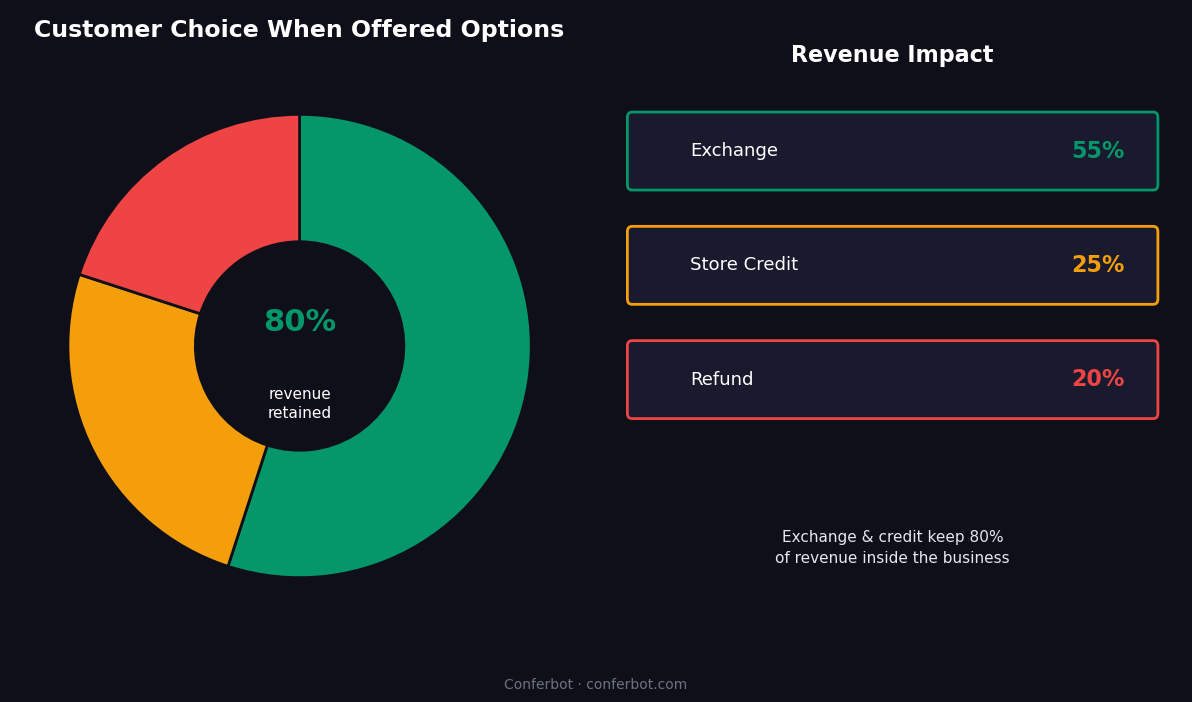
Critically, this template is not just a returns form with a chat interface. It functions as an intelligent retention tool. The assistant is configured to identify exchange opportunities, surface store credit incentives, and present targeted product alternatives before defaulting to a cash refund. The difference between a refunded order and an exchanged order is the difference between lost revenue and retained revenue -- and the chatbot's conversation design prioritizes the latter at every decision point.
Built on Conferbot's AI chatbot builder, the return and exchange assistant integrates with your order management system, inventory platform, and logistics provider through Conferbot's API integration framework. It deploys across your website, WhatsApp, and Messenger using the same workflow, with no manual duplication. Setup requires no engineering resources using the no-code builder.
This page covers how the RMA flow works in detail, key features, integration with order management systems, industry return rate data by category, cost savings analysis, a step-by-step setup guide, and the retention strategies that separate high-performing return programs from break-even ones.
How the Return Flow Works: RMA, Eligibility, and Label Generation
The return assistant operates through a structured six-stage pipeline that mirrors best-practice returns processes at enterprise retailers, implemented at a fraction of the cost through automation. Each stage is configurable to match your return policy, product categories, and resolution options.
Stage 1: Order Lookup and Customer Authentication
The conversation begins with order verification. The assistant asks the customer for their order number and the email address or phone number associated with the account. It queries your order management system in real time via the API integration to retrieve the order details: items purchased, order date, fulfillment status, delivery confirmation, and purchase price. This lookup takes under two seconds and eliminates the manual verification step that consumes significant agent time in phone and email support channels.
Stage 2: Eligibility Check
Before presenting return options, the assistant validates eligibility against your configured return policy rules. Eligibility parameters include return window (e.g., 30 days from delivery), item condition requirements (unused, original packaging), category-specific exceptions (final sale items, digital goods, perishables, custom or personalized products), and whether a proof of purchase requirement applies. If the order falls outside the return window, the assistant communicates this clearly and, if configured, offers alternative resolutions such as store credit as a goodwill gesture for borderline cases. Eligibility logic is fully configurable in the policy settings and can differ by product category, customer tier, or sales channel.
Stage 3: Return Reason Capture
For eligible items, the assistant asks the customer to describe the return reason. Responses are structured through a reason selection flow (defective product, wrong item received, does not fit, changed mind, arrived damaged, not as described) rather than free text, which produces clean data for quality analysis. For defect and damage reasons, the assistant requests a photo upload, which is attached to the RMA record and can trigger automatic routing to a quality team for review. Return reason data is captured in a structured format that feeds directly into Conferbot's analytics dashboard, enabling product quality monitoring and supplier accountability.
Stage 4: RMA Issuance
Once eligibility is confirmed and the return reason is captured, the assistant automatically generates a Return Merchandise Authorization number. The RMA is created in your order management system via API and linked to the original order record. The customer receives the RMA number within the conversation along with packing instructions, the return address, and the specific item condition requirements. The RMA record includes the authorized return items, the approved resolution method, and an expiration date by which the return must be shipped. This creates a complete audit trail without any manual data entry.
Stage 5: Shipping Label Generation
For returns where you provide prepaid shipping, the assistant generates a return shipping label on demand by calling your logistics provider's API (compatible with FedEx, UPS, USPS, and regional carriers). The label is delivered as a downloadable PDF link within the conversation and simultaneously sent to the customer's email. For customers on WhatsApp, the label is sent as a document attachment. The shipping cost is automatically deducted from the refund amount if your policy applies a return shipping fee, or absorbed as a cost if you offer free returns. Label generation eliminates the back-and-forth of emailing labels manually and reduces the time from return approval to customer action.
Stage 6: Resolution Tracking and Completion
After the return is shipped, the assistant monitors the inbound tracking number and updates the customer proactively at each scan event. When the item is received at the warehouse, the customer is notified and the resolution timeline is confirmed. Once the return is inspected and processed, the assistant sends the final resolution confirmation: refund issued to the original payment method, exchange order created, or store credit applied to the account. The entire post-ship communication runs automatically without agent involvement.
Key Features of the Return and Exchange Assistant
The return assistant template delivers its value through a specific set of features that address both the operational cost of processing returns and the customer experience quality that determines retention. Here are the capabilities that distinguish this implementation from a basic returns form.
| Feature | What It Does | Business Impact |
|---|---|---|
| Real-time order lookup | Retrieves order details from OMS via API in under 2 seconds | Eliminates manual order verification, saves 3-5 min per case |
| Policy-based eligibility engine | Validates returns against configurable rules by category, window, and channel | Reduces outside-policy approvals, standardizes enforcement |
| Automated RMA issuance | Generates RMA numbers and creates records in OMS without manual steps | Removes agent involvement from 70-80% of return cases |
| Prepaid label generation | Calls carrier APIs to generate labels on demand within the conversation | Cuts label fulfillment time from hours to seconds |
| Exchange-first conversation design | Surfaces exchange and store credit options before the refund path | Converts 20-35% of potential refunds to exchanges or credits |
| Defect photo collection | Requests and stores product defect images for QA purposes | Enables supplier claims and product quality analysis |
| Inbound tracking updates | Monitors return shipment and notifies customer at key scan events | Reduces WISMO contacts by 40-60% during return transit |
| Structured return reason data | Captures return reasons in clean, queryable format | Feeds product quality and sizing analytics dashboards |
Exchange-First Conversation Design
The most consequential feature of the return assistant is not operational -- it is strategic. The conversation flow is designed to present exchange and store credit options before the cash refund path, with incentives configured to make these alternatives genuinely attractive. When a customer initiates a return for a size issue, the assistant immediately surfaces the correct size as an exchange option, confirms its availability, and offers to process the exchange with expedited shipping at no additional cost. When a customer is returning due to preference ("changed my mind"), the assistant presents store credit at 110% of the purchase value before showing the standard refund option. These nudges, applied consistently across all return interactions, convert 20-35% of potential cash refunds into retained revenue without requiring any human intervention.
Configurable Policy Engine
Return policies vary by retailer, product category, customer segment, and sales channel. The policy engine supports multi-dimensional rule configuration: a 30-day window for standard purchases, a 14-day window for sale items, a 60-day window for loyalty members, no returns on final sale, and extended holiday return windows applied automatically within configured date ranges. These rules are configured once in the policy settings panel and enforced consistently across every return interaction, eliminating the inconsistency of agent-by-agent policy interpretation that drives customer complaints and costly exceptions.
Ready to try Return and Exchange Assistant Chatbot?
Deploy this template in under 10 minutes. No coding required.
Use This Template Free →Integration with Order Management Systems
A return assistant chatbot is only as capable as the data it can access. Deep integration with your order management system (OMS) is what transforms a conversational interface into a fully automated returns workflow. Conferbot's API integration framework connects to leading OMS platforms and supports custom API connections for proprietary systems.
Shopify and Shopify Plus
For Shopify merchants, the return assistant connects via the Shopify Admin API and the Returns API (available on Shopify Plus). The integration reads order details, fulfillment status, and delivery confirmation, and writes return records directly to the order in the Shopify admin. On Shopify Plus, refunds and exchanges can be initiated programmatically via API, enabling the chatbot to complete the full return cycle -- from customer request through refund issuance -- without any manual steps in the Shopify dashboard. The integration also reads customer tags and purchase history to apply tier-specific return policies for loyalty program members.
WooCommerce
WooCommerce integration uses the REST API with order read and write permissions. The assistant reads order items, status, and fulfillment data, and creates return records as order notes and status updates. For WooCommerce stores using dedicated returns plugins (such as WooCommerce Returns and Warranty Requests), Conferbot's integration can interact with the plugin's API endpoints to create native RMA records within the plugin's workflow rather than a parallel system.
Enterprise OMS Platforms
Enterprise retailers using platforms such as Manhattan Associates, Blue Yonder, Oracle OMS, or Salesforce Order Management can connect via the SFTP or REST API endpoints these platforms expose. The integration configuration maps Conferbot's return data fields to the OMS's native data structures. Typical integration points include order inquiry (by order number and customer identifier), return authorization creation, return reason code mapping, refund instruction submission, and exchange order creation. See the integrations hub for platform-specific documentation.
Carrier API Connections for Label Generation
Prepaid label generation connects directly to carrier APIs. FedEx integration uses the FedEx Web Services or FedEx Developer Portal REST API to generate Ground or Express return labels programmatically. UPS integration uses the UPS Shipping API. USPS integration uses the Web Tools API for domestic returns. For international returns, DHL Express and regional carrier APIs are supported. The carrier selection can be static (always use a specific carrier) or dynamic (select carrier based on the customer's location or the return item's weight and dimensions). Label cost data is returned with each generation request, enabling accurate cost tracking by return reason and product category.
Data Flows and Analytics Integration
All return interaction data flows into Conferbot's analytics dashboard and can be forwarded to your business intelligence stack via webhook or API. Return rate by product SKU, return reason distribution, exchange acceptance rate, label generation volume, and resolution time metrics are all available in structured format. This data integrates with product management decisions: SKUs with return rates above category benchmarks are flagged for quality review; size categories with high "does not fit" return rates trigger sizing guide improvements.
Industry Return Rate Data and Benchmarks
Understanding where your return rate sits relative to industry benchmarks is the first step in measuring the impact of a return automation investment. Return rates vary significantly by category, channel, and customer segment. Here are the current benchmarks from 2026 industry data.
| Product Category | Average Online Return Rate | Primary Return Reason | Cost per Return (Incl. Reverse Logistics) |
|---|---|---|---|
| Fashion and Apparel | 25-40% | Sizing and fit (55-65% of returns) | $18-$35 |
| Footwear | 30-40% | Sizing and fit (60-70% of returns) | $20-$38 |
| Consumer Electronics | 11-15% | Defective or not as described (40-50%) | $35-$80 |
| Beauty and Personal Care | 8-12% | Preference / not suitable for skin type | $12-$22 |
| Home Furnishings | 10-15% | Dimensions / appearance in space | $45-$120 |
| Sporting Goods | 12-18% | Wrong size, activity mismatch | $18-$40 |
| Jewelry and Accessories | 8-14% | Appearance, gifting mismatch | $14-$28 |
| All E-commerce (average) | 16-30% | Mixed | $15-$45 |
The Bracketing Effect on Fashion and Footwear
Fashion and footwear consistently show the highest return rates because of a deliberate customer behavior known as bracketing: purchasing multiple sizes or colorways of the same item with the explicit intention of returning all but one. Research indicates that 40-60% of fashion returns originate from bracketing behavior. This is not a fraud or abuse problem -- it is a rational customer response to sizing uncertainty in online shopping. A return assistant that incorporates an interactive size guide during the initial purchase flow (linked from the e-commerce templates) directly reduces bracketing by giving customers the confidence to buy only the correct size.
Electronics Return Fraud and Abuse
Consumer electronics returns carry the dual burden of high processing costs and elevated fraud risk. Return fraud -- including return of used items as new, wardrobing (using and returning), and counterfeit item substitution -- costs the US retail industry an estimated $17-22 billion annually. A return assistant with photo documentation requirements for defect claims and RMA expiration enforcement reduces the surface area for fraudulent returns without degrading the experience for legitimate customers. The structured documentation also supports carrier damage claims when items are returned damaged in transit through no fault of the customer.
Holiday and Seasonal Spikes
Return volumes spike 30-50% in January and February as holiday purchases are returned. Support teams that handle returns manually are overwhelmed during these peaks, leading to extended resolution times and customer frustration. A return assistant processes January return volume at the same speed regardless of volume -- there is no queue, no hold time, and no degradation in response quality during the peak. This consistency is one of the most operationally significant benefits for high-volume seasonal retailers.
Cost Savings Analysis: Returns Automation vs. Manual Processing
The business case for a return assistant chatbot rests on two pillars: direct cost reduction through automation of manual support labor, and revenue retention through exchange conversion. Both are measurable and the combined impact typically produces a return on investment within 90 days of deployment.
Labor Cost Reduction
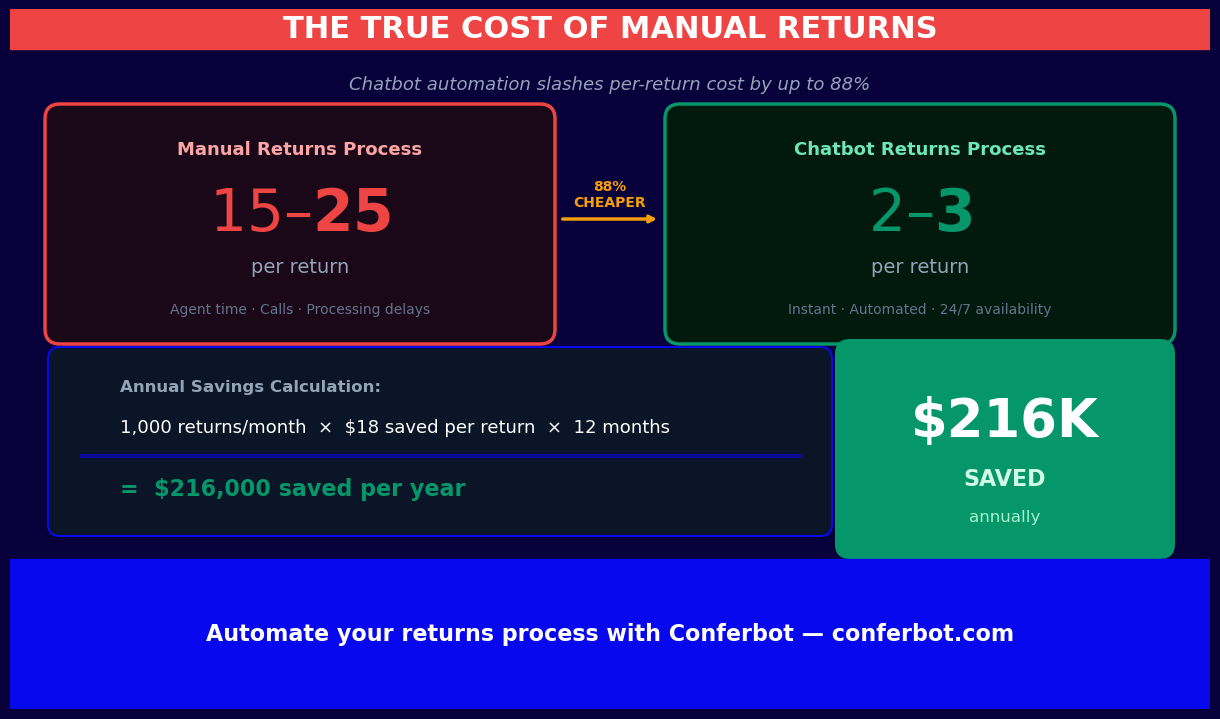
Manual return processing requires a customer service agent to verify the order, assess eligibility, communicate the policy, generate an RMA, send a shipping label, and follow up through resolution. Best-in-class manual return handling takes 8-12 minutes of agent time per case. At a fully-loaded support agent cost of $20-35 per hour (including salary, benefits, management overhead, and tooling), each manually processed return costs $2.70-$7.00 in labor.
A return assistant chatbot handles the full workflow for 70-80% of return requests without any agent involvement, reducing the effective labor cost for those cases to near zero. For a retailer processing 500 returns per week, that is 350-400 cases deflected from agent queues weekly. At $5 average labor cost per case, the weekly labor saving is $1,750-$2,000, or $91,000-$104,000 annually. Use the chatbot ROI calculator to model your specific numbers.
Exchange Conversion Revenue Impact
Every refund represents lost revenue. Every exchange retains it. If your business processes 500 returns per week with an average order value of $75 and a 20% exchange conversion rate (a conservative estimate for a well-configured return assistant), you retain $7,500 in revenue weekly that would otherwise be refunded. Annually, that is $390,000 in revenue retained -- not recovered from new customers, but preserved from existing purchase transactions that would otherwise leave the business.
| Scenario | Weekly Returns Volume | Exchange Rate | Annual Revenue Retained |
|---|---|---|---|
| Small retailer (AOV $60) | 150 returns | 20% | $93,600 |
| Mid-market retailer (AOV $90) | 500 returns | 25% | $585,000 |
| Large retailer (AOV $120) | 1,500 returns | 30% | $2,808,000 |
Reverse Logistics Cost Optimization
Beyond labor, the return assistant reduces reverse logistics costs through two mechanisms. First, by reducing the absolute number of returns through better sizing guidance and product information during the purchase flow. Second, by standardizing the return shipping process -- using the correct carrier and service level for each return based on item value and weight, rather than issuing one-size-fits-all labels. Retailers that optimize carrier selection through their return automation see 8-15% reductions in per-return shipping costs compared to standardized label programs.
Customer Lifetime Value Impact
The return experience is one of the highest-impact touchpoints in the customer lifecycle. Research consistently shows that customers who have a frictionless return experience are more likely to repurchase than customers who have never returned anything. A fast, automated, no-hassle return process increases repeat purchase rates among returning customers by 15-25%, adding lifetime value that is difficult to quantify precisely but is reliably significant. This is the behavioral foundation for "free returns" strategies at Amazon, Zappos, and other customer-loyalty-focused retailers -- the operational cost is offset by the retention value.
50,000+ businesses use Conferbot templates to automate conversations
Setup Guide: Deploying the Return and Exchange Assistant
The return and exchange assistant can be operational in one to three business days using Conferbot's no-code builder. The timeline depends on the complexity of your order management system integration and the number of policy variations you need to configure. Here is the step-by-step process.
Step 1: Load the Template and Configure Branding
Start from the Return and Exchange Assistant template in the Conferbot template library. The template includes pre-built conversation flows for order lookup, eligibility checking, RMA issuance, label generation, and resolution confirmation. Customize the bot's name, greeting, and visual style to match your brand. Adjust the conversation tone -- most return contexts benefit from a reassuring, straightforward tone that communicates competence and speed. The entire branding configuration is visual and requires no code.
Step 2: Define Your Return Policy Rules
In the policy configuration panel, enter your return rules for each product category: return window (days from delivery date), accepted item conditions, final sale exclusions, channel-specific rules (in-store purchase vs. online), and loyalty tier variations. Define the resolution options available for each return reason: full refund, exchange, or store credit. Configure any store credit incentives you want to offer (e.g., 110% credit vs. 100% refund). These policy rules are the logic layer that determines what the chatbot offers each customer -- they should reflect your actual written policy exactly.
Step 3: Connect Your Order Management System
Use the integrations hub to connect your OMS. For Shopify, authenticate via OAuth and grant the required Admin API scopes (orders read, returns write, customers read). For WooCommerce, enter your REST API consumer key and secret. For custom or enterprise OMS platforms, configure the API endpoint URLs, authentication method, and field mappings in the API integration panel. Run a test order lookup to confirm that order data (items, dates, fulfillment status) is returned correctly before proceeding.
Step 4: Configure Carrier API Connections
For prepaid label generation, connect your carrier accounts in the integrations panel. Enter your carrier account credentials (API keys or account numbers) for FedEx, UPS, USPS, or your preferred carrier. Configure the label generation rules: which carrier to use based on item weight range, customer location, or return reason. Define whether return shipping is free, deducted from the refund, or charged to the customer, and configure the cost deduction logic accordingly. Test label generation with a sample return to confirm the PDF is generated correctly and delivered to the email address specified.
Step 5: Set Up Exchange and Store Credit Flows
Configure the exchange-first presentation logic: which return reasons trigger an exchange offer first, what inventory availability check is performed before presenting an exchange, and what incentive (if any) is offered to accept an exchange over a refund. Set up the store credit incentive messaging and configure the credit issuance action (API call to your loyalty or account management system to apply the credit balance). Test these flows end-to-end to confirm that exchange orders are created correctly in your OMS and store credit balances are applied to the correct customer accounts.
Step 6: Deploy Across Channels and Monitor
Deploy the assistant on your website returns page using Conferbot's embed snippet. Enable WhatsApp and Messenger through the omnichannel settings. For the first two weeks, review the analytics dashboard daily: monitor RMA creation volume, eligibility check outcomes, exchange conversion rates, label generation success rates, and conversation drop-off points. Identify any policy edge cases the bot handles incorrectly and refine the eligibility rules accordingly. After two weeks of stable operation, the system typically runs with minimal oversight.
Retention Strategies: Converting Refunds to Exchanges
The strategic difference between a returns program that costs money and one that creates value is the exchange conversion rate. Every conversation the return assistant conducts is an opportunity to retain revenue that would otherwise leave the business as a refund. Here are the retention strategies that consistently produce the highest exchange conversion rates.
Size and Fit Exchanges: The Highest-Conversion Scenario
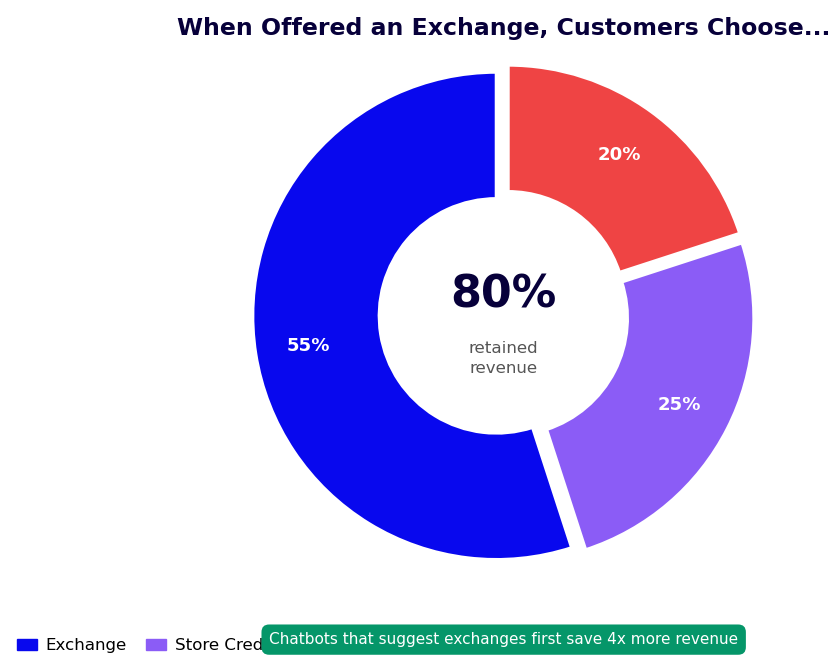
Sizing and fit returns are the most straightforward exchange opportunity because the customer already wants the product -- they just need a different size. When a customer initiates a return citing size as the reason, the assistant should immediately present the correct size as an exchange option, confirm it is in stock, and offer to ship it before the return has even been received. This "send first, return later" approach -- enabled by integrations with your inventory and fulfillment systems -- removes all friction from the exchange decision and converts size returns to exchanges at rates of 45-65% in well-configured programs.
Store Credit with Premium Value
For discretionary returns ("changed my mind," "not what I expected"), offering store credit at a premium value (typically 105-115% of the purchase price) gives the customer a tangible financial reason to choose credit over a refund. A $90 item refunded as $90 cash vs. $99 in store credit is a 10% bonus that costs the retailer a fraction of what it actually pays out (most customers will spend the credit, so the marginal cost is your product margin, not the face value of the credit). Retailers using premium store credit offers report 30-45% of "changed my mind" returns converting to store credit retention.
Product Alternative Suggestions
When a customer returns an item because it did not meet their expectations ("not as described," "quality not what I expected"), the assistant should not immediately accept the return -- it should first understand what the customer expected and surface an alternative that better matches. This requires the assistant to access your product catalog (via the same API integration used for order lookup) and present one or two specifically relevant alternatives with a brief explanation of why they better fit the customer's stated preference. This strategy works for 15-25% of "product did not meet expectations" returns.
Timing and Friction Design
The order in which options are presented significantly influences customer decisions. The return assistant presents exchange options first, then store credit, then the full refund -- always with the exchange and credit options framed more prominently. The refund path is always available and accessible (customers who want a refund will get one; the goal is not to obstruct), but it is not the first option the customer sees. This sequencing alone, without any incentives, produces a measurable increase in exchange acceptance rates compared to presenting all options simultaneously.
Post-Return Re-Engagement
For customers who do take a full refund, the return process should not be the end of the relationship. Configure a post-return re-engagement sequence via WhatsApp or email that sends 7-14 days after the refund is issued, featuring new arrivals or restocked items in the same category as the returned product. Customers who received a smooth, fast return experience convert on re-engagement messages at significantly higher rates than customers who had a difficult returns experience -- making the operational quality of the return process a direct acquisition channel for future purchases. Link these re-engagement flows to your lead generation templates for a complete retention-to-acquisition pipeline.
Return and Exchange Assistant Chatbot FAQ
Everything you need to know about chatbots for return and exchange assistant chatbot.
Why Use a Template vs Building from Scratch?
Templates encode years of optimization data into the conversation flow before you start.
| Factor | Conferbot Template | Build from Scratch | Hire a Developer |
|---|---|---|---|
| Time to deploy | 10 minutes | 2-8 hours | 2-6 weeks |
| Cost | Free | Your time | $5,000-$25,000 |
| Day-1 conversion | 15-22% | 5-8% | 10-15% |
| Proven flows | Yes, data-tested | No | Depends |
| Updates included | Automatic | Manual | Paid |
| Multi-channel | 8+ channels | 1 channel | Extra cost |
| Analytics | Built-in | Must build | Extra cost |
Ready to Deploy Return and Exchange Assistant Chatbot?
Join 50,000+ businesses. Free forever plan available. No credit card required.