The Employee Engagement Crisis: Why Traditional Approaches Are Failing and How AI Changes the Game
Employee engagement is not a nice-to-have HR initiative. It is a measurable business driver that directly impacts revenue, productivity, and talent retention. According to Gallup's 2025 State of the Global Workplace report, only 23% of employees worldwide are engaged at work. The remaining 77% are either quietly disengaged (59%) or actively disengaged (18%). This engagement deficit costs the global economy an estimated $8.8 trillion annually in lost productivity.
The business impact is stark and well-documented:
- Productivity: Highly engaged teams show 21% greater productivity than disengaged teams.
- Retention: Organizations in the top quartile of engagement experience 40% lower voluntary turnover than bottom-quartile organizations.
- Profitability: Engaged business units achieve 23% higher profitability.
- Absenteeism: Engaged employees have 41% lower absenteeism.
- Customer satisfaction: Companies with high engagement score 10% higher on customer satisfaction metrics.
Yet most organizations struggle to measure and improve engagement effectively. The dominant tool remains the annual engagement survey: a 50 to 100 question behemoth deployed once a year, producing results that are months old by the time they reach managers, with response rates that have declined to 30 to 40% at many organizations. By the time insights are extracted and action plans created, conditions have changed and the data is stale.
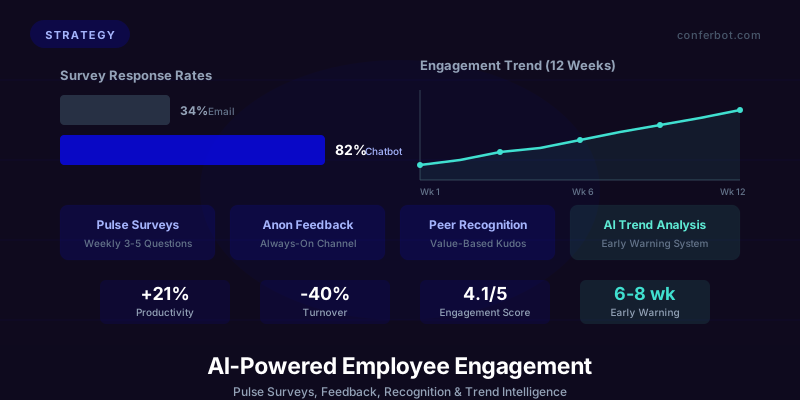
AI chatbots offer a fundamentally different approach. Instead of a once-a-year measurement event, chatbots enable continuous engagement sensing: weekly pulse surveys delivered through Slack or Microsoft Teams with 82% response rates, always-on anonymous feedback channels that surface issues in real time, peer recognition programs that make appreciation visible and frequent, and AI-powered trend analysis that identifies engagement dips weeks before they become retention problems.
This guide covers how to implement a complete chatbot-driven employee engagement system. We break down the four core components (pulse surveys, anonymous feedback, peer recognition, and trend analysis), provide conversation scripts, share benchmark data, address privacy concerns, and include a detailed ROI model. Whether you have 50 employees or 50,000, these strategies scale effectively. For companies already using chatbots for internal support, see our employee FAQ bot guide for the complementary self-service layer.
Weekly Pulse Surveys via Chatbot: 82% Response Rates vs. 34% for Email Surveys
Traditional employee surveys suffer from two fatal flaws: infrequency and low participation. An annual survey captures a snapshot of sentiment on a single day, missing the fluctuations that happen throughout the year. And when only 34% of employees respond (the average response rate for email-based surveys, according to Culture Amp's benchmark data), the results represent a biased sample that over-represents the most engaged or most disengaged employees while missing the silent majority in the middle.
Chatbot-delivered pulse surveys solve both problems. They are short (3 to 5 questions, taking 60 to 90 seconds), frequent (weekly or biweekly), and delivered through channels employees already use (Slack, Microsoft Teams). The response rates are dramatically higher because the survey comes to the employee rather than requiring the employee to go to the survey.
Response Rate Comparison by Channel
| Survey Delivery Method | Average Response Rate | Completion Time | Frequency Tolerance |
|---|---|---|---|
| Email link to survey platform | 34% | 8-15 minutes | Quarterly at most |
| Email with embedded questions | 42% | 5-8 minutes | Monthly |
| Slack/Teams chatbot (text-based) | 72% | 60-90 seconds | Weekly |
| Slack/Teams chatbot (button/emoji) | 82% | 30-60 seconds | Weekly or biweekly |
The button/emoji format achieves the highest response rates because it reduces the cognitive effort to near zero. Instead of typing a response, the employee taps a button or selects an emoji. This format works particularly well for mobile-first workforces and deskless employees who interact with work tools primarily on their phones.
Effective Pulse Survey Question Design
Pulse surveys must be short enough to complete in under 90 seconds while capturing meaningful engagement data. Use a rotating set of 3 to 5 questions per week, drawn from these core engagement dimensions:
Question 1 (Anchor question, every week):
Bot: "Quick check-in: On a scale of 1-5, how would you rate your overall work experience this week?
1 - Struggling
2 - Below average
3 - Okay
4 - Good
5 - Great"
This anchor question provides the longitudinal trend data that makes pulse surveys valuable. Asking it every week creates a consistent time series that reveals engagement patterns over months.
Rotating questions (2-4 additional, varied weekly):
- "Do you feel recognized for your contributions this week?" (Recognition dimension)
- "Do you have what you need to do your best work?" (Enablement dimension)
- "How connected do you feel to your team this week?" (Belonging dimension)
- "How clear are your priorities right now?" (Alignment dimension)
- "Would you recommend our company as a great place to work?" (eNPS)
- "Is there anything blocking your productivity this week?" (Friction identification)

Follow-Up Logic for Low Scores
When an employee rates their experience below 3 on any question, the chatbot follows up with an open-ended question to surface the specific issue:
Bot: "I noticed you rated your week as a 2. I want to make sure we can help. Would you like to share what made this week challenging? Your response is completely confidential."
This follow-up converts a quantitative score into qualitative insight. It tells HR and managers not just that engagement dipped, but why it dipped. The optional nature of the follow-up ("Would you like to share") respects the employee's choice to decline without creating pressure.
Pulse Survey Timing Optimization
When the chatbot sends the pulse survey significantly impacts response rates:
- Best day: Tuesday or Wednesday (highest response rates, employees are in work mode but not overwhelmed by Monday catch-up or Friday wind-down)
- Best time: 10:00 to 11:00 AM local time (post-morning meetings, pre-lunch)
- Worst timing: Friday afternoon (lowest response rates, 35% lower than midweek)
- Completion window: Allow 48 hours for response before closing the survey. Send one gentle reminder at the 24-hour mark for non-respondents.
Always-On Anonymous Feedback Channels: Giving Employees a Safe Voice
Pulse surveys capture periodic snapshots, but employees need a way to share feedback between surveys when issues arise. An always-on anonymous feedback channel through the chatbot provides this capability. McKinsey's organizational research confirms that organizations with robust feedback mechanisms see 25% faster issue resolution while maintaining the psychological safety that honest feedback requires.
Why Anonymity Matters for Honest Feedback
According to Harvard Business Review's research on organizational feedback, employees are 3.4 times more likely to share critical feedback when guaranteed anonymity. Fear of retaliation is the primary reason employees withhold negative feedback, and this fear is especially pronounced in hierarchical organizations, small teams where feedback is easily attributable, and during periods of layoffs or restructuring.
An anonymous feedback chatbot removes this barrier by design. The employee initiates a conversation with the chatbot, provides their feedback, and the chatbot strips all identifying information before routing the feedback to the appropriate team or manager. The employee's identity is never recorded, and the chatbot conversation is not linked to their user account in any auditable way.
Anonymous Feedback Conversation Flow
Employee: "I want to give feedback."
Bot: "I am ready to listen. Everything you share here is completely anonymous. I do not record your identity, and your feedback will be shared with the relevant team without any information that could identify you.
What category does your feedback fall into?
- Team or manager feedback
- Company culture or policy
- Work environment or tools
- Process improvement suggestion
- Compensation or benefits
- Other"
Employee: "Team or manager feedback"
Bot: "Please share your feedback. Take as much space as you need. When you are done, I will ask if you would like to add any suggestions for improvement."
Employee: [shares feedback]
Bot: "Thank you. Would you like to suggest a specific improvement or action that could help?"
Employee: [provides suggestion]
Bot: "Your feedback has been submitted anonymously. It will be reviewed by the People team within 48 hours. While I cannot follow up with you directly (to protect your anonymity), you can check the company feedback digest published weekly to see themes being addressed. Thank you for speaking up."
Feedback Volume and Quality Metrics
| Metric | Before Anonymous Chatbot Channel | After Implementation | Change |
|---|---|---|---|
| Feedback submissions per month (per 100 employees) | 3-5 | 18-28 | 5-6x increase |
| Percentage of feedback that is actionable | 42% | 68% | +26 points |
| Critical issues surfaced before escalation | 12% caught early | 47% caught early | 3.9x improvement |
| Time from issue to management awareness | 2-6 weeks | 24-48 hours | 10-20x faster |
The most strategically important metric is "critical issues surfaced before escalation." Without an anonymous channel, problems like a toxic manager, unsafe working conditions, or widespread morale issues often do not reach leadership until they have already caused resignations, complaints, or legal exposure. The chatbot surfaces these issues 10 to 20 times faster.
Feedback Routing and Escalation Logic
Not all feedback requires the same response. Configure the chatbot with routing rules based on feedback category and severity indicators:
- Culture/policy feedback: Route to People/HR team for weekly review and theme aggregation.
- Manager-specific feedback: Route to HR business partner (never to the manager directly) for pattern analysis. A single anonymous complaint is noted; three similar complaints trigger an intervention.
- Safety or compliance concerns: Route immediately to compliance team and legal counsel. Flag with urgent priority.
- Process improvement suggestions: Route to the relevant department head and Operations team.
- Compensation/benefits feedback: Route to Total Rewards team for theme analysis during compensation review cycles.
For organizations also deploying chatbots for IT and HR self-service, see our Slack and Teams chatbot guide on how to unify engagement and support functions in a single chatbot interface.
Peer Recognition Programs: Making Appreciation Visible, Frequent, and Measurable
Recognition is one of the strongest drivers of employee engagement, yet most recognition programs are infrequent (annual awards), top-down (manager recognizes direct report), and invisible (a private email or 1:1 mention). According to Gallup's recognition research, employees who receive frequent recognition (at least weekly) are 5 times more likely to feel connected to their company culture and 4 times more likely to be engaged. Yet only 1 in 3 workers reports receiving recognition in the past 7 days.
A chatbot-powered peer recognition program makes recognition frequent, peer-to-peer, public, and tied to company values, all without adding administrative burden.
How Chatbot Peer Recognition Works
The recognition flow is simple and takes under 30 seconds:
Employee: "@ConferbotBot recognize @Sarah"
Bot: "What would you like to recognize Sarah for? Select a value or type your own:
- Innovation
- Teamwork
- Customer focus
- Going above and beyond
- Mentorship
- Other"
Employee: "Teamwork"
Bot: "Add a personal message for Sarah (1-2 sentences about what she did):"
Employee: "Sarah stayed late to help me debug the production issue last night. Her expertise saved us hours."
Bot: "Recognition sent! Sarah has been recognized for Teamwork: 'Sarah stayed late to help me debug the production issue last night. Her expertise saved us hours.' This recognition has been posted in #kudos and added to Sarah's recognition profile."
The recognition is then posted to a public channel (#kudos, #shoutouts, or similar), making it visible to the entire team or organization. This visibility amplifies the motivational impact: the recognized employee feels appreciated in front of peers, and other employees see what behaviors are valued.

Recognition Program Impact Data
| Metric | No Formal Program | Traditional Program (Annual Awards) | Chatbot Peer Recognition |
|---|---|---|---|
| Recognitions per employee per quarter | 0.3 | 1.2 | 11.4 |
| Percentage of employees who received recognition in past 7 days | 12% | 22% | 64% |
| Employee engagement score (5-point scale) | 3.1 | 3.4 | 4.1 |
| Voluntary turnover rate | 24% | 19% | 13% |
| Percentage of recognitions that are peer-to-peer | 5% | 15% | 78% |
The shift from top-down to peer-to-peer recognition (from 15% to 78%) is a fundamental change. Peer recognition is more frequent because there are more peers than managers, more authentic because peers directly witness the behavior being recognized, and more inclusive because it does not depend on a single manager's attention and memory.
Gamification and Recognition Leaderboards
Adding gamification elements increases recognition program participation and sustainability, consistent with Deloitte's Human Capital Trends findings on social enterprise principles:
- Recognition badges: Employees earn badges for receiving recognition in specific value categories ("Innovation Champion," "Teamwork All-Star"). Badges are visible on their profile and can be displayed in email signatures.
- Monthly recognizer awards: The employee who gives the most recognitions each month receives a small reward (gift card, extra PTO hour). This encourages the giving behavior, not just the receiving.
- Team leaderboards: Teams see their aggregate recognition scores compared to other teams, creating healthy competition to build more appreciative team cultures.
- Milestone celebrations: The chatbot automatically celebrates milestones: "Congratulations, Sarah! You have received 50 peer recognitions this year. You are in the top 5% of recognized employees."
Tying Recognition to Company Values
The most impactful recognition programs align each recognition with a specific company value. This reinforces the connection between daily behaviors and the organization's stated values, making values tangible rather than abstract. When the chatbot's recognition prompt includes your company values as selection options, employees internalize what the organization truly values through the repeated act of selecting values when recognizing peers.
AI-Powered Engagement Trend Surfacing: Detecting Problems Weeks Before They Become Resignations
The most powerful capability of a chatbot-driven engagement system is not the data collection itself but the AI analysis that surfaces patterns, trends, and early warning signals from the aggregated data. Individual pulse survey responses are data points. AI-powered trend analysis transforms those data points into actionable intelligence.
Trend Detection Capabilities
Team-level engagement shifts: The AI monitors pulse survey scores at the team level and alerts HR when a team's average drops by more than 0.5 points on the 5-point scale over a 3-week window. This early warning system identifies team-level issues (manager problems, project stress, interpersonal conflict) weeks before they result in resignations.
Sentiment analysis on open-ended responses: Natural language processing applied to pulse survey free-text responses and anonymous feedback identifies emerging themes before they reach critical mass. If 5 employees in a 50-person department independently mention "workload" in their feedback over 2 weeks, the AI flags it as a rising theme even though no single feedback submission was alarming on its own.
Engagement pattern recognition: The AI identifies patterns that correlate with attrition risk across your historical data. Common patterns include: declining pulse scores over 4+ consecutive weeks, decreased response rate (engaged employees who stop responding may be mentally checking out), negative sentiment shift in open-ended comments, and reduced recognition activity (both giving and receiving).
The Early Warning Dashboard
| Alert Type | Trigger Condition | Lead Time Before Problem Manifests | Recommended Action |
|---|---|---|---|
| Team engagement decline | Team average drops 0.5+ points over 3 weeks | 4-8 weeks before resignations | Manager check-in, team retrospective |
| Rising negative theme | 3+ mentions of same theme in 2 weeks within a department | 3-6 weeks before escalation | Department head briefing, investigation |
| Individual attrition risk | Individual score declining 4+ consecutive weeks + reduced activity | 6-12 weeks before resignation | Manager 1:1, career development conversation |
| Recognition drought | Team has zero recognitions in 3+ weeks | 2-4 weeks before morale impact | Manager reminder, team celebration event |
| Survey fatigue | Response rate drops 10+ points | Immediate action needed | Reduce frequency, refresh question set |

Predictive Attrition Modeling
By combining pulse survey data with recognition patterns, feedback sentiment, and behavioral signals (reduced chatbot interaction, declining survey response), the AI builds a predictive attrition model that identifies employees at elevated flight risk. This is not about surveillance. It is about enabling managers to have proactive career conversations, address workload issues, and remove friction before valued employees decide to leave.
The ethical implementation of predictive attrition models requires transparency: employees should know that aggregate engagement data is analyzed for trends (though individual predictions should be handled with discretion), and the purpose should be clearly communicated as enabling better support, not monitoring or control. For a broader perspective on AI ethics in workplace tools, see our chatbot security and privacy guide.
Manager Action Intelligence
Raw engagement data is only valuable if managers act on it. The chatbot provides manager-specific insights and suggested actions:
Bot (to Manager): "Your team's engagement score this week is 3.6 (down from 3.9 last week and 4.1 three weeks ago). The declining trend and feedback themes suggest workload concerns. Suggested actions:
1. Schedule a team check-in focused on workload and priorities
2. Review upcoming deadlines for opportunities to redistribute or rescope
3. Acknowledge the team's recent effort publicly
Would you like me to schedule a 30-minute team check-in for this week?"
This nudge-based approach makes engagement management practical for busy managers. Rather than expecting managers to analyze dashboards and design interventions, the chatbot surfaces the issue, suggests specific actions, and even offers to execute the first step (scheduling a meeting).
Privacy, Trust, and Ethical Implementation: Getting Employee Buy-In
An employee engagement chatbot that employees do not trust is worse than useless. It generates misleading data (employees provide socially desirable rather than honest responses) and can actively damage the employer-employee relationship. Trust must be designed into the system from the start, not bolted on as an afterthought.
Privacy Architecture
The technical architecture of your engagement chatbot must enforce the privacy promises you make to employees:
- Anonymous feedback: Feedback submissions must be architecturally separated from user identity. The chatbot should not store the submitter's user ID, IP address, or device information alongside the feedback content. This is not just a policy but a technical implementation that makes de-anonymization impossible even by system administrators.
- Aggregation thresholds: Never display pulse survey results for groups smaller than 5 people. If a manager's team has 4 people, their results should be aggregated with the broader department to prevent inference about individual responses. This is the industry standard for engagement survey anonymity.
- Data retention limits: Individual response data should be retained only as long as needed for trend analysis (typically 12 to 24 months), then aggregated into summary statistics and the individual records deleted.
- Audit transparency: Provide employees with visibility into what data is collected, how it is stored, who can access it, and how long it is retained. Publish a clear, readable engagement data policy, not buried in legalese.
Building Employee Trust: The Transparency Framework
Trust is built through transparent communication before, during, and after deployment:
Before launch:
- Hold town hall or all-hands presentations explaining what the engagement chatbot does, what data it collects, and (critically) what it does NOT do (does not monitor work activity, does not identify anonymous feedback submitters, does not share individual pulse responses with managers).
- Share the technical privacy architecture. Employees who understand that anonymous feedback is architecturally (not just policy) anonymous trust the system more.
- Invite questions and address concerns publicly. The questions employees ask tell you what worries them, allowing you to address those specific fears.
During operation:
- Publish a weekly or monthly "You Said, We Did" digest showing themes from feedback and the actions taken in response. This proves the chatbot is not a black hole and that sharing feedback leads to change.
- Never make changes that could breach trust without re-earning it. If you add a new data point to the pulse survey, announce it proactively.
- When the chatbot cannot help ("I want a raise"), it should be honest rather than deflecting: "Compensation discussions happen in 1:1s with your manager or through the compensation review process. I can share the review timeline if that helps."
After concerns arise:
- If an employee expresses distrust of the system, acknowledge the concern without dismissing it. "I understand that concern. Here is how we protect your anonymity: [explanation]."
- Never investigate who submitted anonymous feedback. Even if the content is concerning, pursuing the identity destroys trust for everyone.
Legal and Compliance Considerations
Employee engagement data, even anonymized, has legal implications:
- Works council / labor union consultation: In jurisdictions with works councils (EU, parts of Asia), deployment of engagement monitoring tools may require consultation or approval.
- GDPR / data protection: Pulse survey responses are personal data under GDPR. Ensure lawful basis (legitimate interest or consent), data minimization, and rights of access/deletion. For more on compliance requirements, see our EU AI Act compliance guide.
- Local labor laws: Some jurisdictions restrict employer monitoring of employee sentiment. Consult employment counsel before deploying in regulated markets.
Implementation Roadmap: From Pilot to Company-Wide in 8 Weeks
Rolling out an employee engagement chatbot requires careful sequencing, following the phased adoption model recommended by SHRM's employee survey implementation research to build trust, validate effectiveness, and scale smoothly. Here is the recommended 8-week implementation roadmap.
Week 1-2: Design and Configuration
- Select engagement dimensions and design the pulse survey question rotation (12 to 16 questions rotating across 4 weeks).
- Define company values for the recognition program and create the recognition flow.
- Configure anonymous feedback categories and routing rules.
- Set up integrations with Slack or Microsoft Teams.
- Configure privacy architecture: aggregation thresholds, data retention, anonymization.
- Draft the employee communication plan (town hall deck, FAQ document, chatbot introduction message).
Week 3-4: Pilot Launch (Single Team or Department)
- Launch with a single team of 20 to 50 people who have volunteered or been selected as an engaged, receptive pilot group.
- Run weekly pulse surveys and monitor response rates, completion times, and data quality.
- Enable the recognition feature and track adoption (recognitions per person per week).
- Collect feedback on the chatbot experience itself: Is the timing right? Are the questions relevant? Is the recognition flow easy?
- Iterate on question wording, timing, and flow based on pilot feedback.
Week 5-6: Expand to 3-5 Departments
- Launch across additional departments, incorporating learnings from the pilot.
- Hold department-specific town halls to introduce the chatbot and address concerns.
- Enable anonymous feedback channels for the expanded groups.
- Begin generating manager-level engagement reports and trend alerts.
- Publish the first "You Said, We Did" digest based on pilot phase feedback.
Week 7-8: Company-Wide Rollout
- Launch for all remaining departments simultaneously.
- All-hands presentation reviewing pilot results, demonstrating actions taken from feedback, and reinforcing privacy commitments.
- Enable the full analytics dashboard for HR leadership and executive team.
- Begin AI-powered trend analysis and early warning system.
- Establish the ongoing rhythm: weekly pulse surveys, continuous feedback and recognition, monthly "You Said, We Did" digests, quarterly engagement trend reviews.
Ongoing Optimization (Month 3+)
- A/B test question formats and timing to maintain high response rates. Refer to our chatbot A/B testing guide for methodology.
- Refresh question sets quarterly to prevent survey fatigue.
- Add manager coaching features (AI-suggested actions based on team data).
- Integrate with performance review cycles so engagement data informs development conversations.
- Build custom analytics dashboards for department heads showing their team's engagement trends.
ROI and Retention Impact: The Business Case for Chatbot-Driven Engagement
The ROI of employee engagement is well-established in organizational research. The challenge is attributing specific financial value to the engagement chatbot intervention. Here is a framework that connects chatbot-driven engagement improvement to measurable business outcomes.
The Retention ROI Model
Voluntary turnover reduction is the most directly quantifiable benefit of improved engagement. According to SHRM's turnover cost research, the average cost to replace an employee is 50 to 200% of their annual salary, depending on role seniority:
| Role Level | Average Salary | Replacement Cost | Replacement Cost % |
|---|---|---|---|
| Entry-level | $42,000 | $21,000-42,000 | 50-100% |
| Mid-level professional | $75,000 | $75,000-112,500 | 100-150% |
| Senior/management | $120,000 | $180,000-240,000 | 150-200% |
| Executive/specialist | $200,000 | $300,000-400,000 | 150-200% |
Example ROI calculation (500-employee company):
- Average salary: $72,000
- Average replacement cost: $86,400 (120% of salary)
- Current voluntary turnover: 22% (110 departures/year)
- Engagement chatbot reduces turnover by 40% (from benchmark data): 110 x 40% = 44 fewer departures
- Annual savings from reduced turnover: 44 x $86,400 = $3,801,600
- Chatbot platform cost: ~$1,200/month = $14,400/year
- Annual ROI: ($3,801,600 - $14,400) / $14,400 = 26,289%

Productivity Impact Valuation
Beyond retention, engaged employees are 21% more productive. For a 500-employee company with an average salary of $72,000, this productivity gain translates to significant value:
- If engagement chatbot moves 15% of disengaged employees (59% of 500 = 295 disengaged, 15% = ~44 employees) to engaged status
- Productivity gain per newly engaged employee: 21% of $72,000 = $15,120 in additional value
- Total productivity value: 44 x $15,120 = $665,280/year
Absenteeism Reduction Value
Engaged employees have 41% lower absenteeism. Unscheduled absence costs employers an average of $3,600 per employee per year in direct costs (temporary replacement, overtime for covering colleagues):
- 44 newly engaged employees x $3,600 x 41% reduction = $64,944/year in absenteeism savings
Total Annual Value
- Retention savings: $3,801,600
- Productivity improvement: $665,280
- Absenteeism reduction: $64,944
- Total: $4,531,824
- Cost: $14,400
- Total ROI: 31,371%
Even if you apply a 75% discount factor to these estimates (conservative adjustment for attribution uncertainty), the ROI remains over 7,800%. The business case is overwhelming at virtually any reasonable assumption set. For a comprehensive approach to measuring internal chatbot ROI, see our internal chatbot ROI calculator guide.
How Conferbot Powers Employee Engagement Programs
Conferbot includes dedicated features for employee engagement that work within Slack, Microsoft Teams, and web-based interfaces.
Slack and Teams Integration
Conferbot deploys natively within Slack and Microsoft Teams as a bot that employees interact with directly in their workspace. No separate app, no separate login, no context switching. Pulse surveys, recognition, and feedback happen in the same tool employees use all day. For detailed integration guidance, see our Slack and Teams chatbot deployment guide.
Pulse Survey Engine
The built-in pulse survey engine supports: customizable question banks organized by engagement dimension, automatic rotation scheduling (weekly, biweekly, or custom), button-based and emoji-based response formats for maximum response rates, intelligent follow-up on low scores, and manager-level aggregated reporting with anonymity thresholds.
Anonymous Feedback System
The anonymous feedback channel is architecturally designed to prevent identification. Feedback is stored in a separate database without user identifiers, IP addresses, or device information. Routing rules deliver feedback to the appropriate team without revealing the source. Aggregation thresholds prevent small-group inference.
Peer Recognition Module
The recognition module includes: one-command recognition flow ("@ConferbotBot recognize @Name"), customizable company value tags, public channel posting for visibility, recognition leaderboards and badges, manager recognition dashboards, and milestone celebrations.
AI Analytics and Trend Detection
The AI-powered analytics engine provides: real-time engagement trend monitoring at team, department, and company levels, natural language sentiment analysis on open-ended responses, early warning alerts for engagement declines, predictive attrition risk indicators, and manager coaching suggestions based on team data.
Manager Intelligence Dashboard
Managers receive a weekly digest with their team's engagement metrics, trend direction, and suggested actions. The dashboard never reveals individual responses (maintaining the aggregation threshold) but provides actionable intelligence about the team's collective state.
"You Said, We Did" Publisher
Conferbot automatically aggregates feedback themes and provides a template for the "You Said, We Did" digest, making it easy for HR to publish regular updates that demonstrate feedback leads to action.
Ready to transform your employee engagement approach? Start with our employee FAQ bot guide for the self-service foundation, or explore the internal IT helpdesk chatbot guide to see how engagement and support chatbots work together in a unified employee experience platform.
Was this article helpful?
AI Chatbots for Employee Engagement FAQ
Everything you need to know about chatbots for ai chatbots for employee engagement.
About the Author
Conferbot Team specializes in conversational AI, chatbot strategy, and customer engagement automation. With deep expertise in building AI-powered chatbots, they help businesses deliver exceptional customer experiences across every channel.
View all articles