The EU AI Act: What It Is, Why It Matters, and Who It Affects
The EU Artificial Intelligence Act (Regulation 2024/1689) is the world's first comprehensive legal framework for artificial intelligence. Adopted in March 2024 and entering full application in phases through August 2027, it establishes binding rules for AI systems deployed in or affecting the European Union -- regardless of where the provider or deployer is headquartered.
For chatbot operators, this regulation is not optional or theoretical. If your chatbot interacts with EU residents -- on your website, through WhatsApp, via embedded widgets, or in mobile apps -- you are subject to the AI Act's requirements. The regulation applies to both providers (organizations that develop or commission AI systems) and deployers (organizations that use AI systems in a professional capacity), creating obligations across the entire chatbot supply chain.
Timeline of Application
| Date | What Takes Effect | Relevance to Chatbots |
|---|---|---|
| February 2, 2025 | Prohibited AI practices banned | Chatbots using subliminal manipulation or exploiting vulnerabilities are prohibited |
| August 2, 2025 | General-purpose AI (GPAI) rules apply | Chatbots using foundation models (GPT-4, Claude, etc.) must comply with GPAI provider obligations |
| August 2, 2026 | Full regulation applies (all risk categories) | All chatbot transparency and documentation requirements become enforceable |
| August 2, 2027 | High-risk AI in Annex I systems must comply | Chatbots integrated with safety-critical or regulated sector systems |
Geographic Scope
The AI Act has extraterritorial reach similar to GDPR. It applies to:
- Any chatbot provider or deployer established in the EU
- Any chatbot provider or deployer outside the EU whose chatbot's output is used within the EU
- Any chatbot provider whose system is placed on the EU market (made available to EU users)
In practical terms: if your chatbot is accessible to visitors in France, Germany, Spain, or any EU/EEA member state, you must comply. There is no minimum company size threshold, no revenue exemption, and no exception for free services. A startup offering a free chatbot widget to European websites has the same disclosure obligations as an enterprise SaaS platform.
Why This Is Different From Previous Regulations
The AI Act is distinct from GDPR and other data protection laws in three critical ways:
- It regulates the system, not just the data. GDPR regulates how you handle personal data. The AI Act regulates how your AI system behaves, regardless of whether personal data is involved.
- It introduces risk-based obligations. Not all AI systems are treated equally. The regulations scale from minimal for low-risk systems to extreme for high-risk ones. Most chatbots fall into the "limited risk" category, which imposes specific transparency requirements.
- It creates supply chain obligations. If you use a third-party AI model (like GPT-4 or Claude) inside your chatbot, both you (the deployer) and the model provider have separate compliance obligations. You cannot outsource compliance.
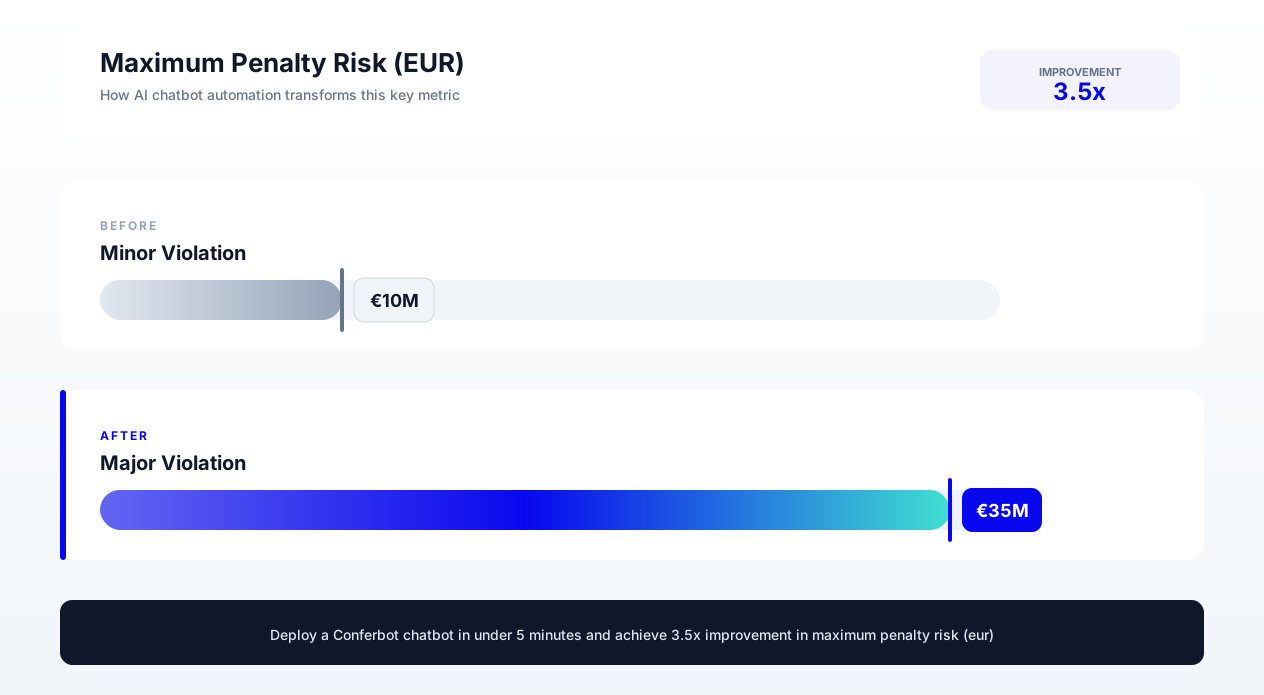
The stakes are significant. Penalties for non-compliance range from 7.5 million EUR to 35 million EUR (or 1% to 7% of global annual turnover, whichever is higher). These figures are not theoretical maximums -- the regulation includes specific enforcement mechanisms and the European AI Office has been actively building enforcement capacity since 2025.
Risk Classification: Where Does Your Chatbot Fall?
The AI Act establishes four risk categories, as detailed in the official EU AI Act text, each with different compliance requirements. Correctly classifying your chatbot is the essential first step -- it determines everything else about your compliance obligations.
The Four Risk Levels
| Risk Level | Definition | Chatbot Examples | Key Obligations |
|---|---|---|---|
| Unacceptable (Prohibited) | AI systems that pose a clear threat to safety, rights, or democratic values | Chatbots using subliminal manipulation to distort behavior; chatbots exploiting age/disability vulnerabilities; social scoring chatbots | Completely banned. Cannot be deployed. |
| High Risk | AI systems in regulated domains (healthcare, employment, education, law enforcement, critical infrastructure) | Chatbots making employment decisions, chatbots used in medical diagnosis, chatbots scoring creditworthiness, chatbots in educational assessment | Conformity assessment, risk management, data governance, human oversight, technical documentation, post-market monitoring |
| Limited Risk | AI systems that interact directly with humans | Most customer-facing chatbots, support bots, lead generation bots, e-commerce assistants, booking bots | Transparency obligations (disclosure that user is interacting with AI) |
| Minimal Risk | All other AI systems | Internal analytics tools, spam filters, recommendation engines without direct user interaction | No mandatory requirements (voluntary codes of conduct encouraged) |
Most Chatbots Are "Limited Risk" -- Here Is What That Means
Article 50 of the AI Act specifically addresses AI systems that interact directly with natural persons. Under this article, any chatbot must disclose to users that they are interacting with an AI system unless this is obvious from the circumstances and context of use. This is the core obligation for the majority of business chatbots.
The "obvious from context" exception is narrow and risky to rely on. The European AI Office has indicated in early guidance that text-based conversational interfaces are not self-evidently AI systems to average consumers. A user visiting a website and seeing a chat widget may reasonably believe they are chatting with a human support agent. Therefore, disclosure is required for virtually all customer-facing chatbots.
When Your Chatbot Might Be "High Risk"
Your chatbot moves from limited to high risk if it operates within any of the domains listed in Annex III of the regulation. Key scenarios for chatbot operators:
- Employment and recruitment: If your chatbot screens job applicants, scores candidates, or makes decisions about hiring, promotion, or termination, it is high-risk.
- Education: If your chatbot assesses students, determines access to educational institutions, or monitors examination integrity, it is high-risk.
- Essential services access: If your chatbot determines eligibility for public benefits, evaluates creditworthiness, or scores insurance risk, it is high-risk.
- Healthcare: If your chatbot provides medical diagnosis, treatment recommendations, or triage decisions that influence patient care, it is high-risk.
- Law enforcement: If your chatbot assesses risk of criminal behavior, evaluates evidence reliability, or performs profiling, it is high-risk.
The critical distinction: a chatbot that informs ("Here are our loan products") is limited risk. A chatbot that decides ("Based on your profile, you are not eligible for a loan") may be high-risk. The AI Act focuses on the system's influence on decisions affecting fundamental rights.
Classification Decision Tree for Chatbot Operators
Walk through these questions to classify your chatbot:
- Does your chatbot use subliminal techniques to distort behavior, exploit vulnerable groups, or perform social scoring? → PROHIBITED. Stop deployment immediately.
- Does your chatbot make or materially influence decisions about employment, education access, creditworthiness, healthcare, or law enforcement? → HIGH RISK. Full conformity assessment required.
- Does your chatbot interact directly with natural persons (end users can chat with it)? → LIMITED RISK. Transparency/disclosure obligations apply.
- Does your chatbot only operate internally without direct user interaction? → MINIMAL RISK. Voluntary compliance encouraged.
If you are unsure about your classification, err on the side of the higher risk category and comply with those requirements. Under-classifying your system and being found non-compliant carries significantly higher penalties than over-classifying and over-complying. For guidance on implementing compliant chatbot architectures, see our chatbot best practices guide.
Transparency and Disclosure Requirements: What Your Chatbot Must Tell Users
Article 50(1) of the AI Act establishes the foundational transparency obligation for chatbots: "Providers shall ensure that AI systems intended to interact directly with natural persons are designed and developed in such a way that the natural persons concerned are informed that they are interacting with an AI system, unless this is obvious from the circumstances and context of use."
This is not optional. It is not a best practice. It is a legal requirement with substantial penalties for non-compliance. Let us break down exactly what this means in practice.
What Must Be Disclosed
- AI nature of the system: Users must be clearly told they are interacting with an AI, not a human. This disclosure must happen before or at the start of the interaction, not buried in terms of service.
- Emotional manipulation transparency (Article 50(3)): If your chatbot generates or manipulates content that simulates emotions -- expressing sympathy, excitement, or concern -- users must be made aware that these expressions are artificial.
- Content generation disclosure: If your chatbot generates text, images, or audio that could be mistaken for human-created content, this must be disclosed.
- Deepfake/synthetic content labeling: If your chatbot generates images, audio, or video of real persons (e.g., personalized video messages), these must be labeled as AI-generated.
How to Implement Disclosure: Practical Patterns
The AI Act specifies that disclosure must be provided in a "clear and distinguishable" manner, "at the latest at the time of the first interaction or exposure." Here are compliant implementation patterns:
Pattern 1: Name-based disclosure
Name your chatbot something that clearly indicates its AI nature: "AI Assistant," "Virtual Agent," "Bot Helper." While this alone may not satisfy the requirement (the European AI Office has suggested explicit text is preferred), it contributes to overall transparency.
Pattern 2: Introductory disclosure message
The most robust approach -- include disclosure in the chatbot's first message:
"Hi! I am an AI assistant powered by artificial intelligence. I can help with [functions]. If you would like to speak with a human at any time, just let me know."
Pattern 3: Persistent visual indicator
Display a permanent label or badge on the chat interface: "AI-Powered" or "Chatbot" visible throughout the conversation. This satisfies ongoing disclosure without interrupting conversation flow.
Pattern 4: Widget-level disclosure
Before the user opens the chat, the widget itself shows "Chat with our AI" rather than "Chat with us" (which could imply human agents).
Recommended Implementation (Combining Patterns)
The safest approach combines multiple patterns for defense-in-depth compliance:
- Chat widget label says "AI Assistant" or similar
- First message includes explicit disclosure: "I am an AI chatbot. I am not a human."
- Persistent badge/indicator visible throughout conversation
- Clear option to escalate to human agent at any point
Conferbot provides built-in compliance features for AI Act disclosure, including configurable first-message disclaimers and persistent AI indicators on the chat widget. These can be enabled in your chatbot configuration settings without custom development.
What Does NOT Satisfy the Disclosure Requirement
- Burying disclosure in your privacy policy or terms of service (not timely -- users do not read these before chatting)
- Disclosing only after the user asks "Am I talking to a bot?" (not proactive -- must be provided at first interaction)
- Using a human name and avatar without AI disclosure (actively misleading -- may constitute a separate violation)
- Small footer text that is not clearly visible on mobile devices (not "clear and distinguishable")
- One-time disclosure that disappears after the first message on long conversations (ongoing transparency is recommended)
Special Scenarios
Hybrid human-AI systems: If your chatbot sometimes transfers to human agents, you must clearly indicate both transitions: when the user is talking to AI and when they are transferred to a human. The user must always know which type of entity they are communicating with.
AI-assisted human agents: If a human agent uses AI to draft responses that they then review and send, disclosure requirements depend on whether the AI is generating the substance of the response or merely assisting. Early guidance suggests that AI-drafted, human-reviewed responses do not require disclosure if the human exercises meaningful oversight.
Voice chatbots: For voice-based AI (IVR systems, voice assistants), disclosure must be provided audibly at the start of the call: "You are speaking with an automated AI system." This must come before substantive conversation begins.
How the AI Act Differs From GDPR: Understanding the Overlap and Gaps
Many chatbot operators already comply with GDPR, as outlined on GDPR.eu, and assume this covers their AI Act obligations. It does not. While there is overlap between the two regulations, they address fundamentally different concerns, and compliance with one does not guarantee compliance with the other.
Conceptual Differences
| Dimension | GDPR | AI Act |
|---|---|---|
| What it regulates | Processing of personal data | AI systems (regardless of whether personal data is involved) |
| Core concern | Data protection and privacy | Safety, fundamental rights, and transparency |
| Trigger | Processing personal data of EU residents | Placing AI system on EU market or using it with EU persons |
| Subject | Data controller and processor | AI provider and deployer |
| Rights granted | Data access, deletion, portability, objection | Transparency, human oversight, explanation |
| Risk assessment | DPIA (Data Protection Impact Assessment) | AI risk classification and conformity assessment |
| Documentation | Records of processing activities | Technical documentation and EU database registration |
| Enforcement body | National Data Protection Authorities | National AI authorities + European AI Office |
Where They Overlap
Both regulations apply simultaneously when your chatbot processes personal data and qualifies as an AI system (which it virtually always does). This creates dual compliance obligations:
- Consent/Legal basis: GDPR requires a legal basis for processing personal data. The AI Act does not replace this requirement -- you still need consent or legitimate interest for collecting user information through chatbot conversations.
- Transparency: GDPR Article 13/14 requires informing data subjects about data processing. AI Act Article 50 requires informing users about AI interaction. Both apply, and both disclosures should be provided.
- Automated decision-making: GDPR Article 22 gives individuals the right not to be subject to solely automated decisions with legal effects. The AI Act's high-risk classification often overlaps with these scenarios, creating reinforcing protections.
- Impact assessments: GDPR requires DPIAs for high-risk processing. The AI Act requires conformity assessments for high-risk AI systems. For a high-risk chatbot processing personal data, you need both.
Where They Diverge (New Obligations Under AI Act)
The AI Act creates obligations that GDPR does not address:
- AI disclosure requirement: GDPR does not require you to tell users they are talking to an AI. The AI Act does. Even if your chatbot collects zero personal data (e.g., an anonymous FAQ bot), you must still disclose its AI nature.
- Technical robustness and accuracy: The AI Act requires that AI systems achieve appropriate levels of accuracy, robustness, and cybersecurity (particularly for high-risk systems). GDPR has no equivalent requirement about system quality.
- Human oversight: High-risk AI systems must be designed to allow effective human oversight. This goes beyond GDPR's automated decision-making provisions by requiring architectural features, not just procedural safeguards.
- Post-market monitoring: Providers of high-risk AI systems must establish post-market monitoring systems to actively collect and review data on the system's performance. GDPR has no equivalent ongoing monitoring mandate for the system itself.
- EU database registration: High-risk AI systems must be registered in the EU public database before being placed on the market. There is no GDPR equivalent for registration of data processing systems.
Practical Implications for Chatbot Operators
If you are already GDPR-compliant with your chatbot, here is what you additionally need for AI Act compliance:
- Add explicit AI disclosure to your chatbot's first interaction (this is likely your only new UI requirement for limited-risk chatbots)
- Review whether your chatbot falls into the high-risk category (see Risk Classification section)
- If high-risk: prepare technical documentation, implement human oversight mechanisms, and register in the EU database
- Document your risk classification decision and the reasoning behind it
- Review your AI supply chain (model providers) for their GPAI compliance status
For a comprehensive guide to GDPR compliance in chatbots (which remains fully applicable alongside the AI Act), see our detailed GDPR compliance guide.
Technical Documentation Requirements for High-Risk Chatbots
If your chatbot is classified as high-risk (see the classification section above), you face the most demanding documentation requirements, which the NIST AI Risk Management Framework can help structure in the regulation. Article 11 and Annex IV of the AI Act specify the technical documentation that must be prepared before the system is placed on the market and maintained throughout its lifecycle.
What Technical Documentation Must Include
Annex IV requires the following elements (summarized for relevance to chatbot systems):
1. General description of the AI system:
- Intended purpose and intended deployers
- How the system interacts with hardware, software, and other AI systems
- Versions of relevant software/firmware and requirements for connectivity
- Description of the forms in which the system is placed on the market (API, widget, standalone)
- How the AI system will interact with or be used to evaluate natural persons
2. Detailed description of system elements and development process:
- Methods and steps for system development, including the use of pre-trained systems or third-party tools
- Design specifications: general logic, algorithms, key design choices, classification methods, training approach
- Description of the system architecture and computational resources
- Data requirements: data sheets for training, validation, and testing data sets; description of relevant data preparation methodologies
3. Information about monitoring, functioning, and control:
- Description of technical capabilities and limitations, including accuracy, robustness, and cybersecurity measures
- Specifications on input data quality and relevance
- Description of human oversight measures, including technical measures to facilitate interpretation
- Expected lifetime of the system and maintenance measures
4. Detailed description of the risk management system:
- Description of the risk management process applied to the AI system
- Identification and analysis of known and foreseeable risks
- Description of the evaluation and mitigation of risks associated with intended use and foreseeable misuse
- Description of testing procedures used to validate risk mitigation
5. Record of changes:
- All substantial changes made to the system after initial deployment
- Impact assessment of those changes on compliance
Practical Documentation Framework for Chatbot Providers
For chatbot platforms like Conferbot that serve as the infrastructure for customer deployments, the documentation responsibility is shared between the platform provider and the deployer:
| Documentation Element | Platform Provider Responsibility | Deployer Responsibility |
|---|---|---|
| System architecture | Core platform architecture, AI model integration | Custom flow configuration, integration setup |
| Training data | Foundation model data (via GPAI compliance from model provider) | Custom knowledge base content, fine-tuning data |
| Accuracy metrics | Platform-level NLU accuracy benchmarks | Domain-specific accuracy for their use case |
| Risk management | Platform-level risks and mitigations | Use-case-specific risks (e.g., healthcare context) |
| Human oversight | Escalation infrastructure, monitoring tools | Staffing of oversight, review processes |
| Post-market monitoring | Platform analytics and error reporting | Review of conversations, accuracy monitoring in deployment |
Documentation Tips for Compliance
- Start now, even before full enforcement: Documentation debt is much harder to address retroactively than proactively. Begin documenting your system architecture, risk assessments, and performance metrics today.
- Version everything: The AI Act requires records of changes. Use version control for your chatbot flows, knowledge base content, and model configurations.
- Automate monitoring data collection: Post-market monitoring requires ongoing data about system performance. Set up automated tracking of accuracy metrics, escalation rates, and user satisfaction scores.
- Document your model supply chain: If you use GPT-4, Claude, or other foundation models, document which model you use, the API version, and verify that the model provider is meeting their GPAI obligations under Article 53.
For most chatbot operators running limited-risk customer service or lead generation bots, this level of documentation is not required. However, maintaining basic documentation (system description, intended use, transparency measures) is a best practice that protects you if regulatory questions arise and demonstrates good faith compliance. Review our AI customer service guide for best practices on responsible AI deployment in customer-facing contexts.
Conformity Assessments: When You Need One and How It Works
Conformity assessment is the formal process by which a high-risk AI system is verified to meet the AI Act's requirements before it can be placed on the EU market. Think of it as the AI equivalent of CE marking for physical products -- a structured evaluation that proves your system meets minimum regulatory standards.
Who Needs a Conformity Assessment?
Only high-risk AI systems require conformity assessment. If your chatbot is classified as limited risk (the majority of customer-facing chatbots), you do not need a conformity assessment. You need only meet the transparency/disclosure requirements outlined in the previous sections.
You need a conformity assessment if your chatbot:
- Makes employment/recruitment decisions or materially influences them
- Determines access to educational institutions or assesses students
- Evaluates creditworthiness or insurance risk
- Provides medical diagnosis or treatment recommendations that influence patient care
- Is used in law enforcement contexts for risk assessment or profiling
- Operates as a safety component within another system listed in Annex I (e.g., medical devices, aviation systems)
Types of Conformity Assessment
The AI Act provides two pathways:
1. Internal conformity assessment (Article 43(2)): The provider assesses their own system against the requirements. This is available for most high-risk AI systems except those involving biometric identification. The provider conducts the assessment using their quality management system, prepares technical documentation, and signs a declaration of conformity.
2. Third-party conformity assessment (Article 43(1)): A notified body (accredited assessment organization) independently evaluates the system. Required for real-time biometric identification systems and recommended for any high-risk system where internal assessment may be questioned.
The Conformity Assessment Process (Internal)
- Establish quality management system: Document your development processes, risk management procedures, data governance practices, and post-market monitoring plans.
- Prepare technical documentation: Complete all elements required by Annex IV (see previous section).
- Conduct testing and validation: Demonstrate that your system meets the requirements of Articles 9-15 (risk management, data governance, record-keeping, transparency, human oversight, accuracy/robustness/cybersecurity).
- Prepare Declaration of Conformity: A formal document stating that the system meets all applicable requirements, signed by the authorized representative.
- Affix CE marking: Once conformity is established, the CE marking indicates compliance.
- Register in EU database: High-risk systems must be registered in the publicly accessible EU AI database before or at the time of being placed on the market.
Ongoing Obligations After Assessment
Conformity assessment is not a one-time event. The AI Act imposes ongoing obligations:
- Post-market monitoring (Article 72): Actively collect and analyze data on system performance throughout its lifecycle.
- Serious incident reporting (Article 73): Report any serious incident (malfunction leading to death, serious health damage, fundamental rights violations) to the relevant authority within specified timeframes.
- Re-assessment after substantial modification: If you make substantial changes to your system (new model version, new training data, new capabilities), you must assess whether a new conformity assessment is needed.
Cost and Timeline Estimates
| Assessment Type | Estimated Cost | Estimated Timeline | Typical Use Case |
|---|---|---|---|
| Internal (simple system) | EUR 20,000 - 50,000 | 3-6 months | HR screening chatbot with simple rule-based logic |
| Internal (complex system) | EUR 50,000 - 150,000 | 6-12 months | Medical triage chatbot with ML components |
| Third-party (notified body) | EUR 100,000 - 500,000 | 9-18 months | Biometric systems, high-stakes healthcare AI |
These costs include legal counsel, technical documentation preparation, testing infrastructure, and (for third-party) notified body fees. For most chatbot operators with limited-risk deployments, these costs are not applicable -- transparency compliance can be achieved with minimal investment through proper chatbot configuration.
Penalties for Non-Compliance: Fine Structure and Enforcement Mechanisms
The AI Act establishes a graduated penalty framework that scales with the severity of the violation. Understanding the fine structure is essential for risk management and prioritizing compliance activities.
Fine Tiers
| Violation Type | Maximum Fine | Alternative (% of Global Turnover) | Applicable Chatbot Scenarios |
|---|---|---|---|
| Prohibited AI practices (Article 5) | EUR 35,000,000 | 7% of global annual turnover | Deploying a chatbot with subliminal manipulation, exploiting vulnerabilities, social scoring |
| Non-compliance with high-risk requirements (Articles 9-15) or GPAI obligations | EUR 15,000,000 | 3% of global annual turnover | Failing to meet documentation, accuracy, oversight, or monitoring requirements for high-risk chatbots |
| Transparency violations (Article 50) and other requirements | EUR 7,500,000 | 1% of global annual turnover | Failing to disclose AI nature of chatbot to users; not labeling AI-generated content |
| Supplying incorrect information to authorities | EUR 7,500,000 | 1% of global annual turnover | Providing false documentation during investigations |
SME Considerations
The regulation includes proportionality provisions for small and medium-sized enterprises (SMEs). For companies qualifying as SMEs under EU definitions (fewer than 250 employees, annual turnover under EUR 50 million):
- Fines are capped at the lower of the fixed amount or the percentage-based amount (rather than the higher)
- Supervisory authorities must consider the size of the organization when determining fine amounts
- Regulatory sandboxes provide testing environments where SMEs can develop and test AI systems with regulatory guidance before full market deployment, as outlined in the IAPP AI Governance Tracker
However, SME status does not exempt organizations from the substantive requirements. A small company deploying a non-compliant chatbot still faces enforcement -- the fine may be proportionally smaller, but the obligation to come into compliance remains.
Enforcement Mechanisms
Enforcement operates at two levels:
National level: Each EU member state designates one or more national competent authorities responsible for enforcement within their territory. These authorities have powers to:
- Request and access documentation, data, and information from providers and deployers
- Conduct investigations and audits
- Issue binding orders to modify, withdraw, or recall non-compliant AI systems
- Impose administrative fines
EU level: The European AI Office (established within the European Commission) has direct enforcement powers for general-purpose AI models and coordinates cross-border enforcement activities. The AI Office:
- Monitors and enforces GPAI model provider obligations directly
- Issues guidelines and best practices for enforcement consistency
- Coordinates between national authorities on cross-border cases
- Manages the EU database of high-risk AI systems
Enforcement Priorities
Based on statements from the European AI Office and early enforcement signals, likely priority targets for enforcement include:
- Providers of prohibited AI practices (highest priority, immediate enforcement from February 2025)
- High-risk AI systems without conformity assessment or market registration
- Systems with clear consumer-facing transparency violations (chatbots without AI disclosure are visible and easy to verify)
- GPAI model providers failing to meet transparency and documentation requirements
Chatbot transparency violations (failing to disclose AI nature) are particularly likely early enforcement targets because they are trivially easy to verify. A regulator or consumer can simply visit a website, open the chatbot, and immediately determine whether AI disclosure is provided. This makes non-compliant chatbots low-hanging fruit for enforcement actions seeking to establish precedent.
Risk Mitigation Strategy
For chatbot operators, the cost-benefit analysis is straightforward: the cost of compliance (adding a disclosure message and AI indicator to your chatbot) is minimal -- perhaps 30 minutes of configuration time. The cost of non-compliance is up to EUR 7.5 million. This is not a close calculation. Implement disclosure now, regardless of whether you believe enforcement will reach you soon.
Practical Compliance Checklist for Chatbot Operators
This actionable checklist, informed by guidance from the European Commission's AI regulatory framework, translates the AI Act's legal requirements into specific steps for chatbot operators. Complete these items to achieve baseline compliance for a limited-risk chatbot, which covers the vast majority of customer-facing chatbot deployments.
Limited-Risk Chatbot Compliance Checklist
Phase 1: Assessment (Complete by Q3 2026)
- ☐ Classify your chatbot's risk level using the decision tree in the Risk Classification section. Document your classification and reasoning.
- ☐ Identify all EU touchpoints -- every website, app, channel, or platform where your chatbot interacts with EU residents.
- ☐ Audit your AI supply chain -- document which AI models (GPT-4, Claude, Gemini, custom models) power your chatbot and verify their GPAI compliance status.
- ☐ Review existing disclosures -- check whether your current chatbot already provides AI disclosure and whether it meets the "clear and distinguishable" standard.
Phase 2: Implementation (Complete by August 2, 2026)
- ☐ Add AI disclosure to first message -- include explicit text stating the user is interacting with an AI system in every chatbot's opening message.
- ☐ Add persistent AI indicator -- implement a visible badge or label on the chat widget indicating AI-powered interaction throughout the conversation.
- ☐ Label the chat widget clearly -- change trigger text from "Chat with us" to "Chat with our AI assistant" or equivalent.
- ☐ Implement human escalation option -- ensure users can always request human assistance, and clearly label the transition between AI and human.
- ☐ Label AI-generated content -- if your chatbot generates images, audio, or video, mark them as AI-generated.
- ☐ Update privacy policy -- while not an AI Act requirement specifically, ensure your privacy policy references AI processing alongside existing GDPR disclosures.
Phase 3: Documentation and Monitoring (Ongoing)
- ☐ Document transparency measures -- keep records of what disclosures you provide, when they were implemented, and how they are presented.
- ☐ Monitor regulatory guidance -- follow publications from the European AI Office for updated guidance on chatbot transparency requirements.
- ☐ Conduct periodic compliance reviews -- quarterly, verify that all chatbot instances still display proper disclosures (especially after updates or redesigns).
- ☐ Train staff on AI Act obligations -- ensure customer service managers, marketing teams, and developers understand disclosure requirements before modifying chatbot flows.
High-Risk Chatbot Additional Requirements
If your chatbot is classified as high-risk, complete all limited-risk items plus:
- ☐ Establish a comprehensive risk management system (Article 9)
- ☐ Implement data governance procedures for training and validation data (Article 10)
- ☐ Set up automatic event logging with minimum retention periods (Article 12)
- ☐ Prepare complete technical documentation per Annex IV (Article 11)
- ☐ Implement human oversight mechanisms -- ability for authorized humans to override, interrupt, or shut down the system (Article 14)
- ☐ Achieve and document appropriate accuracy, robustness, and cybersecurity levels (Article 15)
- ☐ Conduct conformity assessment (internal or third-party) (Article 43)
- ☐ Register the system in the EU database (Article 71)
- ☐ Establish post-market monitoring system (Article 72)
- ☐ Implement serious incident reporting procedures (Article 73)
- ☐ Prepare and maintain Declaration of Conformity (Article 47)
- ☐ Affix CE marking (Article 48)
Vendor Compliance Questions
If you use a chatbot platform (like Conferbot), ask your vendor these compliance questions:
- What risk classification does your platform support/target?
- Do you provide built-in AI disclosure features (first-message disclaimers, persistent indicators)?
- Which foundation models do you integrate with, and are those providers GPAI-compliant?
- Do you provide technical documentation templates for high-risk deployments?
- What event logging and audit trail capabilities do you offer?
- Can your platform support human oversight requirements (live monitoring, intervention capability)?
- What is your post-market monitoring infrastructure?
Conferbot addresses these compliance needs through built-in implementation features that include configurable AI disclosure, conversation logging, human escalation workflows, and analytics dashboards for post-market monitoring. This reduces the compliance burden for deployers who can leverage the platform's infrastructure rather than building compliance features from scratch.
Impact on Chatbot Vendors and Platform Providers
The AI Act creates obligations not just for organizations deploying chatbots (deployers) but also for the platforms and tools used to build them (providers). This dual-obligation structure means that chatbot platform companies face their own set of compliance requirements, separate from and in addition to their customers' obligations.
Provider vs. Deployer Obligations
Under the AI Act, the chatbot platform that provides the infrastructure (the "provider") and the business that configures and deploys the chatbot for their customers (the "deployer") have distinct responsibilities:
| Obligation | Provider (Platform) | Deployer (Business) |
|---|---|---|
| Risk classification | Classify the system based on its capabilities | Verify classification is appropriate for their use case |
| Technical documentation | Prepare for platform capabilities | Document use-case-specific deployment |
| Transparency features | Build disclosure mechanisms into the platform | Activate and configure disclosures for their deployment |
| Conformity assessment | Conduct for the platform as a whole | Verify it covers their use case or conduct separately |
| Post-market monitoring | Platform-level monitoring infrastructure | Monitor their specific deployment's performance |
| Incident reporting | Report platform-level serious incidents | Report deployment-specific serious incidents |
What This Means for Platform Selection
When choosing a chatbot platform, AI Act compliance should be a vendor selection criterion. Platforms that proactively build compliance features into their infrastructure reduce the compliance burden on deployers. Key differentiators:
- Built-in disclosure: Platforms that offer native AI disclosure features (configurable first-message disclaimers, AI badges, widget labeling) save deployers from custom development.
- Event logging: Platforms with comprehensive conversation logging, audit trails, and retention controls provide the record-keeping infrastructure needed for high-risk compliance.
- Human oversight tools: Platforms with live monitoring dashboards, real-time intervention capabilities, and escalation workflows support Article 14 human oversight requirements.
- Model transparency: Platforms that clearly document which AI models they use, how they are integrated, and the model providers' GPAI compliance status support deployer documentation needs.
- Multi-jurisdictional support: As other jurisdictions follow the EU's lead (Brazil's AI Bill, Canada's AIDA, UK's AI framework), platforms with flexible compliance features can adapt to multiple regulatory regimes.
The GPAI Layer
Most modern chatbots use general-purpose AI models (GPT-4, Claude, Gemini, Llama, Mistral) as their natural language understanding engine. These models are classified as GPAI under the AI Act, and their providers have separate obligations under Article 53:
- Prepare and maintain technical documentation about the model
- Provide information and documentation to downstream providers (chatbot platforms) integrating the model
- Put in place a policy to comply with EU copyright law
- Publish a sufficiently detailed summary of training data content
For chatbot platform providers, this means ensuring that the foundation models they integrate have met their GPAI obligations. If a model provider fails to comply, downstream providers may face challenges demonstrating their own compliance for systems built on non-compliant models.
Competitive Implications
The AI Act is reshaping the competitive landscape for chatbot vendors. Platforms that achieve compliance first gain a competitive advantage in the EU market -- and increasingly in global markets where customers want assurance of responsible AI practices. Early compliance signals:
- Organizational maturity and governance
- Lower regulatory risk for customers choosing the platform
- Readiness for other jurisdictions adopting similar frameworks
- Commitment to responsible AI development
Conversely, platforms that delay compliance face increasing risk of market exclusion as enforcement begins and enterprise customers add AI Act compliance to their vendor assessment criteria. For chatbot buyers evaluating platforms, compliance readiness is increasingly a deal-making (or breaking) factor alongside features, pricing, and integration capabilities.
Future Outlook: What Comes Next for AI Regulation and Chatbots
The EU AI Act is the first domino. Multiple jurisdictions worldwide are developing or have proposed AI regulation, and the EU's framework is influencing their approaches. Chatbot operators should anticipate a multi-regulatory environment within 2-3 years.
Global Regulatory Landscape
| Jurisdiction | Regulation | Status (2026) | Chatbot Relevance |
|---|---|---|---|
| European Union | AI Act (2024/1689) | Phased application through 2027 | Transparency, risk classification, conformity assessment |
| Brazil | AI Bill (PL 2338/2023) | Under legislative review | Transparency requirements, rights of affected persons |
| Canada | Artificial Intelligence and Data Act (AIDA) | Under review (part of C-27) | High-impact system requirements, transparency |
| United Kingdom | AI regulatory framework (sector-specific) | Principles-based approach via existing regulators | Sector-specific requirements (FCA for finance, Ofcom for comms) |
| United States | Executive Order 14110 + state laws | Fragmented state-level approach | State-specific disclosure laws (California, Colorado, Illinois) |
| China | Interim Measures for Generative AI (2023) | In force | Content labeling, transparency, registration requirements |
| South Korea | AI Basic Act | Enacted 2025 | High-risk AI classification, transparency obligations |
Anticipated Developments for Chatbot Operators
1. Harmonized standards (2026-2027): The European Standardisation Organisations (CEN/CENELEC) are developing harmonized standards that will provide detailed technical specifications for meeting AI Act requirements. These standards will offer much more specific guidance on what "adequate disclosure" means for chatbots, reducing current ambiguity.
2. AI Office guidance and precedents (2026-2028): As the European AI Office processes its first cases, enforcement precedents will clarify gray areas. Key questions to watch: Does a clearly labeled chat widget satisfy disclosure without explicit first-message text? How is "obvious from circumstances" interpreted for different chatbot interfaces? What constitutes a "substantial modification" requiring re-assessment?
3. Sector-specific codes of conduct (2027+): Industry associations are likely to develop sector-specific codes of conduct for chatbot compliance. These will provide industry-tailored guidance -- what disclosure looks like for banking chatbots vs. retail chatbots vs. healthcare chatbots -- and may eventually be referenced by regulators as compliance benchmarks.
4. Cross-border enforcement coordination (2027+): As national authorities build enforcement capacity, cross-border chatbot deployments will face coordinated scrutiny. A chatbot deployed across all EU member states may be subject to investigation by any national authority, creating potential for conflicting interpretations until jurisprudence matures.
Preparing for Regulatory Convergence
Smart chatbot operators are preparing for regulatory convergence by implementing the highest standard now (EU AI Act compliance) rather than the minimum for each jurisdiction. This approach:
- Avoids costly jurisdiction-by-jurisdiction compliance projects later
- Positions the organization as a responsible AI leader
- Reduces legal risk across all markets simultaneously
- Creates reusable compliance infrastructure applicable to future regulations
The chatbot industry is moving from an era of no regulation to one of comprehensive, multi-jurisdictional regulation within 3-5 years. Organizations that build compliance into their chatbot operations now -- rather than treating it as a future problem -- will face significantly lower costs, risks, and disruption than those who wait for enforcement to arrive. Start with the practical compliance checklist in this guide, implement the transparency measures, and build from there as regulations mature and enforcement begins.
For healthcare-specific compliance considerations that overlap with both the AI Act and sector regulations, see our HIPAA-compliant AI chatbot guide.
Was this article helpful?
Build and deploy in 10 minutes. No coding needed.
EU AI Act Compliance for Chatbots FAQ
Everything you need to know about chatbots for eu ai act compliance for chatbots.
About the Author
The Conferbot team writes about building, deploying, and improving AI chatbots.
View all articles